107 Days by Kamala Harris Summary and Analysis
107 Days by Kamala Harris is a first-person political memoir chronicling the extraordinary and chaotic stretch between President Joe Biden’s withdrawal from the 2024 presidential race and the end of Kamala Harris’s campaign as the Democratic nominee. Told with immediacy and reflection, it captures the intensity of leadership under pressure, the emotional and political challenges of a historic campaign, and the personal balance between duty, identity, and resilience.
Through candid moments of strategy, faith, and resolve, Harris offers readers an insider’s view of democracy’s fragility and strength as she navigates one of the most consequential elections in modern American history.
Summary
107 Days begins in late July of an election year with Kamala Harris spending a quiet morning making pancakes for her grandnieces at the vice president’s residence in Washington, D. C.
The calm breaks when President Joe Biden calls from isolation in Delaware to inform her that he is withdrawing from the presidential race. Shocked but composed, Harris persuades him to endorse her immediately to prevent party turmoil.
Within minutes of Biden’s announcement, his endorsement of her candidacy goes public, transforming her Sunday morning into a turning point in history.
As the news spreads, Harris’s home becomes an impromptu campaign headquarters. Advisors, family, and staff pour in, making frantic calls to secure political endorsements and stabilize the party.
Prominent Democrats, from Barack Obama to Nancy Pelosi, express varying degrees of support, but most signal alignment with her leadership. That night, social media erupts with the viral slogan “Kamala is brat,” turning pop culture into political momentum.
Exhausted but energized, Harris realizes the fight ahead has just begun.
The following day marks the official launch of her campaign. After performing her duties as vice president at a White House event, she travels to Delaware to address campaign staff now rebranded under “HARRIS FOR PRESIDENT.
” She defines her vision: freedom, equality, and economic justice, while contrasting her prosecutorial record against Donald Trump’s criminal indictments. Her line “I know Donald Trump’s type” electrifies supporters.
The campaign rapidly gains steam, raising $81 million in 24 hours and adopting the slogan “We’re not going back.
Harris reorganizes Biden’s campaign infrastructure with fresh energy—bringing in strategist David Plouffe, launching TikTok engagement to reach Gen Z, and emphasizing reproductive rights and middle-class prosperity. Her first rally in Milwaukee becomes a defining moment, as thousands chant her slogan in unison.
Meanwhile, Doug Emhoff, her husband, supports the campaign’s messaging on reproductive freedom, showcasing their partnership and contrasting decency against Trump’s hostility.
As Harris revisits her career—from prosecutor to senator to vice president—she reflects on moments of both loyalty and isolation within the Biden administration. Despite past tensions with Jill Biden stemming from the 2019 debate, Harris stayed committed to serving the administration.
She recalls July 4th at the White House, when Joe Biden appeared frail and Jill confronted Doug about loyalty. The episode deepened Harris’s awareness of political fragility but reinforced her commitment to the broader mission.
She resumes official duties, addressing civic groups and visiting disaster sites, balancing governance with campaigning. Her message—centered on freedom, opportunity, and democracy—resonates across the country.
The campaign’s energy crescendos as she navigates intense scrutiny and prepares for the toughest hundred days of her life.
By late July, the race intensifies. Harris receives endorsement from the Obamas, fueling national momentum.
Her meetings span from global diplomacy with Israel’s Prime Minister Netanyahu to domestic fundraising in Massachusetts. Despite tense exchanges with Netanyahu over Gaza, she maintains a principled balance—affirming Israel’s right to defense while condemning civilian suffering.
Publicly, she urges American voters to stay united, warning that abstention could hand Trump victory.
Meanwhile, she faces the pressure of selecting a running mate within days. After thorough vetting, she considers Pete Buttigieg, Josh Shapiro, Mark Kelly, and Tim Walz.
Ultimately, she chooses Walz, impressed by his authenticity and connection to working-class voters. Their chemistry becomes evident during their first rally in Philadelphia, where Harris introduces him as a teacher, soldier, and servant leader.
The crowd’s response is electric, reigniting the campaign’s sense of purpose.
Through August and September, Harris and Walz embark on an aggressive campaign trail across swing states. Rallies swell in size and passion as union leaders, activists, and celebrities rally behind her message.
Yet Trump intensifies personal attacks, questioning her racial identity and mocking her intelligence. Harris refuses to engage, grounded in her mother’s advice about self-definition.
When tabloids target Doug with rumors, the couple’s quiet resilience stands as a statement of unity and grace under fire.
Amid campaign momentum, Harris continues her vice-presidential duties—overseeing a major prisoner exchange with Russia and responding to natural disasters. She balances diplomacy, national security, and campaign logistics, symbolizing the dual weight of leadership in real time.
As she and Walz gain endorsements from key labor organizations like the United Auto Workers, polls tighten against Trump.
The fall campaign season exposes the emotional cost of leadership. Harris confronts the spread of misinformation and struggles to regain traction among young voters, particularly men influenced by online extremism.
She holds firm against political expediency, refusing to demonize marginalized communities even as Trump’s campaign exploits divisive culture wars. Her joint appearances with Liz Cheney highlight a bipartisan defense of democracy.
A setback comes during an appearance on The View, when Harris’s remark about not changing anything from Biden’s term is misconstrued as blind loyalty. Republicans weaponize the moment, forcing her to clarify her vision for inclusive governance.
Despite media criticism, she stays focused, engaging Latino voters, Native communities, and women affected by healthcare restrictions. Each stop deepens her resolve to connect authentically, even as exhaustion looms.
In the campaign’s final stretch, Harris turns introspective. On her sixtieth birthday—sixteen days before the election—she attends a church service honoring her late mother and women’s health advocates.
That day blends spiritual grounding with renewed energy as she connects faith to purpose. Yet challenges persist—media bias, scheduling chaos, and relentless disinformation from Trump’s camp.
Despite obstacles, she presses forward, embodying persistence and hope.
Major cultural figures like Beyoncé, Cardi B, and Lady Gaga join her closing rallies, infusing the campaign with vibrancy and collective optimism. Her final speech at the Ellipse, a symbolic site of the January 6 insurrection, draws seventy-five thousand people.
She contrasts Trump’s vindictiveness with her vision for America’s renewal, declaring that leadership means serving all citizens, not dividing them.
However, optimism fades on election night. Despite strong early turnout, critical swing states slip away.
By midnight, her advisors accept the inevitable. At Howard University, campaign manager Cedric Richmond announces the loss to tearful supporters.
Harris comforts her family, quietly asking, “What will happen to our country? ” The following day, she calls Trump to concede, emphasizing unity and peaceful transition.
On January 6, she presides over the certification of his victory, closing her chapter in public duty with dignity.
The afterword finds her retreating briefly to Hawaii with Doug as California faces wildfires. She reflects on the dangers of Trump’s authoritarian plans but expresses enduring belief in America’s youth and the resilience of democracy.
Though the campaign ended in defeat, 107 Days concludes with renewal—Harris standing not as a fallen candidate, but as a citizen devoted to rebuilding faith in freedom, equality, and the nation’s enduring promise.
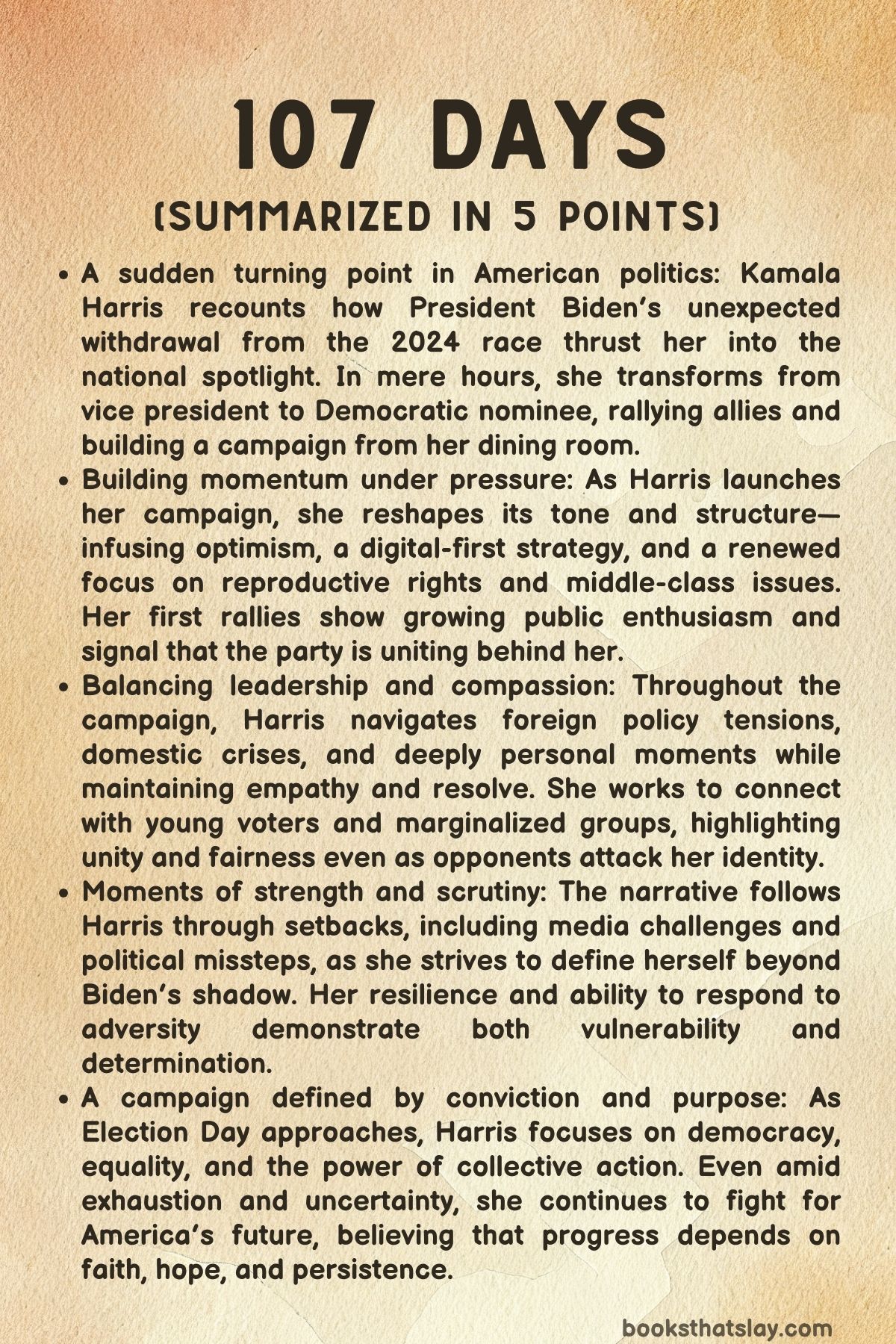
Key People
Kamala Harris
Kamala Harris stands at the center of 107 Days, embodying resilience, intellect, and an unyielding sense of duty to both country and self. Her journey from vice president to presidential nominee is marked by an extraordinary mix of personal reflection and political urgency.
Harris emerges as a woman deeply aware of the historical significance of her position, yet equally mindful of her humanity. The book reveals her as both strategist and empath—someone who thrives under pressure while carrying the emotional weight of representation, legacy, and gendered expectations.
Through the campaign, she evolves from being reactive to circumstances orchestrated by others to asserting her independent vision, unafraid to confront adversity head-on. Her introspection—especially about her marriage, her relationship with Biden, and the burdens of leadership—adds nuance to her character.
Harris’s compassion, evident in her empathy for voters and her sensitivity to global suffering, contrasts powerfully with the ruthlessness of contemporary politics. By the end, even in defeat, her grace and endurance mark her as a figure of integrity who refuses to let power define her worth.
Doug Emhoff
Doug Emhoff, Kamala’s husband, is portrayed as her emotional anchor and moral counterweight. His unwavering support, humor, and humanity provide relief from the intensity of political life.
The book portrays him as a man navigating the rare and delicate role of “Second Gentleman,” dealing with public scrutiny and his own professional sacrifices. His protectiveness toward Kamala—evident in his frustration with the Bidens and his sharp retorts to Trump’s attacks—shows deep devotion, but also the strain that comes with being both partner and political symbol.
Doug’s Jewish identity and his activism against antisemitism bring depth to his role, revealing a man driven by conscience as much as love. Their marriage, though occasionally tested by stress and misunderstanding, symbolizes partnership grounded in respect and shared ideals rather than traditional gender dynamics.
Doug’s steadiness helps humanize Kamala’s public image, showing the strength found in vulnerability and mutual faith.
Joe Biden
President Joe Biden’s character is depicted with a complex blend of frailty and dignity. His decision to withdraw from the 2024 race serves as both a personal reckoning and a moment of political transformation for Harris.
Once a mentor and ally, Biden becomes a symbol of generational transition—representing both loyalty and the inevitable fading of an older political order. His interactions with Harris reveal affection tempered by distance; his reluctance to fully embrace her earlier and his late recognition of her strength speak to the complexities of political alliances shaped by history, ego, and generational shift.
His brief but sincere endorsement of Harris underscores his awareness of duty, even as his physical decline mirrors the fading of a long political legacy. Biden embodies the bittersweet intersection of mentorship and mortality in the machinery of American politics.
Jill Biden
Jill Biden’s portrayal reveals the subtle tensions between loyalty, pride, and resentment. Her initial coldness toward Harris stems from the scars of the 2019 Democratic debates, where Harris’s confrontation with Joe left lingering bitterness.
Yet beneath the surface, Jill represents the protective spouse and political guardian who has watched her husband’s career weather storms. Her conversation with Doug during the July 4 celebration exposes the emotional undercurrents of politics—how personal feelings often shape professional alliances.
Jill’s guardedness contrasts with Kamala’s openness, and their uneasy relationship reflects broader themes of rivalry, respect, and the difficulty of forgiveness in a world where ambition collides with emotion.
Tim Walz
Tim Walz emerges as a symbol of authenticity, humility, and Middle America’s conscience. Chosen as Kamala’s running mate, he balances the ticket with his background as a teacher, soldier, and governor.
His down-to-earth demeanor, humor, and empathy connect with working-class voters, presenting a sharp contrast to the cynicism dominating national politics. Walz’s authenticity reinforces Kamala’s message of unity and integrity.
His partnership with her is one of trust and respect, not subordination—a dynamic that reflects Kamala’s evolution as a leader who values collaboration over control. Walz’s presence in the campaign revives energy and optimism, grounding the movement in real human connection.
Donald Trump
Donald Trump looms over the narrative as both adversary and mirror—an embodiment of chaos, manipulation, and fear politics. His presence, though largely offstage, defines the stakes of Harris’s journey.
Through his lies, personal attacks, and divisive rhetoric, Trump becomes the specter against which Harris must define her own moral compass. The contrast between his authoritarian tendencies and her democratic convictions drives the emotional core of the story.
Despite his hostility, Harris’s willingness to call him after the assassination attempt humanizes her, while exposing his opportunistic charm. Trump represents not just a political opponent but the broader threat of democratic erosion, forcing Harris—and the nation—to confront the fragility of truth and civility in public life.
Maya Harris
Maya Harris, Kamala’s sister, represents the quiet strength and familial support anchoring the protagonist. Though her appearances are brief, Maya’s presence carries emotional weight.
A political strategist herself, she symbolizes intellect, loyalty, and sisterly solidarity. Their relationship reveals the deep familial bonds that sustain Kamala amid political storms.
Maya is the reminder of shared history, cultural roots, and moral grounding—serving as both confidante and mirror to Kamala’s ambition. Her calm composure and strategic insight contrast with the chaos of the campaign, reinforcing the theme that leadership is sustained not only by public allies but by private faith in one’s own people.
Barack and Michelle Obama
The Obamas play pivotal supporting roles as symbols of endorsement, legacy, and continuity. Barack’s public support provides Kamala with both legitimacy and emotional validation, reflecting his recognition of her readiness to lead.
Michelle’s endorsement amplifies that legitimacy with moral resonance, representing the unity of purpose among Democrats who view the moment as larger than individual ambition. Their influence also evokes nostalgia for the idealism of the Obama era, contrasting with the darker tone of Trumpism.
The Obamas serve as both mentors and torchbearers—passing leadership to a successor who must redefine progress under harsher political conditions.
Liz Cheney
Liz Cheney’s alliance with Kamala Harris demonstrates an extraordinary convergence of principle over partisanship. Once a staunch Republican, Cheney’s endorsement of Harris underscores the existential threat Trump poses to democracy.
Her inclusion in the campaign highlights courage and moral conviction, symbolizing a rare bipartisan unity rooted in shared democratic values rather than political convenience. Cheney’s character is one of integrity and sacrifice, representing the conscience of American conservatism in a time of crisis.
Her collaboration with Harris adds philosophical depth to the narrative, illustrating that in the face of tyranny, moral boundaries must transcend party lines.
Themes
Leadership and Responsibility
Leadership in 107 Days is defined not by inherited power but by the ability to shoulder responsibility under extreme uncertainty. Kamala Harris’s sudden elevation to Democratic nominee following Joe Biden’s withdrawal creates an immediate test of judgment and composure.
Her leadership is shaped through crisis management rather than ceremony — transforming her home into a command center, marshaling political alliances, and redefining a fragmented campaign within hours. Harris’s approach contrasts decisiveness and empathy; she leads with strategy while grounding her actions in relationships and moral conviction.
Throughout the narrative, leadership is not portrayed as solitary heroism but as collective stewardship — her reliance on advisors, her bond with Doug, and her collaboration with figures like Tim Walz reveal a belief in shared responsibility. The text portrays the burden of leadership in a polarized democracy: every decision carries symbolic weight, from endorsing a ceasefire in Gaza to selecting a running mate.
Even in defeat, her leadership persists through moral steadiness — presiding over Congress to certify an opponent’s victory becomes her final act of integrity. Leadership, in this story, is endurance under moral pressure — the refusal to relinquish dignity or empathy in a climate dominated by fear, cynicism, and spectacle.
Gender and Power
Gender dynamics form an unspoken current throughout 107 Days, where Harris’s rise becomes a referendum on what female leadership looks like in the 21st century. The scrutiny she faces — from Trump’s racist and sexist taunts to media skepticism — underscores the double standards that persist even at the highest levels of power.
Harris’s demeanor, clothing, tone, and decisions are constantly politicized, reflecting society’s discomfort with women who command authority. Yet, the narrative never reduces her to victimhood; it celebrates resilience and subtle defiance.
Her marriage to Doug Emhoff exemplifies a new model of partnership in political life — one that rejects traditional gender hierarchies. Scenes of Harris juggling empathy and authority highlight the unique pressures of being both a historic figure and a political target.
Her advocacy for reproductive rights and economic equality becomes both personal and political — extensions of her mother’s legacy as a scientist and advocate for women’s health. Gender, in this story, is not merely identity but a lens through which justice, empathy, and strength are redefined.
Harris embodies how leadership grounded in compassion can coexist with toughness, challenging patriarchal assumptions about what power should look like.
Race, Identity, and Belonging
The theme of racial identity runs deeply through 107 Days, as Harris confronts the complex terrain of American identity politics. Her multiracial heritage — Black and South Asian — is both a symbol of inclusion and a trigger for racist attacks that echo America’s historical anxieties about belonging.
Trump’s derisive remarks about her “turning Black” and the media’s fixation on her background reveal how racial authenticity remains a political weapon. Harris responds to these assaults not through confrontation but through presence — by continuing to represent a broad, multiracial America that sees itself in her.
Her speeches, her outreach to Latino, Native, and Jewish communities, and her insistence on coalition-building reflect an inclusive vision of nationhood. Race here is not only personal but institutional; it defines who gets to claim legitimacy in leadership.
The book suggests that belonging in America is not conferred by lineage but by participation — by the willingness to fight for everyone’s inclusion. In loss, her endurance becomes an act of representation, proving that identity can be both a site of attack and a source of unyielding strength.
Democracy and the Fragility of Institutions
A persistent thread in 107 Days is the fragility of democratic systems under populist assault. Harris’s campaign unfolds in the shadow of Trump’s authoritarian resurgence and the collective trauma of January 6.
Her emphasis on decency, truth, and procedural integrity becomes a quiet counterrevolution against chaos. The narrative dramatizes how democracy depends not on laws alone but on the moral conduct of its stewards.
Harris’s decision to call Trump after an assassination attempt, her insistence that “courts, not mobs” decide guilt, and her orderly concession speech all reinforce her belief in institutional continuity even in defeat. Yet, the story also exposes democracy’s vulnerabilities — media distortion, billionaire influence, and public fatigue.
The recurring presence of disinformation, voter disillusionment, and corporate complicity signals how fragile civic trust has become. The final image of Harris presiding over the certification of Trump’s victory stands as both tragedy and triumph — democracy surviving by the integrity of those who lose honorably.
The book argues that the endurance of democratic institutions relies not only on victory but on ethical conduct in loss.
Hope, Perseverance, and Renewal
Despite political defeat, 107 Days concludes with a meditation on renewal. Harris’s retreat to Hawaii after the election is not resignation but restoration — a pause to gather strength for future battles.
Hope is portrayed as pragmatic rather than sentimental; it is the discipline to continue working when optimism falters. Her reflections on Gen Z, climate change, and the rebuilding of government connect personal perseverance with generational continuity.
The fires near her California home mirror the political and ecological crises consuming the nation, yet she focuses on regeneration — rebuilding faith in institutions and people. The theme of hope is intertwined with responsibility: to remain engaged, to believe in incremental progress even when history regresses.
Harris’s journey, from shock at Biden’s withdrawal to moral steadiness in defeat, reveals a faith rooted not in outcomes but in process. The story ultimately suggests that hope is not the absence of despair but its transformation into purpose — the refusal to let cynicism define the future of American democracy.