1491 by Charles C. Mann Summary and Analysis
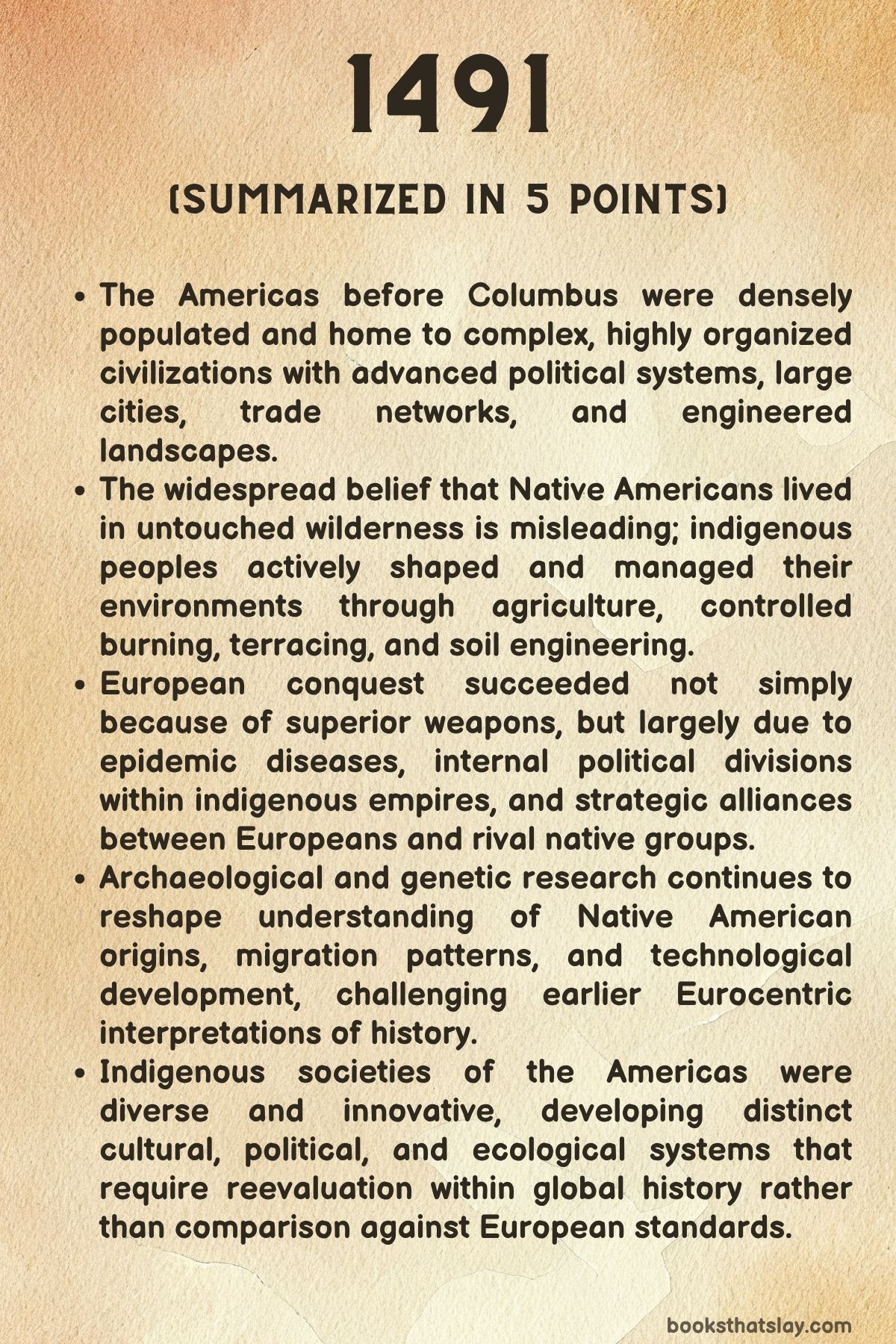
1491: New Revelations of the Americas Before Columbus by Charles C. Mann is a work of narrative history that challenges long-standing assumptions about the Americas before Columbus. Drawing on archaeology, anthropology, ecology, and genetics, Charles C. Mann argues that the Western Hemisphere in 1491 was not a sparsely populated wilderness inhabited by isolated tribes, but a hemisphere of complex societies, engineered landscapes, trade networks, and political systems.
The book reexamines familiar stories—Pilgrims and “friendly Indians,” the fall of the Inca and Aztec empires, and the supposed simplicity of native life—and replaces them with a portrait of innovation, adaptation, and large-scale environmental management. Mann invites readers to reconsider what they think they know about the pre-Columbian world.
Summary
1491 by Charles C. Mann opens by confronting a persistent misconception: that the Americas before European arrival were thinly populated lands occupied by small, simple societies living in harmony with untouched nature. Mann identifies this belief as a fundamental historical error, rooted partly in prejudice and partly in the devastating demographic collapse that followed European contact.
Because disease and colonization erased so many people and disrupted so many societies, later observers mistook absence for primitiveness. Mann argues that this misunderstanding shaped centuries of scholarship and public memory.
He begins with the story of early anthropological interpretations that described indigenous peoples as culturally stagnant and environmentally passive. These interpretations often relied on limited evidence and a tendency to treat “Indians” as a single undifferentiated group.
Mann emphasizes that the term itself conceals enormous diversity. The peoples of the Americas spoke hundreds of languages and built societies that ranged from mobile bands to vast empires.
Recognizing this diversity is essential to understanding the hemisphere before 1492.
A central theme is the scale of the population before European contact. For generations, historians assumed that the Americas held relatively few inhabitants.
Mann presents research suggesting that the population may have been in the tens of millions. When Europeans arrived, they encountered dense cities, managed forests, irrigated fields, and extensive trade routes.
The demographic collapse that followed—driven primarily by smallpox and other diseases—transformed these landscapes so quickly that later settlers believed they were seeing pristine wilderness.
Mann revisits the well-known story of the Pilgrims and Squanto to illustrate how simplified narratives obscure complex realities. Tisquantum, known as Squanto, was not merely a helpful intermediary but a figure shaped by kidnapping, enslavement, diplomacy, and political maneuvering.
After being abducted and sold into slavery, he learned English and returned home to find his community destroyed by disease. His alliance with the Wampanoag and later interactions with English settlers were part of intricate regional politics.
The English did not enter an empty land; they stepped into an unstable world already altered by epidemics that had spread ahead of them. Native groups formed alliances and rivalries with Europeans in efforts to secure advantage, and these relationships often shifted rapidly.
Moving south, Mann examines the Inca Empire, demonstrating that it was one of the largest political entities on earth at the time of its peak. Stretching across diverse terrain, it maintained roads, terraces, storehouses, and a centralized administrative system.
The empire’s structure allowed for efficient governance but also created vulnerabilities. When civil war erupted between rival claimants to the throne, Spanish forces led by Francisco Pizarro arrived.
The Spaniards exploited internal divisions and the destabilizing effects of smallpox, which had already spread through the empire before direct contact. The fall of the Inca was not simply the triumph of superior weapons; it was the convergence of disease, political fracture, and opportunism.
A similar pattern appears in the story of the Mexica and the Aztec capital of Tenochtitlan. Far from being a backward society, the Mexica built a city that rivaled or exceeded European capitals in size and organization.
Their empire governed through tribute and military dominance, creating resentment among subject peoples. When Hernán Cortés arrived, he forged alliances with indigenous rivals of the Mexica.
The conquest of Tenochtitlan depended heavily on native forces. Again, epidemic disease devastated the population and contributed to imperial collapse.
Mann questions genetic explanations that portray native peoples as inherently susceptible, instead emphasizing historical contingency and ecological context.
To explain how the first Americans arrived, Mann turns to genetics and archaeology. Evidence from mitochondrial DNA links Native Americans to populations in Siberia.
During the last Ice Age, lower sea levels exposed a land bridge between Asia and North America, allowing migration. For many years, scholars debated when and how these migrations occurred.
As new scientific tools developed, theories once dismissed gained credibility. Mann uses this story to show how interpretations evolve as evidence accumulates.
The book then explores early American civilizations such as Norte Chico in Peru. This society constructed monumental architecture without the ceramic traditions typically associated with early states.
Some researchers propose that maritime resources, rather than agriculture alone, formed the economic base of Andean civilization. Cotton and fishing supported large populations and centralized authority.
These findings challenge assumptions derived from Old World history about how complex societies must develop.
In Mesoamerica, writing and calendrical systems flourished. Mann compares these developments with those of ancient Sumer, suggesting that writing reflects social priorities.
In Mesoamerica, it often centered on ritual and timekeeping. The absence of wheeled transport in practical use has long puzzled observers, but Mann notes environmental and biological factors, including terrain and the lack of draft animals.
Technological change is not a simple ladder of progress; it depends on local conditions and networks of exchange.
The narrative shifts to the rise and decline of cities across the Americas. Maya city-states expanded and then were abandoned, possibly due to drought and ecological strain.
Along the Mississippi River, Cahokia emerged as a major urban center, complete with monumental earthworks. These societies reshaped their environments through agriculture and controlled burning.
Their decline illustrates how environmental stress and social complexity can combine to produce instability.
In the Amazon, Mann challenges the image of an untouched rainforest. Archaeological and soil studies reveal evidence of dense populations and sophisticated land management.
Techniques such as slash-and-burn agriculture, when practiced over long periods, produced fertile soil known as terra preta. This dark earth, enriched with charcoal and organic matter, supported sustained cultivation.
The rainforest was not merely a natural wilderness but, in many areas, a human-influenced landscape.
The idea of “pristine wilderness” receives sustained critique. Mann argues that European explorers often encountered landscapes that had recently been depopulated by disease.
Indigenous practices such as controlled burns had shaped forests and grasslands for centuries. When pandemics decimated communities, these practices ceased, leading to ecological changes.
Expanding forests and booming animal populations created the impression of abundance. Later declines of species such as bison and passenger pigeons were tied to shifts in land use and intensified hunting under colonial systems.
In the final chapters, Mann examines political organization among the Haudenosaunee, or Five Nations of the Iroquois Confederacy. Their system of governance emphasized consensus and distributed authority.
Women held significant roles in property ownership and clan leadership, although limitations remained. Mann considers whether European thinkers were influenced by their encounters with such societies.
While direct evidence linking indigenous governance to the United States Constitution is limited, the comparison invites reflection on the flow of ideas across cultures.
Across these varied case studies, Mann constructs a consistent argument: before Columbus, the Americas were home to dynamic societies that engineered landscapes, built cities, managed resources, and developed political philosophies. The catastrophe of epidemic disease reshaped the hemisphere so dramatically that subsequent generations misunderstood what had existed.
By drawing on interdisciplinary research, Mann reconstructs a more complex picture of the pre-Columbian world.
In doing so, he challenges readers to reconsider the meaning of civilization and progress. The peoples of the Americas were neither relics of an earlier human stage nor guardians of an untouched Eden.
They were innovators responding to distinct environments and historical circumstances. The transformation of the hemisphere after 1492 was not the meeting of civilization and wilderness, but the collision of two worlds, one of which had already been gravely weakened by forces it did not choose.
Key People
Charles C. Mann
In 1491, the most consistent presence is the author himself, not as a traditional character but as an investigative guide who questions inherited historical assumptions. Mann functions as a critical observer, examining archaeological findings, colonial documents, and modern scientific research with skepticism toward long-standing narratives.
His role is to dismantle the idea that the Americas before European contact were sparsely populated and culturally simple. Rather than positioning himself as a distant academic, he presents himself as someone learning alongside the reader, weighing competing theories and acknowledging uncertainty where evidence remains incomplete.
His intellectual curiosity and willingness to revisit entrenched beliefs shape the tone and structure of the entire work.
Tisquantum (Squanto)
Tisquantum, often remembered as Squanto, emerges as a complex political actor rather than a symbolic helper of English settlers. His life is marked by disruption, survival, and strategic adaptation.
Kidnapped and sold into slavery in Europe, he acquires language skills and knowledge that later make him indispensable in New England diplomacy. When he returns to his homeland and finds his community destroyed by disease, his position becomes precarious yet influential.
Acting as translator and intermediary between the Wampanoag and English settlers, he pursues his own interests within a volatile political landscape. His decisions reflect not innocence but calculated engagement in regional power struggles, revealing the layered realities behind simplified colonial myths.
Massasoit
Massasoit, the sachem of the Wampanoag confederation, is portrayed as a pragmatic leader navigating demographic catastrophe and foreign arrival. Facing weakened populations due to epidemic disease and pressure from rival groups, he views alliance with English settlers as a strategic necessity.
His leadership underscores the political sophistication of indigenous governance structures. Rather than reacting passively to European expansion, Massasoit evaluates risks and benefits in an environment already destabilized by factors beyond his control.
His authority illustrates that Native societies were organized entities capable of coordinated diplomacy and long-term planning.
John Billington
John Billington, a Pilgrim ancestor referenced in the narrative, serves as a lens through which early colonial survival is reconsidered. He represents the vulnerability and dependence of European settlers in unfamiliar territory.
His survival is tied not to European resilience alone but to indigenous assistance and geopolitical conditions shaped by disease. Billington’s presence in the narrative highlights the asymmetry between myth and reality: settlers often relied heavily on native knowledge and networks.
Through him, Mann reframes the early colonial experience as contingent and fragile rather than triumphant from the outset.
Francisco Pizarro
Francisco Pizarro appears as an opportunistic conquistador who capitalizes on internal divisions within the Inca Empire. His success is not portrayed as inevitable or solely the result of technological superiority.
Instead, he benefits from timing, disease, and political fragmentation. Pizarro’s capture and execution of Atawallpa demonstrate his strategic ruthlessness, but also the structural weaknesses of a highly centralized empire in crisis.
His character embodies the broader Spanish approach to conquest: leveraging alliances, exploiting instability, and consolidating power through calculated displays of force.
Atawallpa
Atawallpa, the Inca ruler at the time of Spanish arrival, stands at the center of imperial turmoil. Having emerged victorious from a civil war against his half-brother Huaskar, he inherits a vast yet strained empire.
His authority reflects the administrative strength and territorial reach of the Inca state, but his position is undermined by recent conflict and the spread of smallpox. His encounter with Pizarro illustrates the collision between two political worlds operating under different assumptions.
Despite commanding immense resources, Atawallpa underestimates the nature of Spanish intentions, a miscalculation that contributes to the rapid unraveling of imperial control.
Huaskar
Huaskar, Atawallpa’s rival in the Inca civil war, represents the destructive consequences of succession disputes within centralized systems. His struggle for power fractures the empire at a critical moment.
Although defeated before the Spanish fully consolidate their position, his conflict with Atawallpa weakens administrative cohesion and military readiness. Huaskar’s role underscores how internal divisions can magnify external threats, particularly when combined with epidemic disease and unfamiliar warfare tactics.
Hernán Cortés
Hernán Cortés is depicted as a figure adept at alliance-building and psychological maneuvering. His campaign against the Mexica relies heavily on indigenous allies who resent Aztec dominance.
Cortés understands the political landscape and manipulates existing grievances to expand his influence. His leadership reveals that conquest was not a straightforward clash between Europeans and unified native populations.
Instead, it was shaped by intricate regional politics. Cortés’ ability to coordinate large coalitions and sustain a prolonged siege of Tenochtitlan illustrates his strategic flexibility and capacity to adapt to local conditions.
Moctezuma II
Moctezuma II, ruler of the Mexica at the time of Spanish arrival, presides over a powerful but contested empire. His authority rests on tribute networks and military dominance, which generate both wealth and resentment.
Mann presents him as a leader constrained by ritual expectations, political pressures, and uncertainty about the newcomers. His hesitation and attempts at diplomacy reflect the difficulty of interpreting unprecedented events.
Moctezuma’s downfall symbolizes the vulnerability of even the most impressive urban civilizations when confronted with disease and shifting alliances.
Pachakuti Inca
Pachakuti Inca stands as one of the principal architects of the Inca Empire’s expansion. His reign marks a period of aggressive territorial growth and administrative innovation.
Under his leadership, the empire develops infrastructure, agricultural terraces, and systems of redistribution that sustain large populations across varied terrain. Pachakuti’s achievements demonstrate the scale and ambition of Andean statecraft.
At the same time, the centralized structures he strengthens later contribute to the empire’s susceptibility when leadership is disrupted.
Deganawidah (The Peacemaker)
Deganawidah, known as the Peacemaker, is central to the formation of the Haudenosaunee Confederacy. His vision of unity among the Seneca, Cayuga, Mohawk, Oneida, and Onondaga nations establishes a political framework grounded in consensus and balance.
Through his teachings, the Five Nations adopt a system designed to reduce intertribal warfare and promote cooperation. Deganawidah’s influence highlights indigenous political philosophy as sophisticated and durable.
His legacy challenges assumptions that democratic principles were exclusive to European traditions.
The Five Nations Leaders
The leaders of the Five Nations collectively represent a model of federated governance. Their council system distributes authority and incorporates clan structures, with women holding significant influence in property and leadership selection.
While not identical to modern democratic ideals, their political organization demonstrates deliberate constitutional design. The confederacy’s endurance suggests adaptability and institutional resilience.
Through these figures, Mann underscores that indigenous societies engaged deeply with questions of liberty, order, and collective decision-making.
Betty Meggers
Betty Meggers appears as a prominent voice in debates over Amazonian civilization. As an archaeologist, she argues that environmental constraints limited large-scale development in the rainforest.
Her work sparks discussion about population density, agricultural methods, and ecological balance. Though some of her conclusions are contested, her role reflects the evolving nature of scholarship.
Meggers represents the tension between older environmental determinist views and newer interpretations that emphasize human agency in shaping landscapes.
The Olmec, Maya, and Cahokia Leaders
Though not always represented by individually named rulers, the governing elites of societies such as the Olmec, Maya city-states, and Cahokia serve as collective characters. They oversee urban planning, monumental construction, and religious institutions.
Their decisions influence population growth, land management, and political stability. The eventual decline of these societies illustrates how leadership, environmental stress, and social complexity intersect.
Through them, Mann presents pre-Columbian North America and Mesoamerica as arenas of experimentation, achievement, and vulnerability.
Together, these figures form a mosaic of agency, ambition, adaptation, and contingency. In 1491, characters are not merely historical footnotes but representatives of expansive and dynamic civilizations whose stories reshape our understanding of the Americas before European domination.
Themes
The Myth of the Pristine Wilderness
European settlers often described the Americas as vast, empty, and untouched, a landscape awaiting cultivation and civilization. In 1491, this perception is challenged through archaeological, ecological, and historical evidence showing that much of the “wilderness” encountered by Europeans was, in fact, a managed environment.
Indigenous societies shaped forests, grasslands, and river valleys through controlled burns, terracing, irrigation, and selective planting. These practices regulated animal populations, encouraged particular plant species, and sustained dense human settlements.
When epidemic diseases devastated native populations—often before Europeans physically arrived in certain regions—these land-management systems collapsed. Forests expanded into formerly cultivated fields, animal herds multiplied beyond previous limits, and landscapes appeared wild precisely because human stewardship had abruptly ceased.
This theme reframes colonization not as the arrival of order into chaos but as the replacement of one ecological system with another. Mann argues that environmental change in the Americas cannot be understood without recognizing indigenous intervention.
The idea of untouched nature becomes less a historical reality and more a cultural construct shaped by incomplete observation. By questioning the wilderness narrative, the book also critiques broader assumptions about civilization and environmental responsibility.
Indigenous land use was neither purely destructive nor purely harmonious; it was purposeful, adaptive, and often sustainable across centuries. Recognizing this complicates the moral simplicity of frontier mythology and calls for a more nuanced understanding of human-environment relationships long before European expansion.
Demographic Collapse and the Power of Disease
The sudden and catastrophic spread of Eurasian diseases stands at the center of the transformation of the Americas after 1492. Smallpox, influenza, measles, and other infections traveled faster than European settlers themselves, decimating communities that had no prior exposure.
In 1491, epidemic disease is presented not as a marginal factor but as the defining force that reshaped the hemisphere. Whole cities were emptied, political hierarchies destabilized, and agricultural systems abandoned within decades.
This demographic collapse explains why later observers misinterpreted the Americas as sparsely populated.
Mann resists simplistic biological determinism that frames indigenous peoples as inherently weak. Instead, he situates vulnerability within historical and ecological context.
Eurasian populations had long lived in close proximity to domesticated animals, which facilitated the evolution of infectious diseases and partial immunities. The Americas, with fewer domesticated herd animals and different settlement patterns, developed along another trajectory.
When transatlantic contact occurred, the imbalance proved catastrophic. Disease not only killed but also disrupted diplomacy, succession, and resistance.
Empires such as the Inca faced internal crises compounded by epidemic mortality, making conquest easier for relatively small European forces. This theme highlights contingency rather than inevitability; history might have unfolded differently without the invisible armies of pathogens that preceded and accompanied colonization.
Complexity of Indigenous Civilizations
Long-standing portrayals of pre-Columbian societies as simple or static are systematically dismantled. Evidence from urban centers such as Tenochtitlan and Cahokia, from Andean road networks to Amazonian soil engineering, demonstrates administrative coordination, technological adaptation, and cultural innovation.
In 1491, indigenous societies are shown to possess political institutions, trade systems, monumental architecture, and intellectual traditions comparable in sophistication to their Eurasian counterparts.
The book challenges the homogenizing label of “Indian,” emphasizing linguistic, cultural, and political diversity across the hemisphere. The Inca developed centralized governance and infrastructure across vast distances.
The Mexica constructed a capital city larger than most European cities of its time. The Haudenosaunee Confederacy created a federal structure grounded in consensus and distributed authority.
Even in regions once assumed to be marginal, such as the Amazon, archaeological findings reveal long-term settlement and agricultural experimentation. By foregrounding this diversity and scale, the narrative rejects evolutionary hierarchies that measure civilization against European benchmarks.
Complexity appears in multiple forms, shaped by geography, resources, and cultural priorities rather than by a universal ladder of progress.
The Contingency of Conquest
European domination of the Americas often appears, in hindsight, as inevitable. Mann questions this interpretation by examining the specific circumstances that enabled relatively small groups of conquistadors to defeat expansive empires.
Internal conflicts, such as the Inca civil war, fractured political unity at critical moments. Subject peoples within the Aztec sphere allied with Spanish forces to overthrow dominant rulers.
Epidemics weakened populations before major battles occurred.
In 1491, conquest emerges as a convergence of opportunism, alliance-building, disease, and miscalculation. Spanish leaders like Pizarro and Cortés exploited divisions that already existed.
Indigenous actors made strategic decisions within constrained circumstances, sometimes seeing Europeans as tools against local rivals. The collapse of centralized empires was not a simple contest of steel against stone but a complex interaction of social and biological forces.
By emphasizing contingency, the book shifts attention from narratives of European superiority to the unstable conditions that shaped historical outcomes. The result is a portrait of conquest as fragile and uncertain, dependent on timing and circumstance rather than destiny.
Rethinking Technological Progress
Technological achievement is frequently used as a measure of cultural advancement. Mann challenges this metric by examining differences in writing systems, transportation, agriculture, and urban design.
In Mesoamerica, writing developed in connection with calendrical and ritual needs rather than commercial bookkeeping. The wheel appeared in toys but was not applied to large-scale transport, partly due to environmental constraints and the absence of suitable draft animals.
In 1491, these variations are not signs of deficiency but of adaptation to local realities. Technological paths diverged because ecological and social conditions differed.
The contiguous geography of Eurasia facilitated exchange of ideas, crops, and inventions across long distances. The Americas, separated by oceans and marked by formidable terrain, evolved with fewer cross-continental networks.
Innovation occurred within these parameters. Agricultural achievements such as Andean terracing or the creation of fertile terra preta soils in the Amazon demonstrate ingenuity aligned with environmental needs.
The theme invites readers to reconsider linear narratives of progress and to recognize multiple trajectories of development shaped by context rather than by inherent capability.
Human Agency in Environmental Transformation
Landscapes across the Americas were not passive settings but outcomes of sustained human intervention. Fire management reshaped forests in North America.
Terracing stabilized Andean mountainsides. River systems supported engineered agriculture and settlement planning.
In the Amazon, charcoal-enriched soils reveal centuries of deliberate cultivation strategies.
In 1491, the environment is both a constraint and a canvas. Indigenous communities modified ecosystems to enhance productivity while responding to climatic fluctuations and demographic pressures.
Urban decline in regions such as the Maya lowlands illustrates how environmental stress and social complexity interact. Drought, overuse of land, and political instability combined to produce migration and transformation.
This theme resists romantic portrayals of indigenous peoples as either perfect environmental stewards or reckless exploiters. Instead, it presents them as historical actors making calculated decisions within dynamic ecological systems.
Understanding this agency reframes environmental history as a story of negotiation between human ambition and natural limits, long before industrialization intensified global change.