$2.00 a Day Summary and Analysis
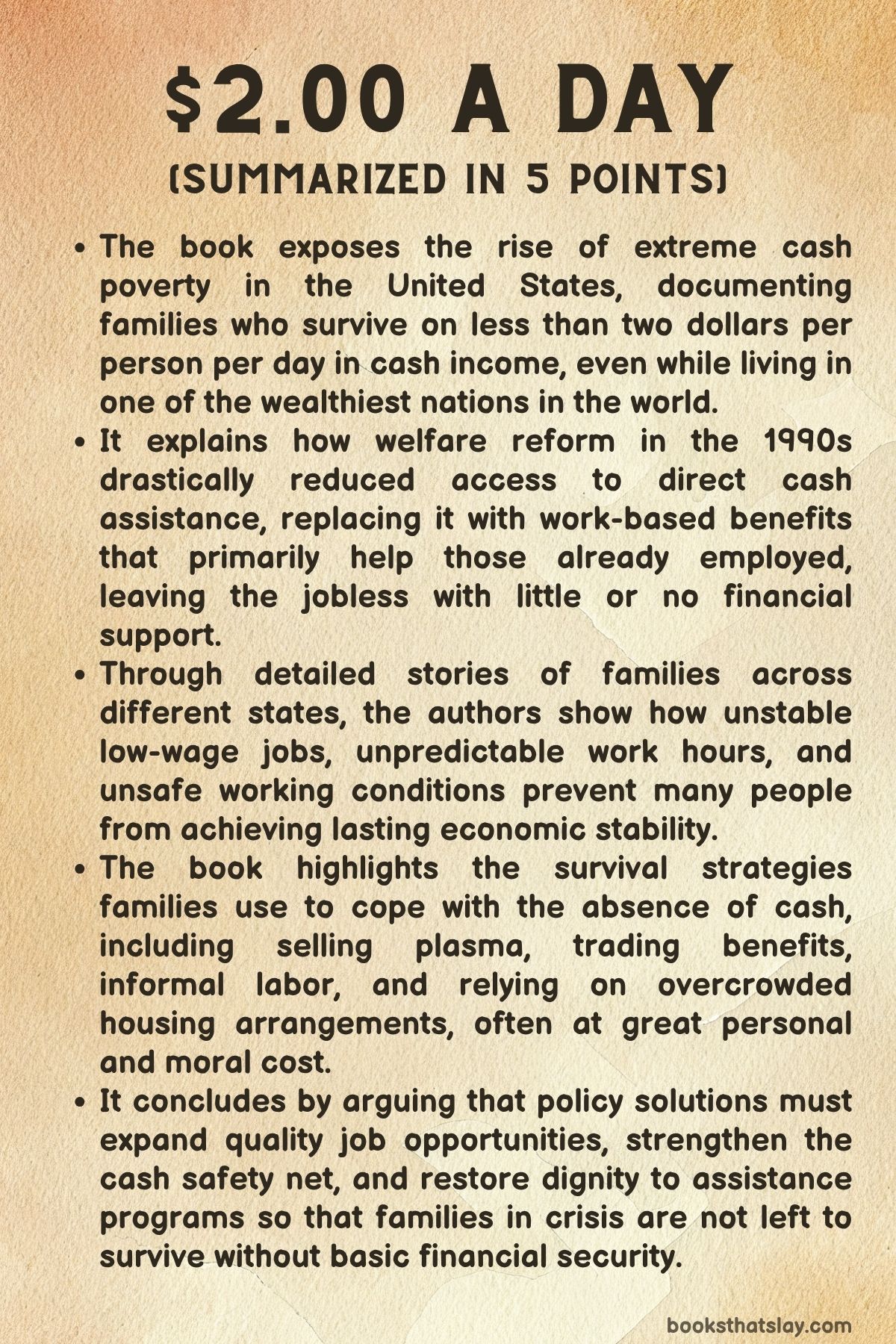
$2.00 a Day: Living on Almost Nothing in America by Kathryn J. Edin and H. Luke Shaefer is a work of investigative social research that reveals a form of extreme poverty many Americans assume no longer exists. Drawing on years of fieldwork and national data, Kathryn J. Edin and H. Luke Shaefer document the lives of families surviving on less than two dollars per person per day in cash income.
Through close, sustained interviews across several states, they show how welfare reform, unstable low-wage work, and a shrinking cash safety net have left some households with virtually no money at all. The book combines personal stories with policy analysis to argue that extreme deprivation is not rare, but growing.
Summary
The book opens with Susan Brown and her family in Chicago, living in a deteriorating home with almost no food and no reliable income. Once, their neighborhood had stable jobs and a sense of order.
Over time, employment opportunities vanished, drugs and violence increased, and families like Susan’s were left stranded. She and her husband want steady work but cannot secure it.
Their situation reflects a broader trend: roughly 1.5 million households in the United States survive on less than two dollars per person per day in cash income.
The authors explain that this level of poverty is closely tied to welfare reform in the mid-1990s. The old cash welfare program provided assistance as an entitlement to poor families.
It was replaced with a new system emphasizing work requirements and time limits. Benefits expanded for the working poor through tax credits, but direct cash aid for the unemployed shrank dramatically.
As a result, families without stable jobs often find themselves with food stamps or housing support, yet little or no cash to meet daily needs such as transportation, toiletries, school supplies, or utility bills.
The story of Modonna Harris in Chicago illustrates these changes. When she had a job as a cashier, she managed to support herself and her daughter.
After losing that job, she struggled to find new work despite submitting many applications. She and her daughter ended up in a homeless shelter.
When she tried to apply for cash assistance, she was effectively turned away. The line was too long, and the system seemed inaccessible.
Modonna came to believe that welfare no longer existed. In many ways, she was correct.
The number of families receiving cash aid had dropped sharply since the reform. The authors argue that policymakers did not redesign welfare so much as dismantle it for those who are not already employed.
The book then examines the nature of low-wage work. Jennifer Hernandez, also in Chicago, spent months in homeless shelters before finding a job cleaning houses and foreclosed properties.
The work was physically demanding and often unsafe. She cleaned unheated buildings in winter, aggravating her asthma and damaging her health.
When illness forced her to miss work, her hours were cut. Eventually she had to quit.
Her experience highlights how unstable employment can be. Low wages, inconsistent schedules, and harsh conditions make it difficult for workers to maintain even minimal financial stability.
The authors point out that applying for jobs has become more complicated for those without resources. Online applications require reliable internet access and a stable phone number.
Listing a homeless shelter as a contact address can reduce an applicant’s chances. Racial discrimination further reduces opportunities for Black and Latino applicants.
Even those who secure employment can lose it quickly. Rae McCormick, who worked at a retail store and received recognition for her performance, was fired after missing work due to a transportation problem.
Her housing situation was unstable, and a simple setback ended her job.
Housing instability emerges as a constant theme. Jennifer once lived with a cousin in a relatively safe neighborhood, and her children attended a good school.
However, conflict in the household and the demands of her employer made the arrangement unsustainable. She later moved in with relatives in another state, where her daughter was sexually abused by a family member.
The authors explain that many extremely poor families double up with friends or relatives because they cannot afford rent. Public housing and voucher programs exist, but they are underfunded, and waiting lists stretch for years.
Without stable housing, families are exposed to conflict, exploitation, and trauma.
Rae’s life shows how early adversity shapes adulthood. She experienced abandonment, violence, and neglect from a young age.
As an adult, she struggles with health problems and chronic stress. She wants to provide a stable life for her daughter, yet her environment undermines her efforts.
The authors link such experiences to research on adverse childhood experiences, demonstrating how poverty and trauma reinforce each other over time.
In Tennessee, Jessica and Travis Compton represent another variation of extreme poverty. Travis completed job training but can only find temporary minimum-wage work.
When his hours were reduced to zero, the family lost its primary income. Jessica sells plasma multiple times a month to earn small amounts of cash.
The process is exhausting but necessary. Their strategies for survival include visiting charities, stretching food supplies, and making painful trade-offs.
Charitable organizations provide food and occasional assistance, but they rarely offer cash. This leaves families scrambling for ways to cover expenses that cannot be paid with food stamps.
Some families turn to selling belongings, collecting scrap metal, or engaging in informal or illegal activities. Selling food benefits for cash, though a felony, becomes a way to obtain money for rent or transportation.
Modonna has traded sex in exchange for help with bills. Such decisions are shaped by immediate need rather than long-term calculation.
The authors emphasize that these actions are often acts of desperation rather than choice.
Paul Heckewelder’s story in Cleveland shows how economic downturns can devastate once-stable families. He previously owned restaurants and provided jobs for relatives.
After the economic crisis, his businesses failed. His home became crowded with extended family members who had nowhere else to go.
His disability check became the primary income for more than twenty people. Paul spends his days gathering scrap, visiting food pantries, tending a garden grown from discarded produce, and conserving water after utilities were shut off.
Survival requires constant labor and creativity.
In the Mississippi Delta, Martha Johnson survives on minimal official income supplemented by small informal earnings. Her housing voucher provides stability, setting her apart from some other families.
Yet the region offers few jobs for those without advanced education. Agricultural modernization reduced the need for labor, and public infrastructure is weak.
In this environment, informal economies flourish. Some residents engage in prostitution, sell benefits, or operate unlicensed businesses.
Alva Mae Hicks, raising thirteen children, embodies the strain of extreme poverty compounded by abuse. With limited options, she has resorted to questionable methods of generating income, including allowing others to claim her children as dependents.
Her daughter Tabitha recounts growing up in overcrowded conditions, often without electricity or adequate food. She remembers humiliation at school and exploitation by adults.
Yet a supportive teacher helped her obtain a scholarship to a boarding school. Tabitha’s story shows both the damage inflicted by poverty and the possibility of change when meaningful support is provided.
In their concluding analysis, the authors argue that extreme cash poverty is a predictable result of policy choices. They do not advocate a simple return to the old welfare system, which carried stigma and political backlash.
Instead, they call for expanding job opportunities and improving job quality. Raising wages, ensuring stable hours, and subsidizing employment could increase security for low-income workers.
They also stress the need for affordable housing and a functional cash safety net for times of crisis.
The book closes with the assertion that poverty at this level is neither inevitable nor invisible. It persists because the systems designed to protect vulnerable families have shifted focus away from those without work.
By combining detailed personal accounts with policy research, the authors argue that the United States must confront the reality of families living with almost no cash and reconsider how assistance is structured so that it supports both work and dignity.
Key People
Susan Brown
Susan Brown stands at the emotional and moral center of the book. She represents the working-age poor who want employment but cannot secure stable work in a labor market that has eroded around them.
Living in a declining Chicago neighborhood, Susan is defined by endurance rather than passivity. She repeatedly searches for jobs, filling out applications through limited technology and without reliable transportation.
Her character reveals the psychological strain of long-term scarcity: constant worry, careful rationing, and the humiliation of asking for help. Yet she retains a deep desire for stability and dignity.
Susan’s life challenges the stereotype that extreme poverty stems from laziness. Instead, she embodies thwarted effort—someone caught between disappearing jobs and an inadequate safety net.
Devin Brown
Devin, Susan’s husband, illustrates how masculinity and identity are reshaped by joblessness. Once able to imagine himself as a provider, he now shares in the frustration of fruitless job searches and shrinking opportunity.
Devin’s character reflects the emotional toll unemployment takes on men in communities where manual and industrial labor once offered stability. He is not portrayed as irresponsible but as sidelined by structural change.
His presence highlights how economic decline affects entire households, not just individuals. Devin’s quiet struggle underscores how the loss of steady work erodes confidence, relationships, and long-term planning.
Modonna Harris
Modonna Harris embodies the shock of falling from modest stability into homelessness. When she worked as a cashier, she maintained housing and routine.
After losing her job for reasons beyond her control, her descent was swift. Modonna’s defining trait is disbelief—she cannot reconcile her effort with her exclusion from assistance.
Her attempt to apply for welfare and being turned away captures the collapse of the cash safety net. She internalizes the message that help is no longer available, which shapes her behavior and expectations.
Modonna is neither reckless nor apathetic; she is disoriented by a system that once promised temporary aid but now offers little when employment disappears. Her choices later in the book, including desperate survival strategies, arise from this exclusion rather than moral failure.
Brianna Harris
Brianna, Modonna’s teenage daughter, represents the children who endure instability without controlling it. Her adolescence unfolds in shelters and uncertain housing.
She is observant and resilient, yet shaped by scarcity. Brianna’s experience reveals how poverty compresses childhood, forcing young people to adapt quickly to adult realities.
Hunger, displacement, and social stigma affect her development, yet she remains closely bonded to her mother. Through Brianna, the book demonstrates how policy decisions ripple into the next generation, shaping aspirations and emotional security.
Jennifer Hernandez
Jennifer Hernandez is a portrait of determination strained by fragile employment. After enduring homelessness, she secures a cleaning job that appears to offer progress.
Her commitment to work is unquestionable; she tolerates harsh winter conditions, unsafe properties, and worsening health. What defines Jennifer is her willingness to sacrifice physically for the chance at stability.
Yet the very job meant to rescue her undermines her health and ultimately vanishes. Jennifer’s story exposes the volatility of low-wage labor.
She is not undone by lack of effort but by conditions that treat workers as expendable. Her maternal instincts also drive her decisions, particularly when housing arrangements threaten her children’s safety.
Jennifer represents the precarious worker who hovers just above collapse, always one illness or scheduling change away from crisis.
Rae McCormick
Rae McCormick’s character is shaped by trauma layered upon poverty. Abandoned and abused in childhood, she enters adulthood carrying emotional wounds that affect her stability.
Rae takes pride in her job performance and briefly experiences structure and recognition. That sense of order collapses quickly when transportation fails and her employer dismisses her.
Rae’s defining trait is hypervigilance, the result of long-term exposure to instability. She lives in a state of constant anticipation of disaster.
Her health problems at a young age reflect the physical cost of chronic stress. Rae is not simply poor; she is burdened by accumulated adversity that narrows her margin for error.
Her devotion to her daughter coexists with a deep awareness of how little control she has over their circumstances.
Jessica Compton
Jessica Compton illustrates the bodily cost of surviving without cash income. Selling plasma becomes her routine method of generating money.
The act is transactional and exhausting, yet she repeats it to bridge gaps left by unemployment and limited benefits. Jessica’s character reveals pragmatism and sacrifice.
She does not romanticize her choices; she endures them. Her identity centers on caregiving and partnership, working alongside Travis to sustain their daughters.
Jessica’s fatigue and physical depletion symbolize the extraction demanded of the poor, where even one’s own body becomes a resource to be monetized.
Travis Compton
Travis Compton embodies frustrated ambition. He completes training and earns credentials, signaling his commitment to self-improvement.
Despite this effort, he cycles through temporary minimum-wage positions with unstable hours. Travis is defined by effort unmet by opportunity.
His hours are cut to zero without warning, demonstrating how low-wage employment offers neither predictability nor loyalty. Travis’s character challenges narratives that blame the poor for lacking skills.
Even with training, he remains vulnerable to arbitrary scheduling and limited demand for labor. His perseverance highlights both personal responsibility and structural limitation.
Paul Heckewelder
Paul Heckewelder represents downward mobility after prior success. Once a restaurant owner who employed relatives, he loses everything in the economic downturn.
Unlike many others in the book, Paul has experienced relative prosperity, making his decline especially stark. His character is defined by industriousness and ingenuity.
He gardens from discarded vegetables, collects scrap metal, and organizes food pantry visits to sustain a household crowded with extended family. Paul’s disability check becomes the foundation for many dependents.
His days are filled with labor that goes unpaid yet is essential. Paul challenges the binary between worker and nonworker; even without formal employment, he works continuously to maintain survival.
His pride and resourcefulness reveal how quickly stability can unravel and how determination alone cannot offset systemic collapse.
Martha Johnson
Martha Johnson provides a contrast to the more chaotic lives depicted elsewhere. Though her official income is minimal, she supplements it through informal snack sales and benefits from a housing voucher.
Martha’s character reflects relative steadiness amid deprivation. Chronic illness limits her ability to work, but she constructs a small, predictable routine within her constraints.
Her life illustrates how housing assistance can anchor a family even when cash is scarce. Martha demonstrates that stability does not require wealth; it requires consistent support.
Her situation underscores the difference a single reliable subsidy can make in preventing complete disarray.
Alva Mae Hicks
Alva Mae Hicks’s character is marked by survival under abuse and overwhelming responsibility. Raising thirteen children, many born during an abusive relationship, she faces demands far beyond her resources.
Alva Mae’s choices, including questionable income strategies, reflect desperation rather than indifference. She is overwhelmed, navigating poverty, violence, and systemic neglect simultaneously.
Her character reveals how limited reproductive autonomy, abuse, and economic scarcity compound each other. Alva Mae is often reactive rather than strategic, responding to immediate crises.
Through her, the book shows how extreme poverty can trap families across generations when support systems are absent.
Tabitha Hicks
Tabitha Hicks stands as a figure of fragile hope. Growing up in overcrowded conditions without consistent electricity or food, she experiences humiliation and hunger from an early age.
Yet she demonstrates academic promise and resilience. A supportive teacher becomes a turning point, helping her access educational opportunity.
Tabitha’s character is shaped by contradiction: ambition mixed with doubt, intelligence shadowed by scarcity. She carries the psychological imprint of deprivation, including uncertainty about her ability to succeed in college.
Tabitha represents the possibility of mobility when meaningful intervention occurs, while also showing how deeply poverty shapes self-perception.
Analysis of Themes and Lessons
Extreme Cash Poverty in a Wealthy Nation
Households surviving on less than two dollars per person per day in cash income stand at the center of $2.00 a Day. The book exposes a form of deprivation that contradicts the common belief that such conditions exist only in developing countries.
What distinguishes this poverty is not simply low income but the near absence of cash. Families may receive food assistance or housing support, yet they lack the flexible money needed for transportation, hygiene products, school supplies, or utility payments.
This absence of cash reshapes daily life into a constant negotiation of trade-offs. A bus ride to a job interview may mean sacrificing dinner.
Paying part of the rent may mean living without electricity.
The theme highlights how public perception lags behind reality. Many Americans assume that a safety net prevents extreme destitution.
The authors demonstrate that policy shifts have allowed a growing number of families to fall into this category. By combining statistical evidence with personal narratives, the book reframes poverty as something more severe and immediate than low wages alone.
The families profiled are not marginal outliers but part of a measurable and increasing population. Their existence forces readers to confront the gap between national wealth and the lived experiences of those at the bottom.
The Transformation and Erosion of Welfare
Policy reform in the 1990s fundamentally altered the relationship between poor families and government assistance. The older welfare system provided cash aid as an entitlement to eligible families.
It was criticized for fostering dependency and for clashing with cultural ideals about work and self-reliance. The new system replaced that entitlement with time limits, work requirements, and significant discretion for states in allocating funds.
While supports for the working poor expanded, direct cash assistance for the unemployed shrank dramatically.
This transformation created a hierarchy within poverty. Those who maintain formal employment can access tax credits and wage supplements, while those who lose jobs often find little support.
The book reveals how this design leaves families most vulnerable precisely when they are jobless. Administrative barriers, lengthy applications, and stigma further discourage participation.
Many people assume welfare no longer exists because their attempts to access it fail. The theme underscores how policy choices reflect cultural values.
Assistance is structured to reward work rather than to protect against the absence of work. As a result, families in crisis experience not only financial hardship but institutional rejection.
The erosion of cash welfare becomes a defining factor in the rise of extreme poverty.
Precarious Labor and the Illusion of Opportunity
Low-wage employment appears to offer a pathway out of poverty, yet the book presents a labor market defined by instability. Jobs available to the families described are often part-time, temporary, and lacking benefits.
Hours fluctuate unpredictably, making budgeting nearly impossible. Workers must remain constantly available, yet employers offer little loyalty in return.
Illness, transportation problems, or minor scheduling conflicts can result in termination.
This precariousness transforms work from a stabilizing force into a fragile arrangement. Even when individuals secure employment, their earnings may be insufficient to meet basic needs.
Unsafe conditions and physical strain further undermine long-term security. The expectation that work guarantees dignity and independence is challenged by stories of people who labor intensely yet remain on the edge of homelessness.
Structural barriers such as racial discrimination compound these difficulties, reducing callback rates and narrowing opportunities.
The theme questions the assumption that poverty results from unwillingness to work. Instead, it shows that effort does not always translate into stability.
Employment alone cannot compensate for low wages, erratic scheduling, and the absence of benefits. The labor market depicted is one where individuals cycle between short-term jobs and unemployment, unable to accumulate savings or build resilience against setbacks.
Housing Instability and Environmental Chaos
Secure housing emerges as a crucial dividing line between relative stability and crisis. Families without reliable income frequently double up with relatives or friends, move between shelters, or inhabit overcrowded and deteriorating spaces.
These arrangements expose them to conflict, exploitation, and trauma. Children change schools repeatedly, adults lose privacy, and tensions escalate under financial strain.
The scarcity of affordable housing intensifies these problems. Public housing and voucher programs offer relief but are limited in availability.
Waiting lists stretch for years, and many eligible families never receive assistance. Rising rents outpace stagnant incomes, leaving even employed individuals vulnerable.
The book illustrates how housing instability is not merely an inconvenience but a source of psychological stress and physical danger. Overcrowding can expose children to abuse, while utility shutoffs create health risks.
Stable housing, when available, functions as a foundation. Families with vouchers experience fewer disruptions, demonstrating how targeted support can reduce chaos.
This theme emphasizes that poverty is not only about income but about environment. Without a consistent place to live, planning for the future becomes nearly impossible.
Housing insecurity amplifies every other hardship, turning temporary setbacks into long-term instability.
Survival Strategies and Moral Compromise
In the absence of sufficient cash assistance and stable work, families develop creative and sometimes risky strategies to survive. Selling plasma, collecting scrap metal, exchanging goods informally, and trading benefits for cash become common practices.
Some individuals engage in illegal or stigmatized activities, including sex work or unauthorized sale of food benefits, to obtain immediate funds.
These strategies reflect the urgency of unmet needs. Rent, utilities, and transportation cannot be paid with food assistance alone.
The book portrays such decisions not as evidence of moral deficiency but as responses to structural exclusion. When legal pathways to income are blocked or inadequate, individuals rely on whatever resources are available.
Even the body becomes an asset to be monetized.
The theme complicates simplistic judgments about right and wrong. It reveals how extreme scarcity narrows options and compresses decision-making into short-term survival.
The line between legality and necessity becomes blurred when children are hungry or eviction looms. These strategies highlight resilience and ingenuity, yet they also expose vulnerability to exploitation and punishment.
Trauma, Toxic Stress, and Intergenerational Impact
Chronic poverty produces psychological and physical consequences that extend beyond financial metrics. Many individuals in the book carry histories of abuse, abandonment, and violence.
Such experiences shape emotional regulation, health outcomes, and relationship stability. Living without reliable income adds another layer of stress, creating a constant state of alertness and fear of impending crisis.
This sustained stress affects children as well as adults. Exposure to hunger, overcrowding, and instability influences cognitive development and academic performance.
Feelings of shame and social exclusion emerge early. The book connects these lived experiences to research on adverse childhood experiences, showing how trauma accumulates over time.
Poor health outcomes, early tooth loss, hypertension, and mental health struggles appear even in young adults.
The theme underscores how poverty is not a temporary inconvenience but a force that shapes bodies and minds. It also reveals how limited support systems allow trauma to persist across generations.
When parents struggle with untreated stress and instability, their children inherit both material scarcity and psychological burden. Breaking this cycle requires more than employment; it demands comprehensive support addressing health, housing, and safety.
Dignity, Stigma, and the Politics of Deservingness
Cultural narratives about self-sufficiency deeply influence how assistance programs are structured and perceived. Welfare reform aimed to align aid with the value of work, distinguishing between the “deserving” working poor and the “undeserving” unemployed.
This distinction shapes both policy design and personal identity. Individuals often feel shame when applying for cash assistance, perceiving it as a mark of failure.
Programs tied to employment, such as tax credits, are experienced differently. Recipients view them as earned rewards rather than charity.
In contrast, applying for direct aid often involves intrusive scrutiny and bureaucratic obstacles, signaling distrust. The theme highlights how dignity is central to effective policy.
When systems imply that applicants are attempting to exploit benefits, they discourage participation and deepen humiliation.
The politics of deservingness influences public support and legislative priorities. Assistance framed as supporting work garners broader acceptance than unconditional cash aid.
The book argues that this framework leaves the most vulnerable families exposed. By centering dignity and reducing stigma, policies could offer support without reinforcing social exclusion.
The tension between cultural ideals and practical needs remains a defining feature of contemporary poverty policy.