25 Days by Per Jacobsen Summary, Characters and Themes
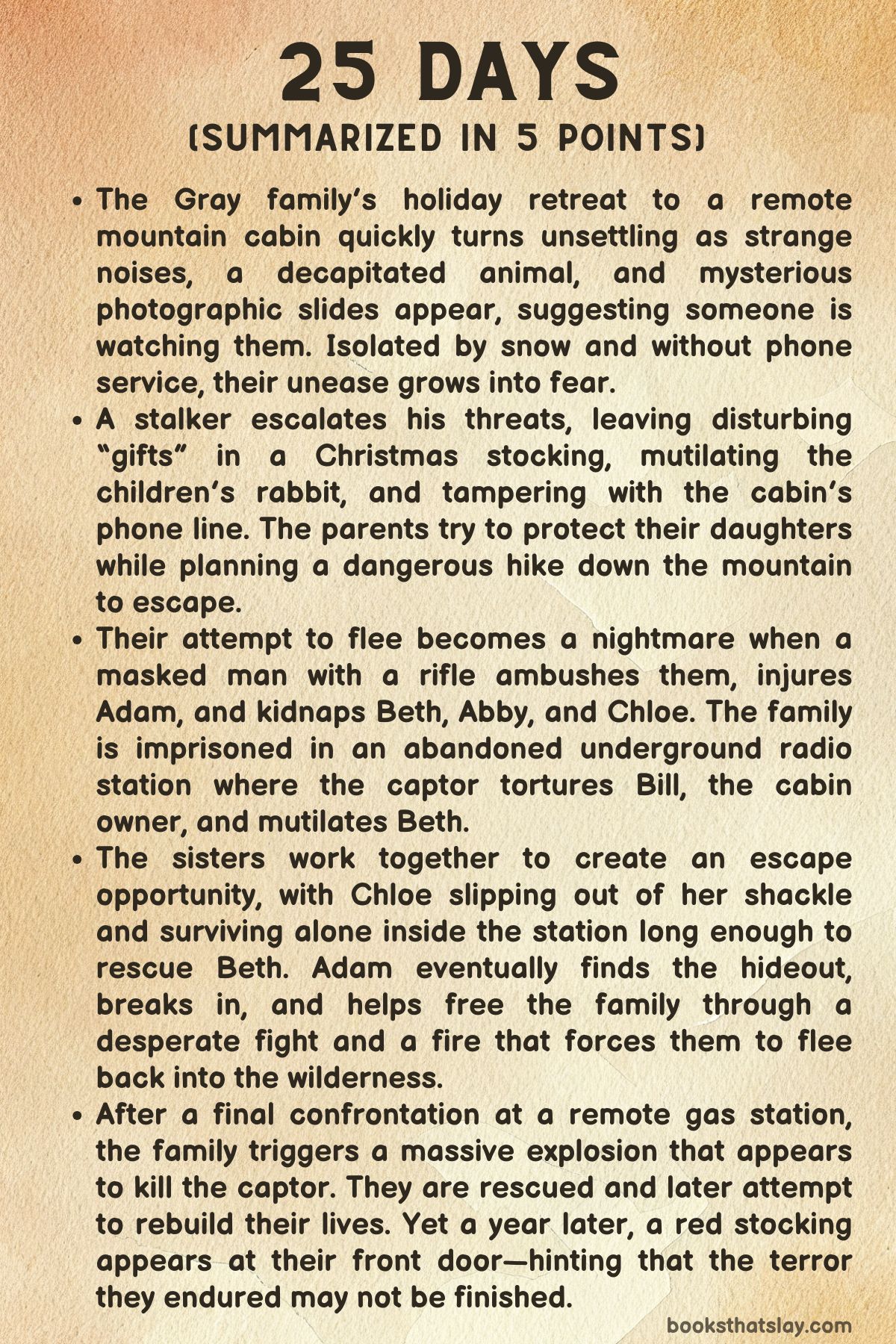
25 Days by Per Jacobsen follows the Gray family—Adam, Beth, and their daughters Abby and Chloe—who set out on what should be a peaceful mountain holiday meant to repair the cracks in their relationships.
Instead, they enter a nightmare. In their isolated cabin above the small town of Crimson, a hidden figure begins watching them, leaving eerie clues and escalating threats that push the family from unease to terror. As their communications fail and the snowy wilderness traps them, they must rely on one another to survive a relentless stalker whose cruelty knows no limits. The story blends slow-building dread with breakneck survival, ultimately exploring how far a family will go to protect each other.
Summary
The Gray family travels to a remote cabin in Willowbend hoping to reconnect, but tension follows them from the start. Adam tries to keep everyone cheerful, yet Beth is distant and their daughters, Abby and Chloe, are glued to their phones. After a tense encounter at a rundown gas station and a warning about the cabin’s isolation, they follow local owner Bill up a long snowy road to a lonely building with a separate barn and a bomb-shelter-turned-food store beneath it. Bill and his strict caretaker, Miss Morris, give the family instructions for feeding the animals and reveal there is no cell service.
That night the first sign of trouble appears: Adam hears violent noises from the barn and discovers fresh blood and a headless chicken, its neck cut with one clean slice. He hides the truth from the girls and convinces himself a person couldn’t have done it.
The next morning, a grimy Christmas stocking mysteriously hangs on the barn door, containing an old photographic slide of the surrounding mountains. The family assumes it is a harmless holiday game. But when a second slide appears showing the cabin from a closer angle—and Beth spots a man on a black snowmobile watching from a distance—the sense of safety begins to peel away.
On the third morning, the girls follow a strange drag mark into the forest and glimpse a lurking figure, sending them running home. A third slide appears the next day, and soon they find a projector in the underground shelter.
When they view the slides enlarged, the truth becomes impossible to ignore: someone is taking photos of the cabin at progressively closer distances. Chloe and Abby whisper a new fear to each other—the photographer has been close enough to capture their freshly built snowman.
Adam decides to check the stocking each morning before the girls can see it. Instead of another slide, he finds a handful of dirty feathers like those from the decapitated chicken. He hides the stocking and tries to call Bill, who does not answer. Beth argues to leave early, but snow blocks the road.
The family tries to relax for a day, and Adam gently comforts a deer in the yard, giving Beth a momentary sense of peace. But late that night she spots the familiar broken taillight of the snowmobile watching from high on the mountain.
The next morning the stocking returns. Abby sees Adam react in horror, hide it in the trash, and kick away snow from the barn entrance. Later she digs through the garbage, finds the stocking, and discovers the severed foot of her beloved rabbit, Bumbleball.
She collapses sobbing. The parents finally admit the situation is dangerous, though they still hide the worst details from Chloe.
That night Chloe wakes to quiet footsteps and the front door opening, proof that their stalker has entered the cabin. In the morning, the snowman stands mutilated, its noose made from their cut telephone cable. The family holds a grim meeting and establishes strict rules: no one goes anywhere alone and they will all sleep in the same room for safety.
Unable to wait for better weather, Adam burns the stocking and prepares for a desperate hike down the mountain. On the trail they find Bill’s abandoned SUV with yet another red stocking inside, this one containing a severed finger wearing Bill’s ring. A man on a ledge aims a rifle at them and fires a warning shot, forcing them into the forest and away from the road.
Lost in the worsening snow, they shelter under a rocky overhang and spend the night huddled together.
In the morning they attempt to confuse their pursuer by creating false tracks and climbing a steep rock face. Abby injures her shoulder during the climb, slowing the group. The next day, they discover a distorted snowman built near their camp during the night, proving the stalker is still close. Soon after, a gunshot hits Adam in the thigh and he falls over a canyon edge while the man on the snowmobile charges at the girls. Abby pushes Chloe out of harm’s way but is beaten unconscious. Beth is knocked out as well, and the captor drags the girls away.
Adam survives the fall and eventually climbs out, following the snowmobile tracks until he finds Beth’s hidden backpack. The girls awaken shackled in a filthy engine room inside an abandoned underground radio station. Beth is held in a separate cell. Their captor, always masked and silent, tortures Bill, who is barely alive, and periodically taunts the family. Abby, determined to save Chloe, provokes the man until he forgets to close the bathroom door.
The sisters use stolen soap to slip Chloe out of her shackle. Chloe escapes into the station, hiding for days and stealing food whenever the man leaves. She eventually finds her mother and helps her break into Abby’s corridor by crawling through the ventilation system.
Just as mother and daughters reunite, the captor shoots Beth and Chloe with tranquilizer darts, chaining them again beside Abby. When he returns with a branch cutter and blowtorch, he amputates Beth’s fingers as punishment. Adam bursts in at the last second, and a violent struggle follows. Beth stabs the captor, who flees just as a fire starts in the next room.
Chloe crawls through burning debris to retrieve the blowtorch, and Adam uses it to free them.
They escape into the mountains. Chloe grows feverish from smoke damage; Beth’s hand is badly mutilated, and Adam can barely walk. After a long descent they reach the same gas station they visited on the first day. The attendant gives them his phone, but before they can call for help he is shot dead. Their captor appears, holding Adam hostage.
Abby spots propane canisters and uses the shotgun to ignite them with Adam’s lighter, triggering an explosion that engulfs the attacker in flames.
The family survives and is rescued after Beth manages to place the 911 call. Weeks later, Chloe awakens in a hospital decorated for Christmas.
A year after that, the Grays celebrate Christmas morning at home, finally feeling safe—until the doorbell rings and Adam sees a red stocking hanging outside, identical to the one used by the man who once hunted them, suggesting their nightmare may not truly be over.
Characters
Adam Gray
Adam is the emotional center of 25 Days, a father determined to hold his family together even as their holiday unravels into horror. At the start, he is a man carrying quiet guilt—about the distance growing between him and Beth, about his strained connection with Abby, and about not knowing how to repair what feels broken.
His desire to create a perfect family getaway makes him initially blind to warning signs, and he repeatedly tries to rationalize dangers in the hope of protecting everyone’s sense of peace. As the threat escalates, Adam shifts from anxious peacekeeper to a fiercely protective parent willing to endure extreme physical suffering. His injuries accumulate—sprains, blood loss, freezing temperatures, burns—yet his drive to find and save his family keeps him moving long after his body should fail. His courage grows alongside his desperation, culminating in his final stand at the gas station.
His willingness to risk his own life, even when nearly broken, shows his evolution into someone who understands that protecting his family matters far more than being perfect for them.
Beth Gray
Beth begins the story guarded and emotionally worn down, her relationship with Adam clouded by unresolved frustration and disappointment.
The isolation of the mountain initially softens her, reminding her of the quieter, kinder parts of their marriage. But when danger emerges, Beth reveals a core of iron resilience. Her protective instincts toward Abby and Chloe become the driving force of her actions, even when terror threatens to overwhelm her. She endures captivity, starvation, and the loss of her fingers with an astonishing ability to stay mentally present for her daughters. Her pain never fully subsides, yet she repeatedly pushes past it to comfort the girls, improvise solutions, and fight for their survival.
Beth’s growth lies in rediscovering her own strength: she starts as someone lost in emotional distance and becomes a parent capable of enduring the unthinkable, always believing that saving her children matters more than the cost to herself.
Abby Gray
Abby is fifteen, caught between adolescence and adulthood, and her arc is one of the most powerful in 25 Days. She initially resents the family trip, feels misunderstood by her parents, and struggles with her shifting role in the family.
As the situation deteriorates, Abby emerges as the family’s sharpest thinker and often the one who sees danger most clearly. Her protective bond with Chloe deepens into something fierce and instinctive, and she repeatedly takes risks to shield her sister. Her courage is not the loud type; it shows in her willingness to endure pain, her quick decisions under pressure, and her growing understanding that she must act when others cannot.
She provokes their captor knowing she will pay the price, uses observation to hatch escape plans, and refuses to collapse under terror even when injured or beaten. Abby becomes a symbol of resilience, stepping fully into adulthood not by choice but by necessity, carrying both bravery and trauma forward into the story’s final chapters.
Chloe Gray
Chloe, at nine years old, brings vulnerability and brightness that make the danger around her feel even sharper. Her curiosity initially fuels small adventures—the snowman, the stocking, the animals—and later becomes a source of both risk and resourcefulness.
She is frightened, yes, but not fragile; Chloe repeatedly shows surprising strength, whether retrieving the blowtorch from a burning room or navigating the radio station’s dark corridors alone.
Her love for her family anchors her actions, especially her trust in Abby, which becomes one of the emotional pillars of the novel. Despite trauma, injury, and her young age, Chloe displays a quiet determination that keeps her from collapsing into panic. Her innocence does not disappear—it is wounded—but she adapts with remarkable bravery, becoming essential to the family’s survival.
Bill
Bill enters the story as a friendly, rustic caretaker who seems eager to help the family settle into the cabin. His warmth is genuine, but it hides his role as the first casualty of the stalker’s sadism. Bill’s disappearance and later mutilated state shift the tone of the story from unsettling to horrific.
His suffering reveals the captor’s brutality long before the family fully understands the danger. Bill’s presence serves another purpose: he symbolizes the ordinary people who have crossed the captor’s path before and paid the ultimate price. His kindness to the Grays, especially the girls, deepens the tragedy of what happens to him and amplifies the family’s terror when they realize he has been taken.
Miss Morris
Miss Morris is stern, practical, and initially seems a possible suspect due to her cold demeanor and isolated role as caretaker. Yet her brief appearance and rigid mannerisms serve primarily to heighten the unsettling atmosphere around the cabin.
She represents the strange, guarded local presence that surrounds Willowbend, the type of person who seems to know more than she says. Though she vanishes from the story early, her seriousness and brusque behavior contribute to the sense that the family has stepped into a world where ordinary social cues do not apply and where the people who live on the mountain understand dangers outsiders cannot begin to imagine.
Sam
Sam, the imposing man from the gas station, initially intimidates Adam with his size and rough humor. His presence feeds early suspicions and injects discomfort into the trip before the true threat emerges. Though he plays a small role, he embodies the town’s harshness and the unease of encountering locals who seem unfriendly or unpredictable. His brief interaction with the Grays plants the idea that the world beyond their city lives by different rules, and that strangers may not always be benign.
Themes
Family Bonds Under Pressure
Family dynamics in 25 Days are strained long before the external threat appears, which allows the story to explore how relationships shift when ordinary frustrations collide with extreme danger. Adam and Beth arrive at the cabin already battling emotional distance, miscommunication, and the exhaustion of trying to hold a fragile household together.
Their daughters embody different responses to tension: Abby withdraws into adolescent skepticism, while Chloe remains trusting and imaginative. As the situation grows more threatening, their individual coping mechanisms begin to clash and then slowly align. The family’s unity is not presented as automatic or sentimental; it is earned through fear, argument, responsibility, and sacrifice. Adam tries to compensate for his guilt over earlier failings by taking on more than he can physically handle. Beth must overcome resentment and awaken her protective instincts in moments that demand immediate action.
Abby shifts from self-conscious teenager to someone who challenges herself to think clearly under pressure, often protecting Chloe at great personal cost. Their bond strengthens not through speeches or declarations but through small decisions: sharing warmth under the rock overhang, refusing to leave each other behind after injuries, and maintaining tiny rituals of reassurance even when hope feels thin.
The narrative shows how a family’s fractures can become the very mechanisms through which they grow stronger, because each member is forced to confront fears, limitations, and regrets. Their survival depends on learning to trust each other fully, replacing misunderstandings with teamwork, and rediscovering a shared identity that had eroded long before they reached Willowbend.
Isolation and Vulnerability
Isolation shapes every danger the Grays face, turning the snowy mountains into a hostile environment where help is unreachable and every sound carries threat.
The cabin, originally intended as a sanctuary, becomes a cage marked by silence, erratic weather, and the ever-present possibility that someone is watching. The lack of phone service, the long road that becomes impassable in snow, and the distance from any town mean that even minor uncertainties grow into serious concerns. The family’s vulnerability intensifies when small incidents—like the headless chicken or the mysterious stocking—can no longer be dismissed as coincidences.
Adam and Beth try to maintain control of the situation, yet their choices are constantly shaped by the reality that they are cut off from the world and must make decisions without outside guidance. Isolation also affects time: each day stretches with the dread of discovering what might appear next on the barn door or in the woods. When they finally leave the cabin on foot, the wilderness proves just as dangerous, stripping away comfort and exposing them to cold, injury, and exhaustion.
The abandoned radio station later becomes a different sort of isolation, trapping them in a maze of forgotten rooms beneath the ground. Even then, isolation carries psychological weight; they cannot tell how long they have been imprisoned, whether rescue is possible, or whether the stalker has a larger plan.
Through these layers, 25 Days shows how vulnerability is not only physical but emotional and mental. The vastness of the landscape becomes a mirror of their helplessness, making every action feel precarious and heightening the impact of each threat the antagonist introduces.
Obsession and Control
The stalker’s presence defines the theme of obsession long before he reveals himself. His surveillance of the Grays is methodical, gradual, and purposeful.
The slides he leaves in the stocking document their lives from increasing proximity, turning photography into a form of domination. Each image communicates that he knows their routines, habits, and vulnerabilities. His silence, both at the cabin and later in the radio station, works as a tool of control; by denying them information or motive, he forces them to remain in a state of uncertainty. He dictates the rhythm of fear, deciding when the family may feel temporarily safe and when their sense of security will be destroyed again.
The stocking becomes a symbol of his influence—something once associated with holiday warmth now twisted into a delivery system for dread and cruelty. His obsession escalates into torture that is designed not simply to harm, but to reshape the power dynamic between captor and captive. Beth’s injuries, Bill’s mutilation, and the psychological manipulation inflicted on the children all point toward someone who seeks absolute authority. Yet the story also examines how control can shift.
Abby’s decision to provoke him into leaving the bathroom door open, Chloe’s escape through the ventilation system, and Adam’s final confrontation in the gas station all challenge his self-appointed dominance. Their resistance destabilizes the very certainty he tries to impose. The final stocking on the Gray family’s front door a year later suggests that obsession does not end with physical defeat; the desire to exert power continues, lingering like a shadow on the edges of their restored lives.
Survival and Moral Cost
Survival in 25 Days requires the Grays to confront actions they never imagined they would take. The story gradually forces them to redraw their moral boundaries as circumstances worsen. Adam, who begins the trip wanting only to reconnect with his daughters and repair his marriage, is pushed into roles that demand violence, deception, and strategic ruthlessness. Beth must overcome personal fears and emotional barriers, shifting from a quiet, disappointed spouse into someone capable of attacking their captor to save her family.
Abby, despite being a teenager, is repeatedly thrust into situations that force her to choose between her own safety and her responsibility to Chloe. Her decision to provoke the captor, knowing it will result in a beating, reflects the grim logic of survival within captivity. Chloe, though younger, faces her own moral challenges when crawling through burning debris to retrieve the blowtorch, knowing what it might mean for her own survival. The narrative does not romanticize their choices; each one carries psychological weight. Adam’s final act at the gas station—using the explosion to kill or disable the attacker—demonstrates how survival reshapes ethics in life-or-death situations.
Even after rescue, the family carries physical and emotional scars that imply survival comes with lasting consequences. Beth must adjust to life with the loss of her fingers, Chloe copes with the trauma of smoke inhalation and captivity, and Abby struggles with the memories of torture and responsibility. Their experience suggests that survival is not a return to normalcy but an evolution marked by endurance, guilt, and resilience. Through these moments, the book explores how extraordinary danger demands choices that permanently alter identity.