6:40 to Montreal Summary, Characters and Themes
6:40 to Montreal by Eva Jurczyk is a tightly contained suspense novel set almost entirely on a morning train ride from Toronto to Montreal.
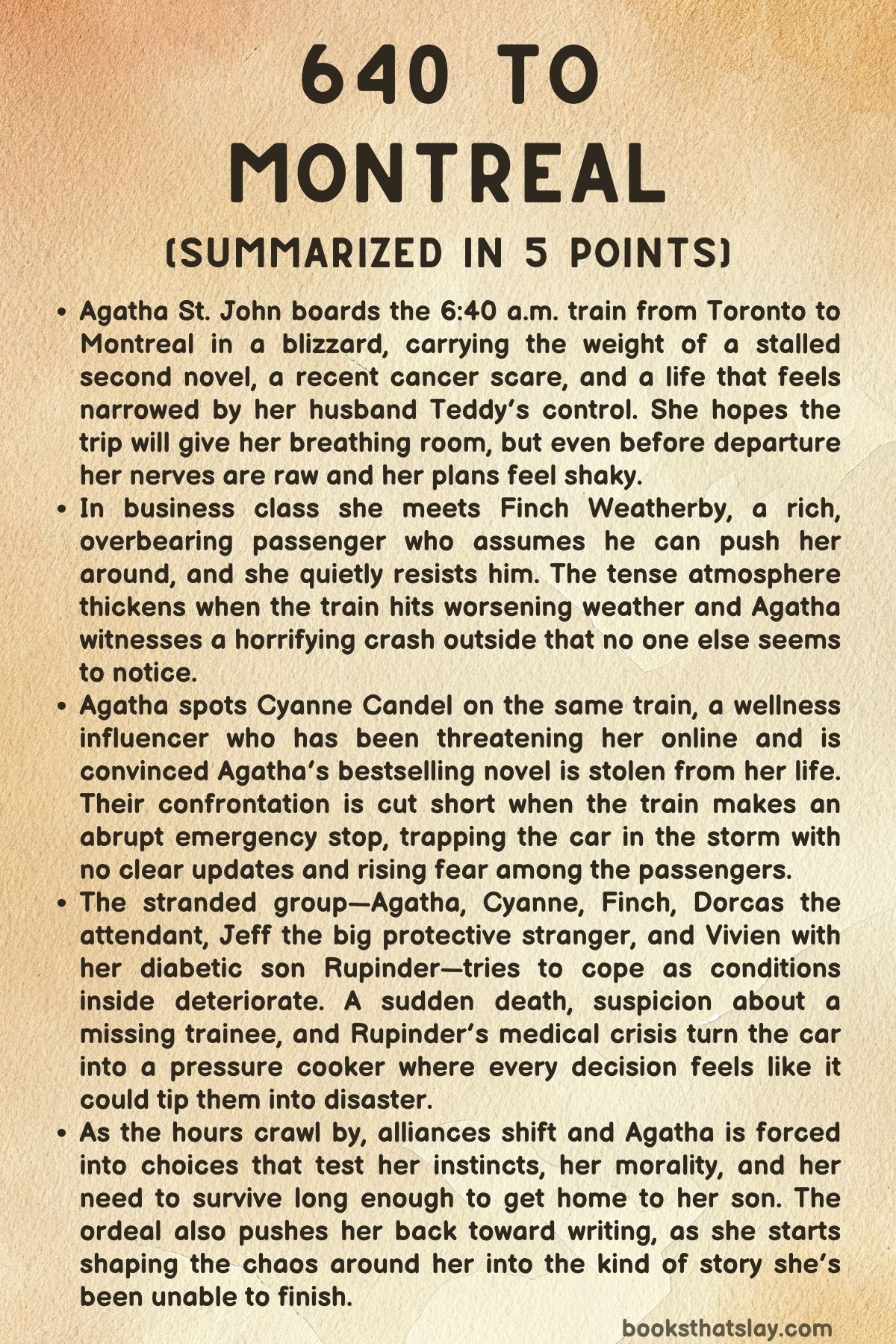
Agatha St. John, a surprise bestselling author, boards the 6:40 a.m.departure hoping for quiet, distance, and maybe a reset from a stalled marriage, creative block, and the shadow of serious illness. Instead, a blizzard halts the train and forces strangers into close quarters. Old resentments surface, a passenger dies, and fear spreads faster than the storm outside. With limited help and rising stakes, Agatha must decide who to trust and what kind of person she will be when survival and truth collide.
Summary
Agatha St. John wakes in the dark to catch the early train to Montreal.
She moves carefully through the new, half-furnished house she and her husband Teddy bought after her first crime novel became an unexpected hit. The money improved their address but not their closeness.
Teddy had urged her to quit her bank job and promised to finish the home, yet months later it still feels unfinished and hollow. Agatha carries a private restlessness: she is behind on her next book, ashamed of her aimless days, and living with the aftereffects of melanoma surgery and recurring scans that keep her aware of mortality.
She packs like someone preparing for more than a day trip, hiding small personal items in her briefcase as if she needs an escape hatch.
She tries to slip out without waking anyone, but Teddy catches her in the hallway. He insists on their family ritual: no leaving without a goodbye, an “I love you,” and a kiss for their young son Freddie.
Agatha complies, frustrated by how even kindness can feel like a restraint. Soon she is seated in business class, hoping the ride will give her space to write before meeting her friend Malee for lunch.
The car is quiet at first. Dorcas, the service agent, does a stiff safety demo while coaching an awkward trainee.
Two other travelers, Vivien and her tall teenage son Rupinder, settle in a few rows back, bickering in a way that suggests long-held tension. Agatha opens her laptop but can’t get traction.
The Wi-Fi fails, the snow outside thickens, and her mind keeps circling the pressure of a looming deadline.
A late passenger storms in: Finch Weatherby, wealthy, entitled, and loud. He drops into the seat beside her and immediately assumes control of the space, demanding her window seat and talking as if they share the same world.
Agatha refuses to move. Finch is stunned by the simple “no,” then continues to narrate his grievances into his phone.
His anger feels directed at someone beyond the train, as if he is mid-war in a separate life.
Agatha switches seats across the aisle to avoid him, and as she looks out the window she witnesses a crash on the highway: a deer bolts into the road, a red car swerves and flips, and the impact appears fatal. The horror lands only in her; no one else seems to notice.
Shaken, she turns back inside—and locks eyes with Cyanne Candel, a glossy yoga influencer who has been attacking Agatha online for months. Cyanne believes Agatha’s bestselling novel stole from her life and painted her as a killer.
Discovering Cyanne on this exact train, in this storm, makes Agatha feel hunted. When Agatha checks Teddy’s social media, she realizes he publicly posted her travel plans, and Cyanne follows him.
The sense of being exposed and trapped tightens.
As the blizzard worsens, the train screeches to an emergency stop. Passengers lurch into the aisle; lights dim; phone service and Wi-Fi die.
Dorcas announces there is no immediate danger, but also no leaving the car, because the doors between cars lock automatically during stops. The storm ices the windows, giving everyone the claustrophobic sense of being sealed inside a moving snow globe.
Time stretches. Vivien grows anxious because Rupinder has type 1 diabetes and needs food and insulin on schedule.
Dorcas follows rigid service rules, starting breakfast from the front row while Vivien pleads to be served sooner. Finch complains and demands special treatment.
Jeff, a big older man with a protective manner, tries to calm the car with conversation but watches Dorcas closely. Agatha becomes increasingly unsettled by the locked doors and Dorcas’s vague updates.
When she tests the door herself, it won’t open, confirming their isolation.
During the stalled hours, Agatha’s mind drifts to why she came to Montreal. She had been stuck on her second book, searching old cases for inspiration, and had latched onto a story of Genevieve, a McGill student assaulted by her boyfriend who later escaped conviction.
Years after the trial, the boyfriend and his father were shot dead in Massachusetts. Genevieve was questioned but never charged, and the murders remained unsolved.
Agatha can’t stop wondering if Genevieve’s sister took revenge. The case sits in her mind like a puzzle missing a final piece.
Cyanne confronts Agatha in the aisle, grabbing her wrist and demanding an explanation for Agatha’s presence. She accuses Agatha of ruining her reputation, insisting the fictional influencer in Agatha’s novel is clearly based on her.
Agatha refuses the claim, but the encounter leaves a live wire of hostility in the air.
Soon after, Finch dies. The circumstances are strange: a deadly spider seems involved, and signs point toward someone handling it deliberately.
Jeff suspects foul play, especially because Dorcas never properly tracked her trainee, who has vanished to another car. As tension rises, Rupinder suffers a seizure.
Agatha and Dorcas stabilize him while Vivien panics. Cyanne offers useless advice, more performance than help.
Rupinder recovers briefly, embarrassed and angry, and insists on going to the restroom alone.
When he returns, the restroom is smeared with burned residue and blood. The mess doesn’t match Rupinder’s condition.
Agatha and Jeff investigate and find Finch’s engraved lighter behind the toilet, suggesting Finch was in there after burning his thumb earlier. The clues make it likely that Finch was killed intentionally, and that the spider was planted.
Rupinder’s condition worsens. Another seizure hits.
Vivien demands real communication, and Agatha urges her to use the galley phone directly. Vivien tries—and finds there is no line.
Dorcas collapses under the pressure and admits she has been faking calls all day. The revelation detonates trust.
Vivien, already at the edge from fear for her son, slashes Dorcas’s throat in a burst of controlled fury. Dorcas dies near Finch’s body, leaving the car with two corpses and no official help.
Agatha and Cyanne, despite their hatred for each other, focus on Rupinder. Jeff goes outside through a manually opened door to search for help in the snow.
The train later starts moving again, but Jeff does not return, and they assume he has been left behind in the storm. Rupinder is close to death, his breathing shallow, his skin gray.
Vivien is frantic. Agatha pushes Cyanne to help hide Dorcas’s body under a blanket and to agree on a story that protects Vivien.
They decide to claim Finch attacked Dorcas with a bottle and Dorcas killed him in self-defense, omitting the trainee entirely.
A customer-service agent named Shawn finally enters from another car, baffled by the scene. He brings supplies and confirms rescue teams had unlocked other cars hours earlier.
Dorcas kept them trapped even when escape routes existed, and Jeff may have gone outside unnecessarily. Shawn helps coordinate emergency care, and Vivien administers insulin to stabilize Rupinder.
At Kingston, paramedics remove Rupinder, and authorities take Finch and Dorcas away. Agatha and Cyanne are interviewed separately.
Agatha repeats the rehearsed lie, and the detective accepts it, relieved to close the case with all apparent wrongdoers dead.
After service returns, Agatha sees angry messages from Dev, the man she had planned to meet for an affair. She also gets a call from daycare confirming Freddie is safe with her mother.
While sorting Finch’s coat, she finds a matchbook from The Riv, Teddy’s restaurant, and recognizes boot prints outside that match Teddy’s gait. The implication hits: Teddy was on the train.
Agatha concludes he likely killed Finch and staged the spider to shock her out of her numbness and to warn her about betrayal.
Two days later, stranded by halted rail lines, Agatha stays in a hotel and writes obsessively, using the ordeal as fuel. She returns home on New Year’s Eve, her draft already taking shape.
Teddy greets her warmly. At midnight she confronts him.
Teddy admits he orchestrated the encounter to jolt her back to life, insisting he never meant for anyone else to die. Exhausted, frightened, and desperate to feel present again, Agatha chooses to believe him.
She lets the marriage restart on a new, uneasy truth: she will keep writing, keep living, and keep the secret of what really happened on the 6:40 to Montreal.
Characters
Agatha
Agatha is the novel’s anxious center of gravity: a recently famous crime writer who is still psychologically shaped by the person she was before success—disciplined, cautious, quietly proud of competence—yet now feels hollowed out by illness, marriage, and the aftershock of sudden celebrity. She begins the story moving with almost ritual care through her house at dawn, which shows both her desire to avoid confrontation and her lifelong habit of control.
The wealth from her surprise bestseller has enlarged her life but not improved it; the unfinished house mirrors her stalled inner world, and her resentment at Teddy’s broken renovation promises is really resentment at how thoroughly he has steered her choices, including pushing her to quit her bank job and leaving her unmoored. Agatha’s melanoma history and ongoing scans add a ticking-clock consciousness that makes every decision feel urgent and existential; her scar is both literal vulnerability and a reminder that her body has already betrayed her once.
On the train, her refusal to give Finch the window seat is a small but important act of autonomy, and her guilty thrill at his burned thumb reveals a part of her that is starved for feeling—even ugly feeling—after months of numbness. Her terror at seeing the highway crash that others don’t register intensifies her isolation and hints at her hypervigilant, possibly dissociative state.
When Cyanne appears, Agatha’s fear isn’t only physical; it is the fear of being trapped by other people’s narratives about her, something she has been battling since her book made her public. Throughout the crisis, she oscillates between panic and fierce practicality: she helps manage Rupinder’s seizures, reads the scene like a detective, and uses writing as a coping mechanism and weapon against helplessness.
Her moral line bends under pressure—hiding Dorcas’s body, inventing a story for Shawn, coaching Vivien to lie—yet these choices come from a protective instinct and from her deep understanding of how stories control outcomes. By the end, her suspicion that Teddy staged events to punish or “jolt” her shows how eroded her trust has become, but her ultimate decision to live fully and reconnect with him suggests not naïveté so much as a deliberate embrace of vitality in the face of death.
Agatha is complicated: principled but capable of deception, fragile but resourceful, craving escape yet longing for home to mean something again.
Theodore/Teddy
Teddy is presented first through Agatha’s wary eyes, so he arrives as a polished, controlling presence whose affection often feels like management. His insistence on the family rule—no one leaves without goodbyes and “I love you”—sounds tender on the surface yet functions as surveillance, a way to keep Agatha within the orbit he governs.
The fact that he is already awake, shaved, and waiting when she tries to slip out suggests he is attuned to her secrets or at least suspicious of her movements. Teddy’s failures to furnish the house, despite repeated promises, are not simple forgetfulness; they are a passive assertion of priority, signaling that the domestic future Agatha wants is less important than his own timeline and perhaps his comfort with her dependence.
His Instagram post exposing her travel plans shows a carelessness with her boundaries, but also a desire to publicly frame her identity—wife-author-on-retreat—in a way that flatters him and cements their shared brand. Later revelations complicate him further: the matchbook, boot prints, and Agatha’s realization that he was on the train cast him as an unseen architect of chaos.
If his confession is taken at face value, Teddy’s motive is chillingly paternalistic—he believes he can shock Agatha out of depression through orchestrated danger, treating her emotional collapse like a machine that needs a hard reboot. Even if he did not intend to kill, this logic reveals a man who equates love with intervention and control, and who trusts his own judgment over Agatha’s autonomy.
Yet Teddy is not written as a cartoon villain; his gentle texts and the whiskey he offers at home are part of his genuine caretaking style, and Agatha’s willingness to believe him shows that his warmth is real enough to compete with his manipulations. Teddy’s character sits in that unsettling space where devotion and domination overlap, making him both a source of safety and a threat to Agatha’s sense of self.
Freddie (Fryderyk)
Freddie is physically absent for most of the narrative but emotionally central, functioning as the tether Agatha can’t quite cut even when she wants to flee. The nickname story—Fryderyk becoming Freddie and Theodore becoming Teddy—marks Freddie as the origin of a family intimacy that once felt playful and mutual.
Agatha’s forced goodbye to him before leaving underscores her maternal love but also her entrapment; Teddy uses Freddie as the moral anchor that blocks her exit, and Agatha experiences this as heartbreak and resentment at once. Later, the daycare voicemail that her mother picked him up because Teddy was “unavailable” raises the stakes of Agatha’s distrust, implying that Freddie’s wellbeing is part of the hidden machinery Teddy runs.
In the end, her tears over sleeping Freddie show that, beneath the affair plot and survival horror, Agatha’s deepest fear is of failing her child. Freddie embodies innocence and the life Agatha still wants to choose, even when everything else is collapsing.
Finch Weatherby
Finch enters as a familiar modern antagonist: wealthy, entitled, performatively aggrieved, and used to bending public spaces to his preferences. His expensive coat, loud phone fight, and assumption of social equality with Agatha paint him as someone whose identity is built on status and dominance.
The casual insistence on swapping seats is not about comfort but hierarchy; his surprise at being refused exposes how rarely he meets resistance, especially from women. Finch’s nonstop chatter and complaints create a claustrophobic pressure cooker around Agatha, making him an early embodiment of the novel’s theme of being trapped with men who feel entitled to access you.
His burned thumb and later death via the spider twist his arrogance into vulnerability; he becomes the first body, the catalyst that turns a tense journey into a locked-room nightmare. The engraved lighter with his initials suggests a private, perhaps meticulous side—someone who values personal markers—and the fact that Vivien considers he might have insulin hints at a life with hidden fragilities beneath the polished exterior.
Even so, Finch is not humanized enough to erase his cruelty; his role is to show how entitlement can be both ridiculous and deadly, and how quickly a person who dominates a room can become an object around which others must improvise morality.
Dorcas
Dorcas is a study in institutional rigidity and personal cowardice wrapped in the uniform of customer service. At first she appears competent and brisk, performing safety demos and trying to train a bumbling coworker, but her professionalism is revealed as rule-bound rather than empathetic.
Her insistence on serving breakfast from row one in order, even as a diabetic teenager needs food urgently, shows how she clings to procedure to avoid making moral judgments. As the crisis escalates, Dorcas becomes more than inefficient; her staged phone calls are a desperate performance of authority, an attempt to keep passengers calm by simulating connection to rescue that doesn’t exist.
This deception is not motivated by malice so much as terror and a belief that control—real or fake—is the only tool she has. Yet the consequences are catastrophic: her lies intensify panic, delay action, and indirectly send Jeff outside to die in conditions that might have been navigable earlier.
Her eventual murder by Vivien is shocking but also narratively inevitable, the moment when the group’s patience with institutional failure turns into primal justice. Dorcas embodies how systems fail in emergencies: not through grand evil, but through small, self-protective untruths that spiral into tragedy.
Cyanne Candel
Cyanne is the novel’s volatile mirror to Agatha: another woman living through a curated public persona, but one who experiences the power of narrative as theft rather than liberation. As a glossy yoga-influencer, she trades in wellness aesthetics and control of image; this makes her sense of being “destroyed” by Agatha’s novel feel existential, because her livelihood depends on her brand being untarnished and singular.
Her rage that Agatha’s fictional murderer resembles her is both paranoid and understandable in a culture where influencer identity is commodified; even a coincidental resemblance can feel like public erasure. Cyanne’s physical confrontation on the train—grabbing Agatha’s wrist, accusing her of stealing her life—shows how deeply she believes the world reads women through archetypes, and how terrified she is of being trapped in one she didn’t choose.
During the ordeal she vacillates between aggression, helplessness, and performative usefulness: she offers dubious movie-based seizure advice and pushes apple cider vinegar as a cure, leaning on wellness myth when real medicine is needed. Yet she also proves capable of solidarity under pressure; she helps move Dorcas’s body, backs Agatha’s lie to Shawn, and shares the platform lookout, suggesting her self-absorption can be overridden by survival and a begrudging recognition of shared danger.
Her demand that Agatha swear not to write about the ordeal reveals her deepest fear: being turned into material again, losing ownership of her story. Cyanne isn’t simply a villain; she’s a portrait of how fragile identity becomes when it’s built for public consumption, and how that fragility can curdle into persecution.
Vivien
Vivien is introduced as a nervous mother, but the crisis reveals her as the story’s rawest expression of love under siege. Her care for Rupinder is ferocious, sometimes to the point of suffocation; their bickering shows years of a parent-child dynamic strained by chronic illness and adolescence.
The blizzard and lack of insulin push Vivien into escalating desperation: she pleads, argues, and finally threatens violence, each step a rational response to her son slipping away while adults around her hide behind protocol. Her moment of trying to force vinegar into Rupinder’s water is tragic precisely because it comes from love distorted by panic and misinformation; she is grasping at any promise of control.
The turning point where she cuts Dorcas’s throat exposes how far survival ethics can stretch when a caretaker believes the system is actively endangering her child. Vivien’s capacity to shift from trembling anxiety to deadly resolve makes her frightening, but the narrative frames this not as inherent brutality but as motherhood weaponized by abandonment.
Even after the killing, she is still focused on Rupinder’s breathing, still making insulin injections, still trying to keep him alive. Vivien embodies the cost of being forced to choose between social law and a child’s life, and she shows how heroism and monstrosity can be separated only by circumstance.
Rupinder
Rupinder is the crisis’s moral heartbeat: a teenage boy whose body becomes the clock everyone can hear ticking. His type 1 diabetes makes him physically vulnerable, but his emotional arc is about the struggle for agency under a mother’s gaze.
He resents Vivien’s overprotection yet also depends on it, and his insistence on going to the bathroom alone after the first seizure is a painful assertion of dignity. The seizures themselves strip him of control, humiliating him through incontinence and collapse, which intensifies his adolescent need to reclaim independence.
His gray skin and weakening breath later on make him the embodiment of urgency, forcing Agatha and Cyanne into moral compromises. Rupinder never becomes just a symbol, though; his fear, embarrassment, stubbornness, and flashes of clarity make him vividly human.
His survival after insulin arrives doesn’t erase the trauma—he is left as the living witness to chaos, even if adults try to script it away.
Jeff (Jeffrey Valentine)
Jeff appears at first as a massive, chatty older passenger, someone who uses humor and storytelling to diffuse tension. His easy conversation with Vivien and gentle demeanor suggest social intelligence, a person who reads a room and offers stability.
As the situation worsens, he becomes the de facto protector and investigator, pressing Dorcas for answers, examining evidence, and balancing empathy with suspicion. His size and calm make him a natural anchor in a locked car, and his willingness to act contrasts with Dorcas’s paralysis.
The revelation that he is actually bestselling writer Jeffrey Valentine reframes his observational style and narrative improvisations: he’s not only socially skilled, he’s professionally attuned to human behavior and plot. His decision to go outside to find help is both courageous and tragically timed, intensified by Dorcas’s lies about the locks; his likely freezing death becomes the novel’s sharpest indictment of institutional deceit.
Jeff’s disappearance also serves the plot by removing the one person who might have unraveled Agatha’s later false story. He is a figure of quiet heroism whose end underscores how survival sometimes punishes the best person in the room.
Dev
Dev exists mostly through Agatha’s memory, but he is crucial to understanding her emotional state. He represents temptation, validation, and escape—an affair not born from deep love but from Agatha’s craving to feel desired and alive against the backdrop of illness and stagnation.
Their months of calls and sexting, hidden and carefully deleted, show Agatha’s secret rebellion against a life that feels supervised by Teddy. Dev’s attention seems tied to her author photo and success, hinting that he is attracted to the idea of her as much as to her.
His unsexy, poorly timed explicit photo punctures the fantasy, revealing his immaturity and the transactional edge of their flirtation. After the chaos, his angry messages and entitlement underline how little he understands her interior world; he wanted a narrative where he was the irresistible escape, and he lashes out when reality interrupts it.
Dev functions as a catalyst for Agatha’s guilt and Teddy’s potential suspicion, but also as proof that her yearning for life is real, even if her chosen outlet was flawed.
Malee
Malee is a small but steady presence from outside the train’s sealed world. Her friendly texts about lunch show that Agatha still has ties beyond marriage and fear, and that Montreal was not only an affair or retreat but also a reach toward friendship and normality.
Malee’s role highlights Agatha’s loneliness: even a simple check-in becomes something Agatha can’t fully answer once she realizes she is trapped with Cyanne. Malee represents the life Agatha might have had—social, open, unhidden—if her world weren’t tightening around secrets.
Shawn
Shawn arrives as a belated lifeline and a symbol of how close rescue might have been all along. His bewilderment at the cold and his confession about the manual override expose the gulf between procedure and passenger perception, turning him into the bearer of devastating knowledge: Dorcas trapped them unnecessarily, and Jeff may have died because of that lie.
Shawn is not heroic in the dramatic sense; he’s a working agent doing his job, awkward around needles, practical about supplies, and willing to contact the crew. This ordinariness matters because it shows that salvation doesn’t always arrive as a savior—it arrives as a tired employee with keys and water, too late to undo the worst consequences.
His trust in Agatha’s invented story also illustrates how authority often accepts the cleanest narrative when chaos is overwhelming.
Detective Brian Pete
Detective Pete functions as the final gatekeeper of truth. His questioning is procedural and, in Agatha’s view, receptive to a simple resolution with all wrongdoers dead.
He is not portrayed as incompetent so much as pragmatically exhausted by a case that appears closed on its surface. His willingness to accept Agatha’s narrative shows how official truth can be shaped by the calmest storyteller in the room, especially when evidence is messy and survivors are traumatized.
By revealing Jeff’s real identity and suggesting he likely froze, Pete also delivers the last emotional blow to Agatha, cementing both her grief and her relief that the lie will stand. He represents the system’s need for coherence over complexity.
Genevieve
Genevieve is not physically present in the train plot, but her “Montreal story” is the imaginative engine Agatha is chasing, and her experience parallels the themes of narrative ownership and institutional failure. As a McGill student assaulted by her boyfriend after rejecting him, Genevieve becomes a symbol of how male entitlement can turn intimate knowledge into violence.
Her compliance with the legal process—police call, examination, charges, testimony—shows courage and faith in the system, which is then crushed by his acquittal. The later civil lawsuit against her deepens the cruelty; even after surviving assault and trial, she is punished for speaking.
The unsolved shooting of her ex and his father years later transforms Genevieve into a figure of ambiguous justice: either a woman who escaped victimhood without legal revenge, or someone surrounded by others who might have taken revenge for her. Genevieve haunts Agatha because her story is unfinished, and Agatha is drawn to that unfinishedness as both writerly fuel and moral puzzle.
Themes
Autonomy under intimate control
From the first morning scene, Agatha’s life is framed by rules that don’t feel like hers. Teddy’s insistence on the goodbye ritual is presented as affection, but it functions like surveillance: she can’t leave quietly, can’t step out of the household script without being corrected.
The new house, funded by her success yet left unfinished, becomes a physical sign of that dynamic. It is technically evidence of freedom—money earned from her own novel—yet the bare rooms and unkept promises show how her achievements are absorbed into Teddy’s timeline and priorities.
His push for her to quit the bank deepens the pattern. Removing her from a job she was competent in doesn’t just create boredom; it strips away an identity that existed outside marriage and motherhood.
On the train, Finch’s entitlement mirrors Teddy’s subtler version. Finch assumes he can take the window seat and social space because he reads status in her appearance, and his shock at being refused shows the social expectation that women should yield.
Agatha’s small defiance—keeping her seat, then giving it away on her own terms—matters because her daily life rarely allows such clean refusals. The emergency stop intensifies this theme: the locked doors literalize what she already feels in the marriage and in her stalled creativity.
Even when she lies to protect Vivien, she is still choosing an action rather than being carried by someone else’s decision. The final revelation about Teddy’s presence and manipulation forces a hard question: if a partner “orchestrates” fear to motivate you, is that love or domination dressed as care?
Agatha’s decision to reconnect with him at the end is therefore not a simple reconciliation. It reads as a complicated bargain made by someone who has been denied easy autonomy.
She wants to live fully, but the space to define what “fully” means remains contested, which makes her agency both hard-won and fragile.
Mortality, illness, and the hunger to feel alive
Agatha’s melanoma scar and ongoing scans shape her inner weather long before the blizzard does. Her body carries a countdown she can’t see, and that uncertainty makes ordinary time feel thin.
The blank Word document in front of her is not just writer’s block; it reflects a mind that has been living beside death long enough to lose contact with desire. Her flirtation with Dev grows out of that numbness.
She doesn’t romanticize it as true love, and she recognizes the shallowness in his attention, yet the sexting gives her a pulse she hasn’t had since diagnosis. The planned affair becomes less about betrayal and more about proof that she can still want something, still be wanted, still take a risk that belongs to her body and not to the clinic.
The train crisis provides another, darker jolt. Fear, disgust, adrenaline—emotions she notes she hasn’t felt in months—return only because bodies are dropping around her and a teenager might die.
The cruel irony is that danger restores sensation. Finch’s death and Rupinder’s decline make mortality immediate and shared rather than private.
They also confront her with different ways of meeting death: Finch’s suddenness, Dorcas’s violent end, Jeff’s slow freezing outside, Rupinder’s near-loss as a child whose life depends on a tiny pouch of insulin. Against that, Agatha’s cancer shifts from abstract doom to one thread in a wider fabric of human vulnerability.
Her obsessive writing in Kingston right after the ordeal looks like a survival response: if life can be taken in moments, then making meaning can’t wait. Even the final scene, where she chooses intimacy with Teddy after believing his explanation, is anchored in her illness.
She is not soothed into forgetting the cancer; she is acting because of it, determined to reclaim appetite for life while she still has a body capable of appetite. The theme is not that death makes life precious in a sentimental way.
It is that living under the shadow of illness can hollow a person out, and sometimes it takes shock, risk, or even moral compromise to bring feeling back.
Truth, storytelling, and the ethics of fiction
Agatha is a crime novelist whose real life keeps offering her plots, but each plot comes with a moral bill. Her fixation on the Genevieve case shows how she looks for narrative patterns in trauma: the boyfriend’s violence, the system’s failure, the later unsolved killings.
She keeps turning over Teddy’s suggestion about the sister, not because she wants to gossip about strangers, but because unresolved stories bother her the way unfinished rooms in her house do. Yet the train makes her confront what it means to shape reality into something usable.
Cyanne’s accusation that Agatha stole her life exposes another tension: fiction’s freedom versus the damage of resemblance. Cyanne’s claim is distorted, but her fear of being publicly identified with a murderous character taps into a real anxiety about authorship and ownership.
The emergency stop then forces Agatha into active fabrication. When Dorcas collapses and the group realizes no help is coming, Agatha becomes the author not of a novel but of the official account they will give police.
Her lie to Shawn is crafted with the same instincts as her books: a motive, a culprit, a plausible chain of events, a missing detail erased to keep the story stable. She quickly judges what the listener needs to hear, how to frame Finch as the aggressor, how to make Dorcas a hero, how to keep Vivien safe.
This is narrative as protection, but also narrative as power. The later police interview shows how easily a clean story can swallow messy truth when the main witnesses are dead and the living are aligned.
The revelation that Jeff was a famous writer adds another sharp edge: Agatha is surrounded by people who use stories, whether for art, for influence, or for survival. By finishing a third of a new novel based on the events, she accepts that she will turn horror into narrative anyway, because that is how she stays upright.
Cyanne’s demand that Agatha swear not to write about it is therefore impossible. The book asks readers to sit with the discomfort that storytelling can be both healing and exploitative at once, and that sometimes the person who controls the story controls who is punished, who is pitied, and who is believed.
Female anger, public gaze, and the cost of being seen
Cyanne’s presence on the train is more than a personal threat; she represents the punishing side of visibility. As an influencer, her livelihood depends on being watched, yet she is also trapped by the judgments of that watching.
She believes Agatha’s novel targets her because she recognizes how quickly the internet collapses distance between fiction and accusation. Her rage is not rational, but it is born from a world where women’s images are treated as public property.
Agatha, too, lives inside that gaze. Teddy’s Instagram post announcing her trip exposes how her movements can be broadcast without her consent, turning intimacy into content.
The online threats from Cyanne echo the earlier control in Agatha’s marriage: different platforms, same violation of boundaries. The train crisis further highlights how women are expected to manage emotion for everyone.
Dorcas clings to rules of service even while danger grows, presenting calm hospitality as a duty. Vivien is judged for desperation as a mother, while Rupinder’s illness makes her both fiercely protective and ashamed of being seen as hysterical.
Agatha becomes mediator, caretaker, and strategist, smoothing panic while her own fear spikes. The violence that erupts among these women is therefore loaded.
Vivien cutting Dorcas’s throat is presented as horrifying, yet it also comes from a cornered maternal terror made worse by Dorcas’s deception. Agatha’s willingness to hide the body and lie to police is another transgression forced by the system’s likely punishment of a desperate mother.
Even Agatha’s earlier private thrill at Finch’s burned thumb is a small, forbidden pleasure in male pain, arising from years of swallowing resentment. The Genevieve case in her research supplies a broader backdrop: a woman who followed every rule, told every truth, and was still denied justice.
That history informs the train’s present. Agatha and Vivien do not trust institutions to protect them or interpret their actions fairly, so they take the story into their own hands.
By the end, Agatha’s suspicion that Teddy staged Finch’s death as “motivation” ties male authority to a kind of theatrical cruelty: women’s suffering repurposed for men’s narratives about what is best for them. The theme traces how anger in women is both provoked and policed, how being publicly visible makes that anger combustible, and how survival sometimes demands choices that society is eager to label monstrous when made by women.