99 Ways to Die Summary and Analysis
99 Ways to Die: And How to Avoid Them by Ashely Alker is a nonfiction medical guide about the many ordinary, unusual, accidental, biological, environmental, and human-made ways life can end.
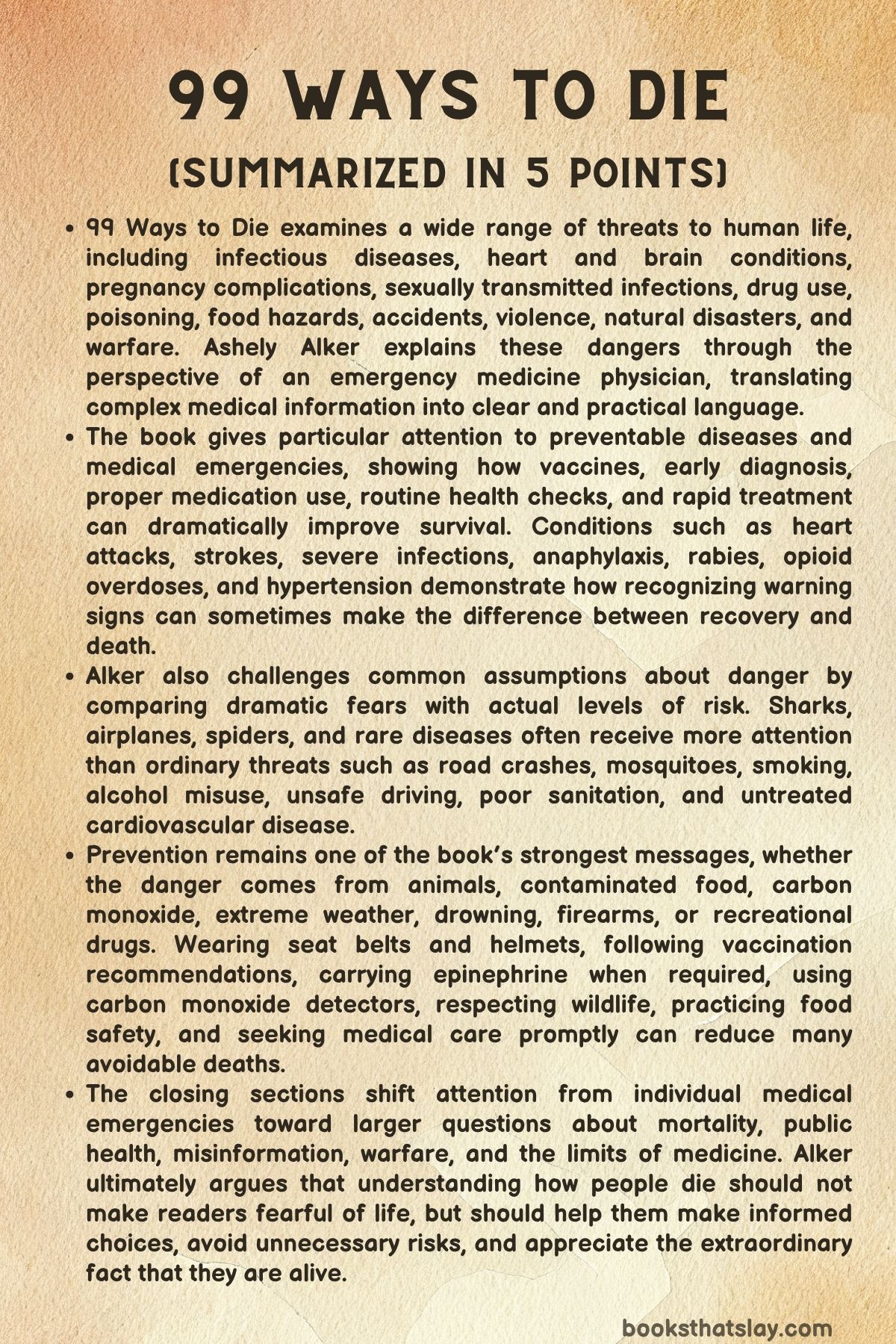
Drawing on her experience as an emergency medicine physician, Alker explains frightening medical conditions and dangerous situations in language intended for non-specialists, combining humor with practical advice about prevention and emergency response. Her personal motivation is closely connected to her mother’s long history of serious illness and to Alker’s own desire to translate difficult medical information into something understandable. The book ultimately treats knowledge about death as a tool for living more safely rather than fearfully.
Summary
Ashely Alker begins from a provocative idea: modern medicine frequently interrupts the brutal logic of natural selection by rescuing people from infections, accidents, illnesses, and poor decisions that might once have been fatal. As an emergency physician, she sees herself as someone who repeatedly confronts death while also trying to teach people how to avoid becoming emergency patients in the first place.
Her interest in medicine is deeply personal. Her mother developed lymphoma shortly after Alker was born and survived the cancer, but treatment left her with major lifelong health problems, including heart operations, a brain tumor, autoimmune hepatitis, and pulmonary hypertension.
Growing up outside a medical family, Alker became frustrated by how inaccessible medical terminology could be. She eventually studied biology, public health, and medicine, and after her mother died during Alker’s final year of medical school, the desire to explain medicine clearly became even more important to her.
From there, 99 Ways to Die moves through a broad catalogue of threats to human life, beginning with infections. Bacterial illnesses can range from familiar problems such as strep throat to tuberculosis, botulism, necrotizing fasciitis, and antibiotic-resistant infections capable of producing tissue destruction, paralysis, organ failure, or death.
Antibiotic resistance becomes an important warning because misuse or incomplete treatment allows bacteria to become harder to eliminate. Viral and parasitic diseases expand the discussion to Ebola, coronaviruses, malaria, tick-borne illnesses, schistosomiasis, sleeping sickness, and several parasites whose spread is strongly influenced by insects, sanitation, contaminated water, animals, poverty, and weaknesses in healthcare systems.
Alker’s experience during COVID-19 gives this discussion a personal dimension. Overcrowded emergency departments, shortages of beds and ventilators, inadequate staffing, and strained supplies show that a disease does not need to threaten only individual bodies; it can also place an entire medical system under dangerous pressure.
Vaccination provides one of the strongest examples of prevention. Diseases such as smallpox and polio once killed or permanently disabled enormous numbers of people, while coordinated vaccination drastically changed their impact and, in the case of naturally occurring smallpox, eliminated the disease worldwide.
Measles, mumps, rubella, tetanus, diphtheria, pertussis, meningitis, influenza, hepatitis, and rabies demonstrate the same principle in different ways. Alker argues that people may underestimate these illnesses precisely because vaccination has made their worst consequences less visible, even though their history shows what can happen when protection disappears.
The book then turns toward failures of the heart and circulatory system. Heart attacks can occur when coronary arteries become blocked, while aortic dissection involves a tear in the body’s largest artery and may be especially difficult to identify because its symptoms can resemble other emergencies.
Stress itself can temporarily weaken the heart through broken-heart syndrome, while pericarditis, myocarditis, endocarditis, and dangerous arrhythmias show how inflammation or electrical disturbances can become life-threatening. Hypertension represents a quieter danger because it can damage the heart, brain, kidneys, and blood vessels for years without producing obvious symptoms.
Neurological disease brings another set of threats. Stroke demands rapid recognition because interrupted or ruptured blood flow can destroy brain tissue quickly, while hemorrhages, Guillain-Barré syndrome, brain infections, traumatic injuries, Alzheimer’s disease, and rare conditions such as prion disease demonstrate how many different processes can damage the nervous system.
One especially frightening example is Naegleria fowleri, a nearly always fatal organism associated with warm untreated freshwater entering the nose. Yet even here, Alker’s emphasis remains practical: recognize risks, protect the head, use seat belts and appropriate sporting equipment, and seek emergency treatment when serious neurological symptoms develop.
Reproductive health and sexually transmitted infections show how embarrassment can itself become dangerous when it discourages people from seeking treatment. Pregnancy can involve ectopic pregnancy, hemorrhage, hypertensive emergencies, blood clots, and serious complications during delivery, while unequal maternal mortality illustrates that health outcomes are influenced by access to care and social conditions as well as biology.
Syphilis, gonorrhea, chlamydia, HIV, herpes, and HPV demonstrate the consequences of delayed diagnosis and the value of screening, treatment, and vaccination. HIV also serves as an example of medical progress, since antiviral therapies have transformed an infection that once frequently led to death into a condition that many people can manage over long periods.
Alker treats drugs with similar caution, especially the assumption that something is safe merely because it is legal, natural, or easily purchased. Ordinary over-the-counter medicines can become poisonous when taken incorrectly, while supplements and herbal products may contain inconsistent doses, interact with other medicines, or be promoted using claims unsupported by reliable evidence.
Recreational substances create risks through several mechanisms. Methamphetamine and cocaine can damage the cardiovascular system, opioids can suppress breathing, alcohol and benzodiazepines can dangerously depress the nervous system, and withdrawal from some substances can itself become a medical emergency.
Naloxone appears as a particularly important intervention because it can reverse opioid poisoning in an emergency. Other drugs may carry lower direct overdose risks but still lead to dangerous behavior, contamination, accidents, or vulnerability to assault, reinforcing Alker’s broader argument that risk involves context as much as chemistry.
Animals receive a more measured treatment because public fear often differs dramatically from actual danger. Venomous snakes can be medically serious, but spiders and sharks are generally less deadly than popular culture implies, while mosquitoes are far more consequential because of their role in spreading infectious disease.
Jellyfish, scorpions, blue-ringed octopuses, cone snails, crocodiles, hippos, and other creatures demonstrate why people should respect local wildlife rather than handle or provoke it. The recurring advice is uncomplicated: avoidance is usually better than improvised heroics, and serious bites, stings, or venom exposure require prompt medical attention.
Poison can be equally dramatic or deceptively ordinary. Cyanide can rapidly prevent cells from using oxygen, while carbon monoxide is especially dangerous because people cannot see, smell, or taste it and may mistake its effects for common illness.
Alker therefore recommends simple preventive tools such as carbon monoxide detectors. She also challenges exaggerated claims about household mold, explains the dangers of poisonous plants and pesticides, considers environmental pollution and microplastics, and warns that even water can become harmful when consumed improperly or contaminated.
Misinformation itself becomes a form of danger. Health influencers who misunderstand scientific evidence, confuse correlation with causation, or promote products beyond their expertise can encourage decisions that place people at risk, making scientific literacy another kind of preventive medicine.
Food introduces dangers ranging from contaminated meals and severe dehydration to anaphylaxis. Proper cooking, refrigeration, hygiene, and storage can prevent many infectious illnesses, while people with severe allergies may depend on immediate access to epinephrine when a reaction threatens the airway or cardiovascular system.
Pufferfish, toxic seafood, and poisonous mushrooms demonstrate a different lesson: food that appears harmless can contain potent toxins. Expertise matters, particularly with wild mushrooms or foods whose safety depends on specialized identification and preparation.
Transportation produces a striking contrast between perceived and measurable danger. Commercial flying may frighten people because aviation disasters receive intense attention, yet road crashes kill more than a million people globally each year, and motorcycles increase vulnerability because riders have little physical protection.
Seat belts, child restraints, helmets, proper training, cautious driving, and better infrastructure therefore matter more than dramatic fears about rare disasters. ATVs illustrate the same problem because their recreational image can hide their potential for severe head, spinal, and internal injuries.
Human violence introduces risks that cannot be solved through individual medical treatment alone. Homicide is often shaped by weapons, relationships, escalating disputes, and location, while gunshot wounds can produce catastrophic bleeding, organ damage, neurological injury, and death within minutes.
Alker also challenges cultural fascination with serial killers, arguing that they should not automatically be imagined as brilliant masterminds. Her larger concern is gun violence as a public-health issue involving homicide, suicide, domestic abuse, accidental shootings, and harm to children, all of which require prevention before victims arrive in emergency departments.
Natural forces expand the scale again. Lightning, tornadoes, earthquakes, fires, volcanoes, extreme temperatures, high altitude, diving pressure, and drowning demonstrate that survival often depends on preparation, shelter, acclimatization, supervision, protective equipment, and responding quickly to warnings.
Aging is included as the unavoidable background to every other risk. Sanitation, vaccination, medicine, and healthier living have lengthened human life dramatically, but they have not removed biological aging itself.
Warfare represents danger deliberately created on a potentially enormous scale. Biological weapons can spread beyond intended targets and overwhelm hospitals, chemical weapons can damage lungs, skin, nerves, and cellular oxygen use, and nuclear weapons combine blast trauma, burns, radiation sickness, fallout, and casualty levels that can exceed medical capacity.
At this level, personal safety advice becomes limited. Shelter, distance, decontamination, protective equipment, and emergency instructions may help, but Alker presents diplomacy, disarmament, international agreements, and responsible leadership as far more meaningful forms of prevention.
The closing movement returns to the emergency department, where doctors perform CPR on a young man without a pulse. Alker contrasts real resuscitation with television, explaining that CPR rarely produces the dramatic awakening commonly shown in fictional medical scenes.
The rare Lazarus phenomenon, in which circulation unexpectedly returns after resuscitation has stopped, reminds readers that medicine still does not fully understand the boundary between life and death. Yet the book’s ending is less concerned with death itself than with what people should do while alive.
Human existence is extraordinarily improbable, and risk can never be eliminated entirely. Alker therefore ends by encouraging sensible protection rather than constant fear: use seat belts and helmets, recognize dangerous symptoms, receive recommended vaccines, avoid needless exposure to poisons and wildlife, prepare for emergencies, and continue living adventurously without making death unnecessarily more likely.
Key People
Ashely Alker
Ashely Alker is the central human presence in 99 Ways to Die, serving simultaneously as physician, educator, witness, daughter, and interpreter of medical science. Her authority comes not only from professional training in biology, public health, and medicine but from years spent working in emergency settings where the risks discussed in the book become actual patients rather than abstract possibilities.
Her narrative identity is built around a tension between fascination with mortality and determination to prevent avoidable death. Describing herself through the humorous idea of a professional who helps people escape death allows her to discuss frightening subjects without treating existence itself as something that should be approached with anxiety.
Alker is also defined by translation. Growing up in a nonmedical family and struggling with difficult terminology made her aware of the distance between medical professionals and ordinary people, so she consciously became someone capable of explaining complicated health information in accessible language.
That role extends beyond clinical medicine into public speaking, healthcare consulting, journalism, and television advising. The range of her work suggests that she sees public understanding itself as part of healthcare, particularly when misconceptions about disease, CPR, vaccines, drugs, or risk can influence life-and-death decisions.
Her voice is also shaped by repeated encounters with institutional limits. During COVID-19, she saw emergency departments strained by shortages of beds, staff, ventilators, and supplies, while her discussion of gun violence shows her frustration with repeatedly treating injuries that might have been prevented through social action.
By the end of the book, Alker is not presented as someone who believes medicine can defeat mortality. She instead becomes an advocate for informed risk: people cannot make themselves immortal, but they can improve their chances by understanding evidence, recognizing emergencies, using preventive measures, and avoiding needless danger.
Alker’s Mother
Alker’s mother is the formative personal figure behind the book even though much of her presence exists through memory. Diagnosed with lymphoma shortly after her daughter’s birth, she survived the cancer but endured a long series of serious health consequences related to treatment, including heart surgeries, a brain tumor, autoimmune hepatitis, and pulmonary hypertension.
Her experience complicates any simplistic picture of medicine as either triumph or failure. Treatment saved her life from one disease while leaving her with other severe conditions, demonstrating how survival can involve years of continuing medical consequences rather than a clean return to health.
She also indirectly shapes Alker’s professional identity. The difficulty her family experienced in understanding medical language contributed to Alker’s decision to become someone who could interpret complicated information for people without medical backgrounds.
Her death during Alker’s final year of medical school gives this motivation additional weight. Medicine becomes more than a career choice; it is connected to Alker’s earliest experience of illness, uncertainty, treatment, survival, deterioration, and loss.
Although she does not participate directly in most of the medical discussions, her influence remains present beneath them. The practical communication style of 99 Ways to Die can be understood partly as an answer to the confusion Alker experienced as a child watching someone she loved move through complicated medical care.
Emergency Patients
Emergency patients function as a recurring collective presence throughout the book. They transform medical categories such as heart attack, stroke, overdose, traumatic injury, infection, poisoning, and gunshot wounds into situations where recognition and response have immediate consequences.
These patients are often represented at moments when time has become critical. A blocked coronary artery, uncontrolled bleeding, opioid-induced respiratory suppression, anaphylaxis, serious brain injury, meningitis, or stroke can change from survivable to fatal depending on how quickly symptoms are noticed and treatment begins.
Their collective role also reveals why Alker places so much emphasis on prevention. From her perspective as an emergency physician, many catastrophes are encountered only after protective opportunities have already been missed: a seat belt was not worn, a symptom was ignored, a medication was misused, a weapon was fired, or an unsafe exposure occurred.
The patients therefore give the book its practical urgency. Alker repeatedly asks readers to act earlier so that fewer people reach the stage where emergency professionals must attempt to reverse severe damage.
At the same time, patients reveal the limits of individual responsibility. Pandemics, maternal mortality, violence, poverty, inadequate sanitation, and strained healthcare systems cannot be solved solely by telling one person to behave more carefully, so the book repeatedly shifts from individual choices toward broader public-health conditions.
The Young Man in the Emergency Department
The unnamed young man in the closing emergency-room scene becomes one of the book’s most concentrated representations of mortality. Found without a pulse, he is surrounded by medical workers performing CPR, placing the reader at the precise boundary the entire book has been examining from many different directions.
His anonymity is significant because he can represent any patient whose life suddenly depends on strangers performing standardized emergency procedures. He is not developed through biography or personality; his narrative purpose comes from his physical condition and from what the response to that condition reveals about real-world resuscitation.
The scene also allows Alker to challenge one of the cultural myths surrounding emergency medicine. Television often presents CPR as a dramatic procedure followed by sudden revival, whereas Alker emphasizes that successful resuscitation is far less common and less cinematic.
Placed near the end, the young man brings the book back from global pandemics, nuclear weapons, poisonous animals, and natural disasters to a single human body. His presence reminds readers that every statistical risk discussed earlier eventually becomes intensely personal when it happens to one individual.
The subsequent discussion of the Lazarus phenomenon further complicates the scene by acknowledging medicine’s incomplete understanding of the exact transition between life and death.
Medical Workers and Public-Health Professionals
Medical workers appear throughout the story as people positioned between danger and its consequences. They treat infections, trauma, cardiovascular emergencies, overdoses, poisoning, pregnancy complications, neurological crises, and violence, often after prevention has failed or circumstances have moved beyond an individual’s control.
Their role becomes especially visible during the COVID-19 pandemic, when overcrowding and shortages demonstrate that healthcare professionals do not operate with unlimited resources. Even skilled clinicians can be constrained when beds, ventilators, supplies, and staffing are insufficient for the number of sick patients requiring care.
Public-health professionals occupy a complementary position because their work aims to prevent emergencies before treatment becomes necessary. Vaccination campaigns, sanitation, safer infrastructure, disease surveillance, health education, maternal care, and evidence-based policy can save lives on a scale that individual emergency interventions cannot match.
The eradication of naturally occurring smallpox provides the clearest example of what coordinated prevention can accomplish. Rather than waiting for each infected patient to require medical rescue, organized vaccination changed the presence of the disease itself.
Together, these professionals reinforce one of Alker’s most consistent ideas: survival is both individual and collective. A person may choose to wear a seat belt or receive a vaccine, but safe societies also depend on functioning hospitals, reliable public information, effective health systems, responsible policy, and preventive infrastructure.
The Reader and the Ordinary Risk-Taker
The reader gradually becomes an implied participant in the book because nearly every danger is connected to a decision, warning sign, preventive measure, or misunderstanding that could occur in ordinary life. The audience is not treated as helpless before mortality but as capable of improving outcomes through knowledge.
That does not mean every death is presented as preventable. Aging cannot be eliminated, rare diseases remain difficult to control, natural disasters can overwhelm preparations, and nuclear warfare could create destruction far beyond the ability of medical systems to respond.
Instead, the ordinary person is asked to distinguish unavoidable mortality from unnecessary risk. Wearing a helmet, using a seat belt, carrying epinephrine when necessary, maintaining vaccination, seeking treatment promptly, respecting wildlife, installing a carbon monoxide detector, and evaluating health claims critically are all examples of small decisions that can substantially alter probabilities.
This implied figure is important because the book does not end by recommending withdrawal from potentially dangerous experiences. Alker instead argues for continuing to explore and enjoy life while refusing to increase one’s risk carelessly.
The reader therefore becomes the final person responsible for converting information into action. Medical knowledge has value not because it eliminates death, but because it can help someone recognize which dangers deserve attention and which fears are exaggerated.
Themes
Mortality, Probability, and the Value of Being Alive
Death is treated less as a single final event than as a probability influenced by biology, environment, behavior, medical care, chance, and social systems. 99 Ways to Die repeatedly shows that human beings live among countless threats, yet the existence of those threats does not mean everyday life should be governed by fear.
Alker’s discussion ranges from common dangers such as road crashes, hypertension, and infections to rare hazards such as brain-eating amoebas, unusual toxins, chemical warfare, and the Lazarus phenomenon. Placing them within the same broad examination of mortality encourages readers to think probabilistically rather than emotionally.
The ending makes that approach especially clear. Human existence itself is described as extraordinarily unlikely, so recognizing mortality becomes a reason to appreciate life rather than retreat from it.
That idea also explains the book’s humor. Jokes do not deny the seriousness of death; they make frightening subjects easier to examine without turning medical education into a catalogue of reasons to panic.
The larger message is that mortality cannot be defeated through perfect behavior. What people can do is alter probabilities by choosing sensible precautions, recognizing serious symptoms, and refusing unnecessary exposure to danger.
Prevention as the Strongest Form of Medicine
Again and again, the most effective medical intervention occurs before a person becomes critically ill or injured. Vaccination, sanitation, safe food preparation, protective equipment, blood-pressure monitoring, prenatal care, carbon monoxide detectors, pool barriers, road restraints, and emergency preparedness all represent forms of medicine practiced before an ambulance or emergency department becomes necessary.
Smallpox provides perhaps the clearest demonstration. Coordinated vaccination did more than help individual patients survive infection; it eliminated naturally occurring disease worldwide, showing how prevention can accomplish something treatment alone cannot.
The same reasoning appears in less dramatic situations. Seat belts cannot prevent all crashes, helmets cannot make motorcycles harmless, and carbon monoxide detectors cannot solve every household hazard, but each measure can change whether an exposure becomes fatal.
Alker also stresses early intervention because some conditions are only preventable for a short time. Stroke, heart attack, anaphylaxis, rabies exposure, severe infection, and opioid overdose may become much more dangerous when symptoms are ignored or treatment is delayed.
Prevention therefore includes both avoiding danger and recognizing when danger has already begun. Knowing when to seek help becomes as important as knowing what to avoid.
Scientific Literacy Versus Misinformation
Knowledge protects people only when the knowledge itself is reliable. Alker repeatedly separates evidence-based medical information from assumptions created by advertising, cultural myths, popular entertainment, pseudoscience, or confident personalities without appropriate expertise.
The discussion of supplements illustrates the problem clearly. Products described as natural or available without prescription may still contain inconsistent doses, interact with medications, or be supported by claims that exceed the available research.
Health influencers become an even broader warning. Confusing correlation with causation or presenting uncertain evidence as certainty can lead people toward unsafe treatments, products, diets, or behaviors, making misinformation capable of producing genuine physical consequences.
Popular entertainment creates another type of misunderstanding. Television depictions of CPR can make successful resuscitation appear far more common and dramatic than it is, potentially shaping public expectations about what emergency medicine can accomplish.
Alker’s own role as a medical communicator is therefore central to this theme. She does not merely present facts; she tries to translate specialist knowledge into language that helps ordinary people judge risks more accurately.
Scientific literacy becomes a practical survival skill. Understanding evidence, asking whether a claim has credible support, and recognizing the limits of expertise can prevent dangerous choices just as surely as some physical safety measures can.
Individual Responsibility and Collective Responsibility
Many dangers in the book can be reduced through personal choices, but Alker repeatedly shows that individual behavior exists inside larger systems. A person can wear a seat belt, receive a vaccine, avoid dangerous drugs, or seek prenatal care, yet survival may still depend on infrastructure, healthcare availability, economic conditions, public policy, and the decisions of other people.
COVID-19 demonstrates this relationship particularly clearly. Individual infection becomes a systemic crisis when hospitals lack beds, staff, ventilators, or supplies, meaning that one person’s outcome may be influenced by pressures far beyond that person’s control.
Maternal mortality similarly reveals inequalities that cannot be explained only through personal choices. Access to medical care and social support help determine whether complications during pregnancy are identified and treated in time.
Gun violence makes the argument more explicit. Alker can treat a gunshot wound after it occurs, but emergency medicine cannot by itself prevent the weapon from being fired, so she frames firearm deaths as a public-health problem requiring evidence, prevention, and societal decisions.
Warfare enlarges the same principle to an international scale. Biological, chemical, and nuclear threats demonstrate circumstances in which personal preparedness becomes secondary to diplomacy, international agreements, disarmament, and responsible leadership.