Agamemnon Summary, Characters and Themes
Agamemnon by Aeschylus is a Greek tragedy about victory, guilt, revenge, and the terrible cost of justice when it becomes tied to bloodshed. Set in Argos after the Trojan War, the play begins with hope: King Agamemnon is returning home after ten years of battle.
Yet beneath the celebration lies a damaged household. His wife, Clytemnestra, has never forgiven him for sacrificing their daughter, Iphigenia, to win favorable winds for war. The drama follows the king’s return and murder, showing how old crimes breed new ones and how power, pride, and vengeance destroy a royal family.
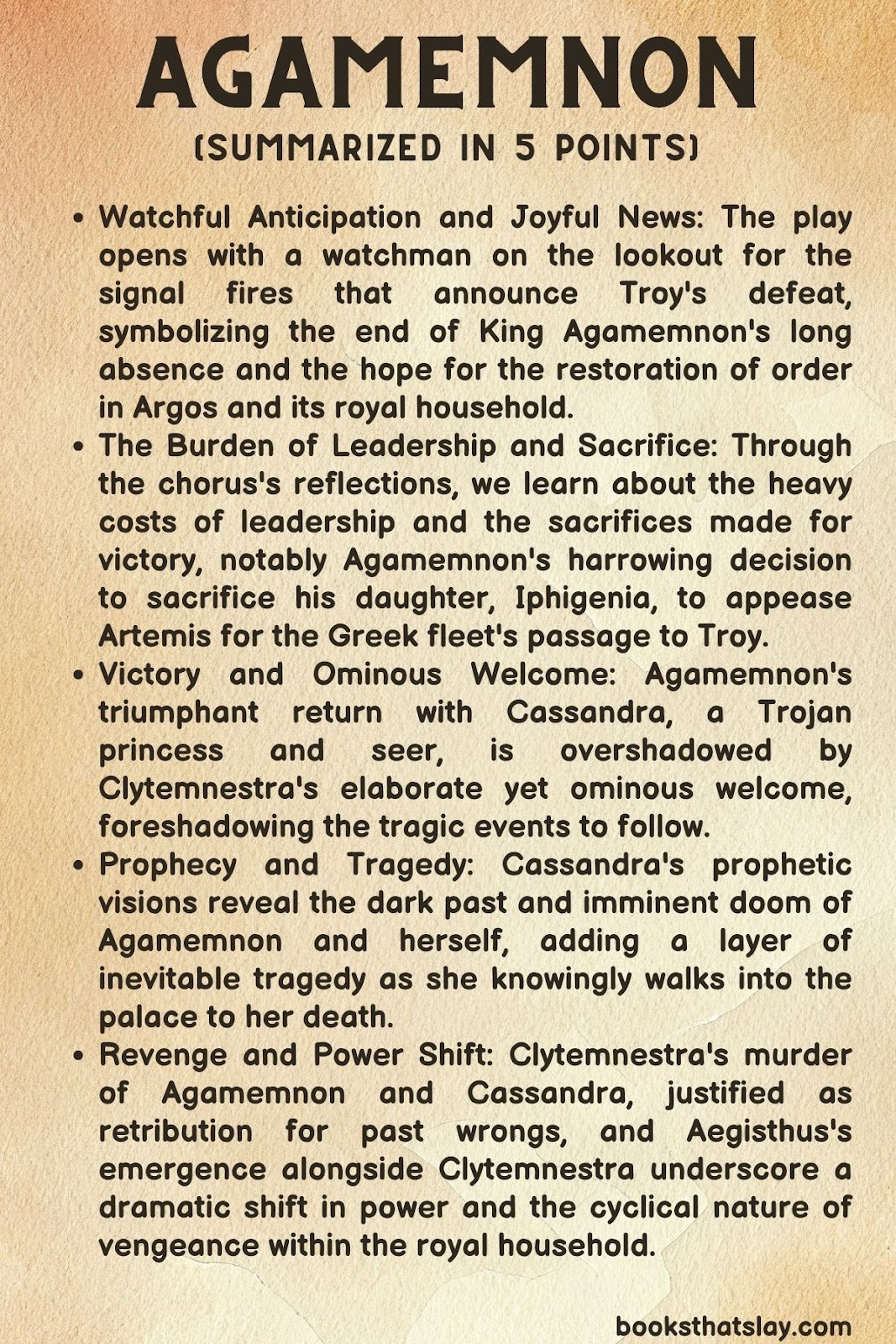
Summary
Agamemnon opens in Argos, outside the palace of King Agamemnon. A watchman sits on the roof, carrying out a lonely duty that has lasted for years.
Queen Clytemnestra has ordered him to watch for a chain of signal fires that would announce the fall of Troy and the return of the Greek army. He is tired, anxious, and uneasy about the atmosphere inside the palace.
Though he longs for the king’s return, he hints that something is wrong in Argos and that the household has become dangerous during Agamemnon’s absence. At last, he sees the distant fire.
Troy has fallen. He rejoices and rushes to inform Clytemnestra, though his relief is mixed with fear.
The elders of Argos enter and reflect on the long war. Ten years earlier, Agamemnon and his brother Menelaus led the Greek forces against Troy after Paris, a prince of Troy, took Helen from Menelaus.
The elders remember the war as a matter of divine justice, since Paris broke the sacred bond between guest and host. Yet they also know that the Greek victory has come at a terrible price.
Many soldiers have died, and the war began with an act that still stains Agamemnon’s name.
Before the Greek fleet could sail to Troy, the winds failed. The prophet Calchas interpreted an omen and declared that the goddess Artemis demanded the sacrifice of Agamemnon’s daughter, Iphigenia.
Agamemnon faced a cruel choice: abandon the war or kill his own child. He chose ambition, duty, and military glory over his daughter’s life.
Iphigenia was taken to the altar, pleading for mercy, but her cries were ignored. The elders remember the scene with horror.
They understand that suffering may teach wisdom, but they also sense that such a crime cannot simply disappear because Troy has been conquered.
Clytemnestra appears and announces that Troy has been captured. The elders are surprised and ask how she can know this so quickly.
She explains the system of beacons that carried the news from Troy across mountains and islands until it reached Argos. She imagines the Greeks moving through the ruined city and hopes they will not anger the gods by committing further acts of violence or disrespect.
Her words sound controlled and intelligent, and the elders admire her confidence, though they remain cautious. They have seen too much suffering to trust good news too easily.
A herald soon arrives and confirms the victory. He is exhausted but overjoyed to see Argos again.
He describes the hardship of the war, the bitter conditions at Troy, and the relief of survival. He announces that Agamemnon is on his way home, honored as the conqueror of Troy.
Clytemnestra greets the news with public joy and sends a message welcoming her husband. She presents herself as a loyal wife who has waited faithfully for ten years.
The elders then ask about Menelaus and the rest of the returning Greeks. The herald reveals that the fleet was struck by a violent storm after leaving Troy.
Many ships were destroyed or scattered, and Menelaus’s fate is uncertain. The victory is therefore shadowed by fresh loss.
The elders reflect on Helen, Paris, and the ruin caused by reckless desire. They compare Paris to a creature raised in comfort that later brings destruction to the house that welcomed it.
In their view, wrongdoing may flourish for a time, but punishment eventually arrives. Human pride, wealth, and success often lead people into moral blindness.
Justice, though slow, cannot be escaped.
Agamemnon then enters in triumph, riding in a chariot with Cassandra, a Trojan princess and prophetess whom he has taken as his captive. The elders greet him respectfully but carefully, aware that excessive praise can offend the gods.
Agamemnon thanks the gods for victory and declares that Troy received the punishment it deserved. He also says that Argos must now be set in order, suggesting that he knows unrest or corruption may have grown while he was away.
Clytemnestra comes out to welcome him. Her speech is elaborate and emotional.
She describes the loneliness, fear, and rumors she endured during his absence. She claims to have suffered as a faithful wife, worried constantly that he might be dead.
She praises him as the savior of Argos and urges him to enter the palace by walking across rich crimson cloths laid before him. Agamemnon resists.
He says such honors are fit for gods, not mortal men, and he fears appearing proud or arrogant. Clytemnestra presses him, arguing that he has earned such glory and should not fear criticism.
At last he gives in. He removes his sandals and walks across the costly cloth into the palace, asking that Cassandra be treated kindly.
Clytemnestra follows him inside, having drawn him into the place where she intends to kill him.
The elders remain outside, troubled. Even though the king has returned and Troy has fallen, they cannot shake their dread.
The mood of celebration has become dark and uncertain. Cassandra stays outside, silent in the chariot.
Clytemnestra returns and orders her to enter the palace, promising decent treatment, but Cassandra does not move. Clytemnestra grows impatient and leaves.
Cassandra then begins to speak, calling on Apollo, the god who gave her prophetic power. Her words reveal the hidden horror of the house of Atreus.
She sees past crimes, including the murder of children by Agamemnon’s father, Atreus, who once slaughtered the sons of his brother Thyestes and fed them to him. This crime created a curse that has followed the family through generations.
Cassandra also sees the immediate future: Agamemnon will be murdered inside the palace, and she will die with him.
The elders struggle to understand her. Cassandra explains that Apollo granted her prophecy, but after she rejected him, he cursed her so that no one would believe her predictions.
She speaks more plainly, saying that Agamemnon is about to die. The elders are disturbed but still cannot fully accept what she says.
Cassandra knows there is no escape. She foresees that Agamemnon’s son, Orestes, will one day return and avenge his father.
Then she enters the palace, accepting death with bitter clarity.
Soon Agamemnon’s cries are heard from within. He has been struck down.
The elders panic and debate what to do, but they hesitate too long. Clytemnestra emerges, standing over the bodies of Agamemnon and Cassandra.
She no longer hides her purpose. She proudly admits that she planned and carried out the murders.
Her earlier words of welcome were a trap. She describes how she caught Agamemnon and killed him, presenting the act not as treachery but as justice.
Clytemnestra’s chief reason is Iphigenia. Agamemnon killed their daughter for the sake of war, and now Clytemnestra has repaid blood with blood.
She also justifies killing Cassandra, whom she sees as her husband’s captive lover and as another insult brought into her house. The elders are horrified.
They mourn Agamemnon and recognize that the family curse has continued. Clytemnestra insists that she has ended a wrong, but the elders see that one murder has only answered another.
Aegisthus then enters with armed guards. He is Clytemnestra’s lover and Agamemnon’s cousin.
He explains his own hatred for Agamemnon’s family. His father, Thyestes, was horribly wronged by Atreus, Agamemnon’s father.
Atreus murdered Thyestes’s children and served them to him as food. Aegisthus sees Agamemnon’s death as revenge for that ancient crime.
While Clytemnestra struck the fatal blows, Aegisthus claims his part in planning the murder and celebrates the fall of his enemy.
The elders condemn him as cowardly and corrupt, especially because he stayed away from the war and now boasts over a dead king. Aegisthus threatens them with force, and violence nearly breaks out.
Clytemnestra stops the confrontation, saying that enough blood has been shed. She tells the elders to go home and accept the new rule.
The elders leave with anger and sorrow, hoping that Orestes will return to avenge Agamemnon. The play ends with Clytemnestra and Aegisthus taking control of Argos, believing they can restore order, while the audience understands that the cycle of revenge is not finished.
Characters
The Returning King
Agamemnon is presented as a victorious ruler, a commander, a husband, and a father whose public glory cannot erase private guilt. He returns to Argos as the conqueror of Troy, carrying the honor of the Greek army and the authority of kingship, yet his greatness is shadowed by the sacrifice of Iphigenia.
His decision to kill his daughter before the war defines the moral weight of his character. He sees himself as a man serving duty, divine demand, and military necessity, but the play exposes the cost of that choice through Clytemnestra’s vengeance.
His caution before stepping on the crimson cloths shows that he is aware of the danger of pride, yet he still yields to persuasion. This weakness matters because it suggests that he can recognize moral limits but does not always hold firm against pressure, ambition, or public honor.
His treatment of Cassandra also reveals the arrogance of conquest: he brings a captive princess home as a spoil of war and expects his household to absorb this insult without consequence. He is not a simple villain, but he is far from innocent.
His death feels both shocking and connected to the violence he has already committed.
Clytemnestra
Clytemnestra is the most commanding figure in the play, a woman of intelligence, patience, anger, and terrifying control. While others wait, worry, or speak in uncertainty, she acts with purpose.
Her public role as queen is marked by discipline and political skill; she manages Argos during her husband’s absence, arranges the beacon system, speaks confidently before the elders, and controls the palace with authority. Beneath this royal surface lies a mother’s rage over Iphigenia’s sacrifice.
Her murder of her husband is not impulsive but carefully prepared over many years. She uses language as a weapon, presenting herself first as the loyal wife and then revealing herself as the avenger.
Her welcome speech is especially important because it turns domestic affection into strategy. She flatters, persuades, and traps him without exposing her true purpose.
Yet Clytemnestra is not only an agent of justice. Her revenge is mixed with power, jealousy, and ambition.
Her killing of Cassandra shows that her violence goes beyond punishment for Iphigenia. She wants control over the house, the throne, and the story of justice itself.
By the end, she believes she has restored order, but her actions only deepen the bloodshed surrounding her family.
Cassandra
Cassandra is one of the play’s most tragic figures because she sees the truth clearly but cannot make others act on it. As a Trojan princess, she enters Argos as a captive, stripped of homeland, status, and freedom.
As a prophetess, she possesses knowledge that should give her power, yet Apollo’s curse turns that gift into torment. She understands the past crimes of the royal house, sees the murder about to happen, and knows that she herself will die.
Her suffering is therefore both personal and cosmic: she is a victim of war, male desire, divine punishment, and inherited violence. Her silence when Clytemnestra first orders her into the palace shows resistance, grief, and dread.
When she finally speaks, her language carries the burden of someone trapped between vision and helplessness. The elders hear her but cannot truly respond to what she says.
Cassandra’s greatness lies in her clear acceptance of reality. She does not deceive herself once she knows escape is impossible.
Her final movement into the palace becomes an act of tragic dignity, as she walks knowingly toward death while also foretelling that the violence will eventually be answered.
The Chorus of Argive Elders
The chorus represents the old men of Argos, and their role is both moral and political. They are too old to have fought at Troy, so they remain in the city as witnesses to the war’s consequences.
Their songs carry memory: they recall the cause of the war, the sacrifice of Iphigenia, the deaths of Greek soldiers, the power of Zeus, and the danger of human pride. They often speak wisely about justice, suffering, and the way wrongdoing returns upon the guilty.
Yet their wisdom is limited by hesitation. They sense danger before it happens, but they cannot prevent it.
They distrust too much happiness, question easy victory, and feel dread when the king returns, but their insight does not become action. Their failure during the murder is especially important.
When cries come from inside the palace, they debate instead of intervening. This makes them a portrait of cautious civic conscience: they know the language of justice but lack the force to defend it.
By the end, they condemn Clytemnestra and Aegisthus, but they are powerless before armed rule. Their hope turns toward Orestes, showing that they expect justice to arrive through another act of revenge.
The Watchman
The watchman appears briefly, but he establishes the emotional atmosphere of the play. He is a minor servant, yet his opening speech reveals the pressure inside the palace before any royal figure appears.
His long duty on the roof shows Clytemnestra’s discipline and the seriousness of her plans. He has been ordered to watch for the beacon announcing Troy’s fall, but his complaints suggest more than physical discomfort.
He feels trapped, exhausted, and afraid to speak openly about what is happening in Argos. This guarded language makes him important because he hints at corruption and fear before the audience knows the details.
His joy at seeing the signal fire is sincere, but it is not simple happiness. He hopes the returning king will restore order, which implies that the house has fallen into disorder during the king’s absence.
The watchman therefore functions as an early warning voice. He does not understand the full shape of the coming disaster, but he senses that victory abroad may not bring peace at home.
The Herald
The herald brings confirmation that Troy has fallen, and through him the cost of war enters the stage in human terms. Unlike Clytemnestra, who speaks of the victory from a distance, the herald has lived through the hardship of the campaign.
His joy at returning home is deeply physical and emotional: he greets the land, the gods, and the city with relief after years of suffering. He gives the Greek victory its heroic public meaning, celebrating the defeat of Troy and the glory of the army.
At the same time, his account complicates that glory. He describes exhaustion, harsh conditions, and the storm that scattered the fleet after the sack of Troy.
His news suggests that even victory does not free the Greeks from divine judgment. The gods may have punished them for excess during the destruction of the city.
The herald is loyal to the king and proud of Greek success, but his speech reveals the instability beneath triumph. He reminds the audience that war damages the victors as well as the defeated.
Aegisthus
Aegisthus enters late, but his presence gives the murder a deeper family history. He is not merely Clytemnestra’s lover or a political opportunist; he is also the surviving heir of a brutal crime committed by Atreus.
His father, Thyestes, was betrayed in one of the most horrific acts associated with the royal house. Aegisthus sees the king’s murder as repayment for that old wrong, and his joy comes from the belief that ancestral justice has finally arrived.
Yet he is also morally diminished by the way he claims victory. He did not strike the fatal blow himself, and the chorus attacks him as cowardly for plotting from behind Clytemnestra’s strength.
His reliance on bodyguards shows that his authority is insecure from the moment he appears. Aegisthus wants to present himself as an avenger, but he also looks like a man eager to seize power after another person has taken the greatest risk.
His character shows how inherited injury can become political ambition. He has a real grievance, but his satisfaction in bloodshed and his threats against the elders make him part of the same corrupt cycle he claims to answer.
Menelaus
Menelaus does not appear directly, but his place in the story is essential. As Helen’s husband and the brother of the returning king, he is one of the causes of the Trojan War.
His personal dishonor becomes a political and military crisis, drawing all Greece into a decade of violence. Through him, the play raises questions about proportion and consequence.
The recovery of one woman and the punishment of one city demand the lives of countless soldiers and the sacrifice of Iphigenia. Menelaus represents injured marital rights, royal pride, and the social code of hospitality that Paris violated.
Yet his absence after the storm also matters. He becomes another uncertain figure in a world where victory does not guarantee safety.
His fate remains unclear, reminding the audience that the war’s consequences extend beyond Argos and that the gods have not finished judging the Greeks.
Helen
Helen is treated by the chorus as a figure of destructive beauty and immense consequence. She does not appear onstage, but her absence is powerful.
To the Greeks, she is the woman whose departure with Paris caused the war; to Troy, she is the presence that brought ruin into the city. The chorus tends to blame her heavily, seeing her as a source of grief for both sides.
Yet this blame also reveals the play’s harsh view of women associated with desire and disorder. Helen becomes a symbol onto whom men project the cost of their own violence.
The kings choose war, the army sails, the gods demand sacrifice, and cities are destroyed, but Helen is remembered as the cause. Her character therefore works less as an individual personality and more as a force in the moral imagination of the play.
She stands for beauty joined to social breakdown, but the scale of blame placed upon her also exposes the unfairness of a world that turns women into explanations for male ambition and revenge.
Paris
Paris is the absent offender whose action begins the chain of public disaster. By taking Helen from Menelaus, he violates the sacred law of hospitality, a serious moral and religious offense in Greek thought.
The chorus presents him as a man whose desire brings ruin not only upon himself but upon his entire city. He is compared to a dangerous creature welcomed into a household, harmless at first but destructive in the end.
His character represents selfish pleasure without regard for obligation. He does not bear the consequences alone; Troy pays for his act through defeat, death, enslavement, and fire.
Paris is therefore important as an example of private wrongdoing becoming public catastrophe. His offense allows the Greeks to claim justice, but the play also questions whether the punishment remains just once it grows into mass slaughter.
Through Paris, the drama shows how one violation can become the excuse for violence on a far greater scale.
Iphigenia
Iphigenia never appears alive in the action, but she is the emotional and moral center of the play’s past. Her sacrifice is the wound that makes the homecoming fatal.
As the daughter killed by her father, she represents innocence destroyed by ambition, war, and obedience to divine command. The memory of her pleading at the altar is one of the most painful images in the play.
She is treated like an offering rather than a child, and her voice is silenced by the needs of the army. For Clytemnestra, Iphigenia is not an abstract sacrifice but a murdered daughter.
This gives Clytemnestra’s revenge its strongest claim to justice. At the same time, Iphigenia’s death becomes part of a pattern in which children suffer for the decisions of parents and rulers.
She exposes the cruelty hidden beneath heroic language. The Greek expedition may be described as glorious, but it begins with a father agreeing to kill his own child.
Atreus
Atreus is dead before the play begins, but his crime poisons the entire royal house. As the father of the king and the enemy of Thyestes, he represents the older generation’s savagery.
His murder of Thyestes’s children and the grotesque meal he served their father created a curse that later violence continues to fulfill. Atreus matters because he shows that the present murder is not isolated.
The palace is built on earlier betrayal, kin-killing, and revenge. Through him, the play asks whether descendants can ever escape inherited guilt.
His actions also complicate the idea of justice. Aegisthus can claim that the murder of Agamemnon answers the crimes of Atreus, but that answer only produces more bloodshed.
Atreus is therefore the hidden source of the family’s moral sickness, a reminder that unpunished cruelty does not stay buried.
Thyestes
Thyestes is another absent but crucial figure in the family history. As the brother wronged by Atreus and the father of Aegisthus, he represents the victim whose suffering becomes the seed of later revenge.
The crime against him is almost beyond ordinary human measure: he loses his children and is tricked into eating them. His grief and humiliation become part of the moral inheritance passed to Aegisthus.
Thyestes helps explain why the murder in Argos is not only about Clytemnestra’s anger over Iphigenia. It is also tied to a much older feud within the ruling family.
Yet the memory of Thyestes also raises a troubling question: when justice is delayed across generations, can revenge still be called justice, or has it become another crime? His story gives Aegisthus motivation, but it does not make the new violence pure.
Orestes
Orestes does not appear, but his name carries the future. As the son of the murdered king and Clytemnestra, he stands at the center of the next expected act of revenge.
Cassandra predicts his return, and the chorus hopes he will avenge his father. This makes him a figure of unresolved justice.
He is both absent child and future avenger, the one who may punish Clytemnestra and Aegisthus but also continue the same cycle of family bloodshed. His importance lies in expectation.
The ending does not close the story because Orestes remains outside Argos, waiting as a possibility. Through him, the play suggests that revenge never truly finishes what it begins.
Every act of retaliation creates a new victim, a new avenger, and a new claim of justice.
Zeus
Zeus represents the divine order that stands above human action, though that order is difficult and often painful. The chorus sees him as the god who teaches wisdom through suffering.
This belief shapes much of the play’s moral world. Human beings learn too late, and their knowledge comes through loss, punishment, and fear.
Zeus is associated with justice against those who violate sacred laws, especially Paris’s violation of hospitality. Yet divine justice in the play does not feel gentle or simple.
It may punish wrongdoing, but it also allows suffering to spread widely across families and cities. Zeus’s authority gives the chorus a framework for understanding events, but it does not remove uncertainty.
People invoke justice, but they often disagree about what justice demands. Zeus therefore stands for a moral order that exists, but whose workings are severe, mysterious, and easily misused by human beings seeking revenge.
Apollo
Apollo is central to Cassandra’s tragedy. He gives her prophetic power, but when she refuses him, he curses her so that her true predictions will not be believed.
This makes him a god of revelation and punishment at the same time. Through Apollo, knowledge becomes a burden rather than a rescue.
Cassandra can see the crime approaching, but her vision cannot save her, the king, or the house. Apollo’s role also exposes the cruelty of divine desire.
Cassandra’s refusal leads not to freedom but to a lifelong punishment that isolates her from human trust. His gift is therefore poisoned.
Apollo helps make the play’s world one where truth exists but may be powerless. The god’s presence deepens the tragedy because Cassandra’s clarity only increases her suffering.
Artemis
Artemis is the divine force behind the demand for Iphigenia’s sacrifice. Her anger stops the Greek fleet and places the king in the position of choosing between his army and his daughter.
She represents the terrifying side of divine power: the gods may demand actions that destroy ordinary human bonds. Her role is especially unsettling because the sacrifice of Iphigenia is presented as both religiously required and morally horrifying.
Artemis does not appear as a comforting guardian but as a power whose anger must be appeased through blood. Her demand exposes the conflict between public duty, divine command, and family love.
Through Artemis, the play shows how obedience to the gods can still leave human beings stained by guilt.
Themes
Justice and Revenge
In Agamemnon, justice is never simple because almost every act of punishment is also an act of violence that demands further punishment. Troy falls because Paris violates hospitality by taking Helen from Menelaus, and this seems, at first, like divine justice.
Yet the Greek victory is built on the killing of Iphigenia, the deaths of many soldiers, and the destruction of a city. Clytemnestra then kills her husband and presents the murder as justice for their daughter.
Aegisthus also claims justice, saying the death repays the crime committed by Atreus against Thyestes. Each character can point to a real wrong, but each answer produces another moral wound.
The play is powerful because it does not allow revenge to appear clean, even when the grievance behind it is understandable. Clytemnestra’s anger as a mother carries force, but her murder of Cassandra and her alliance with Aegisthus complicate her claim.
The chorus longs for justice but ends by hoping Orestes will return and kill in turn. Justice becomes trapped inside family retaliation, where blood answers blood and no one has the authority to end the cycle.
The Cost of War
The Trojan War is celebrated as a victory, but the play constantly measures that victory against what it destroys. The Greeks win glory, but their success requires ten years of suffering, the deaths of countless young men, the sacrifice of Iphigenia, and the ruin of Troy.
The herald’s return gives the audience a human sense of war’s hardship. He speaks not only as a messenger of triumph but as a survivor of exhaustion, danger, and loss.
The storm that scatters the returning fleet further undercuts the idea that conquest brings peace. Even after Troy falls, the Greeks remain exposed to divine anger and physical destruction.
War also damages the home. During the king’s absence, Argos becomes unstable, Clytemnestra gains power, and the unresolved grief over Iphigenia grows into murder.
Cassandra’s presence as a captive shows the suffering of the defeated, especially women taken as spoils. The play therefore refuses to treat war as a distant heroic event.
Its consequences enter the palace, the marriage bed, the political order, and the future of the family. Victory does not heal the damage; it carries the damage home.
Pride, Power, and Human Limits
The play repeatedly warns that human beings invite disaster when they forget their limits. The returning king knows that excessive honor can offend the gods, which is why he first refuses to walk on the crimson cloths.
He understands that such luxury suggests divine status rather than mortal achievement. Yet he gives in, and that surrender becomes a sign of vulnerability.
His public identity as conqueror makes him susceptible to praise, even when he senses danger. Clytemnestra also crosses limits, though in a different way.
She takes on the role of judge, executioner, ruler, and avenger, claiming the right to decide what justice means. Her power is impressive, but it is also unstable because it rests on deception and murder.
Aegisthus likewise mistakes revenge for rightful authority, assuming that old suffering entitles him to rule through fear. Even the Greeks as a whole may have overstepped during the sack of Troy, leading to divine punishment at sea.
The play’s concern with limits is not only religious but political and moral. Mortals who act as if victory, grievance, or royal status places them beyond restraint become agents of ruin.
Inherited Guilt and the Curse of the House
The royal house is shaped by crimes committed before the present action begins. Atreus’s murder of Thyestes’s children creates a history of betrayal so severe that later generations seem unable to live outside its shadow.
The king inherits not only a throne but a polluted family legacy. Aegisthus inherits his father’s suffering and turns it into revenge.
Orestes, though absent, is already being drawn into the same pattern, expected to answer his father’s murder with another killing. This theme gives the play its sense of inevitability.
Characters make choices, but those choices occur inside a house already marked by blood. The past is not dead memory; it is active pressure.
Cassandra sees this most clearly. Her visions connect old crimes with present murder and future retaliation, showing that the family’s violence has a structure that repeats itself.
Yet the play does not remove responsibility from individuals. Clytemnestra chooses deception, Aegisthus chooses ambition, and the king once chose his army over his child.
Inherited guilt creates the conditions of disaster, but human decisions keep renewing it. The curse survives because each generation mistakes revenge for resolution.