The Reappearance of Rachel Price Summary, Characters and Themes
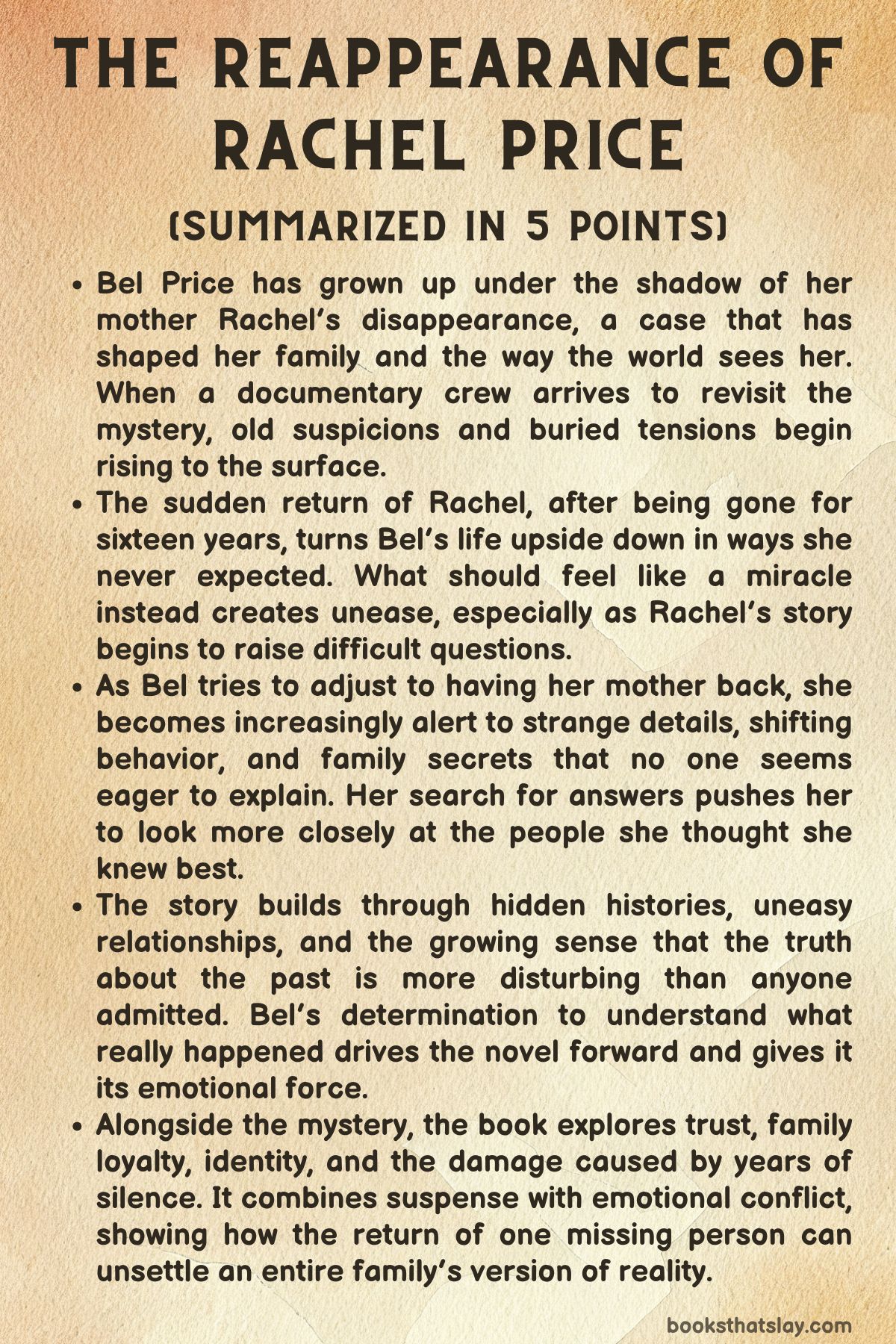
The Reappearance of Rachel Price by Holly Jackson is a sharp, tense mystery about a daughter forced to question everything she has believed about her family. Annabel “Bel” Price has grown up under the shadow of her mother Rachel’s disappearance, a case that shaped her childhood and everyone around her.
When Rachel suddenly returns after sixteen years, the miracle quickly turns unsettling. Bel starts noticing cracks in her mother’s story and begins pulling at threads that expose lies, fear, and buried crimes. The novel blends family drama with suspense, showing how survival can change people and how truth can be far more disturbing than absence.
Summary
Bel Price has lived her whole life with the story of her mother’s disappearance hanging over her. When Rachel Price vanished at a mall sixteen years earlier, Bel was only a toddler and was later found alone in Rachel’s abandoned car.
Since then, the case has defined Bel’s identity. A documentary crew arrives to film the family and revisit the mystery, forcing Bel to relive events she barely remembers.
She lives with her father Charlie and remains close to her uncle Jeff, aunt Sherry, cousin Carter, and grandfather Patrick. The filming stirs old resentments, especially from Rachel’s mother Susan, who still believes Charlie killed Rachel.
The documentary begins by showing old family videos, and Bel is unsettled by seeing her mother alive and ordinary in them. Rachel appears loving and warm, and Charlie speaks as if he still misses her deeply.
The family seems damaged but functional, and Bel has accepted that Rachel is almost certainly dead. Then everything changes.
One day, after a tense filming session, Bel sees a woman in the distance dressed like the actress playing Rachel. As the woman comes closer, Bel realizes with horror that it is actually her mother.
Rachel returns to the house exhausted and disoriented. She says she was held captive in a basement for years by a man she never clearly saw.
According to her, he kept her in darkness, brought her food, and eventually drove her away with a bag over her head before abandoning her near a highway. Bel wants to believe her, but almost immediately she notices inconsistencies.
Rachel changes small details in her account, and some of her comments suggest knowledge she should not have. Charlie also reacts strangely.
Instead of pure relief, he seems frightened. His unease stays with Bel.
Rachel quickly becomes a public sensation. The documentary changes course, reporters swarm the family, and Rachel starts fitting herself back into their lives.
Bel remains suspicious. At the mall, Rachel recalls details about Bel’s old bracelet from a period when she was supposedly imprisoned, which makes no sense.
Bel begins confiding in Ash, a member of the film crew she initially finds irritating but gradually comes to trust. Together, they begin quietly investigating Rachel’s story.
They speak to a shop owner who once reported seeing Rachel months before her supposed return. The woman remembers selling clothes to someone dressed exactly like Rachel was wearing when she vanished and when she reappeared.
This convinces Bel that Rachel had been free before coming home.
Bel also discovers other troubling signs. Rachel borrows Bel’s book, organizes family events, and behaves as though she is trying to settle into control of the house.
Bel snoops through Rachel’s room and finds a baby sock, which makes her wonder whether Rachel planned to abandon her years ago and kept a souvenir. She later finds a fake social media account that appears to have pushed the documentary idea into motion.
Meanwhile, family tensions grow. Sherry hints that Rachel may have had an affair before disappearing, and Bel follows that lead to Mr. Tripp, a teacher who clearly knows more than he admits.
From Rachel’s phone, Bel learns that Rachel once borrowed money from him before vanishing and that he believed Rachel had been afraid of someone.
Just as Bel’s suspicions deepen, Charlie disappears. One morning he is simply gone, along with his passport, phone, and wallet.
Police assume he left voluntarily under the strain of Rachel’s return, but Bel refuses to accept that explanation. She believes his disappearance is connected to Rachel’s reappearance and becomes determined to prove it.
She searches Rachel’s phone and uncovers traces of old secrets involving fake passports, financial arrangements, and suspicious contacts. At the same time, Rachel begins asking odd questions about Bel’s grandfather Patrick and his routines, which suggests she is searching for something.
Bel and Ash set a trap by planting a camera in Patrick’s house, expecting Rachel to snoop while he is away. Rachel finds the camera almost at once, showing she knew exactly what to look for.
Around this time, Phillip Alves, a man from Bel’s past who once kidnapped her as a child while obsessing over Rachel’s case, breaks into the house. He attacks Bel, and Rachel fights him off.
Rachel claims Phillip was the man who imprisoned her, but Bel does not believe it. Soon after, Bel finds Charlie’s wedding ring hidden in Rachel’s room.
Convinced Rachel is lying and may know where Charlie is, Bel confronts her.
The breakthrough comes through a book. Bel notices that Rachel referred to a favorite novel that was published after Rachel supposedly disappeared.
That impossibility sends Bel back to Patrick’s house, where she and Ash examine copies of the same book. Inside, some letters have been marked in bold.
When Bel pieces them together, they form a hidden message from Rachel asking for help and saying she is being kept by Patrick Price in a red truck at the old logging yard. In some copies, the message shifts from singular to plural, suggesting Rachel was not alone for part of her captivity.
Bel and Ash rush to the abandoned logging yard and find the red truck. Inside is Charlie, chained up.
He begs Bel to free him and claims Rachel locked him there. Bel refuses until he tells the truth.
Rachel arrives and finally explains what happened. Years earlier, Rachel had discovered Charlie was dangerous and controlling.
She had planned to run away with Bel using fake passports and money borrowed from Mr. Tripp. Charlie found out and ordered Patrick to kill her.
Instead, Patrick secretly imprisoned Rachel in the truck for years and told Charlie she was dead. Patrick had his own dark history: Charlie knew Patrick had caused his wife’s death and used that secret to control him.
Rachel says Patrick’s dementia eventually led him to release her without understanding who she was. Once free, Rachel set in motion her return, the documentary, and her plan for revenge.
Rachel also reveals an even more shocking truth: Carter is her daughter. Rachel gave birth while imprisoned, and Patrick handed the baby to Jeff and Sherry to raise.
Jeff gradually suspected the truth after Rachel’s return. Chaos erupts as Jeff arrives at the truck and demands answers.
Rachel throws away the key to Charlie’s chains, and everyone scatters into the junkyard. Charlie is freed and chases Rachel and Bel to a cliffside overlook.
Carter appears and pushes Charlie off Rachel, but Charlie grabs Jeff on the way down, pulling both men to their deaths.
Afterward, Rachel takes control of the narrative. She insists that the truth can never come out and says they must protect themselves.
Bel destroys Ash’s documentary footage, though Ramsay later reveals he secretly kept a backup and quietly hands it to her, choosing not to expose the real story. Carter erases most of Rachel’s hidden messages from Patrick’s books.
Sherry is confronted with the truth about Carter’s parentage and is pushed out of their lives. In the final documentary interview, Rachel, Bel, and Carter present a false version of events, claiming that Charlie, Jeff, and Sherry simply disappeared.
By the end, Bel accepts a new and uneasy family shape built on secrecy. She understands that Charlie was never the man she thought he was and that Rachel’s return was not a miracle but the start of another reckoning.
Bel also sees Carter differently now, as both cousin and sister. Ash leaves, but Bel no longer experiences that kind of departure as abandonment.
In the closing moments, Bel realizes Rachel was the one who originally set the documentary in motion to rebuild her life and make money from her case. Rachel also admits she personally killed Charlie after the fall, though Bel is not sure whether that confession is truth or mercy meant to spare Carter.
The book ends with Bel, Rachel, and Carter moving forward together, bound by survival, deception, and a version of family that has been remade through violence and choice.
Characters
Bel Price
Bel is the emotional and investigative center of the novel, and nearly everything in the story is filtered through her fear, suspicion, anger, and growing clarity. She has spent her whole life being shaped by an absence she cannot remember, which leaves her with a hard outer shell and a habit of expecting disappointment before it arrives.
Her sarcasm, sharp temper, and tendency to steal small things reveal a girl trying to hold power in a life that has often made her feel watched, judged, and defined by other people’s versions of her family. At the beginning, she comes across as defensive and abrasive, but those traits are deeply connected to her instability, her distrust of public curiosity, and her constant need to protect her father and herself.
What makes Bel especially effective as a lead character is that she is neither blindly loyal nor easily sentimental. When Rachel returns, Bel does not surrender to the emotional fantasy of getting her mother back.
Instead, she notices cracks, contradictions, and strange details. Her suspicion becomes one of the novel’s strongest engines, but it also exposes her emotional difficulty with intimacy.
She pushes people away before they can leave her, and this pattern appears in her friendships, in her guarded response to Rachel, and even in the way she interacts with Ash. Her instinct is to wound first, retreat second, and trust last.
That makes her difficult at times, but it also makes her believable.
Bel’s development is tied to the collapse of the story she has always told herself about her father. Charlie has been the fixed point in her life, the parent she trusted, the one who stayed.
As the truth emerges, Bel is forced to face a more painful reality than maternal disappearance: the possibility that the parent who remained may have been the greater danger all along. This shift is what gives her arc its force.
She is not just solving a mystery; she is surviving the destruction of her emotional foundation. By the end, Bel has become someone who can live with uncertainty, moral mess, and a truth that offers no clean comfort.
Her final emotional movement is not innocence regained but a rough, hard-earned steadiness.
Rachel Price
Rachel is the most unsettling and complicated presence in the story because she arrives first as a miracle, then as a mystery, and finally as a woman whose survival has made her difficult to fit into any simple moral frame. Her return should restore something, but instead it destabilizes everything.
She is gentle in some moments, controlling in others, affectionate and frightening by turns. That unpredictability is central to her power as a character.
She has been frozen in the family imagination for sixteen years, but when she comes back she is not a memory brought to life. She is a person who has endured years of confinement, loss, and adaptation, and she now moves through the world with secrets, strategies, and a fierce instinct for self-preservation.
Rachel’s characterization depends heavily on doubleness. She can be maternal, attentive, and observant, yet she is also manipulative and highly selective with the truth.
She lies often, but her lies are not random. They are tools for survival, control, revenge, and reconstruction.
She enters the house not as someone passively grateful to be rescued but as someone already working a plan. That makes her both admirable and deeply disquieting.
The novel never allows her to settle into the role of victim alone. She has absolutely been wronged, but she is also willing to shape events, threaten others, and manage the future through secrecy.
One of Rachel’s strongest qualities is the way she exposes the limits of conventional sympathy. It would be easy to read her only through pity because of what was done to her, but the story insists on something more demanding.
Trauma has not made her pure. It has made her practical, guarded, and at times ruthless.
Her love for Bel and Carter seems real, but even that love is mixed with calculation, especially once she sees a path to reclaiming a life, a family, and some measure of control. She is driven not just by a wish to be believed but by a need to rewrite the terms of her existence after years of captivity.
Rachel also changes the emotional logic of the family. Her return forces buried truths to the surface, especially around Charlie and Patrick.
She becomes the figure who reveals that the family’s history was never built around one disappearance alone but around violence, coercion, silence, and inherited corruption. In that sense, she is both person and catalyst.
By the end, she is not restored to who she once was, nor does she become fully knowable. She remains morally difficult, emotionally potent, and impossible to reduce, which is exactly why she lingers so strongly after the story ends.
Charlie Price
Charlie begins as the stable parent, the grieving husband, and the man Bel believes has done his best to give her a decent life under impossible conditions. He appears ordinary in a comforting way, especially compared with the chaos of the case surrounding Rachel.
That appearance is crucial because it makes the eventual revelations hit with greater force. Charlie’s characterization is built on the difference between public impression and hidden reality.
He knows how to look wounded, loving, and patient, but beneath that lies manipulation, selfishness, and terrifying control.
One of the most effective aspects of Charlie’s character is that the novel does not reveal him as openly monstrous from the start. Instead, the clues accumulate through small things: the stories about Bel’s clumsiness, the corrections, the ways he subtly manages space and comfort, the unsettling emotional dependence he fosters.
Once Bel begins seeing him differently, earlier details take on a darker meaning. He is the kind of person who maintains power not only through direct harm but through narrative control.
He tells people who they are, what happened, what they remember, and what should be believed. That quality makes him especially dangerous because it operates inside domestic normalcy.
Charlie’s worst traits are entitlement and cowardice. He wants possession without accountability.
Rachel’s attempt to leave threatens his control, and his response is not grief but violence by proxy. Even after years pass, he continues living within a structure shaped by that original act.
The later discovery that he used Patrick’s guilt over an older death to control him shows how deeply exploitation is embedded in Charlie’s character. He does not just commit harm; he builds systems in which other people carry it out, conceal it, or absorb its consequences.
As a father, Charlie is even more disturbing because Bel’s love for him is genuine. The novel understands that betrayal cuts deepest when it comes from the person who provided safety.
He is not written as a distant villain but as a loved parent, which makes his unraveling emotionally devastating. Bel must confront the fact that care and control have been mixed together in her life for years.
Charlie’s fall is therefore both plot revelation and emotional collapse. By the end, he stands as the clearest representation of hidden abuse within the family, a man whose normal surface concealed the rot beneath.
Ash
Ash enters the story with a slightly comic awkwardness, especially through Bel’s initially irritated view of him, but he gradually becomes one of the most human and grounding figures in the novel. He is part of the documentary crew, which means Bel has every reason not to trust him, yet he distinguishes himself by listening, noticing, and treating her suspicions seriously.
His importance lies not in dramatic dominance but in the steadiness he offers. He becomes a witness, a helper, and a tentative emotional possibility, all while remaining imperfect and realistically limited.
Ash works well because he is not idealized into a flawless rescuer. He is curious, sometimes intrusive, occasionally uncertain, and undeniably connected to a project that profits from the family’s pain.
That tension keeps him interesting. Bel cannot fully separate him from the machinery of filming and spectacle, and the novel does not ask her to.
Instead, their connection grows in a messy space where trust is partial and always at risk. He believes her when others dismiss her doubts, and that belief matters because Bel has spent much of her life feeling either doubted or defined by other people’s assumptions.
Emotionally, Ash helps draw out a softer dimension in Bel without turning her into a different person. Around him, she remains sharp, defensive, and difficult, but she also becomes more open to being understood.
Their relationship is shaped by timing and impermanence. Bel is very aware that he will leave, and this makes her both drawn to him and resistant.
That emotional conflict gives their scenes an extra layer. He matters not only as an ally in the investigation but as someone who challenges her belief that every attachment ends in abandonment.
Ash also serves an ethical function in the story. He is linked to the recording of truth, to evidence, and to the question of who gets to tell a story honestly.
In the closing sections, when Bel destroys material and later learns he might have helped her willingly, his presence sharpens the novel’s interest in loyalty versus truth. He leaves Bel with one of the story’s quietest but most important realizations: someone going away is not always the same as someone leaving you behind.
That insight marks his deeper contribution to her growth.
Carter
Carter begins as Bel’s cousin and closest companion, but over time she becomes one of the novel’s most emotionally charged figures because her place in the family is far more significant than anyone first understands. She is younger, energetic, talented, and often more openly affectionate than Bel, yet she is not written as naïve decoration.
Instead, she functions as an emotional bridge between family members who are unable to speak plainly. Her warmth often softens the atmosphere, but that warmth also masks the instability of her own position in the story.
Carter’s identity carries one of the novel’s biggest revelations, and that twist works because her characterization already contains subtle tensions. She wants harmony, urges Bel to make more of an effort with Rachel, and seems instinctively drawn toward Rachel even before the truth is known.
Once it becomes clear that Rachel is her biological mother, many earlier moments gain new meaning. Carter has not consciously known the truth for most of the novel, but she moves through the story with a connection that feels emotionally charged long before it is explained.
Her relationship with Bel is especially important. Bel often frames herself as the one who gets left, and Carter’s future plans trigger that fear.
Yet Carter is also one of the few people who remains near Bel consistently, even when Bel is difficult. Their bond has the texture of sisterhood before the story officially names it that way.
That deepens the ending, because the revelation about Carter’s parentage does not create their closeness from nothing; it changes the meaning of something already present.
Carter also has one of the most tragic burdens in the final act. Her attempt to protect Rachel during the chase contributes to Jeff’s death, leaving her with shock, grief, and a devastating collision between love and consequence.
Even then, she is drawn into Rachel’s effort to preserve the family through silence. Carter’s final position is emotionally painful because she gains a mother while losing the father who raised her and the world she thought she understood.
She ends the book not as a side character orbiting the central mystery, but as one of its deepest casualties and one of its most important survivors.
Jeff Price
Jeff at first seems like the dependable uncle, a familiar adult presence in Bel’s life and a stabilizing extension of the family around Charlie. He is quieter and less forceful than some of the others, which allows him to occupy the background for long stretches.
Yet that quietness becomes more significant as the story unfolds. Jeff is a man living close to the family’s secrets without fully confronting them, and his evasions suggest that he has sensed for years that something was wrong but never had the full picture.
His emotional role is complicated by the fact that he has raised Carter as his daughter without knowing the truth of her origin. That makes him both participant and victim in the family deception.
When fragments begin to surface, especially in his interactions with Patrick, Jeff’s confusion and guardedness show that he has long been carrying pieces of a puzzle he could not solve. His question about where “they found her” becomes meaningful only later, but it reveals that he suspected more than he ever said aloud.
Jeff represents the damage done by silence. He is not the architect of the family horror, but he is shaped by it and trapped within it.
He tries to maintain order, family function, and emotional restraint, yet those efforts are built on false ground. His relationship with Charlie is especially important because it shows how family loyalty can become a kind of blindness.
Jeff is close enough to Charlie to trust him, but not close enough to understand the danger he poses until it is too late.
His death is one of the book’s bleakest moments because it comes through a split-second act inside a web of truths he has only just begun to grasp. He dies not with full understanding or agency but while trying to intervene in a nightmare that has finally become visible.
That makes him a tragic figure, someone who lived near the center of the family’s buried violence and was ultimately destroyed by it.
Sherry Price
Sherry often appears abrasive, socially clumsy, and insensitive, but she is more than comic discomfort or family awkwardness. She brings a restless, uneasy energy to shared scenes, especially during meals and emotionally charged gatherings.
Her comments are often badly judged, yet she also functions as someone who blurts out what others are trying not to say. In that sense, she has an accidental truth-telling role in the novel.
She notices impropriety, hints at secrets, and breaks the polite surface of family life even when she lacks grace or tact.
Her relationship with Carter reveals another side of her. She can be controlling, particularly around food and behavior, which makes her feel overbearing.
At the same time, she is a mother who has raised a child she believed was hers, and the eventual revelation about Carter transforms her from irritating supporting figure into someone standing on the edge of profound loss. The story does not invite simple admiration for her, but it does make space for the pain of her position.
She has loved and raised Carter, and that emotional fact remains real even after biology rewrites the family map.
Sherry also helps uncover the past. Her suspicion that Rachel may have had an affair with Mr. Tripp gives Bel an important line of inquiry.
She is one of the few people willing to admit that the family’s official version of events may never have made complete sense. That does not make her especially insightful in a polished way, but it does show that she has long been responding to the wrongness around her, however imperfectly.
By the end, Sherry is one of the characters most clearly displaced by Rachel’s return. She loses authority, emotional ground, and eventually her place in the family structure Rachel is rebuilding.
Her final position is painful because whatever her flaws, she is pushed out by forces much larger and darker than her own mistakes. She is left not as a villain but as someone defeated by a truth she could neither prevent nor survive intact.
Patrick Price
Patrick is one of the novel’s most haunting figures because he exists at the intersection of frailty and horror. On the surface, he is an elderly man with vascular dementia, dependent on care, prone to confusion, and often difficult to read.
His condition encourages others to dismiss his outbursts and fragmented speech as symptoms alone. But as the truth emerges, Patrick becomes central to the family’s hidden history.
He is not merely a fading patriarch; he is a man who once carried out monstrous acts and then lived with them in silence and decay.
Patrick’s character gains force through delayed understanding. Early moments that seem strange or uncomfortable later reveal deeper significance.
His slap at Charlie, his warnings to stay away from old trucks, his attachment to books, and his confused reactions all acquire darker meaning. The fact that he imprisoned Rachel instead of killing her shows both cruelty and a twisted remnant of restraint, but it does not lessen the horror of what he did.
He became the keeper of a living secret, turning the old logging yard into a hidden prison.
His history also suggests that violence runs through the family before Rachel’s disappearance. Charlie’s leverage over him comes from knowledge about the death of Patrick’s wife, implying a past already marked by lethal domestic harm.
That connection gives Patrick symbolic weight as well as plot importance. He is the older generation’s buried corruption made literal, the source from which later abuse and coercion have partly grown.
What makes Patrick especially unsettling is that dementia blurs the line between guilt, memory, and helplessness. He is no longer fully in command of himself when the story takes place, but that frailty does not erase what he chose long before.
The books containing Rachel’s hidden messages become the most chilling expression of his role. He lived among those silent pleas while the family continued its daily life around him.
That image captures the moral horror attached to him better than any direct confession could.
Susan
Susan, Rachel’s mother and Bel’s grandmother, enters as an openly antagonistic figure, especially in her accusations against Charlie. Bel dislikes her, and from Bel’s perspective Susan seems cruel, self-righteous, and emotionally absent.
Yet Susan becomes more interesting when viewed beyond Bel’s resentment. She is one of the few people who never accepted the comforting version of the family story.
Her insistence that Charlie was guilty makes her unpleasant in the present but morally sharper in hindsight.
Her greatest failure lies not in suspecting Charlie but in what that suspicion led her to neglect. Bel rightly resents that Susan’s belief did not translate into active, loving support for her granddaughter.
Susan’s moral certainty did not make her emotionally brave or nurturing. She abandoned a child she believed to be at risk, and that contradiction weakens her even while the plot later validates her instincts about Charlie.
She is therefore not a triumphant truth-teller but a damaged, limited adult who was partly right and still failed badly.
Susan’s role in the broader family dynamic is to keep old accusation alive. She refuses the smoothing power of time and social politeness.
Her presence ensures that the family cannot fully settle into a shared lie. Even when Bel hates hearing it, Susan’s voice represents memory that will not cooperate with convenience.
She is abrasive because she refuses closure without truth.
Though she is not as central in the late plot as some others, Susan matters because she complicates the idea that being correct is enough. She sensed danger, but she did not become a refuge.
That makes her a morally mixed figure, one whose sharpness exposed a lie but whose failure of care left its own damage behind.
Ramsay Lee
Ramsay is the director of the documentary and the figure who embodies the novel’s interest in storytelling, exploitation, and performance. He is observant, opportunistic, and professionally calm even when family emotions are raw.
His project turns private pain into a public narrative, and he is never allowed to seem fully innocent of that process. He knows that tension, overlap, and emotional discomfort make compelling footage.
That awareness gives him a slightly predatory edge, even when he is not overtly cruel.
At the same time, Ramsay is not a flat manipulator. He is capable of restraint, and by the end he shows a surprising willingness to sacrifice the most sensational version of the truth.
This does not erase his earlier opportunism, but it adds complexity. He understands story power deeply, which means he also understands what it would mean to expose Bel, Rachel, and Carter fully.
His final choice suggests that he is not governed only by ambition.
Ramsay’s presence throughout the novel also heightens the sense that everyone is being watched, framed, and edited. He is a reminder that truth is never simply discovered; it is packaged, cut, narrated, and sold.
The documentary is both a plot device and a thematic mirror, and Ramsay stands at that center. He asks questions, arranges scenes, and helps create conditions in which buried truths rise to the surface, even if that is not always his ethical aim.
In that sense, Ramsay is less important as an intimate emotional figure than as a structural one. He represents the outside gaze that turns the Price family into a spectacle while also, unexpectedly, becoming one of the people who helps protect their final secret.
That contradiction makes him more compelling than a straightforward media opportunist would have been.
Phillip Alves
Phillip Alves is one of the most openly frightening characters in the novel because he externalizes the obsessive, invasive hunger that the case has produced in the outside world. He is not part of the family, yet he has already violated Bel’s life in a deeply personal way through her earlier kidnapping.
His return late in the story reactivates that old terror and reminds both Bel and the reader that Rachel’s disappearance has generated harm far beyond the original crime.
Phillip is driven by obsession rather than care. He wants answers, access, and ownership over the mystery, and he treats Bel as a means to those ends.
That makes him a useful contrast to characters like Ash or even Ramsay, who are also involved in telling or pursuing the story but retain some ethical limits. Phillip has none.
He is what obsession becomes when stripped of restraint and humanity.
His break-in scene is effective not only because it is violent but because it arrives when Bel is already overwhelmed by uncertainty. Phillip adds immediate physical danger to a plot full of emotional and psychological threat.
Rachel’s attack on him appears to cast her briefly in a clear protective role, but even that moment is later complicated when her version of his connection to her captivity proves false.
Phillip is therefore important less as a deeply layered character than as a force of intrusion. He represents the way sensational cases attract people who feel entitled to other people’s trauma.
His presence intensifies the atmosphere and sharpens the novel’s critique of public fascination with suffering.
Mr. Tripp
Mr. Tripp is one of the more subtle supporting characters, important less for his personal depth than for what he reveals about Rachel’s state before her disappearance. As Bel’s teacher and a man tied to Rachel’s past, he sits at the edge of scandal, secrecy, and missed opportunity.
Sherry suspects an affair, and although the full emotional truth of his relationship with Rachel remains somewhat partial, it is clear that he knew she was afraid and that money passed between them before she vanished.
What makes him interesting is his fearfulness. He is not presented as powerful or commanding.
Instead, he seems like someone who was drawn into Rachel’s crisis but lacked the courage or clarity to confront what was really happening. When Bel questions him, he denies what she already knows and shuts down rather than helping.
That reaction suggests a man who has spent years suppressing his connection to events he never fully understood or never handled properly.
Mr. Tripp helps flesh out Rachel’s earlier attempt to escape. Through him, the reader sees that Rachel had been planning, borrowing money, and trying to assemble a way out long before she disappeared.
He is one of the traces left behind by that hidden effort. His role also underscores the tragedy of how close Rachel may have been to getting away, only to be intercepted before she could save herself and Bel.
He remains a secondary figure, but he is useful because he anchors the idea that Rachel’s disappearance was not sudden chaos alone. It emerged from fear, preparation, and a desperate, unfinished plan.
Dave Winter
Dave Winter, the police chief, represents institutional reason at its most limited. He is not malicious, but he is too ready to accept surface explanations, especially when those explanations reduce complication.
He treats Rachel’s story with procedural confidence, explains away inconsistencies, and later assumes Charlie left voluntarily. His calmness can feel reassuring, but the plot repeatedly shows how inadequate that reassurance is.
Dave’s function in the narrative is to demonstrate how official systems can miss the truth even while appearing competent. He responds, files reports, follows evidence, and speaks in measured tones, yet Bel repeatedly sees beyond what he is willing to conclude.
That contrast strengthens Bel’s role as investigator and highlights the insufficiency of standard logic when family violence is hidden behind performance and partial facts.
He is not written as a fool. The evidence he works with often does point in misleading directions, especially because Rachel is clever and has studied how to stage appearances.
Still, his faith in procedure leaves emotional blind spots. He does not seem to grasp the full texture of coercion, trauma, or manipulation operating inside the family.
He understands events as cases, not as intimate systems of fear.
Dave matters because he prevents the novel from turning into a fantasy where authority immediately validates the heroine. Instead, Bel has to keep digging even when the adults with legal power think things are under control.
His character helps preserve the story’s tension and reinforces the theme that truth can survive for years inside plain sight when institutions settle too quickly for what looks probable.
Yordan
Yordan, Patrick’s caretaker, is a quieter supporting figure, but he serves an important practical and thematic purpose. He is one of the few people who moves around Patrick’s world with regular access, and his presence helps show how something terrible can remain hidden even in spaces that are not fully isolated.
He appears decent, attentive, and functional, someone focused on daily care rather than family history. That very normality makes the buried secret around Patrick more unsettling.
Yordan’s main role is to reveal routine. He knows schedules, habits, and details of Patrick’s life, which becomes useful when Bel tries to create opportunities to investigate.
He also confirms Rachel’s suspicious movements around Patrick’s house, adding weight to Bel’s growing sense that Rachel is looking for something specific. Through him, the house becomes less a vague old-man setting and more a place with patterns, interruptions, and vulnerable openings.
Though not central emotionally, Yordan contributes to the novel’s realism. Families with deep secrets do not live entirely alone; they are surrounded by people who see fragments without grasping the whole.
He is one of those people. His decency and limited knowledge make him a quiet reminder that horror often persists not because everyone is complicit, but because no one person sees enough at the right time.
Sammy
In The Reappearance of Rachel Price, Sammy appears only briefly, but she reflects the social cruelty that has surrounded Bel for years. Once a friend, she now represents the way gossip and suspicion have contaminated Bel’s ordinary teenage life.
Her willingness to step into the documentary space and speak when Bel is already uncomfortable suggests a kind of shallow opportunism, or at least a failure of empathy.
Her significance lies in how she helps define Bel’s defensiveness. Bel does not simply dislike attention in the abstract; she has learned that even peers will absorb public narratives and turn them into personal betrayal.
Sammy is part of that emotional background. She shows how the long shadow of Rachel’s disappearance has damaged Bel’s ability to trust not just family but friendship itself.
As a minor character, Sammy is less about independent complexity and more about social atmosphere. She helps the reader understand that Bel’s hardness was not formed only at home.
It was also shaped in classrooms, hallways, and ordinary interactions where she was reduced to the girl with the missing mother and suspected father.
Themes
Truth, Secrecy, and the Cost of Control
Truth in this novel is never presented as something clean, liberating, or simple. It exists in fragments, hidden inside books, buried in family habits, distorted through lies, and filtered through people who each have their own reasons for withholding what they know.
The story keeps showing that secrecy is not just about hiding facts from the outside world. It is also about controlling how other people understand themselves.
Charlie’s power rests not only in what he has done, but in how successfully he has shaped the story of his family for years. He presents himself as a grieving husband and protective father, and because that version is repeated often enough, it becomes the reality Bel has lived inside.
When the truth begins to break through, Bel is not simply learning new information. She is losing the framework through which she has understood love, memory, and safety.
Rachel also participates in this theme in a complicated way. She has been horribly wronged, yet she does not return as a pure force of truth.
She lies repeatedly, stages parts of her reentry into public life, and keeps vital information hidden until the pressure becomes unbearable. Her secrecy is different from Charlie’s because it comes from survival, fear, and revenge, but the novel refuses to treat it as harmless.
Bel must navigate a world where truth is not owned by the morally innocent. That tension gives the theme its force.
The story does not divide people into honest victims and dishonest villains. Instead, it shows how extreme harm can produce more concealment, more manipulation, and more unstable versions of reality.
The documentary structure sharpens this theme further. A documentary is supposed to organize reality into a meaningful narrative, yet the one being made around this family is always at risk of becoming another false version.
Ramsay wants a compelling story, but compelling stories often depend on editing, emphasis, and selective revelation. That means the novel keeps asking who gets to tell the truth, who profits from it, and what gets lost when private pain becomes public narrative.
Even the ending refuses full openness. Bel, Rachel, and Carter choose silence over disclosure, which leaves the reader with an unsettling conclusion: truth matters, but so does survival, and the two do not always align.
In The Reappearance of Rachel Price, secrecy destroys lives, but truth itself arrives carrying consequences so heavy that even the survivors cannot fully bear to live in it openly.
Family as a Site of Protection and Harm
Family in this story is never treated as naturally safe. Instead, it is shown as the very place where comfort, dependency, obligation, love, and violence can exist side by side.
Bel begins the novel believing that even if her life has been marked by her mother’s disappearance, her father’s presence gave her something solid. That belief keeps her emotionally anchored.
Home may be imperfect, awkward, and full of old tension, but it still feels like the place where she belongs. As the plot develops, that understanding begins to collapse.
The novel shows that the household, which should have been a shelter from the world’s cruelty, has long been structured around hidden domination and fear. This gives the family theme its emotional weight.
The deepest danger has not come from strangers alone. It has grown inside familiar rooms, daily routines, and inherited loyalties.
The older generation intensifies this pattern. Patrick’s hidden crimes and Charlie’s manipulation reveal that family harm is not accidental or isolated.
It moves across generations, sustained by silence and by the expectation that blood ties demand loyalty even when loyalty becomes destructive. Jeff and Sherry raise Carter without knowing the truth of her birth, and their family life is built on a lie planted by someone else’s cruelty.
Susan, meanwhile, suspects the truth about Charlie yet fails Bel in another way by withdrawing rather than becoming a source of active care. These details matter because they show that damage within families does not always come only from obvious brutality.
It can also come from silence, avoidance, refusal, and emotional abandonment.
At the same time, the novel does not dismiss family as meaningless. Bel’s bond with Carter is one of the clearest examples of enduring affection in the story, and Rachel’s desire to reclaim both Bel and Carter is rooted in something that feels emotionally real even when it becomes morally difficult.
The ending depends on this tension. The surviving family unit is not healthy in a neat or ideal sense, but it is still powerful.
Bel chooses Rachel over Charlie not because Rachel is innocent in every respect, but because she finally understands where the deeper threat has lived. The result is a portrait of family as something that can nurture identity while also deforming it, something people continue to reach for even after it has caused profound suffering.
That is why the theme resonates so strongly. The novel does not ask whether family matters.
It asks what people do when the people they love are also the people who have damaged them most deeply.
Identity Shaped by Absence, Memory, and Rewriting the Self
Bel has been shaped by a loss she cannot even remember, which makes identity one of the most important concerns in the story. She is not only the girl whose mother disappeared; she has been made into that person by the town, by media attention, by school gossip, and by the emotional habits that formed around the case.
Her missing mother is not just part of her past. It has become the central fact through which other people read her life.
This creates a form of identity built around absence. Bel grows up carrying a void that others keep naming for her, and her harshness, her sarcasm, and her refusal to soften around people all stem in part from that pressure.
The novel shows that when a person is defined too long by something missing, it becomes difficult for them to know who they are outside of that missing thing.
Rachel’s return disrupts that identity in violent emotional ways. Bel should, in theory, become whole again through reunion, but the opposite happens.
Rachel’s presence throws Bel into uncertainty because the person whose absence shaped her is suddenly there, alive, imperfect, and deeply unsettling. That means Bel must reconstruct herself again.
She is no longer simply the daughter of a vanished woman. She is now the daughter of a returned mother whose story is unstable and whose existence exposes old lies.
The same process affects Rachel. She returns to a world where everyone expects her to fit into familiar roles: mother, wife, victim, miracle.
But she cannot fit neatly into any of them. Years of imprisonment have changed her, and she actively shapes a new self through deception, strategy, and control.
Her identity is no longer something she passively inhabits. It is something she builds in response to what was taken from her.
Carter’s role strengthens this theme in a different way. She learns that the family story she has grown up with is not the truth, and her identity shifts all at once from cousin to sister, from Jeff and Sherry’s daughter to Rachel’s child.
What matters is that the novel does not treat identity as something stable that is merely uncovered. Instead, it shows identity as vulnerable to narrative, secrecy, and revelation.
Who people are depends partly on what they have been told, what has been hidden from them, and what they choose to accept once the truth is known. By the end, none of the central women are who they believed themselves to be at the start.
They are survivors of a reality that has forced them to rewrite themselves. That gives the novel a sharp understanding of identity as something formed not just by facts, but by memory, loss, and the stories that hold a life together until those stories break.
Survival, Moral Ambiguity, and the Refusal of Simple Justice
The novel resists clean moral categories, especially once the full truth emerges. Rachel’s suffering is undeniable, and Charlie’s cruelty is devastating, yet the story does not end by restoring clear ethical order.
Instead, it enters a space where survival requires choices that are difficult to defend in ordinary moral language. Rachel lies, manipulates public perception, threatens Sherry, conceals deaths, and pulls Bel and Carter into silence.
These actions are troubling, but they exist alongside the reality that she was imprisoned for years, robbed of motherhood, and forced to live in conditions shaped by men who treated her life as disposable. This gives the story its moral complexity.
Justice, in any official or orderly sense, has already failed long before the climax. What remains is not a courtroom vision of accountability but a struggle over who gets to live, who gets believed, and what kind of future can still be salvaged.
Bel’s final choices are central to this theme. She is not asked to choose between obvious innocence and obvious guilt.
She must decide what to do with truths that implicate the father she loved, the mother she feared, and the sister she did not know she had. Her decisions are rooted in emotion, loyalty, and a dawning recognition that conventional justice may not protect the people who have already suffered most.
That does not make every choice right. It makes them human under extreme pressure.
The novel is especially effective here because it does not pretend that exposing everything would automatically heal anyone. Full disclosure might satisfy legal or public ideas of truth, but it would also shatter what remains of Bel and Carter’s fragile future.
The handling of Charlie’s death and its aftermath makes the theme especially sharp. There is no cathartic triumph in his downfall.
Jeff dies too. Carter is traumatized.
Rachel admits to killing Charlie after the fall, or perhaps says so to spare Carter guilt. Even at the end, certainty remains unstable.
That lingering uncertainty matters because it prevents the story from becoming a revenge fantasy or a neat resolution. Instead, it shows survival as morally compromising.
The people left standing are not purified by what they have endured. They are changed by it, and they carry forward both love and damage.
This is why the ending feels uneasy rather than celebratory. The surviving characters protect one another by concealing what happened, and the reader is left to wrestle with whether that concealment is cowardice, mercy, self-defense, or all three at once.
The Reappearance of Rachel Price refuses the comfort of simple justice because it understands that some lives are broken by systems of harm long before the final confrontation arrives. In such a world, survival may be the closest thing to victory, even when it comes stained with silence and compromise.