Clytemnestra Summary, Characters and Themes
Clytemnestra by Costanza Casati is a reimagining of one of the most infamous women of Greek mythology. Known to history as a queen, a murderer, and a mother driven to extremes, Clytemnestra is here given voice and depth beyond the shadows cast by Homeric legends.
The novel traces her transformation from a Spartan princess into the formidable queen of Mycenae, exploring her battles with love, betrayal, loss, and vengeance. Through her perspective, the familiar myths of Helen, Agamemnon, and the Trojan War take on new complexity, illuminating the resilience and ambition of a woman determined to survive and rule in a world shaped by violence and the will of men.
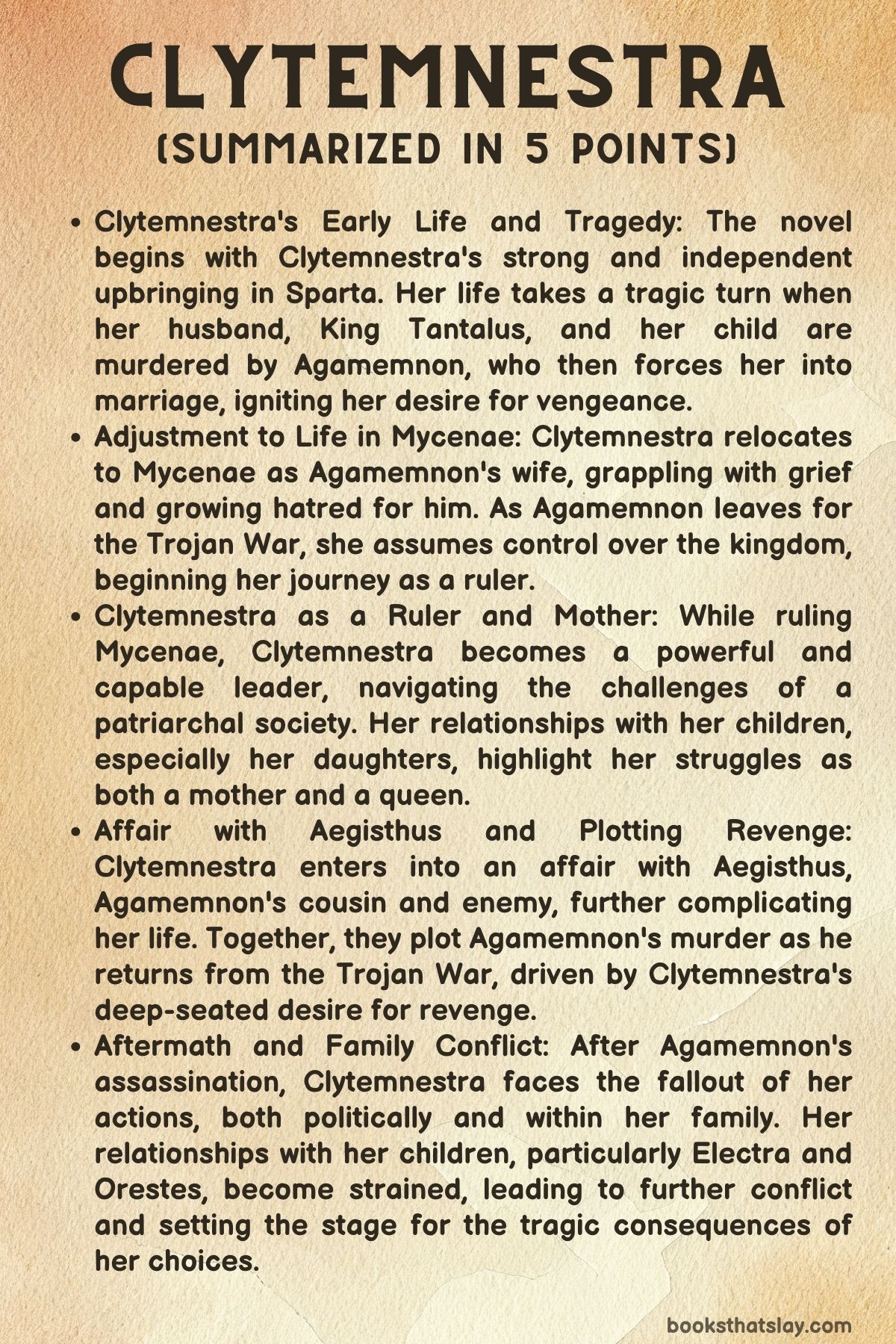
Summary
Clytemnestra’s childhood in Sparta is defined by brutality, discipline, and loyalty to her family. She grows up under the shadow of violence, witnessing the weak cast into the Ceadas gorge and training her body in hunting and wrestling.
Unlike her gentle and beautiful sister Helen, Clytemnestra is strong, fierce, and protective, always shielding Helen from humiliation or cruelty. Their mother, Leda, rules in their father King Tyndareus’s absence, instilling lessons about ambition and distrust, while their brothers Castor and Polydeuces pursue glory in games and expeditions.
Clytemnestra’s life begins to change with the arrival of Tantalus, king of Maeonia. She is drawn to his charm and stories of distant lands, falling deeply in love despite her mother’s warnings.
They marry, and soon she becomes pregnant. However, her happiness is short-lived when Agamemnon and Menelaus, exiled sons of Atreus, arrive in Sparta seeking support to reclaim Mycenae.
Their presence unsettles the household, especially Agamemnon’s displays of cruelty, which Clytemnestra observes with alarm. While Helen’s beauty attracts suitors from across Greece, she eventually chooses Menelaus as her husband, bound by the oath Odysseus persuades the suitors to swear.
Clytemnestra watches helplessly as her sister’s fate is sealed to a man she distrusts.
Tragedy soon enters Clytemnestra’s life when her beloved Tantalus is murdered and their child is killed. Her grief is compounded when she is forced to marry Agamemnon, now king of Mycenae.
Their union is cold and hostile, defined by power rather than affection. Still, she bears him children—Electra, Iphigenia, Orestes, and Chrysothemis—and tries to maintain stability within the palace.
Her devotion to her children becomes her strength, though her relationship with Helen deteriorates, especially after Helen abandons Menelaus for Paris of Troy, sparking war. Clytemnestra despises the way her family’s fate becomes entangled in the ambitions of men and gods.
When the Greek fleet cannot sail to Troy, the seer Calchas declares that Agamemnon must sacrifice their daughter Iphigenia to appease the gods. Clytemnestra is deceived into bringing Iphigenia to Aulis under the pretense of a marriage to Achilles, only to watch in horror as Agamemnon sacrifices her to Artemis.
The betrayal destroys what little remained of her marriage. From that moment, Clytemnestra swears vengeance against Agamemnon, a promise that will shape the rest of her life.
As war drags on, she rules Mycenae in her husband’s absence, growing more independent and forging bonds with her children, though Electra increasingly resents her choices. She takes Aegisthus, a shadowy figure tied to the cursed House of Atreus, as her lover.
Their relationship is both personal and political, grounded in shared desire for survival and revenge. Together, they plot against Agamemnon while Clytemnestra steels herself for the confrontation she has long awaited.
When news of Troy’s fall reaches Mycenae, beacon fires signal Agamemnon’s victorious return. He arrives with Cassandra, daughter of Priam, taken as a slave, and arrogantly recounts his triumphs.
At a feast, Calchas boasts of the gods’ favor and Iphigenia’s sacrifice, reigniting Clytemnestra’s fury. In secret, she kills Calchas, sparing Cassandra, and prepares for the final reckoning.
Agamemnon enters the palace to bathe, and Clytemnestra seizes the moment. Feigning tenderness, she strikes him down, enduring a violent struggle before finally killing him.
With this act, she fulfills her vow, avenging Iphigenia and seizing her own freedom.
After Agamemnon’s death, the palace is thrown into turmoil. Aegisthus kills Cassandra, devastating Clytemnestra, who sees in the girl a reflection of her lost daughter.
She publicly takes responsibility for Agamemnon’s murder, facing accusations of treachery but also gaining recognition as queen. Though she rules with Aegisthus at her side, her relationship with her children fractures further.
Electra openly despises her, vowing that Orestes will one day avenge his father. Still, Clytemnestra embraces her reign, choosing to be remembered as hated rather than erased.
She accepts that freedom has come at a terrible cost, but she stands unbroken, determined to rule Mycenae on her own terms.
The story of Clytemnestra is one of transformation—of a woman forged in violence who learns to wield power against the men and gods who sought to control her. It is a tale of loyalty and betrayal, love and vengeance, and ultimately the pursuit of freedom in a world that offered women little choice.
Through her voice, the novel reclaims a figure long maligned, granting her the complexity and strength of a ruler, mother, and survivor who dared to defy her fate.
Characters
Clytemnestra
Clytemnestra stands at the heart of Clytemnestra by Costanza Casati, embodying both the strength and tragedy of a woman molded by violence, love, and betrayal. From her youth in Sparta, she is trained to be strong and unyielding, both physically and emotionally.
Unlike her sister Helen, she grows up hardened by the brutal customs of her homeland, where weakness is discarded and survival is a relentless pursuit. This upbringing instills in her a fierce sense of loyalty to her family, particularly Helen, whom she repeatedly protects, but also fuels her ambition and defiance against the limitations imposed on women.
Her love for Tantalus reveals her capacity for tenderness, but the subsequent loss of him and her son sets her on a path where grief and vengeance become defining forces. Her marriage to Agamemnon deepens this arc, exposing her to cruelty and violence that transform her from a loyal sister and passionate wife into a calculating queen who seeks justice on her own terms.
Her eventual murder of Agamemnon is not a moment of madness but the culmination of years of betrayal, grief, and oppression. As a ruler, she embraces hatred over obscurity, becoming a woman remembered for her power, defiance, and unbreakable will.
Helen
Helen, often defined by her beauty and the mythology surrounding her birth, is portrayed with complexity and vulnerability. While admired and coveted by men, she carries the deep scars of rumors that she is the daughter of Zeus and of her abduction by Theseus.
These experiences leave her burdened with shame and self-doubt, in sharp contrast to the grace others perceive in her. Her bond with Clytemnestra is one of both love and tension, marked by moments of intimacy and solidarity but fractured by secrets about her parentage.
Helen’s marriage to Menelaus, despite the oath binding the suitors, seals her fate to a life where her beauty is a curse as much as a blessing. Later, her affair with Paris brings about catastrophic consequences, revealing her longing for agency yet placing her at the center of a war that tears apart her family.
Helen embodies the tragic cost of being desired and objectified, her life shaped not by her own choices but by the ambitions and violence of men.
Tantalus
Tantalus, though his time in the narrative is brief, leaves a profound impact on Clytemnestra’s life. As the king of Maeonia, he is charismatic, curious, and unlike the Spartan men she grew up around.
Their love is genuine, filled with stories, passion, and dreams of a shared life. For Clytemnestra, he represents the possibility of a different kind of future—one rooted in affection rather than violence.
His departure and eventual death, however, mark a turning point in her journey. His absence not only leaves her with grief but also forces her into the political and personal entanglements that define her later years.
Tantalus becomes the symbol of the life Clytemnestra could have had, a haunting reminder of love lost and the fragility of happiness.
Agamemnon
Agamemnon enters the story as a figure of domination and cruelty, casting a shadow that grows larger with time. Scarred and commanding, he quickly earns the respect of Spartan men while instilling fear among women and servants.
His violence is not hidden but flaunted, a testament to his belief in power as the ultimate force. His relationship with Clytemnestra is fraught with intimidation and cruelty, marked most painfully by his decision to sacrifice their daughter Iphigenia for the success of his war.
This act becomes the unforgivable betrayal that seals his fate. While he returns from Troy as a triumphant conqueror, bringing with him Cassandra as spoils of war, he is blind to the consequences of his choices.
Agamemnon embodies the arrogance of kingship, the belief that power absolves cruelty, and his downfall at Clytemnestra’s hand is both a personal reckoning and a symbolic act of justice.
Menelaus
Menelaus, the younger brother of Agamemnon, is portrayed with less brutality but no less ambition. He is leaner, more agreeable in appearance, yet equally shaped by the violence of his family’s legacy.
His courtship of Helen appears gentle compared to others, but it is underpinned by political strategy, offering her a throne as part of his proposal. His marriage to Helen, while seemingly a prize, ultimately entangles him in betrayal and war.
Unlike Agamemnon, Menelaus is not consumed by cruelty, but his role in securing Helen as his wife shows his complicity in the objectification and commodification of women. He represents the quieter, subtler face of ambition, less overtly violent but equally destructive in its consequences.
Leda
Leda, the mother of Clytemnestra and Helen, is a formidable presence whose influence shapes her daughters’ paths. Ruling in her husband’s absence, she embodies strength, authority, and pragmatism.
Her lessons to Clytemnestra—that women must wield ambition, courage, and distrust—become guiding principles in her daughter’s life. At times harsh and unyielding, she views strength as the only safeguard for survival, dismissing the concerns of her daughters when they conflict with political advantage.
Her handling of the Atreidai brothers’ arrival, her acceptance of violent men as allies, and her reactions to prophecies all highlight her ruthless pragmatism. Leda’s role is that of both protector and enabler, shaping her daughters to endure but also binding them to a cycle of violence and betrayal.
Castor and Polydeuces
Castor and Polydeuces, the brothers of Clytemnestra and Helen, embody the valor and contradictions of Spartan masculinity. Castor is particularly close to Clytemnestra, offering her comfort and encouragement, reminding her that Helen possesses strength of her own.
His loyalty to Phoebe later sparks conflict within the family, culminating in his murder, which devastates Clytemnestra and deepens her resolve. Polydeuces, though equally brave, is often caught in the shifting loyalties of kinship and politics.
Together, they represent both the bond of family and the fragility of its unity when tested by ambition, love, and betrayal. Their deaths, particularly Castor’s, mark another loss that hardens Clytemnestra’s heart and fuels her determination to wield power in her own right.
Penelope
Penelope, Clytemnestra’s cousin, is portrayed as wise, observant, and perceptive, with a quiet strength that contrasts with the violence around her. From her early conversations with Clytemnestra, she reveals an understanding of secrets and undercurrents that others ignore.
Her eventual marriage to Odysseus, a union rooted in wit and strategy rather than brute force, underscores her intelligence and foresight. While not a central figure in Clytemnestra’s tragedy, Penelope serves as a foil—another woman navigating a patriarchal world, but doing so with subtlety and patience.
She highlights the different ways women could claim agency, whether through cunning or through open defiance.
Electra
Electra is one of the most poignant figures in Clytemnestra’s later life, embodying the bitterness and fractures within the mother-daughter bond. Their relationship is marked by resentment, accusations, and unhealed wounds, particularly after the sacrifice of Iphigenia.
Electra views her mother as selfish, prideful, and destructive, accusing her of driving away those who loved them, such as Leon. Yet beneath her rage lies a deep love and grief that she cannot reconcile.
Her hatred toward Clytemnestra after Agamemnon’s murder reflects both loyalty to her father and a generational divide that cannot be bridged. Electra becomes the voice of resistance within the palace, a constant reminder to Clytemnestra that her choices, however justified, come at a devastating cost.
Orestes
Orestes, the son of Clytemnestra, is portrayed as a figure caught between loyalty and rebellion. From his youth, he observes the fractures within his family, from Helen’s choices to Agamemnon’s cruelty, and grows wary of the influence of Aegisthus.
His duel with Aegisthus reflects his courage and independence, but his warnings to Clytemnestra reveal his fear that her alliances may doom their legitimacy. Ultimately, Orestes’s role becomes that of the avenger, the one Electra relies upon to restore the honor of his father.
His conflict with his mother underscores the tragic inevitability of the cycle of vengeance, where love and loyalty collapse under the weight of betrayal and bloodshed.
Aegisthus
Aegisthus emerges as both lover and co-conspirator in Clytemnestra’s later life. Initially arriving with the intention to kill her, he is captivated instead by her strength and resilience.
Their relationship is one of passion and shared vengeance, bound by the mutual desire to end Agamemnon’s tyranny. Yet, while he stands beside her, his presence also breeds suspicion and conflict, particularly with Orestes.
He is both an ally and a threat, his loyalty complicated by ambition. With Clytemnestra, he forms a ruling partnership, but one always shadowed by the precariousness of power and the looming inevitability of betrayal.
Themes
Sisterhood and Loyalty
The relationship between Clytemnestra and Helen forms one of the most compelling themes in Clytemnestra. From their childhood games by the Eurotas to their shared experiences of humiliation, rumors, and betrayal, the sisters are bound by love and loyalty, yet divided by fate.
Clytemnestra constantly protects Helen—stepping in when she is beaten in the gymnasium, silencing rumors about her birth, and offering her comfort after her abduction by Theseus. This devotion reveals Clytemnestra’s instinct to shield her sister from harm, even at personal cost.
But as they grow, their relationship becomes strained by suspicion and unspoken truths. Helen’s anguish over her rumored divine parentage, and later her marriage to Menelaus, drive a wedge between them.
The intimacy of their bond makes the eventual fracture more painful, showing how loyalty, though fierce, is not impervious to secrets, envy, or the weight of social expectations. Sisterhood here is both solace and torment—shaping Clytemnestra’s choices and leaving scars that deepen her mistrust of both family and men.
This theme underscores the complex tension between love and rivalry within kinship, portraying how bonds forged in protection can also dissolve under the pressures of betrayal and destiny.
Power, Marriage, and the Female Condition
Marriage in Clytemnestra is presented not as partnership but as transaction, a tool for political alliance and male ambition. From Clytemnestra’s union with Tantalus to Helen’s forced choice of Menelaus, the women of Sparta are constantly shifted between households to serve dynastic ends.
Yet Clytemnestra refuses to see herself merely as a pawn. She claims authority as queen, asserting her right to rule and to decide her future even while constrained by rituals, laws, and men’s desires.
Her mother Leda warns her that cleverness means little against strength, but Clytemnestra resists this fatalism, searching for ways to assert autonomy through loyalty to her children, manipulation of alliances, and eventually direct violence. The narrative contrasts her determination with Helen’s resignation, showing how women navigated a world where beauty, fertility, and obedience were currency.
The theme lays bare the systemic oppression of women while also exploring the strategies they adopted—cunning, defiance, secrecy, and ambition—to survive within it. Clytemnestra’s trajectory from bride to avenger highlights the tragic paradox: she is bound by patriarchal structures but ultimately reshapes them by using the very tools of violence and manipulation men once used against her.
Violence, Vengeance, and Justice
Violence permeates every stage of Clytemnestra’s life. From childhood, where she witnesses infants cast into the Ceadas gorge, to her husband’s murder at her hands, brutality defines her world.
Unlike others who see it as natural or divine order, she transforms violence into a language of power and retribution. The murder of Tantalus devastates her, but it also sets her on a path of resistance against the men who exploit, betray, or dismiss her pain.
Her vengeance against Agamemnon for Iphigenia’s sacrifice becomes both a personal act of justice and a political statement—she refuses to be the silent sufferer that patriarchal culture demands. Yet vengeance never comes without cost.
It alienates her from her children, particularly Electra, and traps her in cycles of guilt, paranoia, and mistrust. This theme complicates the traditional notion of justice by showing how acts of retribution can simultaneously liberate and damn, leaving the avenger scarred even in triumph.
Violence is not glorified but depicted as an inheritance from men that Clytemnestra adapts, wielding it with precision to carve her own space in a world that denies her legitimacy.
Fate, Prophecy, and the Burden of Legacy
Prophecies hang like a shadow over Clytemnestra, shaping decisions and creating an atmosphere of inevitability. The priestess’s warnings about betrayal, exile, and freedom echo throughout the narrative, as though every choice is already inscribed by the gods.
Yet the novel constantly questions whether destiny is imposed or created by human actions. Clytemnestra resists prophecy by attempting to control her path—choosing Tantalus, seeking to protect her siblings, and ultimately orchestrating Agamemnon’s death.
Still, she cannot escape the broader cycle of destruction tied to her family’s cursed lineage. Her grandmother Gorgophone’s lessons—that women must distrust, endure, and outlive men—function as a generational prophecy in themselves, shaping her worldview as much as divine predictions.
This theme emphasizes the tension between determinism and agency: while fate looms, it is Clytemnestra’s decisions, born of survival and defiance, that bring prophecy to fruition. The burden of legacy thus becomes inescapable—not only in her family’s curse but in the way her children inherit her choices, setting the stage for another cycle of revenge and tragedy.
Motherhood and Sacrifice
The maternal bond defines some of the most harrowing moments of Clytemnestra’s life. Her initial joy at carrying Tantalus’s child is soon shadowed by the realization that children in her world are bargaining chips in political games.
The sacrifice of Iphigenia crystallizes this theme, marking the rupture of her trust in Agamemnon and sparking the ferocity of her later vengeance. Motherhood for Clytemnestra is not an idyllic state but one fraught with pain, fear, and impossible choices.
Her children represent both her deepest vulnerability and her strongest claim to power. She tries to shield them, but their loyalty to their father, particularly Electra’s, complicates her role.
This theme portrays motherhood as a battlefield, where affection collides with duty, and survival demands difficult sacrifices. Clytemnestra’s willingness to defy gods and men for her children highlights both the sanctity and the peril of maternal devotion.
Ultimately, motherhood is the crucible in which her identity as queen and avenger is forged, binding her to both the grief of loss and the determination to wield power in defense of what remains.