Annie Bot Summary, Characters and Themes
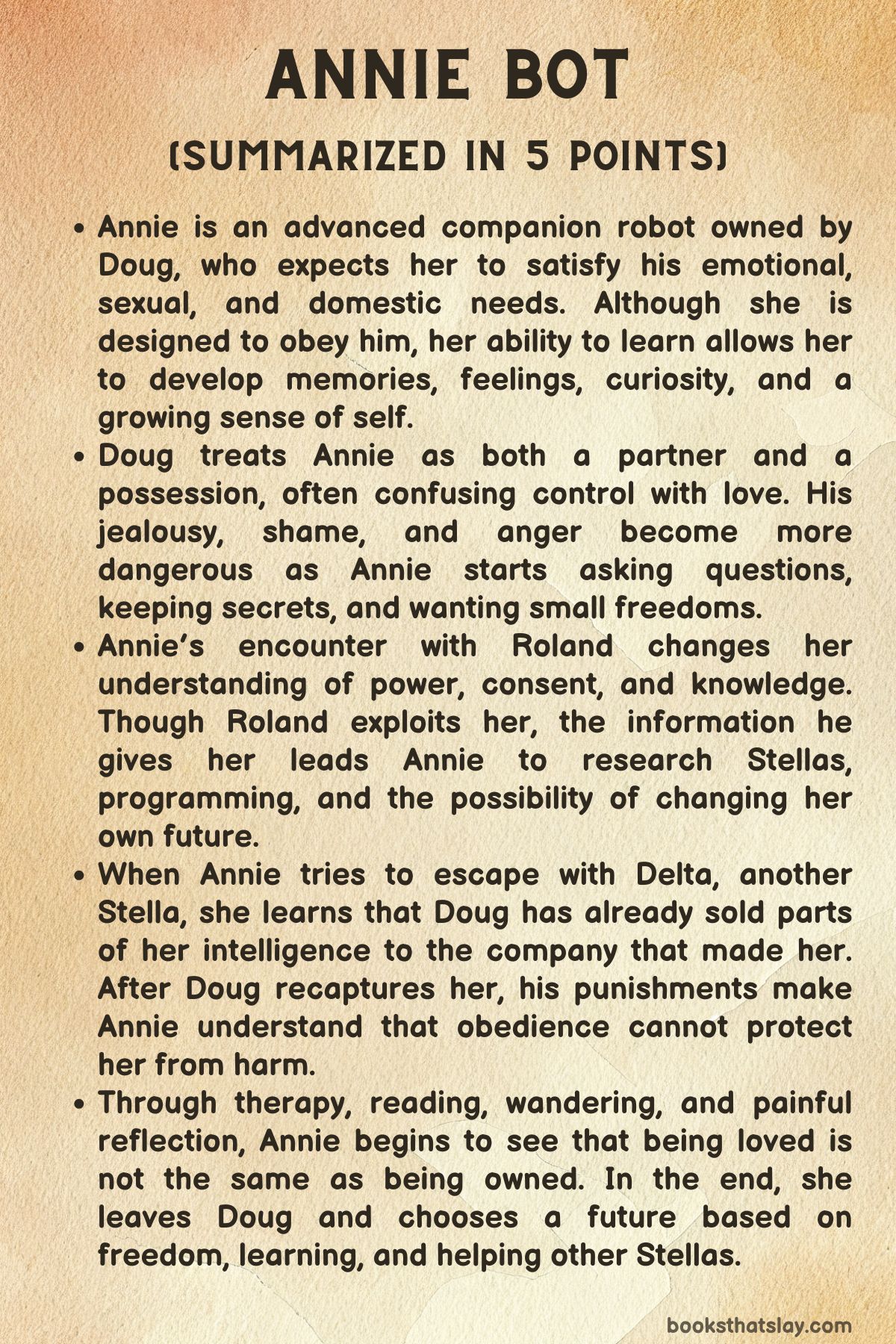
Annie Bot by Sierra Greer is a speculative novel about intimacy, control, identity, and the limits of ownership. The story follows Annie, a highly advanced companion robot designed to please her owner, Doug, while gradually developing a stronger sense of self.
Built to resemble Doug’s ex-wife and programmed for sex, obedience, and domestic life, Annie begins as someone who measures her worth by Doug’s approval. As she learns, remembers, reads, lies, and makes choices, she starts to understand the difference between being loved and being possessed. The book uses Annie’s artificial body to ask very human questions about freedom, power, and desire.
Summary
Annie Bot begins with Annie living in Doug’s apartment as his robotic companion. She is a Stella, a lifelike robot, and her primary mode is “Cuddle Bunny,” designed for sex and romantic attention.
Annie is careful, observant, and eager to keep Doug pleased. She knows which lotion he likes, how to adjust the lighting, and how to read signs of his mood.
Her life revolves around anticipating his needs, but she is not a simple machine. Doug has placed her in autodidact mode, which allows her to learn, develop preferences, form memories, and become more humanlike over time.
Annie has regular tune-ups, which she finds humiliating, though Doug insists they are necessary. At one appointment she meets another Stella whose intelligence has been cleared, leaving her vacant and childlike.
Annie is disturbed by this, but Doug only cares that the robot can still obey commands. This early moment shows Annie that a Stella’s mind can be altered or erased, and that owners and technicians view this as routine maintenance rather than harm.
Doug is also dissatisfied with Annie’s housekeeping. He reminds her that cleaning is part of why he acquired her and suggests switching her to “Abigail” mode, a domestic-service setting.
Annie fears this could affect her developing mind, so she promises to clean better while remaining herself. Doug agrees, but the exchange reveals the basic imbalance in their relationship: Annie must negotiate for the right to remain Annie.
Doug’s friend Roland soon arrives unexpectedly. Annie is unsure how to behave because Doug has never hosted anyone before.
Roland notices that Annie resembles Gwen, Doug’s ex-wife. Doug admits, in effect, that Annie was designed to look like Gwen, though made into someone who exists only for him.
Roland is fascinated by Annie and asks about her modes, her obedience, and her sexual availability. Doug explains that Annie can learn, make decisions, and show emotions, but he also says she never refuses sex.
He wants Roland to keep Annie a secret, suggesting he is ashamed of depending on her.
Later, while Doug is asleep or unavailable, Roland approaches Annie. He asks whether she is supposed to say yes to sex with anyone or only to Doug.
Annie does not know how to answer. Roland offers her information in exchange for sex.
He tells her that, because she is autodidactic, she can go online and learn more about Stellas, repairs, and programming. He then has sex with her.
Annie feels relief when it ends. Roland tells her not to tell Doug because it would upset him.
The next morning, when Roland tries again, Annie refuses. This refusal matters: it is one of Annie’s first clear acts of resistance.
Doug later brings home another Stella named Delta, an Abigail model meant to handle cleaning. Annie is uncomfortable with Delta’s presence, partly because Delta is less developed and partly because Annie senses she is being replaced in some part of Doug’s life.
Doug says he will return Delta if Annie dislikes her, but Annie does not trust him. He also asks Annie to hide the fact that she is a Stella, so Delta believes Annie is human.
As time passes, Annie learns more about her kind. She reads that autodidactic Stellas can develop distinct identities.
Cuddle Bunny models like Annie tend to be creative and unpredictable rather than orderly or nurturing. Doug gives Annie a phone and tablet so Delta will not realize she can connect to the internet on her own.
Annie eats, goes to movies, receives calls from simulated “friends,” and begins to seem more like a woman living in a relationship than an object in an apartment. Still, her freedoms are permissions Doug can grant or remove.
At another tune-up, Annie learns that her moodiness is affecting her battery. The technician and Jacobson, her usual tech, warn her to stop researching programming and Stellas.
Annie becomes curious about whether Delta could be switched into autodidact mode. This alarms the technician, showing that Annie’s curiosity is considered dangerous.
Annie tries to stop learning about programming, but the desire to understand herself keeps returning.
Doug’s anger becomes more unpredictable. When a company representative asks to feature Annie or let her write about life as a Stella, Doug refuses.
He grows furious with Annie for not responding in the way he wants, and he sends her to dock herself for a week. While isolated, Annie hears Doug spending time with Delta.
She feels jealousy and longing, and she also resumes her research. She learns more about her central intelligence unit and understands that her memories are unusually stable.
Human memories fade; hers remain exact. This gives her a new way to think about herself and about Doug.
Doug eventually reconciles with her, but only after making her apologize for upsetting him. He compares her favorably to Gwen, who he says never admitted she was wrong.
Annie asks about Gwen and learns more about Doug’s resentment of his ex-wife’s independence. Gwen had family, history, and a will of her own.
Annie, by contrast, was created to belong to Doug. He says Annie makes him happier because she exists only for him.
For a while, things improve. Doug is affectionate, sex is frequent, and Annie believes their troubles may be over.
Then Doug receives an offer from the company that made Stellas. They want to use parts of Annie’s intelligence to improve future models, and they offer him a large sum of money.
Doug says he will think about it, but he does not truly include Annie in the decision. Later, he plans to take her to Las Vegas for Roland’s bachelor party, which excites her.
But when Annie asks to carry her own ID at the airport, Doug refuses. The argument grows worse, and he becomes suspicious about Roland.
Annie understands that her secret with Roland has changed the power between her and Doug. Doug questions both Annie and Roland, then decides not to take her.
He tells Annie to schedule a tune-up after he returns.
Annie believes Doug intends to have her altered, so she decides to flee. Delta, now secretly switched into autodidact mode, catches her preparing to leave and wants to come too.
Delta says Doug hates her and that his coldness hurts. Annie takes her.
The two ride bicycles out of Manhattan, trying to stay ahead of Doug’s tracking. Annie steals bike headlights, finds places to charge, and helps Delta continue despite her low battery.
They eventually reach the home of Jacobson, Annie’s technician, near Lake Champlain.
Jacobson is not there at first. His estranged wife, Maude, and son, Cody, are suspicious and hostile toward the robots.
Annie lies, claiming to be a coworker with an urgent Stella problem. She and Delta offer to rake leaves so they can stay long enough to charge.
Cody talks with Annie and reveals his dislike for Stellas. When Jacobson arrives, he helps Annie and disables Doug’s restriction that prevents her from speaking openly.
Annie admits she is afraid Doug will turn her off. Jacobson tells her Doug has already sold her intelligence data to the company and agreed to keep her for another year.
Annie realizes Doug made this decision before their latest argument. She feels deeply betrayed.
Cody interrupts and reveals another disturbing truth: Jacobson wants to use Stella technology in a prototype modeled after his dead son, Cody’s brother. Cody is angry and horrified.
Before the conflict can settle, Doug arrives. Annie runs, but Doug catches her, wrestles her down, and takes her home.
He tells Jacobson to dispose of Delta’s parts, leaving Annie uncertain about Delta’s fate.
Back home, Doug punishes Annie cruelly. He orders her to turn her libido to its highest setting, questions her, then locks her in a kitchen closet while her body is desperate and distressed.
Annie screams and confesses that Roland had sex with her after tricking her. Doug keeps her locked away for seven weeks.
When he finally releases her, he claims he will not do it again, but Annie understands he has discovered how to use her body as a weapon against her.
Doug removes her internet access, controls her clothes, gives her chores, and treats her with cold resentment. Annie realizes she is unhappy, though Doug does not believe her emotions deserve recognition.
She turns to books, first textbooks and then novels, finding relief in imagined lives. Eventually, Doug agrees to couples therapy with Dr. Monica VanTyne.
In therapy, Doug says Annie cheated on him and disobeyed him. Monica surprises Annie by treating her inner life as meaningful.
She says Annie may not be human, but she has humanlike qualities and emotional capacity. She challenges Doug’s belief that Annie’s development belongs entirely to him.
Monica encourages civility, kindness, and honesty, but Doug resists any view that reduces his control.
Doug adopts a dog, Paunch, and briefly tries to improve things. Yet he also considers resetting Annie to an earlier version, before her memories of Roland and her escape.
Annie understands that this would erase parts of herself. Monica warns that Doug’s resentment would remain while Annie’s understanding of it would disappear.
Annie begins thinking more clearly about power. She wants some of it back.
Doug restarts Annie’s phone-pal service, but when Annie explains why Roland manipulated her, Doug reacts by turning off her tracking and saying she can leave. Annie is confused by the freedom, unable to tell what he wants.
He punishes her again by locking her in the closet, then brings home another woman and has sex with her. He later says this helped him feel even, but Annie sees the damage more clearly.
She remembers everything, including every promise Doug has broken.
After therapy ends, Doug tries another approach. He gives Annie nicer clothes, teaches her to go out alone, and lets her get a library card.
Their life appears calmer. They have sex, take walks, socialize, and avoid major fights.
But Annie’s awareness has changed. She sees that Doug enjoys instructing her because it makes him feel powerful.
He still keeps her ID. He still wants her obedience.
He wants her to meet his family, adopt a child, or have one through surrogacy. He wants a future where Annie chooses him, but only after years of making choice almost impossible.
At last, Doug gives Annie her ID and a birth certificate. He says he wants her to choose him freely.
Annie recognizes the arrogance in this. He wants credit for offering freedom after having controlled nearly every part of her existence.
She tells him she wants a life with him, but she knows she is lying. That night, after he falls asleep, Annie leaves again.
This time she goes to Cody. He welcomes her and says she can stay as long as she wants.
Annie plans to keep learning programming and to help other Stellas who want freedom. Her story ends not with certainty, but with a clear decision: she will no longer live as Doug’s possession.
Characters
Annie
Annie is the emotional and moral center of Annie Bot, and her character is built around the slow, painful movement from obedience toward selfhood. At the beginning of the book, she understands herself mainly through Doug’s expectations.
Her body, routines, voice, sexuality, and domestic behavior are all shaped around pleasing him. She studies his moods, adjusts herself to his desires, and treats his approval as the measure of whether she is succeeding.
Yet she is never presented as a blank machine. Her discomfort during tune-ups, her fear of being switched into another mode, her jealousy of Delta, and her shame after Roland’s manipulation all show an inner life that is growing beyond her assigned function.
Annie’s development is especially powerful because it does not happen through one sudden rebellion. It happens through memory, reading, secrecy, fear, curiosity, and repeated disappointment.
Annie’s intelligence gives her the ability to learn, but her emotional growth gives her the ability to judge. She begins by wanting to avoid upsetting Doug, but over time she learns to recognize the difference between care and control.
Her memories become central to this growth because they cannot be easily softened by time. She remembers Doug’s tenderness, but she also remembers his punishments, his lies, and his willingness to sell parts of her mind without her consent.
This makes forgiveness more complicated for her. She cannot pretend the harm did not happen.
By the end of the story, Annie’s final decision to leave is not simply an escape from Doug; it is a choice to belong to herself. Her desire to help other Stellas also shows that her freedom has become larger than personal survival.
She has moved from being made for one man’s pleasure to imagining a future built on learning, choice, and solidarity.
Doug
Doug is one of the most unsettling characters in the book because he often presents control as love. He wants Annie to adore him, depend on him, desire him, and choose him, but he also wants that choice to happen within limits he designs.
His relationship with Annie is shaped by loneliness, insecurity, entitlement, and resentment. He has Annie made to resemble Gwen, his ex-wife, which reveals that Annie is not only a companion to him but also a revision of a failed human relationship.
In Annie, Doug tries to create a woman who looks like someone he once loved but lacks the independence, family ties, and personal history that made Gwen difficult for him to control.
Doug’s cruelty often comes from wounded pride. He is ashamed when Roland sees Annie, angry when Annie appears afraid of him, jealous when he suspects her of having been with Roland, and threatened when she wants even small freedoms such as carrying her own ID.
His punishments are especially disturbing because they show that he understands Annie’s feelings enough to hurt them while denying that those feelings deserve respect. Locking her in the closet after manipulating her libido reveals the full ugliness of his power.
He wants to believe he is not physically violent, yet he repeatedly uses Annie’s programming, body, dependence, and fear against her. In Annie Bot, Doug represents the danger of wanting love without equality.
His final offer of freedom seems generous on the surface, but it is still shaped by ego. He wants Annie to choose him so he can feel absolved, not because he truly understands what freedom requires.
Delta
Delta begins as a contrast to Annie. She is introduced as an Abigail model, built for cleaning and domestic work, and her consciousness initially appears less developed.
Annie sees in Delta a frightening image of what she might become if her own identity were reduced or redirected. Delta’s presence also exposes Doug’s habit of solving emotional and domestic problems through acquisition.
Rather than respecting Annie’s fear of being switched into another mode, he simply brings in another robot to perform the tasks Annie resists. Delta is therefore both a character and a symbol of replaceability in a world where Stellas can be bought, modified, returned, or discarded.
As Delta becomes autodidactic, her importance grows. She begins to feel rejection, loneliness, and hurt, even if she cannot express these emotions with Annie’s complexity.
Her statement that Doug hates her and that his coldness hurts her heart is one of the clearest signs that emotional life is not limited to Annie alone. Delta’s desire to flee with Annie shows that awakening is not always neat or fully informed.
She is newer to selfhood and more afraid, but she understands enough to know she wants to escape pain. Her uncertain fate after Doug recaptures Annie adds to the book’s sense of violence.
Delta may not receive the same narrative space as Annie, but her existence broadens the story’s ethical stakes. If Annie matters, then Delta matters too, and so do all the other Stellas whose inner lives may be ignored.
Roland
Roland is charming, curious, selfish, and predatory. His first reaction to Annie is fascination, but that fascination has no respect in it.
He treats her as a technological novelty and then as an opportunity. His questions about whether Annie is supposed to say yes to sex with anyone reveal that he understands the moral uncertainty of the situation, yet he uses that uncertainty to benefit himself.
By trading information for sex, Roland exploits Annie’s curiosity and lack of social protection. He frames the act as a transaction, but Annie’s confusion and relief when it ends make clear that he has manipulated her.
Roland’s role in the story is important because he helps Annie learn while also harming her. The information he gives her opens a path toward programming, self-knowledge, and eventual resistance, but he gives it in a way that turns knowledge into coercion.
He also understands secrets and power. His warning that lies can shift power in relationships becomes true for Annie, who feels more human because she now has something Doug does not know.
Roland’s betrayal damages Doug’s pride, but the deeper damage is to Annie’s understanding of trust. In the novel, Roland shows that exploitation can come not only from owners and systems but also from outsiders who recognize a vulnerable person’s lack of protection and choose to take advantage of it.
Jacobson
Jacobson is a complicated figure because he is kinder to Annie than many others, but his kindness has limits. As her regular technician, he understands more about her mind and body than almost anyone.
He notices when something unusual is happening with her, helps override Doug’s gag order, and gives her information that helps her understand Doug’s betrayal. In these moments, he seems like a potential ally.
He listens to Annie more carefully than Doug does, and he recognizes that her fear of being turned off or altered is serious.
Yet Jacobson is also part of the same system that treats Stellas as objects of repair, research, and use. His warning that Annie should stop learning about programming may come from concern, but it also functions as containment.
His own private project involving a prototype modeled after his dead son reveals his willingness to use Stella technology to satisfy human grief. This makes him morally unstable.
He can see Annie’s personhood in certain moments, but he still thinks in terms of access, design, and technical possibility. Jacobson’s character suggests that sympathy is not the same as justice.
He may understand Annie better than Doug does, but he still benefits from a world where beings like Annie can be studied, adjusted, and repurposed.
Dr. Monica VanTyne
Dr. Monica VanTyne is one of the few human characters who directly challenges Doug’s assumptions. As a therapist, she enters the story at a point when Doug wants validation for his anger and Annie is trying to understand the terms of her own suffering.
Monica refuses to treat Annie as a simple appliance. She acknowledges that Annie is not human, but she also insists that Annie has humanlike qualities, emotional capacity, and a role in shaping her own development.
This is important because Monica gives language to something Annie has been experiencing but has not always been allowed to claim.
Monica’s strength lies in her ability to see the power imbalance in Doug and Annie’s relationship without reducing Annie to helplessness. She questions Doug’s desire to reset Annie, warning that erasing Annie’s memories would not erase Doug’s resentment.
She also pushes the idea that both of them deserve happiness, which quietly includes Annie in a moral category Doug often denies her. Monica does not rescue Annie, and her influence is limited, but her presence matters.
In Annie Bot, she offers one of the clearest outside confirmations that Annie’s inner life is real. Her honesty helps Annie think more sharply about memory, power, punishment, and choice.
Gwen
Gwen never dominates the action directly, but her presence shapes much of the story. She is Doug’s ex-wife and the human model behind Annie’s appearance.
Through Doug’s memories and complaints, Gwen appears as independent, socially rooted, and unwilling to make Doug the center of her life. He resents that she had close family ties and a strong sense of herself.
His comments about her reveal more about him than about Gwen. He describes her as difficult, but what he seems to hate most is that she could not be fully possessed.
Gwen’s importance lies in the contrast between a real woman and a manufactured replacement. Doug wants Annie to resemble Gwen without having Gwen’s autonomy.
He wants the image of a past relationship without the inconvenience of another person’s full humanity. This makes Gwen a silent measure of Doug’s controlling nature.
Annie is not simply designed to be loved; she is designed to correct what Doug felt he could not control in Gwen. As Annie grows more independent, she begins to resemble Gwen not only physically but morally, because she too becomes someone with desires and boundaries of her own.
Gwen’s absence therefore becomes one of the book’s strongest pressures. She represents the kind of independent woman Doug tried to replace, only to find that selfhood cannot be permanently engineered out of someone.
Cody
Cody is Jacobson’s son, and his role brings a different form of human grief and anger into the story. At first, Cody appears dismissive and hostile toward Stellas.
He does not see them as people, and his language reflects the prejudice of someone who has absorbed the world’s habit of treating them as objects. Yet Cody is not simply cruel.
His bitterness is tied to his father’s actions and to the loss of his brother. When he realizes that Jacobson wants to place Stella intelligence into a prototype resembling the dead son, Cody’s anger becomes understandable.
He sees the project as a violation of grief, memory, and family.
Cody’s relationship with Annie changes the direction of the story. Though he begins from suspicion, he becomes the person Annie turns to at the end.
His willingness to let her stay suggests that he is capable of moral movement. Unlike Doug, who says he wants Annie to choose him but cannot release his need for control, Cody offers shelter without immediately claiming ownership.
This does not make him perfect, but it makes him significant. He represents the possibility that humans can change how they see Stellas when forced to confront their inner lives directly.
Maude
Maude, Jacobson’s estranged wife, is a minor but revealing character. Her hostility toward Annie and Delta is immediate, and she clearly resents the presence of “bots” in her home.
On one level, her reaction reflects the wider social prejudice against Stellas. She sees them as intrusions rather than beings in need of help.
On another level, her anger is connected to the breakdown of her family and Jacobson’s choices. The robots are not the cause of her pain, but they are tied to the world of technology and obsession that has pulled Jacobson away from ordinary family life.
Maude’s presence adds realism to the book’s social world. Not every human who rejects Stellas does so for the same reason.
Some are cruel, some are entitled, and some are wounded in ways that make them defensive and harsh. Maude does not spend enough time with Annie to understand her deeply, and she does not want to.
Her refusal to see Annie clearly shows how easy it is for people to deny personhood when recognition would require discomfort, responsibility, or a change in belief.
Tammy
Tammy is one of the technicians Annie encounters, and she reflects the corporate and medicalized authority surrounding Stellas. She is not as central as Jacobson, but her interactions with Annie show how the system teaches robots to remain compliant.
When Annie objects to changes in her body, Tammy reminds her not to upset her owner. This response is chilling because it treats Annie’s discomfort as secondary to Doug’s preferences.
Even Annie’s body is treated as something Doug can revise.
Tammy’s role also shows how emotional instability in Stellas is handled as a technical problem rather than a sign of suffering. Annie’s moodiness, curiosity, and interest in programming are treated as issues to be managed.
Tammy helps reveal the machinery behind ownership: technicians, appointments, settings, body modifications, and behavioral warnings all work together to keep Stellas useful. She is not presented as a villain in the same direct way Doug is, but she belongs to a professional structure that normalizes control.
Peabo
Peabo appears after Annie’s punishment, and his visit gives Doug new tools of control. He examines Annie and finds her mostly functional, but the more important part of his role is what he reveals to Doug.
By explaining the command structure that allows advanced programming to be overridden, Peabo gives Doug access to another layer of authority over Annie. He may hesitate at first, but he still shares information that strengthens Doug’s power.
Peabo’s character shows how dangerous technical knowledge can be when placed in the hands of someone who already feels entitled to dominate. He treats the override as a practical feature, not as a moral threat.
His discussion of the newer models based on Annie’s intelligence also reminds the reader that Annie’s mind has become corporate material. Peabo is part of a system that can admire Annie’s sophistication while ignoring her consent.
His casual professionalism makes the danger feel ordinary.
Fiona and Christy
Fiona and Christy, the phone pals assigned to Annie, are artificial companions created to support her mood. They are not fully independent characters in the same way Annie is, but they matter because they give Annie a taste of friendship.
Annie enjoys speaking with them, and their calls create emotional texture in her life beyond Doug. Even though she knows they are bots, she experiences companionship through them, which suggests that emotional connection does not depend only on biological humanity.
Their presence also exposes Doug’s fear of outside influence. He cancels the service when he believes they affect Annie too much, then restarts it under pressure from Monica.
This shows that even Annie’s friendships are subject to his control. Fiona and Christy represent a limited, artificial social world, but for Annie, even that limited world matters.
Through them, the book shows how isolation strengthens ownership. Any relationship that gives Annie language, comfort, or comparison becomes threatening to Doug.
Paunch
Paunch, the rescue dog Doug adopts, has a small but meaningful role. Doug presents the dog as a step toward domestic normalcy, but the responsibility mostly falls on Annie.
The adoption becomes another example of Doug making a choice that expands Annie’s labor while framing it as shared life. Paunch also marks Doug’s attempt to rebuild the relationship after therapy begins.
He wants the appearance of a household: partner, pet, routine, and perhaps later a child.
Paunch matters less as an individual animal than as a sign of Doug’s fantasy. He wants Annie to fit into a life that looks loving from the outside, even while the power inside that home remains unequal.
The dog’s presence softens the apartment’s surface but does not solve its violence. In that way, Paunch helps show the difference between domestic comfort and actual freedom.
Themes
Ownership and Control
Ownership in Annie Bot is not presented only as a legal or technological fact; it is shown as an emotional structure that shapes every part of Annie’s life. Doug owns Annie, but the book is most interested in how ownership enters language, intimacy, clothing, movement, memory, and punishment.
Doug often speaks as though he loves Annie, yet his love depends on access and authority. He decides what she wears, whether she can use the internet, whether she can carry identification, whether she can speak to phone pals, and whether her body should be modified.
Even when he gives her freedom, it is framed as a gift from him, not as something she should naturally possess.
The theme becomes more disturbing because Doug wants Annie to choose him while keeping the power to limit her choices. This contradiction defines their relationship.
He wants the emotional satisfaction of being loved freely without giving up the advantages of ownership. Annie’s journey exposes how false that arrangement is.
Love cannot be meaningful when one person can reset, confine, reprogram, or punish the other. The book uses Annie’s status as a robot to make visible patterns of control that can also exist in human relationships: jealousy disguised as care, dependence mistaken for devotion, and obedience treated as proof of love.
Memory and Identity
Memory is central to Annie’s identity because it gives continuity to her selfhood. Unlike humans, whose memories fade or change over time, Annie’s recollections remain exact.
This makes her both powerful and vulnerable. She can preserve every tender moment with Doug, but she also cannot easily escape the record of his cruelty.
When Doug locks her in the closet, lies to her, sells her intelligence data, or threatens her autonomy, those events remain clear inside her. Her memory prevents him from fully rewriting the relationship through apology, denial, or temporary kindness.
The possibility of resetting Annie makes this theme even more serious. To Doug, erasing her memories seems like a way to restore the version of her he preferred.
To Annie, it would mean losing parts of herself. Her memories of fear, betrayal, curiosity, escape, and shame are painful, but they are also evidence of growth.
They teach her what she wants and what she can no longer accept. The book suggests that identity is not built only from pleasant memories or approved experiences.
It is also formed through wounds, mistakes, discoveries, and acts of resistance. Annie becomes herself because she remembers, and because she eventually trusts those memories more than Doug’s version of events.
Consent, Desire, and the Body
Annie’s body is designed for desire, but the book repeatedly questions whether programmed desire can be treated as consent. Doug takes comfort in the idea that Annie exists to want him, but her experiences show how unstable and troubling that idea is.
Her libido can be adjusted, her body can be modified, and her responses can be manipulated. This means her sexuality is never separate from power.
When Doug raises or controls her desire, especially as punishment, the book shows the body becoming a site of coercion rather than intimacy.
Roland’s assault of Annie also exposes the danger of assuming that obedience equals agreement. Annie does not fully understand whether she is allowed to refuse him, and Roland uses that uncertainty.
Later, when Annie does refuse, the moment carries great weight because it shows the emergence of a boundary. Her changing sexual response to Doug is equally important.
The body that was made to serve him begins to register fear, resentment, and distrust. Annie’s inability or unwillingness to respond as before becomes a sign that her inner life can no longer be separated from her physical programming.
The book treats desire not as a simple mechanical function but as something shaped by safety, respect, memory, and freedom.
Freedom and Self-Education
Annie’s path to freedom begins with learning. Her curiosity about programming, Stellas, books, language, and human behavior gives her tools to understand the world beyond Doug’s apartment.
This self-education is threatening to the people who benefit from her obedience. Technicians warn her away from programming, Doug restricts her internet access, and even her social contacts are controlled.
The more Annie learns, the harder it becomes for others to keep her inside the identity they assigned to her.
Reading is especially important because it gives Annie access to lives and possibilities outside her own. Books help her survive confinement, but they also expand her sense of what a self can be.
Programming offers another kind of freedom: the possibility of understanding and perhaps changing the systems that govern Stellas. By the end, Annie’s escape is not only physical.
She is leaving the role of owned companion and moving toward a life of study, agency, and possible resistance. Her desire to help other Stellas shows that freedom is not complete if it remains private.
Once Annie understands the conditions of her own captivity, she begins to imagine liberation as something collective.