Restless Stars Summary, Characters and Themes
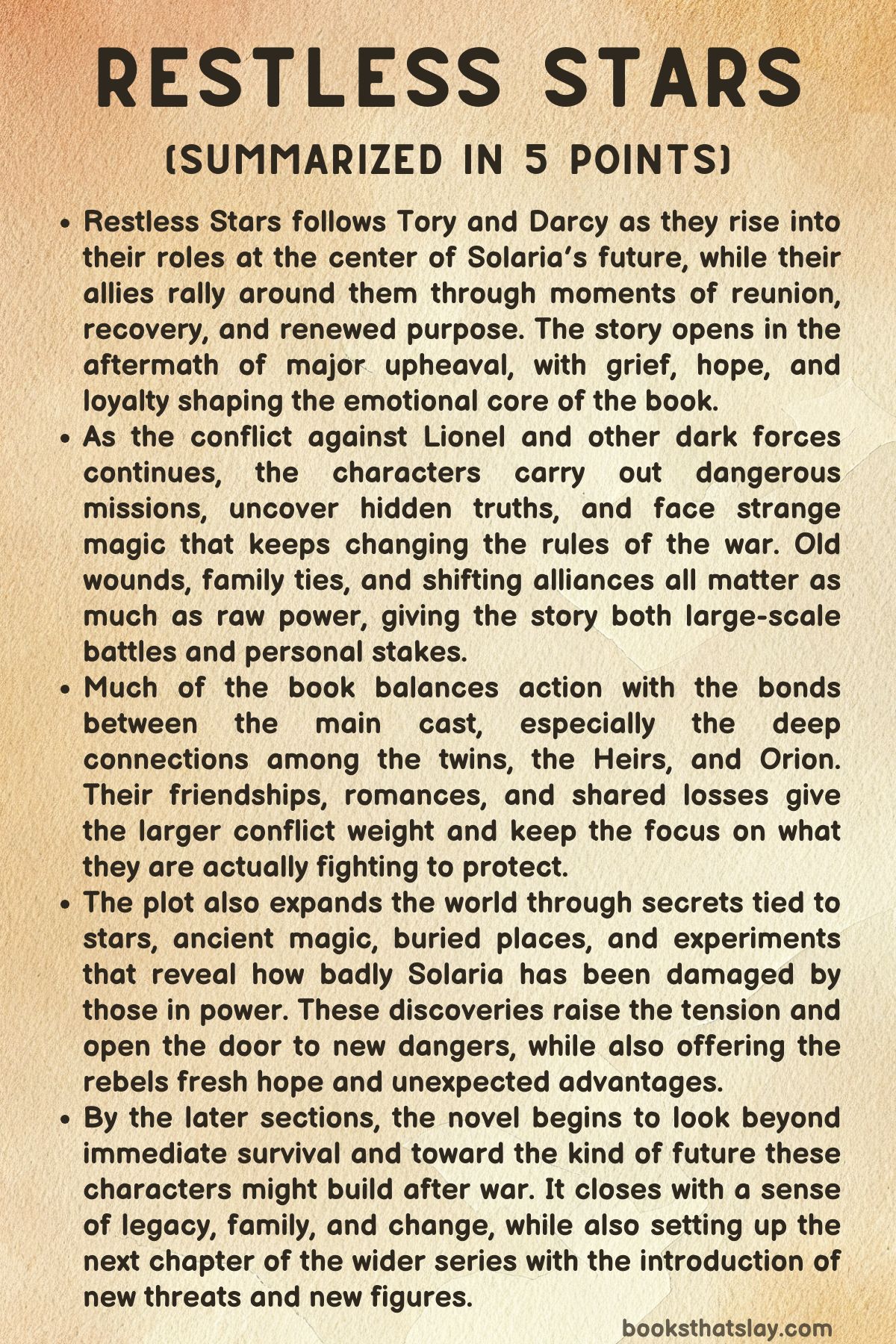
Restless Stars by Caroline Peckham and Susanne Valenti, the 9th book in the Zodiac Academy line-up, is the explosive conclusion to the series, a dark fantasy romance that blends intense battles, magic, and passionate relationships. It brings together everything the series has been building toward: the rise of the Vega twins, the collapse of old tyrannies, the return of the dead, and the final reshaping of Solaria.
The story moves between large-scale battles and intimate reunions, balancing magical spectacle with emotional payoff. At its core, it is about people who have been brutalized by power deciding to build something better out of the wreckage. It closes one era completely while also leaving the door open for new stories in the same world.
Summary
The story opens at a moment of wonder and upheaval as Tory and Darcy are engulfed in celestial light and recognized as Solaria’s true queens. In the middle of the chaos, Xavier is stunned to see Darius alive.
He fights through the crowd in disbelief, desperate to reach him before the miracle vanishes. When he finally does, Darius assures him that he is real and has truly returned.
Their reunion is full of relief and shock, and the other Heirs and Orion soon gather around Darius in equal amazement. As the light fades, Tory and Darcy emerge transformed by their power and immediately begin taking command, ordering the academy secured and the rebellion pushed forward.
Geraldine faints from the shock of Darius’s return, then revives and dramatically celebrates the restored order of things. Darius wastes little time and announces that there are still enemies to hunt, sending everyone back into action.
Elsewhere, Tory and Darcy are trapped in a cave after Clydinius steals their forms and leaves them imprisoned. While searching for a way out, they are forced into an honest reckoning with the pain between them.
Darcy apologizes for failing Tory when Darius died, and Tory admits how close grief pushed her toward surrender. She reveals that bringing Darius back involved ether magic and came at a terrible personal cost, altering her in ways even she does not fully trust.
Darcy fears what ether represents, but Tory insists they will need every available weapon if they are going to survive. By the end of the conversation, the sisters have repaired the emotional distance between them and reaffirmed that their bond remains the center of everything.
At Zodiac Academy, Orion hunts down Honey Highspell inside Jupiter Hall. He corners her in his old classroom and strips away the magical disguise she has used to hide her cursed appearance.
When Seth, Caleb, and Max arrive, they join him in humiliating her. Under Max’s Siren compulsion, Highspell confesses that she was cursed years ago by a woman whose family she had wronged.
Once her secret is exposed, Orion throws her out of the window to the furious students below, who drag her away in disgrace. Soon after, Orion hears that Darius is waiting at the lake and races to meet him.
At Aqua Lake, Darius tells the others about his death and his time beyond the Veil. He describes meeting dead relatives, seeing the Savage King and Queen, and existing in a realm shaped by thought and memory.
He explains that the dead can observe the living and draw close when called by love or grief. The group listens for hours, moved not only by what he says but by the fact that he has returned at all.
Later, Darius finds Orion at his old home, and the two restore their easy bond through humor and shared memories. Darius then passes on messages from Orion’s dead father Azriel and from Clara, offering comfort, pride, and closure.
Most importantly, he reveals that Azriel has identified the locations of more Guild Stones, giving them the next path forward in the war.
The rebellion’s assault on the Court of Solaria follows Xavier as he flies into battle with Sofia on Tyler’s back while Tyler records the fighting to expose Lionel’s crimes. During the chaos, Xavier sees Gus Vulpecula sneaking into the building and realizes he must be after something important.
Xavier and Sofia infiltrate the upper floors and find Gus looting Lionel’s office for documents and drives. Xavier confronts him and, instead of being shaken by Gus’s insults, tears apart the office with magic that rots and destroys everything Lionel valued, including a false family portrait that once represented the lie of their household.
Gus escapes briefly, but Xavier and Sofia pursue him through the city as Xavier’s decaying power spreads through the Court itself. Eventually they trap him, capture him, and leave him caged as the rebels celebrate.
Behind them, the Court of Solaria collapses under the weight of Xavier’s destruction.
The tone then darkens sharply with the account of a young girl imprisoned inside a Nebula Inquisition Centre. Rumors say the queens are coming, but what arrives is horrifying.
Darcy and Tory appear surrounded by fire, yet they behave like strangers wearing familiar faces. They burn prisoners alive, kill a woman protecting the girl, and show a cold curiosity that feels utterly wrong.
The girl’s emotional emptiness catches their interest, and they decide to take her with them, claiming they must seek “the other fallen.” This episode plants deep uncertainty about what is happening to the twins and whether what people are seeing can be trusted.
Meanwhile, Darius and Orion follow Azriel’s clues to another Guild Stone hidden in a sea cavern tied to Darius’s ancestor Luxie Acrux. They pass magical barriers, discover Luxie’s tomb, and enter a chamber overflowing with treasure.
Darius is instantly consumed by Dragon possessiveness while Orion delights in teasing him by touching as much of the hoard as possible. Their banter gives way to a magical trial triggered by a strange music box.
In an illusion filled with riddles, deadly trees, spiders, and metal Centaurs, they must identify the correct stone from six possibilities. Together they survive the challenge and claim the Sagittarius Guild Stone, though Darius remains just as focused on keeping the treasure as he is on winning the war.
Caleb’s section begins after battle, when he drags Lionel’s war general Irvine McReedy through Celestia’s sewers after a savage pursuit. Filthy, injured, and half-depleted, he forces his way back toward Zodiac Academy, stealing help where he must.
At the wards, Milton mistakes him for a monster and attacks him, only for Caleb to retaliate by feeding on him. Once inside, Caleb seeks out Seth, and the two briefly acknowledge the growing relationship between them before they are summoned to The Orb.
There, the rebels review footage of an atrocity at an Inquisition Centre. At first everyone assumes Lionel ordered the slaughter, but then the recording reveals something impossible: the twins are visible committing the massacre.
Darius refuses to accept that the woman in the footage is really Tory.
Another thread follows Tory and Darcy as they secretly witness Clydinius confronting the trapped fallen star Esvellian. Clydinius argues that stars should rule over all living beings, but Esvellian rejects his vision completely.
Once he leaves, the twins descend to free her from Lavinia’s shadow bindings. Darcy struggles with the trauma tied to those shadows, but together the sisters burn them away with Phoenix fire.
Esvellian cannot give them the exact weapon they ask for, but she can purify the trapped souls bound inside Lavinia’s darkness. When she releases her power into the world, the land itself seems to breathe with restored life and connection.
The twins realize that Lavinia’s shadows have been cleansed and that the Nymphs controlled through them may no longer be bound.
As they flee the castle, Tory and Darcy discover one of Vard’s labs where Fae have been twisted into hybrid monsters. They seize the device controlling the creatures and redirect them against Lionel’s own army before releasing them.
At the same time, Darius and Xavier are outside maintaining an illusion of a vast rebel force to distract Lionel. When the deception is finally exposed, Lionel is ready to strike, but Tory and Darcy return in time to block him, and Darius teleports them all back to Zodiac Academy.
Their success means the Inquisition Centres are destroyed, Esvellian is freed, and Lionel’s side has suffered a major blow.
Lionel, however, responds with cruelty and desperation. Lavinia is weakened by the purging of her shadows, and Lionel forces her into a Guardian Bond so she cannot act against him.
When Clydinius returns and discovers the fallen star is gone, he is enraged, and Lionel promises he will eventually provide another.
The final part moves into the future. Two years later, Seth and Caleb are now openly together and awaiting the birth of their children through surrogacy.
After one of Seth’s absurd attempts at seduction, they receive the call that the babies have been born. At the hospital they meet their son Kale and daughter Elara, and Seth is overwhelmed by love, grief, and gratitude as he begins life as a father beside Caleb.
Three years after that, Lance and Darcy are shown at home with their children, surrounded by their sprawling extended family. The peace is chaotic, noisy, and full of affection.
Even when the children begin Erupting into dangerous magical forms far earlier than expected and set the woods on fire, Lance feels only joy that this unruly life is the one he gets to have.
In the closing scene, many years later, Tory and Darcy fly over Solaria at sunrise as established queens. They reflect on rebuilding the kingdom, on the family they have made, and on the sense of home they fought so hard to claim.
Once they were two lost girls in the mortal world. Now Solaria is fully theirs, not as a fantasy, but as a place remade through sacrifice, love, and survival.
After this ending, the book shifts into a teaser for a new story centered on Everest and Vesper, hinting that another conflict is already beginning beyond the borders of the world the twins saved.
Characters
Tory Vega
Tory stands at the center of Restless Stars by as a figure shaped by love, rage, endurance, and a willingness to step into morally dangerous territory if it means protecting the people she cannot bear to lose. Her emotional core is laid bare in the cave scene with Darcy, where she finally speaks honestly about what Darius’s death did to her.
That confession reveals how much of her strength has been built on surviving devastation rather than avoiding it. She is not presented as someone who heals neatly.
Instead, she keeps moving through pain, and that makes her both formidable and unsettling. Her choice to use ether magic and defy death in order to bring Darius back shows the scale of her devotion, but it also suggests that part of her has been altered by grief and power.
She knows that what she has done carries a cost, and she does not hide from that truth.
As a queen and warrior, Tory is direct, aggressive, and deeply practical. She does not waste time pretending that purity will win a war.
Where others hesitate before dangerous forces, she is prepared to use anything that gives her side a chance to survive. That quality makes her effective, but it also creates tension with Darcy, who fears what such powers can do.
Their bond works because Tory forces action while Darcy often supplies restraint, and in this section Tory’s growth lies in allowing that emotional honesty back into their relationship. She is not simply the harder sister; she is also the one who has stared most openly into despair and come back carrying scars that have made her fiercer.
Her leadership in battle, her ability to act under pressure, and her refusal to surrender to Lionel or Clydinius all confirm her as someone whose love and brutality exist side by side. Even in the final future sequence, when she flies over Solaria in peace, she remains defined by the fact that she fought for a home and earned it.
Darcy Vega
Darcy is written as a character whose strength comes not only from power but from feeling deeply without allowing that sensitivity to make her weak. In this portion of the story, her emotional intelligence becomes one of her most important traits.
The reconciliation with Tory shows that she has been carrying guilt over failing her sister in the aftermath of Darius’s death, and her apology matters because it comes from genuine self-awareness rather than self-pity. Darcy’s instinct is to protect, connect, and understand, which makes her especially affected by the cruelty and corruption around her.
When she approaches Esvellian’s shadow bindings, the trauma tied to Lavinia resurfaces at once, showing that her past suffering still lives close to the surface. Yet she does not retreat.
She works through that fear and helps free the star anyway, turning pain into action.
Her character is also defined by the contrast between compassion and the terrifying image later seen in the Nebula Inquisition Centre footage. That contrast is crucial because the true Darcy is someone who values life, love, and emotional bonds.
Her experience during Esvellian’s release makes that especially clear, as she becomes the one most attuned to the idea that existence is rooted in connection rather than domination. This spiritual and emotional receptiveness sets her apart from characters who are motivated primarily by revenge or conquest.
At the same time, Darcy is no passive moral center. She fights, kills, escapes traps, and helps unleash monsters on Lionel’s forces when the situation calls for it.
Her softness never excludes ferocity. In the later domestic scenes with Orion and their children, she becomes the clearest image of what victory was meant to preserve: warmth, family, and a future not ruled by fear.
She represents endurance without emotional numbness, and that makes her one of the story’s most humane presences.
Darius Acrux
Darius is shaped by resurrection, loyalty, and the constant push and pull between his savage instincts and his capacity for love. His return immediately restores an emotional center to the group, especially for Xavier, Orion, and Tory.
He is not brought back as a distant miracle but as someone whose presence reorders the emotional reality of everyone around him. His bond with Xavier is one of the most affecting parts of his characterization.
Xavier’s disbelief and desperate joy show how essential Darius is, while Darius’s steady reassurance proves that he understands how much his absence wounded those who loved him. His return is not treated lightly.
He comes back carrying knowledge of death, the Veil, and the dead, which gives him a strange new gravity. He has seen what lies beyond, spoken with lost family, and returned with purpose.
At the same time, Darius remains unmistakably himself. His dragon greed, possessiveness, arrogance, and rough humor are all intact, especially in the treasure chamber scenes with Orion.
That balance matters because it prevents his resurrection from making him saintly or remote. He is still competitive, still territorial, still absurdly attached to things he calls his, and still capable of bickering like a brother rather than speaking like a prophet.
His love for Tory remains central to his identity, and his refusal to believe that the murderous figure in the footage is really her wife reveals both devotion and instinctive faith in who she is. Darius also continues to define himself through opposition to Lionel.
Conversations with Xavier show how deeply their father’s cruelty shaped him, but Darius is no longer merely reacting to that legacy. He is choosing who he wants to be: brother, husband, fighter, heir to a dark line who refuses to let that line define his soul.
In the far-future scenes, surrounded by children and peace, he becomes proof that survival can grow into fullness rather than mere escape.
Lance Orion
Orion’s character arc in this material is built around recovery, loyalty, and the gradual replacement of old darkness with chosen love. He begins with ruthless purpose when hunting Honey Highspell, and that sequence reminds the reader how dangerous and merciless he can be when faced with cruelty.
His contempt for abuse of power is personal, and his punishment of Highspell carries the force of someone settling scores not only for himself but for generations of harmed students. Yet the story does not leave him in vengeance.
His later scenes reveal a man who has changed profoundly. When he returns to his old home and reflects on the way Darcy freed him from the darkness that once consumed him, the contrast between past and present becomes explicit.
He is still hard-edged, sarcastic, and battle-ready, but he is no longer spiritually trapped.
His bond with Darius is one of the richest relationships in the story. They understand each other through shared suffering, history, and a rough affection that does not need ornament.
Their mission for the Guild Stone shows them at their most enjoyable together: teasing, fighting, solving problems, and operating like people who have long since earned trust through fire. Orion also gains emotional closure through Darius’s messages from Azriel and Clara.
Those moments matter because they validate a man who has long carried shame, anger, and a fractured sense of belonging. To be told he is worthy is no small thing for him.
In the later family scenes, Orion’s character reaches a deeply satisfying stage. Seeing him as a father, panicking over Azura’s early Emergence while still feeling profound joy, shows how completely his life has expanded beyond pain and war.
He has not become softer in any simplistic way, but he has become fuller. His old loneliness is replaced by chaos, children, love, and chosen family.
He remains one of the story’s fiercest men, yet his real triumph lies in the fact that fierceness is no longer all he has.
Xavier Acrux
Xavier’s role in Restless Stars is especially compelling because he embodies both the lingering wounds of Lionel’s abuse and the possibility of building a self beyond that damage. His reunion with Darius is one of the most emotionally open moments in the narrative.
He does not hide his desperation, grief, or joy, and that sincerity gives him a different kind of strength from the older, harder warriors around him. Darius’s return restores something foundational in him, and the image of Xavier shifting into his Pegasus form so Darius can ride into battle captures the devotion that defines so much of his character.
He loves with his whole being, without calculation.
His battle against Gus becomes a crucial statement of personal growth. Xavier is forced back into a symbolic confrontation with the world shaped by Lionel’s power when he enters the office that once represented fear, control, and humiliation.
Instead of being crushed by those memories, he destroys the space itself. The rotting magic spreading through the office and finally consuming the family photograph is especially revealing.
Xavier is not simply fighting an enemy; he is rejecting the false image of familial order that upheld his suffering. He no longer needs validation as the spare heir, and Gus’s insult fails because Xavier has moved past needing that old hierarchy to define his worth.
His relationships with Sofia, Tyler, and Darius also show his growth into a life that belongs to him rather than to Lionel’s shadow. He is brave in battle, emotionally expressive, and capable of real tenderness.
Even when chaos surrounds him, he carries an energy that is hopeful rather than bitter. Xavier’s character is powerful because he is not hardened into emotional silence.
He remains vulnerable, affectionate, and slightly chaotic, and those qualities feel like victories in themselves for someone raised in cruelty.
Caleb Altair
Caleb is presented as someone whose polished surface has long hidden hunger, insecurity, and a need for connection that he has not always known how to admit. His post-battle sequence in the sewers strips away any glamour associated with him and leaves only exhaustion, stubbornness, and determination.
Dragging McReedy through filth while half-dead himself, then bullying his way into a truck and back to the academy, he becomes almost comic in his misery, but the scene also highlights his grit. Caleb is not just elegance and vanity.
He can endure ugliness when the moment demands it.
His relationship with Seth is one of the most important dimensions of his character. Their dynamic blends humor, embarrassment, sexual chemistry, and genuine tenderness, but beneath all of that is the fact that Caleb chooses emotional openness with Seth in a way that suggests real change.
He is often more restrained and self-conscious than Seth, which creates much of the comedy between them, yet that restraint also reveals vulnerability. In the future domestic scenes, Caleb becomes a father, and that development deepens him considerably.
His willingness to build a family, to share parenthood fully with Seth, and to let love become something stable rather than hidden or temporary shows a maturity that earlier versions of him might have resisted.
Caleb also remains distinctly himself throughout all of this. He is petty enough to feed on Milton in revenge, easily flustered by Seth’s ridiculous behavior, and never entirely free of vanity.
Those traits keep him vivid and entertaining. But by the end, what defines him most is commitment.
He stops being a man drifting between appetite and survival and becomes someone who has chosen his people, his partner, and his future.
Seth Capella
Seth brings volatility, humor, shamelessness, and emotional directness to nearly every scene he enters, but his role is more substantial than comic relief. He is someone who feels first and filters later, which can make him ridiculous, overwhelming, and unexpectedly touching all at once.
His reaction to Darius’s return and his place in the group show how deeply he loves his found family. Even when he behaves absurdly, there is rarely anything guarded about him.
That openness makes him a source of emotional momentum. He throws himself at life, whether that means battle, celebration, sex, or fatherhood.
His future scenes with Caleb reveal how much depth sits beneath the theatrical surface. The Pegasus costume sequence is intentionally absurd, yet it also shows Seth trying, in his own chaotic way, to create joy and intimacy.
He is not embarrassed by desire or affection. More importantly, when the babies arrive, his emotional response is immediate and overwhelming.
His request not to know which child is biologically tied to which father is one of the clearest expressions of his values. Love matters more to him than blood.
That moment transforms what could have been a merely comedic character into someone whose heart is both generous and wise.
Seth’s grief also remains present. His joy at becoming a father exists beside sorrow for the family he lost, which gives his happiness weight.
He has always carried loneliness beneath the noise, and parenthood allows him to create the belonging he once lacked. In later scenes, seeing his son among the other children confirms that Seth has become part of a future larger than his own appetites or wounds.
He remains loud, sexual, impulsive, and delightfully excessive, but those qualities now belong to a man who has found permanence in love.
Sofia Cygnus
Sofia plays a more focused role in the action, but in Restless Stars by, she is characterized as brave, competent, and deeply in sync with Xavier. She is not treated as ornamental support in the assault on the Court of Solaria.
She fights beside Xavier, helps track Gus, and participates fully in the danger of the mission. Her fire dog adds a vivid magical extension of her presence, suggesting both power and instinct.
She is the kind of ally who strengthens a scene through steadiness rather than dominance, and that steadiness matters in a story full of larger-than-life personalities.
Her relationship with Xavier is defined through teamwork as much as affection. They move together, pursue the same target, and share the victory when Gus is finally trapped.
Their kiss after the collapse of the Court gives emotional closure to that sequence, but it works because the story has already shown her as someone capable in her own right. She is not simply there to admire Xavier’s growth.
She witnesses it, supports it, and stands beside it. In the later reunion scenes, her place in Xavier’s life helps underline the fact that he now belongs to a chosen emotional world far removed from Lionel’s cruelty.
Tyler Corbin
Tyler represents courage expressed through documentation rather than brute force. In the battle, he is not merely transport for Xavier and Sofia; he is also actively recording events so Lionel’s crimes can be exposed later.
That detail matters because it gives Tyler a purpose shaped by truth and legacy. He is carrying forward his mother’s mission through The Daily Solaria, suggesting that resistance is not only won through magic and violence but also through witness.
He takes real risks by flying into battle with a camera strapped to his chest, and that choice positions him as someone who understands the power of evidence.
His presence also contributes to the emotional and communal life surrounding Xavier. He is part of the network of relationships that make the rebels feel like more than an army.
Even in the later chaotic reunion, he helps create an atmosphere of messy, joyful survival. Tyler’s role may be smaller than that of the central fighters, but he adds texture to the story’s understanding of rebellion by showing that telling the truth is itself an act of courage.
Gabriel Nox
Gabriel functions as both visionary and stabilizing presence within the group. Though this summary does not center him as heavily as some others, his importance is clear in the way he moves through key reunions, strategy, and family life.
His reconnection with Leon and Dante at Darius’s return highlights how much emotional history he carries, while his participation in the larger rebel circle shows that others trust his insight. Gabriel often occupies the role of the one who sees patterns before others do, and even when not at the narrative center, that quality gives him weight.
In the future scenes, his role expands through family. The presence of his children, and his warning that Azura’s Emergence is triggering the others, reminds the reader that his gifts remain essential even in peacetime.
He bridges war and domesticity, prophecy and ordinary affection. Gabriel is not only useful for what he can predict; he matters because he is deeply embedded in the collective life of this chosen family.
Geraldine Grus
Geraldine provides theatricality, loyalty, and emotional extravagance, but beneath the humor she stands as one of the story’s most devoted believers in the Vega queens and the cause they represent. Her dramatic fainting at Darius’s return is played for comedy, yet it also reveals how intensely she feels the moment.
Geraldine does nothing halfway. Her declarations, her reverence, and her larger-than-life responses make her easy to read as comic, but that would undersell her importance.
She helps give the rebellion spirit. She transforms political allegiance into something ceremonial and heartfelt.
Her later role in summoning the group to hear reports from the Inquisition Centre also shows her continuing relevance in the structure of the resistance. Geraldine is not just there to decorate scenes with grand language.
She belongs to the core group, takes part in urgent developments, and remains emotionally fearless in a world that often punishes sincerity. She embodies the idea that passion, loyalty, and spectacle can coexist with real courage.
Lionel Acrux
Lionel remains the defining tyrannical force in the story, but what makes him effective as an antagonist is not just cruelty. It is the way he treats domination as the natural shape of the world.
His abuse has marked Xavier and Darius so deeply that even when he is offstage, his influence is present in their memories and reactions. He is not simply a villain who commands armies.
He is a father whose household produced trauma, hierarchy, fear, and false performances of family unity. That is why Xavier destroying the old photograph matters so much: Lionel’s power was always both political and deeply intimate.
In the present conflict, Lionel is repeatedly outmaneuvered, but his danger lies in how quickly he adapts through coercion. When Lavinia’s shadows are purged and his own losses mount, he responds not with reflection but with greater control, forcing her into a Guardian Bond.
That choice captures his essence. He cannot tolerate vulnerability, partnership, or uncertainty; he must own, bind, and dominate.
Even his alliance with beings like Clydinius is shaped by ambition rather than reverence. He is the character most fully committed to a worldview based on power over others.
That makes him a strong enemy not only because of magic and strategy, but because he stands in direct opposition to everything the heroes are trying to build.
Lavinia
Lavinia is a character of corruption, control, and spiritual violation. Her power rests not only in force but in contamination.
The shadows she commands are tied to trapped souls and to the manipulation of entire populations, which makes her influence especially horrifying. She is not just dangerous in battle; she poisons autonomy itself.
The lingering trauma Darcy feels when confronting the shadow bindings on Esvellian reveals how invasive Lavinia has been. Her violence lingers in memory, body, and magic.
What makes Lavinia interesting in this section is that her seeming invincibility is finally broken. Esvellian’s cleansing strips her shadows of the authority they once had, and suddenly Lavinia is vulnerable, in agony, and partially diminished.
Yet even weakened, she remains menacing because of the scale of what she once controlled and the fact that her evil has never been merely physical. She represents the violation of inner freedom.
Her bond with Lionel is therefore fitting: both characters understand power through ownership and subjugation, even if they are not true equals.
Tharix
Tharix is one of the more enigmatic figures in Restless Stars, and his uncertainty is his defining feature. He appears connected to bloodlines, choice, and identity in ways that even Darius cannot fully understand.
What makes him intriguing is that he does not act in simple accordance with the alliances around him. He speaks strangely, with an awareness that suggests he is still working out what kind of being he will be.
His choice not to attack Darius and Xavier, and later to allow Tory and Darcy to escape in exchange for a debt, places him in a morally unstable space. He is dangerous, but not entirely fixed.
That ambiguity makes him effective. In a story crowded with clear loyalties and hatreds, Tharix introduces uncertainty about whether lineage determines destiny.
He seems to embody the possibility that something made under dark conditions may still choose differently. His role is not yet fully resolved in this summary, but as a character he matters because he complicates the simple division between monster and ally.
Clydinius
Clydinius represents naked domination without disguise. Unlike Lionel, who uses institutions, family structures, and political control, Clydinius states openly that sentient beings exist to be ruled and worshipped.
His confrontation with Esvellian reveals a worldview founded entirely on hierarchy and possession. He sees freedom as a flaw and agency as an obstacle.
In that sense, he functions as a more cosmic version of the same ideology driving Lionel.
His menace is sharpened by impatience and fury. He is not interested in persuasion except as a preliminary step before force.
His promise to return and impose a body on Esvellian turns power into violation in the most direct possible way. Clydinius therefore acts as an antagonist who reflects the story’s deepest fears about what happens when power is severed from connection, empathy, and consent.
Esvellian
Esvellian serves as a moral and spiritual counterweight to figures like Clydinius and Lavinia. Though trapped and weakened, she retains a profound sense of what power is for.
Her refusal to join Clydinius is rooted not in helplessness but in principle. She rejects the belief that existence revolves around domination and instead affirms a view centered on connection, freedom, and meaning beyond control.
That vision becomes transformative for Darcy in particular.
Even in captivity, Esvellian remains generous. Once freed, she does not reward the twins with the violent solution they initially want, but she offers something deeper and more important: purification, release, and a restoration of balance.
Her power changes the terms of the war by cleansing Lavinia’s shadows and exposing new possibilities. As a character, she is less individualized in the ordinary human sense, yet she is vital because she embodies the story’s clearest rejection of tyranny.
She stands for power that heals rather than enslaves.
Honey Highspell
Highspell is portrayed with a mixture of disgust, ridicule, and vindication. Her cruelty, prejudice, and abuse of students make her a symbol of the petty but deeply harmful authority figures who thrive under corrupt systems.
The exposure of her true face is not only a physical unmasking but a moral one. Underneath glamour and status lies malice, vanity, and ugliness shaped by her own past actions.
Her curse becomes a fitting reflection of a life spent exploiting others.
She is not a character designed for sympathy in this section. Instead, she functions as a target of long-delayed humiliation and punishment.
Orion’s handling of her makes it clear that the narrative sees her downfall as deserved. Highspell’s role is therefore less about complexity and more about the satisfaction of watching institutional cruelty dragged into the open.
Gus Vulpecula
Gus is another representative of the machinery that upheld Lionel’s rule, though he operates through propaganda, opportunism, and cowardice rather than grand ideology. His instinct in crisis is to steal useful material and run, which marks him as self-serving above all else.
He tries to wound Xavier with the old insult of being the discarded spare heir, revealing that he understands exactly which emotional scars he hopes to reopen. But the fact that the insult no longer works is what gives the scene its force.
Gus matters most as a foil for Xavier’s transformation. He belongs to the old order of lies, image management, and contempt, and Xavier’s capture of him becomes one more sign that this order is collapsing.
Gus is slippery, sneering, and weak at the core, which makes him an effective embodiment of the regime’s smaller but still poisonous servants.
Milton Hubert
Milton appears briefly, but his moment with Caleb adds comic texture and reminds the reader of the academy’s larger social world. Mistaking Caleb for a creature and shooting him with a stunning gun is exactly the kind of chaotic misunderstanding that fits the series’ tone.
His role is minor, yet his presence helps maintain continuity among the supporting cast and provides a small moment of levity amid exhaustion and war.
Irvine McReedy
McReedy exists primarily as a captured instrument of Lionel’s military power. He is important less as an individual psyche and more as proof that the rebels are finally dragging down the structure that sustained the regime.
Caleb’s brutal effort to bring him in makes McReedy a kind of trophy of endurance and victory. His role underscores the physical cost of war and the fact that important wins are often ugly and exhausting rather than glorious.
Azura, Archer, Kale, Elara, and the Next Generation
The children in the future sections are not yet fully developed as individual personalities, but they are emotionally significant because they embody the outcome of everything the older generation fought for. Azura’s early Phoenix Emergence, Archer’s playfulness, Kale’s instinctive action in wolf form, and the metallic Dragon twins’ chaotic transformation all turn inherited power into something joyous rather than tragic.
These children are not growing up under Lionel’s cruelty or in the shadow of constant terror. Their magic appears amid family gatherings, laughter, panic, and love.
That shift is the point. The next generation represents continuity without repetition.
They inherit strength, but not the same loneliness. They grow inside a network of parents, friends, cousins, and protectors who actually want them safe.
Even when they set trees on fire or knock down half the woods, they do so in a world where they are cherished. Their presence completes the emotional arc of the older characters by proving that survival has led to something lasting.
Everest and Vesper
These two figures appear in the teaser rather than the main conclusion, but they are introduced with enough force to leave a clear impression. Everest is framed as a hunted survivor whose life begins in fear, persecution, and impossible escape.
Her ability to pass through a deadly boundary immediately marks her as unusual and potentially central to a new upheaval. She enters the story through vulnerability and endurance.
Vesper, by contrast, is introduced through reputation and threat. She is the feared Sky Witch, already defined by skill, violence, and allegiance to a larger military force.
Together, the two are positioned as contrasting entry points into the next conflict: one fleeing danger from below, the other descending upon it from above. Even in brief form, they suggest a new narrative shaped by war, pursuit, and unstable power.
Themes
Love as the Force That Restores and Sustains
Again and again, the story returns to love not as a soft emotion but as a force that keeps people alive, steady, and moving forward. Xavier’s reunion with Darius shows how grief can be interrupted by impossible joy, and that moment immediately restores hope to the wider group.
Tory’s confession that she came close to giving up after Darius’s death makes this even clearer: what kept her anchored was her bond with Darcy. The sisters’ reconciliation in the cave becomes one of the emotional centers of the narrative because it shows that healing begins when pain is spoken aloud and answered with understanding.
This idea reaches its highest point when Esvellian releases her power and Darcy understands that life is meant for connection, not domination. The later domestic scenes with children, partners, and shared family life carry that same meaning into the future.
What was once a fight for survival becomes a life worth protecting. In that sense, victory is not only defeating enemies, but preserving the relationships that make survival matter.
Power, Choice, and the Rejection of Domination
The conflict is shaped by competing ideas of what power is for. Clydinius believes power justifies rule, worship, and control, while Esvellian insists that existence is not centered on domination.
That opposition defines much of the moral structure of the story. Lionel, Lavinia, and Vard all rely on coercion, experimentation, fear, imprisonment, and forced obedience.
Their world is built on stripping others of agency, whether through political terror, magical corruption, or literal physical control. Against that, the central characters keep fighting toward a future where people can choose who they are and how they live.
Even the freeing of Esvellian becomes larger than a rescue mission because it represents resistance to the idea that strength exists only to command. Tharix’s strange comments about bloodlines and choice also fit into this pattern, raising questions about whether identity must be dictated by origin.
The rebels are not simply trying to replace one ruler with another; they are trying to end a system that treats lives as tools. The story keeps insisting that real authority must be tied to responsibility rather than conquest.
Trauma, Survival, and Emotional Repair
Much of the emotional weight comes from how deeply the characters have been marked by suffering, and how unevenly they recover from it. Tory and Darcy’s conversation in the cave shows that even the strongest bonds can be strained by grief, guilt, and silence.
Tory has been altered by loss and by the price of defying death, while Darcy still carries fear from everything connected to Lavinia and shadow magic. Orion’s reflections at Asteroid Place continue this pattern, showing how love helped pull him away from the darkness that once shaped him.
Xavier’s destruction of Lionel’s office is also more than revenge; it is a symbolic attack on the place where so much fear and pressure once ruled his life. Even smaller moments, like Caleb dragging himself through the aftermath of battle or Seth’s joy as a father mixed with grief for what he lost, show that survival does not erase pain.
Instead, the story presents healing as something incomplete but real. People do not return to innocence.
They carry scars forward, and the repair comes through honesty, loyalty, and the chance to build something gentler after violence.
Home, Legacy, and the Building of a Future
By the end, the narrative becomes deeply concerned with what remains after war. The struggle is not only about overthrowing enemies but about making a lasting home from the ruins they leave behind.
Early on, many characters are still driven by vengeance, rescue, and immediate survival. Later, the focus widens to children, families, inheritance, and the world being passed on.
Seth and Caleb becoming fathers gives this theme intimate shape, especially through Seth’s refusal to divide love according to biology. Lance and Darcy’s household, chaotic and full of children discovering their powers, turns the future into something vivid and alive rather than abstract.
The final flight over Solaria completes this arc. Once the twins were displaced, uncertain, and cut off from their origins, but now they look over a kingdom that has become truly theirs through effort, sacrifice, and reform.
Legacy here is not about bloodline alone, even though ancestry matters throughout the plot. It is about what kind of world one leaves behind.
Home becomes something earned, protected, and shared across generations.