The Widow’s Husband’s Secret Lie Summary, Characters and Themes
The Widow’s Husband’s Secret Lie by Freida McFadden is a fast-moving psychological thriller built on suspicion, deception, and dark humor. The story follows Alice Lockwood, a recently widowed woman who is trying to settle into life after the sudden death of her wealthy husband, Grant.
But grief is only the surface of her problem. Alice keeps seeing a man who looks exactly like Grant, even though she knows he is dead. As strange visitors, buried secrets, and sharp turns pile up, the novel keeps shifting the reader’s sense of what is true. It is a story about control, fear, survival, and the dangerous consequences of living beside someone you never really knew.
Summary
Alice Lockwood is recently widowed after the death of her husband, Grant, in a car accident. Even while trying to carry out ordinary errands, she feels watched.
At a drugstore, she catches sight of a man who looks exactly like Grant. This should be impossible, since she identified Grant’s body herself and buried him only two weeks earlier.
Still, the sight unsettles her, and this feeling follows her home.
At home, Alice is surrounded by reminders of Grant and by the routines of a life that never really belonged to her. Her friend Poppy keeps visiting with casseroles and sympathy, certain that Alice is simply grieving.
The house itself feels uneasy, especially because of the attic, a locked space Grant never allowed her to enter. Alice also carries a private secret: she recently discovered that she is pregnant.
This news is deeply complicated, because her marriage to Grant was not the happy one outsiders believed it to be.
As Alice tries to move through daily life, more cracks open in the story she thought she understood. She sees Grant’s face again at the grocery store.
She hides her prenatal vitamins from an intrusive former secretary of Grant’s, then rushes outside after spotting the same man through a window. The sightings push her further toward panic.
When she finally confides in Poppy, she is met with doubt and concern rather than belief.
Then a woman named Marnie appears at Alice’s door and claims that she was also Grant’s wife in every way that mattered, even if not legally. Marnie says Grant lived with her for years and fathered her children.
She has come because she believes Alice, as Grant’s legal widow, now controls the money that should help support those children. Alice is stunned.
Grant had always presented himself as a man with no close family, someone who longed for children but had none. Now she is being told he lived a second life.
Alice visits Marnie’s home and finds not one or two children, but eight, all strongly resembling Grant. Family photos support Marnie’s story.
Although Alice is suspicious, she also feels morally cornered. If these children really are Grant’s, then they deserve financial support.
She tells Marnie she will consider sharing the estate if DNA proves the children belong to Grant.
After leaving, Alice notices a green sedan following her. At a stoplight, she sees that the driver again looks like Grant.
This pushes her toward a truth she has been trying not to think about too directly. She goes to Grant’s grave, reassures herself that he is buried there, and then reveals the central secret of her own: she killed him.
Alice looks back on her marriage. At first, Grant seemed charming, wealthy, attentive, and deeply in love with her.
He swept her into a life of comfort and luxury, and she believed she had found happiness. But the illusion broke in a shocking way over something absurdly small: a disagreement about the famous dress image that some people saw as white and gold and others as blue and black.
Grant became furious when Alice insisted she saw white and gold. His anger was not a passing outburst.
It became a pattern of control, humiliation, and terror.
Grant forced his version of reality onto her. He bought her a blue-and-black dress and demanded that she admit the image was blue and black too.
He replaced her clothing with dresses in those colors, used gifts and celebrations to reinforce his obsession, and made Alice fear for her safety and sanity. He threatened to use his money and influence against her if she resisted.
He wanted a child, but by then Alice understood that he was cruel and dangerous. She decided she could never safely leave him.
She also decided she could not allow herself to have a baby with him. Eventually, she concluded that the only way out was to kill him.
Alice sabotaged Grant in multiple ways to make sure he would die. She poisoned his food, created a hazard on the stairs, and cut the brakes on his car.
When he died in the crash, she felt more shock than triumph. She kept one of the blue-and-black dresses as a reminder of what he had done to her and why she had acted.
To herself, Grant’s death was justice and self-preservation.
Back in the present, Alice begins telling Poppy the truth about Grant’s abuse. Poppy is horrified and sympathetic.
Alice also tells her about the pregnancy, though this moment is mixed with one of the novel’s comic misunderstandings: Alice has confused an IUD with LED lights, believing closet lights somehow played a role in contraception. Soon after, the police arrive.
Detective Mancini says an anonymous tip has suggested that Grant’s crash was no accident. Alice had once hoped suspicion might fall on Willie, the housekeeper Grant disliked, but Willie has a solid alibi.
Mancini then shows Alice a photograph from the car and asks her what color a dress in the picture is. She says white and gold.
His reaction suggests that this answer matters.
Searching for painkillers later, Alice finds a key hidden in one of Grant’s prescription bottles. It opens the attic.
Expecting some terrible secret, she instead finds a cat riding a Roomba and a notebook. The attic turns out not to hide evidence of a sinister plot, only clutter and Grant’s strange fantasy writing.
This discovery answers none of her questions and leaves her more frustrated than before.
That same night, Alice confronts the person who has been watching her. The man steps out from the bushes and claims to be Brant, Grant’s identical twin.
He explains that Grant lied about being an only child. He also says that he, not Grant, was the man living with Marnie.
He had pretended to be Grant because he envied his brother’s success. After Grant’s death, Brant let Marnie believe she was widowed so he could leave that life behind.
Alice notices a small mole near his ear, a feature that seems to confirm he is not Grant.
Brant and Alice quickly connect. Unlike Grant, he seems to share Alice’s tastes and dislikes.
He hates tea, likes the music she likes, and seems easy to be around. Alice begins imagining that this man, not Grant, might have been her true match.
But when she goes to tell Poppy, she ends up at the wrong house and is told that a woman named Poppy died there decades earlier. Alice spirals into fear, thinking that Poppy might not even be real and that she may be losing her grip on reality.
She clings to the comfort of Brant’s return, but when he arrives for dinner, things shift. He changes into Grant’s clothes and gives Alice a wrapped present.
Inside is a blue-and-black dress. The truth comes crashing down: this is not Brant.
It is Grant. The mole was fake.
Grant explains that Brant came to him shortly before the crash asking for money. Grant had already seen Alice cutting the brakes, so he used Brant to save himself.
The man who died in the car and whose body Alice identified was Brant, not Grant.
Grant now intends to take control of Alice again. He knows she tried to kill him, and he plans to use that knowledge to force her into obedience.
He also reveals that his first wife, Rebertha, did not die by accident either. He killed her.
As he approaches Alice with the dress, threatening her life, Poppy appears and strikes him with a shovel.
Alice is still shaken and briefly confused, but Poppy explains that Alice simply went to the wrong neighboring house earlier. Poppy is real.
Grant begins to recover, and Alice grabs the shovel and beats him repeatedly until he is dead. This time, she makes certain of it.
She and Poppy bury Grant’s body in the backyard.
Afterward, they clean up. Poppy finds what Alice thought was a positive pregnancy test, only to reveal that it is actually a positive COVID test.
Alice realizes she misunderstood the result entirely. At the same time, news breaks that Detective Mancini has died while responding to a robbery, which means the investigation into Grant’s crash will likely go nowhere.
Alice feels relief for the first time in a long while.
The next morning, she wakes believing she is finally free. She even plans to give Marnie some money, since Brant, the real father of the children, died because of Alice’s actions.
But peace does not last. She hears a man in the shower and finds someone who looks just like Grant.
Horrified, she checks the childhood photo that supposedly showed Grant and Brant. When she unfolds it fully, she discovers there were not two identical boys in the picture, but three.
The story ends with the realization that one more secret has been waiting in the shadows.
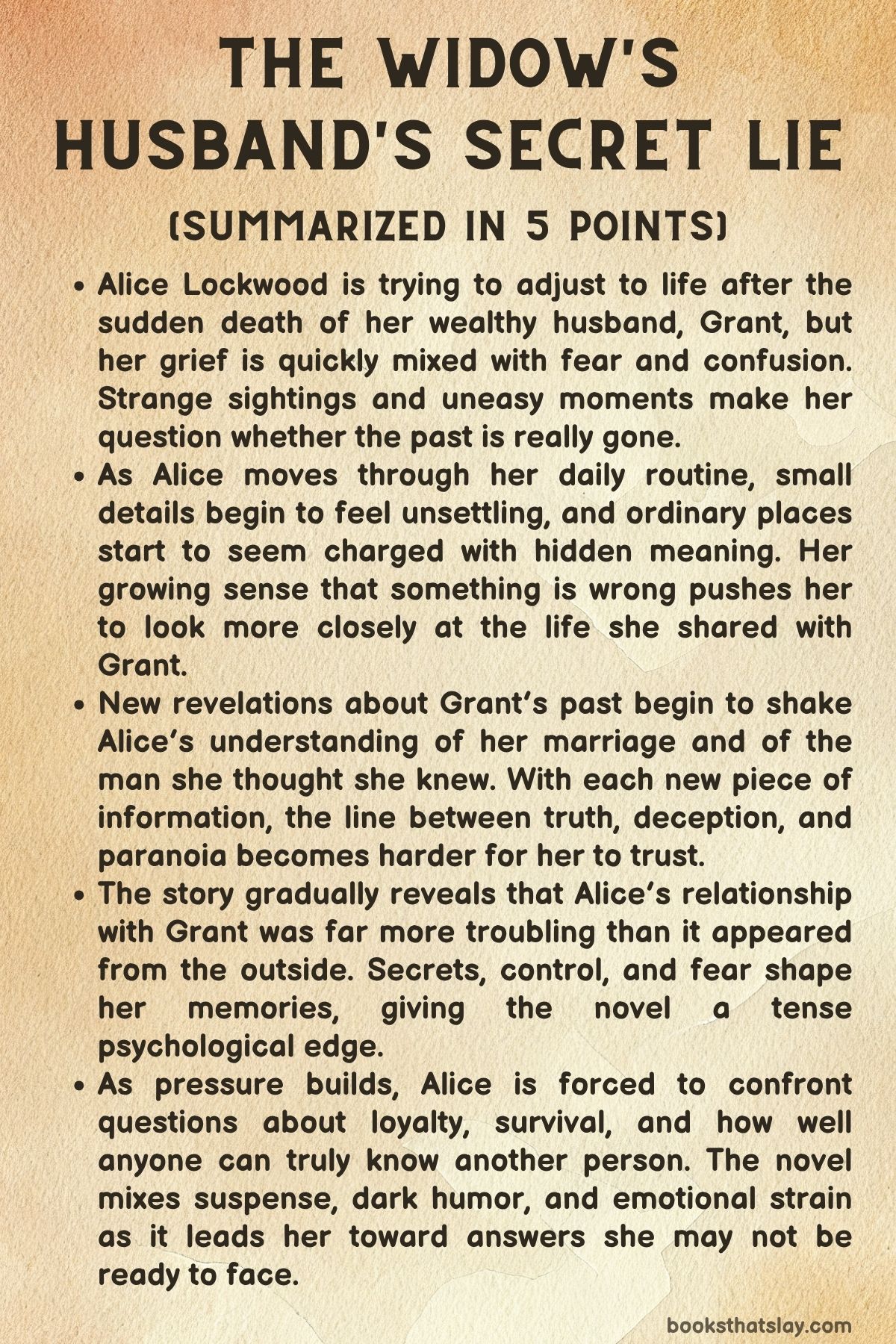
Characters
Alice Lockwood
Alice stands at the center of the story as both victim and unreliable interpreter of events, which makes her one of the most layered figures in The Widow’s Husband’s Secret Lie. At first, she appears to be a grieving widow trying to cope with sudden loss, odd sightings, and rising fear.
But as the plot opens up, her inner life proves much more complicated. She is intelligent, observant, and capable of dark humor, yet she is also confused, emotionally bruised, and often unable to trust her own judgment.
That uncertainty does not come from natural indecision alone. It grows from years of control, manipulation, and fear inside her marriage.
Her confusion over ordinary things, her panic in public spaces, and her tendency to second-guess herself all suggest the lasting damage caused by sustained emotional abuse.
Alice is also morally complicated in a way that keeps her from becoming a simple innocent heroine. She kills Grant, and she does so deliberately.
The story does not hide that fact for long. Yet the act is framed through her desperation and her belief that she has no safe path out.
That tension is what makes her compelling. She is not written as a clean symbol of goodness, but as a damaged person trying to survive a situation that has already pushed her beyond ordinary moral limits.
Even after Grant’s supposed death, she remains trapped in the mental world he built around her. His voice still shapes how she thinks, how she doubts herself, and how she reads danger.
Her fear that she may be imagining things shows how deeply his control altered her sense of reality.
At the same time, Alice has a sharp, often dry voice that keeps her from seeming passive. She notices social absurdities, resents empty gestures of comfort, and quietly judges the people around her.
That wit gives her presence on the page and helps explain how she endures so much pressure without collapsing completely. Her mistakes, including her misunderstandings and moments of poor judgment, also make her feel human rather than idealized.
She is a woman trying to reclaim authorship over her own life, but she can only do so through imperfect, messy, and sometimes violent choices. By the end, Alice becomes someone who has moved from fear into action, yet not into peace.
Her final position shows that escape from abuse does not immediately restore certainty, innocence, or emotional stability. It only opens the door to the next truth.
Grant
Grant is the force around which nearly all fear in the novel is organized. He first appears in memory as charming, wealthy, attractive, and seemingly devoted, the sort of man who can transform an ordinary life into one of comfort and security.
That polished exterior matters because it explains why Alice, and perhaps many outsiders, would trust him so easily. His cruelty is not obvious at first glance.
It emerges gradually, then fully, revealing a man whose need for domination is so extreme that even a trivial disagreement becomes a battlefield. The issue is never really the color of a dress.
What matters to Grant is his demand that another person surrender independent perception and accept his version of reality.
That need for control defines him more than any other trait. He does not merely want obedience in practical matters.
He wants ownership over thought, language, and identity. By forcing Alice to submit over something absurd, he proves that his abuse is not about reason, preference, or temper alone.
It is about total power. He invades her wardrobe, her daily routines, her emotional state, and her future, especially through his insistence on having a child.
He uses money, social status, and the threat of institutional power as tools to trap her. His abuse is psychological before it becomes physical, and that makes him especially dangerous.
He creates a world in which Alice is meant to feel that resistance is madness and compliance is survival.
Grant also represents the public face of respectability that often protects abusers. Other people admire him, speak well of him, and assume his goodness.
Even after his death, some characters struggle to accept that he could have lived a life so different from the image he projected. That gap between public image and private terror is central to his function in the story.
He is believable not because he is subtle in private, but because he is so effective at hiding in plain sight. His wealth allows him to shape environments and expectations, which makes Alice’s isolation even more severe.
The later revelations make him even darker. His deception involving Brant, his manipulation after the crash, and his admission about Rebertha show that his violence is not impulsive but patterned.
He plans, adapts, and exploits people with frightening ease. Even when he seems to have been defeated, his presence lingers as a system of fear rather than just a man.
He is the architect of instability in Alice’s mind and the embodiment of coercive control in the plot.
Poppy
Poppy serves as the story’s most important source of human warmth, though the novel initially complicates her role by making her seem almost too convenient. She appears whenever Alice needs company, support, or reassurance, and because the narrative is filtered through Alice’s unstable perspective, even Poppy’s reality is briefly called into question.
That uncertainty actually strengthens her character. It shows how isolated Alice has become and how badly abuse has damaged her ability to trust even genuine friendship.
Poppy is not glamorous or mysterious. She is practical, nosy, imperfectly helpful, and often a little irritating.
Yet those ordinary qualities are exactly what make her valuable. She feels like a real person rather than a dramatic savior.
Her repeated casseroles and offers of tea are not presented as ideal comfort, especially since Alice dislikes both, but they still matter because they show persistence. Poppy may not always know the right thing to say, yet she keeps showing up.
In a story filled with deception, Poppy’s consistency becomes meaningful. She notices changes in Alice, asks questions, and remains emotionally available even when Alice hides the truth.
When Alice finally reveals the abuse she suffered, Poppy responds with horror and compassion rather than disbelief. That reaction is significant because it gives Alice what Grant denied her for so long: confirmation that what happened to her was wrong.
Poppy also brings balance to the tone of the story. Her conversations with Alice often carry a comic edge, but that humor never empties her of seriousness.
She can be skeptical, blunt, and slightly exasperated, yet when danger becomes real, she acts without hesitation. Her intervention during the confrontation with Grant turns her from supportive friend into active protector.
She is willing to cross a line for Alice, and that choice shows the depth of her loyalty. She does not just comfort Alice after trauma.
She helps end the threat.
What makes Poppy especially effective is that she is not presented as wise in a polished or formal way. Her friendship is domestic, local, and stubborn.
She represents the kind of care that may look ordinary from the outside but becomes life-saving under pressure. In a novel crowded with manipulation and false identities, she anchors the emotional truth of the story.
She is proof that not every relationship in Alice’s life is built on control, performance, or fear.
Marnie
Marnie enters the story as a destabilizing figure because she carries a claim that threatens everything Alice thinks she knows about her marriage. She is not introduced as a villain in an obvious sense, yet she arrives with demands, emotional pressure, and evidence that suggests Grant lived another life.
Her presence forces Alice to confront the possibility that she never understood her husband at all. Marnie’s role is especially effective because she appears believable and suspicious at the same time.
She has photos, children, and a direct manner that make her claims hard to dismiss, but the timing and intensity of her visit also create distrust.
What stands out about Marnie is her relationship to survival. She lives with many children in reduced circumstances and speaks from a position shaped by financial anxiety.
Whether or not her claims are fully accurate at first, she clearly sees money as necessary protection for her household. That practical urgency gives her a certain emotional pressure.
She is not presented as refined or restrained. She uses the visible needs of the children to influence Alice, and that makes her morally ambiguous.
She is not purely manipulative, but she is willing to push hard when she senses opportunity.
Marnie also broadens the novel’s treatment of deception. Through her, the plot shows how one man’s lies can create separate realities for multiple women.
Alice’s shock is not only about infidelity. It is about the discovery that entire lives may have been organized around false identities.
Marnie becomes part of that larger structure of damage, even though she is not central for as much page time as Alice or Poppy. Her children, her home, and her demand for recognition all point to the wide radius of harm created by male deceit.
At the same time, Marnie is not reduced to a mere plot device. She leaves an emotional mark because she forces Alice to think beyond her own pain.
Once the truth about Brant emerges, Marnie becomes even more tragic. She, too, has built her life around a false man.
Her future becomes uncertain not just financially but emotionally, since the person she believed she knew was never stable in identity or intention. Through Marnie, the novel shows that lies do not stay neatly contained within one marriage.
They spread outward into homes, children, and entire versions of family life.
Brant
Brant occupies an unusual place in the story because he first appears as an answer to the impossible. Alice keeps seeing a man who looks like Grant, and Brant offers a rational explanation: an identical twin.
That revelation seems absurd, yet in the moment it feels almost comforting because it rescues Alice from the fear that Grant has returned from the dead or that she has lost her mind. Brant’s function at first is to present a softer masculine alternative to Grant.
He seems casual where Grant was rigid, easy where Grant was oppressive, and emotionally compatible in ways Alice has been denied for years.
The brief connection between Alice and Brant matters because it shows how hungry she is for recognition, likeness, and ordinary compatibility. Their shared dislikes and tastes create the illusion of a life that might have been possible under different circumstances.
That fantasy is important even though it is later exposed. Alice is not simply attracted to Brant because he is physically familiar.
She is drawn to the possibility that someone who looks like Grant could exist without cruelty. In that sense, Brant becomes a projection of relief as much as a character.
Once the truth emerges, Brant takes on a more tragic shape. He is revealed to have been a real person, but one whose weaknesses made him vulnerable to Grant’s manipulation.
He envied Grant, borrowed Grant’s identity, and seems to have made a habit of drifting through life with poor judgment. These details make him neither heroic nor evil, but pathetic in the original sense of the word.
He is weak enough to be used and morally loose enough to help create confusion in other people’s lives. His death becomes one of the novel’s darkest ironies.
Alice thinks she has killed her abuser, but instead she has killed a different man who was tied to that abuser by blood, resentment, and deception.
Brant’s presence deepens the novel’s interest in identity. An identical face can carry very different meanings depending on context, desire, and fear.
For Alice, Brant becomes first a source of terror, then hope, then horror again once the deception is stripped away. Even in limited time, he plays a crucial role in showing how badly appearances can fail as guides to truth.
Detective Mancini
Detective Mancini brings institutional scrutiny into the story, but he is not written as a heavy or purely procedural figure. He arrives with the old-fashioned mannerisms of a detective who seems almost theatrical in presentation, yet his questions are pointed and unsettling.
His role is to remind Alice that private violence rarely stays private forever. Even when the evidence is weak, the state can still begin to circle around hidden crimes.
He introduces pressure not through force, but through timing and suggestion. A question about enemies, a mention of an anonymous tip, and a seemingly simple test about the color of a dress all become loaded moments in Alice’s mind.
What makes Mancini effective is that he seems to understand more than he openly says. He notices detail, follows instinct, and appears to sense that Grant’s death may not be as straightforward as it first appeared.
His conversation style allows the scene to hold both tension and dark comedy, particularly because Alice tries to redirect suspicion toward Willie in ways that expose her own anxiety. Mancini’s presence forces her to improvise under pressure, which reveals how precarious her control really is.
He also represents an imperfect system. The police failed to preserve Grant’s car properly, which means critical evidence has already been lost.
That procedural error matters because it shows that truth and justice in this world are not clean or guaranteed. Mancini may be competent, but he works within a flawed structure.
He is not an all-powerful truth-teller descending to solve the mystery. He is a threatening but limited figure, one who can unsettle Alice deeply without necessarily being able to prove what happened.
His later death cuts off the possibility of orderly investigation and leaves the moral world of the novel unstable. Instead of resolution through law, the story moves toward burial, concealment, and private survival.
Mancini therefore functions as the last serious possibility that events might be sorted through official channels. Once he is gone, the characters are left alone with the consequences of what they have done.
Willie
Willie is initially positioned as a suspicious figure, and Alice herself admits that part of his purpose in the household was to serve as a believable target for suspicion if questions ever arose. That makes him interesting because his role begins not with who he truly is, but with how he can be used inside someone else’s narrative.
He is attractive, physically noticeable, and marked by a criminal past that instantly makes him vulnerable to judgment. Grant distrusts him, and Alice exploits that distrust in her own mental planning.
In a story filled with projection, Willie becomes one more person defined by the assumptions others place on him.
Yet the novel undercuts that suspicion in comic and revealing ways. His alibi removes him from the central crime, and the details surrounding him make him seem more eccentric than dangerous.
He becomes evidence of how easily people can confuse social discomfort with actual threat. Because he has a record, he is treated as naturally suspicious, even though the far greater danger lies inside the polished upper-class image that Grant presents.
This contrast sharpens one of the story’s recurring ideas: people often fear the wrong person because class, polish, and reputation distort judgment.
Willie also adds tonal texture. He carries a flirtatious energy and a slight absurdity that fit the novel’s dark comic mode.
Even so, he is not just there for laughs. His presence reveals how Alice thinks strategically under pressure.
She notices what others might assume about him and quietly stores that information for possible future use. That choice tells the reader something important about her state of mind.
By the time the story begins, she is already living in a mode of calculation and defense.
Though Willie remains secondary, he serves a useful thematic purpose. He exposes the gap between appearance and truth, and he reminds the reader that visible roughness is not the same thing as moral danger.
In a novel where polished men hide monstrous behavior, that contrast matters.
Rebertha
Rebertha is absent from the present action, but her shadow hangs over the story as a warning and a pattern. She is introduced as Grant’s previous wife, supposedly dead in a tragic accident, and at first she seems to belong to the backstory of a man who has endured loss.
That framing fits Grant’s public image and invites sympathy for him. Only later does the truth surface: her death was not accidental.
Grant killed her. With that revelation, Rebertha’s role changes from background detail to crucial evidence of repeated violence.
Even without much direct presence, Rebertha is important because she shows that Alice’s suffering was not a unique collapse of one marriage. Grant’s cruelty has history.
He has done this before, and perhaps refined his methods over time. Rebertha’s fate turns Grant from abusive husband into serial predator.
That shift changes the scale of the story. Alice is not merely trapped with a difficult or cruel partner.
She is living with a man who has already crossed into murder and concealed it successfully.
Rebertha also symbolizes the silence surrounding women harmed in private spaces. Her death was accepted as tragic, her belongings were boxed away in the attic, and her story was reduced to an explanation Alice was expected to accept without question.
In that sense, Rebertha becomes part of the architecture of concealment in the house. The locked attic itself works almost like a physical sign of all the truths Grant forbids others to access.
When Alice finally enters that space, she does not find a direct record of Rebertha, but the secrecy around it still carries the memory of a woman erased by violence.
Her function is therefore emotional as well as structural. She is the woman Alice might have become: dead, explained away, and folded into the false story of a respectable man’s life.
That parallel adds urgency to Alice’s decision to act, even if the action itself is morally disturbing.
Themes
Control, Gaslighting, and the Theft of Reality
Reality in The Widow’s Husband’s Secret Lie is not just unstable because the plot is full of twists. It is unstable because one person deliberately trains another to doubt what she sees, thinks, and remembers.
Grant’s abuse operates through control of interpretation as much as control of behavior. The argument about the dress matters because it shows how domination can begin in something that appears trivial.
He does not simply disagree with Alice. He insists that her own perception is invalid unless it matches his.
Once that demand is in place, every ordinary detail of life becomes vulnerable to takeover. Clothing, language, memory, and even self-trust can be reorganized around the abuser’s authority.
This theme works because the novel shows that psychological domination often appears ridiculous from the outside. A person unfamiliar with coercive control might wonder why a conflict over color matters so much.
The answer is that the content of the argument is secondary. What matters is that Alice is forced to surrender the right to interpret her own experience.
That is why Grant replaces her wardrobe and turns color into a form of discipline. He is not obsessed in a harmless, eccentric way.
He is building a world where her mind must belong to him. By the time the main action begins, the consequences are visible everywhere in Alice’s behavior.
She doubts herself in public, misreads situations, confuses words and objects, and struggles to know whether danger is real. Her nervous system has been trained to live inside contradiction.
The theme also expands beyond Grant’s direct abuse. The larger plot repeatedly asks whether sight can be trusted, whether a dead man can still be alive, and whether familiar people are who they claim to be.
These twists are entertaining on the level of suspense, but they also echo Alice’s damaged inner condition. She has lived so long under pressure that uncertainty becomes her default state.
Even friendship briefly feels unreal to her. The novel suggests that gaslighting does not end when the abuser leaves the room.
It continues inside the victim’s habits of thought. Freedom therefore requires more than physical escape.
It requires rebuilding the ability to believe oneself, and the story makes clear how difficult that can be.
Appearance, Identity, and the Failure of Surfaces
Faces, photographs, family roles, and public reputations are constantly shown to be unreliable guides to truth. The story uses this idea in sensational ways, including identical brothers and hidden lives, but the larger point reaches further than plot surprise.
The world of the novel is structured around surfaces that persuade people too easily. Grant’s good looks, wealth, and social polish help protect him.
He appears generous, successful, and admirable, which allows others to miss or dismiss signs of danger. At the same time, men like Willie are treated with suspicion because their surfaces suggest roughness or instability.
The novel repeatedly shows how social judgments attach themselves to appearance before evidence ever arrives.
Identity becomes especially unstable through the doubling and tripling of male figures. A familiar face can belong to a dead husband, a twin brother, or someone else entirely.
That instability works as suspense, but it also comments on how easily identity itself can be performed. Brant borrows Grant’s name to gain status.
Grant uses his brother’s presence to fake death and rewrite the consequences of Alice’s actions. A photograph that seems to confirm one truth later reveals another when seen in full.
The story keeps insisting that what appears complete is often only a cropped version of reality.
This theme matters because Alice’s entire life with Grant was built on surface impressions. She met a handsome, wealthy man who seemed attentive and romantic, and she interpreted those traits as proof of safety.
Later, Marnie does something similar, attaching herself to a man she thinks is Grant and building a household around that identity. Both women are drawn into structures of false recognition.
Their error is not stupidity. It is trust placed in surfaces that culture itself teaches people to value: charm, confidence, money, fatherhood, and masculine authority.
The novel also asks whether personal identity can survive prolonged control. Alice herself becomes hard to define cleanly.
Is she a grieving widow, a survivor, a murderer, a comic narrator, or a woman on the edge of collapse? The answer keeps shifting because trauma has fractured the neatness of any single label.
In that sense, the theme of unstable identity is not limited to the twisty men in the plot. It includes the heroine’s struggle to know who she is once the roles of wife, victim, and avenger begin to overlap.
Surfaces fail not only because villains lie, but because human identity under pressure becomes more difficult to read.
Domestic Space as a Site of Fear and Concealment
The novel turns ordinary domestic environments into places of threat, secrecy, and unstable memory. Homes, closets, kitchens, driveways, attics, and backyards are not neutral backgrounds.
They carry emotional pressure and often store evidence of control. Alice’s house looks beautiful and orderly, but that polish hides years of domination.
The closet contains the wardrobe Grant imposed on her. The attic remains locked because forbidden spaces help maintain power.
The kitchen becomes a place where casseroles pile up, poison is imagined, and social rituals of care feel unwanted or false. Even the backyard, a space often associated with safety or privacy, becomes a burial ground.
Domestic life is therefore not presented as a refuge from danger. It is the terrain where danger settles in and disguises itself as normal routine.
This theme is especially effective because abuse in the novel is not located in shadowy outside threats alone. Though Alice is stalked and followed, the deepest violations come from within marriage and home.
Grant uses domestic life as a system of enforcement. Clothes are not simply clothes; they become instruments of humiliation.
Gifts are not expressions of affection; they become warnings. The house itself seems to absorb secrecy.
Sounds from the attic, hidden objects, and preserved spaces all suggest that homes remember what their occupants try to bury. Even when nothing supernatural is present, the atmosphere feels haunted because the structure of daily life has been shaped by violence.
The novel also contrasts different kinds of homes to show unequal forms of vulnerability. Alice’s house is affluent, polished, and spacious, yet emotionally corrupted.
Marnie’s house is crowded, strained, and materially precarious, yet full of visible human need. These spaces reveal that deception and suffering do not belong to one social class or one household style.
What changes is the form it takes. The story suggests that domestic ideals such as marriage, motherhood, and home ownership can conceal coercion just as easily as they can signify stability.
By the end, burial literally enters the domestic sphere when Grant is placed in the backyard. That image captures the theme with brutal clarity.
The home does not merely contain secrets; it is made to hold them. Instead of cleansing the space, violence is folded deeper into it.
Alice may finally gain temporary relief, but the house remains a place where truth has been hidden, rearranged, and physically covered over. Domestic space, then, becomes the material expression of denial itself.
Survival, Moral Compromise, and the Cost of Escape
The novel refuses to imagine survival as clean, noble, or morally untouched. Alice escapes Grant’s power not through legal intervention, community support, or a straightforward act of self-defense, but through premeditated violence, concealment, and further killing.
That choice creates one of the story’s strongest tensions. The reader is invited to understand her desperation and the real danger she faced, yet the novel does not transform her into a spotless avenger.
She lies, manipulates appearances, considers scapegoats, and acts with lethal intent. Survival here is bound up with compromise, and that makes the emotional effect more unsettling than a simple revenge story would allow.
This theme gains force because official systems offer little reassurance. Grant’s status and influence make Alice feel trapped long before she acts.
The police are late, limited, and partly undermined by procedural failures. Friendship helps, but even friendship does not provide a full route out.
Under those conditions, the story asks what a person may become when every legitimate exit seems blocked. Alice’s choice to kill Grant emerges from fear and logic shaped by abuse.
She believes that he will never release her and may eventually kill her. The novel does not ask the reader to admire her method so much as to confront the environment that made such a method seem necessary.
The cost of escape appears in several forms. Alice cannot simply move on after Grant’s apparent death because trauma keeps working inside her.
She remains frightened, unstable, and vulnerable to manipulation. When the truth of Brant’s death comes out, her guilt expands beyond the man she meant to kill.
That complication matters. Even justified desperation can harm the wrong person.
The novel therefore resists neat emotional closure. It shows that escaping violence may require terrible actions, and those actions can produce new burdens rather than freedom without residue.
Poppy’s involvement strengthens this theme by showing how survival can become collective compromise. Once she helps kill and bury Grant, she too crosses into secrecy.
Their bond is deepened, but it is also marked by shared guilt. Relief arrives, yet it is inseparable from concealment.
The final revelation that another identical brother may exist keeps the theme alive even after apparent victory. Escape is never complete because the structures of fear, guilt, and uncertainty remain active.
Survival is real, but it is costly, compromised, and unfinished.