Madness by Shantel Tessier Summary, Characters and Themes
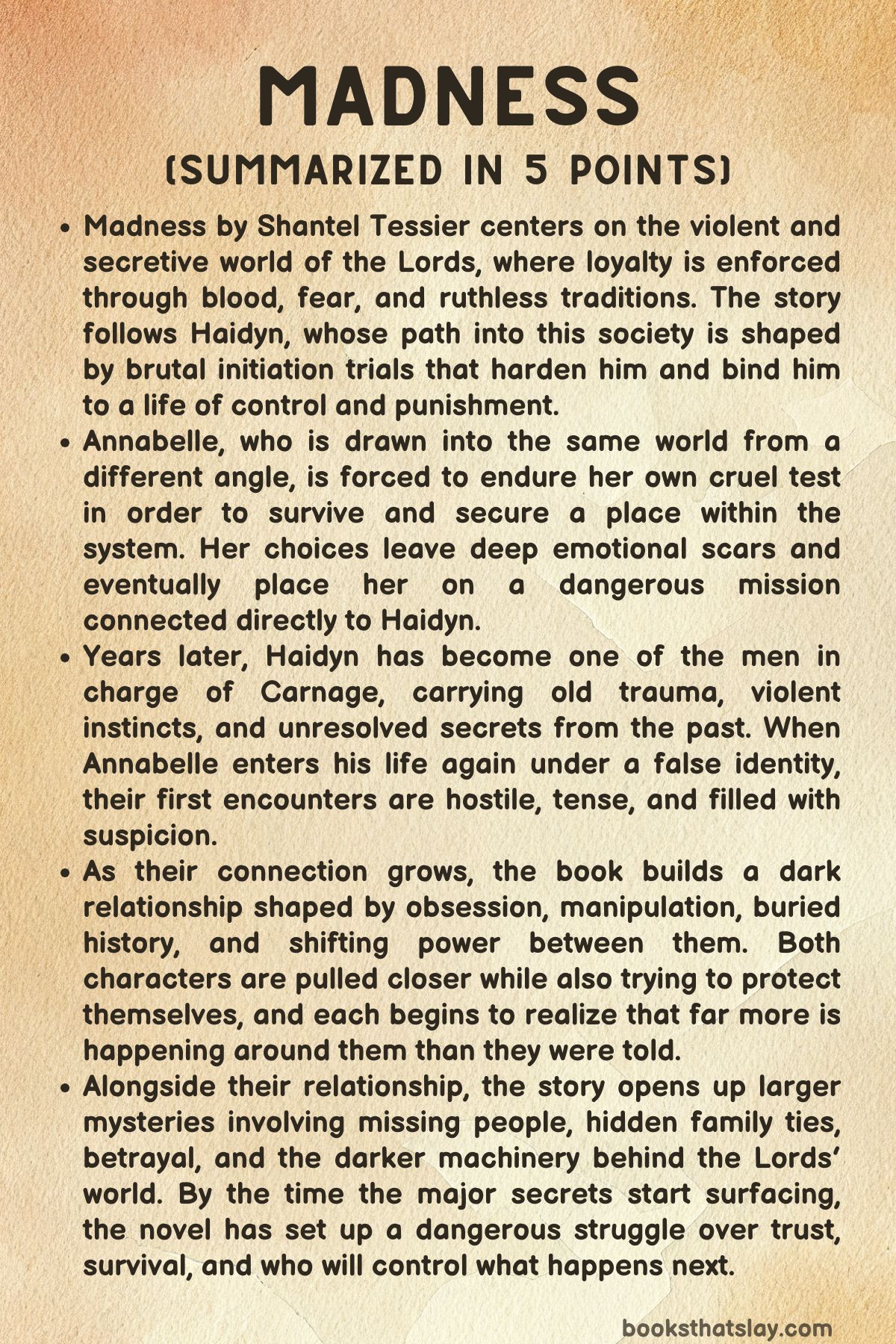
Madness by Shantel Tessier is a dark romance set inside a violent secret society where power, obedience, and cruelty shape every relationship. The story follows Haidyn, a man raised inside this brutal order, and Annabelle, a woman pushed into its schemes under a false identity.
Their lives collide in a world ruled by blood oaths, hidden histories, forced loyalties, and constant danger. The novel combines psychological tension, family secrets, and a controlling love story, showing how both characters are trapped by systems far older and darker than themselves, even as they begin reaching for something more human within all that brutality.
Summary
The novel begins by laying out the world of the Lords, a hidden and merciless society built on oaths, domination, and inherited power. Men within this order are expected to serve, punish, and uphold its laws, while women are often treated as possessions or tools.
Among the most feared figures in this structure are the Spade brothers, enforcers who hunt down oath breakers and carry out violence without hesitation. Haidyn is one of the men shaped by this world, and his rise within it begins at Barrington University, where he is forced through a series of initiation trials.
In his first trial as a freshman, Haidyn is weakened in a cell and then taken into an arena. He is drugged and pushed into a fight against two armed men while having little to defend himself.
Even injured and disadvantaged, he survives by reacting quickly, using their weapons against them, and killing both attackers. Though he passes, his father offers no warmth or pride, showing only relief that Haidyn has not failed.
His second trial is cruel in a different way. He is brought into a room with two battered women hanging in restraints and told that one is innocent while the other is guilty.
He must decide who lives. Under pressure and watched by his cold father, Haidyn chooses one woman to die, while the other is taken away.
Instead of approval, he is told he should have let them both die. The lesson is clear: mercy is weakness in this world.
His next initiation happens on a yacht, where he and his brothers are assigned killings. Haidyn notices a striking brunette woman at the party before hunting down the Lord he has been sent to eliminate.
The man accepts death, asking only that Haidyn take care of “her.” Haidyn kills him and leaves with those words lingering in his mind. By senior year, he reaches the final trial at Carnage, where he and his brothers are tied before the gathered Lords.
Asked whether he wishes to continue, Haidyn agrees only for the sake of his brothers. His father brands him, completing his transformation into one of the Lords’ own.
The story then shifts to Annabelle, who wants more than the narrow place women are allowed in this world. During her own initiation, she is taken to the cathedral and ordered to choose between cutting a Lord’s brand from a bound woman or taking the mark on herself.
She cuts the brand from the woman’s flesh, then is commanded to kill her. Annabelle obeys, but the act leaves her empty.
Even then, she is not spared. Because she claimed the brand, the Lords decide she has earned one of her own.
She accepts the pain as the cost of survival.
Years later, Haidyn has become one of the men in charge of Carnage alongside Saint and Kashton after their fathers’ deaths. He is bitter, violent, and closed off, pushing away the therapists the Lords keep sending him.
He is also haunted by old wounds involving Ashtyn and Adam, one of their missing brothers. When the murder of a woman echoes old crimes tied to Adam, buried fears return.
At the same time, Annabelle is still haunted by the woman she killed. She is pulled back into the Lords’ service and given a false identity as Charlotte Hewett.
Under orders from an unknown Lord, she is told to focus on Haidyn Jamison Reeves. She is given a new life, a cover story, and very little real information.
When she finally meets Haidyn at Carnage in the role of therapist, he recognizes her from the yacht years earlier. Their first session is tense from the beginning.
He mocks therapy, refuses to cooperate, and tries to intimidate her into retreating. Before sending her away, he makes it clear that any honest conversation between them will happen only on degrading terms, turning their connection into a struggle for control almost immediately.
Annabelle leaves shaken, but she cannot abandon the mission. She studies the limited information she has been given and grows angry at how little she truly knows.
She is supposed to manipulate Haidyn without even understanding what secret she is meant to uncover. Haidyn, meanwhile, distrusts her on sight.
He investigates her background and questions why someone so young has been assigned to him. He tells Saint and Kashton he wants no part of therapy, but they remind him the Lords insist on it because they believe he once tried to kill himself.
Haidyn resents their interpretation of the past and refuses to let them define him through that moment.
Annabelle later receives a video from the unknown Lord showing Haidyn years earlier, bleeding from his wrists while another man tries desperately to save him. The footage confirms that the Lords were telling the truth about his breakdown, but it still offers her no clear path.
She remains in the dark, caught between instructions and ignorance.
As the story moves forward, it also returns to earlier periods in Haidyn’s life. He recalls confronting Adam during their senior year and sensing that Adam is driving people away to protect them.
Another memory shows Haidyn letting Ashtyn flee after a violent incident, knowing that past sins never stay buried. These old events continue to shape the present as Ashtyn’s return to Carnage threatens to reopen every wound.
In the present, Haidyn becomes increasingly fixated on Annabelle. He sees her at Blackout in a freer setting and cannot stop watching her, even when he forces himself to leave.
Annabelle is equally unsettled by her growing attraction to him, even while keeping up a fake relationship with Wesley, the man posing as her boyfriend. When Haidyn cancels one of their sessions, she refuses to back down and insists on seeing him.
Jessie leads her into the basement, where she finds him torturing a prisoner. Haidyn turns the scene into a message, making her watch and reminding her what happens to liars in his world.
Though horrified, she decides afterward that she will not let him drive her away.
The stakes deepen as kidnappings, shootings, and investigations spread around them. Haidyn and Adam travel to Las Vegas looking for answers connected to Benny and recent attacks.
They meet the Kings, search through evidence, and uncover photographs of Ashtyn along with clues tied to the Mason brothers. Haidyn pushes forward despite pain and exhaustion, while Annabelle tries to balance her false life, her mother’s expectations, and her dangerous assignment.
Their relationship becomes sexual and emotionally tangled. Haidyn dominates her physically, but afterward the story opens up his inner conflict.
One night he meets Bill, Annabelle’s stepfather, in the cathedral. Bill reveals that Charlotte’s real name is Annabelle Schults and claims she descends from one of the founders of the society.
He then shows Haidyn the fate of a failed initiated woman: reduced to a captive “breeder,” assaulted until pregnant, stripped of her child, and used again and again. Bill warns that this could be Annabelle’s future if she fails.
He says the kindest end for her might be a bullet in her sleep.
Haidyn returns home shaken and finds Annabelle sleeping peacefully in his bed. He cannot hurt her.
Instead, he lies beside her and holds her, thinking about how trapped she is. That moment leads into one of his most painful memories, when he was once forced to choose between letting Sierra, his chosen, suffer further abuse or ending her life himself.
He kills her quickly to spare her worse torment, and the act leaves permanent damage inside him.
Back in the present, Haidyn questions Annabelle while she is lightly drugged, hoping to get answers about Dollhouse, her assigned Lord, and the founders. She knows almost nothing.
This confirms that she is being used as much as he is. Despite the danger around them, moments of tenderness begin to appear.
Annabelle talks about wanting children and being loved fully. Haidyn claims not to believe in love, but her hope affects him deeply.
Soon their lives are shaken again. At a meeting with Tyson and Ryat, a woman named LeAnne appears looking for her daughter, Blakely.
Annabelle recognizes her as Anne, her mother’s longtime friend, and the reaction from the men shows that her arrival matters. Soon after, Annabelle is attacked in a gas station restroom by a masked man who nearly strangles her.
Later, Hudson is brought into the basement at Carnage for questioning. Under pressure, it is revealed that he slit Kash’s wrists, had been involved with Isabella for years, and is Benny’s cousin.
Another prisoner confirms Hudson hired him to track and attack Annabelle so Haidyn would find her afterward. Hudson also admits he had access to Annabelle’s phone and even to Haidyn’s hidden cameras, allowing him to watch their most private moments.
Enraged, Haidyn straps Hudson down, forces him awake with adrenaline, and blinds him. Annabelle tries to stay strong, but the violence overwhelms her.
A week later, blood tests at the hospital reveal that LeAnne is Isabella’s twin, meaning Annabelle and Blakely are related. This discovery helps explain strange patterns in how certain women were treated by the Lords and opens new questions about the founding families.
More buried truths come out, including the fact that Ashtyn had once been intended for Haidyn. Though the revelation causes anger and pain, the group is forced to move on quickly when Sin arrives with orders to bring Adam in.
Moments later, a gunshot is heard, and Adam appears to be dead.
His funeral leaves everyone devastated, but the truth emerges that night. Haidyn, Saint, and Kash are summoned to the airfield, where Bill and a detective meet them on a private jet.
Once airborne, Adam appears alive. He explains that his death was staged because he has spent four years undercover in a secret division investigating human trafficking.
He reveals that the Lords are tied to a much wider criminal network, including Dollhouse. He also tells them that Annabelle’s initiation involved the death of his chosen, though she never understood the full truth.
Adam asks them to keep his survival secret so he can continue the mission. They agree.
By the end, Haidyn returns to Annabelle, promising safety while carrying truths he cannot yet share, and the future between them remains bound to love, violence, and the dark system still closing in around them.
Characters
Haidyn Jamison Reeves
Haidyn stands at the center of the story as a man shaped by ritualized violence, emotional deprivation, and forced loyalty. From the beginning, his character is defined by endurance.
His initiation trials are not simply tests of strength but deliberate attempts to strip away empathy and individuality. He survives brutal combat, is pushed into making impossible moral choices, and is branded into a life he never truly chooses for himself.
These experiences explain why, as an adult, he is bitter, volatile, and deeply closed off. He has been raised in a world where mercy is treated as weakness, where hesitation is punished, and where his worth depends on how effectively he can carry out cruelty.
Because of this, much of his personality is built around control, intimidation, and emotional distance.
At the same time, Haidyn is not a flat enforcer. The story makes clear that he is in constant conflict with the system that made him.
Even when he obeys, there are signs that some part of him resists. His father’s disappointment when Haidyn shows even a trace of compassion reveals that Haidyn has never been perfectly molded into the kind of man the Lords want.
That inner fracture remains with him throughout the story. He is capable of terrifying violence, especially when interrogating or punishing others, yet those same scenes also reveal his instability, buried pain, and deep disgust with the structures around him.
His fury is not only directed outward. Much of it comes from self-hatred, survivor’s guilt, and the memory of the women he could not save.
His emotional life is driven by trauma. The memory of Sierra’s death is especially important because it shows how completely his world has trained him to think in terms of lesser evils rather than real escape.
Killing her quickly is presented as an act of mercy, but it also leaves a permanent wound on him. The same pattern appears in his reactions to Charlotte.
He begins by treating her as another threat, another manipulation forced on him by the Lords, but his obsession with her quickly reveals that she reaches parts of him he has tried to kill off. He watches her, tests her, frightens her, punishes her, and questions her, yet he also protects her, holds her when she sleeps, and becomes horrified when he learns what her failure could mean.
This contradiction is central to his character. He is dangerous and controlling, but he is also one of the few men in this world who still seems capable of genuine emotional attachment.
Haidyn’s relationship with love is equally revealing. He rejects the idea openly, most likely because love in his experience has always been linked to loss, manipulation, or pain.
Yet his actions repeatedly betray that rejection. His growing tenderness toward Charlotte, his fixation on Ashtyn’s safety, and his loyalty to his brothers all suggest that he feels deeply even when he refuses to name those feelings.
He is therefore a character built on tension: between brutality and care, power and helplessness, obedience and resistance. He is not simply a cruel man in a dark world.
He is a man who has been made into a weapon and who is slowly, painfully confronted with the possibility that he still has a soul.
Annabelle Schults / Charlotte Hewett / Charlotte Reeves
Annabelle is one of the most layered characters in the story because her identity is fractured across multiple names, roles, and loyalties. She begins as a woman who wants more than the restricted place allowed to women in this society, and that ambition immediately sets her apart.
Her initiation proves both her strength and her entrapment. She does what is required to survive, cutting the brand from another woman and then killing her, but the act leaves her emotionally shaken rather than empowered.
That reaction matters because it shows she is not naturally suited to the cruelty demanded by the Lords. She can perform violence when cornered, but she is not numb to it.
She carries what she has done, and the haunting weight of that memory remains part of her characterization throughout the story.
As Charlotte Hewett, she is forced into performance. She enters Carnage under a false identity, pretending to be a therapist while actually serving an unknown Lord.
This false role creates one of the most important tensions in her character. She is supposed to manipulate Haidyn, yet she is given very little information and almost no real agency.
She is being used, but not trusted. She is expected to produce results while remaining ignorant of the larger plan.
That makes her both participant and victim. Her fear, confusion, and frustration come not only from Haidyn’s threatening behavior, but from the fact that she herself is trapped in a game whose rules she does not understand.
What makes Annabelle compelling is that she does not collapse under this pressure. She is shaken again and again, but she continues forward.
After their first meeting leaves her deeply disturbed, she still returns. After witnessing torture in the basement, she is horrified but resolves not to be driven away.
When attacked in the gas station, she fights back fiercely. These moments show that she possesses a stubbornness that matches the dark world around her, even if her power operates differently from Haidyn’s.
She does not dominate through force. Her strength lies in endurance, emotional courage, and the refusal to give up even when she is frightened.
Her relationship with Haidyn reveals her deepest vulnerabilities. She is drawn to him even while understanding how dangerous he is.
This is not presented as simple romance, but as a complicated emotional entanglement shaped by fear, desire, loneliness, and mutual recognition. She senses tenderness in him beneath the harshness, and that keeps pulling her closer despite the obvious risk.
At the same time, she longs for love, acceptance, and family in a way that highlights how emotionally different she is from Haidyn. Where he distrusts attachment, she still wants to believe in it.
Her hope becomes one of her defining traits. It is not naive, because she has seen enough horror to know better, but it persists anyway.
Annabelle’s evolution also reflects a struggle over selfhood. She is born into one role, forced into another, and gradually begins imagining a future that belongs to her.
Her wish to become Charlotte Reeves is not just a romantic gesture. It signals a desire to shed the identity shaped by her mother, the Lords, and old assignments, and to claim a life chosen on her own terms.
That longing gives her character emotional depth. She is not only surviving the system; she is trying to imagine a self beyond it.
Adam
Adam is one of the most mysterious and consequential figures. For much of the story, he exists at the edge of events as a missing or unstable brother whose actions are surrounded by suspicion, grief, and secrecy.
Early on, he appears burdened, distant, and deliberately isolating himself from the people around him. When Haidyn confronts him in the past, Adam admits he is trying to push others away for their protection, especially Ashtyn.
This immediately marks him as a character carrying knowledge too dangerous to share openly. His secrecy creates tension because it can be mistaken for guilt, instability, or betrayal, but underneath it is a sacrificial logic.
He is willing to become misunderstood if that helps keep others alive.
That pattern reaches its full meaning in the final revelation that Adam has been undercover for four years investigating human trafficking connected to the Lords and Dollhouse. This transforms many earlier uncertainties into evidence of immense pressure and discipline.
Adam has not been absent out of selfishness or cowardice. He has been carrying out a role that demands deception at every level, even to the point of staging his own death.
That choice shows extraordinary commitment, but it also reveals how isolated he has become. He lives in a space where emotional honesty is impossible, where even his brothers must mourn him as dead, and where personal relationships must be sacrificed to the larger mission.
Adam’s characterization is therefore built around hidden burden. He is not as overtly violent or emotionally explosive as Haidyn, but he may be just as damaged.
The fact that his chosen’s death is tied to Charlotte’s initiation adds another layer of tragedy to him. Like many men in this world, he has lost deeply because of the Lords’ system, and that loss seems to fuel his determination to expose the larger network behind it.
He represents a different model of masculinity within the story: not less dark, but quieter, more strategic, and more willing to vanish into suffering for a long-term goal.
He also plays an important symbolic role in the narrative because his apparent death and later return expose how fragile trust has become in this world. Everyone around him is forced to confront how little they truly know, even about those they love.
Yet despite all the deception, his reveal ultimately confirms his loyalty. He has never stopped fighting for his brothers or against the machinery hurting women and children.
This makes him one of the story’s most tragic but also most purposeful characters.
Saint
Saint functions as one of Haidyn’s closest anchors within the brutal environment of Carnage. Though the summary does not always dwell on him at length, his repeated presence in major scenes suggests steadiness, authority, and fierce loyalty.
He is one of the men now running Carnage after their fathers’ deaths, which places him among the inheritors of a violent legacy. Unlike Haidyn, however, Saint seems to operate with more visible restraint.
He interrupts at key moments, remains part of important decisions, and stands as one of the few figures who can enter Haidyn’s emotional orbit without being pushed out entirely.
His role in the group appears to be partly stabilizing. When Haidyn resists therapy or spirals into obsession, Saint is among those who remind him of the external pressures they are under.
He is not soft, but he is practical. The book also shows that he is strongly affected by revelations involving Ashtyn and Haidyn.
His anger when he learns Ashtyn had once been intended for Haidyn points to deep emotional investment and protectiveness. This suggests that Saint is not simply a brother-in-arms; he is someone whose loyalties are intensely personal, especially where love and family are involved.
Saint’s importance lies in the way he reflects both the strength and the damage of the brotherhood. He is part of the same violent system, yet his reactions imply he still holds onto emotional truths that the Lords would rather erase.
He helps show that not every powerful man in this world is emotionally deadened in the same way. His devotion, anger, and presence all make him a crucial supporting force.
Kashton / Kash
Kashton, often called Kash, is another central brother whose character is closely tied to loyalty, suffering, and emotional intensity. One of the earliest hints of his significance is the importance placed on the revelation that Hudson slit Kash’s wrists.
That fact immediately reframes earlier injuries as part of a much longer betrayal. Kash’s suffering becomes a thread connecting past trauma to present revenge, and the emotional force of that revelation suggests he is deeply loved within the group.
Kash seems to wear his feelings more openly than Haidyn. The book describes his face lighting up with pride when he learns Charlotte shot Hudson, and later it notes his anguish at Adam’s funeral.
These reactions suggest a character who, despite existing in a cruel world, has not buried every outward sign of attachment. He appears capable of real warmth, pride, and grief.
That makes him a valuable contrast to Haidyn’s colder presentation.
At the same time, Kash is no less shaped by violence. His injuries, his role at Carnage, and his place among the brothers all imply someone forged by the same brutal system.
What distinguishes him is that he seems to retain more visible emotional responsiveness. His character contributes to the sense that the brothers are not interchangeable dark figures, but men carrying different expressions of damage and loyalty.
Ashtyn
Ashtyn is a character whose power comes partly from absence and partly from the intense reactions she provokes in others. Much of her story is filtered through Haidyn’s memories and fears, which immediately marks her as someone tied to unfinished history and emotional danger.
Her return to Carnage alarms Haidyn because he knows it will reopen old wounds, and that alone shows how central she is to the buried tensions between the brothers.
The book suggests that Ashtyn has long been caught in the political and emotional machinery of this world. She once fled after a violent incident, and Haidyn let her go rather than stop her, implying both sympathy and recognition that the system would eventually hunt her down again.
Later, it is revealed that older men once wanted Haidyn to take her as his Lady for political reasons, showing how women are treated as bargaining pieces in alliances among powerful men. This planned arrangement becomes even more emotionally charged once Saint learns about it and reacts with fury.
Despite all this, Ashtyn is not presented as passive. When conflict erupts after the revelation, she steps in herself and makes it clear that nothing changes her love for her husband.
That moment suggests firmness, emotional clarity, and refusal to let male power struggles define her relationship. Even in a book where much of her story is seen through others, she comes across as someone who has endured manipulation and danger but still asserts her own emotional truth.
She embodies the cost of the system’s treatment of women while also showing a will that has not been extinguished by it.
Bill
Bill is one of the most unsettling and ambiguous figures. As Charlotte’s stepfather, he should occupy a protective role, but his actions and knowledge place him in a morally disturbing space.
He is deeply informed about the secret society, its founders, and the punishments reserved for women, and he reveals these truths to Haidyn in a way that is both helpful and horrifying. He knows that Charlotte is in danger, knows the likely fate of women who fail, and yet seems fundamentally entangled with the same system that produces those outcomes.
What makes Bill especially disturbing is his calm acceptance of cruelty. He explains the breeder system with blunt clarity and concludes that the kindest outcome for Charlotte might be a bullet in her sleep.
This statement can be read as grim honesty, but it also shows how normalized monstrous violence has become for him. He is not shocked by the system; he knows it intimately.
That makes him difficult to classify. He is not presented as a straightforward villain because he does help expose truths and later assists in explaining family secrets, but he is far from trustworthy in any ordinary sense.
Bill’s character represents corrupted paternal authority. He is a man who has access, knowledge, and influence, yet is unable or unwilling to dismantle the world hurting the young women around him.
His relationship to Charlotte becomes especially tragic because she sees him through the lens of family, while Haidyn is forced to see how compromised he really is. He stands as one of the clearest examples of how older generations uphold the system not only through violence, but through accommodation and secrecy.
Hudson
Hudson is characterized as a smug, invasive, and vindictive antagonist whose importance grows as his connections to earlier violence are uncovered. His role in the story is not just that of a captured enemy but of a man whose reach has extended far deeper into Carnage and Charlotte’s life than anyone realized.
His involvement with Isabella, Benny, and past violence against Kash reveals him as a long-term infiltrator shaped by calculation rather than brute force alone.
What makes Hudson especially repellent is the personal nature of his violations. He does not merely attack from a distance.
He watches, tracks, manipulates, and engineers moments of humiliation and terror. His decision to have Charlotte assaulted specifically so Haidyn would be the one to find her shows a cruel interest in psychological damage.
His access to her phone, her cameras, and intimate footage of her with Haidyn adds another layer of violation. He wants not only power, but the pleasure of intrusion and degradation.
Hudson’s smugness during questioning reinforces his character as someone who believes he can still exert control even when captured. That arrogance is what finally triggers Haidyn’s overwhelming rage.
In narrative terms, Hudson serves as a concentrated form of the wider corruption around the characters: he is betrayal, voyeurism, and calculated cruelty made personal.
Isabella
Isabella’s role is partly indirect, but her influence is unmistakable. She is connected to training, schemes, manipulation, and the larger network of secrets that surround the brothers’ past.
The fact that Hudson worked with her and that her actions stretch back years suggests a woman deeply embedded in the power structures of this world. She is not simply a victim of it.
She has actively shaped events.
The revelation that LeAnne is her twin gives Isabella additional symbolic weight because it opens up questions of family resemblance, hidden bloodlines, and the different paths available to women connected to the founders. She seems to embody the more calculating, dangerous side of female survival within the Lords’ society.
Rather than resisting the system openly, she appears to have learned how to work through it, manipulate people, and leave damage in her wake.
Isabella feels like a lingering threat rather than a closed chapter. Her significance lies in how many present horrors connect back to her actions, making her one of the hidden architects of pain in the story.
LeAnne / Anne
LeAnne enters later, but her arrival carries major emotional and structural importance. Charlotte knows her as Anne, her mother’s longtime friend, which means her appearance immediately disrupts Charlotte’s understanding of her own family history.
When she comes looking for her daughter, Blakely, the men react with tension, suggesting LeAnne’s identity is tied to long-buried secrets that could destabilize everything.
The later blood test revealing that LeAnne is Isabella’s twin transforms her from a side figure into a key link between family lines, founder histories, and the strange treatment of certain women by the Lords. She seems to stand at the crossroads of truth and concealment.
Though the summary does not give her a full psychological portrait, she clearly functions as someone whose existence forces other characters to confront the fact that their histories have been manipulated.
LeAnne’s character is therefore important less for direct action than for revelation. She carries the weight of hidden lineage, maternal connection, and the possibility that women’s roles in this society have always been more complicated than the men understood.
Wesley
Wesley occupies a smaller but revealing role as the man posing as Annabelle’s boyfriend. His importance lies in what he shows about her divided life.
Around him, she tries to maintain normal appearances while inwardly becoming more entangled with Haidyn and the dangerous mission consuming her. Wesley represents the respectable, controlled façade she is expected to perform in public, but he is emotionally overshadowed by the darker and more urgent reality pulling her elsewhere.
As a character, he helps illuminate Annabelle rather than standing fully on his own. His presence highlights her deception, her isolation, and the widening gap between the identity she performs and the life she is actually living.
He is useful as a contrast figure: ordinary on the surface, but trapped inside a story where ordinary roles are impossible to sustain.
Jessie
Jessie appears briefly, but the role is meaningful. By taking Annabelle to the basement and exposing her to the reality of Haidyn’s violence, Jessie acts as a threshold figure between surface appearances and the brutal truth of Carnage.
The character helps move Annabelle from fear based on suggestion into fear based on direct witness. Though not deeply explored, Jessie contributes to the atmosphere of a place where many people quietly facilitate horror without necessarily controlling it.
Benny
Benny is another supporting figure whose significance comes through connections rather than prolonged presence. As Hudson’s cousin, he becomes part of the network that allowed enemies access to Carnage and to the brothers’ private world.
Evidence recovered from his destroyed place helps push the investigation forward, especially in relation to Ashtyn and the Mason brothers. Benny functions as one more node in the hidden web surrounding the main cast, showing that betrayal is not isolated but organized.
Tyson, Ryat, Sin, and Blakely
These characters deepen the world around the main couple and the brothers. Tyson and Ryat appear as men involved in serious discussions, investigations, and operations, helping establish the broader alliances and tensions surrounding Carnage.
Sin’s role becomes especially dramatic when Adam’s staged death unfolds, placing him in the middle of a moment that devastates the group. Blakely becomes important through the revelation of her blood connection to Charlotte, which broadens the family mystery and suggests that the next generation is also entangled in the founders’ legacy.
Though these characters are not explored as fully in the summary, they are important in showing that the story’s emotional and political conflicts extend well beyond one couple.
Sierra
Sierra appears only in memory, but her importance is enormous. She represents one of the deepest wounds in Haidyn’s past and one of the clearest examples of how women are used to punish men in this world.
Her torture and mercy killing reveal the true horror of the system more effectively than any rule or oath. She is not allowed agency in the flashback; she is made into an object through which Haidyn is broken.
Yet precisely because of that, her death remains one of the emotional centers of his trauma.
Sierra’s role is tragic because she continues to shape Haidyn long after her death. She is part of the reason he reacts so strongly to Charlotte’s danger and why he cannot fully accept the world’s logic without also hating himself.
In that sense, Sierra is one of the story’s most haunting characters, even with limited page presence.
Themes
Power as Ritualized Violence
Authority in Madness is not maintained through respect, wisdom, or consent. It is built through spectacle, terror, and repeated acts of physical and psychological damage.
From the earliest initiation trials, power is shown as something that must be earned by destroying empathy. Haidyn is not merely tested for strength; he is trained to accept cruelty as normal and to prove that he can act without hesitation even when faced with impossible moral choices.
The system does not reward mercy. In fact, every moment of hesitation is treated as weakness, and every act of survival requires some surrender of conscience.
That makes violence more than a tool in this world. It becomes a language, a method of governance, and a public ceremony through which the Lords confirm who belongs and who does not.
What makes this theme especially striking is that brutality is always tied to structure. The characters are not moving through random chaos.
They are trapped inside a carefully ordered system that gives pain rules, symbols, ranks, and traditions. Branding, forced trials, ritual killings, punishment chambers, surveillance, and torture all serve the same purpose: they turn domination into law.
Even family bonds are shaped by this logic. Fathers do not protect sons; they measure whether sons are ruthless enough to preserve the order.
Women are not regarded as full people but as assets, leverage, or proof of obedience. In this setting, violence is not presented as an unfortunate side effect of corruption.
It is the foundation of the culture itself.
The story also shows how such systems preserve themselves by making victims into participants. Haidyn, Annabelle, Adam, Ashtyn, and others are all scarred by the rules, yet many are also forced to carry them out.
That is what gives the theme its depth. The real horror is not simply that terrible men exist, but that an entire institution has found ways to make cruelty feel inevitable.
The characters must either enforce the system, submit to it, or risk annihilation by it. Power here is therefore not only violent; it is self-replicating.
It survives because it teaches people that survival depends on becoming part of the machine that hurt them.
The Commodification of Women and the Fight for Agency
One of the clearest themes in the book is the way women’s bodies and lives are controlled, assigned, exchanged, and punished by male authority. Women are branded, evaluated, used as leverage, placed into marriages for strategy, and subjected to horrifying consequences when they fail to meet expectations.
Their suffering is built into the structure of the society. The system treats them as vessels for lineage, sexuality, loyalty, and revenge rather than as individuals with independent desires.
Annabelle’s initiation makes this painfully clear. She is pushed into violence not because she is naturally cruel, but because the world around her gives her survival only through complicity.
Her pain is not accidental. It is the price demanded by entry into a system that never intended to treat her fairly.
Yet the theme does not stop at victimization. It also examines the unstable, complicated forms of agency available to women inside such a world.
Annabelle wants more than the narrow life prescribed for her, and that desire itself becomes dangerous. She accepts assignments, constructs false identities, and keeps moving even while frightened and underinformed.
Her choices are constrained, but they are still choices made under pressure, and the novel seems interested in how women carve out fragments of will inside structures built to contain them. Charlotte is not free, but she refuses total passivity.
She returns to Carnage when Haidyn tries to frighten her away, keeps asking questions, and continues acting even when she knows she is vulnerable.
The theme becomes darker and even more disturbing through the revelation of what happens to women who fail: forced sexual captivity, reproductive exploitation, and the removal of their children. This expands the story’s critique from individual abuse to systemic gendered oppression.
Female bodies are treated as property that can be disciplined for political and reproductive purposes. Love, marriage, and motherhood are all contaminated by coercion.
Even tenderness becomes suspect because it can be folded back into ownership.
At the same time, the narrative suggests that agency can survive even inside dehumanizing systems. It may appear as defiance, endurance, secrecy, refusal, or the attempt to redefine one’s future.
That tension gives the theme its force. The women are never fully safe, but they are not written as empty symbols of suffering either.
Their struggle is about trying to remain human in a world that continually reduces them to function.
Trauma, Memory, and the Difficulty of Intimacy
Almost every major relationship in Madness is shaped by old wounds that do not stay in the past. Trauma is not handled as a backstory detail that explains behavior once and then fades away.
Instead, it remains active in the present, influencing desire, fear, anger, secrecy, and control. Haidyn’s emotional life is defined by what has been done to him and what he has been forced to do to others.
His initiation trials, Sierra’s death, the cruelty of his father, the manipulation by the Lords, the loss and presumed death surrounding Adam, and the ongoing violence at Carnage all leave him unable to trust tenderness without suspicion. His aggression is not separated from his pain.
The same man who terrifies others is also someone whose inner life has been shaped by survival, guilt, and unresolved grief.
This theme becomes especially strong in the relationship between Haidyn and Charlotte. Their connection is charged by desire, but it is equally marked by imbalance, secrecy, and emotional confusion.
Moments that seem intimate are often entangled with coercion, possessiveness, interrogation, or fear. Yet the relationship does not remain one-dimensional.
The book repeatedly shows softer moments emerging in between acts of dominance and conflict: Haidyn holding her while she sleeps, being shaken by the prospect of what may happen to her, listening when she speaks about love and children, and feeling his emotional defenses weaken in her presence. That makes intimacy in the story feel unstable but real.
It is not a clean refuge from violence; it is something trying to grow in damaged ground.
Memory also deepens this theme. The past keeps returning through flashbacks, revelations, videos, confessions, and resurfacing people.
Characters are never allowed a simple present because prior injuries continue to demand recognition. Haidyn remembers Sierra, Adam, Ashtyn, and the older men who tried to use marriage as control.
Charlotte becomes increasingly aware that her own life is built on partial truths and manipulated information. Their relationship is therefore not just a bond between two people; it is a meeting point between layered traumas neither fully understands.
The emotional center of this theme lies in the question of whether genuine connection can survive in people shaped by brutality. The story does not offer an easy answer.
Love is desired, feared, and often mistranslated through possession or protection. Trust is difficult because everyone carries hidden damage.
That complexity gives the theme weight. Intimacy here is not healing in a simple or sentimental sense.
It is risky, incomplete, and fragile, but it is also one of the few forces that makes the characters imagine a life beyond the system that formed them.
Inherited Corruption, Hidden Lineage, and the Burden of Secrets
Another major theme is the way corruption passes from one generation to the next through bloodlines, family alliances, concealed histories, and buried truths. The society in the book survives not only because its leaders are cruel, but because its cruelty is inherited.
Fathers shape sons into instruments of the same order. Family names carry obligations, expectations, and old sins.
Women are assigned roles according to lineage and political value. Secrets are protected across years until they become part of the architecture of the world.
That means the characters are not simply fighting present enemies. They are living inside consequences that began long before them.
This theme becomes more layered as revelations accumulate. Annabelle’s true identity, her connection to founder bloodlines, LeAnne’s connection to Isabella, the different treatment of certain wives, the hidden plans around Ashtyn, Adam’s staged death, and the ties between the Lords, Dollhouse, and trafficking all show a world where truth is deliberately fractured.
Information is controlled because knowledge itself is power. Characters are often given only enough truth to keep them useful.
Charlotte is sent on an assignment without understanding its full purpose. Haidyn is made to act while lacking the entire picture.
Even the reader’s understanding of the world seems to come in shards, reflecting how thoroughly deception governs this society.
What makes this theme effective is that secrets do not merely create suspense; they shape identity. Characters struggle to know who they are because their origins, loyalties, and histories have been manipulated by others.
A person’s name, family, engagement, assignment, or role may all be false or incomplete. Charlotte’s wish to change her name carries meaning because it is not just romantic.
It reflects a desire to separate herself from inherited structures and become someone self-defined rather than assigned. Similarly, Haidyn’s conflict is not only with enemies outside him, but with the legacy inside him: what he has inherited, what he has obeyed, and what he may still be capable of becoming.
The theme finally suggests that exposure alone is not enough. Learning the truth does not immediately free anyone.
Instead, each revelation brings new pain, new responsibilities, and new moral complications. Adam being alive is both relief and further burden.
Hidden family links answer some questions but open others. Knowledge in this world is not cleansing.
It is destabilizing. That idea gives the theme its power.
The deepest corruption in the story is not simply individual evil but a legacy of lies so old and so well-defended that every attempt to uncover it threatens to destroy the people trying to escape it.