Such a Bad Influence Summary, Characters and Themes
Such a Bad Influence by Olivia Muenter is a suspense-leaning contemporary novel about the cost of growing up online, told through the sharp, anxious lens of sisters who were never allowed to be ordinary. Eighteen-year-old influencer Evie Davis has built a life where every outfit, caption, and smile is measured against millions of strangers—especially the cruel ones she can’t stop reading
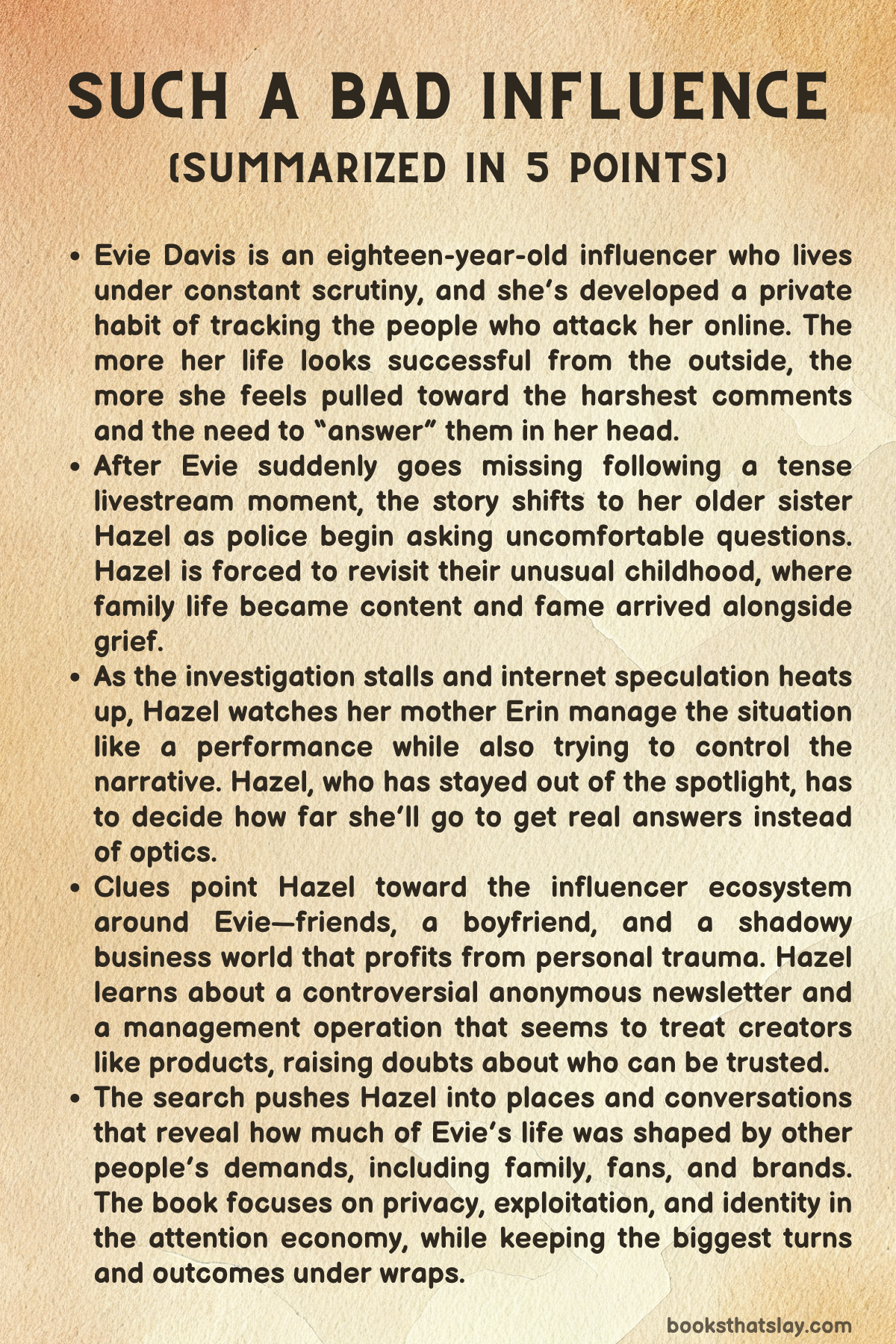
When Evie disappears after a chilling TikTok Live, her older sister Hazel is pulled back into a family history shaped by grief, fame, and a mother who treated their lives as content. The story asks who gets to own a person’s narrative—and what happens when the person fights back.
Summary
Evelyn “Evie” Davis is eighteen and famous in a way that leaves no quiet corners. She has millions of followers, endless brand deals, and a daily routine built around being watched.
Even when she isn’t filming, Evie is thinking about the audience: what they want, what they suspect, and what they hate. She has a private habit that feels like a compulsion—seeking out the meanest comments about herself, the forums dedicated to mocking her, the strangers who seem to resent her for existing.
One critic in particular, a woman who mailed a handwritten letter accusing Evie of being a selfish, dangerous role model, becomes part of Evie’s mental loop. Evie searches for details about people like this, mapping their real lives from their online traces, rehearsing arguments she’ll never deliver.
The more successful she becomes, the more the criticism multiplies, and the more she seems to need it—like proof that her happiness is real only if it survives public judgment.
One afternoon in Los Angeles, Evie sits in her car and scrolls through fresh insults about her authenticity and sponsorships. She starts a TikTok Live.
Hearts and viewer counts climb as she talks, but her attention keeps snagging on the cruelty in the comment stream. As she speaks, a man approaches her vehicle.
The comments flash something harsh—people saying they wish she would disappear. The live ends abruptly, leaving a screen recording that spreads fast and sparks panic.
The perspective shifts to Hazel Davis, Evie’s older sister. Hazel has built her identity around being close to fame without stepping into it.
She describes herself as the link people brag about: they don’t know Evie, but they know Hazel, and that proximity becomes its own strange label. Hazel has spent years trying to protect Evie while also keeping distance from the machine that made Evie a product.
That machine started with their parents. Their mother, Erin Davis, documented everything: road trips, daily routines, the texture of family life.
For a long time they lived in a converted mint-green school bus, chasing a scrappy, wholesome image online.
Then a video of little Evie dancing with their father went viral. The internet’s affection escalated, and so did the family’s visibility.
Shortly afterward, tragedy struck: their father died in a car accident after leaving Evie’s recital to buy her flowers. The grief didn’t stay private.
Hazel remembers seeing the viral upload framed as the father’s “last dance,” and realizing strangers were consuming their loss as entertainment. Erin leaned into the attention, the sponsorships, the new income.
Hazel felt the past being rewritten into content.
In the present, Evie has been missing for six days. Hazel learns this when Evie’s boyfriend, Gavin Ramirez, calls her in a panic.
Hazel drives to Erin’s wealthy home, now filled with brand-provided goods and curated comfort. Detectives interview Hazel and Erin.
Erin performs distress with the polish of someone accustomed to being watched. Detective Buxton shows open contempt for influencer culture, implying that Evie owes her audience access.
Detective Williams stays focused on facts and the urgency of finding Evie. Hazel explains that Evie’s audience includes obsessive fans and vicious haters, and the most unsettling are those who act like they own her.
Hazel gets the screen recording of Evie’s last TikTok Live from Gavin. She watches it repeatedly, searching for something she missed: the man near the car, the shift in Evie’s face, the moment the feed cuts.
Online, the clip turns into fuel for speculation. The detectives tell Erin and Hazel to stay quiet for now, arguing that publicity could complicate the investigation.
Hazel agrees outwardly but can’t stop scrolling, refreshing, and reading what strangers are saying about her sister.
The police trace the location of the live. They find no clear sign of struggle at the scene, but Evie’s car is missing.
A BOLO goes out. Security footage is delayed by bureaucracy.
Buxton urges the family to present a united front if they go public, hinting that internal conflict will invite suspicion and chaos. Hazel senses her mother playing the situation like a role, even noticing subtle flirting as Erin tries to keep Buxton engaged.
Hazel’s distrust of Erin runs deep. She remembers how Erin used her looks as currency online, how Hazel got bullied at school because classmates sexualized her mother, and how Erin seemed to treat criticism as market research.
Hazel explores Evie’s room and closet, which feel staged—too spotless, too ready for a camera. Among the carefully arranged jewelry and outfits, Hazel is hit with memories of Evie as a child trying to understand a world where value meant being appealing.
Hazel recalls a sister sleepover where Evie repeated Erin’s dieting language with a child’s sincerity, talking about “healthier” choices and body size. Hazel sees how early Evie absorbed the idea that her body and image belonged to public opinion.
Later, detectives call with an update: Evie’s car has been found in a parking lot near Palm Springs. Inside is Evie’s phone—factory reset, wiped clean.
Her wallet and ID are gone. There are no obvious signs of a fight.
Hazel feels sick at how intentional it looks. Erin focuses on what people will think and warns Hazel that old scandals could resurface and distract from the search.
As the disappearance becomes public, the internet turns it into a spectacle. Clips, old interviews, and podcasts rehash Evie’s rise—from the family vlog era to the viral dance to the father’s death.
Some blame Erin for exploiting her daughter; others defend her. Gavin begins posting daily “Dear Evie” videos that seem designed for maximum reach.
People argue over whether the disappearance is real or staged. The police interview Hazel again and push into the family’s finances and Erin’s control over Evie’s career.
Hazel tries to speak carefully, aware her mother may be listening.
The detectives ask Hazel to attend a search party Gavin is organizing, partly to observe him. Erin refuses to go, citing therapy.
Hazel drives to the meetup point in Palm Springs expecting crowds, but finds only a small group: Gavin, a couple of girls from Evie’s swim team, and one surprise arrival—Ashlyn Price, a fellow influencer who used to be close to Evie. Ashlyn’s presence jolts Hazel.
It suggests there are parts of Evie’s life Hazel never truly knew.
Detective Williams later tells Hazel that Evie has carried adult pressures for years and hints that Evie may have chosen to disappear. Hazel refuses to accept that.
Back at her own life in Vegas, Hazel is confronted by how far she’s fallen—mess, clutter, unemployment, and a sense that she only ever cleaned up when Evie visited. Messages pour in from people treating Evie like public property, saying they loved “watching” her grow up.
Hazel gets a strange message request from an anonymous account speaking with intense reverence about Evie, offering information. It triggers Hazel’s fear that the danger is real.
Ashlyn calls Hazel and says she can’t stay quiet anymore. She asks if Hazel really believes Evie posted the statement circulating online.
Ashlyn reveals the source of a major rift between her and Evie: an anonymous paid newsletter about influencer culture called SABI, which exposed creators’ private behavior and hinted at scandals. Ashlyn became a frequent target, and the information shared about her felt too personal to be random.
Over time, she started to suspect Evie was the author—especially because Evie’s own mentions were mild, almost protected. Ashlyn tested the theory by feeding Evie fake secrets.
When one of those fake stories appeared in SABI, Ashlyn decided Evie had to be behind it. She confronted Evie, and their friendship collapsed.
Then, weeks later, Evie reached out to Ashlyn sounding scared and paranoid—saying she felt watched, that her phone might be compromised, that personal items were going missing. Ashlyn ignored the messages, assuming Evie was manipulating the situation.
Now Ashlyn regrets it and sends Hazel a color-coded packet of evidence, including newsletters and Evie’s frantic texts. Hazel reads them and feels a new dread: Evie believed something was happening to her before she vanished.
A leaked transcript of Gavin’s police interview hits social media. In it, Buxton needles Gavin with racist remarks and insinuations.
Gavin reveals something significant: he and Evie had been working on a docuseries. Hazel decides to confront him.
She drives back to Arizona and finds Gavin house-sitting at a large suburban home. He’s casual, flirtatious, and unsettlingly confident.
Hazel demands the truth about the project. Gavin admits the docuseries was real and says they were investigating a shady influencer management company called ReBrand.
He describes a recruitment process full of pressure and psychological tactics, including calls from blocked numbers and probing personal questions. ReBrand, he says, pushed creators to monetize their darkest experiences under a “Greater Good” pitch, while taking a huge cut and dangling legitimacy through nonprofit talk.
Gavin claims the system is exploitative, and he and Evie wanted to expose it.
Hazel’s search leads her to Charlie, a therapist who once worked with Evie. Charlie reveals a hidden archive: Evie’s private journals, stored there because Evie feared Erin would read them.
Charlie admits she broke her usual boundary and read the most recent journal after Evie was reported missing, then insists Hazel should read it too. Hazel opens the latest journal and finds an address inside.
She drives toward Joshua Tree, guided by Evie’s words and a playlist Evie made, the desert stretching out like a place where someone could disappear on purpose or be made to disappear.
Interspersed with Hazel’s drive is a true-crime podcast segment investigating ReBrand, describing rumors of cult-like methods, tier systems, steep buy-ins, NDAs, coercion, and blackmail. The podcast suggests the top tier demands not only money but a surrender of identity.
Hazel arrives expecting a remote compound but finds a strange suburban edge: unfinished cul-de-sacs, empty lots, construction debris, and silence. Beyond the half-built neighborhood she sees dozens of small identical markers arranged like a makeshift graveyard.
They have initials on the backs. One newer marker reads “EED”—Evie’s initials.
Hazel panics, sensing a staged message meant to frighten. She notices someone watching from a lit house.
As she tries to flee, a barefoot woman steps into the road and forces her to stop, warning that tire spikes have damaged Hazel’s tires and there’s no service. Hazel demands Evie.
The woman says Evie is inside.
Hazel is brought into a bare, beige house and told to sit on a cushion. Evie appears alive, calm, and almost casual about the situation.
The woman introduces herself as Natalie and insists the tire incident was an accident connected to security precautions. Natalie explains there’s no internet or cell service on the property.
Evie tells Hazel she came to ReBrand for a “factory reset” from her life—an extreme boundary after growing up under constant surveillance. Hazel is furious that Evie let the world believe she was abducted, but Evie argues that normal choices were never available to her.
She wanted to disappear from everyone’s access, including their mother’s.
That night they sleep together like they used to during childhood sleepovers. Hazel admits she found the journals and read enough to see something chilling: Evie had discovered cameras Erin used to watch her, turning her private life into content and profit.
Evie confirms she felt trapped, unable to make any decision without calculating the internet’s reaction, the money, Erin’s control, and even Hazel’s opinions. Hazel tries to comfort her, but Evie snaps at the familiar pattern of being managed and reassured instead of listened to.
The next day they hike near the “graveyard.” Evie admits the markers scared her at first too. Hazel presses her about Ashlyn and Gavin.
Evie explains that her relationship with Gavin was partly performance—useful for public image—and not truly exclusive. She also hints that the theories about who wrote SABI and who benefited from it are more complicated than Hazel wants to believe.
Evie reveals that Natalie is actually Dani Tan, a well-known beauty creator who once disappeared and became ReBrand’s first top-tier success story. Evie admits a frightening video stunt was staged as a publicity tactic, calling it a mistake.
Hazel argues ReBrand is hypocrisy dressed as healing, but Evie insists the retreat helped her reclaim herself, and she believes stories of leaving influencer life can shift culture.
Natalie’s people replace Hazel’s tires, and Hazel is allowed to leave. Evie makes Hazel promise not to tell Erin where she is.
Before Hazel goes, she finds a folded note labeled “hazel.” She waits to read it until she reaches a gas station. The note instructs Hazel to return to Charlie and read every journal from the beginning.
It asks Hazel if she has heard of ghostwriting. It includes a drafted opening where Evie explains she kept two versions of herself: a diary she expected her mother to access and a set of real journals that documented the violations, including the hidden cameras and the way Erin monetized pain.
Two years later, Evie returns publicly with a book deal. Hazel goes back, reads the journals, and becomes deeply involved in shaping the manuscript, interviewing Evie to fill gaps.
Evie stays off social media for a long time, uses a flip phone, and eventually leaves ReBrand after getting what she needed and suspecting financial problems there. Evie and Hazel appear together on television, where Evie speaks smoothly about the harm done to children whose lives are posted for profit and argues for legal protections.
Then Evie delivers a final shock: she reveals on air that Hazel was the ghostwriter—and also the creator of the massively popular paid newsletter about influencers, the one that even wrote about Evie. Evie frames Hazel as different from their mother, but the implication lands hard.
Hazel realizes the internet will now turn its spotlight on her, and that the cycle of ownership, exposure, and profit has reached her too.
Characters
Evelyn “Evie” Davis
Evie is built as a paradox: an eighteen-year-old with enormous cultural power and almost no private life. She has millions of followers, yet her inner world is dominated by fear, shame, and a compulsive need to “check the temperature” of the internet, even when she knows it harms her.
The summary shows her addiction to hate-reading as both self-punishment and self-soothing, a ritual that makes her feel in control of how she is perceived while simultaneously keeping her trapped in other people’s judgment. Evie’s sharp intelligence comes through in how she researches critics and rehearses confrontations, but that same intensity curdles into paranoia and hypervigilance once she begins feeling watched and violated in real life.
Her disappearance is not framed as a simple vanishing but as a deliberate boundary drawn with extreme force, suggesting that for Evie, ordinary autonomy is impossible after being raised as content. Even when she is “safe,” she remains strategic: she understands narrative, leverage, and timing, and by the epilogue she uses those tools to reclaim the story publicly—yet she also repeats the cycle of exposure by turning her family’s trauma into a book and a message campaign.
The final twist, where she reveals Hazel’s hidden authorship and newsletter identity on live television, shows Evie’s ruthlessness when cornered and her willingness to weaponize truth as a form of control, even against the person who loves her most.
Hazel Davis
Hazel functions as both protector and witness, the older sister who has spent years orbiting a celebrity life she never asked for and never benefited from in the same way. She defines herself through proximity—“my sister’s sister first”—which reveals both devotion and a subtle identity erosion, as if her own life keeps shrinking to make room for Evie’s crisis.
Hazel’s narration is shaped by guilt, resentment, and tenderness coexisting at once: she is furious about exploitation, envious of attention, and still reflexively loyal. Her “normal” life in Vegas is depicted as messy and unraveling, implying that stepping away from the spotlight didn’t save her; it merely removed structure while leaving the psychological damage intact.
Hazel’s investigative drive reads like an attempt to turn helplessness into action, and her spirals—doomscrolling, replaying the clip, fixating on mundane texts—mirror Evie’s own compulsions, suggesting the sisters are more alike than Hazel wants to admit. Most importantly, Hazel becomes the ethical battleground of the story: she wants to rescue Evie from being consumed by strangers, yet she is ultimately revealed as someone who also monetized influencer culture through a paid newsletter and then literally ghostwrote Evie’s “truth.” The epilogue forces Hazel to confront that she may be repeating the family pattern in a cleaner, more intellectual form—telling herself she is protecting Evie while still shaping and selling Evie’s life.
Erin Davis
Erin is portrayed as the architect of the family’s public life and the most chilling example of how parental love can be entangled with ambition, vanity, and control. She is charismatic and image-obsessed, and her beauty is not just a trait but a force that organizes the household—how people treat them, how they are marketed, and how power moves through rooms, including her ability to draw Detective Buxton into a familiar dynamic of attention and performance.
Erin’s relationship to her daughters is fundamentally mediated by content: she filmed constantly, promised opportunity, curated their grief after Chris’s death, and treated Evie’s childhood as a brand pipeline. The summary’s most damning detail is that Erin not only failed to protect Evie from online cruelty but seemingly collected the nastiest posts as “guidance,” turning abuse into a management tool.
Her insistence on appearing “united” during Evie’s disappearance reads less like maternal steadiness and more like crisis PR, a reflex to control the narrative before it controls her. Erin’s alleged privacy violations—hidden cameras, monetizing pain, controlling access to friends—position her as someone who does not recognize her children’s inner lives as separate from her project.
Even when she shows moments that could be interpreted as fear or grief, they are filtered through performativity, leaving the reader unsure whether Erin experiences emotion directly or only as something to display.
Gavin Ramirez
Gavin is written as a character who understands the economy of attention and tries to play it while claiming he hates it. His “Dear Evie” videos and the proposed docuseries suggest he is constantly narrativizing events, turning private relationships into public arcs that can be consumed.
At the same time, he is not a simple villain; he provides key information, triggers Hazel’s involvement, and appears genuinely invested in exposing ReBrand’s exploitation, especially after describing how they targeted his father’s Alzheimer’s for monetizable suffering. His flirtation with Hazel and his casual intimacy when she confronts him create an unsettling ambiguity: he can be supportive while still being manipulative, charming while still opportunistic.
Gavin’s relationship with Evie is also revealed to be partially performative—public couplehood as branding—which makes him emblematic of the novel’s larger critique: in influencer culture, sincerity and strategy become impossible to separate. Whether he is ultimately more victim than operator, he still benefits from the machinery that harms Evie, and his instincts continually bend toward content and narrative control.
Detective Buxton
Buxton represents institutional bias meeting influencer culture, and he is consistently characterized by dismissiveness, ego, and a desire to dominate the story of the case. He treats Evie’s work as frivolous and frames her audience’s entitlement as normal, which mirrors the very logic that has haunted Evie her whole life: people believing they own access to her.
His behavior also shows how power can be compromised by personal fascination, as Hazel notices him blushing around Erin and suspects Erin can steer him through flirtation and performance. The leaked interview transcript, where he needles Gavin and makes racist remarks, paints Buxton as someone whose authority is paired with prejudice and cruelty, reinforcing the theme that official systems are not neutral protectors.
Buxton’s insistence on family unity reads less like investigative necessity and more like a desire for clean optics and compliance. In a story about surveillance and control, Buxton becomes another watcher—someone who can turn the search for truth into a stage for his own certainty.
Detective Williams
Williams operates as a counterweight to Buxton: more procedural, more grounded, and more psychologically perceptive about what it means for a young person to be forced into adult responsibility. She repeatedly tries to pull the investigation back to facts and, later, challenges Hazel with a bleak interpretation—that Evie may have chosen disappearance as the only viable form of agency.
Williams’s advice to Hazel to return to her life is not simply pragmatic; it reflects an understanding that families like this can become black holes that consume everyone nearby. At the same time, that stance can feel emotionally cold, because it risks normalizing Evie’s vanishing as inevitable rather than treatable, which underscores a broader social failure: when someone is exploited in plain sight for years, their eventual collapse gets reframed as a “choice.” Williams is not glamorized, but she functions as the closest the story offers to an adult voice that sees Evie as a person rather than a product.
Ashlyn Price
Ashlyn is introduced as a shocking presence in the search party and becomes the key that unlocks a parallel narrative about betrayal, secrecy, and influencer-on-influencer harm. She carries the bitterness of someone repeatedly targeted by SABI, especially because the newsletter contained details so intimate they felt like violations, and her suspicion that Evie authored it comes from both pattern recognition and personal injury.
Ashlyn’s “test” using fake secrets is morally messy but emotionally understandable: in a world where reputations are currency, she responds to perceived sabotage with counter-surveillance. Her greatest wound is not just losing Evie as a friend but realizing that intimacy itself can be weaponized for content.
At the same time, Ashlyn’s confession that Evie once reached out frantic and scared—and that Ashlyn ignored it—makes her a study in how online cynicism can dull real-world compassion. She is both victim and participant in a culture that rewards suspicion, punishes vulnerability, and turns friendships into potential evidence.
Natalie
Natalie functions as the polite face of coercion, presenting as calm, controlled, and “helpful” while orchestrating fear and dependency. Her first encounter with Hazel—blocking the road, announcing tire spikes, insisting there is no service—immediately frames ReBrand’s world as one where safety is conditional on obedience and where “accidents” conveniently enforce compliance.
Natalie’s language of therapy and transformation clashes with her contempt for “lower tiers” and her willingness to justify harsh methods as security for VIP clients, revealing a hierarchy that resembles both luxury wellness branding and cult recruitment logic. She is effective because she does not need to shout; she simply defines reality inside the retreat—no internet, no outside contact, no alternatives—and then calls that deprivation healing.
Natalie’s presence also highlights how the influencer economy can mutate into privatized control systems that mimic protection while extracting identity.
Dani Tan
The revelation that Natalie is actually Dani Tan reframes the character as someone who has lived the transformation ReBrand sells, giving the operation a mythic origin story that strengthens its pull. As a famous beauty blogger who “disappeared” and became the first “Top Tier,” Dani embodies the fantasy of escape from public scrutiny while still remaining a legend within the same attention ecosystem.
Her identity suggests that ReBrand’s pitch is not simply disconnection but rebranding in the most literal sense: erasing the old self, then returning as a curated symbol of redemption. Dani’s role also complicates blame, because she may genuinely believe in the program’s value after surviving her own version of internet violence.
But belief does not negate harm; as Dani, she becomes proof that people who are exploited can later become managers of exploitation, repeating the cycle under the banner of healing.
Charlie
Charlie serves as a quiet guardian of Evie’s private self, a therapist positioned as a rare adult who respected boundaries that Erin repeatedly violated. The chest of journals represents an alternative archive of truth—one that Evie protected by physically removing it from her mother’s reach—suggesting Evie has been living with split realities for years.
Charlie’s decision to read the most recent journal after the disappearance introduces an ethical tension, but it is framed as an emergency act meant to prevent worse harm and to direct Hazel toward understanding what Evie was actually fleeing. Charlie is not sensationalized; she is practical, cautious, and focused on safety.
Her presence underscores the story’s central question of consent: who gets to look, who gets to know, and what it costs when privacy becomes the rarest resource.
Chris Davis
Although Chris is absent in the present timeline, his death is a foundational event that shapes every character’s psychology and the family’s public mythology. The viral framing of his “last dance” transforms tragedy into a growth engine for the family’s fame, and through Hazel’s memory, Chris becomes a symbol of the point where private grief stopped belonging to them.
For Hazel, he is tied to the bus, the earlier life, and a sense of loss that Erin seems eager to erase; for Evie, he becomes part of the narrative the internet consumes and the family sells, whether she wants that or not. Chris’s death also intensifies Erin’s control and the children’s dependence on the online machine, making him a kind of ghost presence whose absence is continually monetized, shaping the family’s identity long after he is gone.
Susan
Susan appears briefly, but she crystallizes the faceless intimacy of parasocial cruelty: a stranger who feels entitled enough to mail a handwritten accusation to an eighteen-year-old’s home. She represents the shift from online criticism as background noise to criticism as a physical intrusion, collapsing the boundary between public persona and private safety.
For Evie, Susan becomes an obsession not because Susan is uniquely powerful but because she is legible proof that the audience can reach into Evie’s real world. The fact that Evie researches critics like Susan shows how the culture of surveillance infects the surveilled; she responds to violation by violating back, searching for leverage to restore a sense of balance.
Themes
Surveillance, Privacy Violations, and the Loss of Inner Life
From the first pages of Such a Bad Influence – Olivia Muenter, Evie’s world is shaped by being watched—by strangers, by fans who feel entitled to her time and body, and most unsettlingly by the people closest to her. The story makes privacy feel less like a personal right and more like a luxury Evie never gets to touch, because her childhood was documented before she could consent and her adulthood is measured in views, engagement, and reaction.
That pressure doesn’t stop at public exposure; it extends into the home, where the possibility of hidden observation becomes a form of control that is both practical and psychological. Once Evie suspects she is being monitored, privacy stops being something she can “win back” through small choices, like turning off her phone or going silent for a day.
It becomes a structural absence in her life, a gap where selfhood should be.
The theme also shows how surveillance changes the meaning of ordinary objects and spaces. A bedroom, a journal, a phone, and even a family dinner become potential evidence of someone else’s access.
Evie’s diaries are not just a record of feelings; they are a strategy for survival, separating what might be safe to share from what must be protected. That split teaches her to live with multiple versions of herself at once, and it reframes authenticity as something dangerous.
The more people demand “realness,” the more risky it becomes to offer any truth that can be used, sold, mocked, or twisted. When Evie chooses disappearance as a reset, it reads as an extreme attempt to restore an inner life that was never allowed to develop privately.
The book pushes the reader to feel how constant observation doesn’t merely embarrass someone or invade boundaries; it can slowly erase the sense that a person belongs to themselves.
Addiction to Judgment and the Compulsion of Online Cruelty
Evie’s relationship to hate is not presented as a simple fear of criticism; it behaves like a compulsion with its own emotional logic. She seeks out the worst comments even when they harm her, and she does it with the intensity of someone trying to regain control over pain by choosing the moment it arrives.
The narrative makes clear that the cruelty is not incidental to influencer life—it becomes part of the routine, a predictable ritual that shapes mood, self-image, and decision-making. Evie doesn’t just read insults; she rehearses responses, researches critics, and imagines confrontations, as if she can make faceless judgment feel manageable by giving it a face and a backstory.
That habit turns strangers into characters living in her head, and it keeps her nervous system locked into a constant state of anticipation.
What makes this theme hit harder is how praise doesn’t save her from the cycle. Compliments and hearts don’t neutralize cruelty; they can intensify the urge to check what the internet “really” thinks, because joy feels unstable unless it is validated by the crowd.
The book suggests that public affirmation can become another hook—an emotional stimulant that never lasts, requiring another hit of feedback. In that context, hate functions like a dark mirror: painful, but also convincing, because it feels “honest” in a way curated positivity does not.
The result is a life where external judgment becomes the primary source of reality, and the self becomes a product that needs constant quality control. Evie’s disappearance then looks like more than escaping danger; it is an attempt to detox from a system that trained her to treat strangers’ reactions as proof of who she is.
Family as Brand, and Love Conditioned by Performance
Hazel’s narration exposes a family structure where care and commerce blur until they’re hard to separate. The early years of filming, the bus lifestyle, and the viral moment that launched Evie’s fame all suggest a household where visibility is normalized and rewarded.
In that environment, affection can start to resemble production: being loved means being useful to the story, and being useful means being on camera. The book doesn’t argue that every parent who posts is malicious; instead, it shows how the incentives of online attention can reshape a parent’s instincts.
Erin’s behavior demonstrates how a caregiver can become a manager without admitting it, and how that shift can make a child’s needs feel like obstacles to content. Even grief becomes material, turned into narrative fuel that attracts an audience and, eventually, money.
This theme becomes especially painful because Hazel’s identity is formed in the shadow of Evie’s. She frames herself as “my sister’s sister first,” which reads as devotion but also as a forced role.
Hazel protects Evie, resents the spotlight, and still orbits the same machine that chews up privacy and sells it. Their bond is real, but it lives inside a system that keeps testing it.
Moments like the sister sleepovers show love trying to exist without an audience, and Evie’s dream house drawing—placing Hazel and Evie together, excluding Erin—signals that the safest attachment in her life is the one not built for viewers. Yet even that bond gets complicated later, when Hazel becomes part of the storytelling economy through ghostwriting and the newsletter reveal.
The family-brand theme ultimately asks whether love can remain unconditional in a home where attention has become currency, and whether any relationship can stay clean when a child’s life has been treated as a long-running series.
Power, Control, and the Exploitation of Vulnerability
The book presents control as something that doesn’t always look like violence; it can look like guidance, opportunity, protection, or “help.” Evie is surrounded by systems that claim to know what’s best for her—her mother’s management, the audience’s entitlement, law enforcement’s assumptions, and ReBrand’s program that offers a “reset.” Each of these systems has its own language of care, but each also benefits from Evie surrendering autonomy. Erin’s control is rooted in access and history: she knows how to steer Evie’s image, how to position herself as indispensable, and how to frame unity as necessary.
The audience’s control is emotional and ideological: they believe they own a piece of Evie because they watched her grow up, turning attention into a moral claim. Even Detective Buxton’s attitude reflects a cultural belief that influencer labor isn’t real labor, and therefore the person behind it owes the public more access than would ever be demanded from someone else.
ReBrand introduces a different version of the same dynamic: institutionalized vulnerability. The “Greater Good” model Gavin describes shows how trauma can be monetized through a structure that pressures people to package their darkest experiences for engagement.
What makes it especially insidious is that it sells itself as healing and purpose. The retreat’s strict disconnection, tier language, and identity surrender are framed as cleansing, but the story keeps highlighting how easily “therapy” can become coercion when consent is shaped by exhaustion and fear.
Evie’s choice to go there complicates the theme in an important way: she is not simply kidnapped or tricked; she is looking for a space where the usual forms of control can’t reach her. That ambiguity forces a harder question: when someone has been exploited for so long, what does genuine freedom look like, and how can they tell the difference between liberation and another system that profits from their desperation?
Disappearance as Boundary, and the Cost of Reinvention
Evie’s disappearance is framed publicly as a mystery and privately as a boundary drawn with a level of force that alarms everyone around her. The book treats disappearance as both a protective act and a harm-inflicting one, especially to Hazel, who is left to absorb the fear and confusion.
That complexity matters because it refuses the easy framing of “vanishing = selfish” or “vanishing = empowering.” Instead, it shows disappearance as a response shaped by lifelong exposure. When every ordinary boundary has been ignored—by strangers who send letters, by fans who feel ownership, by a parent who profits from access—then a normal request for space may feel meaningless.
Reinvention, in that case, demands a dramatic break that can’t be negotiated away.
At the same time, the cost is clear: disappearing doesn’t only cut off the people who exploit you; it also cuts off the people who love you. Hazel’s panic in Evie’s staged room, her fixation on small imperfections as proof of Evie’s reality, and her spirals through online discourse show what happens to family when a person becomes both missing and famous.
The story also complicates reinvention through ReBrand’s staged elements—markers, secrecy, controlled communication—which suggests that reinvention can become another performance if it’s built inside a system with its own incentives. Evie eventually leaves ReBrand, implying she gained something real from the absence and disconnection, but also learned the limits of any institution promising transformation.
By the epilogue, Evie’s return with a book deal shows reinvention doesn’t necessarily mean rejecting public life forever; it can mean returning on different terms, with a new boundary: access only through a form she controls. The theme lands on a hard truth: when someone has been made public too early, the path back to selfhood may require choices that look extreme, and even the “successful” version of reinvention leaves damage in its wake.