Booked for Murder Summary, Characters and Themes
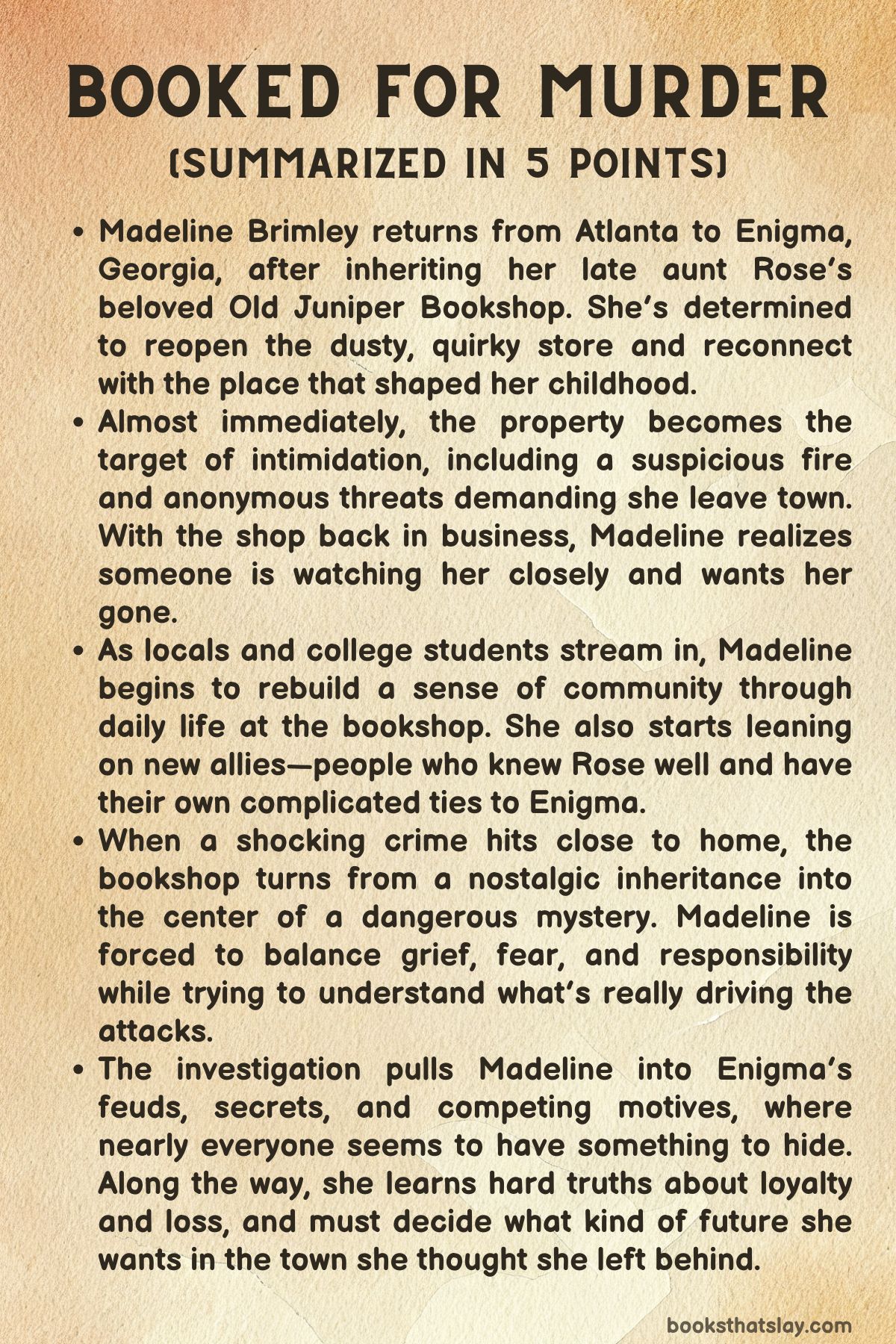
In Booked For Murder by PJ Nelson, Madeline Brimley returns to Enigma, Georgia, expecting grief and paperwork—not danger. Her late aunt Rose has left her the Old Juniper Bookshop, a creaky Victorian house turned bookstore that shaped Madeline’s childhood.
On her first day back, a suspicious fire erupts in the backyard gazebo, and a stranger’s phone call warns her to leave town or burn. Madeline tries to push forward anyway, reopening the shop and relearning its rhythms. But the threats escalate fast, and when someone dies inside the bookshop, Madeline realizes she didn’t just inherit a business—she literally inherited a target.
Summary
Madeline Brimley drives from Atlanta to Enigma, Georgia, to claim the Old Juniper Bookshop, a bookstore tucked inside an aging Victorian home. The day is hot for October, and the building feels unchanged—dusty rooms, creaking floors, and Rose’s odd system of organizing books that only makes sense if you grew up among the shelves.
With the electricity off, Madeline lights candles and settles into the familiar upstairs bedroom she used to call the “greenroom,” letting memories of Rose’s theatre life and bold personality run alongside the shock of being back in a town she left at seventeen.
Hunger pushes her into the kitchen, where most of the food has spoiled. While she improvises beans and rice, she catches the smell of burning juniper and sees orange flicker outside.
The garden gazebo is on fire. Madeline bolts out, fights the flames with the hose, and calls 911.
The fire department arrives quickly, and Captain Jordon—Enigma’s fire chief—examines the scene and informs her the gazebo was doused with gasoline. He treats Madeline as a suspect by default: she arrived, and then the fire started.
Madeline insists she’s just inherited the place and barely got through the door before the blaze began, but the implication is clear—someone wants her rattled, and the authorities don’t know what to make of her yet.
That night, a large black cat appears in her room and curls up beside her, a small comfort in a house that suddenly feels too big. Then the phone rings downstairs.
Madeline answers and hears a harsh male voice ordering her to “clear out.” The caller promises the next fire will take the entire house, with her inside it. The line goes dead.
Madeline is left staring at the receiver, trying to tell herself it’s a prank while her body insists it’s a warning.
The next morning, she opens the bookstore right at ten. She discovers the electricity wasn’t broken at all—it was switched off at the breaker.
Her first visitor is Philomena Waldrop, Rose’s closest friend and a professor at nearby Barnsley College. Philomena’s affection is immediate and overwhelming, and she notices Madeline’s fear before Madeline can hide it.
On the porch, Madeline admits the gazebo was burned and that she received a threatening call afterward. Philomena urges her to contact the police.
Officer Billy Sanders phones and says he’ll stop by. Madeline recognizes his name—she babysat him when he was a kid—and his arrival carries a mix of familiarity and distance.
He inspects the gazebo remains and, unlike Captain Jordon, doesn’t assume Madeline is guilty. He suggests it could have been teenagers or local troublemakers, and when Madeline mentions the threatening call, she downplays it.
Billy warns her to report any repeat calls and gives her his number.
As the day builds, customers trickle in—students Philomena has sent, and locals with particular tastes. Madeline begins to remember how the shop works: which room holds mysteries, which corner hides poetry, which shelf Rose reserved for strange favorites.
While Madeline runs errands for groceries, a quiet student named Tandy Fletcher, who used to help Rose, runs the desk. Tandy sells an impressive amount of books and proves she’s capable and steady.
She also offers an unsettling detail: she drove by the shop the morning Madeline arrived and is sure the windows were closed then, suggesting someone else might have been inside before Madeline opened up.
Tandy returns the next morning with fresh food and starts cooking as if she’s part of the household, bringing warmth into a kitchen that had felt abandoned. Philomena is pleased to see her there.
But the phone rings again, and the same gravelly voice repeats the demand that Madeline leave or face another fire. Madeline tries to shrug it off, but the threat sticks to her like smoke.
By night, Tandy asks if she can stay over, offering to sleep downstairs like she did when Rose was alive. Madeline agrees—partly because she likes Tandy, and partly because she doesn’t want to be alone.
Later that night, Madeline wakes to the smell of smoke. She rushes downstairs and finds Tandy sprawled motionless near the entrance.
The front door is burning. Madeline grabs water, fights the fire with whatever she can, and drags Tandy away from the flames.
When she turns Tandy over, she sees blood soaking the fabric of Tandy’s dress. Tandy has been stabbed.
The firefighters arrive, and Captain Jordon confirms what Madeline already knows from Tandy’s stillness: she’s dead. The shock lands slowly, like the mind refusing to accept what the eyes are seeing.
Philomena forces her way in, frantic that Madeline has been killed. When she sees Madeline alive, she collapses into fierce relief, and that tenderness finally breaks Madeline’s numbness.
Billy arrives and begins asking questions. Madeline confesses the full truth about the threats—the caller didn’t just insult her or joke; he promised to burn the whole house around her “in a furnace of flame.” Billy says the obvious thing Madeline can’t quite say aloud: the attacker came for Madeline.
Tandy died in her place.
The next day, Philomena stays with Madeline, closes the shop, and makes breakfast while turning away curious visitors. Madeline wants to leave Enigma immediately, but when she calls Rose’s lawyer, Rusty Thompson, she learns there’s a catch in the will: Madeline doesn’t fully inherit the property until she lives there for six months.
Until then, Rusty’s firm holds technical ownership and can’t sell the shop. If Madeline runs, she risks losing everything Rose intended for her.
Madeline realizes she’s trapped in a house someone is trying to burn.
Philomena suggests bringing in Gloria Coleman, the town’s new Episcopal priest. Gloria arrives with blunt confidence and admits she has also received threats, including a caller claiming he had a rifle aimed at her.
The three women compare what they know and decide the hostility has a pattern: someone wants certain people gone. That evening, Philomena calls in a panic—Gloria’s church is under attack.
Madeline runs over and finds drunk men ripping down children’s paintings and stacking them for a bonfire. Gloria defuses them in a way that shocks Madeline: she meets them where they are, hands out beer, even lights the pile herself, then shames them with calm precision when they realize they’re burning their own children’s work.
A loud troublemaker named Speck Dixon makes it clear he believes Gloria doesn’t belong.
Billy later shares details from Tandy’s autopsy: she had smoke in her lungs, meaning she didn’t die instantly. The murder and the fire were connected.
Philomena fixates on Speck as the killer, but Madeline and Gloria aren’t convinced. They decide to gather information instead of chasing one theory.
A handyman named David Madison begins repairs—rebuilding the charred doorway and planning to replace the historic gazebo. He hints that Enigma has deep habits of punishing outsiders and women who don’t match the town’s expectations.
While working, David uncovers two items near the gazebo ruins: a dangling earring shaped like three little silver monkeys and a vintage lighter. The objects seem recently dropped, not buried by time.
Madeline learns more about Tandy’s life. Tandy had a boyfriend, Bo Whitaker, and after Rose died, Bo and Tandy secretly stayed nights at the shop-house.
Philomena reacts strongly, claiming Bo is dangerous and involved with drugs. The suspicion grows when Speck Dixon visits Madeline and tries to buy the property, talking excitedly about development plans and a rumored highway project.
Madeline explains she can’t sell due to the six-month requirement, and Speck’s charm drops into anger. He warns that a lot can happen around the house.
After he storms out, Madeline is convinced he may be the threatening caller.
When Philomena sees the recovered earring and lighter, she breaks down. The lighter belonged to her father, and the monkey earring is hers.
Then she confesses: she set the gazebo fire herself, acting out of grief and rage after learning Rose left the shop to Madeline. She watched Madeline arrive, brought gasoline, lit the fire, panicked when it flared, and fled—losing the earring and lighter in the process.
Madeline is horrified, not only by the betrayal, but because Philomena’s confession adds chaos to an investigation already tied to a death. Madeline orders her out and reports the confession to Billy, also warning him about Speck’s visit and threats.
Madeline confronts Speck at a diner with Billy present. Under pressure, Speck admits he made the threatening phone calls, claiming he only wanted to scare Madeline into selling and insists he didn’t start the later fire or kill anyone.
Billy keeps him from leaving town, but privately tells Madeline his focus is shifting. The person who killed Tandy likely had the ability to overpower her—and may be connected to Speck’s muscle.
Billy points to Bo Whitaker, Speck’s cousin, as someone with a reputation for intimidation.
Determined to prove it, Madeline visits the college dorm to speak with Tandy’s roommate, Rae Tucker. Rae reacts with hostility and jealousy, revealing a long history of competition with Tandy and a fierce attachment to Bo.
Rae admits Bo works for Speck and is involved in cooking meth, yet she still pictures a future with him. When Madeline accuses Bo of killing Tandy, Rae explodes, screaming Madeline out of the room.
Rain thickens as Madeline heads to Gloria’s church, shaken by Rae’s instability. Gloria listens and urges compassion, pointing out Rae has endured loss and is unraveling.
But that same day, Rae shows up at the bookshop soaked, drunk, and demanding to talk. Her story spills out in jagged pieces: she knew Tandy had been staying at the shop, she blames Rose and Madeline for enabling it, and she believes Bo used Tandy for Speck’s “job.” Then Rae pulls a knife.
Madeline tries to stall, to talk her down, but Rae lunges. In a brutal fight, Rae slashes Madeline’s neck and arm.
Madeline relies on her acting training and stage-combat instincts to dodge, unbalance Rae, and finally knock her unconscious with a heavy book. Madeline calls Billy, Gloria, and 911.
Afterward, Gloria stays with Madeline as the shock sets in. Gloria explains that Rae confessed repeatedly while drunk: she followed Bo to the shop, argued outside, and after Bo drove away, Tandy came to the door to comfort Rae.
Rae stabbed Tandy and then set the fire, copying what she’d seen on TV to erase evidence. The knife is sent for testing, but the confession—heard by witnesses—changes everything.
The person hunting Madeline wasn’t a shadowy stranger after all; it was someone close to Tandy, acting out of jealousy and obsession.
Philomena returns, remorseful and exhausted, and this time Madeline lets her in. Madeline grieves openly, and the two reconcile.
In the aftermath, Madeline decides the shop shouldn’t be a lonely inheritance or a battleground. She makes Philomena her co-owner, and when Rusty checks Rose’s documents, he finds the will anticipated exactly that choice, allowing joint ownership if Madeline requested it.
As the shop reopens, students arrive to gossip and stare, repairs continue in the yard, and Madeline hires a new helper. Her battered car is towed for restoration, and she’s left using a borrowed truck while the town resets around the scandal.
The Old Juniper Bookshop remains standing—scarred by fire, marked by loss, but still open—while Madeline settles into the hard truth that staying in Enigma means facing what the town is, not what she remembers it to be.
Characters
Madeline Brimley
Madeline Brimley is the emotional and narrative center of Booked For Murder—a woman pulled back into a hometown she outgrew, only to discover that inheritance can be as dangerous as it is comforting. Her return to Enigma isn’t just a logistical move to take over the Old Juniper Bookshop; it’s a collision between the life she built away from home and the version of herself that was shaped inside Rose’s peculiar, theatrical world.
Madeline’s defining trait is stubborn resolve: she opens the shop even while shaken, refuses to leave after threats, and repeatedly tries to muscle through trauma by staying busy—cleaning, organizing, working—because stillness would force her to feel grief and fear all at once. Her acting background quietly becomes survival training: stage instincts, observation, and controlled physicality help her read people, manage conflict, and later defend herself.
At the same time, her confidence is uneven—she can be brave in public but minimizes danger in private, downplaying the threatening calls until it is too late. Over the course of the story, Madeline grows from someone trying to “handle it alone” into someone who learns that community is not weakness, and that trust—carefully given—is part of staying alive.
Her final choice to share ownership of the shop reflects that growth: instead of guarding Rose’s legacy like a lonely inheritance, she turns it into a shared, living refuge.
Rose Brimley
Rose Brimley is physically absent but spiritually dominant, the kind of personality that keeps directing the scene long after she’s gone. In Booked For Murder, Rose functions as both a benefactor and a catalyst: her decision to leave the bookshop-house to Madeline sets everything in motion, and her influence threads through nearly every character’s motivation.
Rose’s theatrical background shows in the way the shop is curated—quirky, dramatic, full of private logic—and in the “greenroom” idea of the upstairs space, which turns the house into a stage where people adopt roles: caretaker, protector, rival, confessor. Rose’s deepest impact is how she created belonging for the ones who didn’t fit neatly into Enigma’s expectations, especially younger women like Madeline and Tandy.
That nurturing power, however, also provokes backlash; for some, Rose represents disruption, independence, and a refusal to obey local hierarchies. Even in death, Rose exposes the truth about relationships people tried to keep invisible, and the fallout reveals the town’s tensions around gender, outsiders, and quiet rebellion.
Rose’s legacy is therefore double-edged: she gives people courage and a home, but she also leaves behind unfinished emotional business that spills into violence.
Tandy Fletcher
Tandy Fletcher is the story’s heartbreak and its moral turning point, the character whose death transforms threat into tragedy and forces the mystery to become personal rather than hypothetical. She initially appears as quiet competence—a student who knows the shop, understands Rose’s system, and can step into responsibility with surprising ease.
Under that calm exterior is a young woman trying to author her own escape: a farm girl studying psychology, dreaming of leaving Enigma, and drawn to the bookshop-house because it represents a different kind of life—one where curiosity is valued and independence is possible. Tandy’s warmth comes through in practical care: bringing food, cooking, offering companionship, and making the house feel lived-in again after Rose’s death.
Yet her circumstances also reveal how vulnerable she is: caught between family expectations, complicated romances, and the town’s policing of female behavior. Tandy becomes the unintended target of violence meant for Madeline, which deepens the cruelty of the crime—she dies because she is in the wrong place, occupying the protective role Rose once held.
Her death also functions as a mirror to other women’s struggles in Enigma: the same forces that push her to seek freedom also create the conditions for jealousy, control, and retaliation.
Philomena Waldrop
Philomena Waldrop is one of the most layered characters in Booked For Murder because she embodies both tenderness and damage, mentorship and volatility. As Rose’s closest friend and a professor, Phil presents herself as stable authority—intellectual, socially connected, and capable of rallying students to support the shop.
Her nurturing behavior toward Madeline feels genuine, and she quickly recognizes fear even when Madeline tries to mask it. Beneath that surface, Phil is driven by grief that has curdled into entitlement: she believes she had a rightful claim to Rose’s world, and when Rose leaves the shop to Madeline, Phil experiences it as betrayal.
Her arson confession exposes that her love for Rose was real but also possessive, and her actions reveal how easily sorrow can be weaponized when someone feels displaced. Importantly, Phil isn’t written as a simple villain—she panics, regrets, and eventually faces the consequences in a way that suggests she is not cruel by nature but emotionally fractured by loss and secrecy.
Her eventual reconciliation with Madeline and transition into co-ownership signals transformation: she moves from trying to control Rose’s legacy to helping preserve it. Phil’s arc shows how complicated love becomes when it is hidden for years and then abruptly stripped of its anchor.
Gloria Coleman
Gloria Coleman enters Booked For Murder like a gust of bracing air—direct, fearless, and oddly practical in the face of threats that would terrify most people. As Enigma’s new Episcopal priest, Gloria is an outsider twice over: new to town and a woman in a role that certain locals resent.
She meets hostility with humor, nerve, and a refusal to be intimidated, which makes her both a target and a stabilizing force. Gloria’s most distinctive strength is her emotional clarity: she listens without collapsing, challenges Madeline when she spirals into assumptions, and insists on compassion even for people behaving badly.
Her approach to conflict is unconventional but effective—she diffuses the church incident not by escalating but by redirecting shame back onto the men with startling precision. At the same time, Gloria is not naïve; she can project danger right back, and her calm confidence suggests experience with confrontation and survival.
Gloria functions as the story’s moral anchor, the character who keeps the others from turning grief into vengeance. She also represents a new kind of community—one built not on tradition or blood ties, but on chosen solidarity among women who refuse to be pushed out.
Captain Jordon
Captain Jordon represents institutional pressure and the story’s atmosphere of suspicion, especially early on when Madeline is new in town again and therefore easy to doubt. His initial posture toward Madeline is guarded and accusatory, shaped by the fact that he arrives to a gasoline-fed fire timed precisely with her arrival, in a building tied to a recently deceased owner.
He isn’t cruel, but he is blunt and procedural, and his skepticism amplifies Madeline’s sense of isolation. After Tandy’s death, Jordon becomes the voice of grim reality: he identifies arson patterns, confirms the stabbing, and focuses on physical facts rather than emotional narratives.
In a town where gossip and personal grudges distort perception, he stands for the uncomfortable insistence that feelings don’t count as evidence. His presence also adds tension because his suspicion forces Madeline to defend herself at moments when she is most shaken, and it makes clear that danger isn’t only the anonymous attacker—it’s also the possibility of being blamed when you are the easiest explanation.
Sheriff Billy Sanders
Billy Sanders is the story’s primary law enforcement viewpoint, but he is also deeply tied to the town’s personal history, which makes him both reassuring and complicated. Madeline remembers babysitting him, and that history softens his approach; he treats her less like a suspect and more like a person trying not to drown in trauma.
Billy is pragmatic and steady, willing to entertain possibilities without being swept up in the town’s loudest theories—especially Philomena’s rush to pin the murder on Speck. He also shows a quiet protective instinct: giving Madeline his number, warning her to report calls, arriving quickly when things turn violent.
Yet his role is limited by evidence and by the social landscape of Enigma, where suspects are entangled with local power. Billy’s shifting focus—from dismissing the early threats as possibly juvenile mischief, to considering Speck, to identifying Bo as a likely enforcer, and finally landing on Rae—illustrates how messy truth becomes when fear, rumor, and partial confessions cloud the timeline.
He ultimately functions as a stabilizer: not a savior, but a steady hand that helps convert chaos into accountability.
Rusty Thompson
Rusty Thompson operates as the legal and structural “trapdoor” of the plot, the character who turns Madeline’s situation from frightening to inescapable. His key contribution is the codicil: the six-month residency requirement that prevents Madeline from selling or fleeing without losing the inheritance.
Rusty’s role isn’t to drive emotion but to define stakes, forcing Madeline to confront danger rather than escape it. He is presented as competent and direct—sympathetic but not sentimental—and his advice reflects practical risk management: protection, documentation, staying within legal boundaries.
Rusty also quietly expands the scope of the story by revealing how Speck’s behavior connects to broader corruption, suggesting the threats aren’t purely personal but tied to money and land. In many mysteries, the lawyer is background detail; here, Rusty is the mechanism that locks the protagonist into the house and makes the mystery unavoidable.
Speck Dixon
Speck Dixon embodies opportunistic menace—the kind of small-town power broker who wraps greed in grand civic promises and becomes dangerous when he can’t buy what he wants. His interest in the property is not sentimental; it’s strategic, tied to development schemes and the promise of profit.
What makes Speck unsettling is how quickly he shifts from sales pitch to intimidation, revealing that his friendliness is a mask for coercion. Even when he admits to making the threatening calls, he tries to reframe them as “just” pressure tactics, showing moral rot: he understands fear as a tool, not a line you don’t cross.
Speck thrives in environments where rumor, misogyny, and outsider-hate can be turned into leverage, and he benefits from the town’s tendency to punish women who resist. Yet the story also frames Speck as a manipulator who often relies on other people to do the dirtiest work, which fits his role as someone whose hands are rarely the ones holding the knife.
Whether or not he commits the murder himself, Speck is a central source of the story’s climate of threat.
Bo Whitaker
Bo Whitaker is constructed as a plausible suspect because he sits at the intersection of tenderness and danger—romantic attachment mixed with rumors of violence, proximity to Speck’s schemes, and hints of illegal activity. He is described as someone who works for Speck and has a reputation that makes it easy for others to believe he could kill.
The story uses that ambiguity to show how suspicion spreads: people project motives onto Bo because he fits a familiar shape of “bad news.” At the same time, the details of his relationship with Tandy complicate that projection; he appears capable of real affection, and the fact that he and Tandy used the shop-house as a secret refuge suggests a desire for intimacy away from judgment. Bo’s most important function is as a catalyst for Rae’s jealousy and unraveling.
Even if he isn’t the murderer, he is part of the chain of harm—whether through manipulation, careless cruelty, or by creating the conditions that lead Rae to violence. He becomes a symbol of how volatile love turns when it is mixed with power dynamics and secrecy.
Rae Tucker
Rae Tucker is the true engine of the murder, and her characterization is built around obsession, insecurity, and the slow burn of rivalry turning into annihilation. She isn’t introduced as a mastermind; she’s presented as abrasive, defensive, and hostile to anyone threatening her fragile sense of control.
Her history with Tandy is fueled by lifelong competition—county fairs, attention, punishment, perceived unfairness—and those grievances calcify into an identity: Rae as the one who is overlooked while Tandy is praised. What makes Rae frightening is how quickly that resentment becomes violence when she feels abandoned by Bo and displaced by Tandy’s closeness to Rose’s world.
Rae’s confession reveals how impulsive the murder truly is: she follows Bo, confronts the situation, and when Tandy offers comfort, Rae interprets it through jealousy and humiliation rather than kindness. The arson attempt becomes a desperate imitation of crime narratives, showing her immaturity and panic rather than cunning.
Rae is also a portrait of someone unraveling under cumulative loss and instability, which doesn’t excuse her but explains the emotional volatility that makes her both pitiable and lethal. Her final confrontation with Madeline forces the protagonist to stop being only a victim of threats and become an active survivor.
David Madison
David Madison serves as the grounded, practical presence who keeps life moving forward even when trauma tries to freeze everything in place. As a handyman restoring the burned doorway and rebuilding the gazebo, David symbolizes repair—literal reconstruction paired with the quieter rebuilding of safety and routine.
He is observant and tactful, willing to share local information without turning it into gossip, and his knowledge of the town’s undercurrents gives Madeline insights she wouldn’t get from official channels. David also acts as a reality check: he questions Madeline’s assumptions when her fear pushes her toward convenient answers, and he warns against reckless disclosures—especially around Frank.
The fact that he finds the earring and lighter is crucial; he becomes the bridge between physical evidence and emotional truth, leading to Philomena’s confession. David’s role is not heroic spectacle but steady competence, the kind of person who helps a community survive by doing what must be done, even when it’s grim.
Frank Fletcher
Frank Fletcher is grief sharpened into anger, a character shaped by family loyalty and resentment toward the world that seemed to “take” his sister away. He blames Rose’s influence, sees the shop as a corrupting force, and directs his rage toward Madeline because she becomes the living stand-in for the change Rose represented.
Frank’s hostility is immediate and personal, and it carries the threat of volatility—especially when paired with mentions of drinking and past confrontations. Yet Frank is also written as someone capable of softening; his later apology and gratitude suggest that beneath the aggression is helplessness, the rage of someone who couldn’t protect his sister and needs someone to blame.
Frank also embodies the town’s suspicion of women’s independence: his anger isn’t only about Tandy’s death, but about her choosing a life outside family control. He functions as a red herring without being a caricature, and his presence adds pressure by reminding Madeline that even innocent grief can become dangerous when it seeks a target.
Jennifer Davis
Jennifer Davis arrives late, but she represents renewal and continuity for the shop after catastrophe. As a student with ambitions beyond Enigma, she echoes Tandy’s desire to leave and grow, but without the same tragic vulnerability.
Hiring Jennifer is Madeline’s attempt to stabilize the shop’s future and refuse the idea that violence gets to decide what the place becomes. Jennifer’s presence also shows Madeline shifting from reactive survival to proactive rebuilding—creating a team, distributing responsibility, and turning the bookshop into a living community space rather than a haunted inheritance.
Idell Glassie
Idell Glassie is a small but meaningful character because she reflects the bookshop’s function as comfort and identity within the town. Her request for cat-sleuth mysteries adds warmth and normalcy, showing that the shop isn’t only a crime scene or a battleground—it’s also a place where ordinary tastes and routines matter.
Idell’s presence underscores why Madeline keeps the doors open: the shop is a refuge for people who want stories, familiarity, and small joys even when real life is frightening.
Elbert and Delmar
Elbert and Delmar contribute a sense of neighborly pragmatism that offsets the story’s darkness. Their work towing and restoring Madeline’s battered car, and arranging a temporary replacement, represents community support expressed through action rather than emotion.
They aren’t positioned as investigators or suspects; they are part of the everyday infrastructure that helps Madeline keep functioning. In a story full of threats, their reliability suggests that Enigma is not only hostile—there are also people willing to help without demanding anything in return.
Themes
Grief as a force that distorts judgment
In Booked for Murder, loss doesn’t sit quietly in the background; it changes what people notice, what they ignore, and what they are willing to justify. Madeline arrives in Enigma with a complicated kind of mourning—she isn’t only grieving her aunt Rose, she is also grieving the version of herself that once felt safe in this house.
That layered grief shows up as restless vigilance: she cleans too much, pushes herself to open the shop too soon, and treats exhaustion like a moral requirement. The story makes grief feel physical through smells, smoke, and the constant return of fire, as if sorrow has a scent that keeps drifting back into the room.
Philomena’s behavior demonstrates a darker angle: grief can become entitlement, a belief that pain grants permission. Her confession about setting the gazebo on fire lands as an admission that mourning has turned into a kind of possessiveness—Rose’s absence feels unbearable, so control becomes a substitute for love.
Even Rae’s volatility fits this pattern. Her anger is not only jealousy; it is grief mixed with shame and fear of being replaced, and that mixture produces actions she later can’t explain without clinging to excuses.
The theme isn’t that grief makes people fragile; it’s that grief changes the moral math. People begin treating harm as “understandable” because it came from heartbreak, and the novel keeps testing how far sympathy should extend before it becomes complicity.
Homecoming and the shock of returning to a place that has moved on
Madeline’s return to Enigma isn’t a comforting reunion; it’s a confrontation with the fact that a town remembers you selectively. The house and shop still hold the cues of her childhood—genre rooms, the creak of stairs, the greenroom—but the meaning of those cues has shifted.
She steps into familiar spaces expecting recognition and instead meets suspicion from authority, gossip from locals, and a sense that her “role” in the community is outdated. That mismatch creates a constant unease: she is both insider and outsider, someone who knows where the candles are kept yet still has to prove she belongs.
The inheritance intensifies this theme because it turns home into a legal trap. The six-month requirement makes the building feel less like a gift and more like a contract that forces her to choose between safety and identity.
The threatening calls sharpen the point: she can physically return, but the town’s social climate may not welcome the person she has become. Even the bookshop’s daily customers show that home is partly a performance—Madeline has to act as the steady proprietor even when she is scared, and the town watches to see if she will fold.
The theme lands in the tension between nostalgia and reality: the place she came back to exists, but it is not the place she remembers, and she can’t reclaim it by willpower alone.
Control, ownership, and who gets to claim a place
Property in Booked for Murder is never just real estate; it is power, memory, and status. The Old Juniper Bookshop functions like a public square disguised as a business, and ownership determines whose values shape the space.
Speck’s push to buy the property exposes how economic ambition can disguise itself as “development” while actually erasing what doesn’t serve profit. His rage when Madeline can’t sell shows that his interest isn’t simply business—it’s dominance, the expectation that the town should bend when he applies pressure.
Rose’s will complicates ownership further by placing conditions on inheritance, as if she understood that the shop’s future required endurance, not just legal transfer. That condition also reveals how control can be disguised as care: Rose protects the shop from immediate sale, but she also limits Madeline’s choices at a moment of danger.
Philomena’s secret relationship with Rose adds another layer, because it shows how people can feel they “own” a place emotionally even when they don’t own it legally. Her arson is a terrible attempt to rewrite the terms of belonging, to punish the person who received what she believed should have stayed closer to her.
By the end, the move toward shared ownership reframes control as stewardship. Instead of one person claiming the space as a prize, the shop becomes something that can be protected through partnership, labor, and honesty, suggesting that a community landmark survives best when it isn’t treated as a trophy.
Threats, intimidation, and the everyday mechanics of fear
Fear in Booked for Murder is not an abstract mood; it is built through specific actions that repeat and escalate. A burned gazebo, a voice on the phone, a fire at the front door—each event teaches Madeline that violence doesn’t always announce itself with a clear motive.
The novel shows how intimidation works by forcing the target to do the work of the aggressor: Madeline starts planning her days around safety, second-guessing her instincts, and minimizing her own alarm to avoid being labeled dramatic. Her choice to dismiss the first threatening call as a prank captures how fear often succeeds because it pressures people into silence.
Reporting the call would mean admitting vulnerability, risking disbelief, and becoming a spectacle in a small town. The story also demonstrates how fear spreads socially.
Philomena and Gloria react not only to the danger itself but to what it means that someone is willing to use fire as a message. The church attack makes intimidation feel communal: it’s not just one woman being targeted, it’s a warning about who is allowed to hold authority and speak openly.
Even Captain Jordon’s suspicion shows another mechanism of fear—institutions can add pressure by treating victims as potential offenders, which isolates them further. The theme ultimately argues that intimidation thrives on ambiguity.
When people can’t agree on what the threat is or who is responsible, the fear becomes harder to resist because it sits in every shadow as a possibility.
Gender, authority, and punishment for women who don’t follow local expectations
The story repeatedly places women into roles the town would rather control: a woman inheriting property, a woman priest leading a church, a woman professor with influence, and a young woman trying to build independence. Each of them faces some version of backlash, and the backlash often hides behind “concern,” “tradition,” or “community values.” Gloria’s presence exposes how quickly authority becomes controversial when it wears a form that certain men don’t accept.
The drunken destruction of children’s saint paintings is not random vandalism; it is a symbolic attempt to humiliate her leadership and reduce her work to a joke. Madeline’s situation shows a more subtle punishment: suspicion, pressure to leave, and threats that aim to force her into compliance without anyone having to say openly that she doesn’t belong.
Tandy’s storyline adds the cost of female independence. She is ambitious, capable, and determined to move beyond Enigma’s limits, yet the narrative shows how easily a young woman becomes a battleground for other people’s power struggles—her brother’s anger, her roommate’s envy, her boyfriend’s entanglements, and the town’s hunger for gossip.
The theme doesn’t treat these conflicts as individual failures; it shows a pattern where women are expected to be agreeable, grateful, and quiet, and when they aren’t, the community’s tolerance drops. Even when the danger turns out to have a specific culprit, the wider atmosphere still matters, because it creates the conditions where harassment feels normal and where women are pressured to absorb harm without making noise.