All the Water in the World Summary, Characters and Themes
All the Water in the World by Eiren Caffall is a climate-collapse survival novel about memory, grief, science, and the stubborn human need to save what matters. Set after rising seas and violent storms have broken much of the United States, it follows 13-year-old Nonie, a girl with an unusual sensitivity to water and weather.
Raised in a rooftop settlement at the American Museum of Natural History, she has grown up among artifacts, logbooks, loss, and fragile hope. When a catastrophic storm destroys her home, Nonie must travel through a flooded, dangerous world with the people she has left.
Summary
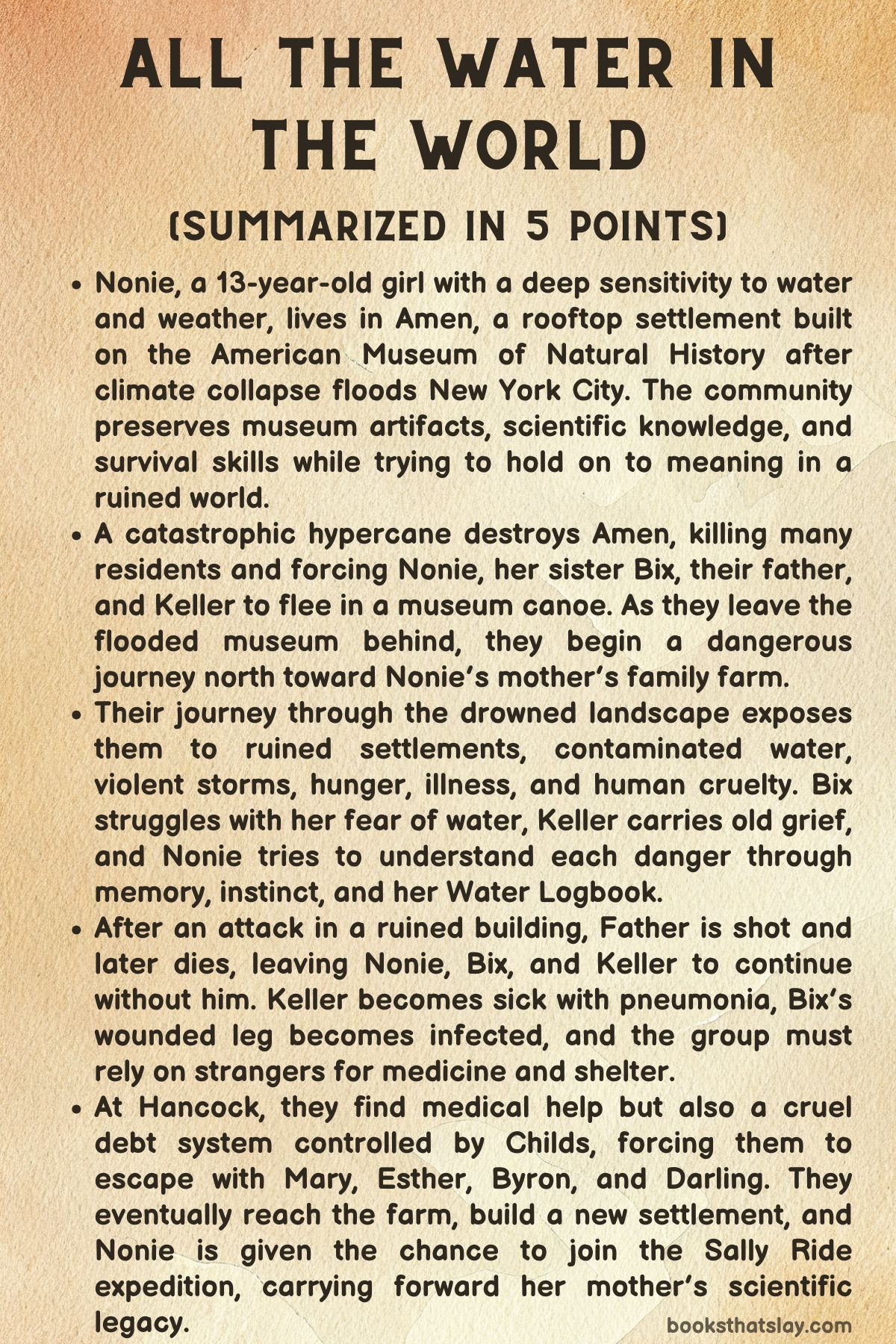
All the Water in the World begins in the ruins of a drowned New York City, where Nonie, a 13-year-old girl, lives in a settlement called Amen. The name comes from the sound of AMNH, the American Museum of Natural History, where the survivors made their home after floods and climate disasters destroyed the city and much of the country’s former life.
Nonie lives there with her older sister Bix, their father, and a small group of survivors who have turned the museum into both shelter and archive. They farm, keep bees, study the changing world, and protect the museum’s cultural and scientific treasures.
Nonie has a gift, or at least a heightened awareness: she can sense water. She notices changes in weather, currents, contamination, storms, and rising floods before others do.
Inspired by her late mother, a climate scientist, she keeps a Water Logbook in which she records everything she observes. Her mother had studied ocean chemistry and believed in evidence, careful observation, and preservation.
Her father, a curator of Indigenous American architecture, helped build structures on the museum roof and believed that saving art, science, and knowledge mattered even after civilization collapsed.
The peace of Amen ends when a hypercane strikes without warning. Nonie, Bix, their father, and Keller, an entomologist and close family friend, grab emergency bags and flee.
Others try to escape too, including a family with a baby, but the storm tears apart the rooftop settlement. The roof is destroyed, killing those who remain there.
Nonie is shaken by the fact that neither her sensitivity to water nor her logbook warned her in time.
The survivors move through the damaged museum, hoping to reach their storm shelter, but it has been destroyed. Floodwater rises quickly through the building.
The city’s floodgates have failed, and New York is being swallowed again. Bix is nearly paralyzed with fear because years earlier, when the first great flood destroyed their apartment, she almost drowned.
Their father saved her then, but the trauma never left her. Now she must face the water again.
The group realizes they need a boat. Their only chance is a birchbark canoe displayed in one of the museum exhibits.
Nonie knows the museum well enough to guide them through the dark, flooded halls. They recover the canoe and launch it into contaminated water.
As they leave, they see the body of Sergio, another member of Amen, floating in the flood. They cannot take him with them.
Leaving him behind means leaving Amen itself behind: the settlement, the dead, the museum, and the life they had tried to preserve.
The survivors decide to travel north to a farm in Tyringham that belonged to Nonie’s mother’s family. It was always the place their father said they would go if they had to leave.
They paddle through the ruined city, past debris, bodies, and memories of a world that no longer exists. They worry about “the Lost,” people without settlements who wander, scavenge, and may attack.
Bix remains withdrawn, still trapped in terror.
Along the way, Nonie remembers the people who shaped her life in Amen. Keller kept bees and studied insects as signs of ecological change.
Jess had medical knowledge. Angel, Keller’s partner, helped build the community before she died.
Mano, Angel’s nephew, had been Bix’s friend and first love. He died after he and Bix went hunting too far from safety and were attacked by a dog pack.
Mano saved Bix, but Keller has carried anger and grief ever since, blaming Bix for the loss.
The group reaches the Cloisters, another settlement. They are allowed inside for one night, though Keller is wary because he is Black and knows that some communities are dangerous for him.
The Cloisters has lost all its children to a mosquito-borne illness, and its people keep records of travelers who pass through. Nonie sees that other settlements have also tried to preserve stories, though each one has its own fears and rules.
At dawn, they must leave.
They continue north by river, then over land, moving through flooded landscapes, damaged forests, and broken towns. The climate has changed every living system.
Trees suffer in the heat. Storms arrive out of season.
Bears fail to hibernate properly. Rivers no longer behave as expected.
Nonie reads these signs as best she can, but the world is often too violent and unstable to understand.
During another storm, they take shelter in a ruined building despite Nonie’s unease. Inside, Bix and Nonie encounter two dangerous men.
Nonie escapes and alerts Keller and her father, but Bix is attacked. In the rescue, Bix fights back and kills one of the men, while the other falls into the water.
Their father is shot in the chest. Keller risks his life in filthy floodwater to recover Nonie and the canoe.
They escape, but Father’s wound is severe.
On Storm King Mountain, the group tries to treat him, but he grows weaker. He tells stories about Nonie and Bix’s mother, remembering love from before the collapse.
During the night, he dies. Nonie and Bix bury him and take his boots.
Bix and Keller, divided for so long by Mano’s death, begin to soften toward each other in their shared grief.
The journey becomes harder. Keller develops pneumonia after inhaling dirty water.
Bix’s leg is infected from the violence at the ruined building. Nonie and Bix struggle to care for both of them.
They eventually see smoke from a house on high ground and go there for help. The house is occupied by Poppy, Mary, Jared, and others.
Poppy is cautious but lets them in when she sees that Keller is sick. Mary, a medic, treats him with willow tea and eventually antibiotics, though Jared objects.
His control over the house is threatening, and Poppy warns that protecting Keller carries extra risk because of racism in this fractured world.
Mary decides to take them to Hancock, a settlement with a doctor and better medical supplies. They leave the river, trade their boat for a horse, and build a travois to carry Keller.
On the road, Nonie encounters a tame dog and is frightened because dogs in her memory are tied to Mano’s death. Bix’s fever worsens, and Mary makes clear that she is not loyal to Jared; she wants to help them escape him too.
At Hancock, they find light, medicine, and organization, but also exploitation. The settlement is ruled by Childs, who forces people into debt-based servitude in exchange for care, food, or shelter.
Esther, the doctor, treats Bix’s leg and removes the infected tissue. Keller also needs continued antibiotics.
Nonie understands quickly that Childs is dangerous, especially to vulnerable people.
Mary warns that they cannot stay. Childs confiscates Keller’s antibiotics, has Mary beaten, and locks her in the icehouse.
Esther agrees to help Nonie, Bix, Keller, Mary, and others escape, but she has conditions: she, Byron, and Darling must come too. Byron is a young man raised in Hancock, and Darling is a strange, wounded man who communicates through song fragments.
During a storm, the group uses the chaos as cover. Nonie helps free Mary, and they flee in a wagon with the sick and injured.
Childs pursues them through the woods. Mary is wounded, and Darling kills Childs to save the others.
Esther is shaken by the violence, even though it ends Childs’s rule over them. The group keeps moving until at last they reach the farm in Tyringham.
The farm is damaged and abandoned, but it is real: the place from Nonie’s mother’s photographs and the destination her father had held in mind for years.
Over time, the survivors build a new settlement there. Keller and Bix recover.
A small hospital is created. Hancock changes after Childs’s death and eventually becomes a trading partner.
Bix and Byron grow close and later marry. Nonie learns that the Sally Ride, the scientific expedition her mother once hoped to join, still exists.
Esther’s friend Virginia is connected to it, and Nonie is given the chance to go.
By the end of All the Water in the World, Nonie has lost her home, her father, and almost everything familiar, but she has also carried forward what Amen taught her: to observe, remember, protect, and begin again. She sets aside her old logbooks and prepares to start a new one aboard the Sally Ride, turning from survival toward science, purpose, and the wider future of a damaged world.
Characters
Nonie
Nonie is the emotional and intellectual center of All the Water in the World. At 13, she is still a child, but the broken world has forced her into a seriousness far beyond her age.
Her defining trait is her unusual sensitivity to water: she can sense shifts in weather, rising floods, contamination, and storms. This ability makes her valuable to Amen, but it also places a burden on her because she feels responsible for signs she cannot always read.
The hypercane that destroys Amen shakes her confidence because it proves that even her strongest gift has limits. Nonie is also shaped by grief.
Her mother’s death, the deaths of people in Amen, Father’s death, and the memory of Mano all live inside her. Yet she does not become emotionally numb.
She cries, remembers, records, observes, and continues forward. Her logbooks show her desire to make sense of chaos through science and memory.
She begins as a girl trying to preserve the world she has lost, but by the end, she becomes someone ready to enter a larger future, joining the Sally Ride and continuing her mother’s scientific legacy.
Bix
Bix is Nonie’s older sister, and her character is built around courage damaged by trauma. At 16, she often appears tougher and more independent than Nonie, but her fear of water reveals how deeply the first flood wounded her.
When she was nearly swept away as a child, the experience lodged in her body and mind, leaving her terrified whenever water surrounds her. This fear makes the journey especially painful because survival depends on travel by canoe, rivers, rain, and flooded land.
Bix is also marked by guilt and loss. Mano died saving her from the dog pack, and Keller’s unresolved anger has kept that wound open.
Her later attack in the ruined building adds another layer of trauma, but Bix is not reduced to victimhood. She fights back, survives, and slowly reclaims agency.
One of her strongest moments is when she begins paddling, showing that she is not free from fear but is learning to move through it. Her recovery at the farm and relationship with Byron suggest a future in which she can live beyond survival.
Father
Father is a protector, builder, curator, and flawed leader. His work with Indigenous American architecture gives him the knowledge to create shelter on the museum roof, and his belief in preservation helps shape Amen’s purpose.
He does not see survival as merely staying alive; he believes people must also save art, science, memory, and culture. This makes him both practical and idealistic.
He is deeply devoted to his daughters, as seen in his rescue of Bix during the first flood and in his final efforts to protect both girls during their escape from the ruined building. At the same time, he can be forceful, nostalgic, and sometimes too attached to the past, such as when he wants to see his old apartment despite the danger.
His death on Storm King Mountain removes the family’s central adult protector and forces Nonie, Bix, and Keller into a new emotional reality. His final memories of Mother soften him, showing that behind his urgency and command is a man shaped by love and loss.
Mother
Mother is physically absent for most of the story, but her influence is everywhere. As a climate scientist, she represents knowledge, observation, and scientific responsibility.
Her study of sea butterflies connects the family’s private life to the larger collapse of the planet, because she understood that small changes in ocean chemistry could signal massive environmental danger. She gives Nonie the model for careful recording through the Water Logbook, and she helps her daughters understand both fear and wonder.
Her stories about the Sally Ride become a symbol of the life Nonie might have had and the life she may still claim. Mother’s illness and slow death also teach Nonie that not all losses come from storms or violence; some arrive quietly, inside the body.
Even after death, Mother remains a guide. The journey to Tyringham is partly a journey toward her memory, and Nonie’s eventual connection to the Sally Ride allows Mother’s unfinished hopes to continue through her daughter.
Keller
Keller is one of the most complex adult characters in All the Water in the World because he is nurturing, wounded, angry, and loyal at once. As an entomologist, he studies insects, keeps bees, and reads ecological change through small living things.
In Amen, he is a gentle presence for Nonie, meeting her on her own terms and helping her calm herself through Animal in Mind. He becomes a chosen-family figure, especially after Mother’s death.
Yet Keller is also burdened by devastating loss. Angel’s death leaves him depressed, and Mano’s death leaves him bitter toward Bix, whom he blames even though she was also a traumatized child.
His journey forces him to confront that grief. When Father dies, Keller and Bix begin to heal their relationship through shared mourning.
Keller’s illness after rescuing Nonie from the floodwater shows both his courage and his vulnerability. He risks his life for the group, and his survival depends on others caring for him in return.
Mano
Mano appears mainly through memory, but his presence strongly shapes Bix, Keller, and Nonie. He fled San Juan after flooding and came to Amen through Angel and Keller.
Around Bix, he represents early love and a brief possibility of ordinary adolescence in a world where childhood has nearly disappeared. Around Nonie, he represents kindness and emotional intelligence.
He understands her need for calm, imagination, and structured play, and he helps her through fear by using Animal in Mind. His death in the dog attack is one of the defining tragedies before the main journey begins.
Because he dies saving Bix, his memory becomes tangled with love, guilt, and blame. Keller’s anger toward Bix is really grief that has not found a healthy place to go.
Mano’s remembered tenderness makes his death even more painful, but it also keeps him alive as a moral presence in the story.
Angel
Angel is Keller’s partner and Mano’s aunt, and she stands for care, endurance, and the cost of trying to build family after collapse. Her journey to Amen is marked by hardship, including the loss of a pregnancy, which shows how dangerous and unstable the world has become for people trying to survive on the road.
In Amen, she helps build community life and contributes to the shelter, classroom, and pharmacy systems that make the settlement more than a hiding place. Her death from illness breaks Keller emotionally and leaves another gap in the community’s already fragile structure.
Angel’s importance lies in the way she expands the idea of family. She is not connected to Nonie by blood, yet she belongs to the network of adults whose care shapes Nonie’s childhood.
Jess
Jess is one of the practical caretakers of Amen. With medical experience and survival knowledge, she helps organize supplies, especially antibiotics, and contributes to the settlement’s ability to treat illness and injury.
Her background in Alaska gives her tracking skills, which are essential in a world where food and safety depend on reading land, animals, and weather. Jess also helps Nonie by teaching her navigation and practical scientific habits, including the use of a homemade barometer.
Through Jess, the novel shows that survival requires shared knowledge, not just strength. Her death in the destruction of Amen is devastating because the group loses not only a person but also a store of medical and survival skill that cannot easily be replaced.
Sergio
Sergio is a member of Amen remembered for teaching people how to make arrowheads from knapped flint. His role emphasizes how the settlement survives by recovering older forms of craft and practical knowledge.
In a collapsed technological world, skills once considered historical or specialized become necessary again. Sergio’s body floating in the floodwater after the storm is one of the clearest signs that Amen is truly gone.
The survivors cannot stop to bury him, and that forced abandonment shows the cruelty of disaster: grief must often wait because survival will not. Sergio’s death also deepens Nonie’s awareness that preservation has limits.
They tried to save people, objects, and knowledge, but the storm takes much of it anyway.
Beaumont
Beaumont appears briefly but meaningfully as one of the residents who tries to flee Amen during the hypercane. Along with Jess and baby Evangeline, he represents the ordinary families and bonds that existed within the settlement.
His death during the rooftop destruction shows that the storm does not distinguish between the prepared and the vulnerable. Though not developed at length, Beaumont matters because he expands the sense of loss beyond Nonie’s immediate family.
Amen was a whole community, and his death is part of the sudden erasure of that community.
Evangeline
Evangeline, the baby killed during the storm, represents the fragility of future life in the climate-ravaged world. Children have become rare because of disease, disaster, and instability, so her death carries symbolic weight.
She is not only an individual loss but also a sign of how difficult it has become for communities to continue across generations. Her presence before the storm briefly suggests renewal in Amen, while her death makes the destruction feel even more complete.
Through Evangeline, the story shows that collapse attacks the future as much as the present.
Douglas
Douglas is the gatekeeper figure at the Cloisters. He is cautious but not cruel, allowing Nonie, Bix, Father, and Keller inside for a night while making clear that they must leave by morning.
His surprise at seeing children and a mixed group reveals the social changes of the post-collapse world. Communities have become isolated, suspicious, and shaped by disease and prejudice.
Douglas also criticizes Amen for turning travelers away, which complicates Nonie’s view of her former home. Amen preserved culture, but it also made hard moral choices about who could enter.
Douglas’s settlement, with its scriptorium, offers a different model of preservation: saving stories from travelers rather than museum objects.
Poppy
Poppy is the first person at the Feral House to show the travelers guarded compassion. She has lost her own children, and this loss affects how she responds to Nonie and Bix.
Her kindness is practical rather than sentimental: she gives them shelter, clothing, and information, but she also knows the dangers around her. Her comment that protecting Keller is “extra work” exposes the racism that persists after civilization’s collapse.
Poppy is not presented as a simple rescuer; she is someone surviving under the control of violent men and dangerous rules. Her warnings about Hancock and Jared help the group understand that shelter can come with hidden costs.
Mary
Mary is a medic guided by skill, conscience, and moral courage. She treats Keller even when others object, and she later helps the group reach Hancock for more advanced care.
Her refusal to carry a gun because of her medical oath shows her commitment to healing, yet the journey forces her into situations where ideals are tested by violence. When she kills during the escape, it is not an abandonment of her values but a painful response to immediate danger.
Mary is also clear-eyed about power. She knows Jared is dangerous, knows Hancock is unsafe, and still chooses to help Nonie, Bix, and Keller.
Her character shows the strain placed on caregivers in a broken society: they must heal bodies while navigating systems built on fear, debt, and control.
Jared
Jared is the controlling force at the Feral House. He represents the kind of man who uses disorder to claim authority over others.
When institutions collapse, people like Jared turn homes, supplies, and weapons into tools of power. His objection to giving Keller antibiotics reveals both selfishness and racialized cruelty.
Jared’s presence makes the Feral House feel unsafe even though it offers temporary shelter. He is important because he shows that danger in the novel does not only come from storms, illness, or hunger.
Human domination becomes another disaster, especially when resources are scarce and accountability has vanished.
Esther
Esther is the doctor at Hancock and one of the story’s most important figures of resistance. She works within a corrupt settlement ruled by Childs, but she has not surrendered her moral judgment.
Her decision to treat Bix’s infected leg quickly and skillfully saves Bix’s life. Esther understands the debt system and knows that accepting help at Hancock can trap people in forced servitude, yet she also uses her position to protect the vulnerable when she can.
Her escape plan shows intelligence and courage, but she is not untouched by violence. Darling’s killing of Childs saves the group, yet it also upsets her, suggesting that even necessary violence leaves moral damage.
Esther’s connection to someone from the Sally Ride also makes her a bridge between survival on land and Nonie’s future in science.
Childs
Childs is one of the clearest human antagonists. He controls Hancock through medicine, electricity, food, and debt.
In a world where antibiotics can decide whether someone lives or dies, he turns care into a weapon. His rule is especially disturbing because it imitates civilization while corrupting its basic duties.
Hancock has structure, light, and medical care, but under Childs those things serve exploitation rather than community. His treatment of Mary and his seizure of Keller’s antibiotics show his willingness to harm anyone who challenges his authority.
Childs also carries a predatory quality that Nonie recognizes through warnings her mother once gave her about men who use affection, sex, or power to hurt people. His death allows Hancock to reform, suggesting that some communities can heal when abusive power is removed.
Byron
Byron is a young member of Hancock who becomes part of the escape and later part of the new life at the farm. Because children are rare, his presence matters immediately.
He has grown up under Hancock’s controlling system, but he is still capable of trust and action. He helps Nonie free Mary, taking a serious risk against Childs’s authority.
His later relationship with Bix suggests renewal after trauma. Their marriage is not just a romantic conclusion; it shows the possibility of building ordinary bonds again after years of fear, loss, and survival.
Byron represents a future generation that has inherited collapse but may not be entirely defined by it.
Darling
Darling is one of the stranger and sadder characters. He communicates through song fragments, suggesting trauma, displacement, or a mind shaped by experiences the story only partly explains.
He arrived in Hancock with Byron as an infant, which makes him part caretaker, part survivor, and part mystery. His habit of hiding from Childs shows that he understands danger even if he does not respond to it in ordinary ways.
During the escape, he kills Childs with a knife, saving the others. This act is both heroic and disturbing.
Darling’s character shows that broken people can still act with courage, and that survival communities often depend on those whom powerful people dismiss or underestimate.
Virginia
Virginia is connected to the Sally Ride, the scientific expedition Nonie’s mother once hoped to join. Although she appears late, she plays a crucial role in opening Nonie’s future.
Through Virginia, the world beyond the farm becomes real. The expedition is not just a memory or dream from Mother’s past; it still exists.
Virginia’s willingness to let Nonie join gives Nonie a path beyond grief and survival. She links Mother’s unfinished scientific life to Nonie’s emerging identity, helping transform Nonie’s logbook habit into a larger calling.
Themes
Survival, Preservation, and the Meaning of What We Save
Survival in All the Water in the World is never limited to food, shelter, and movement, though those needs are urgent throughout the story. Amen’s people preserve museum artifacts, scientific records, architecture, medical knowledge, and ecological observations because they believe human beings need more than physical safety to remain human.
Father’s commitment to cultural preservation and Mother’s scientific discipline shape Nonie’s understanding of responsibility. The museum becomes a shelter, but it is also a statement: even after collapse, memory matters.
Yet the destruction of Amen challenges this belief. The storm wipes out people, objects, and years of effort in a single night.
The survivors cannot save Sergio’s body, the museum, or most of their former life. Still, the theme does not end in failure.
Nonie carries the logbooks, skills, stories, and habits of attention with her. The Cloisters preserves traveler accounts, Hancock eventually reforms, and the farm becomes a new settlement.
The novel suggests that preservation is not only about protecting objects from loss. It is also about carrying knowledge into new conditions, adapting it, and letting it help build something that can last.
Climate Collapse and the New Shape of the World
The environment is not a background setting; it is an active force that has remade every part of human life. Flooded cities, collapsed floodgates, contaminated water, violent storms, dead trees, altered animal behavior, and mosquito-borne illness all show a planet whose systems have shifted beyond familiar expectations.
The old world survives only in fragments: museum halls, ruined apartments, roads, military spaces, photographs, and memories of electricity. Nonie’s ability to sense water gives the reader an intimate way to experience this changed environment.
She does not think of climate as an abstract issue. She feels it in pressure, rain, current, rot, and danger.
The hypercane that destroys Amen is the strongest example of climate disaster, but quieter details are just as important. Bears no longer hibernate properly.
Maple trees burst from heat. Safe drinking water becomes precious.
Illness spreads through insects. These changes show that collapse is not one event but an ongoing condition.
The world has not simply ended; it has become unstable, forcing people to relearn travel, medicine, farming, trust, and time itself.
Grief, Trauma, and the Work of Continuing
Nearly every major character carries grief, and the story studies how differently people live with it. Nonie records, remembers, and imagines conversations with the dead.
Bix freezes, withdraws, and later pushes herself back into action. Keller turns inward after Angel’s death and hardens after Mano’s death, directing blame toward Bix because his sorrow has nowhere else to go.
Father keeps moving and protecting, but his memories of Mother reveal a private sadness beneath his authority. The journey forces these wounds into the open.
Bix’s fear of water comes from nearly drowning. Mano’s death remains unresolved until shared danger and Father’s death begin to soften the distance between Bix and Keller.
Nonie’s grief grows with every loss, but it also matures. She learns that remembering the dead cannot mean remaining trapped beside them.
The burial of Father is a turning point because the group must mourn and move at the same time. The novel treats continuing as difficult work, not easy healing.
Survival requires the body to keep going, but real endurance also requires people to face pain, accept help, and make room for future attachments.
Power, Care, and Moral Choice After Collapse
The ruined world exposes the difference between communities built on care and communities built on control. Amen has flaws, including its history of turning away travelers, but its central purpose is preservation and shared survival.
The Cloisters offers temporary shelter and records stories. The Feral House gives aid but is shadowed by Jared’s authority.
Hancock has medicine and electricity, yet Childs turns those resources into instruments of debt and servitude. These settlements show that after collapse, morality does not disappear; it becomes more visible because every choice carries life-or-death consequences.
Antibiotics can heal Keller and Bix, but in the wrong hands they become leverage. A locked gate can protect a community, but it can also become a refusal of humanity.
Mary and Esther stand out because they choose care even when systems around them punish it. Darling’s killing of Childs raises a harder question: when a violent ruler controls the conditions of survival, resistance may require violence that still leaves emotional damage.
The theme is not simply that good people help and bad people harm. It asks how people protect others when law, safety, and institutions have collapsed, and what moral costs remain afterward.