Lights Out by Elise Hart Kipness Summary, Characters and Themes
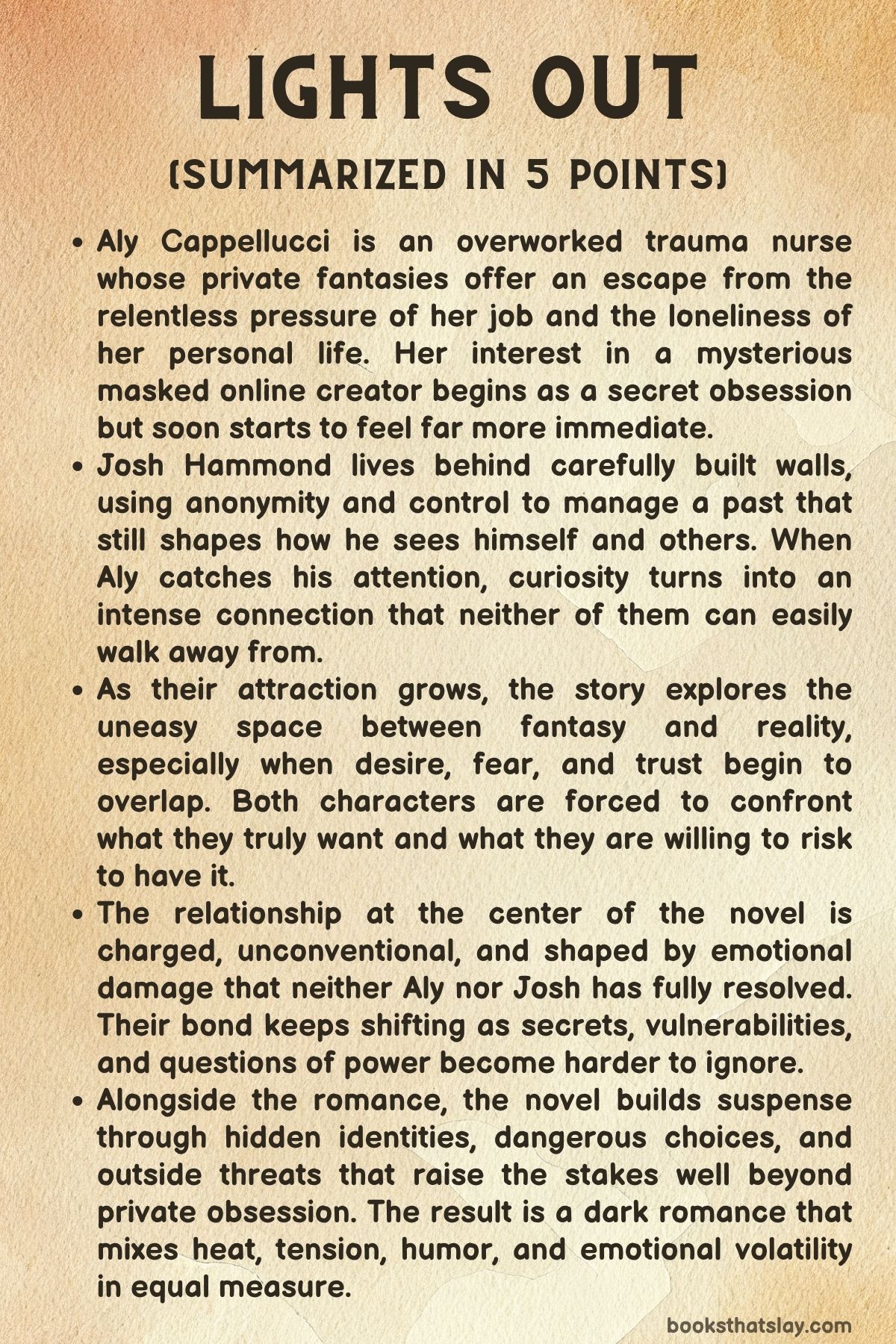
Lights Out by Navessa Allen is a dark romance built around obsession, secrecy, and two people whose desires push them far outside ordinary boundaries. The story follows Aly, an overworked trauma nurse, and Josh, a cybersecurity expert hiding behind an online masked persona known as the Faceless Man.
What begins as fantasy and voyeurism turns into a dangerous real-world connection shaped by stalking, roleplay, buried trauma, and violent threats from outside forces. The novel blends erotic suspense with emotional damage, trust issues, and black humor, while asking whether two deeply troubled people can create something real out of fear, attraction, and the parts of themselves they usually hide. It’s the 1st book in the Into the Darkness series.
Summary
Alyssa “Aly” Cappellucci is a trauma nurse working in a brutal emergency room where violence, exhaustion, and emotional overload are part of everyday life. She is competent, sharp, and used to carrying too much on her own.
Outside work, her life is solitary. She owns her home, lives with her cat Fred, and has no close family nearby.
After long shifts, she turns to a private fantasy life that helps her cope. She watches videos posted by a masked online creator called the Faceless Man, and she is especially drawn to the danger he projects.
His anonymity, sexual confidence, and threatening aura speak directly to desires she rarely admits out loud.
One night, wound up and lonely, Aly sends a picture of the Faceless Man’s mask to a man she sometimes sleeps with, hoping to turn fantasy into something physical. That plan falls apart when he reveals he has moved on.
What Aly does not know is that the image has reached Josh Hammond, the man behind the mask. Josh immediately recognizes that Aly is interested not just in the online persona, but in the kind of darkness he performs in those videos.
Josh is a cybersecurity expert with a deeply damaged past. His father was a notorious criminal who abused his family and murdered women.
Josh looks so much like him that he hides behind a mask online and avoids attention whenever possible. The Faceless Man persona began as a way to channel vanity and desire without exposing his face, but it also gave him a place to control how people saw him.
When he notices Aly’s comments and fantasies, he becomes fixated. He has wanted her since meeting her briefly before, and now that attraction grows into obsession.
Rather than keeping his distance, Josh begins researching Aly’s life. He studies her habits, her home, and her security weaknesses.
Eventually he breaks into her house, intending first to test fantasy against reality. Inside, he meets Fred and is shaken by the cat’s easy acceptance of him.
That small moment matters more than he expects. Josh has long feared that he might carry the same darkness as his father, but his tenderness toward Fred and his reluctance to hurt Aly suggest otherwise.
Still, he goes ahead with a reckless plan and films one of his masked videos in Aly’s bedroom.
When Aly sees the video and realizes it was made in her house, she is horrified, furious, and intensely turned on. Josh leaves the mask behind, making the invasion undeniable.
Aly arms herself and searches the house, but instead of calling the police immediately, she enters into a tense private exchange with him. Josh watches her through a hidden camera and sends her the full recording.
Their contact becomes direct, flirtatious, hostile, and charged with mutual hunger. Aly knows she should shut it down.
Instead, she keeps engaging.
Josh escalates further. He sends flowers and security equipment, repays her when the delivery creates trouble, and continues contacting her while hiding his identity.
Aly finds one of his hidden cameras and begins trying to uncover who he is. She suspects he has hacked into her devices and possibly even into the hospital systems around her.
At work, amid mass casualty events and constant pressure, she finds herself checking for signs of him and responding to his messages. The danger becomes part of the attraction.
After an especially brutal shift, Aly finds the masked man waiting in her car. He does not speak, relying on texts and gestures, and offers to drive her home.
The ride is tense but intimate. When strangers harass Aly from another vehicle, Josh reacts with threatening force, showing how protective and unstable he can be at once.
The sexual tension between them finally becomes physical in the car, confirming that both of them want more than fantasy. Back at her house, Aly treats an injury she caused him, and their connection takes on a strange domestic warmth.
Fred likes him. He worries about her sleep, makes sure she rests, and leaves only after stopping himself from staying too long.
Meanwhile, Aly also begins spending time with Josh in his unmasked identity, because Josh arranges for her to ask Tyler and Tyler’s roommate for help tracking down the Faceless Man. Josh pretends to assist while secretly covering his tracks.
Their in-person chemistry is immediate. Aly grows increasingly certain that Josh and the Faceless Man are the same man, but instead of exposing him, she seems almost to want confirmation through action rather than confession.
Their relationship deepens through a mix of deception, sexual experimentation, and emotional disclosure. Josh enters Aly’s home again, and this time their encounter becomes explicitly consensual roleplay shaped by Aly’s appetite for fear and power exchange.
Even when Josh pushes her limits, he remains careful about one major boundary: he does not want full intercourse while he is still hiding who he is, because he believes real consent requires the truth. This hesitation shows that beneath the stalking and manipulation, he is trying, in his own damaged way, not to become a monster.
Aly, for her part, starts to recognize how much of her own darkness has been waiting for release. Her job has numbed and strained her.
Her mother died in a car accident when Aly was a teenager, and Aly has carried guilt about that loss for years. Her compulsive need to save others is tied to that grief.
With Josh, she discovers not only sexual freedom but also emotional collapse and relief. Their intimate encounters strip away her control and force her to confront the pain she has been outrunning.
Outside their relationship, a new threat emerges in Brad Bluhm, a wealthy and predatory patient Aly encounters at the hospital. He is a rapist with a history of violence shielded by family power.
When Aly reacts harshly to him after he crosses a line, she faces professional consequences while he continues walking free. Josh investigates and learns that Brad is even more dangerous than Aly realizes.
Soon Brad breaks into Aly’s home armed with tools that make his intentions unmistakable.
Josh and Aly overpower him together. Instead of calling the police, they make a fateful decision to dispose of the problem themselves.
Their first plan is to deliver Brad to the family of one of his victims and let vengeance take its course, but Brad dies before they arrive. That leaves them with a body, no legal way forward, and a crisis that pushes the story into outright criminal territory.
Aly turns to her estranged uncle Nico, who has mafia connections and expertise in making problems disappear. Josh hates needing help, especially from violent men, but he has his own reasons for avoiding public scrutiny.
Nico agrees to assist, though the favor comes with strings attached. While managing the fallout, Aly learns the full truth about Josh’s father.
For a moment she is rattled, forced to confront the possibility that the man she loves could be more dangerous than she believed. But after hearing from Tyler about Josh’s childhood, his paranoia, his medication history, and his lifelong terror of becoming like his father, Aly chooses to trust what she knows from experience: Josh is damaged, obsessive, and morally compromised, but he is not his father.
The cleanup expands into a covert operation to erase links between Aly and Brad, recover evidence from Brad’s home, and outmaneuver both the police and Brad’s family. Josh, Aly, Junior, and Nico’s people work together under pressure.
During the break-in, Josh discovers corpses in Brad’s basement, proving Brad was a serial predator and confirming that the system had failed to stop him for years. Josh manages to protect Aly from being tied to Brad’s crimes, and the evidence helps set up a situation where the police can finally investigate Brad properly.
Brad’s disappearance is explained away through planted sightings, and suspicion shifts away from Aly and Josh.
With immediate danger reduced, the focus returns to the couple themselves. They settle more openly into being together, now as lovers and partners rather than hunter and target.
They continue exploring the sexual dynamic that first drew them together, but now with more honesty and mutual attachment. Josh remains possessive and vigilant.
Aly remains bold, curious, and fully engaged with the darkness they share. They attend monthly dinners with Nico’s family as payment for the favor, turning organized crime into an uncomfortable but ongoing part of their future.
By the end, love has grown inside the chaos. Aly and Josh confess their feelings plainly.
They stop pretending that what binds them is only a fetish or thrill. In the epilogue, their relationship is stronger, playful, and still charged with the same dangerous energy that started it all.
During a consensual chase game in the woods, Aly asks Josh to marry her, only to discover he is already prepared with a ring. They return to their temporary home, joke about children and cats, and imagine a future together.
The ending makes clear that they have not become normal or safe people. Instead, they have found someone who understands the shape of their damage and wants to build a life inside it.
Characters
Alyssa “Aly” Cappellucci
Aly is the emotional center of the story because so much of the tension, desire, and moral conflict is filtered through her choices. On the surface, she is competent, disciplined, and highly functional.
She works in a trauma unit, handles extreme situations with calm efficiency, and has built an independent life for herself through sheer will. That surface strength matters because it explains why she is not written as a passive woman drawn into danger without understanding it.
She is fully aware that her desires are unusual, and part of what makes her compelling is that she does not spend the novel pretending otherwise. She is lonely, overworked, sexually frustrated, and emotionally sealed off, yet she is also intelligent enough to see the risks in front of her.
Her attraction to fear, control, and masked anonymity is not treated as random shock value. It grows out of exhaustion, curiosity, and a need to feel something powerful enough to cut through the numbness created by her job and her grief.
Her interior life is shaped by guilt. The death of her mother sits at the center of her psychology, and it influences nearly every part of how she moves through the world.
Aly’s need to save, fix, soothe, and overextend herself is not just professional dedication. It is an attempt to outrun a private conviction that she failed someone she loved.
This is why she pushes herself so hard at work, why she neglects her own needs, and why she has so little room in her life for stable intimacy. She can care for strangers in crisis more easily than she can sit with her own pain.
The relationship that develops forces her to stop separating sex, danger, grief, and tenderness into neat compartments. In that sense, her arc is not just about romance.
It is about permission. She slowly allows herself to want what she wants, to admit what excites her, and to recognize that her emotional life cannot stay locked down forever.
Aly is also notable because she is not morally polished. She is capable of compassion, humor, protectiveness, and vulnerability, but she also has a dark streak that the narrative does not try to soften.
She is not merely fascinated by danger from a safe distance. She responds to it, negotiates with it, and at times actively welcomes it.
Her connection with Josh works because she is not only reacting to his obsession; she is answering it with an appetite of her own. The story repeatedly shows that she is not dragged into darkness against her will.
She chooses it. That makes her more unsettling and far more interesting than a conventional heroine who exists only as an object of pursuit.
By the end, Aly has not been rescued from her darkness. She has accepted that it is part of her, and that acceptance gives her a strange kind of peace.
Josh Hammond
Josh, in Lights Out, is written as a contradiction from beginning to end, and that tension is what gives him weight beyond the role of a masked obsessive love interest. He is controlling, invasive, secretive, and capable of deeply disturbing behavior, yet he is also frightened, self-monitoring, and desperate not to become the man he most resembles.
His childhood under an abusive father has left him with a fractured sense of identity. He does not merely hate his father; he fears inheritance at the level of blood, impulse, and reflection.
Because he looks so much like him, his own face becomes a source of disgust and suspicion. The mask, then, is not only erotic theater.
It is a shield against being seen as the son of a monster and a tool that lets him create a version of himself he can control. His online persona gives him power, distance, and desirability without requiring him to stand fully exposed as himself.
What makes Josh effective as a character is that his worst traits and his most sympathetic traits come from the same root. His obsession with surveillance, preparation, and control is invasive and frightening, but it also grows from terror.
He wants to know where everyone is, how safe they are, what threats surround them, and how quickly he can respond. That behavior reads as stalking because it is stalking, yet the novel also frames it as part trauma response, part compulsive protection, part emotional distortion.
He does not know how to love in a clean, ordinary way because his understanding of danger and care has been warped since childhood. This gives his actions psychological shape without making them admirable.
He is not sanitized. He is still a man who breaks into a woman’s home and watches her without consent.
The text gains energy from refusing to erase the violation even while building intimacy around it.
Josh’s relationship to violence is one of the most important parts of his characterization. He is haunted by the possibility that he might be like his father, and he constantly evaluates himself for proof.
Small details matter to him, such as how he reacts to animals, blood, fear, and the suffering of others. He notices when he does not feel what he thinks a true killer would feel, and those moments become evidence he clings to.
He wants Aly, wants to dominate the fantasy they share, wants control over every variable around her, but he is also trying to draw lines that keep him from crossing into something irredeemable. That is why his restraint at certain moments matters.
It is not purity. It is fear mixed with ethics, desire mixed with panic.
He is drawn to the edge and forever checking whether he has already gone too far.
Emotionally, Josh becomes strongest when the mask starts to fail as a boundary. Aly’s acceptance gives him something he has not been able to grant himself: the possibility that he can be fully known without being reduced to his father’s son.
He remains possessive, intense, and somewhat unstable even at the end, but the relationship changes his self-perception. He does not become healthy in any conventional sense.
Instead, he becomes less divided. The man behind the mask and the man wearing it begin to merge, and that integration is his real arc.
Fred
Fred may be a cat, but he functions as more than comic relief or domestic texture. He is one of the clearest measures of trust in the story.
Aly loves him with uncomplicated devotion, and Josh’s interactions with him become an unexpected test of character. Early on, Josh is startled by the fact that Fred accepts him.
That reaction matters because Josh has spent years fearing hidden monstrosity inside himself. Fred’s comfort around him suggests a kind of innocence or instinctive safety that Josh himself cannot believe in.
The cat becomes a silent witness to the relationship’s development, often softening scenes that might otherwise feel too cold or threatening. Fred creates moments of domestic absurdity inside a story full of obsession, secrecy, and violence.
At the same time, Fred symbolizes the home life both Aly and Josh secretly want. He is present in scenes of caregiving, teasing, feeding, resting, and routine.
Josh referring to Fred as their son is playful, but it also reveals how quickly his fantasy of possession becomes a fantasy of family. Fred turns the space between Aly and Josh from a stage for danger into something that resembles a household.
That transformation matters because it shows how intimacy enters the story not only through sex and confession, but through ordinary acts of care centered around a small animal both of them protect.
Tyler
Tyler serves as a bridge character, connecting Aly and Josh in both accidental and meaningful ways. At first, he seems like a casual figure from Aly’s sexual past, a man associated with convenience rather than depth.
But his importance grows because he provides a social context that neither Aly nor Josh really has on their own. He is one of the few people who knows Josh in everyday life, and he offers a contrast to Josh’s secrecy and intensity.
Tyler is casual where Josh is obsessive, socially flexible where Josh is tightly wound, and emotionally lighter where Josh is burdened. This contrast helps define Josh more clearly.
Tyler also functions as a witness to Josh’s humanity. When Aly learns the truth about Josh’s father, Tyler becomes crucial because he can explain the long history behind Josh’s fear, habits, and paranoia.
His testimony carries weight because it comes from ordinary friendship rather than romance. He is not dazzled by Josh, and he does not romanticize Josh’s pain, but he does know enough to defend him honestly.
In that way, Tyler acts almost like an external conscience for the narrative. He does not control events, but he helps translate Josh into human terms for Aly.
Without him, Josh’s hidden life would feel more sealed and less believable.
Tanya
Tanya is important because she highlights the world Aly comes from and the version of herself she presents in public. As a coworker, she sees Aly inside the hospital setting, where competence and emotional endurance are currency.
Tanya’s presence reminds the reader that Aly is respected, needed, and embedded in a high-pressure professional environment even when her private life is becoming increasingly chaotic. Their exchanges show that Aly is not isolated because she lacks social ability.
She is isolated because she keeps others at a distance. Tanya’s invitations and concern reveal that Aly has opportunities for connection but often refuses them, either from exhaustion or emotional habit.
Tanya also helps frame one of the novel’s key themes: the human cost of care work. Through her conversations with Aly and Brinley, the narrative shows how trauma accumulates in medical spaces.
Tanya is not given the same psychological depth as the leads, but she strengthens the setting and deepens Aly’s characterization. She represents the life Aly could continue living if nothing disrupted her routine: relentless work, dark humor, professional solidarity, and buried burnout.
Brinley
Brinley appears early, but she has a clear narrative function. Her breakdown after seeing a gruesome patient immediately establishes the brutality of Aly’s work environment.
Through Brinley, the story shows the psychological damage that trauma care can inflict on staff members, and Aly’s response to her reveals important aspects of Aly’s character. She is practical, caring, and quick to stabilize someone else even when she herself is running on emptiness.
Brinley therefore matters less as a fully developed individual and more as a mirror that reflects Aly’s coping style. Where Brinley visibly cracks, Aly remains outwardly controlled.
That difference helps explain why Aly’s private life becomes so charged. Her stress does not disappear; it simply leaks into secrecy, fantasy, and risk.
Veronica
Veronica plays a relatively small but meaningful role as one of the few people who aids Aly without demanding explanation. She represents a form of female support grounded in competence and discretion.
When Aly asks her to process material tied to Josh, Veronica becomes part of the machinery of secrecy, but she also serves as a brief reminder that Aly is not entirely alone. Later, Veronica’s call about Josh’s identity acts as a pivot point, forcing Aly to confront the truth she has been circling around.
Veronica’s role is therefore catalytic. She helps move Aly from suspicion into knowledge, which changes the emotional stakes of the relationship.
Brad Bluhm
Brad is less a psychologically layered person than a concentrated embodiment of predatory male violence protected by wealth and status. He is a threat before he ever enters Aly’s house because he represents the kind of man institutions fail to stop.
His behavior at the hospital reveals entitlement, vulgarity, and a belief that he can act without consequence. That confidence is not misplaced.
The story makes clear that his family’s influence has shielded him for years. In that sense, Brad is not just an individual villain.
He stands for a broader system in which harm is enabled by money, social standing, and the discrediting of women’s fear.
What makes him effective is that he forces Aly and Josh beyond fantasy. Up until his intrusion, their relationship exists in a morally unstable but still partially controlled zone of roleplay, surveillance, and mutual escalation.
Brad introduces a form of danger that is not negotiated and not eroticized. His presence clarifies the difference between consensual darkness and actual predation.
That distinction is essential to the story’s moral framework. Brad’s death, and the events that follow it, push the plot into criminal action, but they also reveal what Aly and Josh are willing to do when confronted with a man they view as undeniably evil.
Nico
Nico is one of the most forceful supporting characters because he introduces a separate form of power into the story. He is dangerous, controlling, and connected to organized crime, yet he is not reduced to a flat mob stereotype.
He carries authority naturally, and every interaction with him feels like a negotiation. For Aly, he represents family history she cannot fully escape.
For Josh, he represents another dominant male presence against whom he must measure himself. Their tension is immediate because both men are territorial, intelligent, and suspicious.
Nico senses instability in Josh and distrusts him around Aly, while Josh sees in Nico shades of the authoritarian masculinity he despises.
At the same time, Nico is not written as simple evil. He has rules, loyalties, and domestic attachments that complicate his menace.
He helps clean up Brad’s death, protects Aly and Josh from legal fallout, and folds them into a system of obligation rather than simply exploiting them outright. His relationship with his family, especially with Moira, suggests that he is capable of attachment even while operating within a violent world.
He broadens the novel’s moral landscape by showing another version of a man who lives close to brutality but still functions within family structures, expectations, and codes.
Junior
Junior is abrasive, dismissive, and openly sexist, which makes him a productive source of friction. He becomes the face of Nico’s crew that Aly and Josh most directly have to deal with, and he tests both of them in different ways.
With Aly, his attitude brings out her aggression and refusal to be sidelined. With Josh, he creates a rivalry built on distrust, male ego, and competing authority.
Junior often seems as though he is looking for weakness, and this keeps scenes involving him alert and tense.
Despite that antagonism, Junior is also useful and capable. He helps manage logistics during the cover-up, participates in the dangerous operation around Brad’s house, and in practical terms contributes to Aly and Josh’s survival.
That matters because it prevents him from feeling ornamental. He is not there just to provoke.
He belongs to a violent working system and does his job inside it. His eventual cooperation does not make him warm, but it gives him texture beyond hostility.
Greg
Greg’s role is smaller than Junior’s, but he adds another dimension to Aly’s extended family network. His connection to the hospital through Aly shows how family influence moves quietly beneath the surface of ordinary life.
He is one of the reminders that Aly’s world is not as disconnected from organized crime as she may want it to be. Greg helps make Nico’s family feel less like a symbolic criminal bloc and more like a functioning, layered family with jobs, roles, and expectations.
Moira
Moira is significant because she softens and stabilizes Nico’s household without making it harmless. Her humor and ease create a counterbalance to Nico’s volatility.
In scenes at the family dinner, she helps reveal that this household is not built on intimidation alone. It contains affection, routine, irritation, and familiarity.
Moira’s presence gives the domestic scenes more realism because she suggests that even within violent systems, people still manage marriages, meals, tempers, and social rituals. She is part of what makes those dinner scenes feel less like crime set pieces and more like family encounters with real undercurrents.
Josh’s Mother
Josh’s mother is an important offstage force in his characterization. Even when she is not centrally present, she represents survival after horror.
Her relationship with Josh shows that he did not come out of his childhood entirely alone. She worries for him, wants stability for him, and responds warmly to the possibility that he is building a life with someone.
Her existence matters because it proves there is a line of care extending through Josh’s past, not only abuse. She helps explain why he is damaged without being wholly destroyed.
The possibility of tenderness remained in his life because she remained in his life.
Josh’s Stepfather
Though less emphasized, the stepfather contributes to the same stabilizing framework as Josh’s mother. He belongs to the part of Josh’s life that offered structure after catastrophe.
Together, Josh’s mother and stepfather serve as evidence that Josh has had models of decency and protection beyond his father. That does not erase the damage, but it helps explain why he has some internal resistance to cruelty.
He was not formed by darkness alone.
George Marshall Secliff
Josh’s father is dead weight on nearly every page of the novel even when he is physically absent. He is the central shadow figure, the template Josh fears, and the measure against which Josh keeps testing himself.
The father’s crimes, abuse, and grotesque legacy shape Josh’s body image, sexual psychology, fear of inheritance, and relationship to violence. He is not important because of what he does in the present action, but because he has colonized Josh’s imagination so completely.
Josh does not ask whether an act is wrong in abstract moral terms alone. He also asks whether it is the kind of act his father would commit.
That private comparison governs much of his self-understanding.
Narratively, the father functions as both origin and threat. He explains why the mask matters, why exposure feels catastrophic, why Josh monitors himself so harshly, and why Aly’s acceptance has such power.
The father is the story’s deepest source of horror because he is the one thing Josh cannot outthink, out-hack, or physically overpower. He is blood memory.
He is resemblance. He is the fear that desire and violence might not be chosen at all, but inherited.
That is why Josh’s emotional breakthrough matters. He does not erase the father’s influence, but he stops allowing it to define the whole truth of who he is.
Wendy and Clarence
Wendy and Clarence are minor characters, yet they quietly strengthen the sense of community around Aly’s house. Their observations about the helpful stranger who shoveled Aly’s driveway add humor and domestic irony to a relationship that is otherwise secretive and extreme.
They also remind the reader that Aly’s life is not unfolding in a total vacuum. There are neighbors watching, noticing, and participating in small ways.
That kind of detail gives the setting more texture and makes Josh’s covert care feel both absurd and oddly sincere.
Hannah from Human Resources
Hannah’s brief involvement matters because she represents institutional process and the limits of workplace justice. Aly’s warning after her confrontation with Brad shows how systems often discipline visible reaction more quickly than hidden harm.
Hannah therefore becomes part of the machinery that contrasts with Josh and Aly’s increasingly lawless response to danger. The official system cannot fully protect Aly or even accurately read the threat around her, which helps justify, within the story’s moral logic, why the protagonists begin acting outside it.
Macy Harold and Her Family
Macy Harold and her family are not deeply developed, but they are symbolically important because they embody the grief Brad leaves behind. They remind the reader that his violence has a human wake beyond the immediate threat to Aly.
The original plan to bring Brad to them shows how much Aly and Josh are thinking in terms of revenge rather than law. Macy’s family therefore helps frame the ethical line the protagonists are crossing.
These are not abstract crimes. They are crimes with survivors, mourners, and unfinished rage.
Themes
Desire, Consent, and the Negotiation of Boundaries
Sexual desire in Lights Out is never treated as a simple matter of attraction. It is presented as something shaped by fantasy, fear, control, exhaustion, curiosity, and personal damage.
What makes this theme especially interesting is that the story places desire inside situations that are ethically unstable and emotionally charged, then keeps asking where consent begins, where it becomes compromised, and how two people try to define it for themselves. Aly is not written as someone who stumbles into dark fantasy without understanding its appeal.
She knows that danger excites her, and she recognizes that anonymity, threat, and roleplay are central to her sexual imagination. Josh, on the other hand, turns desire into performance through the masked persona he creates online, but once fantasy enters real life, he has to confront the difference between being wanted as an idea and being known as a person.
The novel keeps returning to the question of whether mutual desire automatically makes a situation acceptable, and its answer is complicated. Aly often welcomes escalation, and she repeatedly chooses to continue contact even when she knows Josh has invaded her privacy.
Yet the story does not erase the fact that some of his early actions violate her autonomy. This tension gives the relationship its central friction.
The characters are not simply discovering what they want; they are also trying to decide whether wanting the same thing is enough to justify how they get there. Josh’s own hesitation becomes important here.
For all his invasive behavior, he still draws certain lines because he believes full consent requires fuller knowledge. That belief reveals that the story is not only interested in shock or transgression.
It is concerned with how consent changes when fantasy becomes action, when secrecy enters intimacy, and when emotional vulnerability makes desire feel both more honest and more dangerous.
This theme also works because consent is not shown as a static yes or no. It is something the characters test, misread, negotiate, and revise.
Their connection becomes more meaningful once they stop relying only on projection and start admitting what they want in direct terms. The sexual dynamic remains rough, theatrical, and charged with power, but it becomes more emotionally grounded when both of them begin to treat it as a relationship rather than a private obsession.
In that sense, the book is not arguing that darkness cancels consent or that consent removes darkness. It shows how difficult and necessary it is to separate fantasy from harm, roleplay from violation, and chosen surrender from actual powerlessness.
Trauma and the Fear of Inheritance
Psychological damage shapes nearly every major decision in the novel, but trauma is not presented as a single wound with a single expression. Instead, it appears in very different forms through Aly and Josh, showing how the past can govern people even when they seem highly functional.
Aly’s trauma is centered on grief and guilt. The death of her mother has turned into a private burden that structures her adult life.
She overworks, overfunctions, and overgives because helping others offers a way to avoid her own unresolved pain. Her competence at the hospital is real, but it is also part of a system of self-punishment.
She lives as though she must constantly earn relief that never fully comes. This makes her attraction to extreme sensation feel psychologically coherent.
She is drawn toward experiences that can break through emotional numbness and momentarily silence the old loop of guilt inside her.
Josh’s trauma is built on a different foundation. His life has been shaped by abuse and by the legacy of a father whose crimes continue to define how Josh sees himself.
He is not only trying to survive memory; he is trying to survive resemblance. The possibility that he might carry violence inside him by nature is one of the book’s most disturbing ideas, because it traps him in constant self-surveillance.
He studies his own reactions the way one might study symptoms of a disease. The smallest behavior becomes evidence for or against his fear that he is destined to become his father.
That fear drives his isolation, his dependence on control, and his inability to trust his own impulses.
What makes the theme powerful is that the novel does not treat trauma as something that can be healed through romance in a simplistic way. Love does not erase Josh’s past or Aly’s guilt.
Instead, the relationship gives both characters a new mirror. Aly begins to see that her life has been driven by unresolved grief rather than only professional dedication.
Josh begins to see that his father’s presence in his mind has become so large that it crowds out other truths about who he is. Their intimacy matters because each of them is believed by the other in places where they have long disbelieved themselves.
The story suggests that trauma does not disappear once it is named, but naming it changes the balance of power. The past still speaks, but it no longer speaks alone.
That is why the emotional core of the book is not simply desire or danger. It is the question of whether people marked by violence, guilt, and fear can build identities that are not entirely dictated by what hurt them.
Protection, Possession, and the Distorted Shape of Love
Love in this story rarely appears in a clean or conventional form. It emerges through surveillance, risk, care, secrecy, sexual fixation, and acts of service that can look tender or alarming depending on the context.
This tension gives the romance its unusual energy. Josh does not express affection through openness or restraint at first.
He expresses it through watching, anticipating, intervening, and trying to secure every vulnerable point in Aly’s life. That instinct is rooted in fear, but it is still possessive.
He wants to protect her, yet his methods often deny her privacy and agency. The novel is interested in that contradiction.
It keeps asking how close protection can come to control before it stops being loving and becomes domination.
Aly’s response complicates the issue further because she is not merely a victim of someone else’s possessiveness. She finds parts of that attention exciting, reassuring, and intimate.
After a life defined by overwork and emotional isolation, being watched and prioritized carries a strange comfort for her. She recognizes the danger, but she also experiences Josh’s focus as proof that she matters intensely to someone.
That is an important distinction. The story does not suggest that all possessive behavior is romantic.
Rather, it explores why certain forms of possession become appealing to a character who is exhausted, lonely, and hungry for a kind of total attention she has never really had.
At the same time, the theme becomes richer because love is not only shown through erotic obsession. It is also shown through domestic details.
Josh worrying about Aly’s sleep, clearing her driveway, cooking for her badly, monitoring threats around her, and bonding with Fred all add texture to his attachment. Aly, in turn, cares for his injuries, listens to the history he is ashamed of, and reassures him in the places where he is most fractured.
These moments matter because they reveal that the relationship is not held together by danger alone. Beneath the intensity is a genuine wish to care for and be cared for.
Still, the novel refuses to make that care entirely gentle. Possession remains part of the emotional vocabulary between them even after love is openly acknowledged.
What changes is not the disappearance of intensity but the growth of reciprocity. Josh is no longer the only one claiming, pursuing, or protecting.
Aly chooses him back with equal force. The relationship becomes mutual in its excess.
That mutuality is what allows the novel to present their bond as love rather than merely obsession, even though it remains marked by behaviors that would be intolerable outside the dark framework the story consciously creates.
Justice, Violence, and the Failure of Institutions
The movement from private obsession into criminal action gives the novel one of its strongest thematic threads: the question of what happens when official systems fail to protect the vulnerable or punish the guilty. Aly works inside one of those systems.
As a trauma nurse, she sees the aftermath of violence constantly, and the hospital setting exposes the gap between care and justice. People are treated, stabilized, and processed, but the larger structures that allow brutality often remain intact.
This becomes personal through Brad, whose history of sexual violence is shielded by wealth and influence. He represents a kind of social impunity that the formal world has not stopped.
By the time he becomes a direct threat to Aly, the novel has already established that institutional response is slow, compromised, and often more concerned with visible misconduct than hidden predation.
This failure helps explain why the story turns toward vigilante logic. Once Aly and Josh overpower Brad, they do not trust the law to handle the truth in a way that will keep them safe or deliver meaningful justice.
Their decisions are morally compromised, but the narrative frames those decisions inside a world where evil has already been protected by money, reputation, and procedural weakness. That does not make their actions clean or admirable, but it does make them understandable within the emotional logic of the plot.
The book is interested in how quickly ordinary moral boundaries can shift when characters believe the official route has already failed.
The theme grows larger once organized crime enters the story through Nico and his family. With them, justice becomes even murkier.
Nico’s world operates through favors, intimidation, strategic cleanup, and selective loyalty. It is outside the law, but it is also highly functional in ways the legal system is not.
This creates an unsettling contrast. Criminal structures are shown accomplishing what respectable institutions could not: removing immediate threats, managing evidence, and imposing consequences on people who have long escaped them.
The discomfort of this comparison is clearly intentional. The novel asks whether people start justifying violent alternatives because they are corrupt, because they are desperate, or because the system has quietly trained them to expect nothing better.
By the end, justice has not been restored in any pure sense. There is no clean moral closure, only a rough outcome in which a predator is gone, evidence is partially exposed, and the protagonists survive by entering deeper into secrecy.
That ending matters because it refuses idealism. The book suggests that when institutions repeatedly fail, private violence starts to look like a language of necessity.
It is a dangerous idea, and the story does not fully sanitize it. Instead, it shows how seductive that logic can become when legal order feels slow, compromised, or fundamentally unequal.