Atmosphere Summary, Characters and Themes | Taylor Jenkins Reid
Atmosphere: A Love Story is a historical romantic drama set around NASA’s space shuttle program in the early 1980s. The book follows Joan Goodwin, a brilliant astronomer turned astronaut, as she enters a world built largely by men and learns what courage demands in work, family, and love.
At its center is Joan’s relationship with Vanessa Ford, a gifted engineer and pilot whose ambition matches her own. Against the pressure of secrecy, public duty, and danger in space, the story explores identity, chosen family, sacrifice, and the right to live honestly.
Summary
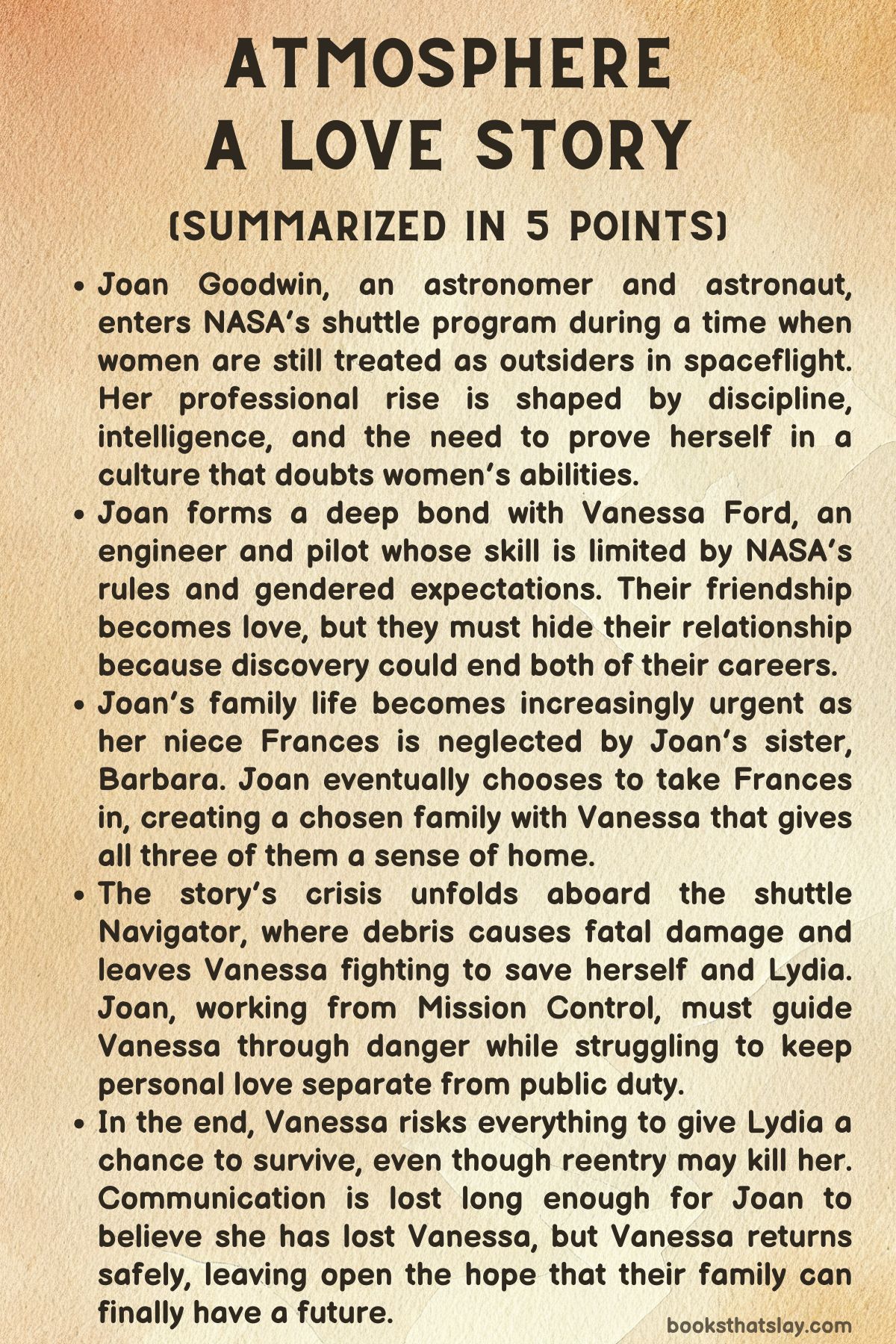
Joan Goodwin arrives at Mission Control at the Johnson Space Center in Houston on December 29, 1984, serving as CAPCOM for a shuttle mission aboard the Navigator. Her job is to speak directly with the astronauts in orbit and relay instructions from flight director Jack Katowski and the rest of the team.
The crew members are not strangers to her. Steve Hagen, Hank Redmond, Griff Griffin, Lydia Danes, and Vanessa Ford are people she knows well, and Vanessa is far more than a colleague.
The mission is supposed to involve the launch of an observation satellite, but when a problem occurs, Griff and Vanessa must perform a spacewalk to release it manually.
The satellite launch goes wrong when one of the explosives malfunctions and debris strikes the shuttle. Griff’s suit is punctured, and the shuttle begins losing pressure.
Mission Control races to understand the damage, while Joan fights to keep her voice calm. Hank, Steve, and Griff lose consciousness.
Lydia searches desperately for the leak inside the cabin, while Vanessa remains trapped in the airlock with Griff. Just before passing out, Lydia seals the leak.
Vanessa believes she may be the only conscious person left alive.
The book then moves back seven years to Joan’s life before NASA. She teaches astronomy at Rice University, having spent years looking at the stars without believing she could actually become an astronaut.
When NASA begins recruiting scientists and women for the shuttle program, Joan applies. She is not selected the first time, but she tries again and is invited for interviews and tests.
Her intelligence, steadiness, and scientific skill earn her a place in the astronaut candidate class.
Joan’s personal life is closely tied to her younger sister, Barbara, and Barbara’s daughter, Frances. Barbara became a mother young and has often depended on Joan for help, even as she resents needing that help.
Joan moves closer to the Johnson Space Center for training but promises to remain involved in Frances’s life. This creates tension, because Barbara feels abandoned while Joan is finally chasing a dream of her own.
At NASA, Joan joins a group of candidates that includes Donna, Lydia, Griff, and Vanessa. Donna is friendly and becomes close to Hank Redmond, a pilot.
Lydia is brilliant, competitive, and guarded. Griff is warm, loyal, and often defends the women against crude remarks from men like Jimmy Hayman.
Vanessa stands apart from the others: private, confident, sharp, and deeply passionate about flying. She is an aeronautics engineer and a pilot, but NASA does not allow her to train as a shuttle pilot because she lacks the military background required for that path.
Joan and Vanessa begin as friends. Vanessa asks Joan to teach her how to navigate by the stars, and Joan takes her to a state park for stargazing.
The night becomes intimate in a quiet way. Joan explains constellations, myths, and her sense that the universe connects all living things.
Vanessa speaks about her father, a Navy pilot who died when she was young, and about how flying saved her from a reckless youth. Their bond grows through honesty, admiration, and a shared hunger for the sky.
Training is physically and emotionally demanding. The candidates study spaceflight, survival, engineering, and NASA history.
They confront the reality that astronauts risk death. Joan is not afraid of death for herself, but she fears leaving Frances without support.
She also faces sexism from male pilots and instructors who doubt women’s place in space. Lydia responds to that pressure by trying to act tougher than everyone else, even laughing along with offensive jokes.
Joan dislikes this but slowly comes to understand that women at NASA are all trying to survive the same system in different ways.
Joan begins to recognize that her feelings for Vanessa are not ordinary friendship. She is slow to admit this to herself, partly because she has always felt detached from romance with men and partly because love between women could destroy both their careers.
Griff develops feelings for Joan, and she briefly tries to respond, even kissing him after a night out, but she immediately knows it is wrong for her. Griff understands more than she says and gently warns her to be careful if her heart belongs to the person he suspects.
Eventually, Joan and Vanessa become lovers. Their relationship is passionate but hidden.
They steal weekends away, spend private nights together, and create small rituals of domestic happiness while continuing to behave carefully at work. For Joan, loving Vanessa helps her understand herself in a way she never has before.
For Vanessa, Joan becomes the person who gives shape and language to things she has never been able to explain, especially her love of flight. They speak about faith, science, mortality, and what it means to belong to someone when the law and culture refuse to recognize that belonging.
Meanwhile, Frances’s situation worsens. Barbara becomes increasingly absorbed in her own romantic life, especially after meeting Daniel, a wealthy and self-satisfied man who does not truly want Frances around.
Frances is neglected, left waiting after school, locked out, or treated as a burden. Joan tries to intervene without overstepping, but she grows more alarmed.
Vanessa, despite initially feeling uncertain around children, forms a sweet connection with Frances, sharing milkshakes and peanut butter and jelly sandwiches with her. Frances begins to feel like part of Joan and Vanessa’s private world.
NASA’s shuttle program advances, and the women candidates watch Sally Ride become the first American woman in space. Joan is eventually chosen for a mission aboard the Discovery, making her the first woman from her candidate group to be assigned to space.
Lydia is hurt and jealous, believing she deserves the spot more, but Joan explains that NASA is not only looking for brilliance. A mission depends on teamwork, trust, and the ability to think beyond individual pride.
Lydia takes this lesson seriously, even if it is painful.
Joan’s own trip to space changes her. At first, it is physically miserable.
She becomes severely sick and disoriented, wondering if she has spent her life wanting something she cannot bear. Then she recovers and sees Earth from orbit.
The sight gives her a powerful sense of human connection and of meaning chosen through love. She realizes that Vanessa and Frances are the center of the life she wants to build.
When Joan returns, she learns that Barbara plans to leave Frances at boarding school over Thanksgiving while she and Daniel travel to Europe. Joan confronts Barbara and demands responsibility for Frances.
Barbara finally says that if Joan thinks she can do better, she can take Frances herself. Joan does exactly that.
She drives to Dallas, picks Frances up, and promises that she will live with her from now on and never again be made to feel unwanted.
Soon after, Joan decides that her future may not be in flying more missions but in Mission Control. She has discovered a talent and calling there.
Antonio, a NASA official, supports the career shift but warns her vaguely about being perceived as morally compromised. His words make clear that rumors about Joan and Vanessa could threaten their jobs and security clearances.
Joan suspects Jimmy may have said something. Terrified of costing Vanessa her dream, Joan breaks up with her just before Vanessa’s mission.
Vanessa refuses to accept it. She calls Joan and says she would rather lose NASA than lose Joan and Frances.
They agree to face the problem together after Vanessa returns.
The story returns to the crisis aboard the Navigator. Vanessa has found Hank and Steve dead.
Griff dies while she is outside trying to secure damaged latches on the shuttle. Lydia is alive but critically injured.
Mission Control tells Vanessa that if she stays outside fixing all the latches, they will miss the reentry window and Lydia will likely die. If she does not fix enough of them, the shuttle may burn up during reentry.
Vanessa decides to disobey orders and return to the cabin to begin deorbit, choosing the chance to save Lydia over a safer delay.
Joan supports Vanessa over the feed, though everyone in Mission Control can hear the fear and love beneath their words. Vanessa asks Joan to tell Frances that she tried.
She also makes clear that she has everything to live for. Jack gently allows Joan to say what she needs to say.
Joan describes the life waiting for Vanessa: home, Frances, food, games, love. Vanessa alludes to David Bowie’s “Space Oddity,” especially the line about telling a wife she is loved.
Joan answers that the wife already knows.
During reentry, communication cuts out. At first this is normal, but silence continues too long.
Joan breaks down, believing Vanessa is gone and regretting every choice that kept them hidden or afraid. Mission Control seems to accept that the shuttle has been lost.
Then Vanessa’s voice returns. She is landing at Edwards Air Force Base, and Lydia is alive.
Joan realizes that their hope was not too much to ask. Against fear, prejudice, death, and impossible odds, Vanessa has survived, and the life they imagined may still be waiting for them.
Characters
Joan Goodwin
Joan Goodwin is the emotional and moral center of Atmosphere, a woman whose intelligence is matched by restraint, loyalty, and a deep need to do what is right. She begins the book as an astronomy professor who has trained herself to accept limits, not because she lacks ambition, but because the world has repeatedly taught women to lower their expectations.
NASA gives her a chance to reclaim a childhood dream, and she proves herself through discipline, calm judgment, and a rare ability to support a team without needing to dominate it. Joan’s quietness is sometimes mistaken for weakness, yet her strength lies in steadiness.
She is able to remain composed when others panic, and this makes her especially suited to Mission Control. Her relationship with Vanessa also forces her to confront parts of herself she has avoided.
She has never fit traditional expectations of romance, marriage, or womanhood, and loving Vanessa helps her understand that her difference is not emptiness but truth. Joan’s growth is not only professional; it is also personal and familial.
Her decision to take Frances in shows her final rejection of passive responsibility. She stops merely helping when asked and instead chooses to build the family Frances deserves.
Vanessa Ford
Vanessa Ford is bold, skilled, restless, and deeply vulnerable beneath her confidence. In the book, she represents both longing and refusal: longing to fly, to be seen, to be loved fully, and refusal to accept the small life that others would assign to her.
Although she is an engineer and a pilot, NASA’s rules keep her from becoming a shuttle pilot, a limitation that frustrates her because it has little to do with ability and much to do with institutional habit. Her love of flying comes from grief over her father and from the sense of peace that flight gives her.
Vanessa has survived recklessness, loneliness, and loss, but Joan gives her a new kind of grounding. Their love does not make Vanessa less ambitious; instead, it clarifies what she is willing to risk and what she is unwilling to surrender.
In the shuttle crisis, Vanessa’s courage becomes unmistakable. She is afraid, she wants to live, and she has a future waiting for her, but she still chooses to act in a way that gives Lydia a chance.
That choice shows her finest quality: she is not fearless, but she is capable of moral action under terror.
Frances
Frances is one of the most important figures in the story because she reveals what love looks like when it is practical, daily, and protective. As Barbara’s daughter and Joan’s niece, Frances grows up surrounded by instability.
Her mother treats her as an inconvenience, especially once Daniel enters the picture, and Frances learns too early what it feels like to be unwanted. Yet she is not written simply as a victim.
She is observant, wounded, funny, and hungry for consistency. Her bond with Joan gives her safety, but her bond with Vanessa adds warmth and playfulness.
The milkshake and sandwich ritual becomes more than a cute habit; it becomes a sign that Frances is being welcomed into a real home. Frances also changes Joan.
Joan’s love for her is one reason Joan hesitates to take risks, but it is also what teaches Joan that responsibility sometimes requires decisive action. When Joan brings Frances home for good, the book makes clear that family is not only a matter of birth.
It is a matter of who shows up, who listens, and who refuses to let a child feel disposable.
Barbara
Barbara is difficult, defensive, needy, and often cruel, but she is not a flat villain. She is Joan’s younger sister, Frances’s mother, and a woman who has spent much of her life looking for rescue through attention, romance, and social respectability.
Her early dependence on Joan creates resentment because Joan’s help reminds Barbara of her own instability. Rather than face that shame, Barbara lashes out.
As a mother, she repeatedly fails Frances. She leaves her unattended, dismisses her distress, and eventually agrees to send her away because Daniel does not want the burden of a child.
Barbara wants the image of a successful adult life: marriage, money, a beautiful home, and freedom from mess. The tragedy of her character is that she chooses that image over her daughter’s emotional needs.
Still, her behavior also shows how some people respond to insecurity by hurting those who rely on them most. Barbara’s conflict with Joan becomes a test of Joan’s boundaries.
Joan spends years smoothing things over, but Barbara’s abandonment of Frances finally forces Joan to stop apologizing and act.
Lydia Danes
Lydia Danes is ambitious, severe, brilliant, and emotionally guarded. She enters the story as someone who seems determined to prove that she is superior to everyone around her.
Her competitiveness is abrasive, especially toward the other women, because she believes only a few of them will be allowed to succeed and that she must beat them to survive. This attitude makes her hard to like at first, yet it is rooted in the brutal pressure placed on women in male-dominated institutions.
Lydia believes she cannot afford softness, solidarity, or humility. Her rivalry with Joan becomes one of the book’s most meaningful professional relationships because Joan eventually tells her the truth: spaceflight is not about proving individual greatness but serving the crew.
Lydia begins to absorb that lesson. Her later role in sealing the shuttle leak is crucial because it shows that she has always had courage and skill, even if she struggled to connect with others.
By the end, Vanessa’s decision to risk reentry for Lydia gives Lydia’s survival moral weight. She is not merely a rival saved by the heroine; she is a colleague whose life matters.
Griff Griffin
Griff Griffin is kind, perceptive, and quietly honorable. He is one of the male characters who understands the unfairness faced by the women at NASA and tries to challenge it, though Joan sometimes resents that women need a man to defend them at all.
Griff’s affection for Joan is genuine, but what makes him admirable is the way he handles rejection. He does not punish her for being unable to love him.
Instead, he gives her space and later offers friendship. His intuition about Joan’s feelings for Vanessa shows emotional intelligence, and his warning about career danger comes from care rather than judgment.
Griff’s death during the shuttle crisis is painful because he has been a steady and decent presence throughout the story. He also serves as a contrast to men like Jimmy.
Griff has privilege in the NASA environment, but he uses it with some sense of responsibility. He is not perfect, yet he is generous, loyal, and capable of seeing people clearly without demanding that they become what he wants.
Hank Redmond
Hank Redmond is a pilot whose warmth distinguishes him from many of the other military men in the astronaut group. He respects Joan during flight training, encourages her when she struggles, and treats the mission specialists with more openness than some of his peers.
His relationship with Donna reveals a softer side, showing him as a man who values domestic love and partnership. Hank’s marriage and fatherhood also create one of the story’s ordinary human stakes.
He is not only an astronaut in danger; he is Donna’s husband and Thea’s father. His death aboard the Navigator is devastating because the book has spent time showing the life attached to him.
Hank’s character also helps balance the portrayal of NASA’s male culture. The institution contains sexism and cruelty, but not every man in it behaves the same way.
Hank is not a radical challenger of the system, but he is decent, supportive, and emotionally available in ways that matter to those around him.
Donna
Donna is friendly, observant, and quietly strong. She begins as one of Joan’s closest companions in training and later becomes Hank’s wife.
Her decision to step back from her own NASA ambitions after becoming involved with Hank may frustrate Joan, but Donna’s choices are her own, and the story treats her with dignity rather than judgment. Donna’s pregnancy shows another form of gendered pressure at NASA, because motherhood can remove women from active assignments in ways fatherhood does not.
Joan’s help in hiding the pregnancy for a time reflects the solidarity between them. Donna also becomes important because she seems to recognize the truth about Joan and Vanessa without condemning them.
Her acceptance gives Joan a rare feeling of safety. In a world where exposure could mean professional ruin, Donna’s quiet understanding is an act of friendship.
She represents a form of love that is less dramatic than romance but deeply necessary: the friend who sees, knows, and protects.
Steve Hagen
Steve Hagen is a mentor figure whose presence carries warmth, authority, and loss. As an instructor and astronaut, he helps shape the newer candidates’ understanding of NASA and of the seriousness of their work.
To Vanessa, he is especially important because he recognizes her talent as a pilot and gives her respect that many others deny her. He allows her to take the controls during flights, validating the skill NASA’s formal rules refuse to reward.
His view of mentorship as a legacy makes him a deeply human figure, someone who understands that achievement is not only what one does personally but what one helps others become. His death during the shuttle accident is therefore more than a plot event.
It removes one of the few men in the institution who actively nurtures Vanessa’s talent. Steve’s loss also reminds the reader that space exploration is built not only on ambition and science but on real people whose absence leaves families, friends, and protégés behind.
Antonio Lima
Antonio Lima is a complicated authority figure. He recognizes Joan’s strengths and gives her opportunities, including her mission assignment and later her place in Mission Control.
He understands that Joan’s calm, collaborative style makes her valuable, and his professional judgment often appears fair. Yet Antonio also represents the limits of institutional tolerance.
When he warns Joan about the appearance of sexual deviation, he does so in polite, indirect language, but the threat is unmistakable. He may not personally hate Joan or Vanessa, but he still enforces a system that treats their love as a risk.
This makes him one of the more realistic figures in Atmosphere. He is not openly cruel like Jimmy, yet his power can still harm.
Antonio shows how discrimination often survives through procedure, reputation, and coded warnings, even when individuals frame themselves as reasonable. His character forces Joan to face the painful truth that professional respect does not guarantee personal safety.
Jimmy Hayman
Jimmy Hayman embodies the ugliest side of NASA’s male culture in the story. He makes demeaning remarks, treats women as intruders, and uses mockery to protect his own insecurity.
Joan eventually realizes that Jimmy is afraid of failure and has been taught to treat fear, kindness, and sincerity as weaknesses. This understanding does not excuse him, but it gives his cruelty a source.
Jimmy matters because he shows how one person’s insecurity can become a weapon when supported by a biased environment. He also becomes a source of danger for Joan and Vanessa, since his suspicion may contribute to the rumors that reach Antonio.
Jimmy does not need to hold the highest rank to cause harm. His power comes from the fact that the institution is already inclined to doubt and police people like Joan and Vanessa.
He is a reminder that prejudice can operate through jokes, gossip, and casual comments long before it becomes official punishment.
Daniel
Daniel is Barbara’s husband and one of the clearest symbols of respectability without real generosity. He appears polished, wealthy, and socially acceptable, which makes him attractive to Barbara because he offers the stability and status she craves.
Yet his presence worsens Frances’s life. He does not want children, and Barbara begins shaping her choices around that fact rather than around her daughter’s needs.
Daniel is not loud or outrageous in his cruelty; his harm is colder. He makes Frances feel like an obstacle to adult happiness, and Barbara accepts that view because it serves the life she wants.
His role in the book is important because he reveals the danger of a home that looks successful from the outside but is emotionally barren within. Through Daniel, the story criticizes a narrow idea of family respectability, especially when that image is valued more than the actual care of a child.
Themes
Love as a Chosen Responsibility
Love in Atmosphere is not treated as a feeling alone. It is shown as a responsibility that people either accept or refuse.
Joan’s love for Vanessa brings her joy, desire, and self-recognition, but it also asks for courage in a world that makes their relationship dangerous. Vanessa’s love for Joan is not casual or temporary; she is willing to risk even her career because she understands Joan and Frances as her family.
The same idea appears in Joan’s bond with Frances. Joan has always helped her niece, but the turning point comes when she stops acting like a supportive aunt on the margins and becomes the adult who chooses Frances fully.
Barbara, by contrast, shows what happens when love is claimed but not practiced. She is Frances’s mother, yet she repeatedly chooses convenience, romance, and social comfort over her daughter’s emotional safety.
The book defines family through action. To love someone means showing up, protecting them, making space for them, and refusing to treat them as a burden when life becomes difficult.
The Cost of Secrecy
Joan and Vanessa’s relationship is shaped by secrecy from the beginning. Their love is real, but they must hide it at work, with family, and in public life because exposure could destroy their careers.
This secrecy creates a double life: one world of NASA, professionalism, and caution, and another world of private tenderness, shared beds, quiet trips, and imagined domestic futures. The emotional cost is enormous.
Joan cannot introduce Vanessa honestly to her parents, cannot bring her openly as a partner to family events, and cannot claim the language of marriage or home without fear. Vanessa is more willing to risk everything, but she too understands the danger.
The secrecy also gives other people power over them. A rumor, a suspicion, or a coded warning from Antonio can threaten the life they are trying to build.
The story makes clear that secrecy is not a personal failure. It is imposed by a culture that punishes honesty.
Joan’s breakdown during the reentry blackout is powerful because, in that moment, secrecy finally collapses. Her love becomes audible to everyone, and the truth matters more than fear.
Women Fighting for Space in a Male Institution
NASA’s shuttle program offers women new possibilities, but the book never pretends that opportunity means equality. Joan, Vanessa, Lydia, Donna, and the other women enter an environment where men often doubt them, mock them, sexualize them, or treat them as symbolic risks.
If a woman fails, her failure threatens to become evidence against all women. Sally Ride’s mission carries this weight, and Lydia understands that any mistake by a woman astronaut may be used to delay every other woman’s chance.
This pressure damages solidarity. Lydia sees the other women as competitors because she believes there are only a few places available for them.
Vanessa’s expertise as a pilot is dismissed because NASA’s rules privilege military pathways dominated by men. Donna’s pregnancy creates professional consequences that male astronauts do not face when they become fathers.
Joan succeeds not by imitating male aggression, but by proving the value of steadiness, cooperation, and trust. The book shows that women are not merely trying to enter space; they are trying to survive the assumptions attached to their bodies, choices, emotions, and ambitions.
Courage Under Fear
Courage in the story is never the absence of fear. It is the decision to act while fear remains present.
Joan is afraid during training, afraid of leaving Frances, afraid of losing Vanessa, and afraid during the Navigator crisis, yet she continues to do what the moment requires. Her calm voice in Mission Control is not evidence that she feels nothing; it is evidence that she can place duty above panic.
Vanessa’s courage is even more visible in the damaged shuttle. She wants to live.
She wants to return to Joan and Frances. She knows that reentry may kill her, yet she refuses to abandon Lydia if there is still a chance to save her.
Frances also shows a quieter kind of courage by continuing to trust Joan after repeated rejection from Barbara. Even Lydia’s final act before losing consciousness is courageous: she seals the leak that saves the others despite the danger to herself.
The book presents courage as a shared human effort rather than a single heroic pose. People survive because others keep choosing action, honesty, and care while terrified.