Love at First Sightings Summary, Characters and Themes
Love at First Sightings by Mallory Marlowe is a romantic science-fiction drama that explores authenticity, human connection, and the illusions we build—both online and in life. The story follows El Martin, a glamorous Los Angeles influencer whose carefully curated image begins to unravel after a mysterious encounter in the Hollywood Hills.
When her viral UFO sighting draws the attention of Carter Brody, an underdog government agent with his own painful past, their lives collide in unexpected ways. What begins as a clash of skepticism and self-preservation evolves into a partnership uncovering corruption, conspiracy, and love grounded not in performance, but in truth.
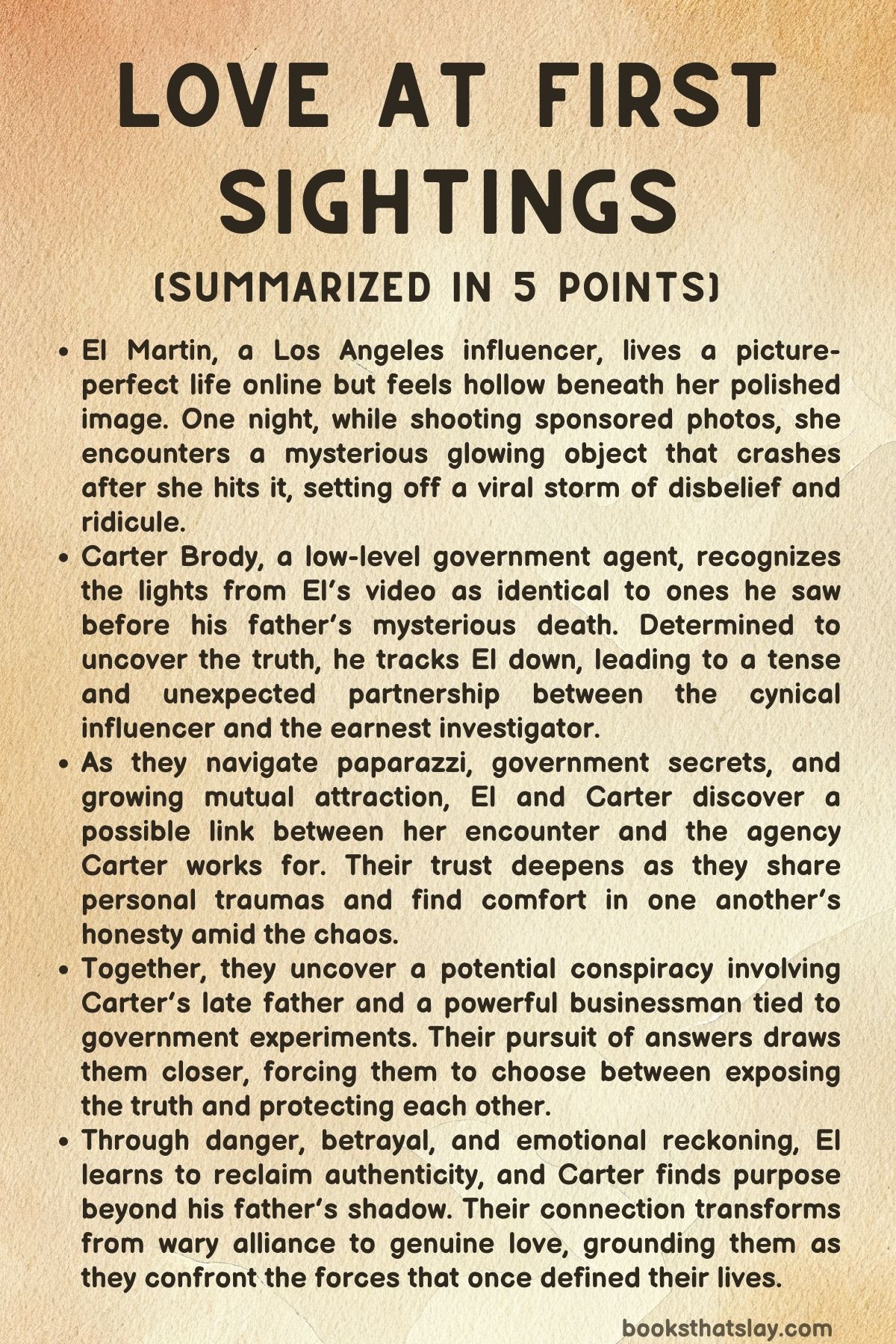
Summary
El Martin, a 28-year-old social media influencer from Los Angeles, is at the height of her online fame yet deeply dissatisfied with her life. While shooting promotional photos for a yoga brand on a mountain at sunset, she experiences something extraordinary—a strange set of glowing lights chasing her in the dark.
Terrified, she knocks a metallic flying object out of the sky and streams the aftermath live. When the footage mysteriously disappears from her profile, and the internet mocks her story, El’s life begins to spiral.
Brands drop her, followers ridicule her, and even her mother and ex-boyfriend exploit her situation for personal gain.
At the same time, Carter Brody, a low-level agent at the Private Intelligence Sector (PIS), spends his monotonous days discrediting alleged UFO sightings. When his trainee shows him El’s viral video, Carter is shaken.
The lights in her footage resemble those he saw the night his father died in a mysterious crash years earlier. Against orders, he decides to investigate, linking El’s experience to his father’s death.
His superior and uncle, Marcus, dismisses his theory, but Carter’s determination drives him to track El down in Los Angeles.
When he finally approaches her, El mistakes him for a stalker or a journalist. Carter reveals confidential information about her and shows her his badge bearing the same insignia she saw on the fallen object.
Shocked, El realizes the craft might have been government property, not alien. Though distrustful of his intentions, she reluctantly begins to believe that Carter’s curiosity might be genuine.
Both are drawn to the mystery—and to each other—despite their guarded hearts.
El tries to avoid Carter, yet he continues to follow her clues online. Their paths cross again after a chaotic chase through Los Angeles, where she breaks down under the weight of ridicule and fear.
Carter comforts her, revealing he, too, once saw something unexplainable. They agree to meet again and investigate together.
Their growing bond begins to transform suspicion into trust.
When they return to the mountain site, they discover a metal door hidden in the hillside with the same emblem as Carter’s agency. The resemblance between the insignia and the wrecked craft deepens their suspicions.
Carter recalls an old photo he took of similar lights before his father’s death. As they discuss these parallels, a glowing craft appears overhead.
It looks manufactured, not alien, suggesting that PIS itself may be behind the incidents. Carter realizes his agency may be hiding dangerous secrets.
Carter files a false report to protect El and the truth. When he learns that the agency plans to erase old archives—including his father’s files—he knows time is running out.
With El’s help, he devises a plan to recover the records before they vanish. Their partnership turns romantic as they share a meal in a diner, teasing and confiding in one another.
El opens up about the emptiness of her influencer persona, and Carter admits he joined PIS to honor his late father. Their chemistry blossoms into affection and mutual respect.
To access the files, Carter turns to his awkward roommate, Leonard, who has clearance to government systems. El plays along as a charming gamer to gain his help, and Leonard provides them with a location and digital keys for an underground archive called Site 47.
That night, Carter and El break into the facility. Though nervous, they press on, aware that they’re entangled in something larger than either imagined—a conspiracy that connects PIS, private corporations, and Carter’s family tragedy.
Soon after, the investigation takes them to a lavish party at the Houdini House, where El assists her ex-boyfriend, magician Alaka-Sam, onstage. There, she tries to get close to wealthy investor Ian Forte, whose company, Terra, is rumored to have ties to secret technology.
Carter, watching from the audience, senses danger. When El meets Ian privately, she discovers he already knows about her “UFO stunt.” His arrogance and veiled threats confirm her suspicions that he’s involved with PIS operations. Before he can act, she sneaks Carter into the room, and together they find a note from Marcus to Ian congratulating him on a “launch.” The discovery proves that Carter’s uncle is colluding with Terra.
Their alliance deepens amid passion and peril. They break into Marcus’s office to uncover more evidence, find records of upcoming meetings between him and Ian, and decide to expose them both.
During a stormy night in the office, their emotional tension gives way to intimacy, solidifying their relationship. But their joy is short-lived—Marcus begins to suspect Carter’s betrayal.
Meanwhile, El’s influencer world collapses completely. After an on-camera argument with her roommates, she abandons the superficial life she built and moves in with Carter.
Together, they begin a quieter, more authentic existence, but danger soon returns. Marcus sends one of his enforcers, Brad, to tail El.
She narrowly escapes, calling Carter for help. A rain-soaked chase through the streets of Los Angeles ends with Carter injured and Brad defeated.
Determined to end it once and for all, they decide to confront Marcus and uncover the truth in the PIS headquarters.
During the confrontation, Carter breaks into Marcus’s office, discovering an old note from his father hidden inside his signature trilby hat. The message leads him to a fallout bunker beneath the building containing the 1995 PIS Code of Conduct—and possibly his father’s file.
As El searches the bunker, Marcus confronts her, confirming his betrayal. He reveals that PIS partnered with Terra to develop experimental crafts under the guise of alien investigations, and Carter’s father was killed for threatening to expose it.
Carter, injured but resolute, arrives in time to save El. A violent fight ensues.
Marcus shoots Carter and corners El, but she distracts him with absurd influencer banter long enough for Carter to climb overhead and drop an old printer onto Marcus, knocking him unconscious. They handcuff him to a beam and flee as sirens approach.
Carter wakes in the hospital, where El tells him she turned the evidence over to the police. Marcus is arrested for conspiracy and attempted murder, while Terra’s secret operations are exposed.
Carter and El confess their love and begin new lives free of deception. Carter leaves PIS, using a government payout to start a photography business.
El rebuilds her career on her own terms, posting authentic content rather than sponsored illusions. Together, they reclaim their identities—he as a free man, she as her true self.
Months later, the couple travels to Europe, pursuing happiness and creativity without pretense. In Paris, Carter photographs El at sunrise near the Eiffel Tower.
They kiss and laugh as the camera clicks, capturing not a staged image, but a moment of real love and peace. Their journey—from fear and fraud to honesty and connection—closes with a shared truth: what they once faked for the world, they now live for each other.
Characters
El Martin
El Martin stands at the heart of Love at First Sightings, representing the tension between self-presentation and inner emptiness. A 28-year-old influencer from Los Angeles, El lives within a carefully curated social media bubble that masks her loneliness and loss of identity.
Her influencer persona, polished and glamorous, contrasts starkly with her internal sense of disconnection and fatigue. Raised in a transactional relationship with her mother—who exploited her for modeling income—El’s adult life becomes a performance of control in a world that constantly commodifies her image.
The UFO incident jolts her into self-awareness, forcing her to confront not only external ridicule but also her need for authenticity. Her interactions with Carter mark a slow shedding of superficial layers; with him, she learns to value truth over optics, sincerity over branding.
By the novel’s end, El evolves from a brand-dependent figure into a woman reclaiming her narrative, redefining what visibility and honesty mean in both love and life.
Carter Brody
Carter Brody, the male protagonist, embodies quiet integrity shaped by trauma and suppressed ambition. As an agent of the Paranormal Investigation Service (PIS), he starts as a bureaucratic cog—skeptical, overlooked, and haunted by his father’s mysterious death.
His life has been defined by loss and duty, leaving him emotionally isolated and craving purpose. When El’s viral video reawakens memories of his father’s fatal encounter with similar lights, Carter is driven not by ambition but by a deep need for truth and closure.
His relationship with El transforms him: she draws out his buried empathy and humor, while he grounds her chaotic world with loyalty and moral clarity. Carter’s journey—breaking free from institutional corruption and embracing love—mirrors El’s search for authenticity.
Together, they represent two wounded people who rediscover meaning through vulnerability. By the story’s end, Carter’s choice to leave PIS and start a photography business symbolizes liberation from legacy and deceit, embracing creation over concealment.
Marcus Brody
Marcus Brody, Carter’s uncle and superior at PIS, operates as both mentor and antagonist. A man steeped in the cynicism of bureaucracy, Marcus initially presents as pragmatic and weary, someone who prioritizes institutional survival over moral principle.
Beneath his guidance lies manipulation and guilt tied to Carter’s father’s death. Marcus’s alliance with Ian Forte and Terra Vodka exposes the rot within PIS, a reflection of power systems that exchange integrity for influence.
Yet, Marcus is not a one-dimensional villain—his actions stem from a fear of irrelevance and a warped sense of protection toward his nephew. His downfall, precipitated by Carter and El’s discovery of his corruption, represents the collapse of an old order built on secrecy.
Marcus’s character serves as a cautionary symbol of loyalty misused, showing how survivalism without conscience leads to ruin.
Ian Forte
Ian Forte epitomizes the seductive corruption of wealth and power. As the CEO of Terra Vodka and a self-styled visionary investor, Ian thrives on charisma, manipulation, and the illusion of control.
His interest in aviation and submarines parallels his obsession with dominance over both sky and sea—symbols of human ambition unchecked by ethics. Ian’s dealings with PIS and Marcus reveal him as the linchpin connecting government secrecy with corporate greed.
Through his suave demeanor and condescending charm, he represents the dark allure of influence in a world obsessed with image. For El, Ian becomes a mirror of everything she once aspired to—status, attention, validation—but now rejects.
His eventual exposure is not just a plot resolution but a moral punctuation: the public unmasking of those who profit from deception while claiming to innovate.
Alaka-Sam
Alaka-Sam, El’s ex-boyfriend and a stage magician, functions as a foil to both El and Carter. Where El’s career relies on digital illusion, Sam’s world revolves around physical performance and showmanship.
His flippant attitude toward El’s crisis underscores his superficiality; he views every event as an opportunity for spectacle, even at her expense. Sam’s refusal to help El reconnects her with the emotional exploitation she has faced throughout her life—whether from family, colleagues, or lovers.
Though not evil, Sam is emblematic of those who prioritize appearance over empathy, leaving El to recognize that sincerity, not style, defines real connection.
Bex
Bex, El’s British-accented roommate and co-inhabitant of the influencer mansion “The Bird’s Nest,” embodies performative identity at its peak. Her fake persona and obsession with maintaining sponsorships illustrate the hollowness of social media success.
Bex’s reaction to El’s viral breakdown—demanding deletion for brand protection—reveals her fear of authenticity and exposure. She serves as a counterpoint to El’s transformation; while El seeks truth and self-ownership, Bex clings to the illusion of perfection.
Through Bex, the narrative critiques influencer culture’s dependence on artifice and the suffocating demand for continuous performance.
Leonard
Leonard, Carter’s socially awkward roommate, provides comic relief but also unexpected depth. Initially presented as a nervous, geeky gamer with high-level security clearance, Leonard becomes an essential ally in Carter and El’s quest.
His willingness to risk his job for them reflects quiet bravery hidden beneath self-doubt. Leonard represents the theme of underestimated intelligence—the notion that heroism can exist in the mundane.
His moral compass and loyalty contrast sharply with Marcus’s corruption, reinforcing the story’s emphasis on integrity arising from unlikely sources.
John Brody
John Brody’s presence looms over the novel as both mystery and motivation. Though deceased before the story begins, his death anchors Carter’s emotional journey.
As a principled PIS agent who uncovered the agency’s unethical ties to corporate interests, John symbolizes the cost of truth in a system built on secrecy. His hidden note inside the trilby hat, discovered by Carter, serves as both literal and metaphorical guidance—a father’s voice urging his son to “back up your work,” to preserve honesty even when surrounded by deceit.
Through John’s legacy, the novel ties together generational trauma, institutional corruption, and the redemptive power of truth-seeking.
Themes
Authenticity and the Performance of Self
In Love at First Sightings, authenticity emerges as a driving force that challenges both personal and social façades. El Martin’s carefully manufactured image as an influencer embodies the tension between who she is and who she feels compelled to appear as.
Her Instagram-perfect lifestyle—composed of brand partnerships, curated sunsets, and filtered smiles—creates an illusion that replaces genuine experience with performance. Mallory Marlowe uses El’s dependence on likes and sponsorships as a reflection of how modern identity can be commodified; the self becomes a product, and emotions are reshaped to fit an algorithm.
When the UFO incident shatters her digital façade, El’s struggle is no longer about maintaining her image but about reclaiming her truth. The disappearance of her viral video underscores how easily one’s “reality” can be manipulated or erased in the digital age, suggesting that truth itself is fragile when mediated by technology.
Carter’s entry into her life provides a counterpoint—his sincerity and awkward transparency contrast with her world of filters and rehearsed charm. As their bond grows, El’s transformation from a manufactured persona to a self-aware individual becomes the emotional core of the novel.
Her rebranding at the end, where she posts unfiltered and authentic content, signifies not only a personal evolution but also a rebellion against the performative structures that once defined her. Marlowe’s narrative ultimately proposes that authenticity is not found in public approval but in shared vulnerability, where one can finally exist without the burden of performance.
Trust, Connection, and Emotional Healing
Trust in Love at First Sightings functions as both a fragile and redemptive force, shaping the relationship between two wounded individuals who have been betrayed by their respective worlds. El, molded by a manipulative mother and exploited by fame, has learned that affection often comes with strings attached.
Carter, on the other hand, carries the emotional residue of losing his father under suspicious circumstances and being dismissed by the very institution meant to uphold truth. When they meet, suspicion defines their interaction—El sees Carter as another figure seeking to use her, and Carter fears that believing her could destroy his career.
Yet, as their shared pursuit of the truth draws them closer, trust becomes their only means of survival. Marlowe treats trust not as an instantaneous realization but as a gradual reconstruction of faith in humanity.
Every conversation, from their banter in the car to their confessions over grilled cheese, functions as a quiet act of rebuilding. Their romance thus becomes less about attraction and more about emotional healing through mutual belief.
Carter’s willingness to risk his life and El’s decision to stay by his side despite danger mark turning points where trust matures into love. In a world defined by deception—from social media façades to government conspiracies—their connection stands as proof that intimacy can exist only when two people are willing to share their truths without masks.
Marlowe concludes this journey not with grand gestures but with ordinary acts of care—cooking together, sharing laughter, and choosing each other daily—illustrating that trust is sustained not by promises but by presence.
The Corruption of Power and Institutional Decay
Marlowe situates the conflict of Love at First Sightings within the decaying framework of PIS, the Private Intelligence Sector, to explore how power, once built on duty, corrodes under secrecy and greed. The agency, initially founded to protect truth, becomes a vessel of suppression—erasing files, silencing witnesses, and colluding with corporate forces like Terra Vodka to sustain relevance.
Through Marcus, Marlowe presents an archetype of bureaucratic rot: a man who justifies betrayal in the name of pragmatism. His alliance with industrial elites reveals how institutions often sacrifice morality for survival, transforming justice into a marketable commodity.
Carter’s rebellion against his mentor symbolizes the moral awakening of a generation that refuses to inherit the sins of its predecessors. The buried files, encrypted archives, and hidden bunkers are more than plot devices—they represent how power conceals itself beneath layers of justification.
El’s outsider perspective sharpens this critique; her experience as a public figure controlled by corporate interests mirrors the same manipulation operating within government systems. The novel blurs the line between personal exploitation and political corruption, suggesting they spring from the same hunger for control.
When Carter exposes Marcus, it is not simply a victory of good over evil but a reclamation of truth from the machinery of deceit. The dissolution of PIS and Terra’s public downfall reaffirm that institutions lose legitimacy when they prioritize image and influence over integrity, leaving authenticity—embodied by El and Carter—as the only sustainable power.
Technology, Surveillance, and the Erosion of Privacy
The recurring motif of observation—cameras, drones, livestreams, and government tracking—positions Love at First Sightings as a commentary on modern surveillance culture. From the opening scene, where El films herself for sponsorship content, technology mediates every human interaction.
Her world operates under constant scrutiny, where privacy is a privilege she cannot afford. The irony of her recording the UFO encounter—an act meant to protect herself—only for the video to vanish, exposes how control over one’s narrative is illusory in the digital ecosystem.
Marlowe expands this theme through PIS’s surveillance machinery, which monitors citizens under the guise of national security. Both the influencer economy and the intelligence apparatus function on the same principle: data as power.
El’s public exposure and Carter’s bureaucratic confinement mirror each other, as both characters are trapped within systems that value information more than people. Their alliance challenges this omnipresent gaze; together, they reclaim agency by choosing what to share and what to protect.
By the novel’s end, El’s decision to “hard launch” her relationship not as content but as genuine expression transforms technology from a tool of control into one of liberation. Marlowe’s vision is not anti-technology but rather a plea for ethical transparency—a reminder that visibility should not cost one’s humanity.
The shift from coerced exposure to self-chosen openness reflects a broader societal yearning to live authentically in a world where every act is potentially recorded, edited, and consumed.
Redemption and Reinvention
At its heart, Love at First Sightings is a story of renewal—how two people scarred by past compromises discover redemption through each other. El’s arc, from a commodified influencer to an authentic creator, mirrors the process of reclaiming self-worth.
Her fall from public grace forces her to confront the emptiness behind her success, and in choosing truth over popularity, she redefines what it means to live meaningfully. Carter’s journey operates in parallel; haunted by his father’s death and manipulated by authority, he seeks redemption not through revenge but through understanding.
Their partnership becomes an act of defiance against both personal shame and systemic corruption. Marlowe portrays love as a redemptive force—not in a sentimental sense, but as a commitment to change.
The novel’s closing scenes in Paris, with Carter photographing El without pretense, symbolize rebirth through honesty and choice. The camera, once a tool of illusion, now captures reality; the lens no longer distorts but preserves.
Both characters move from reaction to creation, from survival to authorship of their own lives. Redemption in this story is not achieved by undoing the past but by transforming its meaning—choosing to carry scars as proof of endurance rather than evidence of failure.