Loved One by Aisha Muharrar Summary, Characters and Themes
Loved One by Aisha Muharrar is a thoughtful exploration of grief, memory, and the complex ways love endures beyond death. The novel follows Julia, a jewelry designer whose closest friend—and former lover—Gabe, a rising musician known as Separate Bedrooms, dies unexpectedly.
As Julia navigates the aftermath of his death, she wrestles with the blurred lines of friendship, love, and regret. Her journey takes her from Los Angeles to London and Barcelona as she searches for a missing bracelet she once made for Gabe, uncovering not only fragments of his life but also her own unresolved emotions.
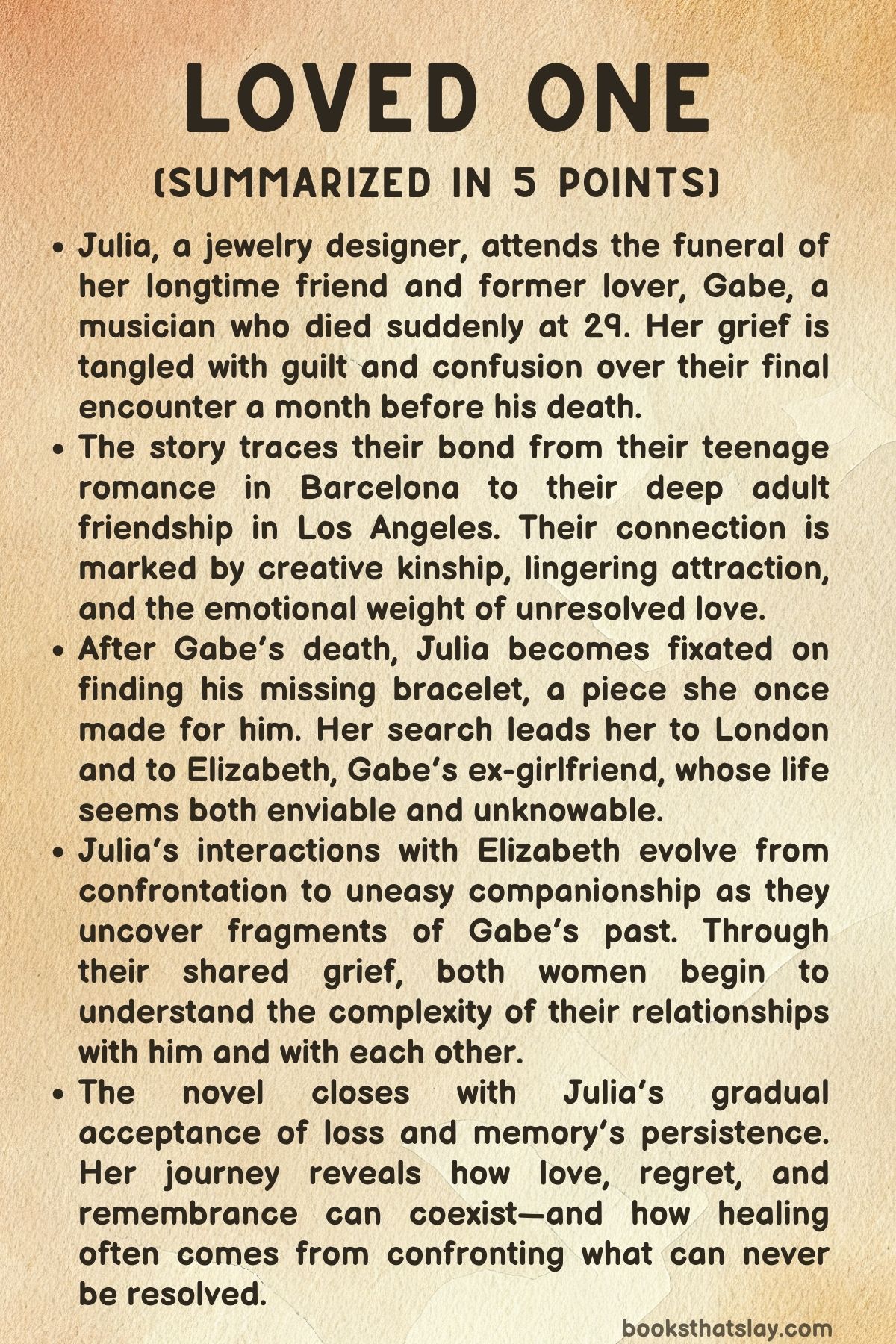
Summary
The story opens at Gabe Wolfe-Martel’s funeral, a 29-year-old musician celebrated under his stage name, Separate Bedrooms. Julia, the narrator and his longtime friend, delivers a eulogy she barely feels capable of giving.
Her grief feels dissonant—more anger and confusion than sorrow—because a month before his death, she and Gabe had slept together for the first time since their teenage romance, leaving everything between them unresolved.
After the funeral, Julia encounters several people who deepen her unease: Gabe’s manager, Kathy, who insists Gabe adored her, and Elizabeth, his ex-girlfriend from London, who curtly remarks, “I know exactly who you were to Gabe. ” Julia’s emotions swirl between guilt, longing, and fury—at Gabe for dying and at herself for still caring.
Back in Los Angeles, Julia’s life resumes in fragments. She runs her jewelry business, but everyday routines feel hollow.
Her grief merges with self-reproach, particularly when she sees Gabe’s image turned into a public symbol of mourning—his name on tip jars, his songs replayed endlessly. These moments remind her how deeply private her loss feels, even as the world romanticizes him.
Her memories shift to twelve years earlier, when she first met Gabe in Barcelona. Seventeen and attending a summer art program, Julia encountered him singing “Through the Fire” at a professor’s party.
Gabe, accompanying his poet mother Leora, immediately charmed her with humor and vulnerability. Their connection grew quickly through long walks, shared jokes, and late-night talks about art and music.
Their first kiss marked the beginning of an intense young romance defined by tenderness rather than urgency.
Gabe’s revelation of his rare condition, situs inversus—where his internal organs are mirrored—became a turning point. Julia, touched by his trust, crafted a silver medical bracelet for him as a gesture of care.
But when she gave it to him, an awkward misunderstanding strained their closeness. Shortly after, Gabe abruptly left Barcelona to start a band, ending their relationship.
Julia last saw him performing from a courtyard window, still wearing the bracelet she had made.
Years later, their paths crossed again in Los Angeles. Julia, now an aspiring jewelry designer, ran into Gabe, whose music career was flourishing.
They rekindled a deep friendship that persisted through their twenties. Both dated other people, but their bond remained a constant—built on shared humor, mutual admiration, and an unspoken awareness of what they had once been.
Their friendship reached a fragile equilibrium until one night, years later, it shifted again. Over dinner, Gabe confessed he’d written songs inspired by her, and their conversation slipped into old warmth and flirtation.
They spent the night together, reconnecting emotionally and physically.
For Julia, it felt like rediscovering something true; for Gabe, it seemed to awaken old contradictions. When he left for his tour the next morning, promising to see her soon, she believed it might mark a new beginning.
But afterward, he vanished—no replies to texts or calls, no explanation. Her anger simmered until his sudden death shattered every chance of understanding why.
In her grief, Julia becomes obsessed with Gabe’s missing bracelet after learning from Leora that it was not among his returned belongings. Believing Elizabeth might have it, Julia decides to find her.
Through obsessive online searches, she uncovers Elizabeth’s thriving life as a London restaurateur and, driven by equal parts duty and obsession, flies to London under the guise of business.
There, Julia’s fixation deepens into confrontation and unexpected empathy. After an initial failed attempt to approach Elizabeth at her restaurant, she coincidentally meets her at an art exhibit.
To Julia’s surprise, Elizabeth is kind and self-possessed, and their conversation about art and loss forges an uneasy connection. Elizabeth apologizes for her harshness at the funeral and invites Julia to dinner at her restaurant, Fleur Bleue.
Julia accepts, though she’s uncertain whether she seeks closure, truth, or revenge.
Dinner, however, ends painfully. When Elizabeth leaves midway, Julia’s emotions spiral—she drinks too much, flirts with the bartender Louis, steals Gabe’s guitar from the restaurant, and sleeps with Louis.
The next morning, she feels emptier than before. Remembering that Gabe had called her before his death—a call she ignored—she’s crushed by guilt, realizing she’ll never know what he wanted to say.
Determined to return the stolen guitar, Julia confronts Elizabeth, who lashes out, accusing her of selfishness. Then Elizabeth drops a revelation: she is pregnant with Gabe’s child.
The shock unsettles Julia’s entire understanding of Gabe’s final days. Elizabeth later retracts her confession, but Julia insists on the truth.
Elizabeth admits Gabe learned of the pregnancy the very morning he left Joshua Tree—the same weekend Julia last saw him. His silence now makes painful sense.
Reluctantly, the two women join forces to recover Gabe’s belongings for Leora. Their uneasy alliance exposes their shared grief and rival memories of Gabe.
At Elizabeth’s apartment, they find remnants of his life: old clothes, a Mets cap, and his unfinished sheet music. Friends gather to remember him, performing one of his songs, and Julia feels how much of Gabe she never truly knew—how many lives he had beyond her own version of him.
When a photo surfaces of Elizabeth wearing what seems to be Gabe’s bracelet, Julia’s resentment resurfaces. But Elizabeth later explains it was a duplicate bought for a magazine shoot.
The real bracelet’s trail leads them to Barcelona, where they meet Leora, now living with her academic friend Roberta. There, family tensions and quiet revelations unfold.
Leora admits she has Gabe’s bracelet after it was mailed to her from a rental in Joshua Tree, meaning Gabe had taken it off while with Julia. The knowledge devastates Julia—it proves he had tried to retrieve it, perhaps as a symbolic gesture of reconnection or closure.
Amid the emotional fallout, Julia and Elizabeth confront each other. Their argument exposes their mutual guilt and love for Gabe, yet also their capacity to understand each other’s pain.
They part on uncertain but tender terms.
Months later, Julia returns to Los Angeles. Time passes, grief softens but never disappears.
She rebuilds her life, her business grows, and she and Elizabeth remain in contact. Elizabeth gives birth to a daughter, Cosme Wolfe-Thompson.
On Gabe’s yahrzeit—the anniversary of his death—they hold a tribute concert in his honor, where Julia finally finds the courage to speak honestly: she loved Gabe, and she still does.
As the novel closes, Julia reflects that grief never truly ends; it changes shape. She continues her quiet walks through Los Angeles, sensing Gabe in the smallest details—a song, a flash of light, a memory that refuses to fade.
The story ends not with resolution but with acceptance: love endures, even when the loved one is gone, not through closure, but through remembrance.
Characters
Julia
Julia, the narrator of Loved One, is a complex and deeply introspective protagonist whose journey is defined by grief, love, and the search for closure. Her emotional depth becomes apparent from the opening funeral scene, where she struggles to reconcile her public eulogy for Gabe with the private turmoil of their unresolved relationship.
Julia’s grief is not linear—it is tangled with anger, guilt, and longing, reflecting her inability to categorize the love she felt for Gabe. Her creative profession as a jewelry designer mirrors her emotional landscape: she crafts tangible symbols of connection and loss, such as the bracelet she made for Gabe, which later becomes the story’s emotional centerpiece.
Throughout the novel, Julia’s relationship with memory and identity evolves. Her time in Barcelona as a teenager represents innocence and idealism, a period when love was new and art was a shared language.
Years later, in Los Angeles, she is an adult defined by restraint, grief, and unspoken emotion. When she travels to London in search of Gabe’s belongings, her actions—bordering on obsession—reflect both a desperate attempt to reclaim control and a deeper wish to remain tethered to him.
Julia’s arc is ultimately one of acceptance: she learns that love and loss coexist, and that her relationship with Gabe, though unfinished, remains an integral part of her. Her growth is subtle but powerful, seen in her ability to forgive, to connect with Elizabeth, and to finally speak of Gabe with tenderness rather than torment.
Gabriel Wolfe-Martel
Gabe is the emotional core of Loved One, his absence shaping every character’s experience. Through memories and fragmented recollections, he emerges as a charismatic, sensitive, and talented musician whose life was marked by both creative brilliance and emotional turbulence.
His condition, situs inversus, symbolizes his mirrored existence—his external charm masking internal confusion. Gabe’s relationships with Julia and Elizabeth reveal his duality: he is deeply affectionate and vulnerable yet also evasive, retreating from intimacy when it threatens his autonomy.
In Barcelona, Gabe is portrayed as a young man filled with passion and potential, someone capable of profound emotional connection. Yet as he matures, fame and self-doubt complicate his identity.
His silence after rekindling his relationship with Julia is both an act of cowardice and confusion, coinciding with his discovery of Elizabeth’s pregnancy. His death cements his status as a figure of longing—an artist mythologized by those who loved him.
Gabe’s story is one of unfulfilled potential, not just musically but emotionally, leaving behind a web of grief that continues to define Julia and Elizabeth’s lives.
Elizabeth
Elizabeth, Gabe’s ex-girlfriend and eventual mother of his child, serves as Julia’s emotional foil throughout Loved One. Older, poised, and successful, she embodies a kind of control and elegance that initially intimidates Julia.
However, beneath her composure lies her own brand of grief—measured, intellectualized, and fiercely private. Her journey from hostility to uneasy alliance with Julia forms one of the novel’s most compelling emotional arcs.
Elizabeth’s professional life as a restaurateur and floral designer mirrors her personality: curated, precise, and steeped in aesthetics. Yet when confronted with Julia’s arrival and the resurfacing of her past with Gabe, she oscillates between defensiveness and vulnerability.
The revelation of her pregnancy humanizes her entirely, transforming her from a rival into a woman equally haunted by love and loss. By the novel’s end, Elizabeth’s motherhood softens her grief into purpose, allowing her to continue living for the memory of Gabe and their daughter.
Her relationship with Julia becomes one of mutual recognition—two women who, despite their pain, share a profound understanding of the man they both loved.
Leora Wolfe
Leora, Gabe’s mother, is a poet and academic whose presence adds both emotional gravity and intellectual reflection to the narrative. Her character is rooted in quiet resilience; she processes grief through order, memory, and art.
Leora’s dynamic with Julia is maternal yet distant, marked by shared mourning and occasional tension. Her literary sensibility shapes the way others interpret Gabe’s legacy—she becomes both guardian of his memory and an emblem of the generational echoes of loss.
Leora’s own life, scarred by widowhood and now the loss of her son, gives her an acute understanding of grief’s permanence. Her calm exterior conceals a profound sorrow that occasionally surfaces in moments of reflection, such as when she chooses to keep Gabe’s bracelet.
Through Leora, the novel expands its exploration of mourning beyond romantic loss to include the enduring ache of parental grief. She represents continuity, ensuring Gabe’s story—and by extension Julia’s and Elizabeth’s—finds a space within remembrance rather than oblivion.
Casey and Will
Casey and Will, Julia’s closest friends, function as emotional anchors and moral counterpoints. Casey offers practical support, serving as Julia’s connection to the outside world when her grief threatens to consume her.
She grounds the narrative, reminding Julia—and the reader—that life continues despite loss. Will, meanwhile, provides a gentler presence, listening without judgment and embodying empathy in a world where emotional restraint often dominates.
Their roles, though secondary, are essential to the thematic structure of Loved One. They represent the constancy of friendship in the face of transient love and the subtle ways grief reverberates through a wider circle.
Their patience and loyalty help Julia reassemble her fragmented identity, reminding her that connection—though altered—is never entirely lost.
Emmanuel Oyi and Other Supporting Figures
Emmanuel Oyi, Elizabeth’s business partner, and minor characters such as Jabari, David, and Ramiro enrich the narrative by expanding the web of relationships surrounding Gabe. Emmanuel reflects Elizabeth’s creative discipline and serves as a quiet observer of her transformation, while Jabari, Gabe’s bandmate, symbolizes the unfinished nature of Gabe’s artistic legacy.
Ramiro’s role in the bracelet’s journey bridges the story’s emotional threads, linking Julia, Elizabeth, and Leora through a shared object of devotion.
Collectively, these figures illuminate the novel’s central theme: that grief is communal, not solitary. Each person touched by Gabe carries a fragment of his memory, illustrating how love, art, and loss intertwine to form a mosaic of remembrance that transcends individual experience.
Themes
Grief and the Unfinished Nature of Loss
In Loved One, grief is portrayed not as a singular emotional state but as an evolving and often contradictory process that defies closure. Julia’s mourning of Gabe is complicated by the unresolved nature of their relationship—their rekindled intimacy before his death leaves her in a space where love, anger, and guilt coexist.
Her grief is not pure sorrow; it is tangled with resentment at Gabe for abandoning her twice—once in life, then in death. This layered portrayal transforms grief from a passive experience into an active confrontation with memory, regret, and self-reckoning.
The rituals of mourning, such as the funeral and eulogy, feel performative to Julia, who cannot align her public expression with her private turmoil. Her grief is fragmented, expressed through obsession—searching for the missing bracelet, fixating on Elizabeth, replaying their last encounters—as if retrieving physical traces of Gabe could restore emotional equilibrium.
Through these actions, Aisha Muharrar presents grief as both a haunting and a form of labor: the mourner’s desperate effort to build meaning where death has left an absence. Ultimately, Julia’s journey demonstrates that grief does not resolve neatly; it reshapes identity.
By the end, she does not overcome loss but learns to coexist with it, recognizing that remembrance, not recovery, becomes the only possible reconciliation.
Love, Memory, and the Impossibility of Return
Love in Loved One is never static—it is remembered, misremembered, and reimagined across time. The novel examines how memory transforms affection into myth, how the act of remembering someone can distort who they were.
Julia and Gabe’s relationship, first marked by youthful sincerity in Barcelona, becomes a nostalgic touchstone in adulthood—a symbol of purity that both idealizes and imprisons her. When they reunite years later, Julia attempts to recapture that intimacy, but the reality of who they’ve become cannot match the memory.
Their night together, filled with warmth and illusion, becomes a cruel echo of a past that can’t be resurrected. Muharrar suggests that love is bound not by permanence but by its imperfection—its failures, misunderstandings, and unfinished moments.
The recurring motif of the bracelet captures this paradox: a token of devotion that travels through time, misplaced and rediscovered, representing the enduring but altered nature of affection. By the novel’s conclusion, Julia realizes that her love for Gabe exists only in the space between what was and what might have been.
Love, here, is not a story that ends with death but a presence that mutates through memory, reminding us that even when people leave, the feelings they inspire continue to live in altered forms.
Female Connection and Emotional Inheritance
One of the most compelling aspects of Loved One is its portrayal of female relationships born from shared grief and conflict. Julia’s interactions with Leora and Elizabeth evolve from tension and rivalry into complex forms of empathy.
Initially, Elizabeth represents a rival—older, accomplished, and once the center of Gabe’s world. Julia approaches her with suspicion and envy, seeking closure and answers.
Yet, through their encounters, both women recognize the futility of comparison. They realize they were shaped by the same absence: Gabe’s inability to stay.
Their eventual collaboration—searching for his belongings, confronting his mother—transforms antagonism into understanding. Muharrar uses their connection to explore how women often become custodians of male legacies, forced to make sense of what men leave behind.
In contrast to Gabe’s disappearance, their persistence in recovering his memory becomes a quiet act of reclamation. The novel also reflects generational continuity through Leora, whose grief offers a mirror to Julia’s own.
Together, these women illustrate that healing often arises not from romantic resolution but from solidarity. Their intertwined stories form a portrait of womanhood grounded in endurance, compassion, and the shared burden of remembering.
Art, Creation, and the Meaning of Legacy
Art in Loved One operates as both medium and metaphor—a way of preserving love and making sense of loss. Gabe’s music, Julia’s jewelry, and Elizabeth’s floral and culinary designs all serve as extensions of their emotional lives.
Through creation, they attempt to impose order on chaos, to give shape to the intangible. For Julia, her jewelry line becomes a quiet form of memorialization; every crafted object echoes her impulse to hold onto what time erases.
Gabe’s music, particularly the posthumously leaked album, blurs the boundary between art and confession, exposing how personal pain is transformed into public artifact. Muharrar uses this to question what it means to leave something behind—whether legacy is an act of self-expression or an unintentional gift to those left grieving.
The creative process, while generative, is also exploitative: Julia and others consume Gabe’s art to keep him alive in memory, yet each interpretation distances them from the truth of who he was. Art, therefore, becomes both salvation and distortion—a reminder that while it immortalizes the artist, it also reduces their humanity to fragments.
In the end, Julia accepts that legacy, like art, is incomplete. What remains is not a finished portrait but a constellation of impressions that continue to evolve in the living.
Guilt, Responsibility, and the Need for Forgiveness
Throughout Loved One, guilt functions as the undercurrent of every action Julia takes. Her inability to answer Gabe’s final call becomes the emotional fulcrum of her grief, transforming sorrow into self-blame.
This guilt manifests in compulsive behaviors—her fixation on the missing bracelet, her journey to London, her fraught encounters with Elizabeth. Muharrar presents guilt as both punishment and propulsion; it drives Julia toward understanding, even as it isolates her.
The novel resists offering easy absolution. Gabe’s choices, Elizabeth’s pregnancy, Julia’s silence—all inhabit moral grayness.
No character is wholly innocent or guilty; each grapples with the limits of their compassion and courage. Forgiveness, when it comes, is not dramatic but quiet—a recognition that love often coexists with harm.
Julia’s eventual acceptance of Leora keeping the bracelet symbolizes this shift: she no longer needs to possess Gabe’s memory to make peace with it. In learning to forgive herself, she acknowledges that closure is not the erasure of pain but the capacity to live with its echoes.
Muharrar thus transforms guilt into a means of humanization, portraying forgiveness not as an ending but as the beginning of genuine self-understanding.