Mrs Christie at the Mystery Guild Library Summary, Characters and Themes
Mrs Christie at the Mystery Guild Library by Amanda Chapman is a literary mystery that merges the charm of classic detective fiction with a modern psychological narrative. Set in New York City, it follows Tory Van Dyne, a meticulous book conservator, whose quiet life unravels after a woman claiming to be Agatha Christie appears in her library.
What begins as an odd encounter turns into a series of intertwined deaths and near-deadly accidents involving Tory’s cousin and her social circle. Through Christie’s spectral guidance, Tory is drawn into solving real crimes, forcing her to confront not only the mysteries around her but also her own buried fears and guilt.
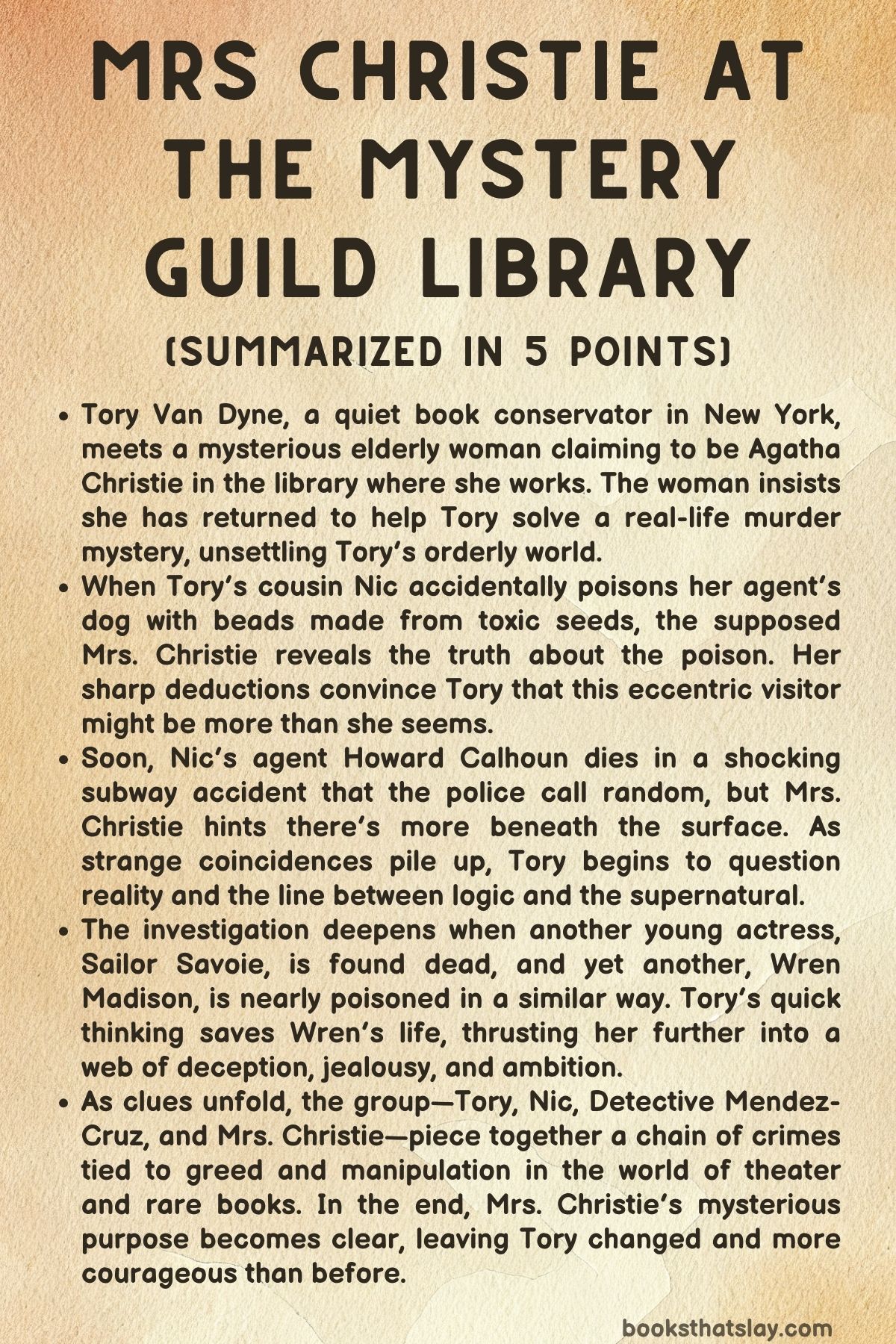
Summary
The story opens in the Agatha Christie Room of the Mystery Guild Library in New York, where Tory Van Dyne, a reserved book conservator, is startled by the sudden appearance of an elegant, old-fashioned woman who claims to be Agatha Christie—Mrs. Max Mallowan.
Despite Tory’s skepticism, the woman’s mannerisms, language, and deep knowledge of Christie’s life convince her that this mysterious visitor might be more than a prankster or eccentric impersonator. Mrs.
Christie announces that she has returned from the afterlife out of boredom, eager to help Tory solve a real mystery. Tory dismisses this as delusion—until events take an unexpected turn.
Tory’s quiet existence is soon interrupted by her dramatic cousin Nic, a Broadway actress, who storms into the library with her spoiled friend Sailor Savoie. Nic reveals that Howard Calhoun’s beloved pug, Bertram, whom she had been dog-sitting, has been poisoned.
Mrs. Christie, intrigued, begins questioning Nic about her borrowed jewelry—specifically red bead earrings from Howard’s recent trip to India.
She deduces that these “beads” are actually seeds from the deadly rosary pea plant, containing the toxin abrin. When Nic admits to accidentally crushing one, Mrs.
Christie concludes that the dog inhaled the powder. Nic, horrified, realizes she unintentionally poisoned Bertram.
Mrs. Christie explains the scientific logic behind her deduction and advises Nic to confess to Howard in her usual, flustered manner—knowing no one will believe such an absurd-sounding story.
Howard Calhoun, Nic’s smooth yet arrogant agent, arrives soon after. Upon hearing Nic’s nervous explanation, he mocks her, dismisses the poisoning idea, and warns her not to spread it.
Mrs. Christie cryptically warns Nic to be cautious, but the warning goes unheeded.
When Tory later checks the locked library, Mrs. Christie has vanished without a trace.
The following morning, Tory dreams of Christie’s words—“Very few of us are what we seem to be. ” Still shaken, she resumes her daily routine but can’t shake the unease.
Soon, Nic reappears—this time accompanied by Detective Sebastian Mendez-Cruz, who reports that Howard Calhoun has been killed after being pushed under a subway train. Nic witnessed the horrifying scene and is in shock.
While the detective leans toward the theory of a random attack, Mrs. Christie insists that the group should consider motive—who stood to gain from Howard’s death?
Her calm reasoning unnerves Tory, especially as the woman keeps disappearing and reappearing mysteriously.
At Howard’s memorial, Tory, Nic, and Sebastian meet an array of eccentric figures from Howard’s world—his bitter cousin Zella, self-absorbed employer Brooke Sinclair, and nervous assistant Rachel Featherstonhaugh. Gossip spreads that Howard was bankrupt and possibly selling off his rare book collection fraudulently.
Tensions rise when another death occurs—Sailor Savoie, Nic’s friend, is found dead under suspicious circumstances.
Detective Mendez-Cruz’s investigation deepens. Traces of arsenic are later found in a sieve in Howard’s kitchen, suggesting that he had been preparing poison himself.
Tory and Sebastian piece together that Rachel might have been selling Howard’s rare books and replacing them with cheaper editions. If Sailor discovered this, Rachel would have had motive to kill her.
However, the evidence remains circumstantial. Amid this chaos, Tory and Sebastian grow closer, and Nic tries to distract the detective by inviting him to a high-profile gala.
Haunted by her past trauma—a deadly nightclub stampede that killed her roommate—Tory struggles with anxiety and crowds. Encouraged by her librarian friend Adrian and inspired by Mrs.
Christie’s quiet wisdom, she decides to attend the Library Lions Gala, wearing her great-grandmother’s vintage gown as a symbol of resilience. At the gala, Tory reconnects with Sebastian, and together they learn startling new information: Sailor had been set to replace Nic in a coveted film role, and another actress, Wren Madison, had just received cocaine labeled “too special to share.” Realizing this gift mirrors Sailor’s fatal poisoning method, Tory races to Wren’s apartment and finds her unconscious from abrin-laced cocaine. Her quick thinking and medical knowledge save Wren’s life.
With Wren’s survival, the case takes shape. Sailor died from arsenic poisoning, Wren nearly from abrin—two rare toxins with one common link: Howard Calhoun.
Evidence shows Howard had been researching arsenic extraction and poison preparation days before his death. He had planned both murders to boost Nic’s career by eliminating her rivals for a major film role.
His assistant Rachel’s fingerprints appeared on a tequila bottle sent to Sailor, but she seems unaware of its true contents. Investigators uncover that after learning about abrin from Nic’s dog incident, Howard had adopted the toxin for his next attempt—hence Wren’s poisoned cocaine.
Phone records and witness statements confirm that Howard ordered the cocaine on the day of his own death, arranging delayed delivery to Wren. He never lived to see his plan succeed.
The horrifying conclusion: Howard had orchestrated two killings, using his charm and cunning to manipulate those around him. His subway “accident,” however, now appears far from random.
Mrs. Christie asserts that Howard’s death was a third, deliberate act—committed by Rachel Featherstonhaugh.
Evidence mounts: the subway attacker wore a designer hoodie identical to Rachel’s, later seen during her assault on Brooke Sinclair. Nic recalls distinctive silver details matching Rachel’s outfit that night.
The motive emerges when they reconstruct events—Rachel, seeing Howard grinding a powder while wearing an N95 mask, assumed he meant to harm her beloved dog Bertram again. When Nic later mentioned abrin, Rachel realized Howard was indeed preparing poison and, in a fit of panic, followed and pushed him under the train.
Her later attack on Brooke stemmed from the same instability and jealousy.
Sebastian confirms the match between subway footage and Rachel’s clothing, solidifying her guilt. While her act stemmed from protective rage, it remains murder.
Mrs. Christie praises Tory’s courage and analytical mind, acknowledging that she has grown from fearful conservator to capable investigator.
As the mystery resolves, Mrs. Christie hints that Howard may have poisoned his own wife years earlier, leaving an unsettling note that not all of his crimes were uncovered.
In a quiet, reflective finale, Mrs. Christie prepares to depart, leaving behind her embroidery and telling Tory she has taken “the Road of Dreams.” Tory understands that her spectral mentor has completed her mission—restoring truth, justice, and perhaps faith in human resilience. With the case solved and her own fears confronted, Tory is finally ready to step beyond her isolation.
The once-quiet library, haunted by ghosts and secrets, becomes a place of renewal, where stories—real and imagined—find their endings.
Characters
Tory Van Dyne
Tory Van Dyne, the protagonist of Mrs Christie at the Mystery Guild Library, is portrayed as a meticulous, introspective, and emotionally scarred woman. As a book conservator, her life revolves around the preservation of order, both literally and psychologically.
Having survived a traumatic nightclub stampede years earlier, Tory clings to solitude, finding refuge in the quiet rhythms of restoration work and in her late grandmother’s lovingly recreated Agatha Christie Room. This attachment to the past reveals her struggle to regain control after chaos once shattered her sense of safety.
Tory’s evolution throughout the novel—from an anxious recluse to a decisive heroine who races against time to save a life—embodies resilience born of empathy and intellect. Her bond with the enigmatic Mrs.
Christie also acts as a mirror to her own moral courage: where Christie represents intuition and wisdom, Tory represents reason and compassion. By the novel’s end, Tory has not only helped solve a complex murder web but has also rediscovered her confidence and capacity to act bravely in the world, transcending her past fears.
Mrs. Christie (Mrs.
The mysterious woman who calls herself Mrs. Max Mallowan—Agatha Christie’s married name—is both ghostly presence and moral compass within Mrs Christie at the Mystery Guild Library.
Poised, sharp-witted, and endlessly enigmatic, she enters Tory’s world as a catalyst for transformation. Whether she is a spirit, a hallucination, or a figment of Tory’s imagination is deliberately left ambiguous.
Her character embodies Christie’s own literary spirit: observant, rational, yet profoundly humane. Mrs.
Christie’s purpose transcends the solving of murders—she arrives to rekindle curiosity, courage, and moral integrity in Tory and those around her. She bridges the gap between fiction and reality, using her signature logical deductions and gentle irony to guide others toward truth.
Through her presence, the novel pays homage to Christie’s legacy as not merely a detective storyteller but as an observer of human frailty. Her final farewell, choosing “the Road of Dreams,” underscores her ethereal nature and symbolizes the enduring relevance of wisdom beyond the confines of mortality.
Nicola “Nic” Van Dyne
Nic Van Dyne, Tory’s cousin, is the antithesis of Tory’s restraint—vibrant, emotional, impulsive, and theatrically expressive. A Broadway actress with a flair for drama, Nic initially appears superficial, but her character gradually reveals complexity.
Beneath her glamorous exterior lies insecurity and a longing for validation, which make her both relatable and fallible. Her accidental poisoning of Bertram the dog with rosary pea beads exposes her recklessness, yet it also marks the beginning of her moral awakening.
Nic’s relationship with Tory oscillates between chaos and affection, embodying familial love strained by personality contrasts. Despite her flaws, Nic evolves into a figure of resilience, confronting grief, guilt, and public scrutiny while remaining fiercely loyal to those she loves.
Her interactions with Detective Sebastian Mendez-Cruz introduce an undercurrent of romantic tension and highlight her instinctive empathy. Ultimately, Nic becomes a foil to Tory—where Tory learns boldness, Nic learns introspection—each finding strength through the other.
Detective Sebastian Mendez-Cruz
Detective Sebastian Mendez-Cruz brings a grounded presence to the surreal interplay of intellect and mystery in Mrs Christie at the Mystery Guild Library. Analytical, stoic, and emotionally perceptive, Sebastian is both investigator and confidant.
His measured demeanor contrasts sharply with the volatility of the people around him, particularly Nic’s emotional turbulence and Tory’s quiet anxiety. His investigative methods reflect patience and integrity, but it is his growing connection with Tory that humanizes him beyond the archetype of the detective.
Sebastian’s curiosity about Mrs. Christie demonstrates his open-mindedness—he balances skepticism with intuition, never dismissing the unexplainable.
As the investigation deepens, his respect for Tory’s insights cements their bond as intellectual equals. His understated romantic potential with Tory serves as a symbol of renewal and trust—proof that rationality and emotion can coexist without contradiction.
Howard Calhoun
Howard Calhoun, the late talent agent whose manipulations ignite the story’s central mystery, exemplifies ambition corrupted by greed. Charming on the surface yet deceitful beneath, Howard is a man of façades—a quintessential Christie-type character driven by vanity and control.
His ability to mask moral decay with professional polish makes his eventual exposure as a calculating murderer both shocking and thematically fitting. Howard’s motives are rooted not in passion but in opportunism: he engineers two deaths to advance his client Nic’s career and thereby his own influence.
Even after his death, his machinations ripple through the narrative, proving that evil, once set in motion, has consequences beyond its architect’s control. Through Howard, Amanda Chapman explores themes of deception, the lure of power, and the emptiness that often underpins ambition in show business.
Rachel Featherstonhaugh
Rachel Featherstonhaugh, Howard’s assistant, initially seems peripheral—efficient, quiet, and loyal—but she emerges as one of the novel’s most morally ambiguous figures. Her devotion to Howard’s dog Bertram reveals her capacity for affection, yet that same loyalty curdles into obsession and vengeance.
When she kills Howard, mistakenly believing he intends to harm Bertram, Rachel becomes both victim and perpetrator—driven by misplaced love and moral panic. Her later violent behavior toward Brooke Sinclair underscores her instability, suggesting a mind warped by trauma and guilt.
Rachel embodies the tragic cost of devotion without discernment; she acts out of instinct rather than malice, making her one of the story’s most psychologically nuanced characters.
Sailor Savoie
Sailor Savoie’s death catalyzes much of the novel’s central investigation. A socialite and actress whose life revolves around indulgence and image, Sailor is portrayed not merely as a victim but as a reflection of the vanity and fragility of fame.
Her death by arsenic-laced tequila mirrors her reckless lifestyle, turning her own vices into instruments of destruction. Sailor’s shallow charm and dependence on others’ approval make her both pitiable and emblematic of a culture that rewards self-absorption.
Even in death, she represents the moral warning that underpins the narrative: that carelessness and deceit, however glamorous, eventually invite consequence.
Wren Madison
Wren Madison, Sailor’s friend and another target of Howard’s manipulations, provides the narrative’s emotional climax. Her near-death from abrin-laced cocaine reinforces the motif of vice as vulnerability.
Unlike Sailor, Wren is portrayed with more innocence—a woman caught in a toxic world of performance and addiction rather than driven by it. Her survival, owing to Tory’s quick thinking, serves as a narrative redemption—a second chance that contrasts the fatalism surrounding Sailor.
Wren’s ordeal also reaffirms the story’s central moral dichotomy: knowledge versus ignorance, conscience versus indulgence.
Adrian Gooding
Adrian Gooding, head librarian and Tory’s steadfast friend, embodies reason, stability, and quiet affection. His role, though understated, is crucial as the rational anchor amidst supernatural and emotional turbulence.
Adrian represents intellectual companionship, offering pragmatic explanations for events that border on the impossible. His unwavering faith in Tory, gentle humor, and emotional intelligence make him a grounding force in her journey toward recovery and confidence.
Through Adrian, the novel emphasizes the value of steady friendship and human connection in navigating grief, fear, and mystery.
Mairead Butler
Mairead Butler, the precocious red-haired girl who visits Tory’s lab, serves as a symbolic echo of innocence and curiosity. Her presence injects light into an otherwise dark narrative, reminding both Tory and the reader of the simple joy found in knowledge and discovery.
Mairead’s unguarded curiosity parallels Tory’s rekindled inquisitiveness, while her interactions with Mrs. Christie hint at the continuity of mentorship and imagination across generations.
Though minor in plot, Mairead’s symbolic significance lies in her role as the inheritor of wonder—the next generation inspired by stories, courage, and inquiry.
Themes
Identity and the Multiplicity of the Self
In Mrs Christie at the Mystery Guild Library, identity becomes a layered puzzle that echoes the mysteries Agatha Christie herself once constructed. The novel continuously questions what it means to be oneself, and how identity can be both fixed and fluid across time, memory, and perception.
Tory Van Dyne lives a life defined by order, control, and solitude, yet the appearance of a woman claiming to be Agatha Christie destabilizes her carefully constructed sense of self. This stranger, whether ghost or manifestation, embodies the parts of Tory she represses—curiosity, intuition, and risk-taking.
Through her, Tory begins to understand that identity is not a singular construct but a combination of all the roles one inhabits—archivist, daughter, survivor, and seeker of truth. Even Mrs.
Christie, in her spectral existence, straddles the boundary between who she was and who she is remembered to be, questioning the permanence of legacy and the authenticity of persona. The theme extends to other characters as well: Nic performs an identity of glamour masking insecurity, while Rachel, the assistant, hides behind loyalty to conceal obsession and rage.
Each figure wears a kind of mask, and the novel asks whether truth lies beneath or within those performances. The story ultimately presents identity as dynamic—a negotiation between public self and private consciousness—suggesting that the truest understanding of who we are often comes only when the layers collapse and the illusion of control gives way to self-awareness.
Guilt, Trauma, and the Possibility of Healing
Tory’s history of trauma runs quietly beneath the murder mystery, shaping her emotional isolation and need for structure. Her survival of the nightclub stampede defines not only her fear of crowds but her detachment from a world that feels unpredictable and unsafe.
The book portrays trauma not through grand displays of pain but through the small, meticulous ways a survivor rebuilds life—by restoring books, arranging objects, and avoiding chaos. Yet healing begins the moment her world is disrupted.
The reappearance of Mrs. Christie forces Tory to face disorder again, to accept uncertainty and loss as inevitable parts of existence.
As the investigation unfolds, each encounter—with death, deception, and courage—becomes a metaphorical act of recovery. Mrs.
Christie’s guidance functions as both detective mentorship and spiritual therapy, steering Tory toward reclaiming her agency. When Tory finally faces her fear at the Library Lions Gala, the symbolism is unmistakable: she walks into the crowd not as a victim but as someone reclaiming the power once taken from her.
The narrative suggests that healing does not arrive as peace but as the courage to reengage with life’s unpredictability. Trauma, while irreversible, becomes the forge of empathy and strength.
In its conclusion, the novel allows Tory’s past and present selves to coexist, showing that acceptance—not erasure—of pain marks the true end of recovery.
The Intersection of Reality and the Supernatural
The haunting presence of Mrs. Christie blurs the boundaries between the living and the dead, between imagination and tangible reality.
Whether she is a ghost, a psychological projection, or an embodiment of literary spirit, her existence challenges the rational worldview Tory clings to. The story never confirms her nature, allowing ambiguity to reign as part of its design.
This uncertainty mirrors how grief and longing often blur perception—the mind’s attempt to reconcile what reason cannot. The library itself, filled with relics of Christie’s life, becomes a liminal space where the past speaks to the present.
Every appearance and disappearance of Mrs. Christie forces Tory to question whether truth depends on physical proof or emotional resonance.
The theme extends beyond ghostly encounters to the broader notion of storytelling as a bridge between worlds. Christie’s ghost does not haunt to terrify but to instruct, reminding both Tory and the reader that reality may be wider than logic allows.
Through this interplay, the novel suggests that belief, even in the improbable, can be a necessary act of faith—one that restores connection and purpose. The supernatural becomes not an intrusion but a reflection of the human need to make meaning, to believe that wisdom, justice, and love endure beyond death’s boundary.
The Power and Ethics of Knowledge
Knowledge in the novel carries both salvation and danger. The story opens with Tory’s meticulous expertise as a conservator—a profession built on preserving truth and history—yet her knowledge is limited to the tangible.
Mrs. Christie expands that horizon, transforming knowledge into moral discernment.
The poisons at the center of the mysteries—arsenic and abrin—symbolize this duality: they are both products of human curiosity and instruments of destruction. Howard Calhoun’s use of intellectual cunning for manipulation and murder contrasts sharply with Tory’s pursuit of understanding for preservation and justice.
Each revelation in the book, whether chemical, emotional, or historical, becomes an ethical test of how information should be used. Even Mrs.
Christie’s role as mentor raises the question of whether possessing too much insight into human behavior is a gift or a burden. By the novel’s end, knowledge emerges as a living force—it can heal, protect, and enlighten, but only if guided by compassion and integrity.
The library, as both a physical and symbolic space, represents this equilibrium: a place where wisdom must be preserved responsibly, for misuse of understanding can be as fatal as any poison.
The Endurance of Female Intellect and Agency
At its heart, Mrs Christie at the Mystery Guild Library celebrates the intellectual resilience of women who navigate a world that often trivializes their insight. Through Tory, Nic, Rachel, and Mrs.
Christie, the novel presents different forms of feminine intelligence—creative, emotional, analytical, and intuitive—and explores how each interacts with systems of power and control. Tory’s logical, detail-oriented mind contrasts with Nic’s performative cleverness, yet both women are underestimated by those around them.
Mrs. Christie, in turn, represents the enduring archetype of the female detective whose wit and perception challenge patriarchal assumptions about reason and intuition.
The story’s unfolding investigation, guided largely by these women, becomes a reclaiming of narrative authority: they are not side characters in a man’s drama but the ones who interpret, decide, and ultimately reveal truth. Even Rachel’s descent into violence underscores how female agency, when stifled or distorted by dependency, can erupt destructively.
By centering women who reason, act, and err within moral complexity, the novel honors their multifaceted power. It reminds the reader that intellect and empathy, long divided by gendered expectation, can coexist within the same mind—and that when women claim the right to both, they rewrite the story entirely.