On Wings of Blood Summary, Characters and Themes
On Wings of Blood by Briar Boleyn is a dark fantasy novel that merges gothic politics, forbidden magic, and the struggle for power within a vampire-dominated world. The story follows Medra Pendragon, a warrior who awakens in a strange realm ruled by vampires after dying in her own world.
Bound by blood to a ruthless prince, she must navigate a kingdom where mortals are enslaved, ancient dragons are myth, and rebellion brews beneath the surface. As she uncovers secrets about her origins and her power, Medra becomes the key to a world’s salvation—or its destruction. The book is the first in the Bloodwing Academy series by the author.
Summary
The novel begins with a moment from Blake Drakharrow’s point of view, showing the damage already done between him and Medra. He reflects on drinking her blood and telling himself that their magical bond would force her to forgive him in time.
Instead, he sees hatred in her eyes and understands that he has crossed a line he cannot undo. When disaster suddenly strikes around them, he realizes she is in even more danger than before and that his betrayal may have destroyed any trust that could have existed between them.
The story then moves back ten months and follows Medra after what should have been her death. In her own world, Aercanum, she sacrificed herself to destroy a corrupt god and believed her life was over.
Instead, she wakes beneath a heap of corpses in a burned village in a strange land. Weak, naked, and in pain, she is discovered by soldiers.
One of them, Barnabas, realizes she is alive and prepares to bite her, revealing himself to be a vampire. Before he can do so, his commander kills him.
That commander is Prince Blake Drakharrow.
Although Blake saves Medra from immediate harm, he does not free her. He orders his men to clothe her and bring her with them.
Medra resists from the start, meeting Blake’s cold authority with sarcasm and defiance. As they travel, she learns that Blake and several others are highblood vampires.
Her appearance immediately sets her apart in this pale-haired society. Her red hair, pointed ears, and other features make her a curiosity, and a court official named Lucius becomes convinced that she is someone important.
When Medra is brought to the capital city of Veilmar and into the Black Keep, she is displayed before a court of nobles. On the way, a noblewoman tears strands of Medra’s hair from her head out of fascination, and Blake sharply stops her, hinting that while he treats Medra harshly, he does not tolerate others laying hands on her.
Before the court, Medra hears the strange voice of a woman in her mind, adding to her uncertainty about what is happening to her.
Lord Drakharrow, Blake’s uncle, questions her identity. Medra gives only her name, Medra Pendragon, and lies about the rest, claiming memory loss rather than revealing she came from another world.
The nobles debate whether she should be tested, used, or killed. Lord Drakharrow declares that her features match those of the long-lost dragon riders, an ancient bloodline tied to dragons and great power.
Some see her as a miracle, others as a threat, and some simply as a breeding asset. Realizing that her value is her only protection, Medra boldly suggests that her bloodline might help bring dragons back.
This shocks the court and makes her too important to dispose of.
Lord Drakharrow decides that Medra will live, but only under control. He claims that because Blake found and saved her, she owes him a life debt.
In a public ritual, Blake and Medra are bound together through blood. A permanent mark appears on Medra’s skin, and Lord Drakharrow names her the Dragon Rider of Sangratha and the second betrothed consort of Prince Blake Drakharrow.
He also forbids anyone else from feeding on her. Medra then realizes why Regan Pansera, a noblewoman at court, hates her so much: Regan is Blake’s first betrothed.
Blake takes Medra to Bloodwing Academy, where she is told she will begin training immediately. He explains the academy’s structure around the four ruling houses and their specialties, but tells her she belongs to a fifth class, riders, which no longer has a place because dragons are believed extinct.
Blake openly tells her she is useless without dragons and predicts she will fail. Medra enters the first-year dorm determined to survive, learn everything she can, and eventually escape.
There she meets Florence Shen, a kind dorm warden who helps her settle in. Florence explains more about academy life, though Medra is disturbed by how much Florence admires vampire society despite its cruelty.
Medra learns that Regan will guide her through her first day. The next morning, Regan surprises her by behaving with warmth and grace, explaining that noble triads are normal and that the two of them are now effectively linked through Blake.
Medra does not trust her but hides it.
At breakfast, Medra meets Blake’s circle, including Theo Drakharrow, his witty cousin; Coregon Phiri; Quinn Riley; and Visha Vaidya. Theo proves lively and informative, while Blake remains tense and distant.
Medra learns more about thralls, blood-bound people who serve vampires, and becomes increasingly disgusted by the system around her. In class, Professor Amina Hassan humiliates Medra for arriving late and uses the occasion to reinforce Sangratha’s official history: that vampires saved mortals through famine, plague, and the Dragon Cataclysm, and are therefore owed obedience, service, and blood.
Medra recognizes this history as propaganda meant to justify oppression.
Meanwhile, Blake struggles with his growing fixation on Medra. During a House Leadership ceremony, while distracted by thoughts of her, he is attacked by Coregon, who reveals that his loyalty was false.
Coregon claims Blake has become weak because he has failed to dominate Medra. Their fight takes place in a deadly shifting arena, and Blake ultimately kills Coregon by trapping him beneath a crushing stone platform.
The crowd celebrates, but Medra alone watches in silence.
Afterward, Blake is summoned by his uncle Viktor, who beats him for making the family look weak. Blake takes the blame for conflict with Medra to protect her from harsher punishment.
He realizes Viktor is obsessed with Medra not just as Blake’s consort, but as a symbol with the potential to stir rebellion among the oppressed. Viktor makes it clear that she must be controlled for life.
Later, Medra goes for a lesson expecting to meet another instructor, but instead finds Blake waiting. He forces a mental confrontation through thrallweave, trying to break into her mind.
He sees fragments of memories from another world and senses that she is hiding enormous secrets. But the invasion backfires when the presence inside Medra’s mind, revealed to be her mother Orcades, notices him and pushes back.
Medra is suddenly thrown into Blake’s own memories. She feels his grief, anger, and desire, sees his affection for his younger sister Aenia, and learns that he once lied to protect her from punishment.
This experience unsettles Medra because it proves Blake is more complicated than the arrogant prince she hates.
Trying to deal with Orcades’ soul inside her, Medra studies a forbidden ritual meant to separate them. She performs it secretly in the Dragon Court using her blood and dried blood taken from Blake’s dagger.
The ritual goes wrong and anchors Orcades into the dagger instead of freeing her. While there, Medra sees Blake enter a hidden passage and follows him through tunnels into ancient dragon catacombs and then into Veilmar.
Outside, she sees children offering their blood for sale to survive, a sight that reveals even more clearly how brutal this society truly is.
After the Consort Games, tragedy deepens the story. Medra and Florence grieve Naveen’s death, and Florence confesses that Naveen had admitted his love for her just before he died.
Medra feels crushing guilt, believing her own survival somehow cost him his life. Soon after, she is summoned with Blake to a disciplinary hearing.
There, Regan is accused of sabotaging Medra during the Games. Blake shocks everyone by defending Medra openly and exposing Regan’s actions.
He then invokes the Right of Dissolution, ending his betrothal to Regan. Given the power to seek Regan’s death, he instead chooses mercy, knowing Medra would not want execution.
After the hearing, Blake and Medra share a charged private moment that turns into a passionate kiss. For a brief time, it seems possible that the anger and attraction between them may become something else.
But Blake is then confronted by Viktor and lies that the bond between him and Medra has already been completed through blood. Realizing this lie will soon require him to make the bond real, he decides he must feed from Medra after Selection Day.
On the final day of school, students are assigned to houses. Medra is placed in House Drakharrow, as expected.
Florence is assigned elsewhere, which leaves Medra uneasy and disappointed. Blake secretly tells Medra to meet him at midnight in the Dragon Court.
When she does, they kiss again, and for a moment she allows herself to trust him. Then Blake bites her without permission and begins feeding.
Medra is horrified, especially when she learns that by drinking his blood during the Games, she completed a bond that now means he can feed only from her. When she tries to refuse, the bond itself freezes her in place and Blake drinks from her while she is helpless.
At that same moment, the Dragon Court begins to shake. Blake shields Medra as stone falls around them.
Then the black stone dragon statue of House Avari cracks apart and reveals a real dragon inside. The creature, Nyxaris, awakens.
Medra realizes her earlier soul-severing ritual must have helped free him. Though she begs for a bond, Nyxaris refuses to belong to her.
He acknowledges that she awakened him, but he owes her nothing. He spreads his wings and flies off into the night, leaving Blake and Medra staring after him.
Both understand that the return of a living dragon will change everything, and that nothing in their world can remain as it was.
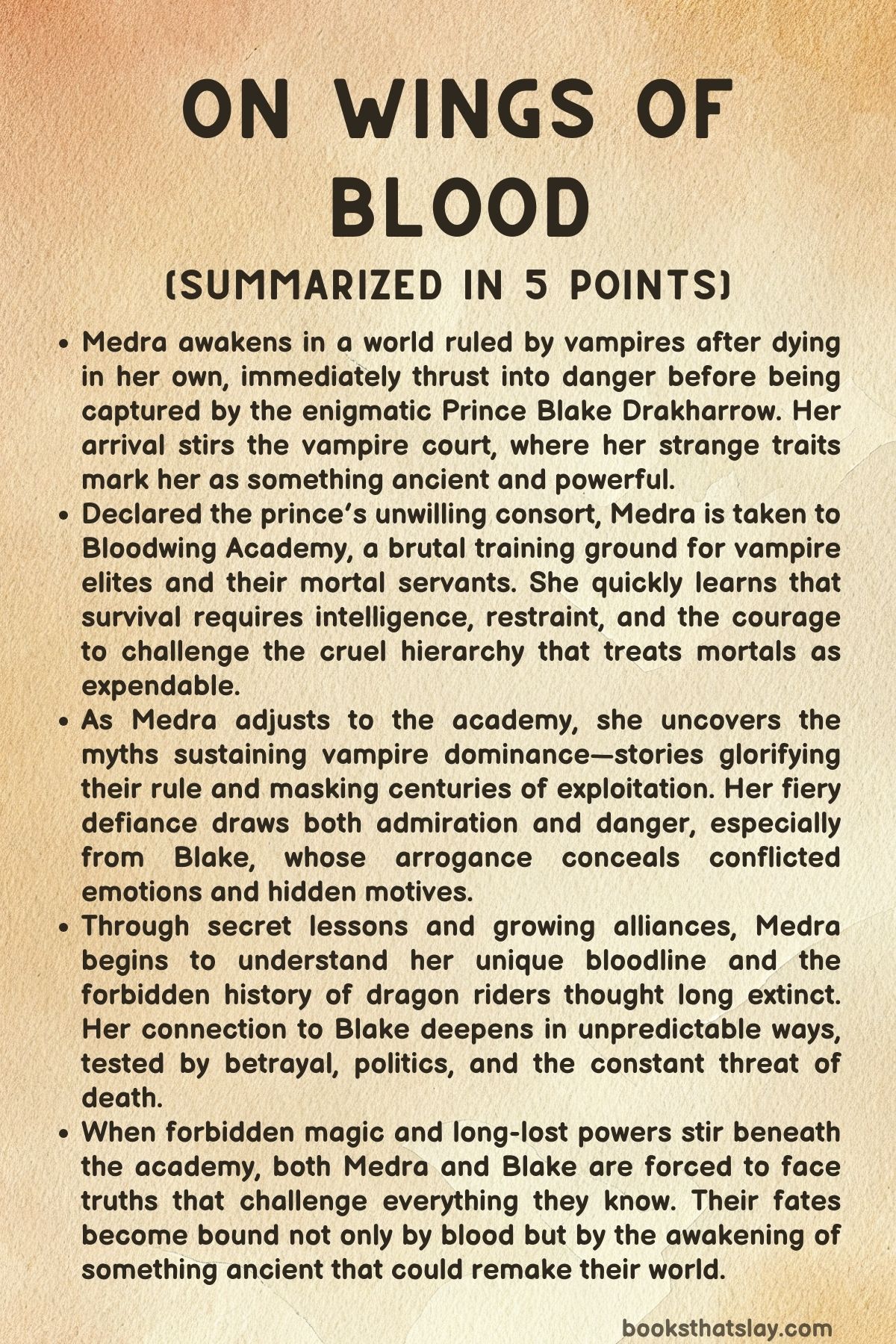
Characters
Medra Pendragon
Medra is defined by survival, resistance, and a fierce refusal to let other people decide who she is. She enters the story after what should have been her death, already carrying the weight of sacrifice from another world, and that history shapes the way she reacts to Sangratha.
She does not arrive as a blank-slate heroine discovering her strength for the first time; she arrives already hardened by loss, already suspicious of power, and already unwilling to kneel. What makes her compelling is that her defiance is not polished or noble in a simple way.
It is raw, sarcastic, impulsive, and often dangerous. She mouths off when silence would be safer, tests people when cooperation would be easier, and keeps secrets even when honesty might help her.
That stubbornness repeatedly puts her at risk, yet it is also the core of what keeps her from becoming absorbed into the cruel system around her.
Her intelligence shows less through scholarship than through adaptation. Once she realizes she is too valuable to be killed immediately, she changes tactics and uses the court’s hopes about dragons to protect herself.
She understands quickly that survival in this world will require performance as much as strength. That instinct appears again and again as she hides her origins, studies the academy’s hierarchy, watches Regan carefully, and pretends cooperation while planning escape.
At the same time, Medra is not emotionally closed off. Her grief over Naveen, her tenderness toward Florence, and her complicated longing for Blake reveal how deeply she feels everything.
She is constantly pulled between caution and emotion, rage and attraction, strategy and instinct.
Another important aspect of her character is the way she confronts systems of domination. She is horrified by the culture of blood, thralls, and forced loyalty, and unlike many others around her, she never accepts the academy’s official myths at face value.
She sees exploitation even when it is dressed up as tradition. That moral clarity matters because it sets her apart from people who have normalized oppression.
Yet she is not untouched by the world she is in. Her bond with Blake, her use of ritual magic, and her growing connection to the dragons pull her into the very structures she distrusts.
This tension gives her arc its force: she wants freedom, but the path open to her may require power, blood, and dangerous alliances. In On Wings of Blood, Medra stands at the center as someone trying to remain herself while the world around her keeps trying to rename, bind, and consume her.
Blake Drakharrow
Blake is written as a character divided against himself. On the surface he appears to fit the image of a cold vampire prince: arrogant, commanding, violent, and deeply shaped by entitlement.
He gives orders easily, expects obedience, and speaks to Medra with a harshness that often sounds like contempt. He is capable of intimidation and coercion, and some of his worst choices come from his need to maintain control when he feels threatened or humiliated.
Yet the story steadily reveals that beneath that hard exterior is someone governed by fear, loyalty, hunger, and emotional confusion. He is not simply cruel; he is a person raised inside a brutal power structure who has learned to survive by performing ruthlessness, even when that performance damages both him and others.
His relationship with authority is central to understanding him. Viktor’s beatings and manipulation make it clear that Blake himself lives under violence, even as he benefits from noble status.
He is expected to embody Drakharrow dominance at all times, and any sign of softness becomes weakness in the eyes of his family and followers. That pressure helps explain why he reacts so intensely to Medra.
She does not flatter him, fear him properly, or remain within the boundaries he knows how to manage. She humiliates him publicly, unsettles him privately, and awakens protectiveness, desire, and guilt all at once.
He keeps trying to frame her as a burden or irritation, but his actions repeatedly expose a deeper attachment. He defends her from others touching or feeding on her, lies to protect her from Viktor, worries about what would happen to her if he dies, and eventually admits that he would do anything for her.
Blake becomes especially interesting when the narrative exposes his emotional interior. His grief over killing Coregon, his tenderness toward his sister Aenia, and his jealousy over the unknown man in Medra’s memories all show that his feelings are intense, not absent.
He is not emotionally numb; he is emotionally dangerous because he feels so much and has been taught no healthy way to live with those feelings. His hunger for Medra is tied not only to blood but also to obsession, protectiveness, and a desperate wish to possess something he fears losing.
That is what makes his betrayal at the end so devastating. He does care for her, but care is not enough to stop him from violating her when fear and entitlement take over.
His tragedy lies in the fact that he is capable of love and sacrifice, yet still shaped enough by power that he turns intimacy into harm. He is both protector and threat, and the story refuses to let either side cancel out the other.
Regan Pansera
Regan is one of the most layered antagonistic figures in the story because her hostility is rooted in more than simple jealousy. At first she appears to fit the expected role of the displaced fiancée who resents the newcomer, and that element is certainly present.
Medra’s arrival threatens her position, her pride, and her emotional claim on Blake. But Regan is more than a rival in a romantic arrangement.
She is a product and defender of the same aristocratic culture that Medra challenges just by existing. Regan believes in hierarchy, bloodline, and the rightness of the established order.
Medra is not only competition to her; she is an insult to the rules Regan has built her identity around.
What makes Regan effective as a character is her ability to weaponize charm. She does not begin with open cruelty when she meets Medra at Bloodwing.
Instead she presents warmth, grace, and the language of sisterhood, creating uncertainty about her true motives. This social intelligence makes her dangerous.
She understands appearances, knows how to move within elite spaces, and can present herself as reasonable even when acting destructively underneath that surface. Her sabotage during the Games shows that beneath her polished exterior lies real malice and a willingness to let Medra die if it protects her status or confirms her worldview.
At the same time, Regan is not written as all-powerful. Her collapse during the disciplinary hearing reveals the limits of that elegance.
Once Blake openly contradicts her and the adults begin judging her actions, her confidence weakens. She becomes a figure shaped by family pressure, noble expectation, and fear of losing everything.
Lord Pansera’s presence suggests that Regan has likely been raised in a world where worth is tied to usefulness and alliance, not emotional truth. That does not excuse her actions, but it helps explain why she clings so fiercely to control.
Blake’s decision not to execute her is significant because it frames her not just as an enemy defeated, but as someone whose life has also been twisted by the violent rules of this society. Regan represents the damage done by systems that teach women to compete for survival inside male power rather than question the structure itself.
Florence Shen
Florence brings warmth, sincerity, and emotional grounding to the story. In a setting filled with predatory politics, blood debts, and noble cruelty, she initially appears almost startlingly openhearted.
She welcomes Medra when others stare, gives her practical help without demanding anything in return, and offers the first real kindness Medra receives at Bloodwing. That kindness matters because it gives Medra a reason not to view everyone in Sangratha as equally monstrous.
Florence becomes proof that goodness can still exist even inside a corrupted world.
Her character is also important because of the contrast between her kindness and her worldview. Florence admires Bloodwing and the vampire hierarchy much more than Medra does, which shows how deeply that system has shaped the people living under it.
She is blightborn rather than noble, yet she treats admission to the academy as an honor and seems to accept many of its values. This makes her more than just the sweet friend archetype.
She represents someone who has internalized the promises of a harmful structure because it offers status, purpose, and belonging. Through Florence, the story shows that oppression is not maintained only by obvious villains; it is also sustained by sincere people who believe the system is legitimate.
Her emotional life becomes sharper through her connection to Naveen. The revelation that he confessed his love just before dying gives Florence a painful depth.
Her grief is not abstract mourning for a classmate. It is grief mixed with guilt, missed possibility, and the agony of an answer that can never be given.
In those scenes she becomes one of the clearest expressions of innocent loss in the story. She also brings out Medra’s softer, more compassionate side.
Their friendship is one of the few relationships not built on coercion, lust, or political advantage, which makes it especially valuable. Florence may not drive the central conflict the way Medra or Blake do, but she carries much of the story’s emotional humanity.
Theo Drakharrow
Theo serves as a source of levity, information, and unpredictability, but he is more than comic relief. His theatrical manner and humor make him one of the first people in Blake’s circle who feels approachable, and that immediately distinguishes him from the colder nobles around him.
He teases, talks freely, and helps explain academy life to Medra, creating the impression of someone less rigidly bound by aristocratic self-seriousness. That social ease makes him useful both to the plot and to the emotional texture of the story.
Underneath the wit, Theo seems highly observant. He understands the politics around him and often uses humor to say things others might frame more harshly.
Characters like him can sometimes exist only to lighten the tone, but here his joking nature feels like a survival method within a dangerous household and academy. A person surrounded by power struggles may learn to stay valuable by being charming, entertaining, and harder to categorize.
Theo’s closeness to Blake also suggests an old familiarity that allows him to needle Blake in ways others cannot.
His importance also lies in how he complicates the Drakharrow image. Through Theo, the noble house is not presented as emotionally uniform.
He suggests that even within elite bloodlines there are people who respond to violence and pressure differently. While he does not appear as morally central as Medra or Blake, he helps reveal social nuance.
He stands near the center of power, yet often behaves at an angle to it, making him a potentially significant figure in the larger politics of the story.
Viktor Drakharrow
Viktor is the clearest embodiment of institutional power and inherited cruelty. He is not merely a harsh uncle or political ruler; he represents a worldview in which people are assets, symbols, and tools long before they are human beings.
His treatment of Blake reveals his governing method immediately. He uses violence as discipline, fear as control, and public image as a measure of worth.
Even his approval is unsettling, because it is rooted in usefulness rather than affection. This makes him the dominant force shaping Blake’s damage and, by extension, much of the story’s conflict.
His interest in Medra is especially chilling because it is never personal in a tender sense. He sees her as bloodline, leverage, myth, and threat.
Her possible connection to dragons excites him not because he reveres the past, but because he wants to possess whatever power that past might return. He also understands the danger of symbols.
He worries that Medra could inspire unrest among the blightborn, which shows that he is politically sharp as well as brutal. He recognizes that control is not maintained only through strength; it is maintained through narrative, ownership, and fear of rebellion.
Viktor’s presence casts a shadow over every major relationship. He is the reason Blake hides truths, the reason Medra remains under such intense threat, and the reason the academy’s culture feels inseparable from violence.
He personifies the predatory logic of Sangratha at its highest level. Rather than acting through open chaos, he acts through structure, decree, blood law, and punishment.
That makes him more dangerous than many open enemies because he has legitimacy as well as force.
Lucius
Lucius plays a smaller but meaningful role as an early interpreter of Medra’s significance. His excitement over her appearance helps establish how unusual and politically charged she is in this world.
He functions as a courtly figure who understands lineage, omen, and ceremonial importance, and through him the reader sees how rapidly Medra shifts from unknown captive to contested symbol. He is less emotionally vivid than some other characters, but he contributes to the atmosphere of scrutiny surrounding her from the beginning.
What stands out about Lucius is the almost scholarly enthusiasm with which he reacts to Medra. Unlike the openly predatory nobles who see her as blood or breeding stock, Lucius seems fascinated by what she might mean.
That does not make him harmless, since treating a person as a significant artifact is still a form of objectification, but it gives him a distinct function within the court. He helps translate Medra into the language of prophecy and history, and in doing so increases both her value and her danger.
Professor Amina Hassan
Professor Hassan represents the intellectual face of Sangratha’s ruling ideology. She is stern, disciplined, and deeply invested in the academy’s official version of history.
Her classroom is not simply a place of learning; it is a place where hierarchy is justified and loyalty is taught as natural law. Her treatment of Medra on the first day shows that she values order and deference, but it also shows that she recognizes challenge quickly.
Medra’s skepticism unsettles the structure Hassan is trying to preserve.
She becomes important because she reveals how oppression survives through education as well as force. Her lecture about vampires saving mortals is clearly shaped by the perspective of the victors, turning domination into duty and exploitation into gratitude.
Hassan may genuinely believe what she teaches, which makes her more interesting than a knowingly dishonest propagandist. She appears as someone who has aligned intellect with power so completely that she cannot separate history from legitimacy.
Through her, the story shows that ideology can be as controlling as any weapon.
Coregon Phiri
Coregon’s betrayal gives him a sharp, memorable role despite limited page time. Before turning on Blake, he appears to be one of the stable members of Blake’s circle, which makes his attack effective both dramatically and thematically.
He exposes how fragile loyalty is in a culture built on dominance and humiliation. His reasoning is revealing: he believes Blake has become weak because Medra has been allowed to defy him.
In that sense, Coregon is not acting from random malice but from a worldview that equates cruelty with strength.
His betrayal also pushes Blake into one of his darkest moments. By forcing Blake into a lethal public confrontation, Coregon becomes a catalyst for revealing Blake’s violence, pride, and emotional desperation.
He matters less as an independent psychological portrait than as a mirror of the house values Blake has inherited. He is what total commitment to those values looks like when stripped of personal conflict or tenderness.
Naveen Sharma
Naveen is one of the quieter figures, but his role carries emotional weight. He first appears as a nervous student helping explain classroom concepts, which gives him an ordinary, vulnerable presence in a world dominated by stronger personalities.
He helps build the sense of academy life beyond the nobles and power players. Because he feels human and unguarded, his later death lands with greater force.
His love for Florence and the timing of that confession make him a symbol of interrupted possibility. He is not remembered for political importance or great power, but for what might have been.
That gives his loss a painful intimacy. Through Naveen, the story reminds the reader that the brutal systems at Bloodwing do not only shape grand destinies; they also destroy gentle futures before they can begin.
Kage
Kage functions as a warning voice and an external check on Blake’s growing centrality in Medra’s life. At a point when attraction and emotional vulnerability are pulling Medra toward Blake, Kage steps in to remind her that the Drakharrows are still driven by power.
This gives him an important narrative role: he resists the romantic pull of the central relationship and insists on a wider, darker perspective. His warning that something larger is approaching also links the personal drama to broader looming danger.
Though he is not developed here as fully as others, Kage’s presence suggests independence and insight. He is valuable because he refuses to let emotional tension erase political reality.
Characters like him often become crucial later because they see what more entangled figures are too compromised to admit.
Orcades
Orcades, Medra’s mother, exists in an unusual space because she is both presence and absence, memory and active force. At first she is only a voice in Medra’s head, something that could be mistaken for instability or magical residue.
As the story develops, however, she becomes a real influence, guiding Medra and intervening directly when Blake invades her mind. That intervention is one of the clearest signs that Medra’s inner life is not hers alone and that her past world continues to shape the new one.
Orcades adds maternal power, mystery, and spiritual complexity to the narrative. She is not presented simply as comforting or nurturing; she is formidable, knowledgeable, and tied to dangerous magic.
When Medra’s failed ritual anchors her mother’s soul into the dagger, Orcades shifts from hidden influence to a more materially altered existence. Her character expands the story beyond academy politics into deeper magical inheritance and unresolved family history.
Aenia
Aenia appears only through memory, but that memory is crucial to Blake’s characterization. The image of him playing tenderly with his younger sister on the beach reveals a softness and capacity for love that his present-day behavior often conceals.
Because the scene comes through forced mental contact, it feels intimate and unguarded. Aenia therefore matters not because of actions in the main plot, but because she proves something essential about Blake: cruelty is not the whole of him, and loss connected to family likely runs deeper than he admits.
Nyxaris
Nyxaris arrives late, but his appearance transforms the entire scale of the story. Until his awakening, dragons are largely history, legend, and political symbolism.
Once he emerges alive from stone, that history becomes immediate reality. His first defining trait is independence.
Although Medra awakens him and hopes for a bond, he refuses automatic loyalty. That refusal is important because it prevents the dragon’s return from feeling like a simple reward or chosen-one confirmation.
Nyxaris carries ancient power without offering easy allegiance. He is grateful, but not submissive.
That makes him feel like a true force rather than an extension of Medra’s will. His awakening signals that older powers are returning on their own terms, and that neither Medra nor Blake fully understands what they have set in motion.
He closes the book not as a companion safely gained, but as a living disruption that changes the balance of the world.
Themes
Power and Oppression
The world of On Wings of Blood is dominated by an unrelenting hierarchy built upon blood, control, and servitude. The vampire elite—referred to as the highbloods—rule over mortals with absolute authority, using divine myths to justify their supremacy.
Power in Sangratha is not merely political; it is physical and spiritual, flowing through the act of feeding and the mystical exchange of blood. This structure defines every relationship, whether between rulers and subjects or between individuals like Medra and Blake.
The blood bond becomes a metaphor for coercion disguised as sanctity, turning intimacy into subjugation. Medra’s existence in this world underscores how systems of power manipulate language and belief to maintain dominance.
The vampires’ claim of having saved mortals from plagues is revealed to be a carefully curated myth to rationalize centuries of exploitation. Through Medra’s defiance, the novel exposes the fragility of this system—her refusal to submit disrupts the illusion of divine order and exposes the parasitic dependence of the oppressors on the oppressed.
Even Blake, a product of privilege, is trapped within the same web, controlled by his uncle Viktor and by the blood rituals that bind him. Power in this story is never pure strength; it is a chain of obedience linking predator and prey.
The emergence of Nyxaris, the freed dragon, finally fractures this hierarchy, symbolizing the collapse of domination built on blood. Yet the aftermath shows that liberation, when born from centuries of control, carries its own forms of destruction and uncertainty.
Identity and Transformation
Medra’s journey throughout the story centers on the struggle to define herself in a world that constantly assigns her meaning. From the moment she awakens in the blood-soaked battlefield, she is treated as an object of curiosity—a relic, a prophecy, a weapon.
The vampires label her “blightborn,” “dragon rider,” and “consort,” all roles designed to strip her of individuality and turn her into a vessel for others’ desires or fears. Her transformation from victim to self-possessed being unfolds not through magical empowerment but through resistance to these imposed identities.
Her dragon heritage and red hair, initially sources of danger, become symbols of an unclaimed truth that belongs to her alone. This theme is echoed in Blake, whose outward cruelty conceals an internal war between inherited identity and moral conflict.
His training as a vampire noble leaves no room for tenderness or self-doubt, yet his connection with Medra forces him to confront both. The novel uses their bond to question whether transformation is possible when the foundations of selfhood are built on control.
When Medra performs the soul-severing ritual, intending to reclaim autonomy from her mother’s possession, it mirrors her broader struggle against every force that has ever tried to define her. By the end, her actions awaken a dragon—a literal manifestation of rebirth and ancestral power—marking her emergence as something beyond the identities imposed upon her.
The theme of transformation thus extends beyond individual change; it becomes an act of rebellion against history itself.
Gender, Autonomy, and Consent
The novel constructs a dark reflection of patriarchal power through the lens of vampiric dominance. Women like Medra and even noble vampires such as Regan Pansera are measured by their utility to male ambition and bloodlines.
Medra’s forced betrothal and blood-binding to Blake illustrate the violence of a world where consent is irrelevant to the structures of ritual and power. The blood bond, though presented as sacred tradition, is a symbolic violation—her body and blood claimed to serve political and divine purpose.
Yet Briar Boleyn refuses to render Medra as a passive victim. Her constant defiance, her decision to manipulate belief in her dragon lineage, and her later confrontation with Blake’s physical transgression show a layered portrait of resistance.
Even moments of desire are marked by unease, as the line between love and domination remains uncertain. Blake’s feeding from her without permission becomes a pivotal act that forces both characters to face the moral rot at the heart of their connection.
Medra’s fury and resilience after the act redefine the narrative of female suffering—her agency is not reclaimed through revenge but through survival and self-knowledge. The awakening of Nyxaris, too, becomes an allegory for autonomy reclaimed.
The dragon’s refusal to be bound echoes Medra’s own refusal to remain a possession, suggesting that true freedom requires breaking both personal and societal chains of ownership and desire.
Corruption of Faith and Myth
Religion and myth operate as mechanisms of control, shaping the consciousness of an entire civilization. The cult of the Bloodmaiden—venerated as the origin of the vampire race—serves as both theology and propaganda, justifying the enslavement of mortals through a narrative of salvation.
Through Professor Hassan’s lesson on Sangratha’s history, the text reveals how faith has been weaponized to erase the truth of oppression. The story of divine sacrifice, once a tale of hope, has decayed into a doctrine of obedience.
The vampires see themselves as gods, but their divinity is built on blood theft and rewritten memory. Medra’s growing skepticism toward these beliefs signals a larger philosophical revolt: the struggle to separate faith from falsehood.
Her eventual discovery of the dragon catacombs beneath Bloodwing uncovers a buried history that predates the vampire order, suggesting that what is sacred has been deliberately hidden or distorted. The resurrection of Nyxaris shatters the sanctity of vampire myth by proving that the old legends of dragon riders were real, not divine lies.
This act collapses the religious foundation of Sangratha and exposes faith as a tool of fear rather than enlightenment. The theme underscores how civilizations manipulate divinity to sustain authority—and how the recovery of forgotten truth can dismantle even the oldest gods.
Love, Violence, and Redemption
Love in the story is inseparable from power and pain. The connection between Medra and Blake oscillates between tenderness and brutality, revealing how deeply violence is entwined with the capacity for affection in a corrupted society.
Blake’s attraction to Medra is born not of purity but of conflict—his desire mirrors his hatred for his own humanity. Each act of closeness between them becomes a test of whether compassion can exist in a system built on domination.
Their evolving relationship forces both to confront the idea that love cannot thrive where one holds power over the other. When Blake defends Medra in court or lies to protect her from execution, glimpses of redemption appear, but they are fleeting and fragile.
His later assault through blood feeding nearly destroys that possibility, reminding the reader that redemption cannot exist without accountability. Medra’s reaction—her refusal to let victimhood define her—becomes the truest form of strength in the story.
Love, in this narrative, is not salvation but confrontation. It exposes the moral decay beneath ritual and hierarchy, and through pain, it carves a space for rebirth.
The awakening of the dragon at the novel’s end transforms their bond from a curse into a revelation: even in a world steeped in blood, the yearning for connection remains the most dangerous and transformative force of all.