My Favorite Lost Cause Summary, Characters and Themes
My Favorite Lost Cause by Elizabeth O’Roark is a contemporary romance that blends emotional healing, self-discovery, and the complexities of love found in unexpected places. It follows Maren, a woman trapped in a controlling marriage and yearning for meaning, and Charlie, her troubled stepbrother grieving the loss of his mother.
When Maren accompanies him to South Carolina to restore his late mother’s abandoned house, the two are drawn into a journey that forces them to confront their past wounds, forbidden attraction, and the power of starting over. Through restoration, ghosts of history, and renewed hope, they uncover what it truly means to rebuild a life. It’s the 2nd book in The Favorites series by the author.
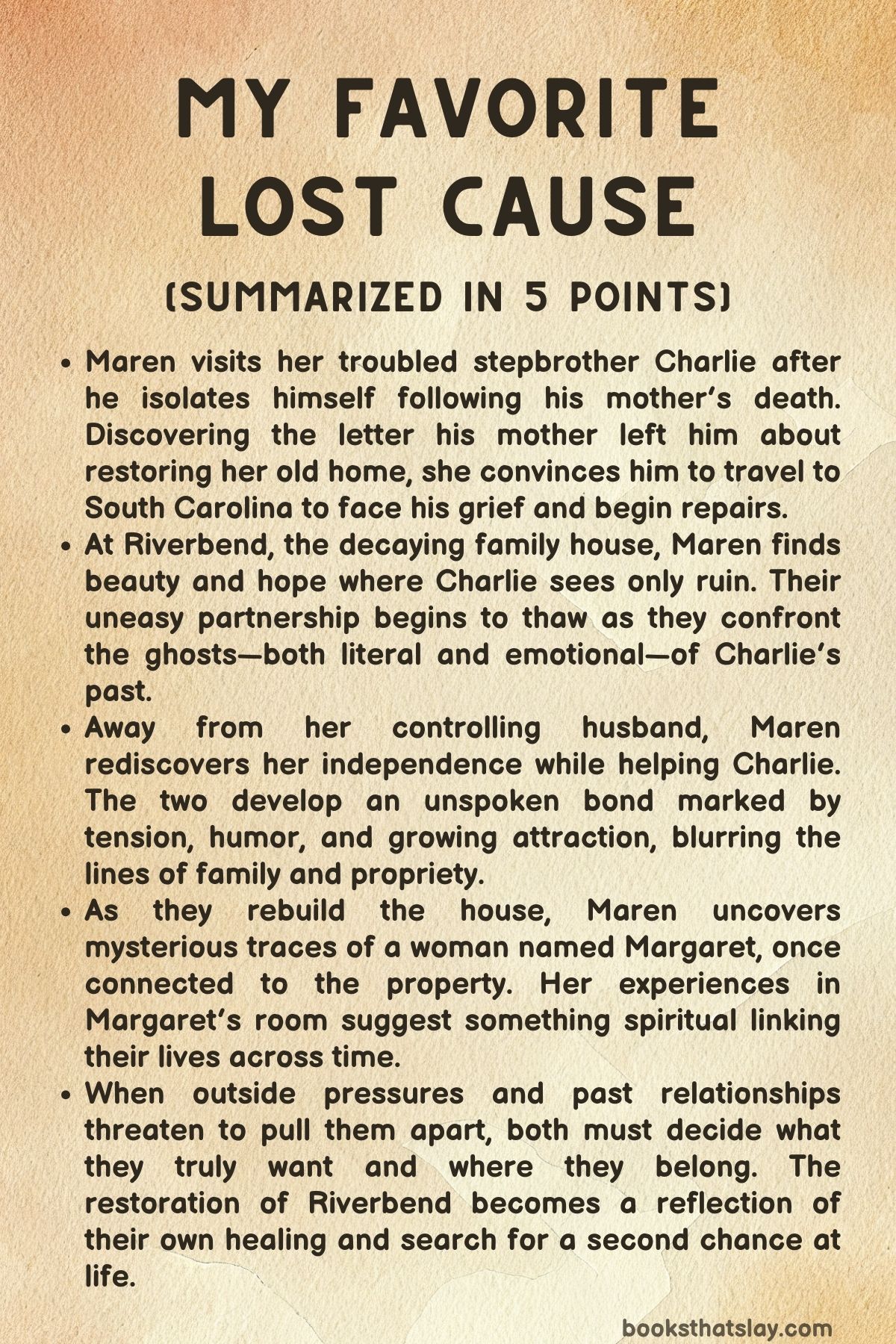
Summary
Maren’s stepfather sends her to check on her stepbrother Charlie, who has spiraled into depression and alcoholism after his mother’s death. She finds his apartment trashed and his life in ruins.
To help him, she lies that her own apartment is being fumigated and moves in temporarily. Though Charlie resists, she cleans his apartment and pushes him to confront his grief.
Eventually, he reveals a letter from his late mother, who died of cancer in Panama. In the letter, she leaves him her house, Riverbend, in South Carolina, asking him to restore it himself.
The request devastates him, but Maren insists that fulfilling it might help him heal.
Charlie reluctantly agrees to visit the house, and Maren accompanies him, eager to escape her suffocating marriage to Harvey. When they arrive in the small town of Oak Bluff, Riverbend proves to be a decaying mansion, neglected for years.
Charlie feels only guilt and sorrow, but Maren is drawn to the place’s faded beauty and insists it can be saved. They meet Elijah, an engineer who declares the house salvageable, though repairs would cost a fortune.
Despite the risks, Maren decides they should stay the night. Amid humor and unease, they share a fragile intimacy that hints at a deeper bond forming between them.
Over the following days, they begin cleaning and repairing the property. Maren thrives in the physical labor, finding satisfaction she never felt in her pampered Manhattan life.
Her marriage to Harvey, focused entirely on image and failed fertility treatments, feels increasingly hollow. As she and Charlie work together, their banter grows flirtatious, masking a deep emotional connection.
When Maren’s mother calls to criticize her appearance, she lies about her whereabouts, realizing she’s finally living honestly for herself rather than for others’ approval.
One evening, they share dinner and wine, and their attraction becomes undeniable. Yet both are restrained by guilt—Maren’s marriage and their family tie.
As the days pass, Maren’s feelings deepen. She finds comfort in the house and an eerie pull toward one of its upstairs rooms.
When she finally enters it, she experiences a strange rush of emotion—joy followed by deep sorrow—and later discovers an old journal belonging to a woman named Margaret Ames, who once lived there. Margaret’s story, set a century earlier, tells of love, loss, and enduring heartbreak.
Maren begins to feel that Margaret’s presence still lingers, as if guiding her toward self-discovery.
Tensions rise when Maren’s husband calls to berate her for neglecting their fertility plans. In a moment of rage and grief, he tells her he’s given away her beloved dogs.
Heartbroken, Maren finally breaks free—she tells him she wants a divorce. Her emotional liberation coincides with a stronger connection to Charlie.
They grow closer as they restore Riverbend together, and their relationship evolves from uneasy companionship into an undeniable partnership.
Their peace is soon threatened when a corrupt local inspector declares the house condemned. Charlie suspects a developer’s interference.
Maren calls on Andrew, her ex-boyfriend and lawyer, for help. Andrew’s reappearance stirs jealousy in Charlie, and old emotions in Maren.
When Andrew arrives in town, it becomes clear he still wants her, but Maren’s heart is no longer his. Despite their complicated feelings, Maren and Charlie attend a local ball together, their chemistry visible to everyone.
They dance under the stars, realizing how much they’ve come to mean to each other.
The following days bring separation and clarity. Maren returns to New York for her sister Kit’s engagement—an event made worse by the fact that Kit is marrying Maren’s ex, Andrew.
Overwhelmed and alone, Maren feels out of place among her shallow family until Charlie unexpectedly appears. He rescues her from judgmental guests, confesses his feelings, and asks her to return with him to Riverbend.
Though she hesitates, the kiss they share before parting confirms what both already know—they belong together.
Maren later returns to South Carolina, continuing her work on the house and her reading of Margaret Ames’s journal. Through the journal, she learns about Margaret’s tragic love story with William Howard, a Marine who died in World War I.
Margaret never married, dying alone at Riverbend in 1993—the same day Maren was born. The eerie connection unsettles her, as though fate has intertwined their lives.
Soon after, Maren discovers she’s pregnant. Terrified of Charlie’s reaction, knowing he doesn’t want children, she decides to leave quietly for a work trip to Barcelona.
When Charlie learns she’s gone, jealousy and fear consume him. He chases her across cities and finds her in Spain, where she confesses the truth about the pregnancy.
Overwhelmed but deeply in love, he admits he wants to be with her and the baby. They return to New York together, only to learn she’s carrying twins.
Maren’s joy contrasts with Charlie’s fear of inadequacy, but he ultimately realizes that love, not perfection, defines family.
Their relationship faces more challenges as Maren’s divorce drags on. A court case reveals that Harvey faked her infertility diagnosis to manipulate her, which finally ends the marriage.
Free at last, Maren and Charlie marry quietly at Riverbend, surrounded by a few close friends. The once-crumbling mansion becomes a home, filled with laughter and new life.
Years later, they return for Easter with their children—twin daughters, an older daughter named Rosemary, and a baby, Mae. Riverbend, now fully restored, is alive with warmth and family.
Charlie is a devoted husband and father, and Maren finally lives the life she always dreamed of—independent, loved, and at peace. In the nursery once belonging to Margaret, Maren senses a gentle presence watching over her family, as if the past has finally been laid to rest.
The story closes on gratitude and renewal, with Riverbend symbolizing not just a house rebuilt, but the enduring strength of love that transcends generations.
Characters
Maren
Maren is the emotional core of My Favorite Lost Cause, a woman caught between obligation, guilt, and a yearning for authenticity. At the beginning, she is portrayed as a dutiful stepdaughter and wife — a product of an environment that prizes appearances over fulfillment.
Her marriage to Harvey has hollowed her out, leaving her subdued and compliant, desperate to meet impossible standards of beauty, fertility, and obedience. Yet, beneath that façade lies a woman of deep empathy and courage.
Her decision to help Charlie, even under false pretenses, reveals her instinct to nurture and heal others, though it also reflects her inability to confront her own unhappiness.
Over time, Maren’s stay at Riverbend transforms her. The decaying house becomes a mirror of her neglected inner life — damaged but restorable.
Her physical labor, once foreign to her, becomes a kind of spiritual cleansing. The haunting presence of Margaret Ames acts as both a supernatural and symbolic catalyst, pushing her to reclaim autonomy, confront grief, and rediscover joy.
Her interactions with Charlie awaken emotional and sensual aspects of herself long suppressed by a controlling marriage. Even when she faces supernatural terror, marital betrayal, and moral conflict, Maren emerges resilient and self-assured.
By the end, she is no longer the fragile woman who sought permission to exist — she is a creator of life and love, standing firmly on her own terms, transforming loss into renewal.
Charlie
Charlie begins as a man drowning in guilt and alcohol. His mother’s death and his ignorance of her final days consume him with self-loathing, manifesting in self-destructive habits and detachment from others.
When Maren reenters his life, she disrupts his inertia, challenging him to face both the wreckage of his home and of his heart. His initial abrasiveness and cynicism mask deep vulnerability.
Charlie’s journey is one of reluctant redemption — from a man who seeks oblivion to one who dares to rebuild.
The restoration of Riverbend becomes his salvation. As he labors to repair his mother’s home, he symbolically rebuilds his fractured identity.
His evolving bond with Maren reveals his capacity for tenderness and humor beneath the bitterness. However, the moral complexity of their relationship — a connection between step-siblings and a married woman — forces him to confront the boundaries between love and transgression.
By the novel’s end, Charlie’s transformation is profound: from a man afraid of attachment to a partner and father willing to embrace life with all its imperfections. His arc closes with a sense of peace and belonging, achieved not through escape, but through acceptance and responsibility.
Harvey
Harvey represents the oppressive forces of control and superficiality that have shaped Maren’s life. A wealthy, image-obsessed husband, he treats Maren as an accessory rather than a partner.
His obsession with perfection extends to her body and her fertility, turning intimacy into performance. Harvey’s manipulations — from dictating her diet to fabricating infertility — reveal not only cruelty but an insidious emotional abuse that has eroded Maren’s self-worth.
His downfall is poetic justice: as Maren reclaims autonomy, his power over her dissolves. Harvey is not merely an antagonist but a cautionary figure — the embodiment of a life lived for appearances, void of empathy.
Through him, the novel critiques societal expectations that reduce women to their reproductive and aesthetic functions. By freeing herself from his control, Maren symbolically dismantles that toxic structure.
Elijah
Elijah serves as the stabilizing presence amid the emotional storms of the novel. A pragmatic engineer and old acquaintance of Charlie’s, he bridges the gap between the material and spiritual restoration of Riverbend.
His calm demeanor and grounded wisdom contrast sharply with the volatility of both Maren and Charlie. Elijah’s quiet loyalty makes him a moral compass — he doesn’t interfere, but subtly guides them toward honesty and responsibility.
He embodies the idea of balance: faith in what can be repaired without romantic illusions. Through his friendship, Charlie rediscovers community, and Maren finds reassurance that kindness and decency still exist in a world that has often demanded too much from her.
Elijah is not a central romantic figure, but his integrity gives emotional structure to the chaos surrounding the protagonists.
Ulrika
Ulrika, Maren’s mother, is a portrait of vanity and generational damage. A former model obsessed with appearances and social standing, she perpetuates the emotional neglect that defined Maren’s upbringing.
Her constant criticism — of weight, looks, and choices — reflects her own insecurities and fear of irrelevance. Ulrika’s fixation on control and presentation makes her both comic and tragic, embodying a hollow version of success.
Yet, in brief moments, she reveals vulnerability — a flicker of affection buried beneath decades of self-absorption. Her eventual softening during Maren’s pregnancy shows that even the most rigid facades can crack.
Still, she remains a reminder of the societal pressures that shaped Maren’s early identity and the emotional cost of mistaking perfection for love.
Andrew
Andrew is the charming specter of what might have been — Maren’s ex-boyfriend, whose return tests her emotional growth. His polished charisma and flirtation contrast sharply with Charlie’s rugged sincerity.
Andrew represents comfort, nostalgia, and the seductive pull of a safer path. However, his reappearance ultimately exposes how far Maren has evolved.
What once seemed ideal — stability, admiration, social prestige — now feels hollow compared to the authenticity she’s found with Charlie.
Through Andrew, the narrative underscores the theme of self-awareness. Maren’s rejection of his advances is not a romantic choice alone, but a moral one — proof that she no longer seeks validation through others’ desire.
Andrew’s role, though limited, is pivotal in highlighting Maren’s transition from dependence to autonomy.
Margaret Ames
Margaret Ames, the long-deceased former owner of Riverbend, functions as both ghost and guide. Her journal bridges past and present, connecting two women across time who suffer from constrained love and societal expectation.
Margaret’s tragic romance — loving a man lost to war, living decades in solitude — mirrors Maren’s emotional entrapment. The eerie parallels between their lives and even their shared date of birth suggest a spiritual lineage, as if Margaret’s unfinished story finds closure through Maren’s rebirth.
Margaret’s presence imbues the novel with a quiet mysticism. She is not merely a haunting but a symbol of endurance and feminine resilience.
Through her, the house becomes animate — a vessel for memory, grief, and hope. When Maren transforms Riverbend into a home once more, she not only redeems her own past but gives peace to Margaret’s restless spirit, completing a century-old cycle of loss and love.
Martha
Martha, the local store clerk and later a friend to Maren, embodies the intuitive, spiritual dimension of the Southern Gothic setting. Her early observation of Maren’s “muted aura” establishes her as a figure attuned to the unseen.
She offers warmth, community, and maternal comfort, filling the emotional void left by Ulrika. Martha’s belief in energy, spirits, and the healing power of home anchors the novel’s supernatural thread in a deeply human truth — that healing often requires faith in what cannot be explained.
By the end, she becomes a surrogate grandmother to Maren’s children, symbolizing continuity between generations. Her grounded kindness contrasts the emotional turbulence of others, making her one of the quiet heroes of the story — proof that empathy can be the most restorative force of all.
Themes
Healing Through Restoration
The restoration of Riverbend forms the emotional backbone of My Favorite Lost Cause, functioning as both a literal and symbolic process of healing. Charlie’s inheritance of his mother’s decaying estate is not simply an architectural project—it becomes a mirror to his own fragmented emotional state.
His mother’s death, coupled with years of neglect and addiction, leaves him hollowed out, much like the ruined mansion. When Maren insists that the house can be saved, she isn’t only referring to wood and plaster; she’s invoking the possibility of renewal for them both.
The labor of cleaning, repairing, and reclaiming the property parallels the slow reconstruction of their inner lives. For Maren, who has been suffocated by her sterile, loveless marriage and the oppressive pressures of infertility treatments, Riverbend represents escape and rediscovery.
Each moment spent peeling wallpaper, sanding beams, or uncovering traces of Charlie’s mother’s life reawakens her sense of agency. Similarly, for Charlie, the house becomes a bridge to forgiveness—both of himself and his mother.
The act of preservation restores not just a building, but a lineage, an emotional connection long abandoned. By the novel’s conclusion, the completed restoration signifies the endurance of love and the triumph of vulnerability over avoidance.
Riverbend stands as a testament that what is broken need not be discarded; it can be rebuilt, not into what it was, but into something new, resilient, and deeply alive.
Rebirth and Self-Discovery
The novel’s arc is a journey of rebirth for Maren, whose life before Oak Bluff is defined by subservience and quiet despair. Living under the dominance of her husband Harvey and her mother’s incessant criticisms, she has lost her sense of identity, existing more as a project than a person.
Her time at Riverbend allows her to rediscover autonomy through physical labor and emotional risk. The contrast between her sterile Manhattan apartment and the wild, salt-heavy air of South Carolina captures the transformation from confinement to freedom.
Each task she undertakes—clearing rooms, cooking, confronting ghosts both literal and metaphorical—marks a shedding of the old self. Her reconnection with the natural world mirrors her internal renewal; the decay of the mansion is countered by her growing vitality.
The haunting she experiences through Margaret’s lingering spirit reinforces the theme of rebirth by linking two women separated by time but united by unfulfilled longing. By the end, Maren’s journey has evolved from survival to creation—she carries not only new life in her womb but a reclaimed identity, one forged by choice rather than obligation.
Love Beyond Boundaries
At the heart of My Favorite Lost Cause is an exploration of love that defies societal and moral conventions. Maren and Charlie’s relationship, complicated by their step-sibling bond, evolves in the shadow of shared pain and emotional isolation.
Their affection arises not from romantic idealism but from understanding, the recognition of mirrored wounds. The novel challenges the reader’s notions of acceptable love, arguing that genuine connection often grows in unconventional soil.
Their relationship is marked by guilt, restraint, and eventual surrender—each moment of closeness a confrontation with taboo and vulnerability. The emotional legitimacy of their bond becomes undeniable as both characters shed external expectations—Maren leaving behind her oppressive marriage, Charlie forgiving himself for his past neglect.
Their union is not portrayed as impulsive passion but as the culmination of healing, the merging of two incomplete people who finally find wholeness in each other. By the end, their love—tested by distance, jealousy, and fear—emerges as something redemptive and deeply human, illustrating that love, in its truest form, often exists beyond the boundaries society tries to impose.
The Weight of Grief and Guilt
Grief saturates the novel, shaping the actions and emotional landscapes of its characters. Charlie’s loss of his mother and the revelation of her secret suffering anchor his descent into self-destruction.
His guilt—rooted in absence, neglect, and missed goodbyes—renders him emotionally paralyzed. The inheritance of Riverbend confronts him with the physical remnants of that guilt: dust-covered rooms, forgotten possessions, and the silent echo of a life he failed to witness.
Maren, too, carries her own form of grief—the quiet mourning of a life unlived. Her infertility treatments, her marriage devoid of affection, and the loss of her dogs symbolize the small deaths of hope and agency that she endures daily.
The novel presents grief not as a singular event but as an evolving state, intertwined with guilt, love, and memory. Through restoration, confrontation, and eventual reconciliation, both characters learn that grief cannot be erased; it must be carried differently.
The transformation of Riverbend mirrors their emotional recovery, showing that guilt can coexist with forgiveness and that acknowledging sorrow is the first step toward healing.
The Supernatural and the Legacy of the Past
The faint supernatural presence in My Favorite Lost Cause—embodied by Margaret Ames and her tragic love story—serves not as horror but as emotional inheritance. The house itself functions as a vessel for memory, its decaying structure haunted by the echoes of those who once lived and loved there.
Margaret’s journal and her ethereal influence over Maren blur the boundaries between the living and the dead, suggesting that certain emotions—love, loss, longing—are timeless. The parallels between Margaret’s unfulfilled life and Maren’s constrained existence reveal a cyclical nature of female suffering and resilience.
The revelation that Margaret died on the day Maren was born transforms the haunting into a symbolic transfer of spirit, as if the older woman’s unfinished story found continuation through Maren. This interplay between past and present elevates the narrative beyond romance, offering a meditation on continuity, inheritance, and the unseen forces that guide human destiny.
By the novel’s end, the supernatural element underscores that restoration extends beyond the physical and emotional—it is also spiritual, binding generations through shared yearning and renewal.