Once a Villain Summary, Characters and Themes
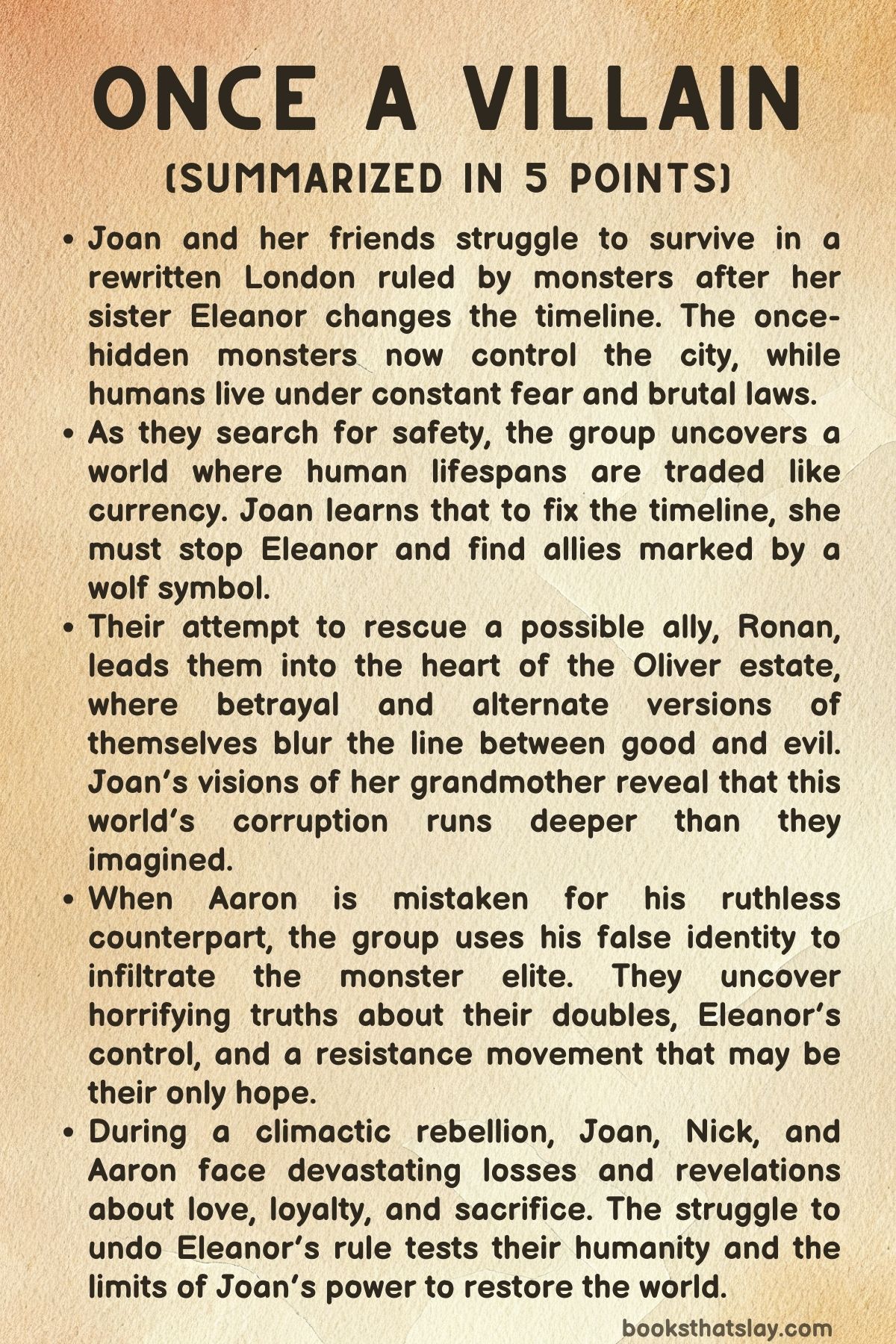
Once a Villain by Vanessa Len continues the story of Joan Chang-Hunt, a girl caught between two worlds—human and monster—after the catastrophic timeline shift that has placed monsters in control of history. London is now a nightmarish version of itself, a gothic city ruled by Eleanor, Joan’s sister and self-proclaimed eternal queen.
As Joan struggles with her powers and guilt, she leads a small band of allies on a mission to restore the true timeline, rescue those lost in the shift, and confront Eleanor before reality collapses. The novel expands the moral complexity of its predecessor, blending fantasy, rebellion, and sacrifice into a tale of identity, love, and the price of power. It’s the 3rd book in the Monsters series by the author.
Summary
In the altered London ruled by monsters, Joan and her allies—Nick, Aaron, Ruth, and Jamie—hide in a narrow alley while guards patrol the streets. The once-human city has become a grotesque blend of gothic towers and monstrous banners, its people enslaved under Queen Eleanor’s reign.
Joan realizes her sister’s manipulation of time has upended everything: humans live under curfews and servitude, while monsters walk openly. With no other option, the group decides to cross the Thames into Liu territory in search of refuge.
Crossing the city exposes the horror of this new order. On London Bridge, now lined with banners celebrating Eleanor’s eternal rule, the group passes cages of tortured humans and crowds of fearful citizens.
Nick restrains his anger while Aaron warns against drawing attention. When a man is publicly beaten by guards for breaking curfew, the group seizes the chaos to slip through a checkpoint.
But when they reach the other side, they find that Liu territory has also fallen—Argent sigils now dominate. Power has shifted completely, and there is nowhere safe to turn.
Seeking shelter, they reach the Serpentine Inn, now expanded into a monstrous marketplace where humans serve as staff under strict curfew. Aaron pays for rooms with enchanted tokens that steal fifty years of human life, horrifying Joan.
Wanted posters for Joan plaster the walls, marking her as a traitor. As they hide in a nearby apartment, Joan discovers books describing this society’s monstrous laws: humans owe decades of their lives to their overlords, their time literally counted and traded.
Determined to restore the timeline, Joan vows to kill Eleanor.
Her powers begin to fail, causing dangerous “fade-outs” where she feels herself vanishing. Her grandmother’s spectral voice urges her to seek allies marked by a wolf.
When a nervous inn clerk, Ronan, secretly gives her a note with a wolf symbol, Joan suspects he’s part of that resistance. Before she can meet him, guards storm the market and arrest him for conspiracy.
Convinced Ronan is crucial, the group pursues the convoy taking him away, commandeering a self-driving bus through the stormy city.
The bus leads them to Richmond and the Oliver estate—home of Aaron’s powerful family. Inside the vast, walled property, they witness Lucien Oliver, Aaron’s cousin, execute Ronan by draining his life.
Joan’s grief triggers another vision of her grandmother, who confirms that Eleanor has rewritten history and warns Joan not to trust her own counterpart in this timeline. When guards discover the intruders, they unexpectedly address Aaron as “Lord Oliver.” In this altered world, he is the head of the family. Assuming his counterpart’s role, Aaron commands the guards to stand down and pretends Joan and Nick are his human lovers.
Inside the mansion, he learns his father has been exiled and that his monstrous counterpart is a trusted enforcer of the Queen.
A call from Eleanor herself confirms their fears. She praises Aaron’s supposed loyalty in helping crush the human resistance known as the wolves.
While hiding, Joan and Nick discover a recording showing this world’s Aaron torturing and killing Nick’s alternate self—a rebel leader. The revelation devastates them both.
Aaron is forced to impersonate his cruel counterpart during an upcoming public execution meant to eliminate captured rebels. The group realizes the only way to contact the resistance is to infiltrate the ceremony and save the prisoners.
Nick and Joan travel through the crumbling human quarter of Covent Garden, where they reunite with Nick’s surviving siblings, Finn and Mary. They live in poverty, their remaining years displayed on pendants.
Finn sketches the colosseum’s layout for them, revealing that the Queen will appear in person during the jubilee celebrations. Two weeks later, the group infiltrates the arena, posing as nobles and servants among fifty thousand spectators.
Beneath the spectacle of gladiatorial slaughter, they plan to reach Eleanor’s imperial box and strike. Ruth creates diversions, freeing prisoners while Joan uses her Grave power to break through barriers.
Above, the jubilee descends into madness as Eleanor feeds on the chaos to strengthen her control of the timeline.
Nick, realizing the only chance lies in distracting her, disguises himself as a gladiator and enters the arena. When Eleanor drops her shield to anchor the timeline, he attacks—his spear grazing her arm and drawing blood, proof she’s vulnerable.
For a moment, hope surges. But Eleanor retaliates, collapsing the balcony beneath him.
Nick falls onto iron spikes, dying as the tear in the sky seals. The Queen’s dominion is complete.
Joan is shattered by grief. Back at the mansion, she and Aaron, broken by loss, find fleeting comfort in each other.
Later, Joan discovers a love note between the alternate Aaron and Nick, revealing they had loved each other in this world. She shares the truth with Aaron, and together they mourn both love and lives lost.
In the final act, Joan, Nick—miraculously alive—and their friends launch a last assault on Eleanor at Holland House, seat of the Monster Court. Time stands still as they infiltrate the ballroom, confronting her amid monstrous courtiers.
Their plan unravels into chaos when Eleanor unleashes devastating power, revealing that she cannot die—she has bound the timeline to her life. Joan, regaining control of her abilities, fights back with Aaron and Ruth, shattering the Queen’s shield.
Aaron realizes that Joan’s full power only awakens through love and loss. As Eleanor’s control tightens and the void consumes the collapsing world, Aaron steps willingly into the tear, sacrificing himself to trigger Joan’s deepest strength.
Overwhelmed with grief, Joan unleashes her power, unmaking the world’s fabric. She tears the metaphysical leash binding Eleanor to time, refusing to replace her as master of the timeline.
Instead, she frees it entirely, breaking the cycle of control. Eleanor, severed from her source of power, dies.
The world rebuilds itself around Joan and her surviving friends. When she wakes, the city is restored, and reality has healed.
But the price has been immense.
As Joan and Nick mourn by the ruins, Aaron returns—alive, reborn as a gift from the freed timeline. A year later, they share peace at a riverside picnic, their world renewed.
Together, they release a candle boat in Eleanor’s memory. As Joan watches the water ripple, she senses a faint pulse in time, a sign that the story isn’t truly over—and that redemption, even for the lost, may one day return.
Characters
Joan
Joan stands at the heart of Once a Villain, embodying the struggle between power, morality, and self-identity. Once an ordinary girl who discovered she was part monster, she now bears the impossible burden of restoring a world twisted by her sister Eleanor’s corruption.
Throughout the story, Joan grows from a frightened survivor into a resolute leader capable of unmaking and remaking reality itself. Her Grave power—literally the ability to “unmake”—is both her curse and her salvation, mirroring her internal conflict between destruction and compassion.
Despite her immense power, Joan’s greatest strength lies in her humanity: her empathy for those enslaved or broken under Eleanor’s rule, her guilt for the deaths and distortions caused by timeline changes, and her unwavering loyalty to her companions. She is a character constantly torn between love and duty, ultimately defining heroism not as victory but as sacrifice.
By the end, Joan’s refusal to claim dominion over time shows her moral evolution—she chooses freedom and restoration over control, proving that redemption lies in letting go rather than ruling.
Nick
Nick’s character arc is defined by redemption, love, and defiance against fate. Once a legendary monster slayer, his decision to save Joan rather than kill her altered the course of history, leading to the monstrous dystopia they now face.
Haunted by guilt and the suffering caused by his choice, Nick transforms from a man of vengeance to one of compassion and courage. His relationships—particularly with Joan and Aaron—reveal his complexity; he embodies both the protector and the penitent.
Nick’s endurance in the face of endless loss, especially his tragic death in the colosseum and miraculous survival, marks him as the emotional center of the group. His bravery is never blind aggression—it is a conscious stand against tyranny, even knowing he might lose.
When he finally joins Joan and Aaron as equals in love and purpose, Nick completes his transformation into a symbol of hope, showing that even those who have been instruments of destruction can become saviors through love and sacrifice.
Aaron
Aaron Oliver is perhaps the most nuanced figure in Once a Villain, caught between his monstrous lineage and his human conscience. A scion of a powerful monster family, he embodies restraint and intelligence rather than brutality.
Aaron’s calmness contrasts sharply with the chaos around him, and yet his composure often masks deep pain and guilt. Witnessing his alternate self’s cruelty and the torture of Nick’s counterpart forces Aaron to confront the darkness that exists within his bloodline and within himself.
His evolution from a reluctant ally to a self-sacrificing hero reaches its peak when he willingly steps into the void to trigger Joan’s full power, proving his love for both her and Nick. Aaron’s quiet heroism is rooted not in grand gestures but in empathy, intellect, and the willingness to bear others’ burdens.
When he is later returned to life by the freed timeline, it feels not like resurrection but vindication—Aaron’s humanity, the part of him he feared most, is what ultimately redeems him.
Eleanor
Eleanor serves as both villain and mirror, the embodiment of power corrupted by grief and obsession. Once Joan’s sister and protector, she becomes the eternal queen of a monstrous empire, ruling over a world where humans are enslaved and their lives traded like currency.
Her desire to reshape history is driven by a tragic misunderstanding of love—she seeks control over time itself to prevent loss, not realizing she perpetuates it endlessly. Eleanor’s monstrousness is not inherent but born from fear of powerlessness.
Her bond with the timeline, which ultimately consumes her, symbolizes the danger of conflating love with possession. In her final confrontation with Joan, Eleanor’s defiance softens into tragic recognition; she realizes too late that control cannot heal pain.
Her death, following Joan’s act of release, is both punishment and mercy—a reminder that even villains are victims of their own humanity.
Ruth
Ruth brings sharp wit and resilience to the story, acting as both the moral compass and the voice of reason among the group. Her pragmatic approach often tempers Joan’s impulsive idealism and Nick’s self-destructive courage.
Despite living in a world that repeatedly erases and reshapes itself, Ruth’s sense of self remains steadfast. She refuses to be a victim of circumstance, fighting fiercely for freedom and justice even when hope seems futile.
Her loyalty to Joan and the group underscores her strength of character, while her capacity to adapt—whether orchestrating diversions in battle or manipulating magical tools—marks her as indispensable. Ruth’s arc is one of perseverance; though she does not wield the grand powers of her companions, her humanity and intellect make her the backbone of their survival.
Jamie
Jamie serves as the emotional heart of the ensemble, grounding the story in love, loss, and endurance. His grief over the disappearance and eventual rediscovery of his husband Tom reflects the broader theme of memory and time’s cruelty.
Unlike the others, Jamie does not seek power or vengeance—he seeks belonging. His illusions and quiet courage provide hope in moments of despair.
Through Jamie, the novel explores how love endures even when reality itself fractures. His presence softens the darker edges of the narrative, reminding both characters and readers that small acts of kindness and loyalty can resist even the most tyrannical forces.
In the final restored timeline, Jamie’s peace and reunion with Tom symbolize the healing of wounds time cannot erase.
Tom
Tom represents endurance through compassion. Though his role is less central than Joan or Nick’s, his reunion with Jamie and his steadfast support of the group highlight the quiet strength of ordinary goodness amid chaos.
In a world where power is measured in domination, Tom’s decency and loyalty stand as quiet rebellion. His courage in the climactic battle at Holland House proves that heroism need not come from magic or might—it can come from faith in others.
Tom’s story, intertwined with Jamie’s, reinforces Once a Villain’s central message: that love, not power, endures across timelines and tragedies.
Themes
Power and Corruption
In Once a Villain, Vanessa Len presents a world where the pursuit and preservation of power completely redefine morality, governance, and identity. Eleanor’s rewriting of history turns monsters into rulers and humans into subjugated beings, demonstrating how authority, when unchecked, corrodes both the wielder and the world itself.
The book portrays how absolute control reshapes every layer of society—from the banners declaring Eleanor’s eternal reign to the casual use of human lives as currency. The normalization of such cruelty underscores the dangers of a world where moral responsibility has been replaced by hierarchy and fear.
Even characters like Aaron, who impersonates his monstrous counterpart, reveal how power molds behavior; his transformation from fearful fugitive to commanding nobleman shows how easily authority can erode empathy. The corruption is not just political but deeply spiritual: Eleanor binds herself to the timeline, making power her very lifeblood, and in doing so, she loses her humanity entirely.
Len uses this dynamic to suggest that the lust for dominance inevitably isolates its holder, creating an endless cycle of violence and subjugation that consumes both ruler and ruled. The destruction of London’s skyline, the blood-stained laws, and the hierarchy of servitude are not just dystopian visuals—they symbolize a civilization that has traded compassion for control.
Through this lens, the novel becomes an exploration of how the desire to shape reality in one’s image turns even love and family into casualties of ambition.
Identity and Duality
The novel constantly interrogates what it means to be oneself when time, memory, and morality are mutable. The existence of alternate selves—each living out a different fate—forces every character to confront the question of identity beyond circumstance.
Joan’s horror at meeting her counterparts and seeing Aaron’s monstrous double exposes how fragile selfhood becomes when reality fractures. The book treats identity not as a fixed essence but as something forged in choice and consequence.
Joan’s struggle to reconcile her monstrous heritage with her human empathy mirrors Nick’s conflict as a once-hero turned fugitive, suggesting that being good or evil is never absolute but defined by what one chooses to protect. When Aaron watches a recording of his other self torturing Nick’s counterpart, the moment shatters his understanding of who he is—it becomes clear that identity is a moral compass that must be actively maintained rather than inherited.
The dual worlds serve as a metaphor for the dualities within every person: compassion versus survival, duty versus desire, and truth versus illusion. Len uses these mirrored realities to argue that the self is both a reflection of and rebellion against the world that shapes it.
Identity, in this sense, becomes an act of resistance against forces—political, familial, or supernatural—that seek to dictate who one must be.
Sacrifice and Redemption
Sacrifice in Once a Villain is not portrayed as a single heroic act but as a recurring, painful necessity in the quest for redemption. Each major character bears the weight of choices that demand personal loss for a greater good.
Nick’s decision to save Joan rather than the world initiates the apocalypse of Eleanor’s reign, yet it also becomes the foundation for his later redemption. Aaron’s final act—stepping into the void to trigger Joan’s power—redefines sacrifice as an act of love rather than obligation.
His death is not martyrdom in the traditional sense; it is an acknowledgment that salvation often requires surrendering the self entirely. Joan’s evolution culminates in her refusal to seize control of the timeline even when it is offered to her, proving that true redemption lies in relinquishing the desire to dominate.
Throughout the story, Len reframes sacrifice as an emotional crucible that transforms rather than destroys. Redemption, therefore, is not about undoing the past but about choosing compassion despite it.
This theme resonates in the closing moments of the novel, where the restored timeline offers peace, yet grief persists—a reminder that healing does not erase loss but redefines it. The characters’ willingness to give up what they love most becomes the moral axis of the story, asserting that power must always bow to empathy if humanity is to survive.
Resistance and Hope
Amid oppression and despair, Once a Villain builds its emotional core around the persistence of resistance and the fragile endurance of hope. The enslaved humans, the underground network of wolves, and even small acts of rebellion—like Ronan’s secret note or Joan’s decision to save strangers—embody a quiet defiance that refuses to vanish even under tyranny.
Len emphasizes that rebellion does not always manifest in grand gestures; it survives in the preservation of memory, kindness, and love. The distorted London, filled with lifespans traded like currency and humans reduced to property, becomes a landscape where hope itself is an act of revolution.
Joan’s determination to fix the timeline, despite witnessing repeated deaths and betrayals, signifies belief in restoration even when the world appears irredeemable. The novel’s conclusion reinforces this spirit—the timeline heals, but the ripple Joan senses hints that hope is never static; it is the ongoing will to rebuild, to forgive, and to begin again.
Through these moments, Len presents resistance as both a moral duty and a deeply personal expression of faith in the possibility of change. Hope, fragile yet enduring, stands as the final counterweight to despair, proving that even in a corrupted reality, humanity’s greatest strength is its refusal to stop fighting for a better one.