Pucking Strong Summary, Characters and Themes
Pucking Strong by Emily Rath is a contemporary sports romance that explores the intersection of love, loss, and resilience within the high-pressure world of professional hockey. The story centers on Teddy O’Connor, a physical therapist whose life becomes entangled with Henrik Karlsson, a Swedish NHL star.
What begins as an internship marked by unspoken admiration evolves into a deep emotional connection shaped by grief, guardianship, and a marriage of convenience that turns unexpectedly real. Through humor, vulnerability, and evolving self-acceptance, the novel traces how two men build a family, discover emotional intimacy, and redefine strength—not through winning, but through love and healing. It’s the 4th book in the Jacksonville Rays series by the author.
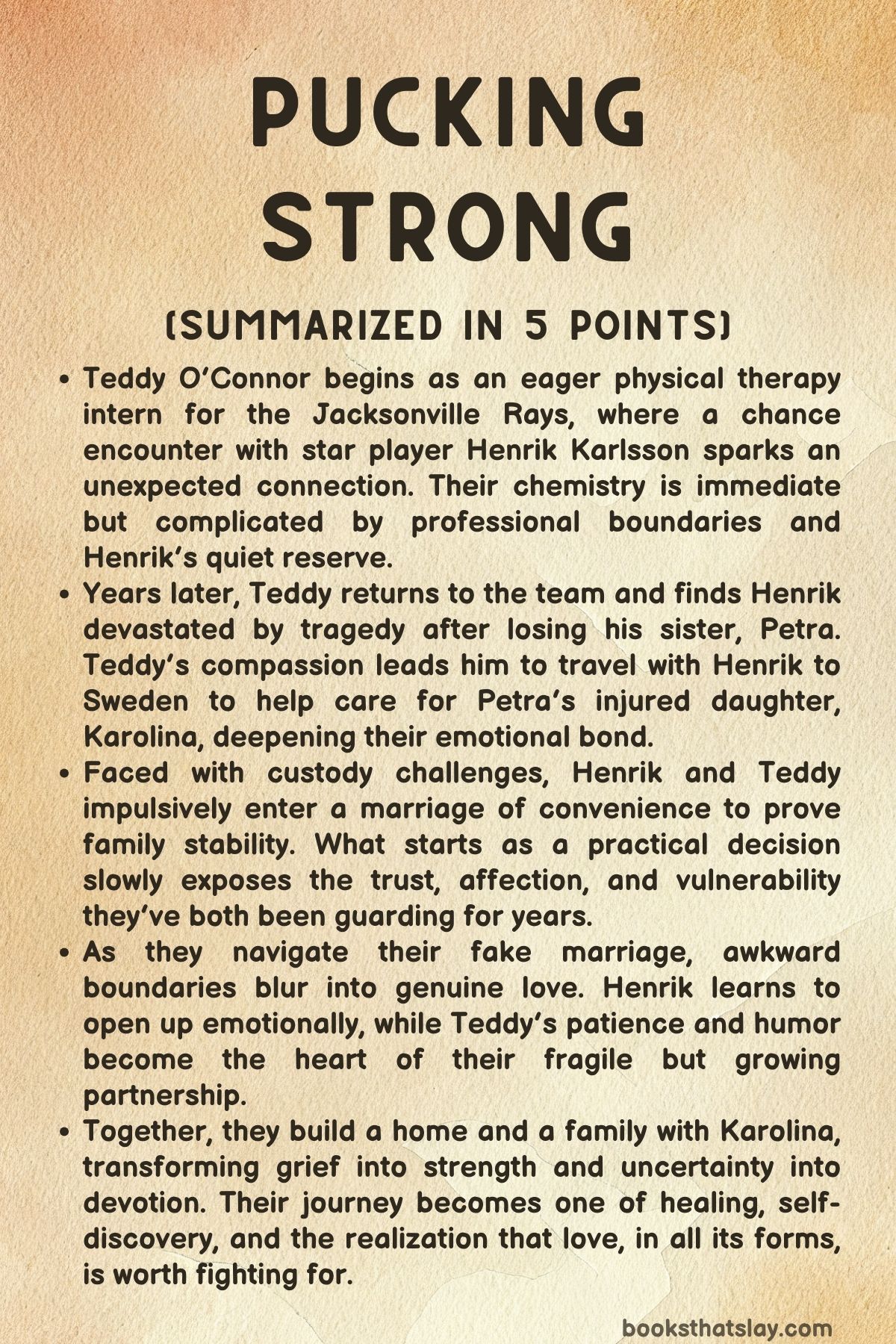
Summary
Teddy O’Connor, a young physical therapy student, begins an internship with the newly formed NHL team, the Jacksonville Rays. On his way to his first day, he narrowly avoids an accident when a handsome Swedish stranger, Henrik Karlsson, pulls him out of the path of an oncoming truck.
Their instant connection leaves Teddy shaken, but he hurries off to his new job—only to discover that Henrik is a star forward on the very team he’s interning with. Teddy tries to maintain professionalism despite his growing admiration, while Henrik remains polite but distant.
Their mutual respect and restrained attraction linger quietly as the season progresses.
Years later, Teddy returns to the Rays as a licensed physical therapist. Now confident yet still harboring old feelings, he finds Henrik unchanged—charming, disciplined, and emotionally reserved.
Their reunion takes a tragic turn when Henrik learns his sister, Petra, has died in a car crash in Sweden, leaving behind her young daughter, Karolina. Shattered, Henrik insists on returning home immediately to care for his niece.
Teddy volunteers to accompany him, arguing that his pediatric experience will help Karolina’s recovery. The two men fly to Stockholm together, navigating grief, awkward humor, and the faint flicker of connection that has never quite disappeared.
At the hospital, Henrik struggles to face his niece’s injuries, haunted by memories of his sister saving him as a child. Teddy helps him steady his emotions, repeating simple words that bring him back to the present: “She’s alive.
” When Karolina awakens, she and Teddy form an immediate bond, sealing their connection when she names a stuffed bear “Teddy. ” They return to Henrik’s cozy Stockholm apartment, where grief, exhaustion, and tenderness coexist.
As Henrik wrestles with bureaucratic barriers to gaining custody—Swedish authorities doubt his ability to raise a child while maintaining his career—Teddy refuses to let him give up. His unwavering support rekindles Henrik’s strength and hints at the emotional intimacy growing between them.
Henrik’s lawyer, Elin Ågren, warns that his custody claim will likely fail. The government prefers stability and often favors two-parent households.
When Elin presses Henrik about his plans, Teddy impulsively suggests a solution: marriage. If Henrik were legally married to someone responsible and settled—someone like Teddy—it might help his case.
Shocked but desperate, Henrik agrees. Within hours, the two men marry in a civil ceremony, both acutely aware of the risks of fraud but determined to protect Karolina.
Teddy’s humor and nervous energy fill the tense moment, while Henrik remains calm and grateful. Despite the legal nature of their union, the emotional undercurrent between them deepens.
Their arrival at Henrik’s childhood home introduces another layer of complexity. His mother, suffering from dementia, mistakes Teddy for her son’s real husband and insists on teaching him to bake kanelbulle.
Teddy plays along, winning her affection. Henrik’s father, more lucid, quietly approves, encouraging his son to let his mother enjoy the happiness she perceives.
The visit becomes bittersweet as they bury Petra’s ashes and share a quiet night in the family boathouse. When Teddy tries to return Henrik’s mother’s wedding ring—a mistaken gift—Henrik insists he keep it.
Forced to share a bed, they find an uneasy comfort in each other’s presence. Though Teddy insists on boundaries, the closeness between them continues to blur lines neither fully understands.
Back in Florida, life resumes under the guise of a fake marriage. Henrik and Teddy navigate domestic adjustments, PR appearances, and growing attraction.
During a staged dinner date meant to convince the media of their “love,” their real feelings begin to surface. Over dinner, Henrik opens up about being demisexual—experiencing attraction only through emotional connection.
He admits he feels safe and drawn to Teddy, sensing something deeper than friendship. Their playful banter turns vulnerable as Teddy confesses his long-standing crush, while Henrik reveals he finds Teddy beautiful and grounding.
What begins as an act for the cameras turns into a real emotional reckoning, culminating in shared laughter and tender honesty.
Their relationship faces tests of trust and understanding. During a game, Henrik misinterprets Teddy’s closeness with a friend as romantic interest and confronts him.
The tension erupts into their first real kiss—fiery, confused, and filled with suppressed emotion. For the first time, Henrik begins to understand desire through connection, while Teddy sees hope that their love may be real.
Later that night, Henrik’s whispered Swedish—“Du är min man,” meaning “You are my husband”—cements their emotional bond. They set new rules: take things slowly, remain honest, and stay faithful.
Their marriage, once a legal arrangement, evolves into something authentic and mutual.
Time passes, and their family grows closer. Teddy becomes a father figure to Karolina, guiding her recovery and nurturing her spirit.
Henrik’s dedication to both of them deepens, even as external pressures threaten their peace. When a journalist exploits Henrik’s mother’s dementia, media backlash endangers their custody case.
In response, Henrik publicly addresses his mother’s condition, donates millions to Alzheimer’s research, and launches a charitable foundation, “Ray of Hope. ” His emotional transparency earns widespread admiration.
After the press conference, Henrik kneels before Teddy in front of friends and family, proposing they marry again—this time for love, not convenience. Teddy accepts, overwhelmed with joy.
Their second wedding marks the true beginning of their shared life. Henrik gifts Teddy his mother’s ring again, this time as a symbol of chosen family and enduring love.
In their home, Henrik surprises Teddy with a renovated bathroom featuring a double vanity—a simple but profound gesture of equality and permanence. Their intimacy deepens as they finally embrace love without fear or pretense.
Months later, at a Christmas festival, Henrik, Teddy, and Karolina receive an email confirming full custody of Karolina. Overcome with relief, they celebrate surrounded by friends.
The family that began in tragedy finally becomes whole. Years later, at Karolina’s ballet recital, Henrik and Teddy—now legally married and emotionally fulfilled—watch proudly as she performs.
Afterward, she gives Teddy a handmade card asking if she can call him “Dad. ” He tearfully agrees.
Henrik, in turn, surprises Teddy with adoption papers allowing him to take the Karlsson name. Their playful exchange ends with Teddy joking that he’ll agree only if Henrik attends Burning Man, a plan Henrik and Karolina have already arranged.
The story closes with the three of them—Henrik, Teddy, and Karolina—sharing dinner at the restaurant where their first real date took place. Their journey from a near-accident and a fake marriage to a loving, chosen family is complete.
Together, they embody the quiet power of compassion, healing, and love’s ability to transform even the most unexpected beginnings into something unbreakably strong.
Characters
Teddy O’Connor
Teddy O’Connor stands at the emotional heart of Pucking Strong, evolving from a shy and self-effacing intern into a confident, compassionate man who learns to claim love, family, and authenticity. When first introduced, Teddy is awkward but deeply empathetic, his humor often serving as a shield for his insecurities.
His professional competence as a physical therapist contrasts with his internal uncertainty; he thrives when caring for others but struggles to accept care in return. Over time, his character deepens as he confronts both external and internal challenges—navigating workplace boundaries, coping with unrequited love, and eventually embracing a relationship that defies convention.
Teddy’s emotional intelligence becomes his strength; his ability to comfort Henrik through grief and guide Karolina’s recovery reveals his nurturing core. His journey is also one of self-acceptance.
Once afraid to be fully seen, he grows into a man who can stand beside Henrik as an equal, unashamed of his love. By the novel’s conclusion, Teddy’s warmth, resilience, and humor have transformed him from a background caretaker into a cornerstone of a family built on healing and truth.
Henrik Karlsson
Henrik Karlsson, the stoic Swedish hockey star, embodies the classic contrast between outer composure and inner turmoil. At first, he appears distant and disciplined, maintaining emotional barriers shaped by loss, fame, and cultural restraint.
Beneath that calm exterior, however, lies a man haunted by guilt and grief, especially after his sister Petra’s tragic death. His early aloofness toward Teddy hides not indifference but self-protection—Henrik fears vulnerability, both as an athlete constantly scrutinized and as a man uncertain about his own desires.
His arc is one of emotional awakening. Through Teddy’s steady presence, Henrik begins to explore his identity, eventually recognizing his demisexuality and redefining intimacy on his own terms.
His love for his niece Karolina catalyzes his transformation from a solitary figure into a devoted guardian, while his evolving bond with Teddy teaches him that strength lies not in control but in openness. By the story’s end, Henrik has shed the armor of stoicism to become a partner who communicates love through action, empathy, and shared purpose, culminating in a life that balances passion, responsibility, and peace.
Karolina Karlsson
Karolina Karlsson, affectionately known as Karro, represents innocence, resilience, and the healing power of family. Her introduction follows a devastating car accident that claims her mother’s life and leaves her physically and emotionally scarred.
Despite her trauma, Karolina becomes the emotional glue binding Teddy and Henrik together. Her presence forces both men to mature beyond their personal fears, centering their lives on nurturing her.
She embodies the story’s theme of chosen family—where love, not biology, defines belonging. As she recovers, her curiosity and gentle humor bring levity to grief-stricken moments, and her attachment to Teddy cements his role as more than just a caretaker.
Over time, Karolina’s growth mirrors the healing journey of her guardians: from pain to joy, from loss to stability. Her final act of calling Teddy “Dad” symbolizes not only her acceptance of him but also the culmination of the novel’s emotional journey—the creation of a family grounded in love, trust, and renewal.
Petra Karlsson
Though Petra Karlsson dies early in the narrative, her influence echoes throughout Pucking Strong. As Henrik’s older sister and Karolina’s mother, Petra represents the selfless love and sacrifice that drive the story’s emotional core.
Through flashbacks and memories, readers glimpse her as fiercely protective and compassionate, the person who once saved Henrik from drowning as a child and later served as his moral compass. Her death catalyzes the events that bring Teddy and Henrik together, forcing Henrik to confront his grief and sense of duty.
Yet Petra’s legacy extends beyond tragedy—her memory guides Henrik toward fatherhood and emotional maturity, and her daughter’s well-being becomes a living testament to her love. In many ways, Petra functions as the unseen guardian of the narrative, the silent force shaping the lives of those she left behind.
Elin Ågren
Elin Ågren, Henrik’s lawyer, represents pragmatism and reason amid emotional chaos. Her sharp intellect and no-nonsense attitude ground the narrative during the fraught custody proceedings.
Elin’s skepticism challenges Henrik and Teddy to confront the real-world implications of their impulsive choices, particularly their marriage of convenience. Yet beneath her professionalism lies empathy—her warnings to Teddy reveal genuine concern, and her insistence on authenticity underscores the novel’s central moral tension between duty and truth.
Elin’s presence also highlights the legal and cultural pressures surrounding nontraditional families, emphasizing that love must not only be felt but proven in the eyes of society. She becomes a moral mirror for Henrik and Teddy, forcing them to transform their pretense into genuine partnership.
Lukas “Novy” Novikov
Lukas “Novy” Novikov injects levity and camaraderie into the narrative, serving as both comic relief and emotional support. A teammate of Henrik and one of Teddy’s closest friends, Novy embodies the warmth and irreverence of found family.
His teasing nature and flamboyant humor often balance the story’s heavier moments, while his loyalty to Teddy underscores the depth of their friendship. Beneath his bravado, Novy demonstrates insight and compassion—he understands Teddy’s unspoken pain and provides the kind of support that makes emotional vulnerability possible within the masculine world of professional sports.
His generosity, whether through a loaned suit or a well-timed joke, makes him an anchor of joy in a story steeped in grief and love.
Poppy St.
Poppy St. James, the Jacksonville Rays’ PR director, exemplifies confidence, intelligence, and adaptability.
Initially a pragmatic figure managing the team’s image, she grows into an ally and confidante for both Teddy and Henrik. Her strategic mind transforms crises into opportunities, as seen when she orchestrates their public “date” to control media narratives or later helps channel Henrik’s pain into philanthropic action.
Poppy’s evolution into a philanthropic leader reflects the book’s theme of transformation—turning personal struggles into collective good. She bridges the worlds of sport, media, and compassion, and her steady influence allows Henrik and Teddy’s relationship to flourish under public scrutiny.
Ultimately, she symbolizes the power of empathy fused with professionalism—a reminder that image and integrity can coexist when grounded in genuine care.
Maria Karlsson
Maria Karlsson, Henrik’s mother, personifies both love and loss through the lens of dementia. Her fading memory adds emotional depth to the novel, representing the fragility of time and the bittersweet persistence of affection.
Despite her cognitive decline, Maria’s gentle warmth and occasional clarity offer some of the story’s most tender moments, particularly when she mistakes Teddy for Henrik’s real husband. This mistaken belief, rather than causing embarrassment, becomes a source of unexpected comfort and belonging for Teddy, affirming his place in the family long before the world officially accepts their marriage.
Maria’s decline also humanizes Henrik, revealing his vulnerability as a son grappling with the inevitability of losing another loved one. Her memory lingers in their final wedding and charitable acts, proving that even as her mind fades, her influence endures.
Johan Karlsson
Johan Karlsson, Henrik’s father, is a quiet pillar of strength, embodying stoicism tempered by compassion. He represents generational endurance—the steady presence that holds a family together through tragedy and change.
His acceptance of Teddy and his understanding of Maria’s condition demonstrate quiet wisdom, allowing love to take precedence over convention. Johan’s interactions with Henrik and Teddy provide subtle but powerful validation, bridging the old and new definitions of family.
Through his encouragement and calm pragmatism, Johan helps Henrik reconcile his past with his present, ensuring that the Karlsson legacy is one not of rigid tradition but of acceptance and resilience.
Themes
Love and Emotional Vulnerability
In Pucking Strong, love is explored as a transformative force that challenges emotional walls, redefines masculinity, and bridges pain and healing. The relationship between Teddy and Henrik begins not with mutual desire but with restraint, misunderstanding, and unspoken affection.
Teddy’s quiet devotion and Henrik’s guarded nature reflect two contrasting ways of coping with emotional fear—one through openness, the other through suppression. As their relationship develops from professional respect to genuine intimacy, love becomes a form of courage rather than comfort.
Henrik’s demisexual identity adds a nuanced layer to the theme; his realization that attraction for him arises from trust and emotional connection gives the narrative a rare sensitivity. Their evolving relationship demands honesty, vulnerability, and the willingness to unlearn old beliefs about what love should look like.
By the end, their marriage—once a facade to protect a child—becomes a sincere partnership built on equality and emotional truth. Love, in this story, is not grand or idealized; it’s a choice to show up for each other every day, even through uncertainty, loss, and fear.
Grief, Loss, and Healing
Grief permeates every layer of Pucking Strong, serving as both a wound and a catalyst for growth. Henrik’s loss of his sister Petra sets the story’s emotional tone, but it is through Teddy’s empathy that grief transforms from isolation into connection.
Henrik’s pain initially manifests as stoicism and control, traits often reinforced by his career in professional sports. Yet when Petra dies, those defenses collapse, revealing a man unable to reconcile his guilt with his love.
Teddy’s presence allows Henrik to face grief not as something to suppress but as something to live alongside. Their shared care for Karolina deepens this process—her innocence becomes a mirror of hope amid devastation.
The novel portrays mourning as nonlinear and deeply human: it lingers, resurfaces, and changes form over time. By the final chapters, grief is no longer just a memory of loss but an integrated part of their family’s identity.
Through compassion and shared responsibility, the characters learn that healing does not erase pain; it reshapes it into something that coexists with love and purpose.
Found Family and Belonging
At its core, Pucking Strong is a story about creating family beyond bloodlines. Both Teddy and Henrik carry emotional loneliness long before they meet—Teddy estranged from his mother and Henrik burdened by a life of fame that isolates him from genuine intimacy.
When they come together through tragedy, they begin to construct a family defined by choice rather than circumstance. Karolina becomes the emotional anchor, a child whose presence transforms two men searching for meaning into fathers learning to nurture.
The Rays hockey team further extends this idea, functioning as a network of support and affection that substitutes for traditional kinship. Characters like Novy, Poppy, and Rachel contribute to this web of belonging, reinforcing that love and loyalty can be freely chosen.
The novel celebrates nontraditional families without apology, affirming that family is not determined by legal bonds but by emotional commitment. When Henrik and Teddy finally receive custody of Karolina, it symbolizes more than bureaucratic success—it represents the triumph of chosen love over societal expectations.
Identity and Self-Acceptance
The journey toward self-acceptance is central to both protagonists’ arcs in Pucking Strong. Teddy’s humor and self-deprecation conceal years of insecurity—his fear of being “too much” or “not enough” in professional and personal spaces.
His growth lies in learning to see himself as deserving of love without condition. Henrik’s path is quieter but equally powerful.
His discovery of his demisexuality redefines how he understands attraction and emotional intimacy. Through Teddy, he learns that love is not a performance of desire but a patient unfolding of connection.
Their relationship becomes a space where both men confront the parts of themselves they once hid from the world. Identity in this story is not static—it evolves through experience, reflection, and acceptance.
By the end, when Teddy takes Henrik’s surname and Karolina calls him “Dad,” the act carries symbolic weight: it marks the moment both men stop seeking external validation and start embracing who they are—with all their flaws, histories, and humanity.
Duty, Sacrifice, and Redemption
Duty and sacrifice underpin much of the novel’s emotional conflict. Henrik’s decision to assume guardianship of Karolina forces him to weigh personal ambition against moral responsibility.
His career, reputation, and freedom all become secondary to the promise he made to his sister’s memory. Teddy’s role as caretaker extends beyond professional obligation—his decision to marry Henrik, even under false pretenses, speaks to a deep moral conviction that love often requires risk.
The narrative repeatedly tests the boundaries between duty and desire, showing how acts of selflessness can also lead to self-discovery. Their marriage, initially a sacrifice, becomes the means through which both find redemption: Henrik learns to forgive himself for past failures, and Teddy learns that devotion does not mean losing oneself.
The theme culminates in Henrik’s public defense of his family, where duty transforms into empowerment. By reclaiming their story from public scrutiny, Henrik redeems not only his image but also his faith in love’s endurance.
Resilience and the Power of Hope
Throughout Pucking Strong, resilience emerges as the force that carries the characters through emotional storms. Every major event—Petra’s death, the custody battle, public scandal, and personal insecurities—tests the strength of their convictions.
Yet rather than depicting resilience as mere endurance, the novel frames it as the ability to rebuild joy after devastation. Hope operates as a quiet but persistent presence, visible in small gestures: Henrik cooking breakfast, Teddy comforting Karolina, the team rallying around their own.
Each act of care becomes an assertion that life, no matter how fractured, can still hold beauty. By the final chapters, hope materializes in the image of a stable, loving family—a child healed, two men united, and a future reclaimed from loss.
The closing scene at Karolina’s recital embodies this hope not as fantasy but as fulfillment earned through persistence. Pucking Strong ultimately affirms that resilience is not about avoiding pain but about choosing love despite it, again and again.