Salem’s Fall by Rektok Ross Summary, Characters and Themes
Salem’s Fall by Rektok Ross is a dark legal thriller set against the eerie backdrop of modern Boston and the haunted town of Salem’s Fall, Massachusetts. The story follows James “Jamie” Woodsen, a once-promising young attorney haunted by her family’s past and desperate to prove herself.
When she’s assigned to defend Damien Blackhollow, a wealthy industrialist accused of murdering his fiancée in a ritualistic killing, Jamie’s professional challenge turns personal. As she digs deeper, she uncovers a web of ancient secrets, occult societies, and personal betrayals that blur the line between justice and damnation. What begins as a murder case becomes a fight for truth—and survival.
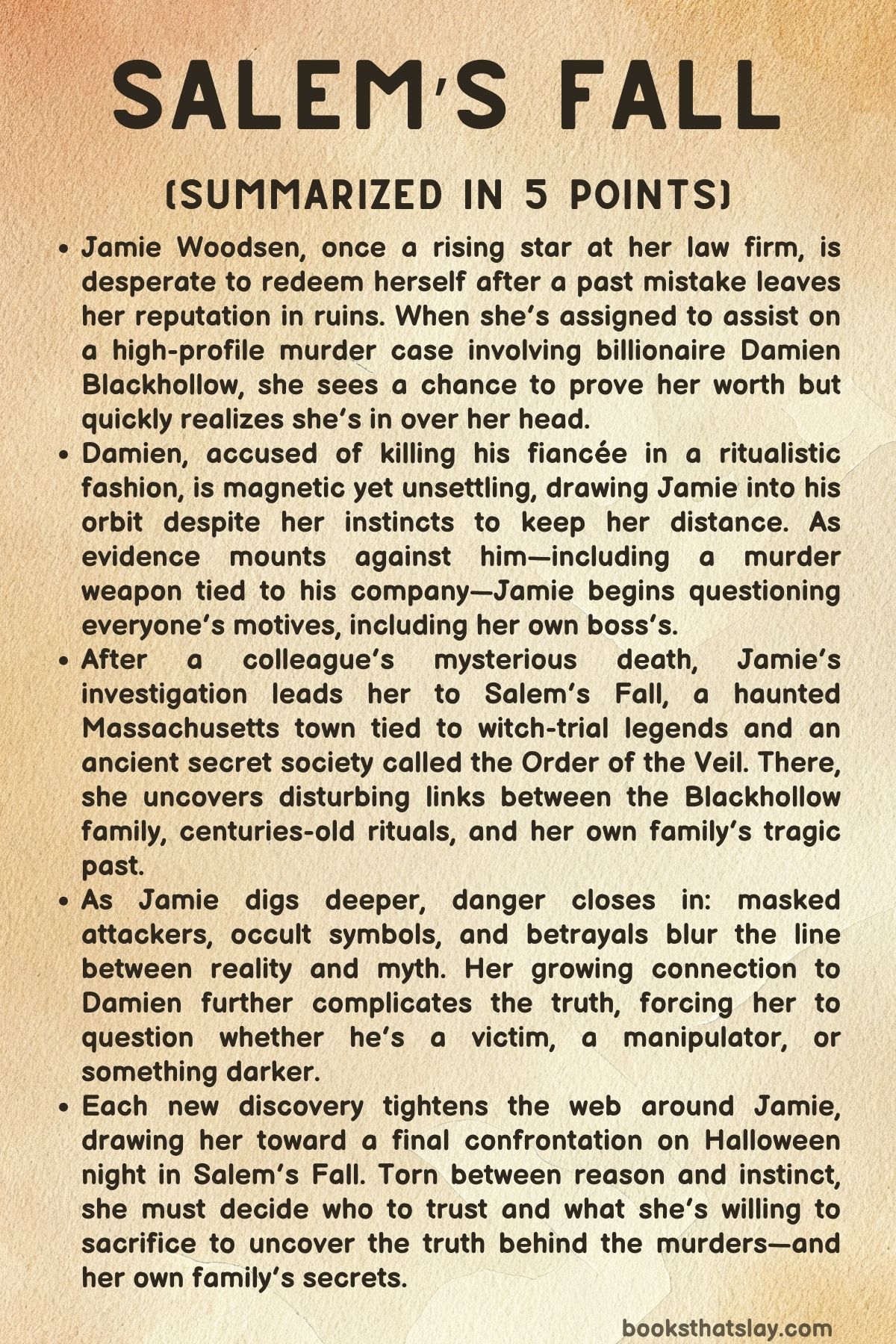
Summary
Jamie Woodsen, a young associate at a top Boston law firm, is working late into the night, trying to regain her reputation after a career-threatening mistake. Her relationship with her younger sister Madison is strained, and she carries the heavy burden of their family’s past: their father’s imprisonment for their mother’s murder.
Her quiet evening is disrupted when she is suddenly called in to help with a high-profile case—the Halloween Heiress Murder. Damien Blackhollow, the billionaire CEO of Blackhollow Industries, stands accused of brutally killing his fiancée, Vivienne Van Buren.
The murder scene is disturbing, filled with occult symbols that hint at ritualistic intent.
At the courthouse, Jamie meets Damien and her mentor Quinn Kensington. Damien’s cold charm unsettles her, and the prosecution paints him as both dangerous and untouchable.
Despite the mountain of circumstantial evidence—his fingerprints on the murder weapon and lack of a solid alibi—Jamie is drawn into defending him. Her colleague Mark Sharma belittles her, reviving memories of her past failure.
When Damien demands Jamie be kept on his defense team, she realizes she’s become personally involved in something far more complicated than a simple murder trial.
While combing through evidence, Jamie is assigned the task of retrieving security footage that could confirm Damien’s alibi. What seems like busywork quickly turns sinister when she discovers strange glitches on the tapes.
They show Damien’s limousine returning to the museum where Vivienne was last seen—after he claimed to have left. That same night, Mark is killed in a supposed hit-and-run accident.
Jamie receives a threatening message with photos of his body, warning her to stop investigating. Convinced the death is linked to the case, she sneaks into Mark’s office and uncovers his hidden research.
He had been studying symbols tied to a secret group called the Order of the Veil, a cult rumored to have roots in Salem’s witch trials.
Determined to follow the trail, Jamie travels to the town of Salem’s Fall, where she meets Professor Nicolas Hargrove, an expert on the Veil. He explains that the Blackhollow family was one of several powerful dynasties that once formed the secret society.
The Veil practiced forbidden rituals promising wealth and power through human sacrifice. Hargrove warns that the group still operates in the shadows, manipulating events through generations.
Damien’s family, he implies, is at the heart of it. The more Jamie learns, the more she sees parallels between these rituals and her own mother’s murder years earlier.
That night, she’s attacked by a masked figure bearing the Veil’s sigil, only to be rescued by Damien himself. He claims to have been following her to keep her safe, but his sudden appearance raises questions.
He warns her that unseen forces are working against them both. Despite his arrogance, there’s a growing tension—both professional and emotional—between them.
Quinn, meanwhile, grows increasingly protective of Jamie, blurring his own professional boundaries. When he arrives in Salem’s Fall to bring her home, she refuses to leave, convinced she’s close to uncovering the truth.
Back in the haunted town, Jamie learns from Hargrove that Damien and his estranged half-brother Lucien are rivals for control of the Veil. Lucien, rejected by their father, is obsessed with performing an ancient ceremony known as the Ascension Ritual.
The rite requires four annual sacrifices of loved ones, each murder granting greater power to the Veil. Damien’s fiancée Vivienne was the third victim—meaning the final one is imminent.
Jamie fears that either she or her sister could be next. When she sneaks into Damien’s room, she finds evidence of his connection to the cult, including a ceremonial knife.
Torn between trust and suspicion, she begins to believe that Damien might both love and endanger her.
Her investigation leads her to the discovery of a pattern of ritual killings tied to the Blackhollow family. Former nannies, girlfriends, and associates have all died under mysterious circumstances near Halloween.
Each time, the family’s fortune or influence rose dramatically. Her growing dread peaks when Hargrove’s behavior becomes erratic—his fascination with the Veil too intense to be purely academic.
She realizes too late that he may be involved himself. As Halloween, or Veil Night, approaches, Jamie’s sister Madison is kidnapped, forcing Jamie to return to the heart of Salem’s Fall one last time.
Desperate, Jamie contacts her imprisoned father, who cryptically warns her that the Veil’s ritual demands a willing sacrifice. With no help from the police, she goes alone to Strega’s Hollow, a historic site where the cult once held executions.
There, in an underground chamber lit by torches, she finds Lucien, Damien, and the Veil’s masked members. Madison is bound on the altar.
Lucien reveals that Madison was only bait—the real sacrifice must be Jamie herself. As the “Tether,” her bloodline is tied to completing the ritual begun decades ago with her mother’s death.
If she refuses to give herself, Madison will die in her place.
In a moment of courage, Jamie offers her life for her sister’s. But Damien defies Lucien, offering himself instead.
The ritual spirals into chaos. The elements themselves react—the chamber quakes, flames engulf the cultists, and Lucien completes the ceremony by killing one of his own followers.
In the ensuing inferno, Damien saves Jamie and Madison, guiding them through collapsing tunnels back to safety. Their survival, however, leaves the balance between light and darkness uncertain.
The cult’s power remains intact, and Lucien ascends to leadership, marking only the end of one chapter in the Veil’s reign.
Months later, Jamie has returned to Boston, trying to rebuild her life and career. She writes to the district attorney, providing evidence to clear Damien’s name while planning to reopen her father’s case.
Despite the horror of Salem’s Fall, she acknowledges that Damien is not the monster she once feared. He remains an enigma—part savior, part sinner—but one she cannot deny caring for.
When they reunite beneath winter lights, Damien reveals he has left the Veil, choosing love and redemption over legacy. He asks her to join him in forging a new path, free of blood and secrets.
Jamie accepts, embracing both forgiveness and uncertainty.
The book closes with a brief glimpse into a new story—set on a distant island, with fresh characters and familiar undercurrents of mystery—hinting that the world of Salem’s Fall is far from finished.
Characters
James “Jamie” Woodsen
James “Jamie” Woodsen stands at the center of Salems Fall, embodying ambition, guilt, and moral conflict. A former Harvard Law prodigy now struggling to reclaim her lost reputation, Jamie’s arc is defined by her relentless pursuit of truth—both in the courtroom and within herself.
Her early demotion at Whitehall & Rowe after an ethical lapse demonstrates her desperation to prove her worth in a male-dominated profession that undervalues her. Despite her insecurities, she remains fiercely protective of her sister Madison and morally anchored, even when tempted by the dark allure of Damien Blackhollow and the occult world surrounding him.
Jamie’s transformation from a self-doubting associate into a courageous investigator mirrors her deeper internal evolution: she learns to confront the sins of her past and her family’s entanglement with the Order of the Veil. Her intelligence, empathy, and resilience make her both flawed and heroic—a woman forced to balance law, loyalty, and the supernatural while rediscovering her own strength.
Damien Blackhollow
Damien Blackhollow is the enigmatic core around which the novel’s tension revolves. The billionaire CEO accused of murdering his fiancée, Damien is at once alluring and unsettling—a man cloaked in mystery, guilt, and power.
His charisma conceals deep wounds: a legacy of control under his father Ian Blackhollow, rivalry with his half-brother Lucien, and the burden of being heir to the dark society known as the Order of the Veil. Damien’s interactions with Jamie are layered with manipulation and sincerity, oscillating between protector and predator.
Yet beneath his commanding presence lies a man yearning for redemption and love, even as he is bound to a lineage steeped in blood rituals and corruption. His decision to sacrifice himself during the Veil Night climax transforms him from a symbol of darkness into a tragic antihero—one who chooses humanity over power.
Quinn Kensington
Quinn Kensington, Jamie’s mentor and the youngest partner at Whitehall & Rowe, personifies ambition tempered by genuine care. Polished, disciplined, and commanding, he plays the dual role of guide and moral anchor in Jamie’s chaotic journey.
His complicated relationship with her—part professional, part emotional—adds a layer of realism and restraint to the story. Quinn’s belief in Jamie’s potential contrasts with the cynicism of their colleagues, and his willingness to defy firm politics on her behalf reveals both integrity and vulnerability.
Yet, his control and emotional distance hint at unspoken feelings that remain unresolved even as the novel closes. Ultimately, Quinn represents the world Jamie might have had—a life rooted in reason and stability—serving as a foil to Damien’s intoxicating danger.
Madison “Maddie” Woodsen
Madison Woodsen is Jamie’s troubled younger sister and the emotional fulcrum of her choices. Reckless, impulsive, and vulnerable, Maddie mirrors the parts of Jamie that remain unhealed—the pain of abandonment, grief, and guilt.
Her dependency on Jamie’s protection and her descent into irresponsibility symbolize how trauma corrodes family bonds. Yet, Maddie’s eventual role as bait in the Veil’s ritual exposes her as more than a passive victim: she becomes a catalyst forcing Jamie to confront her deepest fears.
Maddie’s survival and transformation by the novel’s end signify renewal and the restoration of familial strength, even as the sisters remain haunted by the shadows of their past.
Lucien Blackhollow
Lucien Blackhollow is Damien’s half-brother and the embodiment of envy and decay within Salems Fall. Denied legitimacy by their father, Lucien’s bitterness festers into a ruthless hunger for power and vengeance.
He emerges as the true villain—not merely because of his cruelty, but because of his ideological devotion to the Veil’s dark rituals. Lucien’s charm masks psychopathy; he manipulates faith, bloodlines, and belief to justify murder.
Yet his final actions on Veil Night—allowing Jamie and Maddie to escape—reveal a fractured morality, suggesting that even monsters in Ross’s world are capable of ambiguity. Lucien’s dynamic with Damien provides the moral contrast that drives the story’s supernatural and familial themes: brotherhood corrupted by ambition and destiny.
Professor Nicolas Hargrove
Professor Nicolas Hargrove begins as an ally but unravels into one of the story’s most chilling figures. As an occult scholar, his initial fascination with the Veil’s history seems academic, yet it soon morphs into obsession.
He represents the danger of intellectual curiosity untempered by conscience—someone who crosses from studying evil to embracing it. Hargrove’s betrayal of Jamie’s trust and his death through the same dark forces he sought to master encapsulate the novel’s warning about knowledge without morality.
His duplicity deepens the atmosphere of paranoia that permeates Salems Fall, blurring the boundary between research and ritual, truth and corruption.
Thomas Woodsen
Thomas Woodsen, Jamie’s imprisoned father, is a tragic figure haunted by legacy and sin. Convicted for his wife’s murder, Thomas embodies the novel’s motif of inherited guilt.
His cryptic warnings and fragmented recollections of the Veil reveal that he, too, was ensnared by its rituals, though perhaps unwillingly. Through Thomas, the novel explores the corrosive power of secrecy and the generational cycles of violence that define both the Woodsen and Blackhollow families.
His ambiguous morality—part victim, part accomplice—casts a long shadow over Jamie’s quest, reminding her that the line between innocence and complicity is often blurred.
Vivienne Van Buren
Vivienne Van Buren, though dead before the story begins, exerts a ghostly influence throughout Salems Fall. The murdered fiancée of Damien Blackhollow, she symbolizes both sacrifice and silence—the beautiful victim whose death sets the narrative in motion.
As layers of the plot unravel, Vivienne’s role evolves from that of a tragic socialite to a piece in the Veil’s sacrificial puzzle. Her murder exposes the extent to which privilege and secrecy conceal horror, and her presence lingers as a haunting reminder of the price paid for power and ambition.
Mark Sharma
Mark Sharma serves as Jamie’s professional adversary and a mirror for her insecurities. Arrogant and condescending, he initially embodies the toxic competitiveness of elite law firms.
Yet his death transforms him into a martyr of truth, the one who stumbled too close to uncovering the Veil’s existence. His hidden research, later discovered by Jamie, reignites the investigation and propels her into the heart of Salem’s Fall.
Mark’s character underlines the recurring theme that arrogance and integrity can coexist—and that sometimes, those dismissed as enemies become unexpected allies in death.
Lucky the Cat
Though seemingly minor, Lucky symbolizes fate and intuition throughout the novel. As Jamie’s silent companion, the cat’s appearances often foreshadow danger or deliver comfort during her darkest hours.
In a story saturated with betrayal and illusion, Lucky’s constancy provides grounding humanity and emotional continuity. The cat’s reappearance at the end, after the inferno of Veil Night, signifies survival, protection, and perhaps a touch of the supernatural that remains with Jamie even after she leaves Salem’s Fall behind.
Themes
Power and Corruption
The story in Salems Fall portrays power as a force that both seduces and destroys, shaping the destinies of those who seek it and those caught in its orbit. The Blackhollow family epitomizes this relationship between power and moral decay—generations of wealth built upon blood rituals and manipulation.
Damien Blackhollow’s privilege allows him to move through the world untouchable, his charm and status shielding him even as suspicion of murder grows. Yet beneath that control lies the rot of his inheritance, a legacy of the Veil’s dark promises.
James “Jamie” Woodsen becomes the moral counterpoint to this corruption, confronting how power tempts her in more subtle ways: her desperation to restore her reputation, to control her sister, and to prove herself in a male-dominated law firm. As the narrative unfolds, both characters discover that true power lies not in dominance or wealth but in the capacity to choose sacrifice over selfishness.
The cult of the Veil mirrors the corrupting potential of unchecked ambition—what begins as a pursuit of influence becomes an enslavement to violence. Each ritual murder reflects how corruption perpetuates itself through generations, justified as “tradition” or “destiny.
” The novel’s world of elite lawyers and secret societies reveals that the corruption of the soul is often indistinguishable from professional success. By the end, Jamie’s rejection of the Veil and Damien’s renunciation of ascension redefine power not as control but as moral autonomy, suggesting redemption only comes when one refuses to exploit others to maintain authority.
Guilt, Redemption, and Moral Responsibility
The characters in Salems Fall live under the weight of guilt, both inherited and self-created. Jamie’s every decision is haunted by her past failure at the law firm and the unresolved trauma of her mother’s murder, which she secretly believes she could have prevented.
Her career misstep—the unethical use of unverified legal sources—becomes a metaphor for moral compromise, showing how even small betrayals can spiral into defining guilt. Damien’s guilt is more insidious: his entire identity is built on the deaths of others, even when he claims innocence.
The suspicion that he benefits from ritual murders makes him both victim and perpetrator of the Veil’s curse. Their shared burden of guilt forms an emotional connection that blurs professional and personal lines.
Redemption, however, is not granted easily. The novel presents it as a painful process of confronting one’s complicity in evil, whether active or passive.
Jamie’s willingness to sacrifice herself to save Maddie marks the culmination of her journey from self-protective ambition to moral courage. Damien’s decision to surrender his life instead of taking hers redeems him from generations of inherited sin.
Redemption here is not absolution—it does not erase the past—but it allows for the possibility of transformation. The story insists that morality is not static; every act of courage, every refusal to repeat inherited harm, becomes a form of redemption in a world that constantly demands compromise.
Family, Legacy, and the Weight of Inheritance
Family in Salems Fall is both a source of identity and a prison of expectation. Jamie’s life has been defined by her father’s alleged crime and her mother’s death, trapping her in a legacy of violence she barely understands.
Her devotion to Madison stems from guilt as much as love, a desperate attempt to rewrite the failures of her parents through protective control. The Blackhollow family represents the opposite extreme—heritage as domination.
Damien and Lucien embody the destructive consequences of being raised under a patriarch who valued lineage over love. Their rivalry is less about affection and more about who inherits the Veil’s power, showing how family bonds can become battlegrounds for control.
Across these parallel lineages, the novel examines how people either repeat or resist their inherited curses. Jamie’s investigation into the Veil exposes how generations of both her family and the Blackhollows are intertwined through ritualistic violence, suggesting that the sins of one generation bleed into the next.
Legacy becomes a haunting presence rather than a gift. The act of choosing love and moral clarity over bloodline expectations—Jamie’s refusal to participate in the sacrifice and Damien’s decision to abandon the Veil—breaks the cyclical burden of inheritance.
The story closes with the idea that family can only be redeemed through conscious defiance of its corrupt legacy, not through blind loyalty to its name or power.
Truth, Secrets, and the Nature of Justice
In Salems Fall, truth is portrayed as both liberation and danger. The legal world Jamie inhabits prizes evidence and logic, yet the deeper she searches for truth, the further she strays from institutional justice.
The case against Damien Blackhollow exposes the fragility of the system she once trusted—how evidence can be manipulated, how privilege can distort the meaning of guilt, and how power shields the corrupt. Her pursuit of the truth behind the Veil forces her to confront a terrifying realization: justice within the law and justice in reality are often incompatible.
Secrets dominate the novel’s atmosphere—hidden research, coded symbols, masked figures, and repressed family histories. Each secret uncovered unravels another layer of deception, but the cost of knowing is immense.
Knowledge becomes perilous; those who learn too much, like Mark or Hargrove, meet violent ends. The narrative suggests that truth itself can be weaponized, especially in a world where those in power control its dissemination.
Yet, despite this, Jamie refuses ignorance. Her insistence on unearthing the full truth—about her mother, the Veil, and Damien—transforms her from a passive participant in justice to an active agent of it.
The book questions whether truth can ever truly restore balance, but it affirms that confronting it is a moral imperative, even when it brings ruin instead of peace.
Love, Obsession, and the Duality of Desire
The romantic tension between Jamie and Damien in Salems Fall is not a simple subplot but a reflection of the story’s moral core. Their relationship exists in the shadow of death, guilt, and secrecy, embodying the dangerous allure of desire intertwined with fear.
Damien’s attraction to Jamie borders on obsession—his need to control and protect her mirrors the possessiveness of the Veil itself. His gifts, surveillance, and dominance blur affection into manipulation, raising questions about whether love can exist without autonomy.
Jamie, equally conflicted, finds in Damien both danger and understanding. He represents everything she has been taught to resist—power, temptation, moral ambiguity—but also the only person who recognizes her strength.
Their relationship dramatizes the struggle between surrender and resistance, between passion and ethical conviction. As the story progresses, love becomes a test of moral endurance rather than romantic fulfillment.
True affection, the novel argues, is not about possession but about sacrifice. When Damien offers his life to save Jamie and Maddie, love transcends obsession and becomes an act of redemption.
The final scene—where they choose to face the future together, free from the Veil—suggests that love can purify rather than consume when it is rooted in mutual choice instead of control. Through them, the book explores the fragility of intimacy in a world poisoned by deceit, proving that love can survive only when it is an act of courage rather than conquest.