Scorched Earth Summary, Characters and Themes | Danielle L. Jensen
Scorched Earth by Danielle L. Jensen continues her sweeping saga of gods, mortals, and empires at war.
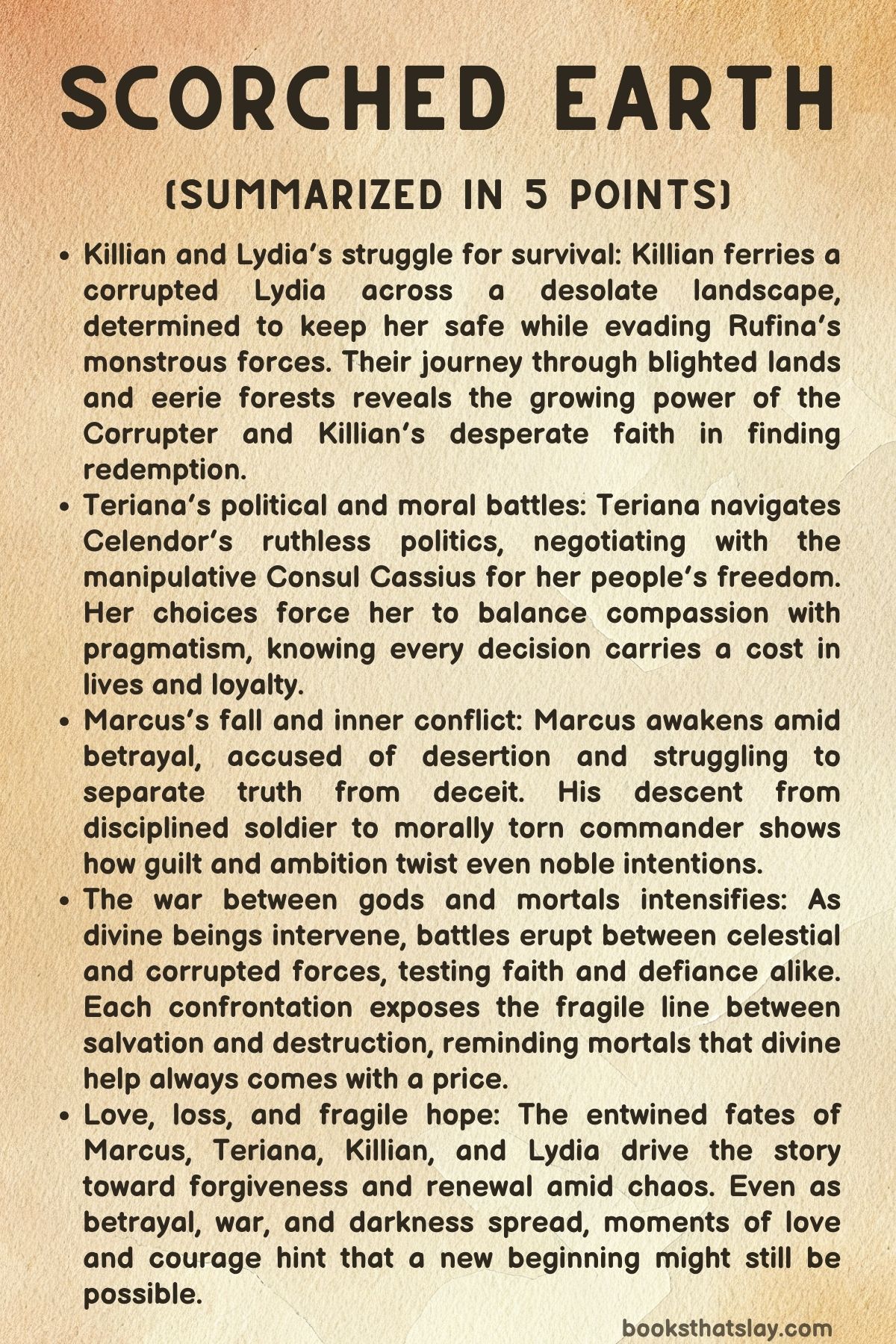
Set in a world torn apart by divine corruption and human ambition, the novel explores the intertwined fates of warriors, rulers, and lovers as they struggle against both inner darkness and political deceit. Jensen crafts a vivid, militarized fantasy where loyalty and betrayal walk hand in hand, and the boundaries between salvation and ruin blur with every choice. Through characters like Teriana, Marcus, Lydia, and Killian, the story examines faith, sacrifice, and the price of freedom in a land on the brink of collapse. It’s the 4th book in the Dark Shores series by the author.
Summary
As night falls, Killian rows across a vast, silent lake, desperately evading Rufina’s monstrous deimos patrols. Bound beside him lies Lydia, tormented by the Corrupter’s infection that makes her swing between deadly rage and chilling clarity.
Determined to keep her alive, Killian guides their small craft into a ghostly forest illuminated by glowing fungi. Though the strange creatures within leave them untouched, his mind churns with worry for their companions—Malahi, Agrippa, and Baird—and for the spreading blight that consumes the land.
When Lydia awakens, venomous and hateful, Killian’s resolve hardens; he will find safety, no matter the cost.
Elsewhere, Teriana seeks news of Marcus, who has vanished amid chaos. She confronts military leaders debating the perilous “rule of three” that limits consecutive xenthier jumps through magical gateways.
Too many jumps can destroy a person’s mind, but Marcus’s disappearance suggests he may have risked it. The council argues about his loyalty and whether he has turned traitor.
The Senate and its manipulative proconsul, Lucius Cassius, loom over every decision. When Cassius demands an audience, Teriana braces for a political negotiation that will decide not only Marcus’s fate but her people’s survival.
Marcus, meanwhile, awakens in a camp ruled by Titus, a nervous legatus fearful of retribution from Marcus’s legion. Suffering from head trauma and memory loss, Marcus hears whispers of betrayal—his men think he deserted.
A Gamdeshian advisor named Zaide attaches himself to Titus, hinting at political opportunity in Marcus’s fall. Amid mounting tension and alarms, Marcus drifts between guilt and confusion, uncertain who framed him or why the Empire turned against him.
Killian and Lydia eventually reach a remote cabin where Hegeria, one of the divine Six, awaits. Recognizing Lydia’s cursed mark, Hegeria offers healing but warns that the mark cannot be removed—only Lydia’s willpower can resist the Corrupter.
When Lydia’s control breaks, black smoke erupts from her, and the Corrupter’s storm descends. The Six gods appear to battle the dark force in a cataclysm of light and shadow.
Though victorious, they warn that the war between gods is far from over. Tremon returns Killian’s father’s sword and reminds him that mortal courage will decide what comes next.
Teriana visits Cassius at his villa to negotiate freedom for her people. She bargains with him, offering knowledge of xenthier routes in exchange for their release.
Cassius manipulates her ruthlessly, claiming Lydia drowned in the palace baths and dangling limited concessions. Devastated but resolute, Teriana secures the release of a hundred prisoners, including children, and is forced to agree to find viable xenthier routes within six months—or face executions.
Lydia awakens healed but haunted by the Corrupter’s whispers. She and Killian resolve to find Agrippa and Baird, believing them to have fled toward Anukastre.
Their journey deepens Lydia’s struggle between humanity and hunger. In Celendrial, political games escalate as Cassius tightens his grip.
Valerius reveals Lydia’s true identity as Kitaryia Falorn, heir to Mudamora’s legacy, making her survival a threat to the Empire’s plans.
Teriana fulfills her grim deal, descending into Celendrial’s hellish prison to choose the hundred lives she can save. Hostus, Cassius’s brutal legate, delights in tormenting her.
Forced to select prisoners by hand, she chooses the weak, the elderly, and the young—souls least likely to survive without her mercy. Though Hostus mocks her, Teriana swears vengeance and leads the freed captives to a Maarin ship, vowing she will save them all one day.
Austornic leads the Fifty-First Legion through xenthier gates toward Arinoquia, where they discover a massacre. The camp is littered with bloated corpses wearing the armor of fallen legions.
Among the dead they find Marcus’s ledger and a letter suggesting he was alive but wounded. Nic orders the burial of the fallen and marches to confront the Thirty-Seventh Legion, intent on uncovering the truth.
Lydia and Killian’s path crosses Rufina’s corrupted army, where they witness a horrific clash between the living and the dead. Mudamora’s queen, Malahi, uses living roots to shield her people.
Lydia’s battle against a corrupted foe forces her to draw upon forbidden power, nearly losing herself before Malahi restores her. Despite the chaos, fragile alliances form between those still loyal to life and the gods of light.
Back in the Thirty-Seventh, Marcus faces mutiny. Accused of desertion, he’s nearly killed by his own soldiers before Felix intervenes.
Through pain and guilt, Marcus recounts how Cassius and Titus manipulated events to destroy him. Though Felix distrusts him, he spares Marcus to investigate the truth.
War looms as power shifts rapidly across the fractured empire.
Marcus later dines with Proconsul Grypus, whose gluttony and arrogance epitomize the Empire’s corruption. Outraged by Grypus’s cruelty toward Gamdesh’s people, Marcus murders him in a calculated fit of rage, staging the death as an accident.
Felix warns that this act will only hasten conflict, but Marcus’s fury and paranoia consume him. Believing himself destined to bring peace through conquest, he embraces a darker purpose.
Teriana, unaware of Grypus’s death, plans her people’s liberation with Quintus. When Marcus confesses his crime and rekindles their love, hope briefly returns—until Bait reveals that Marcus murdered Lydia under Cassius’s orders.
Heartbroken, Teriana strikes him and escapes. When Bait reveals Lydia lives, Marcus’s guilt turns into cold obsession.
He begins plotting invasion routes through the newly revealed xenthier paths, setting in motion another war.
Teriana flees aboard the Quincense to warn her people. At sea, she learns from her aunt that Lydia survives as Queen Kitaryia.
Realizing Marcus now knows the path to Mudamora, she orders her ship toward the West to prepare for invasion. Marcus, meanwhile, consolidates his power, intimidating allies and demanding reinforcements to expand the Empire’s reach.
As darkness spreads, Lydia and Killian return to Mudamora, rallying allies while the blight poisons the land. Betrayal and fear spread through the courts as the Corrupter’s influence seeps deeper.
Even in death, its voice mocks the living, warning that corruption exists among them.
Marcus’s ambition culminates in Celendrial, where his army surrounds the city. Through psychological warfare and manipulation, he sparks revolt from within.
When the gates fall, he seizes power but rejects the title of ruler. In a climactic tribunal, Marcus confesses to his crimes—Lydia’s attempted murder, election fraud, and conspiracy—and orders his own execution to restore justice.
Teriana begs him to flee, but he refuses, believing the world must see justice done.
Before thousands, Marcus is hanged beside his father, brother, and Cassius. His final speech condemns both the Senate and the people for enabling tyranny, urging them to rebuild with honor.
Teriana’s cries echo as his body falls. Yet later, Lydia and Teriana learn Marcus survived—the execution staged with Felix’s help.
Stripped of command and name, Marcus renounces his past and reunites with Teriana aboard the Quincense. They vow to wander freely, helping where they can, while Lydia and Killian plan to care for the orphaned and rebuild what remains of their world.
As the ship sails beneath a silver moon, the survivors look toward a fragile dawn. The war between gods may not be over, but for now, the sea offers peace, and friendship endures amid the ruins of empire.
Characters
Marcus
Marcus is one of the most complex and conflicted characters in Scorched Earth. Once a disciplined soldier and strategic leader, his journey is marked by the corrosion of his ideals under the weight of imperial corruption, guilt, and divine manipulation.
From his initial portrayal as a loyal commander to his descent into moral ambiguity, Marcus’s arc reflects a man torn between his sense of justice and the monstrous instincts provoked by trauma and divine interference. His killing of Proconsul Grypus, though seemingly an act of righteous defiance, signifies his irreversible break from reason—a slide into paranoia and self-appointed martyrdom.
Yet, even in ruin, Marcus’s humanity persists; his love for Teriana and his remorse for Lydia’s supposed death reveal a conscience struggling against the shadow within. His final act—accepting execution to atone for his crimes—cements his transformation from soldier to savior.
Revived afterward, Marcus becomes emblematic of rebirth and moral clarity, relinquishing power to live as a man seeking redemption rather than conquest.
Teriana
Teriana serves as the emotional and ethical compass of Scorched Earth. Her unwavering loyalty to her people and her faith in the goddess Madoria set her apart from the cynicism surrounding her.
She embodies resilience, often forced to bargain with tyrants and navigate moral gray zones to save lives. Her relationship with Marcus adds depth to her character, contrasting love’s tenderness with the anguish of betrayal.
When she learns of Marcus’s supposed role in Lydia’s death, Teriana’s heartbreak transforms her from a diplomat of hope into a hardened leader resolved to act independently. Yet her ultimate forgiveness and renewed alliance with Marcus underscore her compassion and belief in redemption.
Through Teriana, the narrative explores faith not as blind devotion, but as an active struggle to reconcile divine purpose with human fallibility. Her journey concludes with quiet strength, steering the Quincense toward a future shaped by mercy and resolve rather than vengeance.
Lydia
Lydia, later revealed as Kitaryia Falorn of Mudamora, is a study in duality—between corruption and grace, power and restraint. Her possession by the Corrupter introduces the central moral battle of Scorched Earth: the conflict between free will and divine influence.
Lydia’s transformation from victim to warrior-healer mirrors the novel’s broader theme of redemption. Despite being tainted by darkness, she refuses to surrender her soul, choosing instead to wield her curse as a force for good.
Her dynamic with Killian reflects mutual salvation; he anchors her humanity while she provides purpose to his guilt-driven existence. As a healer and queen, Lydia becomes a living symbol of resilience—one who has suffered, sinned, and yet emerged compassionate and strong.
By the end, her calm resolve beside Teriana and Killian signifies not just survival, but transcendence—a hard-earned peace born from suffering.
Killian
Killian represents steadfast loyalty amidst chaos. His pragmatic courage and moral restraint distinguish him in a world of divine warfare and political deceit.
Burdened by the memory of Lydia’s corruption and his own helplessness, Killian’s journey is defined by endurance rather than conquest. His devotion to Lydia is quiet yet profound, rooted not in heroism but in steadfast humanity.
Where Marcus grapples with ambition and Teriana with faith, Killian embodies duty stripped to its core: the will to protect others even when hope seems lost. His interactions with the gods and his eventual receipt of his father’s sword mark his acceptance of destiny, not as a chosen savior but as a servant of balance.
In the closing scenes, his choice to nurture orphans alongside Lydia shows his evolution from soldier to guardian—a man who finds redemption not through war but through care.
Cassius
Consul Lucius Cassius personifies the cold, calculating side of imperial power in Scorched Earth. A master manipulator, he wields political leverage and psychological cruelty as effortlessly as others wield swords.
Cassius thrives on control, seeing morality as a tool rather than a truth. His treatment of Teriana and Marcus exposes his cynicism—he believes all virtue is self-serving, all loyalty transactional.
Yet beneath his composure lies fear: fear of losing power, of being remembered not as a statesman but a tyrant. His eventual capture and execution serve as poetic justice, but also as a grim reminder that the fall of a tyrant rarely dismantles the system that birthed him.
Cassius’s shadow lingers, shaping Marcus’s rebellion and haunting Teriana’s diplomacy long after his death.
Felix
Felix stands as the moral conscience within the legions, the friend and brother-in-arms who challenges Marcus’s descent into madness. Bound by loyalty yet guided by principle, Felix often acts as the quiet mediator between justice and compassion.
His decision to save Marcus’s life after the execution marks him as both pragmatic and merciful, willing to subvert empire and divine order alike to preserve humanity’s better nature. Felix’s faith in Marcus’s capacity for redemption becomes the moral hinge on which the story turns.
By the end, his guardianship of the Thirty-Seventh Legion reflects his understanding that true strength lies not in domination, but in restraint.
Hegeria and the Six
Hegeria and the Six—divine beings embodying aspects of balance and justice—serve as the metaphysical backbone of Scorched Earth. Hegeria, in particular, represents compassion tempered by divine wisdom, aiding Lydia not by absolving her sin but by restoring her choice.
The gods’ intervention in battles and their warnings of ongoing war underscore the cosmic scale of the conflict, reminding mortals that their struggles echo divine wars fought for the soul of creation. Yet their actions are not omnipotent; they, too, are bound by rules and morality, making their presence both reassuring and tragic.
The Six’s relationship with humanity blurs the line between faith and manipulation, suggesting that even divinity is fallible.
Rufina
Rufina, the Queen of Derin, emerges as one of the novel’s most chilling antagonists. Her alliance with the Corrupter and mastery over deimos mark her as both mortal ruler and vessel of darkness.
Unlike Cassius, whose evil is human and political, Rufina’s is cosmic and corrupted. She mirrors Lydia as a cautionary reflection of what complete surrender to power entails.
Her presence transforms every scene she inhabits into one of dread and decay—her armies of the dead a manifestation of her inner desolation. Through Rufina, Scorched Earth explores how the lust for control can strip away identity, leaving only the hunger to dominate.
Agrippa, Baird, and Malahi
Agrippa, Baird, and Malahi serve as vital supports within the ensemble, each embodying loyalty and sacrifice in distinct ways. Agrippa’s strategic mind and measured faith anchor the group’s survival against overwhelming odds.
Baird’s sorrow after Bercola’s death reveals the emotional toll of endless conflict, grounding the story’s larger-than-life battles in human grief. Malahi, as the last uncorrupted tender and queen of Mudamora, bridges the realms of mortal and divine.
Her nurturing strength and communion with nature contrast starkly with Rufina’s corruption, underscoring the thematic opposition between creation and decay. Together, these characters form the moral scaffolding of the narrative, their quiet heroism illuminating the novel’s darker currents.
Themes
Redemption and Moral Reckoning
Throughout Scorched Earth, the notion of redemption emerges as a guiding force driving the characters toward self-confrontation and renewal. Marcus’s journey embodies the torment of a man who has seen too much blood and deceit and finally turns inward to face the corruption festering within him.
Once a soldier defined by loyalty to empire and command, he becomes the instrument of moral judgment against his own kind. His murder of Grypus—committed under the guise of justice but driven by wrath—marks his moral descent, yet his later confession and acceptance of execution signify his ascent toward atonement.
In choosing to die publicly, Marcus transforms his guilt into a lesson for a nation drowning in its own sin. Similarly, Lydia’s struggle against the Corrupter’s mark personifies the battle between temptation and moral clarity.
Her constant fear of succumbing to darkness while striving to heal others underscores how redemption is not a single act but a continual resistance to corruption. Teriana, too, carries her share of guilt—her bargains with Cassius, her compromises, and her belief in Marcus’s purity—all culminating in a painful awakening that forgiveness must come through acceptance, not denial.
The novel thus portrays redemption not as absolution from wrongdoing but as the endurance to face one’s failures without self-deception. It suggests that moral reckoning requires not divine intervention but the courage to bear one’s consequences and still choose the good that remains possible.
Power, Corruption, and the Collapse of Empire
Power in Scorched Earth is depicted as a corrosive substance that erodes integrity, faith, and humanity. From the Senate’s manipulative politics to Cassius’s calculated cruelty and Grypus’s hedonistic tyranny, every level of authority is saturated with moral decay.
The Empire’s obsession with dominance over Gamdesh and Mudamora mirrors its internal collapse; it conquers outwardly even as it rots from within. Marcus’s transformation from a loyal legatus to a rebel leader reflects the tension between serving power and resisting it.
Once a tool of imperial ambition, he becomes its destroyer, exposing the futility of conquest without conscience. Cassius embodies political corruption at its purest—his manipulations reveal how governance becomes indistinguishable from exploitation.
Yet the tragedy lies not only in rulers but in those who serve them. The legions’ blind obedience, the citizens’ complicity, and the senators’ cowardice all contribute to the system’s decay.
Even the gods in this world are divided and flawed, their warfare mirroring human corruption. By the novel’s end, Marcus’s execution before the cheering crowd becomes a ritual of purification—a dying empire washing its hands in the blood of one man who dared to see its truth.
The collapse of the Empire, then, is not a spectacle of military defeat but a moral implosion where power devours itself and leaves only ruins behind.
Love and Betrayal
Love in Scorched Earth does not emerge as a soothing escape but as an ordeal through which the characters are remade. Marcus and Teriana’s relationship is marked by deep passion and even deeper betrayal.
When she learns he murdered Lydia under orders, her love shatters, and what remains is a hollow ache between duty and emotion. Their later reunion is not a return to innocence but a fragile reconciliation built on shared suffering.
Danielle L. Jensen portrays love as a testing ground for truth—one that demands honesty, humility, and forgiveness even when wounds still bleed.
Lydia and Killian’s bond operates on a quieter plane but carries the same essence. He becomes her tether to humanity when the Corrupter’s hunger tempts her toward ruin, while she forces him to confront his fear of loss and moral compromise.
Every relationship in the novel is shadowed by betrayal—between lovers, comrades, and nations—emphasizing that affection without trust is a burden rather than a comfort. Yet love, though battered, endures.
The final scene aboard the Quincense, where Teriana and Marcus find solace without grandeur, offers not the triumph of passion but its purification: love stripped of illusion, surviving because it chooses to.
The Conflict Between Faith and Free Will
Faith and free will form one of the most philosophical threads in Scorched Earth, shaping both human and divine actions. Teriana’s devotion to Madoria places her in constant tension with the world’s moral ambiguities.
Her belief that peace can be achieved through divine purpose repeatedly collides with the grim realities of human cruelty and political deceit. Lydia’s experience with the Corrupter’s mark dramatizes this conflict on a metaphysical level: she possesses immense power yet must constantly choose restraint.
The gods themselves, once seen as arbiters of destiny, are revealed to be embroiled in their own rivalries and errors, their interventions often as destructive as they are salvific. This instability transforms faith from a source of comfort into a crucible of doubt.
Marcus, though not pious, engages in a spiritual battle of his own, questioning whether his actions are guided by destiny or his own fractured conscience. His decision to face death willingly can be read as both surrender to a higher order and the ultimate assertion of free will.
In the end, the novel suggests that faith has meaning only when paired with choice; divine purpose without human courage leads to tyranny, while freedom without moral grounding leads to chaos.
War, Sacrifice, and the Cost of Peace
The world of Scorched Earth exists under the shadow of perpetual war—between empires, gods, and inner selves. The novel explores how war consumes not just bodies but beliefs, turning virtues like honor and loyalty into instruments of destruction.
Marcus’s legions, once symbols of order, devolve into agents of terror, their discipline twisted by political ambition. The recurring motif of the xenthier stems—gateways between worlds—acts as a metaphor for the ease with which violence spreads beyond borders and generations.
Each crossing exacts a toll, both physical and spiritual, echoing the broader cost of conquest. Teriana’s attempt to negotiate peace through diplomacy highlights the futility of seeking reason amid systemic brutality; her eventual disillusionment reveals that peace cannot be bought through compromise with evil.
Lydia’s confrontation with the Corrupter mirrors this theme in divine form: even salvation demands sacrifice. The deaths of Bercola, Ria, and countless nameless soldiers reinforce the novel’s bleak truth—that peace is never achieved by the victors but inherited by the survivors who must live with what war has made of them.
By concluding with Marcus and Teriana choosing a humble life of quiet service, the narrative proposes an alternative vision of peace—not as the end of conflict, but as the refusal to perpetuate it any longer.