Zomromcom Summary, Characters and Themes
Zomromcom by Olivia Dade is a witty, imaginative blend of romance and supernatural adventure set in a world overrun by zombies and haunted by the remnants of failed scientific ambition. The novel follows Edie, a brave yet ordinary woman whose life changes forever when she saves her neighbor—only to discover he’s a centuries-old vampire named Max.
As zombies rise again and governments collapse under secrecy and betrayal, the pair are drawn into a chaotic fight for survival. Amid danger and deception, their uneasy alliance deepens into trust, passion, and ultimately love, challenging the boundaries between human and monster, life and death. It’s the 1st book in the Supernatural Entanglements series by the author.
Summary
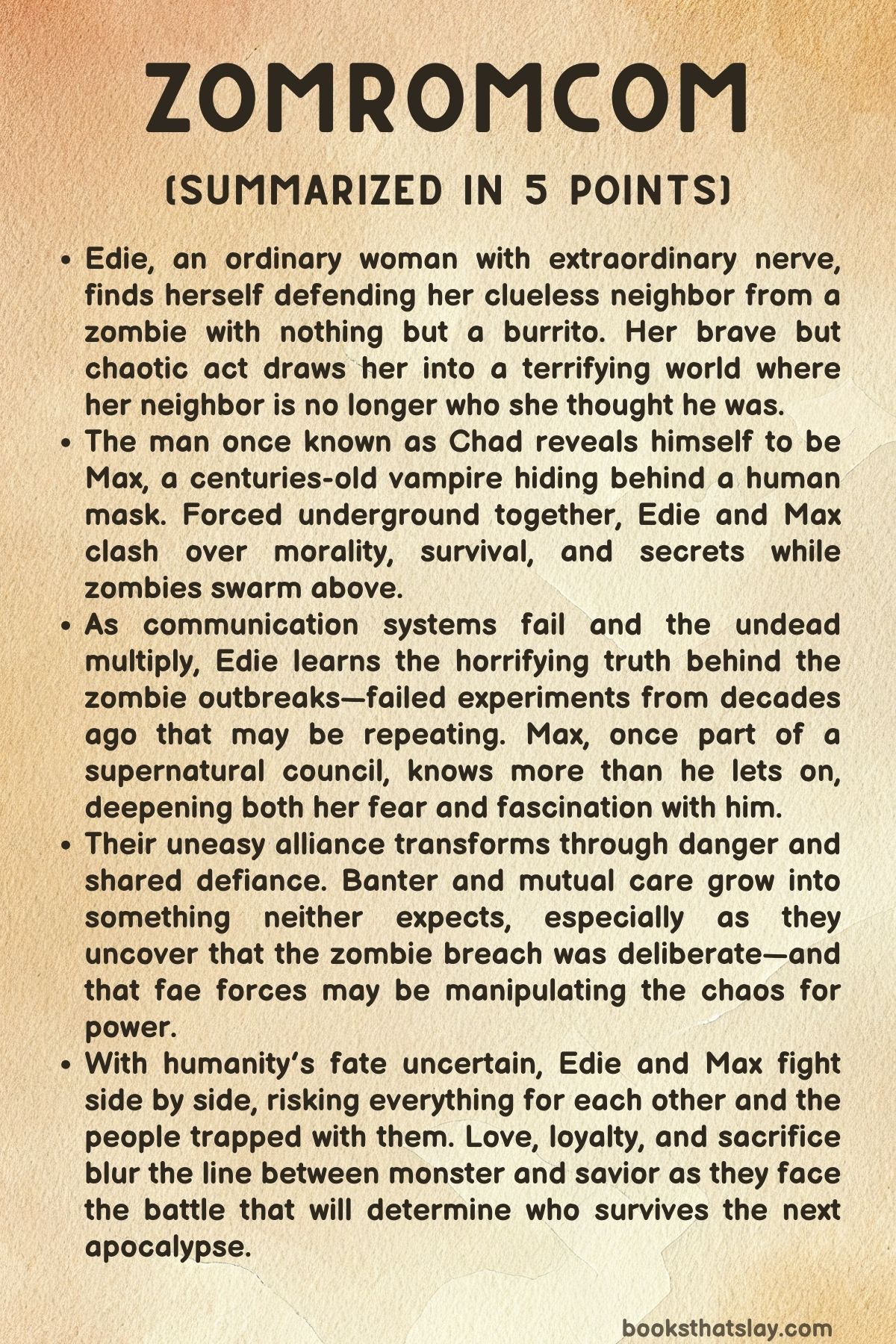
The story begins with Edie, an unassuming woman living in the Containment Zone, noticing her neighbor Chad in danger. A zombie lurches toward him while he listens to music, unaware of the threat.
With nothing but a burrito in hand, Edie rushes in to help. Her bravery buys Chad time—but what happens next shatters her understanding of reality.
Chad kills the zombie with terrifying speed and precision, revealing strength, confidence, and a dark aura completely unlike the bumbling neighbor she knew. His tone is sharp, his presence commanding, and his appearance altered.
When another zombie appears, he slays it effortlessly, showing he’s far from human.
Chad, now exposing his true identity, drags Edie to safety through a hidden trapdoor beneath his home. They descend into a massive underground compound—luxurious, secret, and disturbingly advanced.
As power flickers and communication lines fail, Edie realizes something catastrophic is happening outside. Government emergency lines go silent, and the city’s systems crumble.
Chad, whose real name remains hidden, monitors security cameras showing hordes of zombies overrunning the area. Even worse, he has been secretly surveilling Edie’s home.
Furious yet too shocked to act, Edie stays because the surface is no longer safe.
When she searches for food, she finds his refrigerator filled with blood bags. The truth clicks—Chad is a vampire.
His cold logic and disdain for human frailty infuriate her, yet he never harms her. Their uneasy truce deepens as they wait out the chaos.
He eventually confides that he’s lived for centuries and that the recent outbreak is eerily similar to one that occurred twenty years ago—a failed government experiment to engineer undead soldiers to hunt werewolves. That project triggered the “First Breach,” devastating both humans and Supernaturals.
Now, history is repeating itself.
As the danger intensifies, their conversations grow more personal. Chad, whose real name is Max, admits he once worked with the Supernatural and Enhanced Ruling Council (SERC), the body that enforced peace after the first zombie war.
His disillusionment and withdrawal from the world stem from betrayal and corruption he witnessed firsthand. Edie’s warmth and humanity challenge his isolation.
Their banter—equal parts tension and humor—turns into a tentative bond built on reluctant respect.
Max reveals classified zombie data to Edie, helping her understand how dire their situation is. Zombies don’t decay, heal almost instantly, and can infect others in minutes.
Edie insists they warn the authorities, but Max doubts anyone outside will respond. Still, she refuses to remain passive.
Despite his warnings, she prepares to leave the compound to help others, showing the compassion that defines her character. Max, irritated but secretly protective, insists on going with her.
Together they venture above ground. The world outside is silent, desolate, and swarming with undead.
After several attacks, Max’s combat prowess saves them both. They gather supplies from Edie’s house, where Max admires her soapmaking business—a rare moment of softness between them.
Their teasing reveals chemistry beneath the fear. As they drive through the deserted city, Edie uncovers his secret identity as the creator behind a famous fashion channel—his disguise to blend into human society.
Their laughter fades when they reach the zone’s drawbridge and find it open. The containment barrier has been sabotaged.
Zombies surround them before they can retreat. Trapped on the bridge, they make a desperate escape plan—jumping into the moat below.
Edie dives into the freezing water, slashing at undead bodies as they sink and drown. When she surfaces, Max is gone.
Believing him lost, she pushes onward alone.
But Max survives, and together they later investigate the breach. They discover evidence that the fae, not demons or humans, orchestrated the catastrophe.
By disguising their involvement, they intend to let zombies annihilate other species before claiming dominance. Realizing the world is on the brink of supernatural war, Edie and Max vow to stop the outbreak before it spreads beyond the walls.
During one of their missions, a zombie attacks, gravely injuring Max. Edie rescues him, caring for him through his recovery in scenes that blur fear and intimacy.
Her tenderness contrasts his centuries of detachment, and he begins to see her as his equal rather than a fragile human. When he heals, they confess their mutual fear of loss, and their relationship turns physical—uniting vampire and human in both body and spirit.
As the crisis deepens, they join a resistance group led by the witch Sabrina, her telepathic wife, and other survivors. Max’s history with SERC and his past lover Jacquette—whose death still haunts him—explain why Sabrina mistrusts him.
Yet Edie’s presence bridges the divide. Together, the group devises a plan to trap and destroy the zombie horde.
They use fire, traps, and fae-enhanced strategies, working in coordinated waves to lure and destroy the undead before they reach the city walls.
The battle is brutal. Zombies fall into pits, are beheaded, burned, or restrained by magical vines, yet the endless waves keep coming.
When victory finally seems possible, a stray zombie attacks Max from behind. Edie kills it—but not before being bitten.
The infection spreads rapidly. Despite magical healing, the curse lingers.
Max refuses to let her die. In a desperate act of love, he offers his immortality in exchange for her life.
The spell works: Edie is cured, and Max becomes mortal, trading eternity for her heartbeat.
When the fighting ends, Max and Edie emerge alive but changed. Their enemies remain hidden, the fae threat looming larger than ever.
Yet amid exhaustion and ruin, they find peace in each other. Edie decides to leave behind her parents’ home and memories of endless survival.
Max agrees to follow her, teasing her even as he hides the depth of his devotion. The story closes with the pair planning a new life beyond the Containment Zone—together, human and former vampire, facing whatever apocalypse comes next with courage, humor, and love.
Zomromcom is both a darkly funny supernatural adventure and a tender exploration of connection under impossible circumstances. Through Edie and Max’s unlikely bond, it reimagines survival not just as staying alive, but as daring to love in a dying world.
Characters
Edie
Edie is the emotional core of Zomromcom, a woman whose courage, empathy, and dark humor define her survival and relationships throughout the story. From the opening scene, her decision to confront a zombie armed only with a burrito captures her blend of fearlessness and absurdity—a heroine both brave and disarmingly human.
Edie’s compassion repeatedly drives her choices, even when logic dictates retreat. Her willingness to risk herself for others contrasts sharply with Max’s pragmatic detachment, positioning her as a moral anchor in a world unraveling under supernatural chaos.
Beyond courage, Edie embodies resilience shaped by loss. The First Breach cost her parents, yet she chooses to remain in their home, turning grief into action through her soapmaking business—a symbol of creation amid destruction.
Her humor, even under duress, becomes both armor and bridge, allowing connection with Max despite his monstrous nature. Over time, she evolves from a reactive survivor to a strategic leader, coordinating defenses, reading patterns of attack, and rallying allies.
Her transformation culminates in self-sacrifice, where she risks and nearly loses her humanity to save others. Yet the story affirms that love and willpower—her defining traits—restore both her life and the fragile hope of coexistence in a fractured world.
Max (Chad / Gaston Maxime)
Max begins as an enigma: the lazy, beer-drinking neighbor “Chad” who hides a centuries-old vampire beneath the guise of suburban mediocrity. His duality—mask and monster, cynic and savior—drives much of Zomromcom’s tension.
Initially aloof, sarcastic, and disdainful of human frailty, Max conceals deep guilt and weariness from centuries of survival. His transformation from self-imposed exile to reluctant protector parallels Edie’s journey from ordinary human to warrior.
Beneath his arrogance lies a man burdened by past losses, particularly Jacquette, whose death left him wary of love and connection.
Max’s complexity is revealed through contrasts: his brutal efficiency in combat juxtaposed with tenderness toward Edie; his cynical philosophy of “life means nothing” undermined by constant acts of rescue. His immortality isolates him, yet Edie reawakens his capacity for vulnerability.
His evolution culminates in sacrifice—abandoning eternal life to save her—turning his cold detachment into profound devotion. By the novel’s end, Max is no longer defined by what he hides but by what he gives up, transforming from predator to partner, embodying the romantic paradox at the heart of the book: that love, not power, is the truest form of immortality.
Sabrina
Sabrina, the witch and long-time ally of Max, embodies wary pragmatism and moral complexity. As one of the most powerful witches in the Containment Zone, she is simultaneously protector, strategist, and skeptic.
Her mistrust of Max stems not only from his vampire nature but also from his dark history—rumors of past lovers’ deaths and his ambiguous role before SERC’s rise. Yet despite her suspicions, she remains committed to collective survival, illustrating the fragile alliances between Supernatural species.
Sabrina’s strength lies in her ability to balance empathy with ruthlessness. She orchestrates the group’s defense with precision, showing both tactical intelligence and emotional restraint.
Her interactions with Edie reveal mutual respect: two women navigating power in worlds that underestimate them. Through Sabrina, the novel explores the moral tension of leadership during apocalypse—what must be sacrificed for survival, and how trust can coexist with fear.
Gwen
Gwen, the oracle, operates on the boundary between insight and burden. Her prophetic visions are both gift and curse, leaving her emotionally and physically drained.
Initially serving as a supporting figure, she becomes a crucial link between the supernatural and human worlds, interpreting omens that others cannot. Gwen’s moral compass mirrors Edie’s compassion but with an added weight of foresight—she knows too much, yet remains powerless to prevent all suffering.
Her climactic vision of impending war between fae, humans, and Supernaturals expands the narrative’s scope beyond local survival to global catastrophe. Gwen represents knowledge’s double edge: understanding may save lives, but it also isolates the seer.
Her quiet strength, despite exhaustion and trauma, offers a counterpoint to Max’s stoic endurance and Edie’s kinetic bravery.
Jacquette
Though absent from the present timeline, Jacquette’s shadow defines much of Max’s emotional arc. Her death centuries earlier becomes the wound that shapes his distrust and detachment.
Through his recollections, Jacquette emerges not as a mere tragic lover but as a symbol of moral consequence—how love and death intertwine in the life of a creature who cannot die. Her presence haunts Max’s every decision, influencing his initial resistance to Edie and his fear of repeating history.
When he finally reveals Jacquette’s fate, the confession serves as both penance and closure, freeing him to love again.
Kip and Lorraine
Kip and Lorraine, the troll couple, bring earthy humor and steadfast loyalty to the group dynamic. Their physical strength complements Edie’s courage and Max’s intellect, grounding the supernatural coalition in a sense of found family.
Despite their rough exteriors and sardonic banter, their devotion to each other exemplifies one of the novel’s recurring themes: that love and partnership endure even in monstrous forms. They act as moral and emotional ballast, proof that affection can survive apocalypse without irony or self-destruction.
Riley
Riley and her group, the Girl Explorers, symbolize the new generation’s adaptability and courage. Blending youthful optimism with lethal efficiency, they embody the story’s balance of horror and hope.
Their inventive tactics—firebreaks, razor wires, coordinated attacks—demonstrate the practical heroism born from necessity. Riley’s leadership and the girls’ unity challenge stereotypes of helpless survivors; they are instead architects of their own salvation.
Through them, Zomromcom reframes apocalypse as a proving ground for community rather than despair.
Themes
Humanity and Morality Amid the Supernatural
Throughout Zomromcom, Olivia Dade constructs a sharp moral tension between survival and compassion, using the chaos of zombies and vampires to question what truly defines being human. Edie’s instinct to save others—even when she is armed only with a burrito—contrasts powerfully with Max’s detached pragmatism and self-preserving philosophy.
Her compassion challenges the logic of a world fractured by fear, bureaucracy, and betrayal. Dade situates humanity not in species but in the capacity for empathy and choice.
Max, a vampire who insists that survival outweighs sentiment, gradually unravels this belief as Edie’s actions force him to confront the remnants of his own conscience. In doing so, he reveals that moral worth is not tied to being human but to the willingness to act selflessly in a world designed for self-interest.
The novel’s moral core lies in the friction between Edie’s boundless empathy and Max’s ancient cynicism. Her resistance to moral decay becomes an act of rebellion against a society that has normalized inhumanity.
Even in the face of monstrous creatures and government corruption, she insists on ethical responsibility. Max’s eventual decision to sacrifice his immortality for her completes this transformation—from self-serving creature to a being capable of true moral love.
In essence, Zomromcom uses its supernatural lens not to estrange readers from human emotion but to magnify it, asking whether compassion can endure when the world itself has become monstrous.
Love and Connection Beyond Mortality
The relationship between Edie and Max evolves as an unlikely romance between predator and protector, rooted not in physical attraction alone but in mutual recognition of loneliness. Their bond challenges traditional boundaries between human and supernatural, suggesting that love itself can be an act of defiance against fear and history.
Max’s initial indifference—his constant reminder that her life “means nothing” to him—is slowly eroded by the persistence of Edie’s warmth. Their growing affection is a reclamation of intimacy in a world stripped of trust.
Dade frames love as both salvation and vulnerability. For Max, love dismantles the armor of centuries; for Edie, it becomes an anchor that steadies her amidst chaos.
When Max sacrifices his immortality to save her, it is not framed as a tragic forfeiture but as the natural culmination of their emotional journey. He does not lose his essence but reclaims his humanity.
Through this act, the novel asserts that connection has the power to transcend mortality and rewrite the rules of existence. Love is not presented as naïve or sentimental—it is raw, earned, and deeply human, capable of restoring faith where logic and survivalism fail.
Power, Control, and Deception
Zomromcom is steeped in the politics of secrecy and manipulation, where every institution—from the SERC to the fae factions—operates through deception. The zombie outbreak, once a failed military experiment, becomes a metaphor for human hubris and the moral collapse that follows when power is placed above responsibility.
Dade’s world thrives on half-truths: vampires cloud memories, governments distort reality, and even Max hides his true identity behind a facade of mediocrity.
This theme underscores how control is maintained not by strength but by knowledge and its suppression. The revelation that the fae engineered the new breach demonstrates how truth is weaponized for political gain.
The manipulation of information becomes more dangerous than the undead themselves, because it breeds apathy and ignorance among the living. Dade uses Edie as the antithesis to this machinery—her insistence on transparency and justice directly threatens the architecture of control.
The novel thus critiques how institutions exploit crises for power, portraying deception as both a tool of domination and a moral rot that corrodes even the supernatural elite.
Identity and the Masks We Wear
From the opening chapters, Zomromcom exposes the fragility of identity through disguise and performance. Max’s persona as “Chad,” the harmless neighbor in a beer-stained hoodie, contrasts violently with his true self—an immortal being burdened by history and guilt.
His masquerade protects him from discovery but also isolates him from genuine connection. Similarly, Edie’s outward normalcy hides a survivor’s resilience, a woman living with trauma from past breaches yet refusing to retreat into numbness.
The novel suggests that identity, whether human or supernatural, is fluid and performative. Masks are not simply lies but survival mechanisms in a world where exposure means vulnerability.
Yet, Dade also shows that authenticity carries transformative power. When Max reveals his true self, the shift is not merely physical but emotional—his honesty becomes an act of intimacy.
Edie’s acceptance of his dual nature reflects her rejection of the rigid binaries that define their world: human versus monster, victim versus savior. By dismantling these false divisions, Zomromcom proposes that identity is not what one hides behind, but what one chooses to reveal despite fear.
Sacrifice and Redemption
The climactic act of Max surrendering his immortality encapsulates Dade’s exploration of redemption. His existence, shaped by centuries of detachment and guilt over past failures, finds meaning not through domination but through loss.
This transformation reframes immortality not as a gift but as a burden—a perpetual witness to decay. When he gives it up for Edie, his action reverses his earlier creed that survival is paramount.
It becomes an affirmation that life gains value through what one is willing to risk for others.
Edie’s own sacrifices mirror his: her repeated decisions to protect strangers, her acceptance of danger, and her readiness to die for the world’s safety underscore a form of moral heroism often denied to ordinary humans in supernatural fiction. Through her, Dade elevates sacrifice from martyrdom to empowerment—it is the refusal to let cynicism dictate action.
Together, Edie and Max rewrite the concept of redemption: it is not found in divine forgiveness or heroic victory but in the choice to act selflessly despite inevitable loss. Their union at the end—mortal yet bound by mutual salvation—embodies the novel’s central truth that love and redemption are inseparable, each giving the other meaning.