A Land So Wide Summary, Characters and Themes
A Land So Wide by Erin A. Craig is a hauntingly imaginative tale that merges myth, isolation, and survival into a story of love and legacy.
Set in the remote town of Mistaken—hemmed in by mysterious Warding Stones and ancient forces—the novel follows Greer Mackenzie, a woman caught between duty and freedom, history and destiny. When monstrous creatures known as the Bright-Eyed threaten to destroy her world, Greer embarks on a perilous journey beyond the town’s borders to save those she loves. What begins as a search for truth becomes a reckoning with power, sacrifice, and the monstrous depths within humanity itself.
Summary
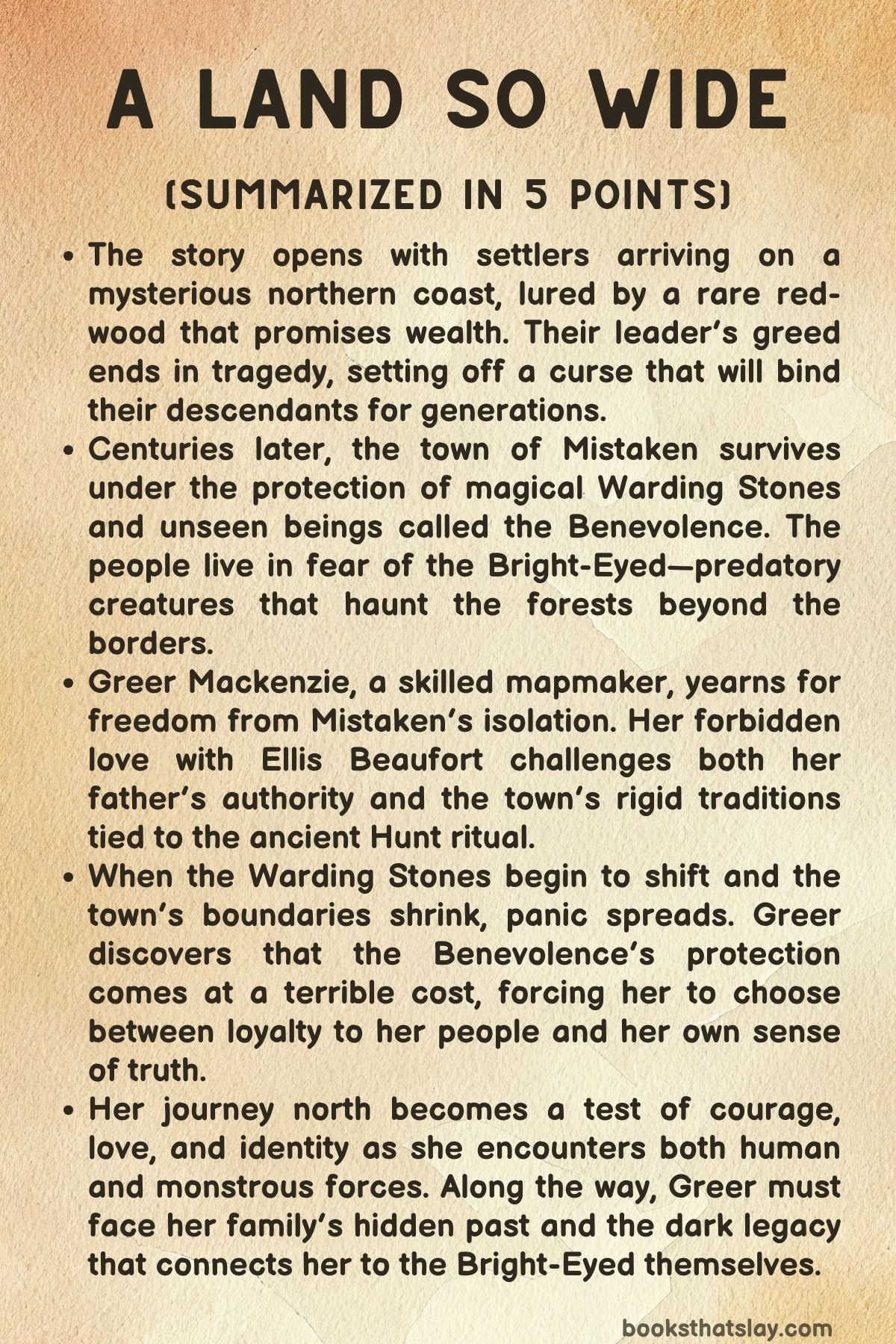
The story begins with a doomed expedition led by Resolution Beaufort, a man obsessed with harvesting a strange red-sapped wood from a distant land. His greed drives him and his followers across the sea to an uncharted coastline.
There, a storm wrecks their ship, and Beaufort dies impaled by a branch of the very tree he sought to exploit, his last words warning that coming to this land was a mistake. His death sets the stage for generations of mystery and tragedy in the settlement that follows—Mistaken.
Years later, Greer Mackenzie and her friend Louise Beaufort, descendants of the original settlers, work as mappers and hunters on the outskirts of Mistaken. The town is surrounded by dark forests filled with the scarlet-barked trees known as Redcaps and is protected—or imprisoned—by ancient black monoliths called Warding Stones.
These stones are believed to guard the town from supernatural creatures called the Bright-Eyed, who dwell beyond the forest. When Greer ventures outside the safe boundary to leave an offering for the Benevolence—mysterious beings credited with their protection—she encounters something unnatural: enormous two-toed footprints and a whispering voice that calls her “little Starling.
” This eerie meeting foreshadows the unraveling of Mistaken’s fragile peace.
Back in town, Greer faces the weight of local customs and her father Hessel’s strict authority. The people of Mistaken live by rituals meant to appease unseen powers, including the Hunt—a ceremony where young women hide and men pursue them as a courtship tradition.
Greer and her beloved, Ellis Beaufort, hope to marry after the coming Hunt, but Hessel forbids their union, revealing long-standing resentment toward the Beauforts. Despite this, Greer and Ellis secretly meet at a barn celebration, sharing a quiet dream of escaping Mistaken’s confinement.
Their joy is shattered when an inhuman scream splits the night.
Following the cry, townsfolk discover the Calloway family slaughtered, their bodies mangled, and the ground torn apart. Greer, gifted with a supernatural sense of hearing, realizes the Warding Stones themselves have shifted—a phenomenon that should be impossible.
The town’s borders have literally moved inward, shrinking Mistaken’s territory. Fear sweeps through the community as they understand that the old protections are failing.
The Stewards, Mistaken’s ruling council led by Hessel, interpret this as punishment from the Benevolence and rush to appease them by advancing the Reaping Festival, a sacred day of tribute. Though uneasy, the people obey, praying their sacrifices will restore balance.
Amidst the preparations, Greer grows skeptical of the Benevolence’s true nature. Her conversations with Martha Kingston, a survivor from another fallen town, reveal that divine protection can turn to vengeance when faith falters.
The Reaping Festival arrives under dark skies. Offerings of livestock and food fill the square, and each family performs their rites.
But instead of reassurance, the ceremony brings terror: earthquakes shake the ground, and more Stones shift violently. Mistaken begins to collapse in on itself, and several townspeople vanish near the borders, pulled into the forest by unseen forces.
The ancient agreement that sustained them is breaking.
Ellis, determined to protect Greer, volunteers himself as an offering to the Benevolence, disappearing into the northern wilderness. Refusing to lose him, Greer follows despite her father’s protests.
Along the journey, she discovers she possesses a dangerous gift—an ability to release a scream of immense power capable of repelling or killing enemies. The power frightens her, suggesting a hidden heritage linked to her late mother, Ailie, whose bloodline may not have been entirely human.
As Greer tracks Ellis through snow and forest, she encounters traces of monstrous life: mutilated bodies, giant tracks, and spectral voices. Her journey leads her to a mysterious stranger named Noah Finn, who rescues her after she nearly freezes to death.
Finn is kind but unsettlingly inhuman—his eyes gleam like an animal’s, and he knows too much about her. When he vanishes one night and returns in a monstrous form, Greer realizes the truth: Finn is a Bright-Eyed.
Unlike the savage legends told in Mistaken, he speaks rationally and claims his kind once coexisted with humans before the settlers’ greed and fear fractured the balance. Finn admits he has followed her since her offering in the forest, drawn to her power and bloodline.
Despite fear and distrust, Greer accepts Finn’s help to reach the Sandry Mining Camp, where Ellis is held by the Bright-Eyed queen, Elowen. Along the way, Finn teaches her survival, hinting that she may share their nature.
When they finally find the camp, Greer sees that the Bright-Eyed are not mindless beasts but an organized society ruled by Elowen’s cruelty. Ellis is tortured to bait Greer into appearing.
During the confrontation, Ellis strikes Elowen with an iron knife, triggering a chaotic battle. Finn and Greer fight side by side, killing several Bright-Eyed before being overwhelmed.
Ellis is carried to safety, but Greer is trapped underground with Elowen’s forces.
In desperation, Greer dons her mother’s enchanted cloak—Ailie’s “skin”—which Hessel had hidden from her. The cloak fuses with her body, awakening immense power and transforming her into something neither human nor Bright-Eyed.
She tears through the lair, battling monstrous wolves and Elowen’s magic, but the cost is great: each use of power consumes more of her humanity. Elowen captures and tortures her, draining her blood to steal her strength.
At the brink of death, Greer hears Ellis’s distant voice and rekindles her will to fight. Using the iron-rich rocks in the cavern, she burns her captors, and Finn reappears to free her.
Together they flee through tunnels filled with Bright-Eyed reinforcements. When they reach a rope bridge spanning a vast chasm, they are ambushed.
Finn sacrifices himself to save Greer, killed by Elowen before she can act. Enraged, Greer unleashes her final scream—an earth-shattering cry that collapses the mountain, burying the Bright-Eyed and their queen beneath iron and stone.
The explosion annihilates the monsters but spares Greer. When she awakens outside the ruins, Ellis finds her alive, though transformed.
She confesses that the Bright-Eyed are gone and that she is now the last of their kind. Ellis accepts her still, and together they return to Mistaken.
In the aftermath, the survivors destroy the Warding Stones, ending the centuries of confinement. With the Bright-Eyed extinct and the Benevolence silenced, the people rebuild and prepare to journey into the wider world.
Greer, knowing her blood still carries the curse, vows it will die with her. As the settlers’ ships sail toward the horizon, a single Bright-Eyed figure—Greer—rises into the morning sky, wings spread wide, vanishing into the endless expanse above.
A Land So Wide closes not with despair but with freedom hard-won, as both the land and its last daughter are finally released from their long captivity.
Characters
Greer Mackenzie
Greer Mackenzie stands at the heart of A Land So Wide, embodying courage, grief, and transformation. From the moment she appears, Greer is portrayed as a woman bound by love and responsibility yet yearning for freedom beyond the constricting Warding Stones of Mistaken.
Her connection to the supernatural is evident through her heightened hearing and the mysterious way the Benevolence acknowledge her existence, calling her “Starling. ” These gifts isolate her from the townspeople but also foreshadow her destiny as the bridge between humanity and the Bright-Eyed.
Throughout the story, Greer evolves from a curious and cautious mapmaker into a fierce, self-determined warrior. Her journey to rescue Ellis becomes a metaphysical passage through fear, loss, and self-realization.
The inheritance of her mother Ailie’s cloak transforms her physically and spiritually, forcing her to reconcile the human tenderness of love with the monstrous instincts of the Bright-Eyed. Ultimately, Greer’s acceptance of both sides of her nature becomes her salvation and the world’s deliverance.
She sacrifices her humanity to end the curse but transcends mortality as a symbol of liberation—a creature of both dark and light, love and destruction.
Ellis Beaufort
Ellis Beaufort, Greer’s steadfast lover, represents moral strength and devotion amid chaos. As the descendant of Resolution Beaufort, the cursed founder of Mistaken, Ellis bears the burden of ancestral guilt.
Despite this legacy, he stands apart from his forebears in compassion and courage. His love for Greer anchors him, driving many of his decisions, including his self-sacrificial choice to offer himself to the Benevolence.
This act is not of cowardice but of integrity—an attempt to protect his people at any cost. Ellis’s intelligence, gentleness, and deep faith in Greer contrast with the brutish pragmatism of others like Hessel or Lachlan.
Even in captivity, Ellis resists submission, his defiance inspiring rebellion among monsters and men alike. In the end, he becomes the emotional core that grounds Greer’s humanity, reminding her of who she is beyond magic and vengeance.
His reunion with her at dawn signifies not only love’s endurance but also the reconciliation between human endurance and supernatural consequence.
Hessel Mackenzie
Hessel Mackenzie embodies the generational cycle of pride, love, and bitterness that defines Mistaken. Once a young man betrayed in love, his early heartbreak with Mary McIntyre and the deceit surrounding the Hunt shape him into the controlling patriarch he becomes.
As Greer’s father and the Steward of Mistaken, Hessel values order and tradition, clinging to the rituals that keep the town imprisoned in superstition. Yet beneath his rigidity lies a man haunted by guilt and grief—grief for his lost wife Ailie, whose power he both revered and feared, and guilt for his failures as a father.
His attempts to control Greer’s choices, particularly regarding Ellis, stem from fear of loss, not malice. When he bargains with Finn, offering the hidden cloak for survival, his desperation exposes a tragic vulnerability.
His death at the hands of Elowen becomes the symbolic end of old authority—a man destroyed by the very forces he sought to master. Through Hessel, the novel explores the futility of human control against the vastness of the unknown.
Finn
Finn is the most enigmatic figure in A Land So Wide, a Bright-Eyed creature torn between his monstrous nature and his lingering humanity. His dual existence as both savior and predator encapsulates the book’s central conflict between instinct and empathy.
When he rescues Greer, he blurs the line between captor and companion, protector and tempter. His warmth and mystery draw Greer toward him even as his glowing eyes remind her of danger.
Finn’s fascination with her stems not merely from attraction but recognition—she is the heir to Ailie’s power, the one who could change his doomed species. Through him, the reader glimpses the Bright-Eyed as more than monsters; they are remnants of a fallen world, hungry yet haunted.
Finn’s death—his throat torn by Elowen—marks the final severing of Greer’s ties to the supernatural realm, but it is also an act of love, as he sacrifices himself to save her. His presence lingers in her final transformation, representing the possibility of redemption even in monstrosity.
Elowen
Elowen, the Bright-Eyed queen, personifies the destructive seduction of power. Once perhaps a being of beauty and purpose, she has decayed into a tyrant who feeds upon life to maintain her reign.
Her manipulation of fear and loyalty among her followers mirrors the authoritarian control of Mistaken’s human leaders, creating a dark parallel between oppressor and oppressed. Elowen views Greer as both threat and reflection—a successor who could either restore or end their dying race.
Her confrontation with Greer reveals a profound irony: both women are heirs to ancient power, yet one seeks to end the cycle of domination while the other perpetuates it. Elowen’s fall beneath the collapsing mountain signifies not just her death but the extinction of a predatory order, paving the way for renewal through Greer’s transcendence.
Ailie Mackenzie
Ailie Mackenzie, though deceased before the story’s main events, is the spiritual fulcrum of the novel. Her presence lingers through memory, myth, and the enchanted cloak that becomes Greer’s inheritance.
Ailie’s power, rooted in empathy and nature, contrasts with the fear-based magic of the Benevolence and the predation of the Bright-Eyed. She represents a bridge between the two worlds—a woman who wielded great magic but chose family and community over domination.
The secrets surrounding her death and the concealment of her cloak reveal Hessel’s fear of female power and the patriarchal anxiety underlying Mistaken’s traditions. When Greer absorbs Ailie’s magic, she not only inherits her strength but also fulfills her unspoken legacy—to end the cycle of fear and confinement.
Ailie thus endures as a maternal archetype, guiding her daughter toward unity with the natural and supernatural alike.
Louise Beaufort
Louise Beaufort serves as a foil to Greer, grounding the story in realism and skepticism. Where Greer believes in omens and the Benevolence, Louise dismisses such faith as childish.
Her cynicism stems from her family’s history—the Beauforts’ curse and their ostracization in Mistaken. Though she begins as Greer’s friend, her pragmatism often clashes with Greer’s spiritual inclinations, revealing the tension between survival and belief.
Louise’s presence also highlights the limited roles available to women in Mistaken; her mockery of rituals masks her resentment at being bound to them. Through Louise, the narrative questions the cost of obedience and the burden of inherited sins.
While her role diminishes as the story turns northward, her skepticism lingers as a reminder of the fragile line between faith and folly.
Resolution Beaufort
Resolution Beaufort’s ghostly shadow looms over the entire narrative as the progenitor of Mistaken’s curse. His greed-driven expedition to harvest the red trees triggers the supernatural chain reaction that traps generations of settlers within the Warding Stones.
Though he dies early, impaled by the very wood he sought to exploit, his legacy persists as a parable about the arrogance of conquest and the hubris of humanity. Through him, the novel establishes its moral foundation: the land and its mysteries are not to be mastered but respected.
Resolution’s death becomes the original sin from which every later tragedy descends, reminding readers that colonization, exploitation, and blindness to nature’s will inevitably invite ruin.
Martha Kingston
Martha Kingston provides the novel’s voice of warning and wisdom. A survivor from a destroyed town, she carries the memory of what happens when people forget the fragility of their safety.
Her quiet presence contrasts with Hessel’s authority and the younger generation’s impulsiveness. Through her, the reader glimpses the weary knowledge of those who have seen cycles of faith and destruction repeat endlessly.
Her ominous words—that the Stones can move again—frame the story’s tension between complacency and awareness. Martha’s role, though secondary, underscores the importance of remembrance and humility in a world haunted by forgotten sins.
Themes
Power and Corruption
The narrative of A Land So Wide exposes how the desire for control and expansion corrodes both individuals and societies. Resolution Beaufort’s quest to exploit the strange red wood sets the foundation for the novel’s recurring cycle of greed, conquest, and downfall.
His ambition, which masquerades as progress and enterprise, brings only destruction—his death impaled by the very tree he sought to master mirrors the futility of attempting to dominate forces beyond comprehension. This same hunger for power later manifests in the townspeople of Mistaken, whose leaders seek to maintain authority through rigid traditions like the Hunt and Reaping.
Even the supernatural beings—the Benevolence and the Bright-Eyed—are ensnared by hierarchy and domination. The Benevolence offer protection at the cost of freedom, while Elowen, queen of the Bright-Eyed, rules through fear and consumption.
Power here is not a neutral tool but a contagion; it twists motives, isolates hearts, and perpetuates violence disguised as duty. Greer’s own inheritance of Ailie’s cloak symbolizes this peril: to wield absolute strength is to risk becoming indistinguishable from those once opposed.
The novel thus transforms its fantastical setting into a moral landscape where the pursuit of control—whether over nature, others, or fate—inevitably leads to corruption and tragedy.
Isolation and the Limits of Protection
Mistaken’s confinement within the Warding Stones reflects a deeper condition of human fear masquerading as safety. The town believes itself safeguarded by divine forces, yet that protection is a gilded cage.
Over generations, its people forget the original purpose of the Stones and reinterpret confinement as divine favor. Their isolation breeds suspicion, superstition, and a claustrophobic morality in which rituals replace compassion.
The very landscape becomes a metaphor for the emotional and intellectual imprisonment of its inhabitants, who measure life by distance from the unknown. Greer’s yearning to see the world beyond Mistaken embodies a hunger for truth over comfort, while her eventual crossing into the wilderness represents both liberation and peril.
The revelation that the Benevolence manipulate the town for their own ends turns the illusion of safety into a sinister form of control. By the end, when the Stones are destroyed and the people finally leave Mistaken, freedom comes not through divine rescue but through rebellion and sacrifice.
The novel suggests that protection without autonomy is indistinguishable from imprisonment, and that to truly live, humanity must risk vulnerability rather than hide behind false walls of safety.
Inheritance and the Weight of the Past
Generational guilt and legacy shape every conflict in A Land So Wide. The sins of the forebears—Resolution Beaufort’s greed, Tormond Mackenzie’s pact with the Benevolence—become invisible shackles on their descendants.
Mistaken is literally built upon ancestral mistakes, its name an ironic reminder of the origin sin that binds its people. Hessel’s bitterness, Ellis’s shame, and Greer’s struggle all stem from histories they did not create but are forced to bear.
The novel examines how communities enshrine these inherited burdens through ritual and myth, preserving trauma under the guise of tradition. Even the supernatural elements are hereditary: Greer’s transformation through Ailie’s cloak is both inheritance and curse, making her the embodiment of her family’s past.
Yet Craig refuses to let legacy dictate destiny. Greer’s final act—using her inherited power to end the Bright-Eyed race and free her people—transforms inheritance from bondage into redemption.
The novel thus argues that confronting the past, not escaping it, is the only path toward renewal.
Transformation and Identity
Greer’s metamorphosis, both physical and emotional, anchors the book’s meditation on what it means to be human. Her journey from sheltered mapmaker to winged being mirrors an evolution from passive survival to self-determination.
Each stage of transformation forces her to confront the boundaries between human and monster, protector and predator, love and hunger. The cloak she inherits becomes a catalyst for revelation, forcing her to accept that identity is fluid and forged through choice rather than birthright.
Finn’s dual existence as both Bright-Eyed and man parallels her struggle, showing that monstrosity often lies not in form but in intent. Their bond challenges rigid divisions between species, gender roles, and moral categories.
In embracing her hybrid nature, Greer redefines humanity itself—as the capacity for empathy even amid power. By ending the Bright-Eyed while preserving love and memory, she asserts that transformation need not erase the self but can instead reconcile its contradictions.
The closing image of her soaring above the departing ships encapsulates this theme: identity, once bound by fear and expectation, is now boundless and self-chosen.
Faith, Myth, and the Search for Meaning
Throughout the story, faith operates as both solace and manipulation. The rituals of Mistaken—the offerings, the Reaping, the Hunt—originate from survival but ossify into superstition.
The Benevolence’s supposed guardianship reflects humanity’s impulse to explain what it cannot control through divine narratives, even when those narratives demand suffering. The people’s devotion to unseen forces reveals how belief can substitute for understanding, enabling authority to thrive unchallenged.
Yet faith also fuels courage and love; Greer’s prayers and rituals are acts of hope, not blind obedience. Her eventual realization that gods are merely powerful beings reclaims faith as an inward strength rather than an external bargain.
The novel thus portrays belief as a double-edged force—capable of preserving community yet also perpetuating ignorance and fear. In dismantling the myth of divine protection, the book redefines spirituality as a search for truth and moral responsibility, not a surrender to unseen masters.
By the end, when the people destroy the Warding Stones and sail into open waters, their departure becomes a collective act of reimagined faith—faith in themselves, in the world’s vastness, and in the possibility of beginning again.