Alchemised Summary, Characters and Themes
Alchemised by SenLinYu is a dark fantasy romance about memory, war, power, and survival. Set in a world where alchemy, necromancy, healing, and soul magic shape politics and warfare, the novel follows Helena Marino, a gifted healer and former Resistance member who wakes after captivity with large parts of her past missing.
As enemies try to recover the memories she buried, Helena must confront the truth about the war, the people she trusted, and Kaine Ferron, the dangerous man who was once her rival, captor, ally, and lover. The book examines love under coercion, moral compromise, trauma, loyalty, and the cost of staying alive.
Summary
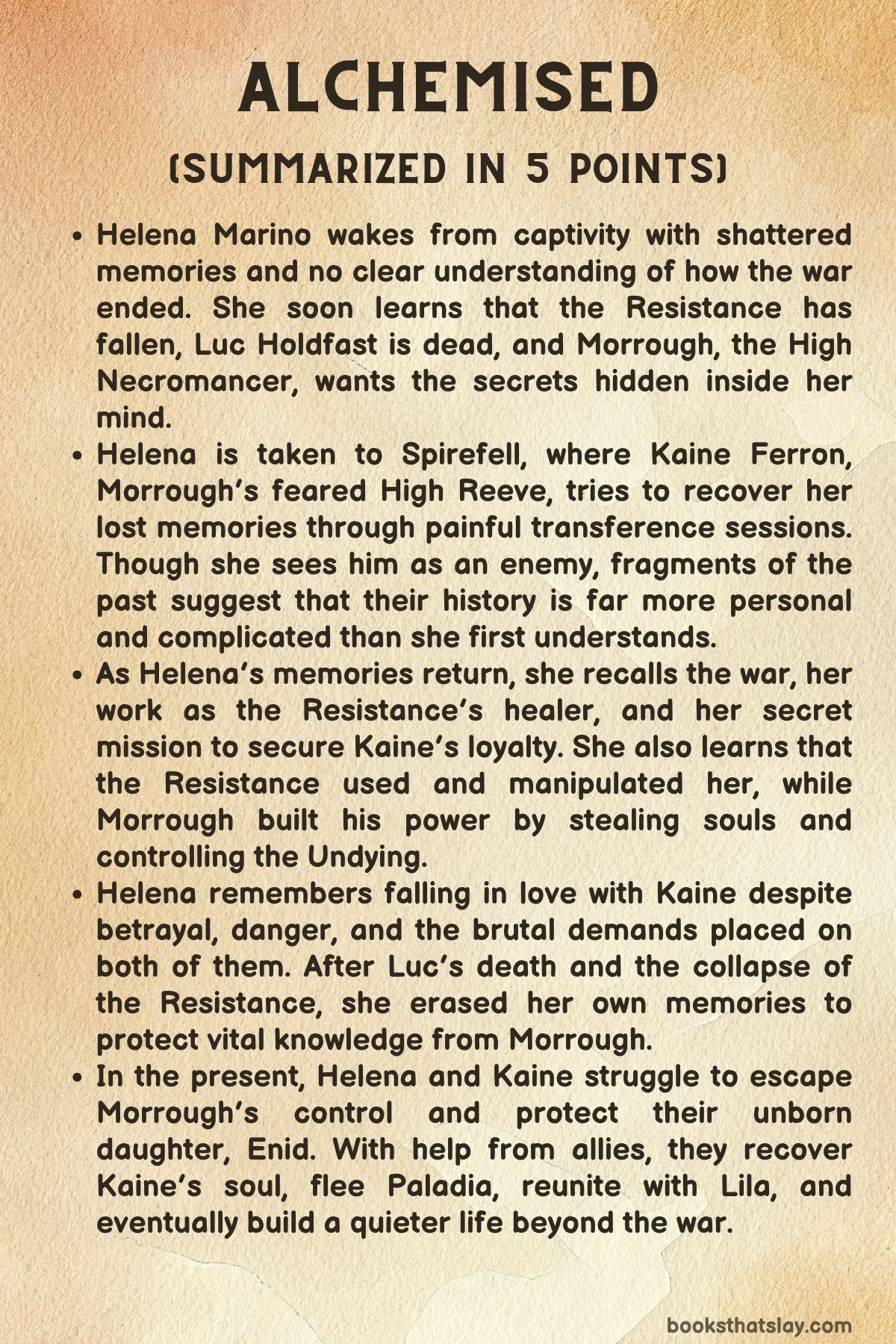
Helena Marino wakes in darkness, trapped in pain and confusion, holding on to only one command: survive. When she is finally brought back to consciousness, she discovers that she has been kept in a stasis chamber after the end of a devastating war.
Her body is weak, her mind is damaged, and her memories are fractured. She remembers being part of the Resistance, loyal to Luc Holdfast and the Order of the Eternal Flame, but she does not understand why she has been imprisoned or why so many people believe she should be dead.
The world she wakes into is ruled by Morrough, the High Necromancer, and his followers, the Undying. Helena learns that the Resistance has been crushed, Luc is dead, and nearly everyone she loved is gone.
Morrough wants her memories, but Helena’s mind has been altered so deeply that even she cannot reach the truth. Her survival under impossible conditions reveals that she is more powerful than anyone expected.
She is not only a healer but also an animancer, someone capable of working with souls and the dead.
Helena is taken to Spirefell, the manor of Kaine Ferron, the High Reeve and Morrough’s most feared weapon. Kaine is familiar to her as a former classmate and academic rival, but something about him troubles her.
He is cold, controlled, and dangerous, yet his presence also stirs buried feelings she cannot explain. He begins repeated transference sessions, forcing his way into her mind to retrieve the hidden memories Morrough needs.
Helena resists him fiercely, determined to protect whatever secret she once sacrificed herself to bury.
Life at Spirefell becomes a battle of endurance. Helena is watched, confined, and questioned.
Kaine’s wife, Aurelia, resents her presence and grows increasingly unstable. Dr. Stroud, a vivimancer loyal to Morrough, monitors Helena’s health because Morrough sees her as valuable.
Helena learns more about the new regime, including cruel programs that exploit alchemists and use bodies, souls, and bloodlines as resources. She also discovers that Morrough’s power depends on the Undying: their stolen souls feed him, and as they die, he weakens.
As Kaine continues searching Helena’s mind, her past begins to return. She remembers the war years, when the Bayard family’s home became a haven for the Resistance and Helena worked as its only healer.
Luc Holdfast was a symbol of hope, the expected future leader of Paladia, and one of Helena’s closest friends. Yet the Resistance was not as pure as Helena once believed.
Its leaders, especially Jan and Ilva, used her loyalty, isolated her, and forced her into morally terrible choices.
Helena recalls how she first began working with Kaine during the war. The Resistance believed he could provide information about Morrough, and Jan and Ilva ordered Helena to act as his liaison.
Their true aim was to use her to secure his loyalty. Kaine, who hated Morrough for the torture and death surrounding his family, agreed to spy, but he demanded trust on his own terms.
He taught Helena animancy, showed her how to defend her mind, and warned her that if she were ever captured, the Undying would try to strip her memories from her.
What begins as suspicion and manipulation changes over time. Helena sees the damage Morrough has done to Kaine.
Morrough experiments on him, wounds him, drains him, and uses him as a living instrument of power. Helena treats Kaine’s injuries in secret and begins to understand his loneliness and rage.
Their meetings become the one place where both of them can be honest, even when they hurt each other. Helena is torn between her duty to the Resistance and her growing attachment to a man she was ordered to exploit.
The Resistance itself grows harsher as the war worsens. Helena is pushed aside, distrusted, and later forced to take part in torture.
Luc becomes distant after Helena proposes reanimating the dead to fight Morrough, a suggestion the Council condemns. Lila and Soren Bayard remain among her closest friends, but even those bonds strain under fear, secrecy, and loss.
When Soren dies during an escape mission to rescue Luc from prison, Helena tries to reanimate him and fails. His death devastates her, and Luc blames her for it.
Helena’s love for Kaine deepens despite the guilt attached to it. He gives her weapons, protects her, teaches her, and eventually becomes devoted to her.
She learns about the Stone of the Heavens, a powerful relic tied to soul magic and the origins of Morrough’s strength. The Resistance leaders have lied about it for years.
They know Kaine is central to Morrough’s plans, but they are willing to spend his life if doing so helps them win. Helena, trapped between opposing sides that both use her, begins making her own choices.
The war reaches disaster when Morrough uses Luc’s body and soul to infiltrate Resistance headquarters. Helena realizes too late that Luc is no longer fully himself.
In a terrible confrontation, the real Luc briefly returns and asks Helena to kill him to stop Morrough. Helena cannot do it.
Luc dies after asking her to protect Lila and her unborn child. Helena helps Lila escape and plans a bombing at West Port Laboratory as a distraction.
The attack succeeds, but Helena is captured before she can reach safety. Morrough and his servants try to break into her mind, and Helena uses her animancy to block them, sacrificing her own memory to keep key truths hidden.
Back in the present, the returning memories shatter Helena’s understanding of everything. She remembers that she and Kaine loved each other before her capture.
She remembers why she erased her own mind. She learns that Lila and her son, Apollo, survived.
She also understands the cruel truth behind Morrough’s plan for her pregnancy: he wants Helena and Kaine’s child because of Helena’s animancy and Kaine’s power. The pregnancy was forced during Helena’s captivity, and both Helena and Kaine must face the pain of how their daughter was conceived.
Despite that trauma, Helena chooses to love the child. She helps Kaine see that their daughter is innocent and that he is allowed to love her too.
They name her Enid, after Kaine’s mother. But Morrough still controls part of Kaine’s soul, stored in a phylactery made from his bone.
Kaine believes his death may be necessary to weaken Morrough, but Helena refuses to accept that. With information from Ivy, a former traitor to the Resistance, Helena learns there may be a way to restore Kaine’s soul.
After more violence at Spirefell, Ivy retrieves Kaine’s phylactery. Helena performs the dangerous procedure to restore him.
Once Kaine is whole enough to flee, he and Helena escape on his chimaera. They reunite with Lila and Apollo, then leave Paladia for a remote island off the coast of Etras.
There, Helena gives birth to Enid Rose Ferron. For a time, they live quietly together, trying to build safety from the ruins of war.
Lila eventually returns to Paladia, determined to kill Morrough and avenge Luc. Kaine trains her while Helena works on a bomb.
After a long struggle, Lila succeeds in killing Morrough. She later visits Helena, Kaine, and Enid, but Helena chooses not to return to Paladia.
Her life is with Kaine and their daughter, away from the country that used and broke them.
Years pass. Helena and Kaine raise Enid in isolation but with love, giving her the safest childhood they can.
When Enid grows up, she leaves for Paladia to study vivimancy. There, she reunites with Lila and Apollo.
The next generation carries the marks of the war but also the chance to live beyond it, shaped by the survival, sacrifice, and difficult love of those who came before them.
Characters
Helena Marino
Helena Marino is the emotional and moral center of Alchemised, a woman whose identity has been broken apart by war, captivity, memory loss, and coercion. At the beginning, she exists almost as a wound before she is a person: trapped in darkness, in pain, and clinging to survival when she has little else.
Her missing memories turn her into a mystery even to herself, and this makes her character arc especially complex. She is not simply trying to escape her enemies; she is trying to recover the truth of who she was, what she did, whom she loved, and what she chose to sacrifice.
Helena’s role as a healer shapes almost every part of her character. She is trained to preserve life, yet the war repeatedly forces her into situations where healing is not enough.
Her suggestion that the Resistance use reanimated bodies shows the depth of her desperation and pragmatism. She is compassionate, but she is not innocent in a simple sense.
She makes morally dangerous choices because the world around her has made clean choices impossible. This tension between mercy and necessity defines much of her inner conflict.
Her loyalty to Luc and the Resistance initially seems absolute, but as her memories return, that loyalty becomes more complicated. Helena realizes that the people she trusted also manipulated her.
Jan and Ilva used her devotion, isolated her, and pushed her toward Kaine for their own political goals. This revelation does not erase Helena’s love for her friends, but it forces her to confront how easily idealism can become exploitation.
Her growth lies in learning to trust her own judgment after years of being used as a tool by competing powers.
Helena’s relationship with Kaine is one of the most difficult parts of her character because it contains love, coercion, trauma, guilt, and recognition. In the past, she grows to love him because she sees the abused and lonely person beneath his cold exterior.
In the present, after her memory loss, he appears first as captor and threat, which makes her recovered love painful and confusing. Helena’s strength is not shown through emotional purity but through her ability to face unbearable contradictions.
She can acknowledge harm without denying love, and she can choose survival without pretending survival is clean.
By the end, Helena becomes someone who refuses to let war decide the meaning of her life. She chooses Kaine, Enid, Lila, and a fragile future away from Paladia’s violence.
Her refusal to return is not cowardice; it is an act of self-definition. She has already given her body, mind, gifts, and loyalties to causes that consumed her.
Her ending is about reclaiming the right to live for herself and for the people she chooses.
Kaine Ferron
Kaine Ferron is one of the most morally complex figures in the story, presented first as a terrifying agent of Morrough’s regime and later revealed as a damaged man shaped by torture, grief, and long-term exploitation. His reputation as the High Reeve makes him appear almost inhuman: controlled, cold, powerful, and lethal.
He is Morrough’s secret weapon, a figure feared by enemies and allies alike. Yet the more Helena remembers, the clearer it becomes that Kaine’s power has never truly belonged to him.
He has been used, experimented on, and spiritually violated by Morrough.
Kaine’s personality is built around control because control is the only defense he has left. He speaks harshly, keeps emotional distance, and often tries to dominate situations before they can hurt him.
His early interactions with Helena are brutal and invasive, especially during the transference sessions. Yet this harshness is also part of his damage.
Kaine has learned to survive in a world where weakness is punished and attachment can be weaponized. His coldness is not an excuse for his actions, but it explains why intimacy terrifies him as much as it draws him in.
His love for Helena exposes both the best and worst in him. In the past, she becomes one of the few people who sees him as more than a weapon.
Her healing of his injuries is not just physical care; it is recognition. She witnesses the scars Morrough has left on him, and that recognition breaks through Kaine’s isolation.
In the present, however, his love is distorted by the circumstances of Helena’s captivity and Morrough’s command. His participation in the forced pregnancy arrangement is one of the darkest elements of his character, and the story does not make it emotionally simple.
Kaine’s guilt over Enid’s conception shows that he understands the horror of what happened, even though understanding cannot undo it.
Kaine’s bond with his mother, Enid Ferron, is central to his emotional life. Her suffering and death form the foundation of his hatred for Morrough and his fear of losing Helena.
He associates love with helplessness because the people he loves are taken, used, or destroyed. This is why he often imagines sacrifice as the only meaningful endpoint for himself.
He believes he is already too damaged to be saved and that his death may be the only useful thing he can offer.
His eventual restoration through the phylactery is symbolic as well as literal. Kaine is not fully free until his soul is returned to him.
His escape with Helena marks the first time he chooses life over usefulness, family over war, and love over punishment. His later role as Enid’s father shows slow, difficult healing.
He does not instantly become gentle, but he learns to accept love without treating himself only as a source of harm.
Luc Holdfast
Luc Holdfast represents hope, legacy, and the terrible burden of being turned into a symbol. As the heir of the Holdfast family and the expected leader of Paladia’s future, Luc is never allowed to be only himself.
The Resistance looks to him as a figure of light, continuity, and victory. This public role makes him beloved, but it also traps him.
He is expected to inspire others, make impossible decisions, and embody moral certainty even as the war destroys everyone around him.
To Helena, Luc is initially a source of loyalty and emotional stability. Their friendship is rooted in shared history, trust, and affection.
She sees him as someone worth serving and protecting. Yet Luc’s relationship with Helena becomes strained as the war exposes their differences.
When Helena suggests using reanimated bodies as infantry, Luc and the Resistance react with horror. To Luc, certain boundaries must not be crossed, even in desperation.
To Helena, refusing such options may mean losing the war. This disagreement marks a deeper divide between symbolic purity and practical survival.
Luc’s treatment of Helena after Soren’s death reveals his limitations. His grief makes him cruel, and he blames Helena for failing to save someone she desperately tried to protect.
This does not make Luc evil, but it makes him human in a way that clashes with his heroic image. He is capable of love and courage, but also of anger, judgment, and emotional blindness.
He cannot fully understand what Helena has endured or the impossible position she occupies.
His final possession by Morrough is one of the story’s harshest reversals. The man who represented resistance becomes a vessel for the enemy.
This fate is especially cruel because Luc’s body and vitality are used against the people who trusted him. When the real Luc briefly returns and asks Helena to kill him, the scene strips away the symbol and leaves only a suffering person who wants the horror to end.
His final request that Helena care for Lila and the baby restores some of his humanity. Luc dies not as a perfect savior but as a broken man who still tries, in his last moments, to protect what remains of his love.
Lila Bayard
Lila Bayard is one of the strongest emotional anchors in the story because she represents friendship, endurance, and the possibility of life after ruin. She begins as part of Helena’s circle of warmth and belonging, connected to the Bayard household that gives the Resistance a temporary sense of home.
Her bond with Helena is intimate and trusting, and Helena’s memories of Lila carry the pain of a lost world. When Helena wakes with broken memories, her longing for Lila shows how deeply that friendship shaped her sense of self.
Lila’s role expands as the war intensifies. She is not merely someone Helena wants to protect; she becomes a survivor of violence in her own right.
Her capture, rescue, injuries, and pregnancy place her at the center of the Resistance’s losses and hopes. Her pregnancy with Luc’s child is both dangerous and meaningful.
It makes her vulnerable in a world where bodies and bloodlines are politically valuable, but it also gives her a reason to continue after Luc’s death. Through Apollo, Lila carries forward something of Luc without being reduced to his memory.
Her grief hardens into purpose. After escaping with Helena and later living in hiding, Lila does not remain outside history forever.
She returns to Paladia to kill Morrough, not because she is untouched by fear but because she refuses to let his violence remain unfinished. Her decision contrasts with Helena’s refusal to return.
Neither woman is framed as weaker or stronger than the other; they simply choose different paths after surviving the same catastrophe. Lila’s path is vengeance and public reckoning, while Helena’s is private healing.
Lila’s later presence in Enid and Apollo’s lives suggests that she becomes a bridge between past and future. She remembers the war, loves those who survived it, and helps guide the next generation.
Her character shows that survival can become action, and that grief can be transformed into responsibility without losing its pain.
Morrough
Morrough, the High Necromancer, is the central embodiment of power without moral restraint. He is not frightening only because he commands armies or practices necromancy; he is frightening because he treats souls, bodies, memories, and bloodlines as materials to be harvested.
His promise of immortality attracts followers because he offers a way to overcome death, but the truth behind that promise is theft. He builds power by taking what should be most sacred and personal from others.
Morrough’s use of the Undying reveals the emptiness of his vision. He claims mastery over death, but his immortality depends on domination.
The Undying are not free beings who have transcended mortality; they are evidence of his parasitic rule. Their souls feed him, their bodies serve him, and their deaths weaken him.
His power is therefore both vast and fragile. He depends on the very system of exploitation he has created.
His treatment of Kaine shows his particular cruelty. Kaine is not just a subordinate; he is an experiment, a weapon, and a container for stolen power.
Morrough’s ability to remove and store parts of a person’s soul makes him a violation of personhood itself. He does not simply kill his enemies.
He occupies them, empties them, uses their remains, and turns love against the living. His possession of Luc is a perfect example of this cruelty, because he turns the Resistance’s hope into a means of destruction.
Morrough’s obsession with Helena’s memories and future child shows that he fears what he cannot fully control. Helena’s ability to hide knowledge from him is a threat because memory becomes resistance.
Her unborn child matters to him not as a person but as a potential asset. In this way, Morrough’s villainy is not only magical but political and bodily.
He represents systems that consume people while calling that consumption progress, order, or survival.
Jan Crowther
Jan Crowther is one of the most unsettling characters because he belongs to the Resistance yet repeatedly behaves with the same utilitarian cruelty that defines its enemies. As a member of the Eternal Flame Council, he presents himself as someone committed to defeating Morrough and restoring a better Paladia.
However, his actions reveal how easily moral causes can become corrupted when victory matters more than the people being saved.
Jan sees Helena primarily as a resource. He uses her guilt, loyalty, and isolation to control her.
When the Council rejects her ideas, he and Ilva do not simply cast her aside; they redirect her into a secret mission that requires emotional and sexual manipulation of Kaine. He expects Helena to secure Kaine’s loyalty regardless of the personal cost to her.
Later, he pushes her into torture and intelligence work, forcing her to participate in acts that damage her sense of self.
What makes Jan especially complicated is that he is not wrong about the stakes. Morrough is a monstrous threat, and the Resistance truly is desperate.
Jan’s choices occur in a brutal war where hesitation can mean mass death. Yet the story uses him to show that necessity can become an excuse for cruelty.
He does not merely ask Helena to make sacrifices; he manages, pressures, and corners her until sacrifice becomes the only available option.
Jan’s failure is moral imagination. He can imagine victory, strategy, and leverage, but he cannot fully imagine Helena as a person with limits, dignity, and trauma.
His Resistance may oppose Morrough, but in his treatment of Helena, he mirrors the same logic of using bodies and gifts as instruments. He is not a simple traitor or villain; he is more disturbing because he shows how good causes can still harm the people they claim to protect.
Ilva Holdfast
Ilva Holdfast is a sharp political figure whose intelligence and ruthlessness make her one of the most powerful forces within the Resistance. Helena once admires her, and that admiration makes Ilva’s manipulation more painful.
Ilva understands people, institutions, myths, and power. She knows how to hide information, how to pressure others, and how to use loyalty as a chain.
Her authority comes not only from her position but from her ability to control what others believe.
Ilva’s relationship with Helena is marked by exploitation disguised as necessity. She recognizes Helena’s usefulness and shapes her accordingly.
When Helena becomes inconvenient or dangerous, Ilva helps discredit her. When Kaine becomes strategically valuable, Ilva directs Helena toward him.
Her willingness to threaten Helena’s father shows how far she will go to maintain control. She may believe that her actions serve the Resistance, but belief does not soften the cruelty of her methods.
Her knowledge of the Stone of the Heavens exposes the Resistance’s hidden corruption. Ilva knows that the official story surrounding the relic and the Holdfast legacy is incomplete or false.
By withholding the truth from Luc and others, she preserves a myth that keeps the Resistance functioning. This makes her a guardian of both hope and deception.
She understands that symbols can hold people together, but she is willing to lie to maintain them.
Ilva’s character complicates the idea of righteous rebellion. She is fighting a real evil, yet she builds that fight on secrecy, manipulation, and selective truth.
Her tragedy is that she may be too clear-eyed for innocence but not wise enough for mercy. She sees the board, the pieces, and the possible outcomes, but she loses sight of the human cost.
Dr. Irmgard Stroud
Dr. Irmgard Stroud represents science stripped of compassion. As a vivimancer and medical authority, she should be associated with healing, but her work serves captivity, breeding programs, forced bodily control, and Morrough’s political order.
Her presence around Helena is clinical and practical, which makes her cruelty especially chilling. She does not need to rage or threaten constantly because her authority is institutional.
She can harm through examination, medication, diagnosis, and procedure.
Stroud’s treatment of Helena reveals her view of the body as state property. Helena’s health matters because Morrough needs her alive.
Her pregnancy matters because Morrough wants the child. Her memories matter because they contain strategic value.
Stroud’s concern is not rooted in care for Helena as a person but in preserving an asset. This makes her a key figure in the story’s critique of medical and scientific systems used for control.
She also shows how intellectual ambition can become moral surrender. The world of the novel contains many debates about whether magic should be understood as sin, science, power, or divine gift.
Stroud stands on the side of experimentation without ethical restraint. Her work is modern, organized, and systematic, but that only makes it more dangerous.
She gives brutality a professional face.
Stroud is not the grand architect of evil in the way Morrough is, but she enables him. Her role proves that tyrannical systems depend on specialists who normalize harm.
She is terrifying because she makes violation procedural. In her hands, healing knowledge becomes a method of ownership.
Aurelia Ferron
Aurelia Ferron is a tragic and cruel figure shaped by patriarchy, resentment, and emotional starvation. She is introduced as Kaine’s wife, but the marriage is less a relationship than an arrangement made for family and political advantage.
Aurelia’s parents had her for the purpose of securing an alliance, which means her life has been defined by usefulness from the beginning. Like many characters in the story, she has been treated as a tool, but unlike Helena, she turns much of her pain outward.
Her resentment of Helena comes from humiliation and fear. Kaine rejects her emotionally and sexually, while Helena holds his attention in ways Aurelia cannot understand.
This does not justify Aurelia’s violence, but it explains the intensity of her jealousy. She has been raised to see marriage as her purpose, and Helena’s presence makes her failure public and unbearable.
In a world where women’s value is often tied to alliance, fertility, and obedience, Aurelia’s position is both privileged and suffocating.
Aurelia’s attack on Helena exposes how desperation can become brutality. She is not merely jealous; she wants to damage Helena in a way that will make her less valuable to Kaine.
Her cruelty mirrors the broader world’s obsession with bodies as symbols of power. She has learned the logic of harm from the society that shaped her.
Her death at Atreus’s hands completes her bleak arc. Aurelia never escapes the system that made her.
She is not innocent, but she is also not free. Her character shows how women can become enforcers of the same structures that imprison them, especially when they believe another woman has taken the little power available to them.
Atreus Ferron
Atreus Ferron is a father whose failures are bound to pride, fear, and denial. As Kaine’s father, he should be the person most invested in protecting him from Morrough.
Instead, he remains entangled in allegiance, hierarchy, and resentment. His relationship with Kaine is defined by emotional distance and violence, and this makes him one of the clearest examples of familial failure in the story.
Atreus’s inability to face what Morrough has done to Kaine is central to his character. He reacts with anger when Helena tells him the truth about Kaine’s suffering and Enid Ferron’s torture.
This anger comes partly from shock, but also from self-defense. To accept the truth would mean accepting his own failure to protect his family.
Rather than confront that guilt, he lashes out at Helena and Kaine.
His view of Kaine is shaped by expectation. He sees his son through the lens of power, duty, and family legacy, not vulnerability.
Kaine’s pain offends him because it exposes weakness in the Ferron line and in Atreus himself. This is why his confrontations with Kaine are so brutal.
He cannot offer comfort because comfort would require humility.
Atreus is important because he shows that Morrough’s power extends beyond direct magic. Morrough’s rule depends on fathers, families, guilds, and institutions that sacrifice their own children to preserve status or survive.
Atreus may not be the chief villain, but his failures help create the conditions that allow Kaine to be used for so long.
Enid Ferron
Enid Ferron, Kaine’s mother, is mostly present through memory, but her influence is immense. Her suffering shapes Kaine’s hatred of Morrough, his fear of attachment, and his belief that love ends in helplessness.
She is a ghostly presence in the emotional structure of the story, representing a loss that never stops acting on the living.
For Kaine, Enid is both mother and wound. What happened to her teaches him that the people he loves can be targeted and destroyed.
This shapes his possessiveness toward Helena and later his fear around his daughter. His grief for his mother is not simply sadness; it is the foundation of his worldview.
He expects love to be punished because that is what his life has taught him.
The naming of Helena and Kaine’s daughter after Enid is deeply significant. It transforms the name from a marker of grief into a possibility of renewal.
The first Enid represents what Morrough took; Enid Rose represents what Helena and Kaine choose to protect. Through this naming, the story links memory and hope.
The past is not erased, but it is answered by a new life.
Enid Rose Ferron
Enid Rose Ferron represents survival after violation and the possibility of love born from circumstances of pain. Her conception is tied to coercion and Morrough’s plans, which makes her arrival emotionally difficult for both Helena and Kaine.
Yet Helena’s choice to love her daughter refuses Morrough’s definition of the child as a weapon or asset. Enid Rose becomes a person, not a political object.
For Kaine, fatherhood is initially burdened by guilt. He struggles to separate the child from the violence surrounding her conception.
Helena helps him understand that loving Enid does not deny the harm that occurred. This is one of the story’s most important emotional movements: the child is not made responsible for the circumstances that created her.
Kaine’s gradual warmth toward Enid becomes part of his healing.
Enid’s childhood in isolation is both protected and limited. Helena and Kaine give her safety, but that safety comes at the cost of distance from the wider world.
When she eventually leaves for Paladia, her departure shows that the next generation cannot remain forever inside the shelters built by survivors. She must enter history on her own terms.
Her decision to study vivimancy connects her to Helena’s healing legacy while also distinguishing her from her parents’ trauma. Enid Rose carries the consequences of the past, but she is not confined to them.
Her future suggests that survival can become inheritance without becoming imprisonment.
Soren Bayard
Soren Bayard is a figure of friendship, warmth, and devastating loss. As Lila’s brother and part of Helena’s intimate circle, he belongs to the world Helena longs for after she wakes without memory.
His kindness toward Helena after her rejection by the Council shows his role as someone who offers comfort when institutions withdraw it. He represents the personal bonds that make the Resistance worth saving.
His death is one of the turning points in Helena’s moral and emotional journey. When he dies during the escape from the prison, Helena’s attempt to reanimate him comes from desperation and love.
She cannot accept another loss, especially not one so close. Yet the attempt fails and leads to even more suffering, including Luc’s rage and Helena’s deeper guilt.
Soren’s memories entering Helena adds another layer to his role. He does not vanish completely; traces of him remain inside her.
This makes grief literal. Helena carries the dead not only emotionally but magically and mentally.
It reflects the larger world of the novel, where death is never simple and the boundary between memory, soul, and body is unstable.
Soren matters because his death exposes the limits of Helena’s healing. She can save many people, but not everyone.
His loss teaches that love cannot always overcome death, and that attempts to do so may carry terrible consequences.
Ivy
Ivy is a morally compromised survivor whose choices reveal how grief can make people vulnerable to evil. She first appears as a healer connected to Helena’s world, but later it is revealed that she betrayed the Resistance by helping the Undying.
Her motive is painfully human: she wants her dead sister Sofia returned. This does not excuse her betrayal, but it makes her more than a simple villain.
Ivy’s actions lead to enormous harm. By allowing the enemy into Resistance spaces, she contributes to death, collapse, and trauma.
Her selfishness is real, and Helena’s anger toward her is justified. Yet Ivy also reflects a temptation present throughout Alchemised: the desire to undo death at any cost.
Morrough builds an empire from that desire, and Ivy becomes one of the people caught by it.
Her later return with information about Kaine’s soul gives her a chance at partial redemption. She cannot undo what she has done, but she can help save Kaine.
Her retrieval of the phylactery is dangerous and meaningful because it shifts her from betrayal to repair. The story does not make her innocent again, but it allows her to act differently.
Ivy’s character suggests that guilt does not disappear through one good act, yet moral change is still possible. She is marked by weakness, grief, and cowardice, but also by the capacity to choose courage after failure.
Shiseo
Shiseo is an important supporting figure because he represents knowledge, technical skill, and quiet loyalty. He appears in discussions of alchemy, resonance, memory, and experimentation, often occupying the space between science and strategy.
Unlike characters who seek power for domination, Shiseo is more associated with understanding how power works.
His assistance to Helena and the Resistance shows his practical importance. He helps test resonance, supports Helena’s research, and later aids her escape plan.
He is not as emotionally central as Kaine, Luc, or Lila, but his work makes several major developments possible. His presence also expands the intellectual world of the story, where alchemical theory has direct consequences for survival.
Shiseo’s death while trying to reach Spirefell underscores the danger of helping Helena and Kaine. It also marks the closing of one of their possible lifelines.
His loss forces Helena and Kaine to rely even more heavily on each other and on riskier plans. In a world where knowledge is constantly weaponized, Shiseo represents one of the few people who tries to use it in service of resistance and rescue.
Dr. Pace
Dr. Pace, or Matron Pace, functions as one of the story’s steadier figures of care. In a world where healers are often exploited, corrupted, or forced into violence, Pace represents a more grounded form of medical compassion.
She tends to the wounded, guides Helena, and gives practical support during moments of exhaustion and fear.
Her importance lies partly in contrast. Dr. Stroud uses healing knowledge as an instrument of control, while Pace uses it to preserve dignity where she can.
She cannot stop the war, and she cannot protect Helena from every demand placed on her, but she offers moments of humane attention. That matters in a story where systems repeatedly erase personhood.
Pace also plays a key role in Lila’s pregnancy. Her advice and recognition help Helena protect Lila when secrecy is necessary.
She understands the body not as property of the state, the Resistance, or a bloodline, but as something requiring care. Through Pace, the novel keeps alive a quieter, less dramatic form of resistance: tending to life without turning people into tools.
Erik Lancaster
Erik Lancaster is a predatory figure who represents the entitlement and cruelty that flourish under violent regimes. His attack on Helena is one of the clearest examples of personal violence enabled by political power.
He sees Helena’s captivity and vulnerability as permission. His behavior shows that war does not only create battlefields; it creates environments where powerful men feel free to harm those with less protection.
Erik’s presence also reveals the danger of Helena’s position at Spirefell. Even when she is valuable to Morrough, she is not safe.
Her body is constantly subject to the claims, desires, and plans of others. Kaine’s intervention stops Erik, but that rescue does not erase the broader reality that Helena lives inside systems where her consent is repeatedly violated.
As a character, Erik does not require great psychological depth to be effective. His function is to show the ugliness of opportunistic power.
He is not a grand strategist like Morrough or a conflicted weapon like Kaine. He is a man who takes advantage of a brutal world because that world allows him to.
Mandl
Mandl is an agent of Morrough’s system, associated with captivity, experimentation, and the hidden machinery of the regime. Her role in Helena’s imprisonment and the stasis tanks connects her to one of the novel’s most disturbing images: human beings suspended, studied, and preserved for use.
Mandl’s actions show how Morrough’s empire depends on administrators and operators as much as on magical power.
Her death is significant because she is Undying and therefore supposed to be beyond ordinary vulnerability. When she is killed, fear spreads through Paladia because it proves that Morrough’s followers can be destroyed.
Her death becomes a sign that resistance may still be possible. For Helena, it is evidence that Morrough’s power has a weakness.
Mandl also matters because Helena later investigates her memories and learns more about the prison tanks. Through Mandl, the story connects individual cruelty to organized atrocity.
She is part of the structure that turns bodies into resources, and her fall helps expose the fragility of that structure.
Themes
Memory, Identity, and the Fight to Own the Self
Memory in Alchemised is not passive recollection; it is identity, evidence, shelter, and weapon. Helena’s missing memories create the central mystery, but their absence also raises a deeper question: who is a person when her own past has been taken from her?
At first, Helena clings to fragments such as Luc, the Resistance, and the command to survive. These fragments give her enough structure to resist Kaine and Morrough, but they are incomplete.
As her past returns, she learns that memory is not comforting by default. Some memories restore love, while others restore guilt, betrayal, and unbearable knowledge.
The act of remembering becomes painful because it forces Helena to face not only what others did to her, but what she herself chose under pressure. Morrough wants her memories because they contain strategic truth, while Helena hides them because they protect people and plans that still matter.
This turns the mind into a battlefield. The story treats memory as a form of ownership: to control someone’s memory is to control their story, loyalties, and future.
Helena’s recovery is therefore not just informational. It is a reclamation of selfhood after being made into a prisoner, weapon, patient, lover, traitor, and survivor by other people’s needs.
The Corruption of Power and the Cost of Victory
Power in the novel rarely remains clean, even when it is used for a just cause. Morrough is the clearest example of power without conscience: he steals souls, reanimates bodies, experiments on prisoners, and turns immortality into a system of extraction.
Yet the Resistance is not presented as morally pure simply because it opposes him. Jan and Ilva manipulate Helena, conceal truths, authorize torture, and treat Kaine as a resource to be used against the enemy.
Their choices are made under extreme pressure, but the story refuses to pretend that desperation erases responsibility. The war creates a world where every side justifies harm through necessity.
Morrough claims power through domination; the Resistance claims moral authority through liberation. Still, both sides are capable of reducing people to tools.
Helena’s arc exposes this most clearly because she is used by everyone: as healer, spy, seducer, memory vault, weapon, and potential mother of a powerful child. The theme becomes especially strong in the contrast between symbols and people.
Luc is turned into a symbol of hope until his humanity is crushed beneath expectation. Kaine is turned into a weapon until he barely believes he deserves a life.
Victory, the novel suggests, becomes hollow when it demands the destruction of the very people it claims to save.
Love, Coercion, and Moral Ambiguity
Love in the story is powerful, but it is rarely simple or untouched by harm. Helena and Kaine’s relationship is the clearest example.
In the past, their bond grows from suspicion, manipulation, shared danger, and reluctant tenderness. Helena is ordered to secure Kaine’s loyalty, which means their intimacy begins under false and coercive circumstances.
Yet as she sees his wounds and loneliness, her feelings become real. In the present, after her memory loss, Kaine is both the man she loved and the man participating in her captivity.
This creates an emotional conflict that cannot be resolved by calling the relationship purely romantic or purely destructive. The novel sits in that discomfort.
It shows how love can exist inside damaged conditions without making those conditions acceptable. Helena’s feelings for Kaine do not erase his actions, and Kaine’s love for Helena does not erase the harm done to her.
Their daughter Enid makes this theme even more difficult. She is conceived through coercion, yet Helena insists that the child herself is innocent and lovable.
The story’s treatment of love is therefore not sentimental. Love can heal, but it can also be used, distorted, and forced into morally compromised spaces.
What matters is whether the characters eventually move toward choice, honesty, and protection rather than possession.
Survival, Trauma, and the Possibility of Renewal
Survival is the first command Helena gives herself and the final condition that makes any future possible. Yet the novel does not present survival as triumphant in a simple way.
Helena survives captivity, memory loss, war, coercion, grief, and bodily violation, but each survival leaves marks. Kaine survives torture and soul theft, but his survival makes him believe he is monstrous and expendable.
Lila survives the war and motherhood under threat, but her grief drives her back toward vengeance. Survival is necessary, but it is not the same as healing.
The story is deeply concerned with what happens after people endure the unendurable. Some characters, like Morrough, respond to fear of death by consuming others.
Some, like Jan and Ilva, respond to possible defeat by sacrificing moral boundaries. Helena’s later life offers another answer: survival can become the slow building of a chosen life.
Her refusal to return to Paladia is not a rejection of responsibility but a recognition that she has already paid too much to systems that consumed her. The island, Enid’s childhood, and the eventual departure of the next generation all suggest renewal without forgetting.
Trauma remains part of the characters’ lives, but it does not get the final word.