Beautiful Nightmare Summary, Characters and Themes
Beautiful Nightmare by Katee Robert is a paranormal romance that explores the boundary between fear and desire, transformation and acceptance. The story follows Gemma, a young shape-shifting trainee demon learning to harvest human fear, and Caleb, a human whose empathy and curiosity disrupt her understanding of what it means to be monstrous.
When their encounters take an unexpected turn from terror to intimacy, both characters find themselves confronting the rules of their worlds. What begins as a routine assignment soon grows into a tale about consent, connection, and self-discovery, revealing that love can transcend even the most forbidden boundaries.
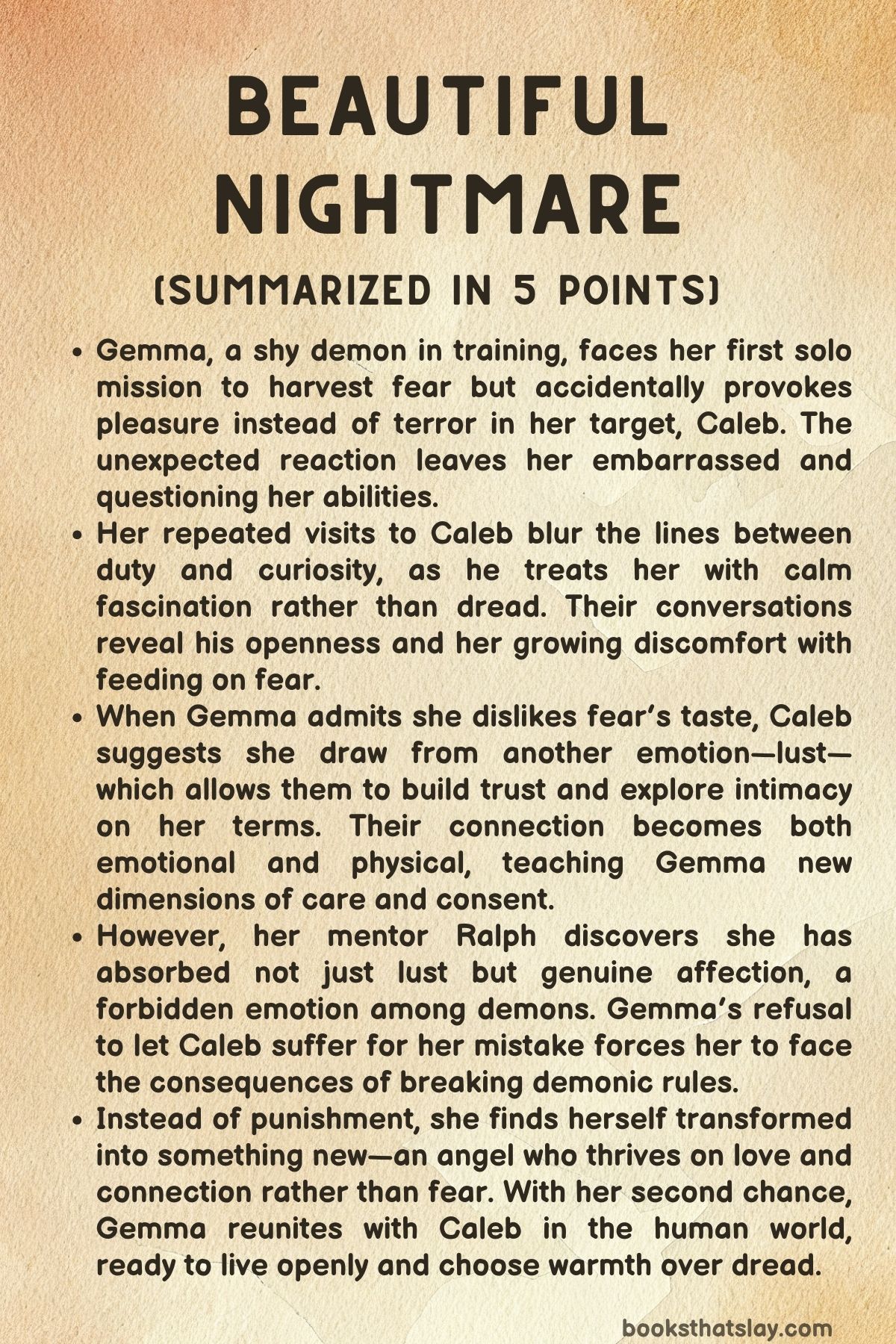
Summary
Gemma, a trainee demon in the realm of nightmares, is finally sent on her first solo mission after years of training under her mentor Ralph, a towering, skeletal figure known for his intimidating appearance but gentle guidance. Her assignment is to act as a sleep paralysis demon and harvest fear from a human subject.
Nervous but eager to prove herself, she enters the mortal world through a portal and appears in the bedroom of a red-haired man. Following her training, she immobilizes him and stages the haunting.
However, when she sits on his chest to draw out his fear, the man reacts with pleasure instead of terror, reaching climax unexpectedly. Horrified and confused, Gemma flees back through the portal.
Ralph, unaware of the details, senses that she is well-fed and congratulates her, while Gemma hides her shame and confusion, vowing to succeed properly next time.
Two days later, hunger and guilt push Gemma to return. She attempts another encounter with the same man but startles him awake, breaking the illusion of paralysis.
He introduces himself as Caleb, calm and surprisingly unafraid. Instead of recoiling, he speaks to her openly, admitting that the world already frightens him enough and that her strange appearance excites him more than it scares him.
In desperation to fulfill her duty, Gemma transforms into Ralph’s horrifying form, making Caleb scream briefly before she retreats after consuming only a trace of fear. When she reports back, Ralph gently reprimands her for stealing his likeness and encourages her to embrace her individuality instead of hiding behind imitation.
Drawn by curiosity as much as hunger, Gemma visits Caleb again. This time she finds a note he has written inviting her to talk before she scares him.
The gesture disarms her. Starved for connection and tired of pretending, she sits with him and explains that demons feed on intense human emotions—fear being her assigned sustenance.
Caleb listens and suggests that they find another emotion she can draw from, one that doesn’t hurt either of them. After an awkward discussion, they agree on lust as a safer alternative.
Caleb’s kindness and willingness to understand her stir something new in Gemma—something both frightening and comforting.
Before they act on it, Caleb insists on boundaries and consent. He shares pieces of his life: he’s a pediatrician who spends his days caring for children and working in the community.
Gemma, in turn, confesses how isolated she feels in demon society, constantly failing to meet expectations. Their conversation stretches into the night, both hesitant but curious.
When they finally touch, the sensations overwhelm Gemma. She feels not only Caleb’s desire but a deep undercurrent of affection and trust—emotions demons are forbidden to consume.
Their connection grows physical, tender, and exploratory. The exchange leaves Gemma filled with warmth and power unlike anything she has ever experienced.
In the afterglow, Caleb notices something unusual—two enormous eyes staring from his closet. The realization that another presence is watching sends Gemma into panic.
She kisses him goodbye and vanishes back into the demon realm. Waiting for her is Ralph, devastated.
He knows instantly that she has broken sacred law: she has absorbed emotions far beyond lust, including genuine fondness and care. Ralph explains that such feelings corrupt demons, and the punishment is severe.
He offers to shield her by taking over Caleb’s case, but Gemma refuses. She argues that Caleb, a man who spends his life helping children, doesn’t deserve to be tormented.
She admits she hates what she is supposed to do—scaring and deceiving humans for survival. Accepting her fate, she asks Ralph to make her punishment swift.
Instead, Ralph pushes her through a different kind of portal—one glowing with silver light. Gemma lands unharmed in a strange new environment.
There she meets Raven, a blue-skinned being with golden curls, who explains the truth: demons who refuse to feed on fear are not destroyed but transformed. Gemma has been transferred to a new order—angels.
These beings also feed on human emotion, but they do so by nurturing relationships and drawing on authentic connections rather than fear or pain. Raven welcomes her, explaining that angels must appear approachable and human-like, and assigns her new lodgings and training.
Gemma is startled but relieved to hear that she is allowed to continue her connection with Caleb, as his genuine affection has already linked them emotionally.
A week later, after learning the ways of her new role, Gemma steps through a portal again—this time into Caleb’s kitchen in broad daylight. It’s Halloween, and the world feels bright and ordinary.
Caleb, startled but overjoyed, drops what he’s doing and embraces her tightly. She explains what has happened, that she has become an angel, and that her presence no longer depends on fear or darkness.
He listens, trying to comprehend the impossible, then invites her to share a real date with him—a movie and a school Halloween event where he volunteers. Wanting to belong, Gemma shifts into a human-like form with purple hair and takes his hand.
As they walk out into the sunlight together, the world feels new for both of them. Gemma is no longer bound by hunger or shame, and Caleb, once paralyzed by fear, finds courage in the strange beauty of what they share.
What began as a haunting ends as a partnership between two beings learning how to love across boundaries, proving that redemption and transformation are possible even for those born of nightmares.
Characters
Gemma
Gemma is the emotional core of Beautiful Nightmare, a young, nervous shape-shifting demon whose journey from fear to love symbolizes self-discovery and moral awakening. At the outset, she is defined by uncertainty—both in her form and her purpose.
Despite being trained to instill terror as a sleep paralysis demon, Gemma’s inherent empathy clashes with her role. Her nervousness and awkwardness make her instantly relatable, grounding the supernatural world of demons and angels in human emotion.
Her interactions with Caleb mark the beginning of her transformation. Initially, she approaches him as a target, but their connection exposes her distaste for feeding on fear.
This rejection of her demonic nature and her growing preference for genuine emotional connection showcase her yearning for authenticity. Through her mistakes—feeding on Caleb’s fondness and care—Gemma’s humanity becomes evident, even before her literal transformation into an angel.
By the novel’s end, she evolves from a creature of darkness to a being of light, not merely because of divine intervention but because she chooses empathy over duty. Gemma’s arc embodies the struggle between imposed identity and self-chosen morality, making her one of Katee Robert’s most introspective and transformative protagonists.
Caleb
Caleb serves as both counterpart and catalyst in Gemma’s metamorphosis. A red-haired human and pediatrician, he represents compassion, steadiness, and the inherent goodness of humanity.
His calm demeanor in the face of Gemma’s terrifying presence sets him apart—where others would recoil, Caleb engages with curiosity and empathy. This quality redefines the traditional human–demon dynamic, as he humanizes the monstrous and invites vulnerability instead of fear.
Caleb’s backstory as a doctor who works with children deepens his characterization, portraying him as someone who dedicates himself to healing rather than harming. His willingness to communicate openly and establish boundaries with Gemma—discussing consent, safety, and emotional exchange—positions him as a symbol of emotional maturity.
In his relationship with Gemma, he becomes both lover and teacher, helping her understand that emotional intimacy can nourish instead of destroy. Caleb’s quiet heroism lies not in action or dominance but in his ability to see beauty in what others might find grotesque.
Through him, Beautiful Nightmare challenges the notion that fear defines power, showing instead that love and understanding can rewrite even the laws of the supernatural.
Ralph
Ralph, Gemma’s mentor, embodies a complex blend of authority, compassion, and tragedy. His skeletal, horse-skulled appearance and his position as a seasoned demon make him an intimidating figure, yet he treats Gemma with unexpected kindness.
His mentorship provides structure to her otherwise chaotic existence, and his guidance reflects a nuanced morality uncommon in demon hierarchies. Ralph understands the rules of their world but also recognizes Gemma’s difference.
His reprimands are gentle, born not from cruelty but concern—he knows the danger of her defiance and tries to protect her from the consequences.
When Gemma breaks the ultimate taboo by feeding on love, Ralph’s heartbreak becomes palpable. His choice to save her, even knowing the risks, reveals a paternal tenderness beneath his monstrous exterior.
Ralph represents the gray space between good and evil—bound by duty but driven by care. His actions highlight the theme that redemption often requires sacrifice, and his willingness to defy demonic law for Gemma’s sake cements him as a tragic yet noble figure.
Raven
Raven’s introduction marks a tonal and thematic shift in Beautiful Nightmare. As a blue-skinned angelic figure with golden curls, Raven represents both structure and liberation.
Unlike Ralph’s world of repression and fear, Raven’s domain is one of emotional truth and acceptance. Her demeanor is brisk but not unkind; she provides Gemma with the first sense of belonging she has ever felt.
Raven’s role is both guide and gatekeeper, offering Gemma a path toward redemption and a new way of understanding her powers—not as tools of fear, but as conduits for connection.
Through Raven, the novel expands its moral universe, suggesting that heaven and hell are less about geography and more about intent. Her pragmatic acceptance of Gemma’s relationship with Caleb contrasts the dogmatic rigidity of demonic law.
Raven’s presence underscores a central theme of the novel: emotional authenticity as salvation. By granting Gemma permission to continue her relationship with Caleb, she reaffirms that love, in all its forms, can be both divine and sustaining.
Themes
Identity and Transformation
The story of Beautiful Nightmare is anchored in Gemma’s profound journey of self-discovery, where identity is not fixed but fluid, shaped by experience, emotion, and moral awakening. From the beginning, Gemma is presented as a nervous trainee demon, constantly under the shadow of expectation and conformity.
Her existence revolves around meeting the standards of her world—feeding on fear, assuming terrifying forms, and hiding her discomfort behind obedience. Yet her failure to find satisfaction in fear reflects a deeper internal conflict: she is a being out of sync with her assigned nature.
Her evolution from demon to angel becomes a metaphor for personal reinvention—the shedding of an imposed identity to embrace one that aligns with inner truth. The transformation does not simply signify a change in classification but a fundamental reorientation of her essence.
It underscores the narrative’s message that true identity cannot be dictated by external forces or societal constructs; it must be lived authentically, even when it defies convention. Through Gemma’s metamorphosis, the book explores the courage required to reject a system that defines one’s worth through cruelty and control.
Her eventual acceptance of her new angelic role is not presented as redemption in the religious sense, but as self-actualization—the point where she ceases performing and begins existing on her own terms.
Morality and Choice
Moral conflict threads through the relationship between Gemma and the demonic order. Her role demands exploitation of human fear, yet she experiences guilt and revulsion toward her assigned purpose.
What begins as a story about supernatural feeding quickly transforms into a meditation on the ethics of emotional consumption and consent. Gemma’s refusal to feed on Caleb’s terror, despite her hunger and her society’s expectations, demonstrates moral agency—the ability to choose empathy over survival.
Her interactions with Ralph reveal that even within oppressive systems, individuals may express kindness while still upholding harmful norms. The tension between obedience and conscience shapes the moral core of the narrative: whether goodness is defined by compliance or by the willingness to defy unjust laws.
When Gemma resists Ralph’s plan to reassign Caleb, she affirms her belief that ethics are personal, not institutional. Her final act of surrender—accepting punishment rather than perpetuating harm—marks her transformation from a passive participant in evil to an active moral agent.
The book suggests that morality is not innate to one’s nature (angelic or demonic) but constructed through compassionate choice.
Fear, Desire, and Emotional Authenticity
Fear and desire form the emotional axis of the novel, illustrating how both can define intimacy and power. In Gemma’s world, fear is a resource, a currency of control.
Her job is to extract terror, converting it into sustenance. Caleb’s unexpected arousal subverts this system, forcing her to confront the complexity of emotion—how boundaries between fear and desire blur under vulnerability.
Their evolving relationship dismantles the binary of predator and prey, exposing the richness of consensual emotional exchange. Lust becomes not an act of corruption but of healing, enabling Gemma to feed without harm and to experience genuine connection.
Through Caleb’s openness and care, the story contrasts fear’s corrosive energy with love’s sustaining warmth. Emotional authenticity emerges as the antidote to exploitation: Gemma learns that only by engaging with honest, mutual feeling can she survive without destroying others.
The transformation from fear-feeding demon to affection-nourished angel literalizes this lesson—love, when freely shared, nourishes rather than consumes.
Rebellion and Freedom
At its heart, Beautiful Nightmare is about liberation from imposed systems. The demonic hierarchy enforces rigid rules of behavior and emotion, mirroring real-world structures that demand conformity at the expense of individuality.
Gemma’s defiance—first tentative, then resolute—represents the struggle for freedom in an environment built on fear and obedience. Her rebellion is not loud or violent but deeply personal, expressed through her refusal to participate in cruelty.
This quiet resistance becomes revolutionary, challenging the foundations of her world’s moral economy. The “disappearance” that follows is intended as punishment, but instead becomes emancipation.
Her transfer to angelic status reframes rebellion as rebirth: freedom achieved not through domination but through the reclamation of compassion. The book positions freedom not as escape from rules but as alignment between moral conviction and lived reality.
By choosing affection over fear, honesty over deception, and empathy over conformity, Gemma becomes a symbol of liberation—the proof that rebellion grounded in love can create new worlds where emotional integrity thrives.