Beyond Her Reach Summary, Characters and Themes
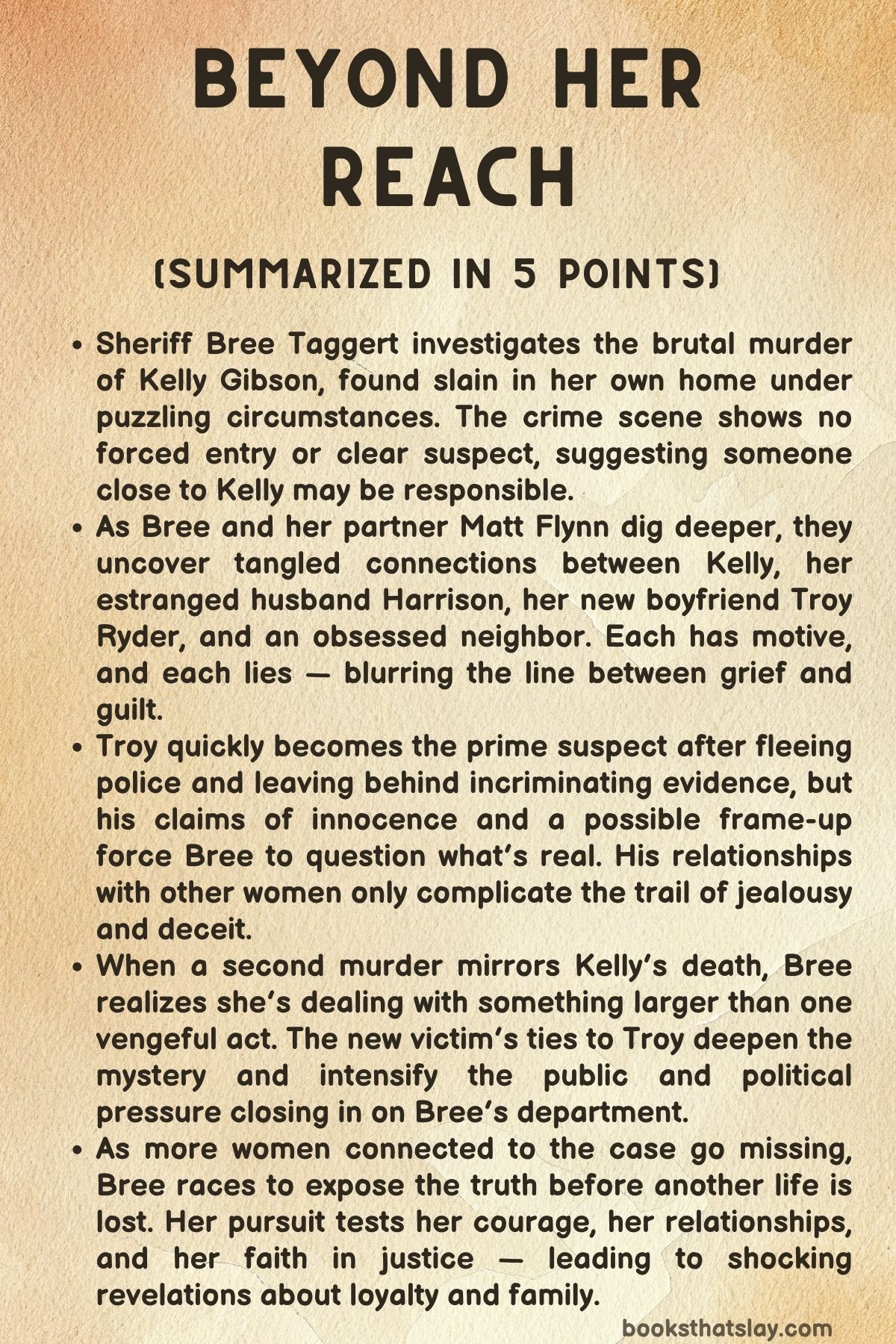
Beyond Her Reach by Melinda Leigh is a suspenseful crime novel centered around Sheriff Bree Taggert, who investigates a series of brutal murders that shake her quiet New York town. When a local mother, Kelly Gibson, is found murdered in her home, Bree’s pursuit of justice exposes a tangle of deceit, jealousy, and revenge.
As she and her partner, Matt Flynn, uncover links between the victim and several potential suspects—including a jealous ex-husband, a volatile neighbor, and a secretive boyfriend—the investigation spirals into a deadly web that tests Bree’s instincts, her relationships, and her resolve to protect those she loves. It’s the 10th book in the Bree Taggert series by the author.
Summary
The story begins with Sheriff Bree Taggert responding to the discovery of Kelly Gibson’s body in a suburban home. A tile contractor had entered the house after Kelly failed to answer the door and found her dead on the couch with her throat slashed.
The crime scene offers few clues—no forced entry, no missing valuables, and footprints limited to the contractor and deputies. Bree’s early observations suggest that the killer was precise, the attack personal, and the weapon sharp and narrow.
Bree and her team, including deputies Renata Zucco and Juarez, begin piecing together the timeline. Kelly’s estranged husband, Harrison Gibson, quickly becomes a person of interest.
He claims he was at a trampoline park with his girlfriend, Marina Maxwell, and her sons during the time of the murder, but Bree senses evasion. Meanwhile, Kelly’s neighbor, Jeff Burke, displays troubling aggression and an obsessive concern for Kelly’s life, further muddying the waters.
Medical examiner Dr. Serena Jones determines Kelly died from blood loss about a day earlier.
Broken nails and fabric under her fingers hint at a brief struggle, but the wound indicates surprise rather than defense. Bree and her partner Matt Flynn reconstruct the murder sequence: the killer approached Kelly from behind and struck swiftly, suggesting personal rage or betrayal rather than random violence.
As Bree and Matt investigate, they uncover more about Kelly’s turbulent personal life. She had separated from Harrison, who resented her newfound independence, and she was dating a man named Troy Ryder.
When Bree and Matt attempt to question Troy, he flees, prompting a high-speed chase that ends with a crash. The abandoned car contains a bloody box cutter and shirt—potential evidence linking Troy to the murder.
A K-9 unit follows a scent trail to a nearby lake, indicating Troy may have escaped by kayak. However, he later turns up at his home, injured but calm, insisting on his innocence.
Troy claims he and Kelly had argued after she said she was pregnant, something he insists was impossible since he’d had a vasectomy years before. He also claims someone stole his car and planted evidence to frame him.
His attorney, Morgan Dane, and private investigator Lance Kruger join the defense, advising him to remain silent. While the physical evidence against Troy looks strong, Bree begins to suspect a setup when inconsistencies appear in the forensic reports.
Further investigation reveals Kelly’s friend, Virginia Hobbs, witnessed Harrison confronting Kelly days before her death. Surveillance footage supports her account.
When Marina confirms Harrison’s alibi but seems evasive, Bree grows certain the couple is hiding something. Surveillance footage from the trampoline park then reveals that Harrison left earlier than he claimed—within the window of Kelly’s death—destroying his alibi.
Before Bree can act, another murder occurs. Janet Hargrave, a quiet freelancer, is found dead in her home, killed in the same brutal manner as Kelly.
Her roommate identifies her ex-boyfriend as Troy Ryder, linking the two victims. Bree now faces public panic and political pressure from County Executive Madeline Jager, who demands fast results.
Bree’s instinct, however, tells her something deeper is at play.
Troy maintains his innocence, explaining he was at his cabin during both murders. His story is partially supported by two cleaners who claim to have seen him that day.
When Bree’s team tests the evidence, Kelly’s blood is found on the box cutter in Troy’s car, but the sock in his hamper contains blood that doesn’t match Kelly—it belongs to someone else entirely. This discovery strengthens Bree’s belief that Troy was framed.
Bree and Matt start connecting patterns between the victims: both had dated Troy and were killed with precision, their scenes staged to implicate him. With the help of forensic analysis, Bree deduces that two people might be working together.
Her attention shifts to Harrison and Marina, who both had motive—financial gain and revenge—and opportunity. As they investigate Marina’s movements, reports come in of an attempted break-in at the home of Barbara James, another woman who had briefly dated Troy.
Soon after, another potential victim, Claudia Ferguson, vanishes. Her house shows signs of a struggle and traces of white fibers later identified as alpaca wool.
A witness provides a breakthrough: a gray-haired woman was seen near Kelly’s house the day of her murder. The description matches Elaine Gibson, Harrison’s mother.
Bree obtains a warrant for the Gibson family farm, which leads to a tense night raid. Inside, deputies encounter deadly booby traps—collapsing stairs, tripwires, and falling debris.
During the search, Elaine confronts Bree and her deputies with a shotgun, while an accomplice—Marina—opens fire from the shadows. After a chaotic shootout, Marina is wounded and captured, and Elaine attempts suicide but survives.
Deputies discover Claudia alive, bound and hypothermic, hidden in a root cellar beneath the farm.
At the hospital, Elaine finally confesses. She admits she killed Kelly to secure Harrison’s financial future and eliminate what she saw as an obstacle to his happiness with Marina.
Elaine and Marina framed Troy by planting his garage code, smearing Kelly’s blood in his car, and placing a bloodied sock in his hamper. When Troy wasn’t immediately arrested, Elaine killed Janet to intensify suspicion.
She and Marina also abducted Claudia, intending to silence her, but the rescue foiled their plan. Elaine claims Harrison knew nothing, though her motives centered on him.
Forensics later corroborate her story, confirming that the blood on the sock was Elaine’s own.
As the dust settles, Bree’s team recovers. Chief Deputy Todd Harvey, injured during the raid, witnesses the birth of his son with Cady Flynn.
Bree, meanwhile, clears Troy’s name and faces off with Madeline Jager, who tries to spin the resolution into political advantage. Amid the aftermath, Bree seeks personal closure about her own past.
A retired social worker helps her understand her late mother’s plans to escape an abusive marriage, easing Bree’s long-standing guilt. Her brother, Adam, proposes using his art earnings to fund a women’s shelter in their mother’s memory, and Bree embraces the idea wholeheartedly.
The novel closes on a hopeful note. After the harrowing investigation, Bree and Matt reflect on their shared resilience and the family they’ve built.
Bree proposes to Matt, who happily agrees, signaling a new beginning built on trust, love, and strength forged through survival. Beyond Her Reach ends not just with justice served, but with the promise of healing and renewal for Bree and those closest to her.
Characters
Sheriff Bree Taggert
Sheriff Bree Taggert is the emotional and moral anchor of Beyond Her Reach, embodying the strength and vulnerability of a leader who has endured personal trauma yet remains steadfast in her duty. She is portrayed as methodical, intelligent, and deeply compassionate, balancing her professional rigor with a genuine empathy for victims and their families.
Bree’s investigative style reflects her sharp instincts and calm authority—she analyzes crime scenes with precision, commands her team decisively, and maintains composure even in chaos. Yet beneath her composed exterior lies the lingering influence of her tragic past, which gives her both resilience and emotional depth.
Her protective nature toward her niece and nephew, as well as her tenderness with her partner Matt, adds a familial warmth that humanizes her amidst the violence and moral grayness of her profession. Bree’s evolution through the novel—particularly her confrontation with familial pain and eventual engagement to Matt—represents her journey toward healing and acceptance, blending her personal courage with professional excellence.
Matt Flynn
Matt Flynn, Bree’s partner both in life and in the field, complements her in temperament and skill. A former investigator with a grounded, empathetic nature, Matt serves as both Bree’s emotional support and her analytical counterpart.
His experience allows him to approach cases with calm rationality, yet his protectiveness of Bree and her family reveals his deep emotional investment. Matt’s quiet strength manifests not only through his investigative insights but also through his capacity for patience, loyalty, and steady affection.
His nurturing side is evident in his interactions with his sister Cady and in moments of levity with Bree’s niece and nephew, where he provides a stabilizing presence. Throughout Beyond Her Reach, Matt’s balance of professionalism and personal warmth reinforces the theme that resilience and love can coexist even in the shadow of violence.
His partnership with Bree underscores mutual respect and equality—two strong individuals working side by side, bound by trust and shared trauma.
Kelly Gibson
Kelly Gibson is the catalyst of the novel’s central mystery, her murder unraveling a web of betrayal, jealousy, and revenge. Initially presented as a victim, Kelly’s backstory reveals a woman striving for independence and transformation after years of emotional suffocation in her marriage.
Her recent lifestyle changes—sobriety, fitness, and newfound confidence—mark her as someone reclaiming agency, which tragically invites resentment from those around her. Through witness recollections, Kelly emerges as kind yet fragile, hopeful yet haunted by past abuse.
Her relationships—with her estranged husband Harrison, her new boyfriend Troy, and her best friend Virginia—reflect her search for stability and affection in a life marred by control and manipulation. The brutality of her death mirrors the societal punishment often faced by women who assert autonomy.
In death, Kelly becomes both a symbol of strength and a victim of toxic dependency, her story driving Bree’s pursuit of justice.
Harrison Gibson
Harrison Gibson is a complex portrayal of narcissism and self-pity masquerading as charm. As Kelly’s estranged husband, he embodies the entitlement and insecurity of a man unable to accept his wife’s independence.
His interactions with law enforcement reveal a veneer of concern quickly replaced by self-centered calculation, fixated on appearances and control rather than grief. Harrison’s lies about his alibi and his attempts to manipulate perception expose his moral decay.
Even as he proclaims innocence, his defensiveness and volatile emotions betray deep resentment. Beyond Her Reach frames Harrison as both a suspect and a mirror for the patriarchal arrogance that fuels much of the story’s violence—men punishing women for leaving or changing.
Yet, as the plot unfolds, it becomes clear that he is not the killer but rather a pawn manipulated by the true masterminds. His character’s downfall lies in his weakness, not malice, serving as a cautionary study in the fragility of ego.
Troy Ryder
Troy Ryder is the enigmatic thread connecting multiple victims, his charm concealing a past shaped by loss and emotional withdrawal. A widower who uses dating apps to find companionship, Troy projects an image of sophistication but remains emotionally distant.
When accused of Kelly’s murder, his evasive behavior and decision to flee suggest guilt, yet his eventual exoneration exposes him as another victim—of manipulation and circumstance. His claim that Kelly’s pregnancy announcement was impossible reveals the psychological strain he carries, rooted in grief and mistrust.
Troy’s relationships with both Kelly and Janet highlight his pattern of seeking connection while remaining detached, a tragic irony that draws dangerous women into his orbit. In Beyond Her Reach, Troy symbolizes the destructive consequences of emotional repression: his failure to confront his past leaves him vulnerable to being framed and misunderstood.
Ultimately, he stands as a man haunted by love, loss, and survival within a world quick to condemn.
Marina Maxwell
Marina Maxwell presents a deceptive contrast of surface gentility and underlying cruelty. Initially introduced as Harrison’s girlfriend and a potential alibi witness, she soon emerges as manipulative, complicit, and emotionally unstable.
Marina’s calculated lies and her willingness to enable Harrison’s deceit position her as a moral foil to Bree. Her sharp temper, witnessed in her interactions with her children, reveals a domestic tyranny that mirrors the psychological abuse Kelly endured.
Beneath her composed exterior lies a craving for control, driven by jealousy and fear of losing social status. By the novel’s climax, Marina’s alliance with Elaine Gibson—Harrison’s mother—exposes her as both participant and puppet in a murderous scheme.
Her downfall is emblematic of self-destruction through greed and moral blindness, reflecting Beyond Her Reach’s recurring theme of women consumed by the desire to please or dominate men.
Elaine Gibson
Elaine Gibson is the most chilling embodiment of twisted maternal devotion in Beyond Her Reach. Her character fuses love, control, and delusion into a force capable of unspeakable violence.
Elaine’s actions—murdering Kelly, framing Troy, and orchestrating further killings—stem from a warped belief that she is protecting her son’s future. She views Harrison not as a grown man but as a fragile extension of herself, a dynamic that distorts her morality.
Her meticulous planning, from booby traps to framing tactics, reveals intelligence darkened by obsession. Elaine’s duality—rural grandmotherly exterior masking a cold, strategic killer—renders her one of the novel’s most psychologically layered antagonists.
Her final confession, tinged with both pride and remorse, exposes the perverse logic that love can justify evil. Through Elaine, the novel explores the terrifying power of familial loyalty turned pathological, a mother’s love transformed into lethal fanaticism.
Jeff Burke
Jeff Burke serves as a volatile reminder of possessiveness disguised as protection. As Kelly’s neighbor and self-proclaimed friend, Jeff’s aggressive behavior and obsessive concern blur the line between devotion and stalking.
His violent temper, evident in his attack on Harrison and his intrusive questioning, paints him as a man consumed by frustration and unrequited affection. Yet, Jeff is not purely villainous; his grief and confusion hint at genuine care twisted by loneliness.
He represents the socially invisible man whose emotions fester in isolation until they erupt in destructive outbursts. In Beyond Her Reach, Jeff functions as both red herring and cautionary figure—a man whose misguided need to be the hero reveals the fine line between justice and obsession.
Virginia Hobbs
Virginia Hobbs, Kelly’s best friend, stands as one of the few steadfastly moral figures in the story. Through her perspective, readers glimpse Kelly’s transformation and the emotional abuse she endured.
Virginia’s loyalty contrasts sharply with the duplicity surrounding Kelly, offering a grounded and compassionate lens on the victim’s humanity. Her recollections provide critical context for Bree’s investigation while underscoring the theme of female solidarity.
Virginia represents the quiet strength of women who bear witness to suffering and insist on truth even when powerless to prevent tragedy. In Beyond Her Reach, she symbolizes integrity and the courage to speak for the silenced, anchoring the narrative’s emotional realism amid its darkness.
Madeline Jager
Madeline Jager, the ambitious county executive, injects political tension into the story’s moral landscape. Her character exposes the bureaucratic pressures and public optics that often interfere with justice.
Madeline’s manipulative charm and eagerness to exploit Bree’s case for publicity create constant friction between governance and law enforcement. She embodies institutional hypocrisy—celebrating victories she didn’t earn and undermining the very people responsible for them.
Yet, beneath her ambition lies insecurity and the desperate need for validation. In Beyond Her Reach, Madeline functions as a secondary antagonist, not through violence but through opportunism, illustrating how corruption can manifest not only in bloodshed but in self-serving ambition.
Todd Harvey
Chief Deputy Todd Harvey is Bree’s loyal colleague and the embodiment of competence and steadfast friendship. His pragmatic approach and unflappable demeanor make him an indispensable pillar of Bree’s team.
Despite being injured during the raid on Elaine’s farm, Todd’s resilience and eventual joy at witnessing his son’s birth serve as a touching reminder of life’s renewal amid death. His subplot balances the novel’s darker elements, showing that dedication to service can coexist with family and hope.
In Beyond Her Reach, Todd represents the everyday heroism of law enforcement professionals who quietly persevere, embodying courage without spectacle.
Cady Flynn
Cady Flynn, Matt’s sister, offers a gentler domestic counterpoint to the story’s intensity. Pregnant and struggling to manage her household, she symbolizes the ordinary life that Bree and Matt fight to preserve.
Her subplot involving the unruly dog Turbo injects warmth and humor into the narrative, humanizing the investigative world through glimpses of familial chaos. Cady’s eventual safe delivery of her baby parallels the story’s thematic rebirth—life persisting after trauma.
Within Beyond Her Reach, she reinforces the idea that love and endurance, however mundane, are acts of quiet heroism.
Themes
Justice and Moral Responsibility
The story of Beyond Her Reach explores justice not as a simple dichotomy of guilt and innocence but as a layered construct built from human frailty, grief, and the relentless pursuit of truth. Sheriff Bree Taggert’s dedication to uncovering the real perpetrator in the face of deceit, political interference, and emotional exhaustion shows justice as an evolving process rather than a fixed end.
Her investigative integrity contrasts sharply with the moral decay seen in characters like Elaine Gibson and Marina Maxwell, who justify murder as a form of protection or vengeance. Their warped moral compass highlights how easily righteousness can be twisted when driven by self-interest or love turned toxic.
Bree’s struggle also reflects the emotional toll that justice demands; she must balance empathy for victims with an unwavering commitment to the law. The theme broadens as the investigation exposes how society often measures justice by results—arrests, confessions, public reassurance—rather than truth.
Political figures like Madeline Jager exploit the case for visibility, turning justice into spectacle. Bree’s quiet defiance of these pressures reaffirms moral responsibility as something internal and sacred.
Ultimately, the book portrays justice not as retribution but restoration: the restoration of truth, dignity, and moral equilibrium in a world corroded by deception and fear. Through Bree’s ethical resilience, the novel suggests that true justice requires courage to resist convenience and compassion to see beyond guilt into the human cost of every crime.
The Complexity of Family and Loyalty
Family in Beyond Her Reach is not an emblem of safety but a source of tension, manipulation, and distorted love. Bree’s personal and professional lives collide through her family relationships—her guardianship of Kayla and Luke, her connection with Matt, and her memories of her mother’s murder—all of which inform how she perceives the victims’ families.
The Gibson family becomes a dark reflection of this dynamic: fractured, embittered, and poisoned by control and resentment. Harrison’s self-absorption, Elaine’s obsessive maternal instincts, and Marina’s willingness to commit atrocities for acceptance reveal how loyalty can become dangerous when it is rooted in fear and possessiveness rather than trust.
Elaine’s murders are framed as acts of devotion to her son, illustrating how familial loyalty can mutate into justification for evil. This theme is deepened by Bree’s confrontation with her own past—understanding her mother’s desire to escape an abusive marriage brings both grief and closure.
It connects her emotionally to the women she seeks to protect and the families she must piece together after tragedy. The contrast between Bree’s nurturing household and the Gibsons’ toxic one underscores the fragile boundary between love that protects and love that imprisons.
In this sense, family loyalty in the novel is both a bond and a burden—a test of one’s ability to love without possession and to protect without control.
Female Strength and Survival
At its core, Beyond Her Reach is a study of women’s endurance in environments shaped by violence, deception, and male dominance. Bree Taggert embodies resilience through intellect and emotional composure, navigating trauma while commanding respect in a profession still shadowed by gender bias.
Her leadership demonstrates that strength lies not only in confrontation but also in empathy and moral clarity. The women around her—Kelly, Janet, Virginia, and even Marina—represent varying shades of strength and vulnerability.
Kelly’s efforts to reclaim her identity through health and independence show a woman fighting for autonomy, only to be destroyed by the forces resisting her change. Janet, disciplined and private, becomes another casualty of misplaced trust.
In contrast, Marina manipulates strength into coercion, illustrating how power without ethics becomes self-destruction. Bree’s interactions with these women mirror her internal evolution; she channels their broken stories into a renewed sense of purpose, ultimately transforming pain into resilience.
The theme extends to the personal as Bree redefines femininity through compassion, decisiveness, and courage, rejecting stereotypes of fragility. The creation of the Mary Taggert Women’s Shelter at the novel’s end serves as both literal and symbolic continuation of this theme—turning survival into legacy.
Through Bree and the women whose stories intersect with hers, the book asserts that strength is not the absence of suffering but the refusal to surrender to it.
Deception and the Search for Truth
The narrative of Beyond Her Reach thrives on deception—lies told to protect, to manipulate, and to conceal guilt. Each major character hides something: Harrison with his false alibis, Marina with her duplicity, and Elaine with her ruthless scheming.
The murders themselves are built on deception—a layered performance meant to frame Troy and mislead law enforcement. This environment of deceit challenges Bree’s instincts, forcing her to navigate half-truths and emotional manipulation while maintaining objectivity.
The theme extends beyond criminal deceit into the subtler moral lies people tell themselves. Elaine’s justification for murder, Harrison’s denial of emotional abuse, and even Bree’s struggle to confront her past all reveal how truth becomes blurred by fear and pride.
The novel presents truth as something that must be earned through persistence, empathy, and self-awareness. Bree’s ability to uncover not just who committed the crimes but why they occurred represents a deeper form of understanding—the recognition that truth often hides beneath grief and denial.
In the end, the revelation of Elaine’s crimes restores order but also exposes the fragility of perception: how easily love, guilt, and desperation can distort reality. The theme of deception thus underscores every moral and emotional choice in the novel, positioning truth not as an endpoint but as an act of courage continually reclaimed in the face of human weakness.