Bitten by Jordan Stephanie Gray Summary, Characters and Themes
Bitten by Jordan Stephanie Gray is a dark fantasy novel that merges supernatural politics, ancient curses, and the brutal hierarchy of werewolf society. The story explores the struggle between destiny and choice, where loyalty, betrayal, and love collide under the moonlight.
Through its richly imagined world of seven ruling courts bound by merciless laws, the novel follows Vanessa Hart—a human girl whose life is violently upended when she becomes part of a centuries-old feud between two royal sisters. Blending romance, mystery, and tragedy, Bitten examines power, vengeance, and the price of transformation.
Summary
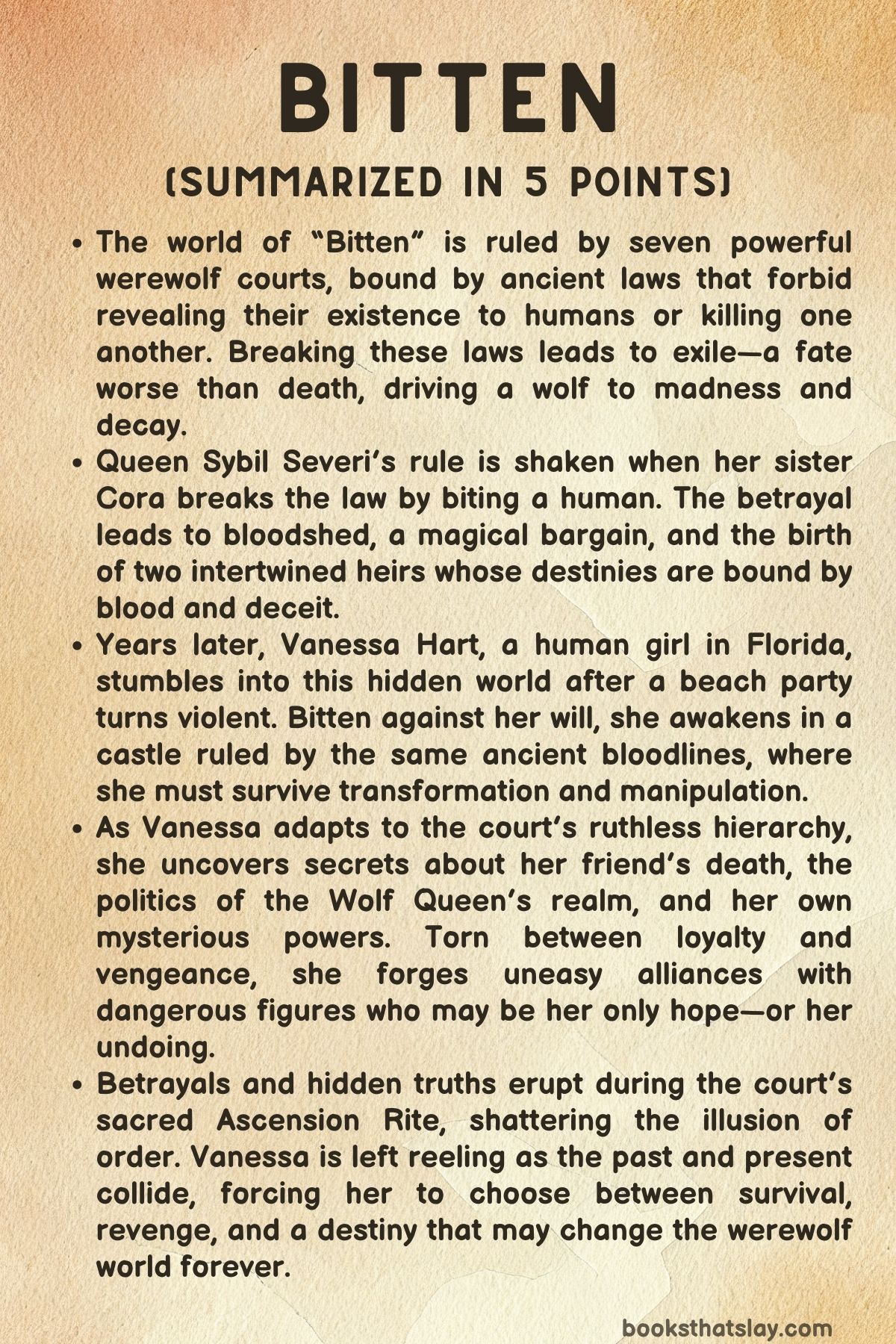
The werewolf world of Bitten is governed by seven powerful courts that maintain order through four unbreakable laws: never reveal your wolf to humans, never share court secrets, never bite humans without the regent’s consent, and never kill another wolf. The penalty for breaking these laws is exile—an agonizing fate known as becoming a Lone Wolf, where madness and death soon follow.
The story opens within the Severi Court, ruled by Queen Sybil Severi. When Sybil discovers her sister Cora in bed with a human man who bears a fresh bite, she denounces her as a traitor.
Cora’s violent resistance leads to bloodshed in the throne room, where she kills a Wolf General, breaking the most sacred law. For this, Sybil exiles her sister forever.
As the magic of exile severs their bond, Cora, broken and pregnant, begs her sister to spare her unborn child. Sybil hesitates—her own son is weak and dying, yet a prophecy claims he will one day be strong.
Using the power of the Cassiopeia constellation, Sybil strikes a blood bargain: if Cora kills her lover and leaves her child at the castle gates after birth, the child will live and be bound to protect Sybil’s heir. Their lives will be linked by blood—if one dies, so will the other.
Cora accepts the cruel deal and kills her lover before fleeing. When she gives birth, she leaves the baby boy at the castle gate and dies soon after.
True to Sybil’s word, the boy grows up beside the prince as his guardian and shadow—two brothers tied by a curse. The narrator hints that the real story begins years later, with a human girl destined to change everything.
In present-day St. Augustine, Florida, seventeen-year-old Vanessa Hart lives an ordinary life with her best friend Celeste Ward.
During an unplanned beach party on Anastasia Island, Vanessa tries to loosen up under Celeste’s encouragement. The night turns dark when Vanessa is shoved by a mysterious stranger—an elegant boy with red eyes.
Moments later, chaos erupts. Celeste is attacked and killed, and Vanessa is dragged into a black SUV by unknown captors.
Bleeding and delirious, she realizes she has been bitten.
Inside the car, a pale man named Lord Allard calmly explains that she is “transitioning” into a werewolf. He tells her that the transformation varies depending on the bite—some lose control and go mad, others die.
He orders her taken to Castle Severi, where she will either survive the change and face the Wolf Queen or perish. When Vanessa resists, he threatens her father and injects her with wolfsbane to force unconsciousness.
She awakens imprisoned in a lavish yet sealed room in the castle. Her body convulses through agonizing waves as her transformation begins.
During this torture, she hallucinates Celeste, whose ghost torments her with guilt and rage. The pain fuels Vanessa’s anger until she finally shifts into her wolf form, bursting through the iron door of her cell.
Following a familiar scent, she enters the throne room of Queen Sybil Severi—the same queen from the ancient prologue. Surrounded by nobles, Vanessa confronts Evie, the girl who killed Celeste, and attacks her.
The queen intervenes, forcing Vanessa to obey with a magical command. To prove her power, she compels Vanessa to bark like an animal, humiliating her before the court.
After dismissing most nobles, Sybil and her son Sinclair test Vanessa’s strength. Though she can be compelled by the prince, she resists the command of a lower-ranked wolf, marking her as something rare and dangerous.
Her molten-purple wolf eyes, unseen before in their history, signify a new and unknown power.
Weeks pass as Vanessa adjusts to life in the castle. She attends lessons, keeps to herself, and investigates Celeste’s death.
Despite her mistrust, she grows close to Sinclair—known as Sin—a prince with his own emotional wounds. Their chemistry builds until they share an intense, forbidden kiss, interrupted by Evie’s jealousy.
That same night, the court learns of a gruesome murder within the castle, and suspicion spreads. When Evie attacks Vanessa publicly, Sin defends her, escalating tensions further.
Driven by grief and anger, Vanessa plots revenge. She steals wolfsbane, intending to poison Evie, but is caught by Calix—the stoic warrior assigned to oversee her.
Their confrontation turns violent, yet Calix saves her from killing herself with the toxin. He reveals his own tragic past and teaches her the difference between vengeance and justice.
A fragile alliance forms between them as both begin investigating the court’s hidden crimes.
Later, at a royal ball before the Ascension Rite, Vanessa sees Evie alive despite believing she died. The girl acts as if nothing happened, deepening the mystery.
At the ball, Sin and Vanessa’s secret feelings flare again. Queen Sybil and Queen Jae—Evie’s mother—notice their closeness, forcing Sin to protect Vanessa with a lie.
He makes her dance with Calix, sparking more tension.
During their dance, Vanessa tells Calix about a dungeon filled with tortured humans. To disprove her, he takes her there—but the dungeon appears clean and empty.
When she insists she’s seen it before, he reveals a terrible truth. The scar on his chest, left by silver, matches the wound Vanessa inflicted on the wolf that killed Celeste.
He confesses that he was that wolf, acting under Queen Sybil’s orders. Devastated, Vanessa attacks him until Sin intervenes.
In the aftermath, Sin admits his own betrayal: he was the one who bit Vanessa the night she was taken, turning her into a wolf to save her life. His confession destroys her trust completely.
During the Ascension Rite, Queen Sybil oversees the next generation’s initiation. Sin is revealed to be an Alpha Dreamweaver, a powerful manipulator of minds.
When asked to name his mate, he defies expectation and claims Vanessa, shocking the entire court. Before anyone can respond, monstrous wolves attack the ceremony, slaughtering nobles and students.
In the chaos, Sin restrains Vanessa using compulsion, claiming he’s protecting her, but she realizes he knew the attack was coming. Many of her friends die, including Oona and Shepherd.
Out of the forest emerges Cora Severi—Sybil’s long-exiled sister—leading an army of her own Bitten wolves. Sin calls her “Mother.
” Cora reveals the truth behind the royal bloodlines: when Sybil and Cora gave birth on the same night, Sybil switched their infants. Sin is Cora’s son; Calix is Sybil’s true heir.
Cora orchestrated the massacre to reclaim the throne. As her army overwhelms the court, Cora kills Sybil and claims victory.
Cora offers the survivors a place in her new order, but Vanessa refuses. In retaliation, Cora exposes another secret—Sin used his Dreamweaver powers to manipulate Vanessa’s memories and dreams.
The illusions she thought were nightmares were his creation, meant to control her. He insists he acted out of love; Vanessa sees only betrayal.
Cora, impressed by Vanessa’s Truthseer ability to sense lies, calls her a weapon of immense value.
With her world shattered, Vanessa makes a cold choice. She pretends to surrender to Cora and tells Sin she loves him, masking her hatred.
Inside, she vows vengeance—for Celeste, for the fallen, and for her stolen humanity. As the sun rises over the bloodstained forest, she and Calix stand among the ruins, determined to reclaim the throne and end the reign of lies, no matter the cost.
Characters
Queen Sybil Severi
Queen Sybil Severi embodies the essence of ruthless authority and political control in Bitten. As the ruling monarch of the werewolf world, she wields power with precision and cold pragmatism.
Her reign is characterized by the four unbreakable laws that maintain order among the wolves, and she enforces these laws with a detachment that borders on cruelty. Her decision to exile her own sister, Cora, demonstrates her unwavering loyalty to the laws above family, yet beneath that regal rigidity lies fear and insecurity—especially concerning her fragile son and the prophecy surrounding him.
Sybil’s actions are driven by a desperate desire to secure her bloodline and legitimacy as queen, even at the cost of love, morality, and justice. Her use of the Cassiopeia constellation to create a blood bargain underscores her cunning intellect and mastery of magical politics, revealing a ruler who will bind lives, twist destiny, and manipulate kinship to maintain power.
Sybil is not purely villainous; she is tragic, a woman consumed by her need for control in a kingdom forever at the brink of chaos.
Cora Severi
Cora Severi is both the emotional heart and the original sin of Bitten. Her impulsive love for a human man and defiance of the sacred laws ignite the chain of events that define the novel’s universe.
Unlike her sister, she is ruled by passion rather than reason—an untamed force of nature whose choices spring from both rebellion and devotion. Her transformation into a white wolf symbolizes purity corrupted by defiance, while her killing of the Wolf General represents both liberation and damnation.
Cora’s exile and death mark her as a martyr of freedom and love, yet her later return as a powerful antagonist reveals how vengeance festers through generations. In reclaiming her throne, she mirrors Sybil’s coldness, proving that love turned to wrath is the most dangerous power of all.
Her manipulation of the Bitten army and her twisted sense of justice transform her into both a liberator and destroyer, blurring the line between heroism and monstrosity.
Vanessa Hart
Vanessa Hart is the emotional nucleus of the story—a girl thrust from normalcy into supernatural horror. Her journey in Bitten is one of violent transformation, not just into a werewolf but into a creature of resilience and moral ambiguity.
Initially naïve and human in every sense, Vanessa’s introduction paints her as vulnerable, overshadowed by bolder figures like Celeste. However, the trauma of her best friend’s death, the agonizing transition into a wolf, and the betrayals that follow strip away her innocence.
Vanessa’s arc is that of a truth-seeker and survivor. Her unique power as a Truthseer symbolizes her struggle to uncover honesty in a world built on deception and compulsion.
Each relationship she forms—whether with Sin, Calix, or Sybil—tests her capacity for forgiveness and strength. By the novel’s end, she evolves into a figure of vengeance and destiny, resolved to dismantle the corrupt court that broke her.
Vanessa’s humanity becomes her weapon, and her wrath, her rebirth.
Sin (Prince Sinclair)
Sinclair, often called Sin, represents the quintessential tragic prince in Bitten, torn between love and duty, truth and deceit. As a Dreamweaver, his powers over illusion and perception mirror his own moral ambiguity.
Sin’s love for Vanessa appears genuine, yet it is tainted by manipulation—his use of illusions to control her mind reveals the duality of his nature. Raised as the heir to Queen Sybil, he embodies royal charisma, strength, and compassion, but beneath that lies a deep fracture: his identity is not his own.
The revelation that he is Cora’s true son, not Sybil’s, unravels his entire existence, turning his devotion into madness. His choices, though rooted in protection, betray the woman he claims to love and the world he seeks to rule.
Sin is both victim and villain, shaped by lies that predate his birth and doomed by the illusions he himself creates.
Calix Severi
Calix is the silent storm of Bitten, a man defined by restraint, guilt, and buried nobility. Raised as Sybil’s second son, he lives in the shadow of Sin, unaware that he is the rightful heir to the throne.
His stoic demeanor conceals an emotional complexity born from loyalty and trauma. Calix’s role as Vanessa’s reluctant ally evolves into something deeper, marked by mutual pain and reluctant trust.
His confession that he killed Celeste under Sybil’s orders shatters his stoicism, revealing a man tormented by the sins of obedience. Calix’s journey is one of atonement; he becomes the embodiment of moral awakening within a world addicted to hierarchy and violence.
Unlike Sin, who manipulates truth, Calix confronts it—even when it destroys him. His ultimate alliance with Vanessa to reclaim justice positions him as both a redeemer and tragic hero, destined to rise from blood and betrayal.
Celeste Ward
Celeste Ward, though her life ends early, casts a long shadow throughout Bitten. She is the spark that ignites Vanessa’s transformation and symbolizes lost innocence.
Her vivacious personality and reckless joy contrast sharply with Vanessa’s cautious nature, embodying freedom unrestrained by fear. Celeste’s death is both literal and metaphorical—the end of Vanessa’s human world and the beginning of her monstrous awakening.
Through Vanessa’s hallucinations and memories, Celeste becomes a haunting voice of guilt and rage, blurring the boundary between ghost and conscience. Her memory drives Vanessa’s need for justice and her descent into vengeance, making Celeste both muse and martyr.
Evie
Evie represents jealousy, privilege, and the corrosive nature of power in Bitten. As the daughter of Queen Jae and Sin’s betrothed, she personifies entitlement and cruelty shaped by expectation.
Her rivalry with Vanessa transcends personal hatred—it is a reflection of societal hierarchy and female rivalry under patriarchal rule. Evie’s mockery and violence expose her insecurity; she clings to her status because it is the only identity she knows.
Yet her death and strange resurrection complicate her character, hinting at manipulation beyond her control. Evie is less an independent antagonist and more a tragic pawn, a mirror to Vanessa’s potential corruption if vengeance consumes her completely.
Lord Allard
Lord Allard is the cold embodiment of aristocratic obedience in Bitten. As Sybil’s enforcer, he operates with precision and cruelty, maintaining the illusion of order through fear.
His calm demeanor during Vanessa’s abduction and transformation establishes him as both mentor and tormentor. Allard’s loyalty to the crown surpasses empathy, making him a chilling symbol of how institutional devotion dehumanizes even the powerful.
Yet, there are flickers of regret in his measured cruelty, suggesting that beneath the monstrous facade lies a man long broken by servitude.
Oona
Oona serves as a fragile yet vital thread of humanity within the brutal world of Bitten. Initially a servant to Vanessa, she evolves into a figure of quiet loyalty and compassion.
Her nervous manner and awkward affection for Instructor Shepherd highlight her innocence amidst savagery. Oona’s presence reminds readers that kindness can exist even in corrupted systems.
Her tragic death during the Ascension Rite massacre signifies the collapse of that fragile goodness, deepening Vanessa’s isolation and fueling her resolve to rebel.
Instructor Shepherd
Instructor Shepherd, though a minor figure, represents moral intellect and academic curiosity in Bitten. His role as a teacher of the werewolves marks him as an intermediary between knowledge and violence.
His gentle bond with Oona and his mentorship of Vanessa offer moments of light in a dark narrative. His death during the chaos of the Ascension Rite underscores the extinction of reason within a society ruled by blood and superstition.
Queen Jae
Queen Jae, mother of Evie and co-ruler of another wolf court, embodies the political cruelty and manipulation that define the Seven Courts. She contrasts Sybil through her fiery temperament and overt ambition.
Jae views marriage alliances and bloodlines as weapons in the eternal chessboard of power, and her fury at Sin’s rejection of Evie exposes both maternal pride and imperial ego. Her dynamic with Sybil is one of rivalry and mutual contempt, symbolizing the broader decay within the ruling order.
Themes
Power and Corruption
In Bitten, power is not simply authority—it is survival, lineage, and identity. The werewolf courts operate through rigid hierarchies and merciless enforcement of their four laws, where the punishment for transgression is exile and eventual madness.
From the earliest scenes between Queen Sybil and her sister Cora, power is portrayed as something that consumes rather than protects. Sybil’s authority rests not on justice but on fear and blood bargains.
Her choice to bind her sister’s unborn child to her own heir exposes how governance in this world is sustained through coercion and manipulation. The court’s nobles, obsessed with rank and obedience, mirror Sybil’s ruthlessness, creating a culture where morality is secondary to control.
As the story unfolds, Vanessa’s abduction and forced transformation reveal how deeply corruption runs within this system. Lord Allard and Calix enforce the queen’s will with clinical detachment, proving that even loyalty has been tainted by fear.
By the time Vanessa discovers the truth about Sin’s manipulation and the queens’ deceit, the narrative exposes that power within the werewolf world has become a parasitic force—one that feeds on blood, secrets, and emotional submission. The system’s collapse during the Ascension Rite is less a tragedy than an inevitable reckoning.
The destruction of the courts symbolizes the implosion of an order that could not sustain itself without exploiting the bodies and wills of others. In the end, power in Bitten is shown to corrode every bond—familial, romantic, or political—until the only path left is rebellion.
Identity and Transformation
Transformation in Bitten functions on multiple levels: physical, emotional, and moral. Vanessa’s evolution from a hesitant teenage girl into a supernatural being capable of both violence and discernment mirrors the painful process of identity formation.
Her forced metamorphosis is not a gift but an act of violation. Every convulsion, hallucination, and burst of rage marks her body as a battleground between human vulnerability and the monstrous power forced upon her.
Yet beneath the torment lies an existential question—what does it mean to be human when humanity itself becomes fragile and corrupt? Vanessa’s wolf is not an alter ego but an exposed truth, the raw embodiment of her suppressed desires, grief, and anger.
The story contrasts her unwilling transformation with the inherited power of born wolves like Sin and Calix, underscoring how identity in this world is tied to origin and bloodline. However, Vanessa’s defiance reshapes that hierarchy; her refusal to submit to compulsion challenges the court’s genetic determinism.
Her molten purple eyes, unique among wolves, symbolize the emergence of a new identity that transcends inherited definitions of species and class. By the conclusion, Vanessa’s identity is forged not through belonging but through resistance.
Transformation, then, becomes less about the supernatural act of turning into a wolf and more about reclaiming agency in a world that sought to define her through pain.
Betrayal and Trust
Every relationship in Bitten carries the shadow of betrayal. From the opening act, when Sybil condemns her own sister to exile, the novel establishes treachery as the price of survival.
Bonds of love and loyalty exist only to be tested and broken. Cora’s forced betrayal of her human lover mirrors the court’s twisted moral code—obedience over affection, power over compassion.
This pattern repeats in Vanessa’s experiences, as she’s deceived by every figure who offers protection. Sin’s confession that he bit her to “save” her exposes the cruel irony that even love in this world is expressed through domination.
The revelation that Calix, who seemed a reluctant ally, was the wolf who killed Celeste deepens Vanessa’s isolation. Trust, once broken, becomes impossible to restore, leaving her surrounded by deceit masked as duty.
The ultimate betrayals—Sin’s dream manipulations and Cora’s orchestration of the massacre—reveal how manipulation has become indistinguishable from affection in the werewolf hierarchy. Yet betrayal in Bitten is not only destructive; it also catalyzes awakening.
Vanessa’s capacity to lie to Sin at the end, declaring love while vowing revenge, marks her mastery of the same deceit once used against her. In a world where truth is weaponized, her survival depends on learning to wield falsehood as both armor and blade.
Love, Obsession, and Control
The novel transforms romantic attraction into a study of possession and control. Sin and Vanessa’s relationship oscillates between tenderness and coercion, illustrating how easily passion can blur into domination.
Sin’s compulsion over Vanessa’s body and dreams reveals the invasive nature of werewolf love, where intimacy often becomes indistinguishable from manipulation. His justification—that his actions were to protect her—reflects a broader pattern within the werewolf courts, where affection is frequently a pretext for control.
Similarly, Sybil’s maternal love for her heir is tainted by obsession with destiny, compelling her to bind her child’s life to another’s through magic. Cora’s maternal love becomes destructive vengeance, erasing entire bloodlines to reclaim what she believes was stolen.
Through these distorted expressions of care, Bitten argues that love, when entangled with hierarchy, becomes a mechanism of power rather than liberation. Vanessa’s eventual rejection of both Sin’s and Cora’s dominance signifies a reclamation of emotional autonomy.
Love, for her, transforms from a force of submission into an act of defiance—a decision to feel without surrendering freedom. In this sense, the novel reframes love not as redemption but as resistance, the refusal to let desire erase selfhood.
Fate, Choice, and Moral Ambiguity
Throughout Bitten, destiny operates as both a curse and a construct. Prophecies, bargains, and bloodlines bind every major character to paths they cannot easily escape.
Sybil’s belief in her son’s prophesied strength justifies the atrocities she commits; Cora’s sense of injustice fuels her rebellion; and Sin’s manipulation of Vanessa’s mind is rationalized as inevitable fate. Yet the novel persistently undermines the idea of predestination.
Vanessa’s Truthseer ability—a power that exposes lies—becomes the narrative’s moral compass, suggesting that fate loses its grip when confronted with knowledge. Her final deception, lying to Sin about loving him, embodies the paradox of choice within constraint.
She cannot undo her past or the forces that shaped her, but she can decide how to respond. Every character’s downfall stems from confusing destiny with justification, using prophecy as an excuse for cruelty.
The novel’s conclusion, with Vanessa and Calix preparing to reclaim the court, blurs the line between justice and vengeance. It suggests that moral clarity is impossible in a world built on cycles of blood and betrayal.
Choice, in the end, does not absolve anyone—it only determines what kind of monster they become.