Blackwicket by Bea Northwick Summary, Characters and Themes
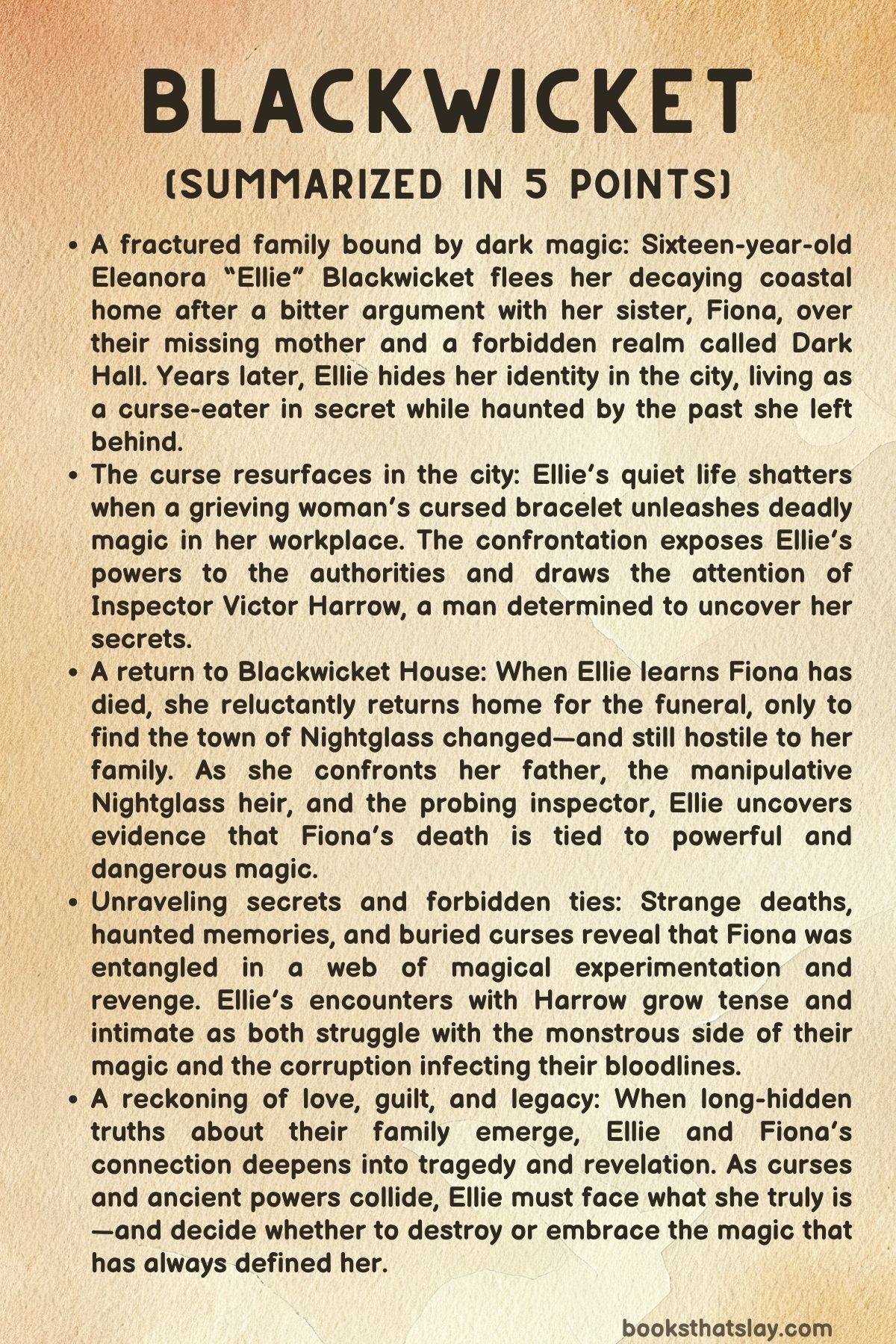
Blackwicket by Bea Northwick is a gothic fantasy novel set in a decaying coastal world haunted by magic, grief, and legacy. The story follows Eleanora “Ellie” Blackwicket, a young woman born into a cursed family with the power to consume corrupted magic.
Years after fleeing her ancestral home, she is drawn back to confront the death of her sister, Fiona, and uncover the truth about their family’s dark connection to a forbidden realm known as Dark Hall. Through betrayal, loss, and revelation, the novel explores power, inheritance, and the blurred boundaries between protection and destruction.
Summary
Eleanora “Ellie” Blackwicket wakes in her childhood home to the sound of her sister Fiona weeping. Their ancestral mansion, Blackwicket House, feels strange and hollow—the guardian creature known as a Drudge has vanished.
When Ellie finds Fiona near the sealed Narthex, the portal that once led to Dark Hall, Fiona reveals their mother has crossed into that forbidden realm, an act tantamount to death. The revelation breaks what little stability they had left.
Their argument exposes years of resentment—Ellie’s interference, Fiona’s submission to Grigori Nightglass, and the town’s hatred of their bloodline. Fiona admits that Grigori plans to claim her life in exchange for magical sponsorship.
In anguish and fury, Ellie leaves home at sixteen, vowing never to return.
Years later, Ellie lives under the name Elizabeth Knoles in the bustling city of Devin, hiding that she is a Curse Eater—someone capable of absorbing cursed magic. She works quietly in a department store until a cursed incident exposes her secret.
A grieving woman, Ms. Rosley, enters the store wearing a cursed bracelet meant to consume her life.
Ellie intervenes, absorbing the emerging Drudge and saving the woman, but in doing so, reveals her true nature. Inspector Victor Harrow of the Authority, who has long suspected her involvement in a previous death, spots her.
As she flees through the alleys, she is intercepted first by a mysterious witch and then by her estranged father, Darren. He saves her by forcing the Drudge out of her body and reveals that the Authority is hunting her.
He also delivers devastating news—Fiona is dead.
Despite her vow never to return, Ellie travels with Darren back to their coastal town for Fiona’s funeral. The town of Nightglass has changed, but its people still fear the Blackwickets.
At home, the house hums with old magic. Inspector Harrow arrives soon after, announcing that he will stay in the house as part of his investigation into Fiona’s death.
Ellie resents his intrusion but cannot drive him away. The next days bring encounters that blur the past and present—strange townspeople, hostile gentry, and the lingering presence of curses.
When Ellie visits the morgue to change her sister’s burial, she meets William Nightglass, Fiona’s former lover and the heir of the ruling family. He is powerful and wounded, but his authority over the town is absolute.
He reveals that Fiona was found dead by curse magic and subtly blames Ellie for abandoning her. She insists on burying Fiona at Blackwicket House instead of the Nightglass estate, but the confrontation with William reopens old wounds.
Viewing Fiona’s body, Ellie discovers a hidden Drudge crawling from beneath her sister’s skin, proving that the curse still lingers. Mr.
Farvem, the mortician, warns her that the town’s elite are tampering with forbidden magic, and that Fiona was caught in the crossfire.
As grief consumes her, Ellie’s fragile control shatters. Her father admits to being paid by William to bring her home, and when she tries to retrieve a photograph of a boy linked to Fiona’s past, she finds Darren murdered, his throat slit.
The shock is overwhelming—her father, the undertaker, and others tied to her family die in the same brutal fashion. Inspector Harrow, despite his role as investigator, shows unexpected compassion and takes her back to the house.
Their strained alliance evolves into something more intimate and dangerous as they share secrets and battle curses that seem drawn to them both.
The tension peaks when the undertaker, Mr. Farvem, reveals himself as part of a faction called the Veil—an extremist group that hunts magic users.
He attacks Ellie, blaming her family for the corruption of magic. She barely survives, saved by Harrow, who kills Farvem after a violent struggle.
The pair’s bond deepens as they confront the chaos together, and in the aftermath, their shared grief and power bring them physically closer. Yet Harrow’s monstrous nature emerges—he too is cursed, a living product of magical experiments.
His transformation horrifies him, but Ellie accepts what he is.
Ellie begins piecing together Fiona’s final days. Photographs and blackberry flowers link her sister to a string of disappearances, revealing that Fiona had been poisoning people through enchanted jam to destroy those connected to the Brom—a secretive order seeking to control or eliminate magic.
When Harrow confirms that all the missing people appear on the Authority’s lists, it becomes clear that Fiona’s death is part of a larger war.
Soon, chaos strikes again. A young boy named Jack is brought to Ellie’s door, afflicted with multiple curses.
She and Harrow work together to save him, discovering that Jack’s magic mirrors their own—a sign he was born of Dark Hall. Their victory is brief.
The town unravels as William Nightglass, now violently unstable, tries to seize control through forbidden rituals. At the Nightglass estate, a confrontation erupts.
William attempts to dominate Ellie, and Harrow’s cursed form explodes into being, releasing Blackwicket curses that devastate the estate. In the chaos, Ellie kills William to stop him, and the mansion burns as Harrow rescues her from the flames.
Ellie awakens in a seaside refuge, tended by Harrow. Their shared suffering draws them together once more, and Harrow finally reveals the full horror of his past.
Grigori Nightglass, his father, experimented on both his sons to create Drudge soldiers. Harrow’s monstrous nature is the result of these experiments, while William’s sanity was destroyed by their father’s cruelty.
Ellie and Harrow find a fragile peace together—until a weakened Drudge appears, transforming into Fiona, alive but no longer fully human.
Fiona confesses that she became a Drudge herself after years of absorbing curses. She faked her death to dismantle the Brom and exact revenge on those who exploited her family.
She admits to killing several men—including their father—and reveals that their mother, Isolde, became the Drudge known as Auntie. The Blackwickets, she says, were creations of Dark Hall’s magic, not born but made.
Fiona’s final plan is to stop William, whose spirit has fused with the Fiend, a monstrous being from Dark Hall. The group—Ellie, Harrow, Fiona, and their allies—race to Blackwicket House, where Fiona opens a Narthex to the other realm.
Inside Dark Hall, they face horrors from beyond reality. Thea and Jack are held captive by William, now merged with the Fiend.
A brutal battle follows, with Ellie and Harrow fighting together as William attempts to merge his Drudge with Harrow’s. To save him, Ellie absorbs the curse herself, sacrificing her humanity.
Fiona fires the final shot, destroying William’s body as the Fiend drags his essence into the void. In the collapse of the Narthex, Fiona is mortally wounded.
She dies in Ellie’s arms by the sea, confessing that she created Roark—the boy born of Dark Hall—as her son.
As the house crumbles, Ellie and Harrow, joined by Thea and Jack, are found by otherworldly agents who open a portal to Elsewhere—a surviving realm untouched by Dark Hall’s corruption. Ramsey and Hannah warn them that the Authority will hunt them for their unnatural power.
Hand in hand, Ellie and Harrow step through the Narthex, leaving behind the ruins of Blackwicket House, Fiona’s grave, and their haunted world for a new beginning in the unknown.
Characters
Eleanora “Ellie” Blackwicket
Eleanora Blackwicket stands at the turbulent heart of Blackwicket—a woman forged by abandonment, guilt, and cursed magic. From the beginning, she is portrayed as both vulnerable and formidable, her life defined by the legacy of her family’s decaying magic and the monstrous power she carries within.
Her transformation from the frightened girl who fled her home into the hunted Curse Eater of Devin reveals a character torn between survival and atonement. Ellie’s ability to absorb Drudge—manifestations of corrupted magic—symbolizes her burden of taking in the darkness of others, an act that saves lives yet isolates her further.
Her fractured relationships with her family, especially Fiona and Darren, deepen her sense of alienation, while her constant confrontation with Authority figures and the haunted ruins of her lineage underscores her internal conflict: she is both destroyer and savior, inheritor of a cursed legacy and its reluctant redeemer. Over time, Ellie’s courage becomes inseparable from her despair.
Her intimacy with Victor Harrow unites two beings shaped by suffering, each capable of monstrosity yet striving for humanity. Ultimately, she emerges as a tragic heroine—a woman whose compassion costs her everything but whose endurance redefines the meaning of redemption.
Fiona Blackwicket
Fiona Blackwicket is the ghostly shadow of her sister’s conscience and the story’s moral enigma. At once victim and executioner, she embodies the cycle of vengeance that curses the Blackwicket bloodline.
Once dependent and yearning for freedom, Fiona evolves into a woman who wields magic as both weapon and penance. Her descent into becoming a Drudge parallels Ellie’s struggle against corruption, yet Fiona’s path is marked by a fatal conviction that justice can be carved through destruction.
She kills men who abuse and exploit, viewing herself as the hand of retribution, but each act consumes more of her humanity. Her revelation as the orchestrator of several deaths and as the mother of Roark—created through forbidden magic—cements her as both creator and destroyer.
Fiona’s final sacrifice, opening the Narthex to Dark Hall to save her sister and the child, transforms her into the very guardian their mother once was. Through Fiona, Blackwicket explores how love can twist into obsession, how justice can mirror cruelty, and how redemption may lie only in death.
Victor Harrow
Inspector Victor Harrow is a man fractured between duty and damnation. Initially introduced as a cold investigator hunting Eleanora, he gradually reveals himself as another victim of Grigori Nightglass’s grotesque experiments.
Within him resides a monstrous Drudge, the manifestation of his father’s attempt to weaponize curse magic. His transformation—both literal and emotional—mirrors Ellie’s own: a man learning to reconcile the monster within with the humanity he fears he’s lost.
His connection with Ellie transcends survival; it becomes an intimate merging of two corrupted souls seeking solace in each other’s brokenness. Victor’s sense of justice clashes with his guilt, particularly regarding the deaths that orbit Eleanora’s life.
His tragic awareness that he is both protector and threat lends his character an aching complexity. By the novel’s end, Victor embodies the fragile possibility of redemption—that even those shaped by horror can still choose tenderness and truth.
Darren Blackwicket
Darren, the estranged father, is a man steeped in guilt and compromise. Once a smuggler of cursed relics, he is defined by cowardice disguised as pragmatism.
His love for his daughters is genuine but corrupted by his moral decay; he sells Eleanora out to William Nightglass under the guise of protection, perpetuating the betrayal that defines the Blackwicket family. Darren’s death—violent, undeserved, yet hauntingly fitting—serves as both punishment and release.
He dies as he lived, caught between love and deceit, his final confession revealing how deeply he was ensnared in Nightglass’s web. Through Darren, Blackwicket explores the moral erosion of a man who mistakes survival for salvation, and the lingering cost of paternal failure in a world where bloodlines are both curse and chain.
William Nightglass
William Nightglass represents the seductive face of power—aristocratic, magnetic, and steeped in inherited corruption. His duality as Fiona’s former lover and Eleanora’s oppressor situates him at the moral center of decay within the story.
Once a man of charm and intellect, William’s descent into obsession and violence mirrors the rot of Nightglass itself. He becomes a living embodiment of the town’s moral collapse—one who manipulates both politics and magic to assert control.
His relationship with his brother Victor exposes the generational trauma inflicted by their father, Grigori. By the time of his death, consumed by fire and curse, William is less man than symbol: the manifestation of power unrestrained by conscience.
His fall is both horrifying and cathartic, a purification by flame that consumes the empire his cruelty sustained.
Grigori Nightglass
Though absent for much of the narrative, Grigori Nightglass’s influence poisons every life in Blackwicket. He is the origin of the story’s corruption, a patriarch whose obsession with controlling curse magic leads him to mutilate his sons and destroy his legacy.
His experiments—creating Drudge soldiers and manipulating Dark Hall’s power—blur the boundary between science and sadism. Grigori’s legacy is not merely in his creations but in the trauma he breeds; he turns love into a laboratory and family into an experiment.
The horrors he unleashed ripple through generations, rendering him the unseen architect of everyone’s suffering. Even in death, his shadow endures as the prime mover behind the decay of both the Nightglass family and the world they tried to dominate.
Isolde Blackwicket (“Auntie”)
Isolde, mother of Eleanora and Fiona, is the lost matriarch who becomes myth incarnate. Her transformation into the Drudge known as Auntie fuses motherhood and monstrosity into one tragic being.
In life, she was the emotional anchor of Blackwicket House; in death—or transformation—she becomes its guardian spirit, the spectral embodiment of sacrifice and suffering. Through Auntie, the novel reframes monstrosity as devotion taken to its extreme—she protects her daughters even in cursed form.
Her reemergence near the end as both savior and curse completes the cycle of maternal legacy in Blackwicket: each Blackwicket woman inherits both love and damnation from the one before her. Isolde’s existence questions whether the boundary between magic and motherhood can ever be pure, or whether creation itself is an act of consuming love.
Jack
Jack serves as both catalyst and symbol of continuity—a child marked by the same magic that defined Eleanora and Fiona. His presence reawakens the story’s central question: can innocence survive in a world shaped by curses?
As a child from Dark Hall, Jack embodies the potential for healing or destruction. He becomes the mirror in which Eleanora sees her own beginning, and his survival represents the fragile hope that the Blackwicket curse might one day evolve into something gentler.
Jack’s role in the final confrontation, as vessel and victim, binds him irrevocably to the cycle of Dark Hall, but his rescue ensures that not all magic born of corruption must end in tragedy.
Patrick Farvem
Patrick Farvem begins as a kindly mortician but is later revealed as a member of the Veil, a secretive group committed to exterminating powerful magic users. His duality—gentle mourner and silent executioner—embodies the novel’s fixation on moral grayness.
Through him, the narrative examines how righteousness can decay into fanaticism. Farvem’s betrayal and death reinforce the theme that violence begets violence, even when cloaked in purpose.
His actions against Fiona and later Eleanora blur the line between justice and vengeance, showing that zeal, no less than magic, corrupts the soul.
Themes
Identity and Transformation
Identity in Blackwicket operates as a shifting and volatile force, shaped by bloodline, trauma, and the corruptive nature of magic. Eleanora’s evolution from Ellie Blackwicket to Elizabeth Knoles and finally back to her original self embodies a struggle to define who she is beyond what she has inherited.
Her transformation mirrors the curse she bears—absorbing darkness to contain it, a physical manifestation of the emotional burden she carries from her family’s legacy. The revelation that she and Fiona were creations of Dark Hall, rather than natural-born daughters, complicates this search for selfhood.
It strips identity of traditional meaning and forces Eleanora to confront the horrifying idea that her humanity and monstrosity are inseparable. The narrative suggests that identity is not static; it mutates through survival, guilt, and love.
Victor Harrow’s dual existence as both man and Drudge parallels Eleanora’s own fractured nature, creating a haunting reflection between them. Both are forced to reconcile the parts of themselves society deems unholy.
In this way, Blackwicket becomes a meditation on whether identity is something chosen or inherited, and whether redemption is possible when one’s very existence defies natural order. The transformations—emotional, physical, and magical—reveal that selfhood in this world is not about purity or morality, but about endurance.
Eleanora’s acceptance of her cursed self by the end signifies a reclamation of power, a refusal to let lineage or fear dictate who she becomes, even as she steps into an uncertain new realm.
Family, Legacy, and Inherited Corruption
Family in Blackwicket is both the source of salvation and damnation. The Blackwicket bloodline is burdened by the sins and experiments of their forebears, especially Grigori Nightglass and Isolde Blackwicket, whose obsessions with magic and control fracture generations.
The novel portrays family as a chain of debts—emotional, moral, and magical—that the living must pay for the dead. Eleanora’s resentment toward Fiona, her grief over their mother’s disappearance, and her conflicted bond with her father Darren reveal how love in this family is indistinguishable from damage.
Each relationship is tainted by manipulation and secrecy, producing a cycle of betrayal and atonement. Fiona’s descent into becoming a Drudge symbolizes how familial devotion can twist into vengeance, while Eleanora’s efforts to save her sister become acts of both love and defiance.
The story redefines family as something forged in survival rather than birthright. Even as blood binds them to darkness, the sisters’ loyalty to one another remains the novel’s emotional spine.
Their shared inheritance—the ability to absorb and manipulate cursed magic—reflects the moral inheritance of their lineage: power born from corruption. The tragedy of Blackwicket lies in how each generation tries to use that power for protection, only to perpetuate destruction.
In the end, Eleanora’s act of embracing her heritage while choosing a different path breaks the family’s cycle. She refuses to repeat their sins, proving that legacy can be transformed, not erased.
Power, Corruption, and Control
Power in Blackwicket exists as a contaminant—something that seduces, mutates, and destroys those who seek to master it. Magic, in this world, is inseparable from moral decay; it consumes the soul as much as it amplifies ability.
The Authority, Grigori Nightglass, and the Veil all represent different faces of control, using curses, experiments, and fear to dominate others. Through these institutions, the novel examines how power justifies cruelty under the guise of order or progress.
Eleanora’s role as a Curse Eater positions her uniquely within this system. She absorbs corruption to protect others, but each act erodes her body and spirit.
The paradox of her gift mirrors the broader political corruption around her: salvation that demands self-destruction. Victor’s condition—created through his father’s experiments—shows how control over others’ power becomes a means of dehumanization.
Even Fiona’s vengeance, which begins as righteous rebellion, becomes corrupted by obsession until she too becomes what she once fought against. The novel uses these interlocking stories to critique systems that equate dominance with safety.
Every attempt to regulate magic only breeds further instability, suggesting that control itself is the true curse. By the conclusion, Eleanora’s rejection of both the Authority and the Veil signifies a rejection of that ideology.
True power, the book implies, lies not in domination or purification, but in coexistence—with one’s darkness, one’s history, and one’s own flawed humanity.
Guilt, Redemption, and the Cost of Survival
The emotional weight of Blackwicket centers on guilt and the desperate need for redemption. Eleanora carries the guilt of leaving Fiona, of causing deaths through curses, and of inheriting a family that thrives on secrecy and sin.
This guilt shapes every decision she makes, driving her toward dangerous acts of penance—absorbing Drudges, confronting Harrow, returning to Blackwicket House. Her survival is never a victory but a negotiation with loss.
Each time she escapes death, she sacrifices a piece of herself, both physically and spiritually. Fiona’s confessions toward the end mirror Eleanora’s own burden: both sisters act from love and vengeance, and both face the impossible task of redeeming the unredeemable.
The book argues that redemption is not achieved through purity or forgiveness but through acknowledgment. When Eleanora accepts her role in the family’s legacy of destruction, she stops seeking absolution and starts building meaning from ruin.
Victor’s presence reinforces this theme; his monstrous transformations are literal embodiments of guilt made flesh, yet Eleanora’s acceptance of him signals that compassion is the only path through shame. The deaths of Fiona and Darren, tragic as they are, cleanse the narrative of illusion, leaving Eleanora free to define her survival as its own form of redemption.
Blackwicket suggests that guilt cannot be erased, only lived with, and that the endurance of love in the face of corruption becomes the truest act of grace.