Burning Daylight Summary, Characters and Themes
Burning Daylight by Emily McIntire is a modern romantic drama set against the backdrop of generational conflict, power, and forbidden love. It tells the story of Juliette Calloway and Roman Montgomery—two heirs to rival families whose feud runs deep in the foundations of Rosebrook Falls.
As the weight of legacy, betrayal, and manipulation closes in, Juliette and Roman must decide whether love can survive the sins of their bloodlines. The novel blends romance with mystery and suspense, exploring the darkness of family loyalty, the corruption of influence, and the courage it takes to break free from a destiny shaped by others.
Summary
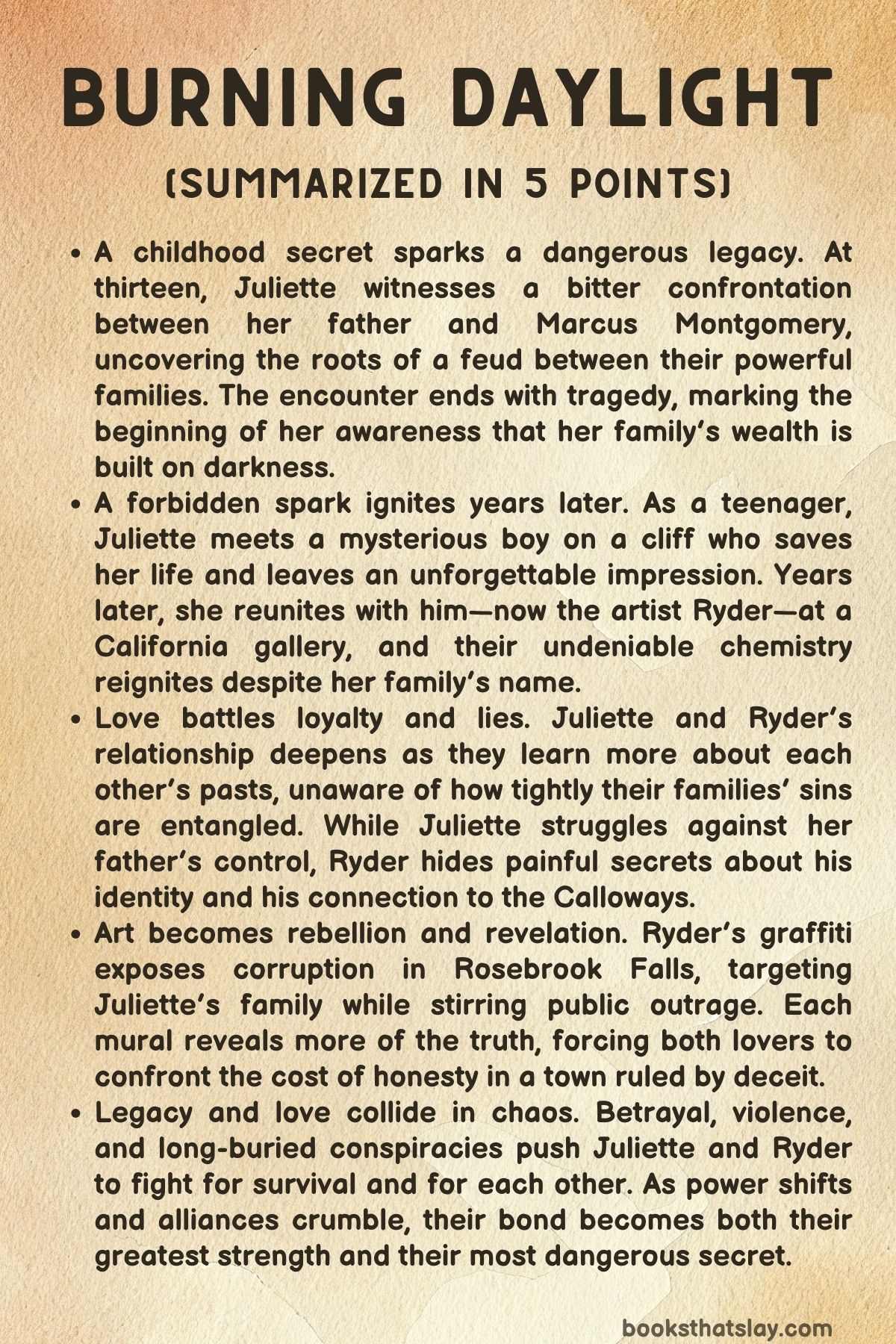
The story begins when thirteen-year-old Juliette Calloway hides in her family’s mansion and overhears a heated confrontation between her father, Craig Calloway, and Marcus Montgomery, a man despised by the Calloways. Marcus accuses Craig of exploiting the residents of HillPoint and of engineering violence to maintain control.
Their quarrel centers on the century-old WayMont agreement that binds their families in rivalry. When Marcus refuses Craig’s demands, Craig ominously warns him about his son.
Days later, news breaks that artist Heather Argent and her children have died in a car crash in Montgomery territory, and Juliette catches her father smiling—an unsettling sign of something sinister beneath the tragedy.
Years later, at seventeen, Juliette reflects on the cursed history of Rosebrook Falls and her family’s obsession with alliances built through arranged marriages and manipulation. During her brother Paxton’s engagement party, Juliette searches for her missing brother Lance at a cliffside spot called Upside Down Rock.
There she nearly falls but is rescued by a mysterious young man who calls her “Princess. ” Their playful and flirtatious encounter leaves a deep impression on her, and she writes about him in her notebook, turning him into a fantasy.
She revisits the spot several times, hoping to see him again, but he never returns.
At twenty-one, Juliette is in college and lives under the watchful expectations of her family. Her best friend Felicity encourages her to have fun before graduation, dragging her to an art show featuring a mysterious graffiti artist known only as RMO.
Meanwhile, Roman Montgomery—Marcus’s estranged son—struggles to support his drug-addicted mother and sick sister, Brooklynn. He refuses to seek help from his powerful father, who abandoned them years ago.
At the art show, Juliette is drawn to the paintings and unexpectedly reunites with the same boy from Rosebrook Falls—now revealed as Ryder, or Roman. Their chemistry reignites instantly.
They flirt, challenge each other, and share a tense almost-kiss before parting. Roman returns home to sketch her, realizing the depth of his attraction, while Juliette tries to rationalize her emotions despite knowing the danger of falling for a Montgomery.
The next morning, Juliette’s family demands she skip her graduation to attend a political event in Rosebrook Falls. Frustrated and impulsive, she follows Roman to his apartment to apologize for the tension between them.
He eventually agrees to draw her. During the session, they talk about art, identity, and the suffocating expectations of their families.
The walls between them collapse as they give in to desire, only to be interrupted by Roman’s unstable mother, Heather. Heather recognizes Juliette’s surname and lashes out, calling her a threat.
Juliette leaves, humiliated, though Roman chases after her to make amends. Before she departs, he reveals his true name, solidifying the connection between them—and the danger.
Soon, Roman’s father reappears, pressing him into a dangerous mission: use his graffiti to expose the corruption of the Calloways. Roman agrees out of desperation to provide for his sister.
His murals—bold, accusatory pieces depicting power and decay—start to appear across town, igniting public controversy. Juliette secretly stays in touch with Roman, conflicted by her family’s fury over the graffiti that implicates them.
Their secret meetings grow more intense, even as their families’ feud threatens to destroy them.
Juliette’s brother Lance warns her that the family is far more dangerous than she realizes. He hints that their father’s empire is built on manipulation and violence.
Meanwhile, Roman wrestles with his conscience, torn between love for Juliette and loyalty to his dying family name. Their paths collide again at The Round Table Tavern, where Roman protects Juliette from Art Penngrove, the mayor’s son.
Their chemistry is undeniable, and they share another passionate kiss in an alley, both realizing how impossible it will be to let go.
A new mural appears—this one accusing Craig Calloway directly of puppeteering politicians and businesses. The public uproar grows.
Roman’s secret is nearly exposed when a compromising photo of him and Juliette reaches Frederick Lawrence, a calculating lawyer connected to both families. Frederick warns Roman that continuing their relationship could destroy them both but offers his help if Roman is serious about protecting her.
Juliette, meanwhile, confronts her cousin Tyler about the growing violence between the families and learns that Art’s shady operations at The Round Table are tied to deeper corruption. When Frederick meets Juliette to discuss Roman, she grows anxious and arranges to meet Roman at Upside Down Rock.
Their reunion turns into a confrontation—she feels betrayed by his secrets, while he insists he never wanted her in danger.
Chaos follows. Marcus Montgomery dies under suspicious circumstances, and Roman is accused of murder.
Bloodied and terrified, he learns from Frederick that he has inherited the Montgomery estate. Unable to trust anyone, he rushes to Juliette’s home to warn her, confessing his love before vanishing again.
Juliette awakens to find her house in turmoil. Beverly, the loyal housekeeper, insists she must flee because Roman allegedly killed Tyler.
Drugged and confused, Juliette is taken to the cliffside where her story with Roman began. In truth, Beverly and Frederick are part of a conspiracy that orchestrated everything—Heather, Marcus, and even Roman’s rise.
Their manipulation aimed to consolidate control of both family empires. When Roman arrives, he finds Juliette bound and drugged, and a violent confrontation ensues.
He overpowers Frederick but refuses to kill him, handing the gun to Lance instead. Lance executes Frederick, while Benjamin, Roman’s ally, wipes the scene clean to protect them all.
In the aftermath, the media reports that Frederick was the true mastermind behind multiple crimes and that Heather and Beverly have vanished. Roman stays by Juliette’s side as she recovers, confirming that Tyler survived and that the lies surrounding their families are finally unraveling.
Despite lingering distrust between the Calloways and Montgomerys, Juliette’s rescue begins to heal the decades-long divide.
The novel closes with a fragile peace forming in Rosebrook Falls. Roman becomes head of the Montgomery family, and Juliette moves in with him at Montgomery Manor.
Their parents are gone—Craig and his wife in hiding, Heather missing, and Beverly on the run. At Marcus’s funeral, old tensions simmer, but there’s also a quiet sense of hope.
In the final scenes, the characters gather at The Round Table, trying to rebuild their lives. Roman reflects on the chance to start over with Juliette and his sister Brooklynn, finally free from the shadow of the feud.
Yet hints of danger remain when mysterious men nod to Lance before leaving, suggesting that the cycle of secrets and power may not be fully broken.
Burning Daylight concludes with love emerging from chaos, but its characters remain marked by the history they inherited—proof that even in peace, the past still burns beneath the surface.
Characters
Juliette Calloway
Juliette’s journey in Burning Daylight is one of self-discovery, rebellion, and reclamation of identity. From the very beginning, she is portrayed as a young girl trapped within the suffocating expectations of her family’s legacy.
Her childhood curiosity and intuition set her apart—she sees through the facade of wealth and control that defines the Calloways. As she matures, Juliette’s inner conflict between duty and desire intensifies.
Her family’s manipulation, especially her father’s, shapes her into someone perpetually wary of vulnerability, yet her encounters with Ryder (Roman Montgomery) awaken a buried yearning for authenticity.
Her character matures from a timid observer to a woman capable of defiance.
The Calloway name represents power and corruption, while Juliette’s personal evolution symbolizes the fight to break generational curses. Her intelligence and introspection, expressed through her habit of writing in notebooks, make her both an emotional anchor and a mirror for the novel’s broader theme—the struggle between appearance and truth.
In love, she finds courage; in rebellion, she finds freedom. By the end, Juliette becomes the moral and emotional heart of the story, the bridge between two warring families and the embodiment of renewal.
Roman “Ryder” Montgomery
Roman Montgomery, also known as Ryder, is the emotional foil and counterpart to Juliette. He is the novel’s dark romantic lead—brooding, wounded, and deeply loyal beneath his rough exterior.
His life is defined by abandonment and betrayal, beginning with his father’s rejection and his mother’s addiction. Roman’s art, under the alias RMO, becomes his way of reclaiming power and voice, transforming pain into expression.
His graffiti acts as rebellion and truth-telling—artistic vengeance against the corruption that destroyed his family.
His relationship with Juliette marks his evolution from anger to redemption.
Through her, Roman learns that vulnerability is not weakness but salvation. His loyalty to his sister Brooklynn exposes his capacity for love and sacrifice, while his complex dynamic with his manipulative parents underscores the tragedy of inherited wounds.
Roman’s final choices—to protect Juliette, confront Frederick, and rise as a new leader—solidify his arc as a man who reclaims his identity not through vengeance, but through love and moral integrity. He is the darkness yearning for light, the survivor turned savior.
Craig Calloway
Craig Calloway epitomizes control, privilege, and moral decay. As Juliette’s father, he embodies the generational corruption that plagues Rosebrook Falls.
His cold manipulation of both his family and the Montgomerys makes him a chilling antagonist. Craig’s belief in dominance—through wealth, coercion, and fear—shows the toxic nature of legacy and power unchecked.
Though he doesn’t face the same public downfall as Frederick Lawrence, his role in creating the cycle of violence and deceit is undeniable.
Through Craig, the novel explores the corruption of paternal authority and the ways in which love can be distorted into control.
His interactions with Marcus Montgomery reveal how greed can masquerade as tradition, and his callousness toward his children exposes the emptiness behind his façade of perfection. In the end, Craig represents the decaying old world—the patriarchal force that must collapse for healing to begin.
Marcus Montgomery
Marcus Montgomery is a man torn between pride and regret. Once a rival to Craig Calloway, his life becomes defined by guilt and manipulation.
His refusal to help Roman and Brooklynn in their youth stems from a misguided attempt to protect them from his enemies, but his absence leaves deep scars. Marcus’s death becomes a symbolic cleansing—the end of a poisonous legacy.
While Roman’s hatred of his father drives much of the plot, Marcus’s later actions reveal a complicated man ensnared by his own compromises. His alliance with Frederick Lawrence and his inability to free himself from past sins underscore the theme of corrupted loyalty.
His death, and Roman’s inheritance of his title, mark the turning of an era—a son inheriting not the sins but the chance for redemption.
Heather Argent (Roman’s Mother)
Heather Argent is a haunting presence—addictive, manipulative, yet pitiful. Her descent into drug abuse and emotional instability reflects the psychological cost of being used by powerful men.
Once Marcus’s lover, later Roman’s tormentor, Heather embodies the human wreckage left behind by the feud between the Calloways and Montgomerys.
Her relationship with Roman is heartbreaking.
He continues to care for her out of a sense of duty and guilt, despite her cruelty. In the final revelations, her complicity with Frederick Lawrence transforms her from victim to villain, illustrating how corruption seeps into every broken soul touched by power.
Heather is not merely evil—she is tragic, the product of systemic exploitation and personal weakness.
Frederick Lawrence
Frederick Lawrence is the true architect of chaos in Burning Daylight—a master manipulator who thrives on deceit. His hidden ties to both families and his control over Heather, Roman, and Juliette reveal his ambition to rewrite Rosebrook Falls’s balance of power.
Frederick’s brilliance lies in his patience; he weaponizes information and emotion with surgical precision.
His eventual downfall is both shocking and inevitable.
When his manipulations are exposed—his orchestration of deaths, blackmail, and long-term psychological manipulation—he becomes the embodiment of institutional rot. Frederick’s death closes a dark chapter, symbolizing the purging of the corruption that bound both families.
Yet, even in death, his shadow lingers, suggesting that power never truly disappears—it only changes hands.
Felicity
Felicity is Juliette’s spirited and loyal best friend—the light amid darkness. Her humor, blunt honesty, and emotional warmth contrast Juliette’s restraint, serving as both comic relief and moral grounding.
Felicity’s role extends beyond friendship; she symbolizes the freedom and self-acceptance Juliette longs for.
Through her teasing, affection, and occasional tough love, Felicity helps Juliette reconnect with her authentic self.
Her relationship with Keagan and later her connection with Alex illustrate the novel’s exploration of love that heals rather than controls. By the end, Felicity represents the simple, uncorrupted joy of choosing one’s own path.
Lance Calloway
Lance Calloway is one of the most complex supporting figures—a man caught between loyalty to his family and his own sense of justice. Protective yet secretive, he acts as Juliette’s emotional shield within a toxic household.
His actions often appear harsh or erratic, but they stem from love and guilt. His involvement in the darker dealings of Rosebrook Falls blurs the line between hero and sinner.
Lance’s eventual alliance with Roman and his decisive act of killing Frederick mark his redemption. He transitions from a product of the Calloway machine to a man reclaiming his autonomy.
His mysterious connection with Genevieve at the novel’s end hints at healing and the possibility of a new beginning.
Brooklynn Montgomery
Brooklynn serves as Roman’s heart and moral compass. Her fragility—both physical and emotional—anchors his humanity.
Her illness, her distrust of their father, and her resentment toward Roman for leaving home encapsulate the novel’s recurring theme: love burdened by sacrifice.
Despite her suffering, Brooklynn is not a passive figure.
Her sharpness, independence, and unwillingness to be bought by their father’s wealth make her a quiet revolutionary. Through her, the story underscores the power of truth and resilience.
In the end, Brooklynn’s survival symbolizes hope—the endurance of innocence in a world steeped in deceit.
Benny, Merrick, and Tyler
These three men form the intricate web of secondary relationships that influence Roman and Juliette’s journey. Benny’s street-smart loyalty, Merrick’s humor, and Tyler’s tragic entanglement with both families provide the narrative’s moral complexity.
Each carries scars of manipulation and betrayal, yet they embody friendship and chosen family—what true connection looks like when bloodline fails.
Their eventual reconciliation and participation in Frederick’s downfall mark the restoration of justice among the younger generation.
They are survivors of a poisoned system who choose loyalty, truth, and humanity over legacy.
Themes
Family Legacy and the Weight of Inherited Power
In Burning Daylight, the concept of family legacy operates as both an inheritance and a curse. The Calloways and Montgomerys are ensnared by generational conflict, their bloodlines intertwined in cycles of manipulation, revenge, and control.
Juliette and Roman inherit not only their families’ wealth and influence but also the expectations and moral decay that accompany them. The WayMont agreement, a century-old pact binding the two families, symbolizes the deep-rooted corruption that seeps through every generation.
Both Craig Calloway and Marcus Montgomery perpetuate this toxicity—Craig through his ruthless business dealings and Marcus through emotional abandonment masked as protection. Their choices ripple into their children’s lives, forcing Juliette and Roman to confront histories written before their births.
The novel explores how legacy functions as a prison; Juliette’s life is micromanaged under the guise of family loyalty, while Roman bears the Montgomery name like a wound that refuses to close. Their relationship becomes an act of rebellion against that legacy—a conscious choice to redefine what they’ve inherited.
By the end, when Roman assumes leadership of the Montgomerys and Juliette moves into Montgomery Manor, the pair transforms legacy from a chain of suffering into an opportunity for reform. Yet, lingering threats—like the mysterious suited men—suggest that escaping legacy entirely is impossible.
It can only be reshaped, not erased.
Corruption and Moral Decay
Corruption in Burning Daylight operates on both systemic and intimate levels, forming the novel’s moral backbone. Craig Calloway embodies the ruthless, amoral pursuit of power; his manipulation of land deals, political alliances, and even his own children illustrates how corruption becomes a family value masquerading as success.
Similarly, Marcus Montgomery’s duplicity—his selective morality cloaked in paternal regret—reveals how the elite perpetuate injustice while convincing themselves they act for protection or progress. The WayMont agreement becomes a metaphorical disease, infecting generations with greed disguised as duty.
This moral rot extends beyond boardrooms and mansions into the psyche of every major character. Juliette learns to lie, repress her desires, and measure worth by appearances, while Roman’s art—his graffiti—becomes an act of defiance against this decay.
His murals expose hidden truths, forcing the town to confront corruption masked as civility. When Frederick Lawrence’s elaborate manipulation is unveiled, the story’s architecture of deceit collapses, revealing how deeply corruption thrives when people mistake control for order.
Even after the villains fall, the survivors remain haunted by how easily righteousness can mimic corruption’s language. The novel ultimately suggests that true morality requires self-awareness and the courage to choose transparency over power, love over legacy.
Love as Defiance and Redemption
The relationship between Juliette and Roman serves as the emotional and ethical counterpoint to the darkness surrounding them. Their love is not a naive escape from corruption but a confrontation of it.
Both characters begin damaged by family—Juliette suffocated by control, Roman embittered by abandonment—and their connection forces them to confront what they’ve become. Their intimacy is electric, but what gives it weight is how it functions as an assertion of autonomy.
Each kiss, each confession, stands against a lineage of manipulation and silence. Through love, they reclaim their humanity from the machinery of family politics.
Roman’s affection for Juliette softens his cynicism and gives purpose to his rebellion, while Juliette’s devotion emboldens her to reject her father’s coldness and pursue authenticity. Their union blurs the lines between forbidden love and moral revolution; to love across enemy lines is to resist the entire system.
By the novel’s conclusion, their bond becomes a means of redemption—not only for themselves but symbolically for both families. Love, in this context, is not idealized passion but the capacity to choose vulnerability over fear.
It is the single act that cuts through inherited corruption, proving that even in a world built on deceit, truth can be born from tenderness.
Identity and Self-Liberation
Identity in Burning Daylight is constantly under siege—from societal expectations, familial control, and personal guilt. Juliette’s journey from a sheltered daughter to a woman reclaiming her agency mirrors the broader theme of breaking free from imposed definitions.
Every stage of her life—childhood obedience, adolescent rebellion, and adult awakening—reveals the tension between who she is and who she’s told to be. Her writing becomes a quiet rebellion, a way of documenting truth when speaking it aloud would invite punishment.
Similarly, Roman’s struggle with his dual identity as the disowned Montgomery heir and the anonymous artist RMO embodies the fragmentation of self that comes from generational trauma. His graffiti allows him to express truths he cannot articulate as Roman Montgomery; anonymity grants him freedom.
Both characters navigate the perilous intersection of authenticity and survival. The climax—where hidden identities, long-buried betrayals, and false allegiances collide—forces them to embrace self-definition over familial expectation.
Their final acceptance of who they are, both separately and together, signals not a clean break from their past but a reconciliation with it. In embracing their truth, they refuse to let others narrate their stories.
Art as Resistance and Revelation
Art in Burning Daylight transcends aesthetics; it becomes the language of rebellion, truth, and catharsis. Roman’s graffiti exposes corruption, turning public walls into moral mirrors that reflect the town’s hypocrisy.
His murals are not acts of vandalism but of revelation, transforming urban decay into protest. Through art, he articulates what words cannot—rage, grief, and longing for justice.
Juliette’s art form, her writing, mirrors his in function if not in medium. Her notebooks chronicle not just family secrets but the evolution of her conscience.
Both characters use creativity as an instrument of survival, shaping expression into resistance. Their artistic union—his sketches of her, her stories of him—symbolizes the merging of truth and beauty as a form of redemption.
The final murals and writings that linger after the chaos suggest that while institutions crumble, art endures as testimony. It preserves honesty in a world built on façades and gives voice to those silenced by legacy and fear.
In the end, art stands as the novel’s purest form of light—burning through deceit, illuminating love, and marking the beginning of healing.