Crazy Spooky Love Summary, Characters and Themes
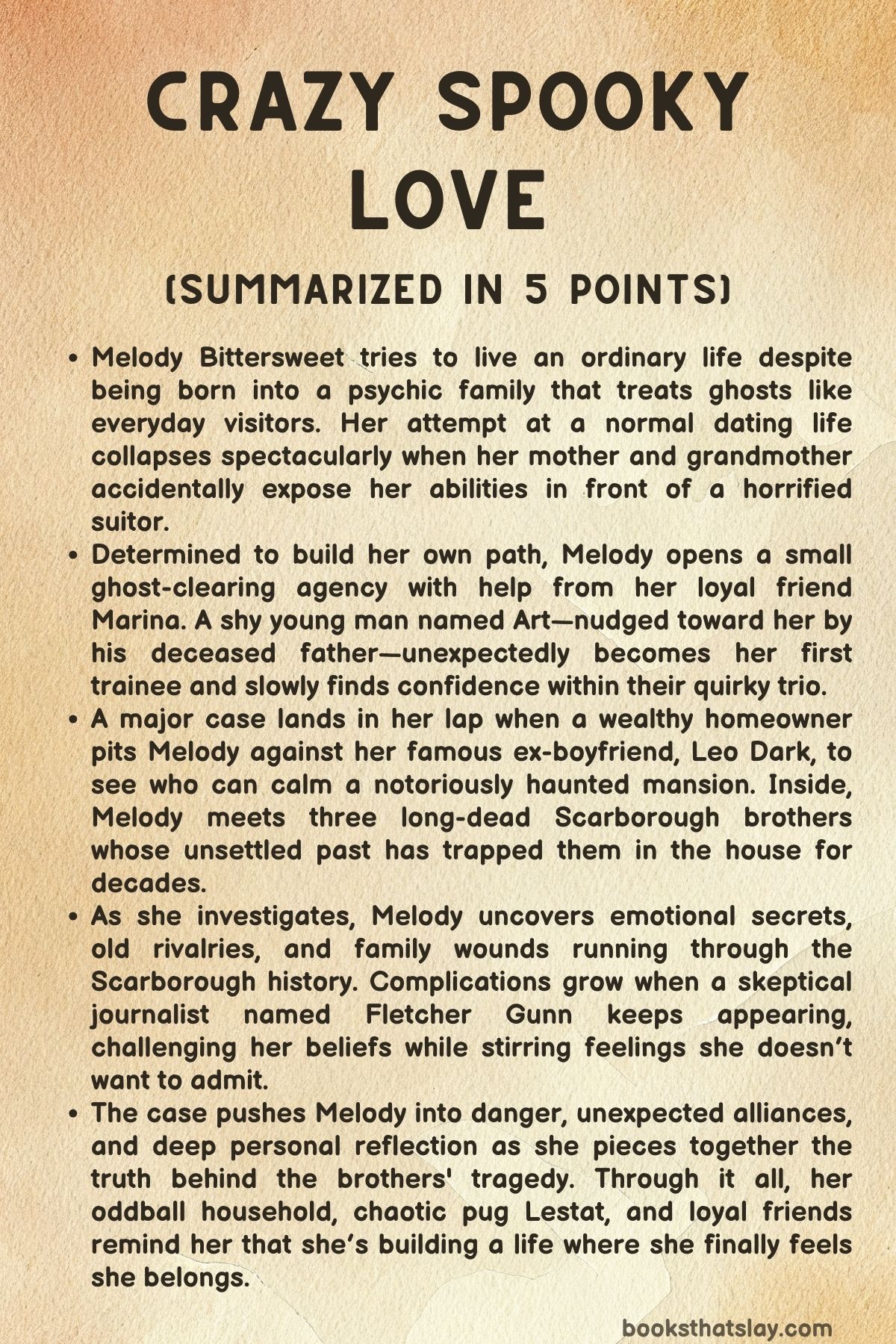
Crazy Spooky Love by Josie Silver follows Melody Bittersweet, a young woman born into a loud, eccentric family of psychics whose ability to see and speak to ghosts has shaped every part of her life, often at the worst possible moments. Longing to build an identity outside her family’s chaos, Melody launches her own business helping restless spirits resolve unfinished business.
What begins as a career experiment soon becomes an emotional quest involving three trapped ghosts, a dangerous family mystery, old heartbreaks, and confusing sparks with two very different men. With humour, warmth, and supernatural mayhem, the story explores family ties, belonging, and the courage to build a life that finally feels like her own.
Summary
Melody Bittersweet’s attempt at a normal date with kind but unsuspecting Lenny collapses the moment they step into her flat and discover her mother standing on the coffee table in transparent nightwear, calling out to a ghost in the ceiling. When Melody’s glamorous grandmother also arrives and a recently deceased man materializes to complain about missing housekeeping money, Lenny flees in panic.
Tired of embarrassment and eager for independence, Melody decides the next morning to start her own agency dedicated to helping stuck or disruptive ghosts move on. Her mother protests, believing the Bittersweets exist to serve the dead rather than the living, but her grandmother encourages Melody to create her own path and even offers the help of their efficient administrator, Glenda.
Opening her business terrifies Melody until she is visited by Big Art, a gentle ghost desperate for help concerning his shy and lonely son, Little Art. He wants Melody to offer the boy a job so he will not drift through life with no direction.
Hoping the young man won’t respond, Melody writes a formal job offer anyway. To her surprise, he appears on the agency’s first real working day, overwhelmed but eager.
After a hesitant interview, he agrees to become a trainee. Marina, Melody’s best friend, immediately takes charge of him, and the three begin forming an unlikely team.
While unwinding that evening, Melody and Marina notice her ex-boyfriend Leo Dark on television filming at Scarborough House, a decaying mansion reportedly filled with ghostly disturbances. Sensing opportunity, they drive there in their decrepit van, Babs, and confront Leo and the current owner, Donovan Scarborough.
Donovan, tired of the hauntings and desperate to sell the property, throws down a challenge: whichever psychic clears the house first earns the job. Melody accepts, fully aware that Leo intends to outshine her.
The next morning, Artie arrives determined to impress but dressed in an outfit that makes him look like a discount paranormal exterminator. Marina puts him to work repainting Babs with a bold new agency logo, while Melody prepares to investigate Scarborough House.
Leo arrives at her office to intimidate her, but their old rivalry resurfaces and she refuses to hand over her key.
At Scarborough House, Melody, Marina, and Artie explore the cold, neglected rooms. Melody meets three ghosts: Isaac, elderly and reserved; Douglas, youthful and charming; and Lloyd, elegant but hostile.
All are members of the Scarborough family and trapped by the unresolved murder of Douglas, who was stabbed in 1910. Each brother denies guilt, but Isaac has lived under suspicion for decades.
Their conflicting stories reveal a family torn apart by grief and pride. Before Melody can uncover more, the ghosts vanish and a skeptical reporter, Fletcher Gunn, barges in.
His snide remarks infuriate her, yet an undeniable attraction simmers beneath their exchanges.
As Melody investigates, she juggles chaotic family life, old tensions with Leo, and increasing interference from Fletcher. One day she, Marina, and Artie discover hidden diaries in Scarborough House.
Shortly after, Agnes Scarborough’s ghost appears in Melody’s bedroom, revealing she made terrible mistakes regarding her children. The diaries show that Agnes, drowning in grief over Douglas, unfairly blamed Isaac and pushed him away.
They also reveal that Isaac had a child, Charles, whose existence the ghosts never mentioned.
Melody’s growing responsibilities lead her friends to encourage her to adopt a dog, and she finds herself bringing home a one-eared pug named Lestat, who adds more mayhem to her already unpredictable life. Meanwhile, Donovan becomes increasingly desperate to clear his house but refuses to reveal his own suspicions.
When Isaac becomes violent after hearing talk of demolition, Melody calms him only by mentioning Charles, proving she has uncovered secrets Leo knows nothing about. Donovan fires Leo and grants Melody one more week to finish the job.
To solve the mystery, Melody, Marina, and Artie travel to Hull, where they find Isaac’s grandson Richard and his daughter Jojo. After Melody proves her ability by relaying messages from Jojo’s deceased friend, they accompany her back to Scarborough House.
Donovan unexpectedly returns with Leo and two overzealous fans who work for him, forcing Melody and Marina to hide under a bed until Fletcher arrives to rescue them. With help from Douglas’s ghost, the group gathers in the cellar, where Isaac meets his descendants.
Melody allows Isaac to step into her body to hug them, giving him long-needed peace.
Finally, Melody confronts Lloyd. Fletcher uncovers the hidden murder knife inside a child’s teddy bear, and Lloyd appears filled with rage.
When Melody reveals that she knows the truth, Lloyd confesses he stabbed Douglas out of jealousy over a woman named Maud. He admits he stayed bound to the house to prevent Douglas from finding her in death.
His fury tears him apart, and his spirit splinters and vanishes.
Douglas, now free, thanks Melody before fading peacefully. Isaac departs soon after, whispering the name of the woman he loved, ready to reunite with her and his son.
Police arrest Donovan after he attacks an officer, and the evidence of the old murder is handed over.
In the days that follow, Melody recovers at home while Fletcher publishes an article on the case. Life at the agency resumes its familiar chaos: Marina’s teasing, Artie’s earnest dedication, Glenda’s sharp efficiency, and Lestat’s constant mischief.
When a new client calls about a haunted circus ringmaster and his lion, Melody smiles and tells Glenda to book the appointment, ready for whatever comes next.
Characters
Melody Bittersweet
Melody Bittersweet, the protagonist of Crazy Spooky Love, is a young woman determined to build a life beyond the shadow of her eccentric psychic family. Compassionate, self-deprecating, and often chaotic, she straddles an uneasy line between craving normalcy and embracing the paranormal legacy she inherited.
She longs for love, belonging, and emotional stability, yet her world is shaped by ghosts, disasters, and misadventures she never quite sees coming. Melody’s journey is not only about solving a century-old murder but also about discovering her own resilience.
Her empathy for the living and the dead alike defines her gift—she sees ghosts not as spectacles but as people whose stories deserve closure. Through the messy creation of her agency, her conflict with Leo, her unexpected connection with Fletcher, and her growing fondness for her new “pack,” Melody steps into her own identity with courage, humor, and vulnerability.
Marina Knight
Marina, Melody’s fiercely loyal best friend, is bold, sharp-tongued, and unfiltered. She balances Melody’s uncertainty with unshakeable confidence, often acting as her protector and cheerfully dragging her into questionable decisions.
Marina thrives on chaos—whether threatening Leo’s fan-girl twins, teasing Artie into blooming, or embracing every adventure with gusto. Beneath her bravado, she deeply values her chosen family.
Marina’s creativity, irreverent humor, and unwavering belief in Melody make her the emotional backbone of the agency. She represents the power of friendship as a grounding force amid supernatural turmoil.
Arthur “Artie” Elliott
Artie begins as an anxious, painfully shy young man overwhelmed by both life and the paranormal world he steps into. Yet his innate kindness, awkward honesty, and earnest desire to help make him indispensable to the agency.
Artie’s transformation—from trembling trainee to unexpectedly brave assistant who walks through ghosts without realizing it—highlights his quiet strength. He finds belonging with Melody and Marina, who treat him with a mix of affection and exasperation.
His relationship with his deceased father, Big Art, is tenderly portrayed, emphasizing his longing for connection and validation. Artie—gentle, diligent, and endearing—becomes the heart of Melody’s new venture.
Silvana Bittersweet
Melody’s mother, Silvana, is a theatrical, spiritually flamboyant woman who lives fully and loudly in her psychic identity. She is unpredictable, often dramatic, and entirely unapologetic about her eccentricities.
Though her antics humiliate Melody at times, Silvana’s love is undeniable. She resists Melody’s independence because it threatens the traditions she values, yet she ultimately supports her daughter’s new path.
Silvana represents generational legacy—beautiful, burdensome, and woven with complicated love.
Dicey Bittersweet
Gran Dicey is a force of nature—glamorous, mischievous, and joyfully inappropriate. She delights in scandalizing people, including fully corporeal strangers and the ghosts who wander through the Bittersweet household.
Dicey encourages Melody’s independence with dramatic flair, often steering situations with cunning disguised as whimsy. Her larger-than-life presence brings levity and wisdom, reminding Melody that embracing one’s weirdness is often a path to empowerment.
Glenda Jackson
Glenda, the efficient administrator lent to Melody each morning, is the grounding presence amid the chaos. Practical, no-nonsense, and subtly formidable, she brings order to the unruly world of ghost hunting.
Her dry humor and steady reliability give structure to the business, allowing Melody’s dreams to function beyond paper and panic. Glenda symbolizes stability—proof that even in a world of spirits and drama, strong organization is a kind of magic.
Big Art (Arthur Elliott Sr.
Big Art is one of the most touching spirits Melody encounters. He is devoted to his son, desperate to ensure Little Art finds purpose and connection after his untimely death.
His appearance sets in motion the chain of events that brings Artie into Melody’s life. Big Art’s love transcends death, illustrating the emotional depth of the paranormal world in the novel.
His fading after Melody’s promise is bittersweet, showing that closure for the dead can come from hope rather than certainty.
Leo Dark
Leo, the famous TV psychic and Melody’s ex-boyfriend, is charismatic, vain, and endlessly dramatic. He is both rival and lingering emotional complication.
Leo thrives on performance—perfect hair, adoring fans, televised séances—yet beneath the gloss is a man insecure about his own limitations. His rivalry with Melody masks professional jealousy, romantic residue, and a need to maintain control.
Despite his flaws, Leo occasionally reveals a softer side, helping Melody at critical moments and showing he is not truly malicious—just deeply invested in preserving his spotlight.
Fletcher Gunn
Fletcher Gunn enters the story as a cynical journalist who mocks psychics, ghost hunting, and Melody herself. Yet his skepticism masks vulnerability, intelligence, and a surprising tenderness.
His banter with Melody is electric, charged with irritation, attraction, and grudging respect. Fletch represents the rational world crashing into Melody’s supernatural chaos.
His willingness to help her—even when it puts him at risk—proves his loyalty. Their kiss in the rain reveals that beneath all the sarcasm lies genuine connection.
Fletcher is the balance to Melody’s mystical life: grounded, challenging, and charismatic.
Douglas Scarborough
Douglas, forever young and charming in his cricket whites, is a ghost trapped by the injustice of his own murder. His flirtation and humor mask decades of longing and frustration.
Douglas’s presence adds warmth and melancholy to the haunting—he is a reminder that the dead carry emotional lives as vivid as the living. His final release after the truth emerges brings a poignant sense of peace, marking the emotional heart of the mystery.
Isaac Scarborough
Isaac is a misunderstood, gentle soul wrongfully blamed for his brother’s murder. His haunting is fueled by grief, resentment, and an aching longing to be believed.
Isaac’s emotional volatility—sometimes violent, sometimes heartbreakingly vulnerable—reflects the torment of a man imprisoned by lies. The revelation of his descendants and the chance to embrace them becomes his salvation.
His departure is deeply moving, signaling forgiveness, restored dignity, and reunion with the family he lost.
Lloyd Scarborough
Lloyd serves as the story’s tragic antagonist. Consumed by jealousy, regret, and bitterness, he is a man destroyed not only by his crime but by what it cost him emotionally.
His rage and manipulation keep the house in turmoil. His confession reveals a complex character shaped by insecurity and the desperate, damaging belief that control can substitute for love.
Lloyd’s ultimate shattering is violent but symbolic—he is a ghost broken by his own secrets.
Agnes Scarborough
Agnes, the grieving mother whose diary entries unravel emotional truths, embodies the devastating power of unchecked sorrow. Her misdirected rage at Isaac and her inability to process Douglas’s death cement the tragedy of the entire Scarborough family.
Agnes’s regrets echo through time. Her ghostly appearance to Melody shows a woman desperate for redemption, and her diaries prove essential to solving the century-old mystery.
Her presence emphasizes that grief can shape generations.
Donovan Scarborough
Donovan, the current owner of the house, is desperate, volatile, and overwhelmed by the hauntings destroying his future. His temper and selfishness escalate the danger, particularly when he nearly derails Melody’s investigation.
Donovan’s arrest underscores his inability to face responsibility—he is a man ruled by fear and anger rather than courage.
Lestat the Pug
Lestat, the chaotic one-eared pug, brings humor and heart into Melody’s life. A whirlwind of snorts, bodily mischief, and unconditional affection, he symbolizes Melody’s reluctant embrace of unpredictability.
Despite his flaws—or perhaps because of them—Lestat grounds Melody emotionally, becoming an unexpected but cherished member of her “pack.
Themes
Identity and Self-Acceptance
Melody’s struggle to regard her psychic heritage as something other than a burden forms a central emotional current in Crazy Spooky Love. Her desire for a “normal” life repeatedly clashes with the reality of who she is and where she comes from.
The opening disaster with Lenny underscores how much she fears being seen as odd, yet her attempts to hide her abilities only magnify her sense of disconnection. The journey that follows pushes her into situations where concealing her gift becomes impossible, whether she is confronting irritable ghosts, negotiating with irate homeowners, or attempting to mentor Artie, who looks to her with earnest admiration.
Each encounter forces her to acknowledge that her identity isn’t a flaw to tidy away but a source of capability, purpose, and connection. The Scarborough case is especially transformative, because she cannot solve it through performance or charm—she must rely on the very traits she once tried to suppress.
Helping Isaac reunite with his family and untangling Douglas’s murder requires emotional intelligence shaped by her lineage. By the end, Melody is no longer negotiating between a life she wants and a life she was born into; she realizes they are not separate categories.
Her chaotic household, unsettling talents, and unconventional work form a life that is entirely her own, not an inheritance she must escape. Accepting this allows her to stand more firmly in her choices, her relationships, and her future.
Family Legacy and Generational Influence
The Bittersweets represent a lineage that is humorous, overwhelming, and steeped in centuries of psychic tradition, and Melody’s relationship to this legacy is layered with affection and frustration. Her mother and grandmother embody opposing interpretations of what it means to continue the family work—Silvana clings to convention and ritual, while Dicey embraces flamboyant freedom—but both view their abilities as a natural extension of identity.
Melody’s conflict with her mother over starting a business that “helps the living” reflects deeper generational tension: the question of who gets to redefine tradition. This dynamic parallels the Scarborough family’s unresolved history, where the weight of unspoken assumptions and misplaced blame imprisoned several generations in a loop of grief and misunderstanding.
Agnes’s diaries reveal how parental choices ripple through decades, shaping the destinies of children and grandchildren. Isaac’s exile, Douglas’s unavenged death, and Lloyd’s bitterness all trace back to decisions rooted in parental blindness and emotional turmoil.
By confronting these ghosts—literal and metaphorical—Melody not only breaks the cycle for the Scarboroughs but also recognizes the patterns within her own family. She learns that legacy does not mean confinement; it can be a foundation from which to build something new.
Her psychic gift, once a source of embarrassment, becomes a bridge between past and present, allowing her to carry forward the strengths of her lineage while discarding the parts that never belonged to her.
Belonging and Found Family
Throughout the narrative, Melody carries a quiet longing for a place where she fits, even though she is surrounded by people. Her eccentric family overwhelms more than comforts, and her past with Leo shows how easily she can be overshadowed or dismissed.
The creation of her agency becomes the first deliberate step toward claiming a community of her own choosing. Marina, with her fierce loyalty and chaotic enthusiasm, represents a friendship that keeps Melody grounded, while Artie brings tenderness, innocence, and the first signs that Melody can lead others with compassion.
Their small agency evolves into a chosen family—a trio bound not by blood, but by trust, misadventure, and shared purpose. Even Lestat, the unruly one-eared pug, becomes part of this developing sense of home.
This theme expands during the Scarborough investigation, where Melody learns how profoundly people yearn for connection. Isaac’s separation from his family, Douglas’s halted love story, and Lloyd’s toxic jealousy all spring from ruptured bonds.
Restoring these connections gives the ghosts peace, but it also reflects Melody’s own internal shift: she no longer sees herself as someone who doesn’t quite fit. She realizes she is building a life full of people who choose her, rely on her, and grow with her.
Belonging stops being something she hopes will happen to her and becomes something she actively cultivates.
Love, Vulnerability, and Emotional Risk
Melody’s complicated entanglements with Leo and Fletcher reveal her evolving relationship with vulnerability. Leo represents the comfort of familiarity but also the stagnation of old patterns—competition disguised as affection, glamour masking insecurity, and charm used to control narratives.
With Fletcher, the dynamic is more volatile; their sharp banter and reluctant attraction expose insecurities neither fully admits. The rain-soaked kiss outside the cinema captures how drawn they are to each other, yet both fear the implications of being fully seen.
These relationships mirror Melody’s broader struggle to risk emotional openness. Her psychic work requires intimacy—listening to ghosts’ fears, witnessing private grief, and navigating unresolved love stories—but she hesitates to grant herself the same compassion.
Watching Isaac embrace his descendants and Douglas finally find release forces Melody to confront how powerful honesty can be, even when it hurts. By the end, she is still unsure where her romantic life will lead, but she has stopped withdrawing from the possibility.
She lets herself hope, flirt, argue, and want. Love becomes not a distraction from her purpose but a reminder that emotional courage is as necessary as supernatural skill.
Her willingness to take risks—professionally and personally—signals a new chapter in which she no longer shields herself from attachment out of fear.
Justice, Truth, and Restoring What Was Lost
The Scarborough mystery embodies a longing for resolution that spans more than a century. Douglas’s death remains unsolved not because the truth is unknowable, but because those left behind were too afraid or too broken to confront it.
Isaac lived his entire life under suspicion, while Agnes drowned in grief that obscured her judgment. Lloyd’s jealousy festered into lifelong bitterness, and the house itself became a monument to unresolved pain.
Melody’s investigation cuts through myths, assumptions, and the distortions of memory. She pieces together fragments—diaries, whispers from the dead, emotional cues—to reconstruct a truth that everyone else avoided.
Her approach is neither clinical nor detached; she treats each ghost as a person whose suffering deserves acknowledgment. The revelation of the murder weapon and Lloyd’s confession do more than solve a crime—they release generations from the weight of false narratives.
Justice here is not punitive but restorative. It allows Douglas to move on, Isaac to reclaim his dignity, and Agnes’s legacy to be understood rather than pitied.
Through this process, Melody discovers the significance of truth-telling in her own life. She lies about small things—dogs she doesn’t own, dates she invents—to avoid emotional discomfort, but confronting the Scarborough tragedy shows her how destructive avoidance can become.
In delivering justice to the dead, she learns to live with greater honesty herself.
Purpose, Confidence, and Professional Growth
Melody enters the story doubting her ability to lead anything, let alone a paranormal agency. Her early efforts are riddled with insecurity—botched dates, business jitters, and the fear that she will fail before she even begins.
Yet every challenge pushes her toward stronger self-belief. Training Artie forces her to articulate what she knows rather than rely on instinct.
Rivalry with Leo compels her to stop minimizing her skills. Handling Fletcher’s skepticism teaches her to stand firm in her abilities without relying on theatrics.
Most importantly, solving the Scarborough case proves that she is capable of navigating danger, emotional complexity, and high-stakes decisions. Her bravery in letting Isaac channel through her, her steady handling of Lloyd’s rage, and her quick thinking during Donovan’s violent outburst all demonstrate growth far beyond the timid woman who once tried to hide her heritage.
By the conclusion, Melody is not simply running a business; she is shaping a career founded on empathy and competence. The final scene, where she accepts a new case involving a circus ringmaster and his lion, symbolizes her confidence in the path she has chosen.
She is no longer waiting for life to feel meaningful—she is actively crafting a future where her skills matter and her presence makes a difference.