Eldritch by Keri Lake Summary, Characters and Themes
Eldritch by Keri Lake is a dark fantasy romance set in a world where ancient magic, forgotten gods, and the remnants of brutal empires collide. The story follows Maevyth, a young woman marked since birth by forces she never understood, and Zevander, a warrior bound to destructive power he can barely contain.
Their lives twist together through curses, forbidden magic, and a fate tied to a rising darkness that threatens entire realms. With themes of survival, identity, sacrifice, and fierce devotion, the novel blends horror, mystery, and slow-burn intimacy as the characters struggle to uncover truth and confront monsters both human and divine.
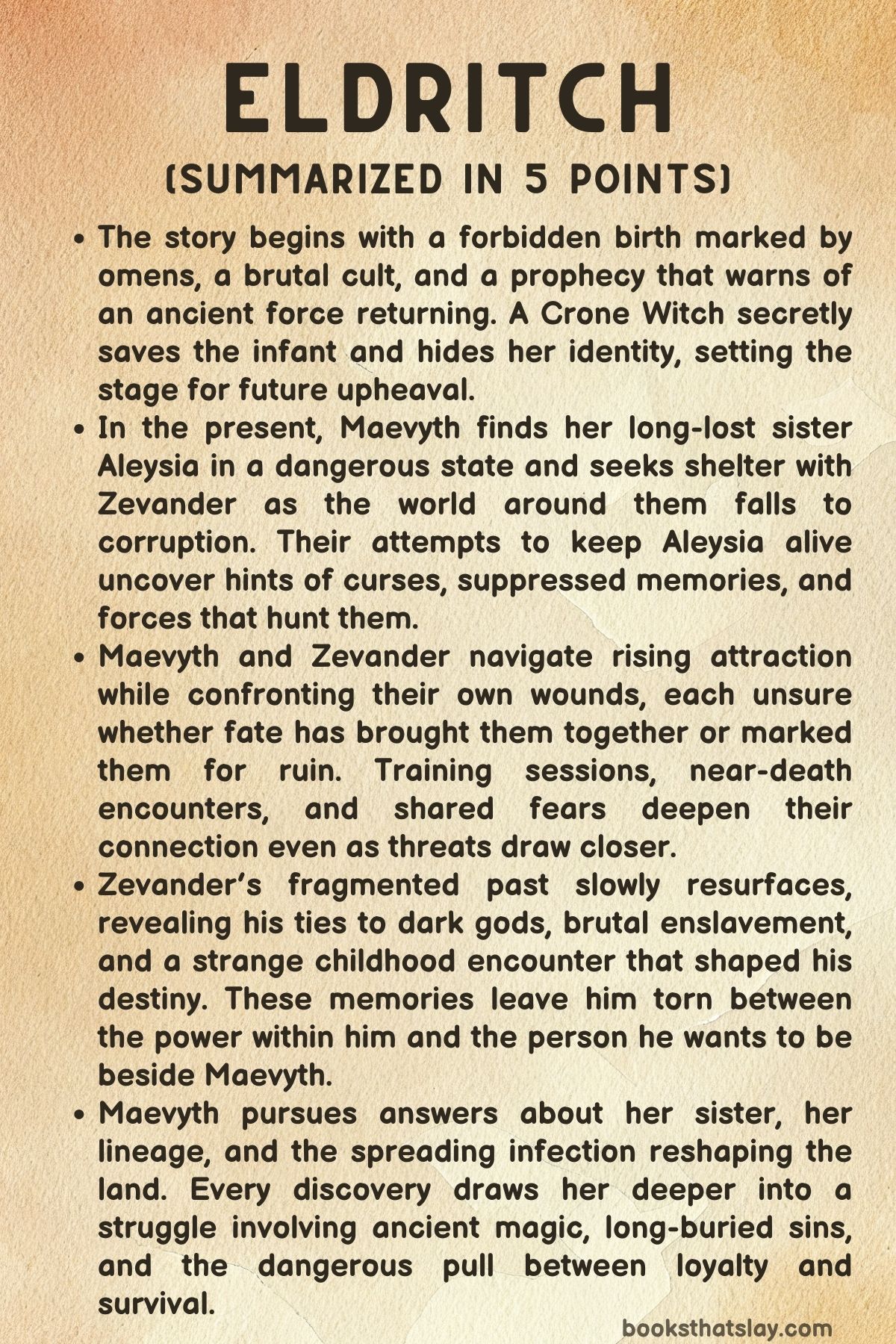
Summary
Long before Maevyth’s birth, a secretive sect known as the Red Men sacrificed women and children beneath a temple. When a Lyverian prisoner gives birth to a baby with silver eyes—an omen of a feared prophecy—Sacton Crain orders the child taken into The Eating Woods to be destroyed.
The acolyte sent to carry out the task is attacked by a monstrous wrathavore, leaving the infant behind. A Crone Witch finds the baby, recognizes her as a foretold child, and hides her existence by cursing away the silver color of her eyes.
Pressured by ravens and an oath she once made, the Crone leaves the baby at Godfrey Bronwick’s cottage, ensuring the child can survive among mortals.
In the present, Maevyth and Zevander discover Maevyth’s long-lost sister, Aleysia, hidden beneath the Crone’s cabin floorboards. Cold and unconscious, Aleysia shows signs of a strange infection.
Zevander warns that if she cannot wake or is contaminated, she will never cross into Aethyria—a realm that rejects mortals and anything dangerous. Maevyth, who has already lost her home and village, cannot accept abandoning her sister.
The two settle into an uneasy vigil.
As Zevander fights withdrawal from the vivicantem that keeps his ancient powers stable, he tries to support Maevyth while hiding his worsening condition. Their tension deepens—marked by longing neither fully understands and fears neither can voice.
A nightmare shakes Maevyth, showing Aleysia transformed into something monstrous, and she wakes feeling as if a sinister voice is trying to push her toward violence. Meanwhile, Zevander investigates the crawlspace where Aleysia lay imprisoned, finding claw marks and a black substance that sinks into the wood.
In quieter moments, Maevyth and Zevander discuss blood-spells, shared exhaustion, and the sense that Aleysia’s life may be tied to another’s. Zevander suffers a sudden attack of pain, only soothed when he grips Maevyth’s scorpion necklace—hinting at a deeper bond.
Zevander’s past emerges through flashbacks: as a boy imprisoned in mines, he endured torture, witnessed death, and struggled to survive under the crushing rule of the Solassion forces. The Bellatryx—elite warriors—hunted escape attempts ruthlessly.
In the mystical plane of Caligorya, Zevander was told he carried power tied to the god Deimos, a truth he refused to accept until much later.
Back in the present, he trains Maevyth to wield her glyph-magic. She struggles until imagining threats to Aleysia allows her to break through, destroying infected townspeople who have become spider-like creatures.
Their mutual attraction grows during training and afterward, where flirtation builds into deeper connection. But Zevander’s enchanted piercings, left by abusers, tie his pleasure to pain.
When Maevyth accidentally hurts him during intimacy, she demands reassurance that he does not associate her with those who damaged him. Deeply moved, he admits how long he has searched for her and how unworthy he feels.
Their emotional closeness leads to a night of vulnerability, comfort, and deepening trust.
Centuries-old memories begin to return for Zevander. He recalls comforting a terrified imprisoned girl with his flame—Maevyth as a child.
He kissed her forehead, unknowingly placing a sigil that marked her as his mate. The godly powers around them erased the memory from his mind, but the truth resurfaces when he touches the sigil on her back.
Horrified at how fate has bound them, he struggles with the realization that their lives have been linked far longer than either knew.
When Zevander disappears in his weakened state, Maevyth follows his trail into haunted woods. She later finds a hidden temple chamber filled with murdered children, victims of ritual sacrifice.
One child still clings to life, and Maevyth eases her passing with a glyph. She also discovers her own long-lost father imprisoned and resolves to save others despite the dangers.
Zevander, meanwhile, is drawn into visions showing Cadavros’s past. Cadavros was once a spindling named Alastor who gained monstrous power by swallowing a vivicantem stone, reshaping his life and his sister’s.
These buried histories rise just as Maevyth is dragged to the Rotting Tree, where Cadavros reveals the presence of an ancient god within its depths. He promises power if she joins him as queen.
When she refuses, he unleashes the infection inside Zevander, sending him after her in a fog-shrouded maze of roots.
Zevander, lost to Pestilios’s influence, attacks Maevyth with burning force. Unable to reach his mind, she tricks him by pretending to surrender and then cutting her own throat so he is compelled to drink her blood.
Her blood poisons the infection, breaking Pestilios’s hold. Zevander collapses and meets Morsana in a realm of death, where she urges him to abandon his mortal life.
He refuses, choosing Maevyth’s heart over godhood, and is returned to the living world—though only until Maevyth’s destined death.
Reunited, they flee with help from Kazhimyr, Ravezio, and an Elvyniran mage named Dravien. Battles with spiders and monstrous hybrids force them toward the Umbravale.
Raivox, the Corvugon, burns a colossal spider to protect them. Zevander weakens the barrier so the others can cross into Aethyria, but the realm judges him a threat when Cadavros appears wielding the combined power of Pestilios and Deimos.
After Cadavros kills Ravezio, Zevander fights back. Yet the Umbravale opens beneath him, dragging him toward Nethyria.
Maevyth and Dravien try desperately to pull him free. Maevyth confesses her love, but Zevander slips from her grasp and falls into the chasm.
On the other side of the barrier, Maevyth collapses in grief. General Loyce and Melantha—Cadavros’s sister—seize her power and capture her.
Far below, Zevander survives on a narrow ledge, clutching Maevyth’s necklace. As monstrous shapes fall past him, Raivox dives into the abyss to save him.
Characters
Maevyth
Maevyth emerges as the emotional center of Eldritch, shaped equally by love, loss, and a destiny she never asked for. Her defining trait is her relentless loyalty, most vividly seen in her refusal to abandon Aleysia even when it threatens her own survival.
This devotion is complicated by the dark urges that Morsana whispers into her mind, pushing her toward violence and self-doubt. Yet Maevyth consistently resists these internal shadows, demonstrating a moral resilience that marks her as more than a warrior; she is someone who seeks to remain compassionate even in a world built on cruelty.
Her relationship with Zevander reveals her deepest conflicts: she yearns for connection but fears the consuming power of fate, curses, and the possibility that her dreams of love and safety may be illusions. Through training, confrontation, and intimacy, she grows from a survivor into a figure capable of confronting gods and monsters.
Her courage is not born of fearlessness but of continuing despite terror, which makes her both vulnerable and formidable.
Zevander
Zevander is a character layered with trauma, violence, and buried tenderness, forged in the horrors of imprisonment, torture, and divine manipulation. His connection to Deimos and the sablefyre marks him as someone caught between monstrous power and fragile mortality.
Haunted by memory loss and fractured visions of his past, he is constantly fighting both external enemies and the threat of becoming the very thing he fears. His tenderness toward Maevyth contrasts with the brutality that shaped him, revealing a profound longing to be seen, accepted, and forgiven.
Their intimacy challenges his belief that love is fleeting and destructive, and it exposes his vulnerability beneath the layers of pain, enchantment, and self-loathing. Zevander’s sense of unworthiness is a recurring theme, yet his actions are defined by sacrifice: he offers protection even at the cost of his own body and sanity.
His fall into Nethyria symbolizes not weakness but a final act of defiance against gods and destiny alike. Through him, the story examines trauma’s long reach and the possibility of reclaiming one’s humanity despite it.
Aleysia
Aleysia is both a catalyst and a mystery throughout the narrative. Her disappearance and later discovery hidden beneath the Crone Witch’s floorboards establish her as a figure caught at the crossroads of magic, curse, and prophecy.
Though unconscious for much of the present-day events, she exerts a significant emotional influence over Maevyth, whose protective instincts are sharpened by fear of losing her again. Aleysia’s condition evokes dread, not only because of infection risks but also due to Maevyth’s terrifying visions that blur the boundaries between sisterly love and supernatural threat.
When she finally begins to stir, she represents both hope and danger, embodying the fragile line between salvation and corruption. Aleysia’s presence becomes a test of Maevyth’s morality, her resistance to dark whispers, and her willingness to risk everything for family, even when the past and present conspire to tear them apart.
Sacton Crain
Sacton Crain functions as a chilling embodiment of religious fanaticism and cruelty. His actions during the prologue set the tone for the depths of human evil in Eldritch.
His blind devotion to dogma, particularly the fear of silver-eyed children as omens, drives him to commit atrocities with cold efficiency. The murder of the mother moments after childbirth reflects his belief that obedience to doctrine outweighs humanity.
His terror in response to the woman’s dying prophecy reveals that beneath the rigid faith lies deep insecurity, suggesting he fears the very forces he claims to understand. Crain’s role in manipulating fate, hiding secrets, and initiating the events that shape both Maevyth’s and Zevander’s destinies makes him not only a villain but a foundational architect of their suffering.
Cadavros
Cadavros represents the corruption that comes from power mixed with suffering. As a former spindling child who killed to protect his sister Melisara, he began as a victim of systemic cruelty.
His transformation through consuming vivicantem and adopting a new name illustrates his desire to rise above oppression by embracing the very forces that tortured him. Adult Cadavros is complex: charismatic, monstrous, and deeply wounded.
He genuinely believes he is offering Maevyth a path to immortality and salvation, even as he manipulates, threatens, and destroys lives. His monstrous antlered form mirrors the inner rot consuming him.
His confrontation with Zevander is as much philosophical as physical, a clash between two men who survived the same horrors but chose opposite paths. Cadavros’s tragic root does not absolve him, but it deepens his portrayal as a villain shaped rather than born.
Ravezio
Ravezio represents loyalty, endurance, and the quiet strength forged in the mines and captivity. As a fellow survivor of brutality, he shares with Zevander a bond built on mutual suffering and resilience.
His Eremician identity makes him a target of cruelty, yet he maintains dignity even when stripped of his scales and tortured. His final act — pleading with Zevander for a mercy killing — reveals profound bravery and trust.
Ravezio’s death is one of the story’s most harrowing moments, serving as a stark reminder of the cost of resistance and the devastation wrought by Cadavros’s rise to power.
Kazhimyr
Kazhimyr serves as both an anchor to Zevander’s past and a link to the world of Aethyria. His determination, intelligence, and resourcefulness make him invaluable as he navigates forbidden magic to reach the mortal realm.
Kazhimyr is defined by his sense of duty and his refusal to abandon allies, even when crossing the Umbravale puts him at enormous personal risk. Throughout the narrative, he balances pragmatism with loyalty, making decisions that prioritize survival without sacrificing his principles.
His presence reinforces the theme of found family, standing in contrast to the betrayals and manipulations that dominate other parts of the story.
Dravien
Dravien acts as a stabilizing force amid chaos, offering tactical strength, magical ability, and emotional steadiness. His role in helping Maevyth and Kazhimyr cross the Umbravale, battling monstrous hybrids, and providing support in moments of crisis positions him as a reliable protector.
Though not as emotionally central as Zevander or Maevyth, he adds depth to the ensemble dynamic, showing the importance of unity against corrupt gods and twisted magic. Dravien’s actions are guided by duty and a belief in collective survival rather than glory or recognition, making him a subtle but essential presence.
Raivox
Raivox, the Corvugon, is a creature who embodies both terror and unexpected loyalty. Initially appearing monstrous and dangerous, he reveals a protective instinct that aligns him with Maevyth and Zevander’s struggle.
His dramatic rescue of Maevyth in the Rotting Tree and later his descent into Nethyria to save Zevander speak to a deeper intelligence and bond that transcend the boundary between beast and ally. Raivox serves as a reminder that in Eldritch, appearances are deceiving, and salvation often arrives from where it’s least expected.
Melantha (Melisara)
Melantha, once the deformed sister Melisara, embodies the tragedy of survival under monstrous circumstances. Her vampiric inheritance and transformation into Cadavros’s powerful sister reveal a character who has endured lifelong exploitation and reshaped herself into someone formidable.
She is both participant in and victim of Cadavros’s ambitions, her loyalties split between sibling devotion and the realities of their corrupted power. Her presence near the story’s end, aligned with General Loyce, suggests a character who chooses strength over vulnerability, even if it places her on the wrong side of justice.
General Loyce
General Loyce symbolizes militarized cruelty and the institutional evil of Aethyria’s darker factions. As a high-ranking figure who commands soldiers and monstrous creatures, he thrives on domination and fear.
His treatment of Maevyth when she is captured demonstrates his lack of empathy and reliance on violence as authority. Loyce’s presence underscores the systemic rot of the world, proving that danger comes not only from ancient gods and magical beasts but also from human systems built on oppression.
Themes
Prophecy, Fate, and the Terrifying Weight of Destiny
In Eldritch, prophecy is not a distant myth whispered by mystics but an active force that shapes every life it touches, binding characters through blood, magic, and consequence long before they understand the forces manipulating them. The story opens with a prophecy uttered in a mother’s dying breaths—a declaration of rising ancient power, spreading rot, and a reckoning that will bring men to their knees.
This sets in motion a chain of events that reverberates through generations, shaping Maevyth’s existence and Zevander’s long-buried past. Fate becomes less a path and more a trap, a design crafted by gods who view mortals as vessels, tools, or experiments.
Maevyth’s silver-eyed birth and the desperate efforts to hide her true nature show how a prophecy can provoke fear so deep that even her existence is treated as a threat. Zevander’s childhood encounter with her—erased by divine intervention—reveals destiny’s cruel habit of dragging two souls together only to tear them apart until they fulfill a role they never chose.
Both characters struggle under the weight of what they were marked to become, while trying to salvage the fragments of who they wish to be. Prophecy governs their identities, relationships, and the wars unfolding around them, but it also challenges them to reclaim agency from forces far older and more powerful than themselves.
Their fight is not just against monsters or gods but against a script written before their births—a struggle to redefine what fate intends for them.
Trauma, Survival, and the Scars That Shape Identity
Trauma saturates the narrative, not merely as backstory but as a living presence that follows characters into every decision, relationship, and fear. Zevander’s years in the mines, the torture chambers, and Caligorya carve him into someone who does not understand tenderness without pain, or desire without restraint, because every experience has been twisted by cruelty.
His enchanted piercings, forced upon him to turn pleasure into agony, are emblematic of how trauma reshapes the body as much as the mind. Maevyth’s struggles stem from loss, displacement, and the constant fear of losing the few she loves.
Her internal battles—especially the invasive influence of Morsana urging her to harm Aleysia—create a sense of instability that mirrors how unspeakable experiences fracture one’s sense of self. When the siblings discover the children starved in the sacrificial cells, the trauma becomes collective, extending beyond individual suffering into a cultural wound inflicted by zealotry and corrupted power.
The theme underscores that survival is not simply endurance but a reshaping of identity in the aftermath of violence. Maevyth and Zevander’s intimacy becomes a place where trauma collides with vulnerability, demanding honesty and patience as they attempt to build something human from the ruins of their pasts.
Their connection is not a cure but a recognition that healing is an ongoing negotiation between what hurt them and what they hope to become.
Corruption, Rot, and the Nature of Power
Power in Eldritch is rarely clean. It is threaded with rot—literal and figurative—as gods, zealots, and monsters exploit it to manipulate, dominate, or consume.
The Red Men, Sacton Crain, and the cults surrounding the temples embody institutional decay, using faith as a pretext for brutality. Their sacrifices and secrecy reveal a system where power perpetuates itself through fear and indoctrination.
Pestilios’s influence manifests through infection and monstrous transformations, turning once-innocent villagers into spider-creatures that symbolize what happens when corruption is allowed to fester unchecked. Zevander’s infection, held back only by sablefyre, demonstrates how power can be both salvation and poison.
Cadavros embodies the final stage of corruption—someone who once sought power to protect the powerless but ultimately surrendered to the very forces he hoped to resist. The Rotting Tree becomes a physical expression of this theme: a living wound, a birthplace of horrors, and a throne of a twisted god.
Throughout the story, characters confront the question of whether extraordinary power can ever be free of moral decay, or whether strength inevitably demands sacrifice. Maevyth’s refusal to accept Cadavros’s offer demonstrates her belief that power devoid of humanity is no power worth holding.
The narrative suggests that corruption thrives when fear outweighs compassion, and that true strength must be bound to purpose rather than dominance.
Love, Bonding, and the Fragility of Connection
Love in the world of Eldritch is dangerous, consuming, and often weaponized by fate. Maevyth and Zevander’s connection is forged from prophecy, trauma, and an ancient bond neither fully understands for most of their lives.
Yet their relationship grows from a space of chosen vulnerability rather than destiny’s dictate. Their moments of intimacy are fraught with fear—fear of harming each other, fear of dependence, fear that love itself might be a weakness exploited by gods or enemies.
Zevander hesitates to bond with her, knowing such rituals can strip a person of autonomy, while Maevyth fears hurting him because pain has been grafted to his body as something inseparable from want. The narrative explores how genuine connection requires confronting wounds rather than burying them.
Love becomes an anchor, not because it saves them effortlessly, but because it gives them a reason to resist the darkness pressing in from all sides. Their bond is also a rebellion—against gods who claim their fates, against the trauma that sought to shape them, and against a world that sees love as expendable.
Even when Zevander falls into Nethyria, their connection endures as a promise that defies impossibility. Through their journey, love emerges not as a fragile sentiment but as a force capable of challenging destiny itself.
Identity, Becoming, and the Influence of the Supernatural
Characters struggle constantly with who they were born to be versus who they choose to become. Maevyth’s hidden heritage—marked at birth, concealed through magic, and tied to a goddess—places her between mortal and divine realms.
Her journey is marked by fear of what she might become if Morsana’s influence consumes her. Zevander faces his own crisis of identity, as he grapples with being a vessel for Deimos, the haunting loss of his memories, and the unnatural bond formed with Maevyth long before he understood it.
Cadavros’s transformation from an abused boy into a monstrous wielder of divine power illustrates how supernatural influence can distort identity when rooted in suffering. Through these arcs, the book examines how identity is shaped by forces both chosen and imposed.
The supernatural is not merely magical—it acts as a lens that magnifies strengths, flaws, and desires. Characters must confront their origins, their curses, and the weight of their powers to determine who they will become in a world that constantly tries to define them.
Ultimately, identity becomes an act of defiance, a carving of selfhood from the hands of gods and monsters alike, and a declaration that destiny and divinity do not have the final word.