Every Spiral of Fate Summary, Characters and Themes
Every Spiral of Fate by Tahereh Mafi continues the fantasy tale of impossible loyalties, ancient forces, and two souls bound by choices neither wanted to make. In this 4th installment of The Woven Kingdom, Mafi deepens the emotional and political stakes as Alizeh steps fully into her role as the prophesied queen while Cyrus, chained by a deadly bargain, tries to protect her even as disaster closes in on them both.
The story explores devotion, fear, duty, and the consequences of power through a world on the edge of war and magic on the rise.
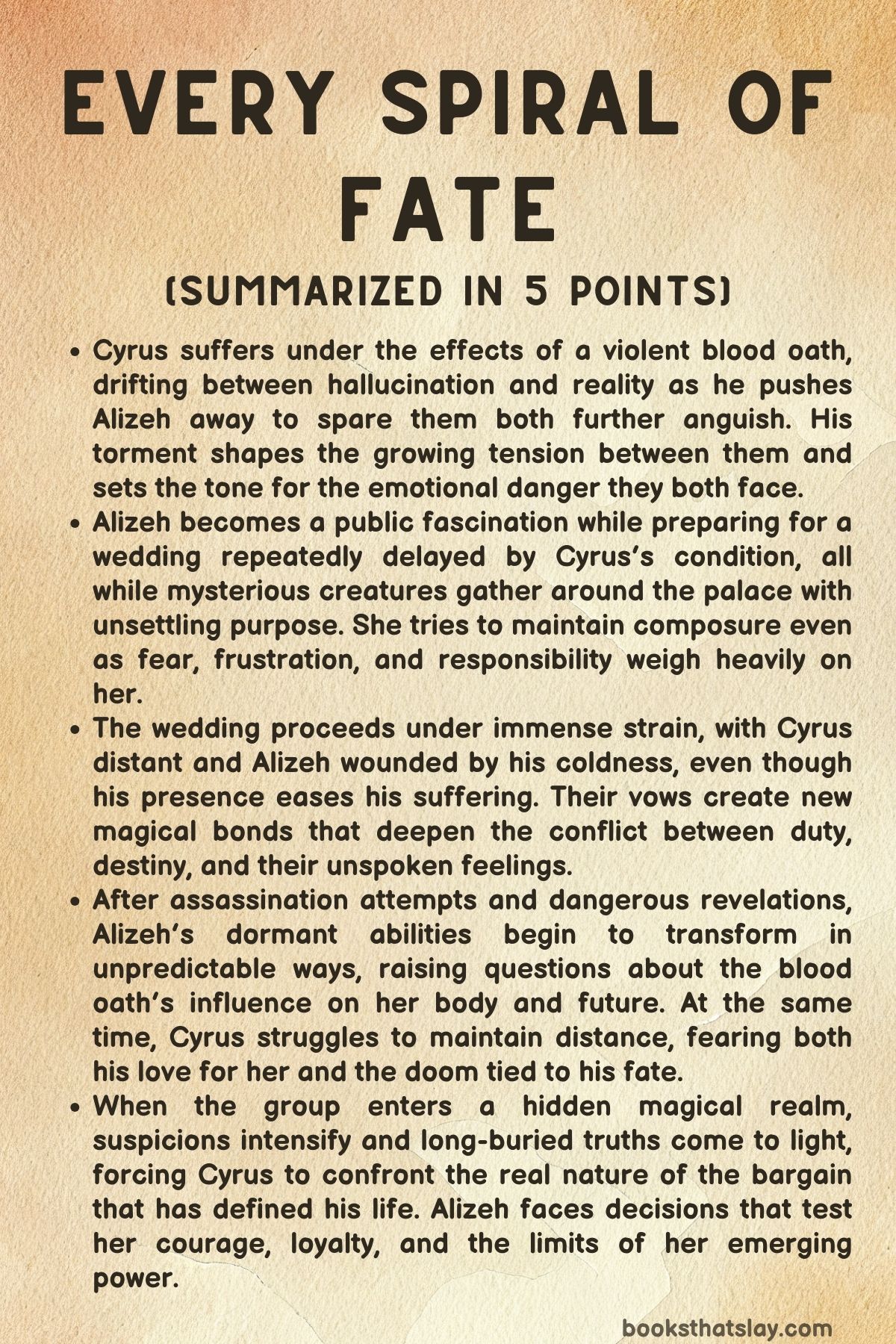
Summary
Alizeh’s story unfolds alongside Cyrus’s descent into agony. The book opens with Cyrus caught in the torment of the blood oath he forged, slipping between reality and hallucination as the devil Iblees taunts him.
He mistakes Alizeh’s attempts to help as another trick, pushing her away despite the relief her presence brings. His suffering keeps him isolated and volatile, and his refusal to let her near creates tension throughout the palace.
While Cyrus deteriorates, Alizeh works late into the night in the palace kitchen, sewing her wedding cape as the kingdom watches her through the windows with awe and unease. She has gone from servant to future queen in a matter of weeks, and the constant attention unsettles her.
Weddings plans fall apart again and again because Cyrus is too sick to appear, and the palace staff begins to fear the king has abandoned the ceremony altogether.
The palace grows stranger by the day. Cyrus’s roses creep through the walls, and animals of every kind begin gathering around his quarters—locusts, bees, spiders, foxes, crows, snakes, owls, even a snow leopard.
None behave violently, but all seem pulled toward him. Alizeh senses a connection but cannot make sense of it.
Her friend Deen urges her to force her way into Cyrus’s chamber rather than wait for permission. When she finally does, she finds him close to collapsing.
Hazan helps her tend to him, and Cyrus falls asleep instantly with her hand on his forehead. Though he fears being close to her, he cannot function without her.
On the morning of the ceremony, confusion continues as Huda bursts into Alizeh’s room assuming Cyrus has fled. But Cyrus is in an adjoining bath, recovering under Alizeh’s care.
Moments later, he appears wearing only a towel, followed by a locust perched calmly on his shoulder. The swarm outside scatters the moment he handles it, leaving Alizeh uneasy about what this means.
Their conversation deteriorates when he rejects the wedding garments she lovingly made. He insists on wearing black, calling it appropriate for his “funeral.
” His refusal deeply wounds her.
At the ceremony, Cyrus remains distant and hollow-eyed. He wears black despite Hazan’s criticism.
When Alizeh enters in her gown, those around her are full of admiration, but Cyrus keeps his distance. The pair are then lifted in a glass sphere high above the crowd since Cyrus, tainted by the devil’s contract, cannot step onto holy ground.
As they exchange vows, Cyrus’s dragons perform an intricate display in the sky. Magic binds the couple’s wrists, a ring appears on Alizeh’s finger, and she is immediately hit by a chilling inner vision of Iblees claiming her as his bride.
She collapses into Cyrus’s arms.
During the celebration, Cyrus grows increasingly withdrawn. Alizeh, overwhelmed by his distance and the effects of the blood oath, finally confronts Hazan, then rushes to Cyrus’s rooms.
He is on the floor convulsing with pain. Their confrontation exposes their mutual confusion and longing, ending only when Omid arrives carrying a stabbed and poisoned Deen.
Cyrus uses rare Diviner magic to heal him, and the group realizes that organized assassination attempts are underway in the palace.
When the group later travels to the Jinn outpost in the mountains, the strain between Cyrus and Alizeh worsens. The blood oath ensures Alizeh is pulled toward him whenever he is near, yet he hides behind formality, unable to reconcile his love with the certainty that she is destined to kill him.
Along the way, soldiers treat Alizeh with reverence while barely recognizing Cyrus. Alizeh learns surprising truths, including Hazan’s role as general and Cyrus’s ability to mind-speak with dragons and people.
As they all study the prophetic Book of Arya, Alizeh goes through strange changes. Her coldness disappears, her magic flares, heat radiates from her skin, and she begins bleeding red instead of ice-blue.
The group suspects the blood oath—Cyrus’s blood in her veins—has altered her. That night in their cottage, Alizeh and Cyrus finally confront the pull between them.
Cyrus confesses his love but refuses to act on it, determined not to burden her with his doomed fate.
Days later, as the group continues its search for the entrance marked in the Book of Arya, Kamran raises concerns about Cyrus’s loyalty. He accuses Cyrus of manipulating events on Iblees’s orders.
At first the group resists, but Kamran’s reasoning forces them to reconsider. Cyrus realizes Kamran is right: the devil has been using him to bring Alizeh to her power.
The realization crushes him. When he decides to confess everything, he knows it will kill him.
He returns Alizeh’s nosta, which glows as he speaks the truth. He recounts the century-old bargain made by a Naran king and how he became trapped in the devil’s demanded favor.
As he explains every task he performed for Iblees, his body begins turning to stone. Alizeh collapses beside him, begging him to stop, but he continues until petrification consumes him.
His body shatters, rises, and Iblees takes control.
In Cyrus’s body, Iblees freezes the others and tells Alizeh his plans: he intends to rule through her and keep her subdued with dark magic. But Alizeh discovers the blood oath still binds Cyrus somewhere within.
That means Iblees cannot harm her yet. She summons a dagger, strikes him using Cyrus’s vows against him, and traps the devil in cycles of pain and forced healing until he bargains for his release.
He promises to free Cyrus from the bargain, spare Tulan, and leave them all alone. Once he swears, a plume of smoke leaves his mouth and he disappears.
Alizeh collapses over Cyrus, believing him dead. She pours all her power into him until she hears him whisper her name.
Slowly, he returns to life. Their friends gather around them as the collapsing magical world dissolves, and Alizeh realizes she has saved him from both death and the devil’s control.
Characters
Cyrus
Cyrus is a character defined by contradiction—king and captive, lover and weapon, savior and destroyer, all at once. Much of his arc unfolds beneath the crushing weight of a blood oath that torments his body and mind, leaving him in constant agony and subject to hallucinations, nightmares, and the ever-present whisper of the devil, Iblees.
This suffering shapes his every choice. Though he loves Alizeh fiercely, he fears her with equal intensity, believing himself unworthy of her and terrified of what proximity to him might cost her.
His emotional conflict becomes a haunting refrain: he needs her presence to survive, yet avoids her to keep her safe. Beneath his battle-hardened exterior lies profound vulnerability—self-loathing rooted in his destiny as the devil’s pawn and in the inevitability of his own death.
He is deeply compassionate, though he tries to disguise it, and repeatedly sacrifices his own well-being for the protection of others. Moments of tenderness, such as healing Deen or controlling his dragons to honor Alizeh, clash against his internal narrative of unworthiness.
His eventual confession about the ancient bargain reveals the immense guilt and helplessness he has carried alone for years. Even as he turns to stone, he uses his final breaths to apologize, illustrating a soul defined not by darkness but by heartbreaking loyalty.
Cyrus’s resurrection at the end is not a triumphant return of a hero but the rebirth of a man who has been shattered and remade by love, pain, and fate.
Alizeh
Alizeh’s journey is one of transformation—from a servant who once feared being seen, to a prophesied queen who becomes the fulcrum of destiny itself. She begins the story overwhelmed by the weight of expectation: strange new magic awakening in her, the eyes of the kingdom pressed to every window, and the suffocating knowledge that her marriage to Cyrus is both a political necessity and a death sentence for him.
Her empathy, however, remains her guiding force. Even when Cyrus rejects her presence, she returns to him, kicking down doors—literally and emotionally—to help him.
Her compassion is fierce, not delicate. She struggles deeply with her rising anger, increasing power, and the knowledge that she is tied to two kingdoms, two men, and two futures.
Her emotional landscape is shaped by guilt, fear of failure, and a growing sense of responsibility toward her people. Yet she also harbors a quiet bravery, stepping into a magical world she has waited her entire life to reach, even when she knows it might destroy her.
The climax of her arc comes when she realizes that the only way to save Cyrus—and herself—is by weaponizing her compassion into something ruthless. Her battle against Iblees shows a terrifying evolution: she can be both merciful and merciless.
By the end, she has become a woman capable of breaking a devil and resurrecting a king, her power intertwined with the depth of her love and the enormity of her destiny.
Hazan
Hazan is the steady heartbeat of the group—a man whose quiet strength and secret burdens shape the path of nearly every character. He operates from a place of calm wisdom, often mediating conflicts and carrying knowledge he withholds only out of concern for others’ emotional well-being.
The revelation that he is a general commanding northern militias—and someone with far greater political weight than Alizeh ever realized—adds a new depth to his character. He has long protected Cyrus and Alizeh, sometimes by orchestrating distance between them, sometimes by pushing them together, always with a strategic and compassionate understanding of their needs.
His loyalty is unwavering yet often invisible, the kind that works behind the scenes and accepts blame if it means keeping others safe. Hazan’s emotional restraint hides a rich moral complexity, particularly when he admits that he concealed truths to prevent Alizeh from falling deeper into a devastating love.
Even in moments of crisis, such as Deen’s stabbing or Cyrus’s breakdown, he maintains a calm authority, reminding the reader that he is one of the few who sees the entire battlefield—literal and emotional. Hazan embodies the quiet sorrow of someone who cares too much and reveals too little.
Huda
Huda brings humor, candor, and a strikingly human perspective to otherwise tense environments. She is loud, irreverent, and unfiltered, but beneath that flamboyant exterior lies a loyal friend who uses comedy as armor.
Her commentary—whether she is scandalized by Cyrus’s state of undress or teasing Alizeh about the nature of her upcoming marriage—serves as both comic relief and emotional grounding. Huda has an uncanny ability to speak truths others hesitate to voice, often exposing the absurdity of their circumstances with sharp wit.
Yet she is more than humor; she is deeply protective of Alizeh, quick to defend her and quicker still to worry about her. Her reactions to magical chaos, political tension, and personal conflict remind the reader of the stakes from an ordinary perspective.
Amid gods, devils, kings, and ancient oaths, Huda remains gloriously human, her fear, loyalty, and humor offering warmth in contrast to the story’s darkness.
Kamran
Kamran is a character defined by love, suspicion, and a desperate need to protect Alizeh, even at the cost of alienating the group. His history with her—deep affection complicated by the sins of his family—creates a painful tension in every interaction.
Kamran’s mistrust of Cyrus is not born solely from jealousy but from a genuine and reasoned fear; his determination to expose the truth ultimately becomes the catalyst for Cyrus’s confession. Kamran is a warrior and prince, raised on discipline and duty, and that foundation drives him to speak hard truths even when it fractures relationships.
His love for Alizeh is quiet but steadfast, expressed more through actions than words, seen in the way he supports her during ceremonies or stands guard at her side. Despite his rigid nature, Kamran struggles emotionally with the shifting dynamics—especially the growing connection between Alizeh and Cyrus.
His protectiveness can verge on stubbornness, but it is ultimately rooted in genuine care. He represents the ache of unrequited love in a world ruled by fate.
Deen
Deen is the gentle soul of the group, a healer defined by kindness, unassuming loyalty, and a capacity for emotional insight that others frequently overlook. His apothecarist knowledge makes him invaluable, but it is his empathy that shapes his role.
He is the one who advises Alizeh to break down Cyrus’s door, recognizing emotional truth where others see only royal protocols. Deen’s stabbing marks a turning point in the story, revealing his bravery and willingness to throw himself into danger without hesitation.
Even in moments of fear, he remains steady, offering calm reflections that often challenge assumptions. His capacity to interpret magical patterns and question history shows an intellectual depth beneath his gentleness.
Deen stands as a reminder that bravery is not always loud—it is often quiet, compassionate, and selfless.
Omid
Omid is earnest, young, and emotionally transparent, serving as the audience’s eyes in chaotic moments. His arrival carrying a wounded Deen reveals his bravery and loyalty, even when he is clearly frightened.
He reacts with genuine human emotion—panic, urgency, fear—providing contrast to the stoic or emotionally repressed characters around him. Though less central to the grand schemes of prophecy and magic, Omid’s presence emphasizes the human cost of the conflict and the vulnerability of those drawn into Alizeh’s orbit.
He adds warmth and sincerity to scenes otherwise dominated by duty and destiny.
Princess Firuzeh
Princess Firuzeh is a whirlwind of theatrical energy—sharp-tongued, dramatic, and unapologetically meddlesome. Her commentary is often cutting, highlighting tensions others are too polite to address, and she delights in stirring emotional reactions.
Yet beneath her flamboyant exterior lies a perceptive intelligence. She notices discord between Alizeh and Cyrus almost instantly and probes the issue with relentless curiosity.
She represents both chaos and clarity, depending on the moment. Her presence challenges the group to confront truths they might prefer to ignore, and though she is often exasperating, she is far from foolish.
Firuzeh’s mixture of comedy and intensity adds complexity to the social dynamics of the story.
Themes
Sacrificial Love and the Urge Toward Self-Destruction
From the opening torture sequence onward, love is repeatedly shown as something that pushes characters toward the edge of self-annihilation rather than offering simple comfort. Cyrus is the clearest embodiment of this pattern.
He chooses to endure a blood oath that flays his body and mind because it binds him to Alizeh and serves as a hedge against the devil’s plans, even though he believes the path it sets before him ends in his own death. His love for her is not gentle or easy; it is obsessive, overwhelming, and laced with despair.
That is why he keeps shoving her away, turning her from his sickroom and refusing the kindness that would ease his suffering. He is not protecting her from physical harm so much as trying to protect his own fragile self-control: being near the person he loves, knowing she is destined to kill him, feels worse than the torture itself.
The wedding crystallizes this tension. There is real tenderness in the vows and in the dragons’ celebration, but for Cyrus the ceremony is a march toward his grave, and he insists on wearing black as if dressing for his own burial.
Love, for him, becomes the justification for wanting to burn out quickly rather than endure a life defined by divided loyalties and inevitable betrayal. Alizeh’s side of the equation is no less destructive.
Her feelings for Cyrus grow under the shadow of a prophecy that says she will end his life, and so intimacy with him becomes indistinguishable from the preparation to kill him. When she later turns Cyrus’s body into a weapon against Iblees, stabbing the devil repeatedly while he inhabits the man she loves, the story pushes sacrificial love to its most harrowing conclusion: she is willing to torture the person she cares about to save him, his people, and the wider world.
Even her final act of pouring all her power into Cyrus’s seemingly lifeless body is a form of self-erasure; she appears ready to exhaust herself completely if it means he might rise again. In Every spiral of fate, love is not a soft landing but a dangerous commitment that repeatedly tempts its bearers to trade away their sanity, safety, and even their will to live.
Destiny, Prophecy, and the Struggle for Agency
Destiny in Every spiral of fate does not appear as a vague backdrop but as a detailed network of contracts, prophecies, and inherited debts that hem in every major character. Alizeh’s entire life has been shaped by the prophecy naming her the Jinn queen, and the Book of Arya waits until she reaches a specific age, returns to particular mountains, and steps through a conjured door before revealing her true power.
The world itself seems designed around a schedule for her awakening. Cyrus’s story is even more tightly bound to predetermined bargains.
Long before he is born, the first Naran king pledges a future heir to Iblees in exchange for the salvation of Tulan, and the devil arrives a century later to collect. Cyrus’s father forfeits his own freedom rather than comply, his brother runs, and Cyrus is left as the sole heir who cannot escape the role.
By the time the reader meets him, much of his life has been lived inside that cage, and the blood oath to Alizeh is both a desperate attempt to carve out a different path and another chain locking him into a prescribed future. The Diviners and their rituals add yet another layer: they grant Alizeh and Cyrus vows that sound romantic but actually function as legal clauses in a cosmic argument, ensuring that Cyrus cannot sacrifice her “for the greater good,” and that the devil cannot directly harm her while Cyrus lives.
When Cyrus finally confronts the full picture in the embroidered world and realizes he has been maneuvered by Iblees into delivering Alizeh and her magic, his despair is not just about guilt but about the sense of having been cast in a role he never chose. Yet the book refuses to leave destiny as an absolute.
Alizeh’s decision to stab Iblees, use Cyrus’s vows as a trap, and then bargain him into releasing his claims shows that even inside a dense web of prophecy and contracts, cleverness and moral courage can create room for choice. She does not break the rules of fate so much as master them, turning the constraints to her advantage.
The final image of Cyrus alive again, freed from his bargain, suggests that agency in this story is less about escaping destiny altogether and more about confronting the terms you have inherited and forcing them to bend, even if the cost is almost unbearable.
The Body as Battlefield: Pain, Magic, and Possession
Physical experience is never just background texture in Every spiral of fate; bodies are where power is written, bargains are enforced, and identities are reshaped. Cyrus’s suffering under the blood oath occupies a central place in the narrative.
Fever, starvation, sleeplessness, and hallucinatory torment are not simply signs that he is unwell; they are the visible and visceral expression of his contract with Alizeh and, indirectly, with Iblees. His body becomes the ledger on which each oath and broken boundary is recorded.
The agony is so extreme that it distorts his perception and sense of self, making him doubt reality and push away the only person who could ease his pain. At the same time, Alizeh’s body is undergoing its own transformation.
The cold that has defined her since childhood disappears, her blood turns from ice-blue to red, she becomes immune to fire, and her strength grows to the point that she can crush diamonds without intending to. All of these changes are keyed to the blood oath—Cyrus’s blood in her veins—showing how magical bonds literally rewrite flesh.
Her evolving powers are not abstract blessings but strange, sometimes frightening sensations in her hands, throat, and chest, forcing her to re-learn how to inhabit herself. Possession takes this bodily focus to its most terrifying extreme when Iblees takes over Cyrus’s corpse.
The devil revels in speech, taste, movement, and the simple act of standing in sunlight, making clear how precious the basic functions of a mortal body are to a being that normally exists as distant, disembodied malice. For Alizeh, the horror lies precisely in this dissonance: she recognizes Cyrus’s face and voice, but everything about the way they are used is wrong.
The blood oath, however, becomes an unlikely safeguard. Because Cyrus’s vows to protect her remain active, Iblees cannot act freely, and Alizeh discovers that as long as Cyrus’s body lives, she can hurt the devil without giving him the power to strike back.
The sequence in which she repeatedly stabs, heals, and paralyzes him turns the body itself into a prison and a negotiation table. The same vessel that had been the site of helpless suffering is weaponized into a tool of resistance.
By rooting magic and morality in bruises, fevers, transformed blood, and inhabitable flesh, the book keeps reminding the reader that power is never just an idea; it is something that leaves marks, demands endurance, and can be both violated and reclaimed.
Public Spectacle, Monarchy, and the Burden of Rule
Royalty in Every spiral of fate is less about glamour and more about being constantly watched, judged, and used as a symbol. Alizeh’s introduction in the palace kitchen sets the tone: she is trying to complete the humble task of stitching a wedding cape, but the hearth has become a stage.
Servants and townsfolk crowd the windows, whispering about the prophesied Jinn queen, pressing their faces to the glass as if she were an exhibit. Their fascination is tinged with unease; they are not sure whether to revere or fear her.
That mixture follows Alizeh everywhere. Diviners and nobles treat her as a pivotal piece on the board, and ordinary people turn her wedding into a public event of staggering scale, with “hundreds of thousands” gathering to watch her marry a king many of them barely know.
Cyrus’s presence in the story often underscores how hollow royal power can feel from the inside. He is the king of Tulan, bound by ancestral bargains and staggering under the responsibility of fifteen million subjects, yet at the Jinn outpost the soldiers barely recognize him.
They idolize Alizeh as their queen and see Cyrus as a slightly shabby outsider, even jokingly labeling him a “dusty moth. ” In the wedding ceremony itself, the couple is suspended in a glass sphere high above the crowd, a literal image of how monarchy isolates its rulers while turning their most private commitments into spectacle.
Cyrus’s dragons turn the sky into an elaborate display, the kind of theatrical gesture expected from a king in love, but no one in the crowd can see the anguish inside the man who arranged it. The assassination attempts and poisoned drink bring home another side of rule: to be visible is also to be a target.
Every public moment has a shadow, every celebration carries the risk of violence. Alizeh’s guilt over inconveniencing the palace staff and terrifying the masses with repeated postponements reveals how deeply she internalizes the burden of representation; she worries less about her own safety than about the disturbance her existence causes.
Even in the enchanted, embroidered landscape where she claims her power, the stakes are framed in political terms: if she fails, entire kingdoms burn. The narrative suggests that being a monarch or a prophesied queen means carrying a constant tension between image and truth, splendor and exhaustion.
The crown is simultaneously a shield and a cage, and the characters must learn to operate within a world that sees them not as full people but as symbols to be worshiped, blamed, or destroyed.
Identity, Transformation, and the Search for Belonging
Identity in Every spiral of fate is unstable, layered, and often at odds with how the world categorizes the characters. Alizeh’s journey from servant to queen does not erase the habits and insecurities formed in her earlier life.
Even while she sits in luxuriously appointed rooms, wearing finery and preparing for a wedding that will catapult her to near-mythic status, she feels foolish, out of place, and overwhelmed by the expectations attached to her title. The palace staff’s uncertainty about her sanity mirrors her own internal confusion about who she is allowed to be.
She is Jinn yet has lived among humans, revered as a prophesied sovereign yet still thinks of herself as someone who scrubs floors and stitches garments in the quiet corners of a kitchen. Her body’s transformation after the blood oath intensifies this identity crisis.
Losing the perpetual cold that once defined her, changing the color of her blood, gaining immunity to fire, and discovering new strength all force her to ask not just what she can do, but what she is. Is she still the same Alizeh whose people were slaughtered, who hid in plain sight as a servant, who longed for safety more than power?
Cyrus’s identity is equally fractured. He is at once king, reluctant heir to a demonic bargain, quasi-priest trained at the temple, dragon speaker, and doomed lover.
Despite holding earthly authority, he is treated as a pawn by Iblees and handled warily by Alizeh’s allies, who see him either as a potential traitor or as a tragic figure. Hazan embodies another kind of dual identity.
To Alizeh he has been a steady friend and ally, someone she associated with private loyalty, yet she discovers he is also a general commanding militias across the north. The revelation that he has hidden this from her—along with his knowledge of Cyrus’s past—forces her to confront how partial her understanding of even her closest companions has been.
Throughout the book, clothing and living spaces become outward signs of identity shifts. Cyrus’s refusal to wear the wedding garments Alizeh sewed reads as a rejection not only of the ceremony but of the role of loving husband she hopes he will occupy.
Their cramped cottage at the outpost, with its single bed and utter lack of privacy, symbolizes how the world insists on defining them as a married couple even while their emotional reality is fractured and unresolved. In the end, the embroidered realm where Alizeh gains her power offers a kind of mirror: it is beautiful, fragile, and constructed, and it begins to unravel as soon as she asserts her will.
Her act of bargaining with Iblees and then saving Cyrus suggests that identity in this world is not handed down solely by prophecy or blood; it is also shaped by the choices a person makes when no one else can act.
Trust, Betrayal, and Long-Running Manipulation
Mistrust is not a passing obstacle in Every spiral of fate but the atmosphere the characters breathe. From the first assassination attempt at the wedding celebration, where a disguised servant tries to poison Alizeh and then stabs Deen, it becomes clear that enemies can be hidden behind familiar faces and that political alliances are fragile.
The palace itself, a place that should represent stability, becomes a maze of potential threats where every cup of tea and every passing hand can carry death. Kamran’s mounting suspicion of Cyrus gives this theme a more personal dimension.
Standing at the threshold of the magical landscape where Alizeh’s power waits, he lays out a frighteningly coherent argument: perhaps every battle, every miraculous rescue, every convenient intervention has been orchestrated by Cyrus and the devil to earn their trust. The very acts that once seemed heroic begin to look like staged illusions designed to shepherd Alizeh toward a trap.
This re-reading of events infects the group with doubt and shakes Cyrus to his core, because he realizes that Kamran is, in many respects, correct. Iblees has in fact been maneuvering him for years, using him as an instrument to locate, marry, and deliver the Jinn queen.
The breach of trust runs back generations to the original royal bargain with the devil, an agreement that saved Tulan but mortgaged its future heirs. Cyrus’s father and brother each attempt to evade that obligation in their own way, leaving Cyrus to carry the consequences.
Hazan, normally the group’s moral compass, is not exempt from this pattern. His decision to hide the details of Cyrus’s past and the full nature of the Diviners’ knowledge from Alizeh comes from compassion—he fears that seeing Cyrus in a more human light will cause her deeper pain—but the effect is still a kind of betrayal.
Alizeh is kept in the dark about matters that directly concern her destiny. The nosta, a simple truth-detecting marble, becomes an ironic symbol in this world of half-truths and hidden agendas.
When Cyrus finally uses it to confirm his confession, he is effectively tearing down all the layers of manipulation he has participated in, willingly or not. The revelation that Iblees has been “protecting” Alizeh for years by killing those who harmed her is the most chilling twist of this theme: even apparent mercy is revealed as a strategic move to guard his investment.
Against this backdrop, genuine trust—like the faith Alizeh ultimately places in Cyrus’s core goodness, even after learning of his role in the devil’s schemes—feels rare and hard-won. The story suggests that loyalty in such a world cannot be naïve; it has to be built on clear-eyed knowledge of other people’s scars, compromises, and past mistakes.
Power, Oaths, and Moral Constraints
Magic and authority in Every spiral of fate are tightly bound to promises, contracts, and spoken words that carry binding force. The blood oath between Cyrus and Alizeh is a physical manifestation of this principle: once sworn, it reshapes their bodies, connects their sensations, and punishes them for emotional distance.
The oath is not just a romantic bond but a hard rule that shapes their behavior, inflicting torment on Cyrus when he tries to keep Alizeh at arm’s length. Wedding vows operate on a similar plane.
When the Diviners bind their wrists with bands of light in the glass sphere, their promises become more than symbolic; they limit what Cyrus is allowed to do with his power. He swears to protect Alizeh, and this prevents him from sacrificing her even when doing so might save millions.
In other words, the story proposes that true power is not measured solely by how much destruction a person can cause but by the constraints they accept on themselves. The devil’s bargain with the Naran line initially seems like the opposite of such honorable binding.
Iblees grants salvation from catastrophe in exchange for a vague “future favor,” a deliberately open-ended clause that allows him to claim Cyrus’s body and influence events a century later. Yet even the devil is not entirely free.
When Alizeh tortures him in Cyrus’s body and demands concessions, he is forced to respond with his own form of oath, swearing by his dark power not to massacre Tulan or pursue her further. That promise carries such weight that once he speaks it, he must withdraw in a plume of black smoke.
The Book of Arya reinforces this theme by revealing information only at key moments, as if the text itself is bound by a higher ethic about when certain knowledge should be wielded. Throughout the narrative, characters constantly navigate the tension between what they could do and what they are allowed to do by virtue of the promises they have made.
Hazan’s choice to hide truths, Kamran’s insistence on voicing his doubts despite the discomfort it causes, Deen’s instinct to interpose himself between Alizeh and a poisoned drink—each decision reflects personal codes of honor that sometimes conflict with strategic advantage. By the time Alizeh forces Iblees into her bargain, the reader has seen enough examples of oaths to understand how radical her move is.
She does not defeat him with greater raw power; she wins by exploiting the moral and metaphysical rules that even a devil must obey. In doing so, the book suggests that in a world swimming in magic and divine beings, the most enduring form of power is not a spell or weapon but the word that cannot be taken back once spoken.