Falling Like Leaves Summary, Characters and Themes
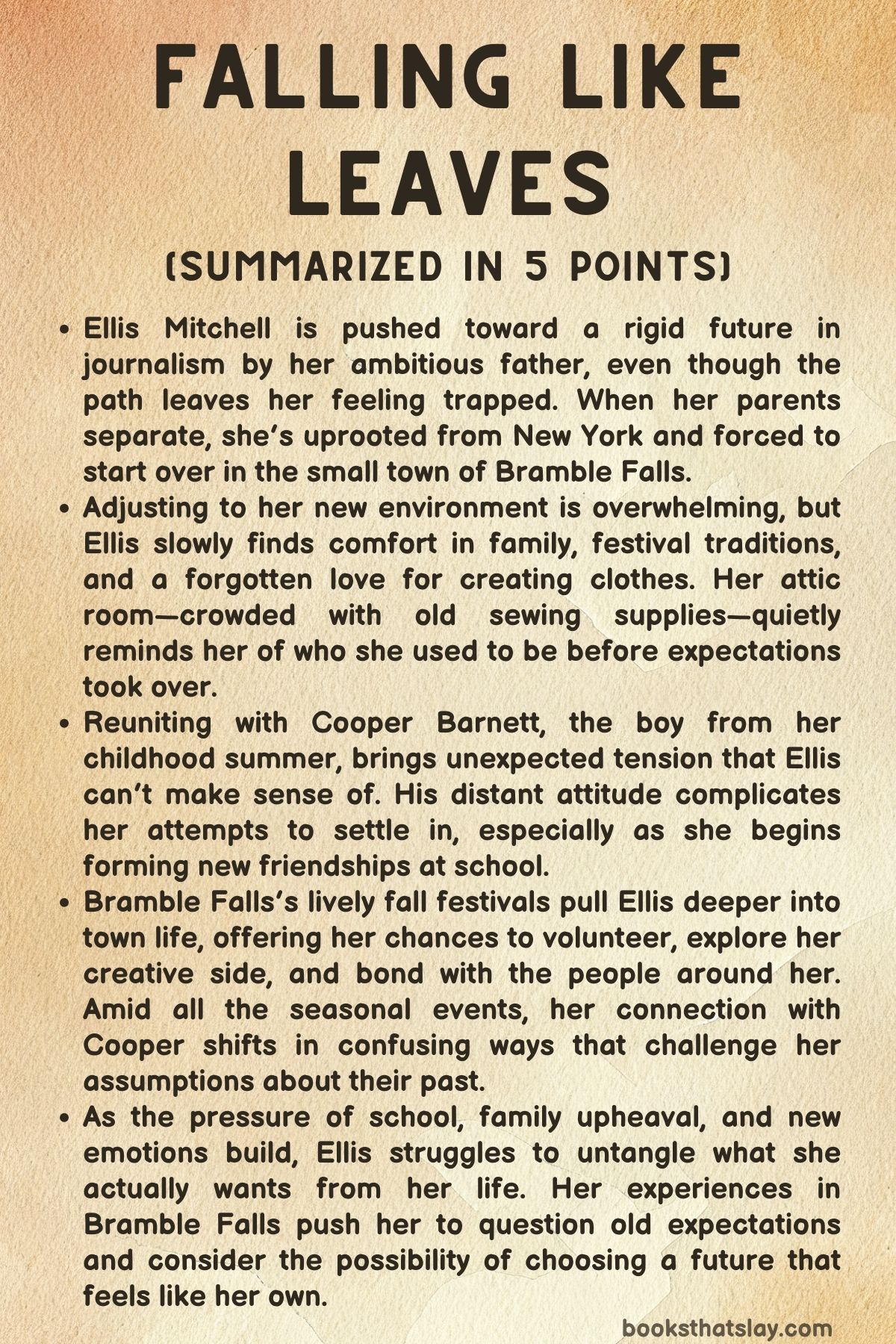
Falling Like Leaves by Misty Wilson follows Ellis Mitchell, a New York City senior whose life is engineered around success, prestige, and expectations she never chose. When her parents’ marriage collapses, Ellis is uprooted and forced to leave behind the future she spent years shaping.
Sent to the small town of Bramble Falls, she must confront a version of herself she buried long ago. Through new friendships, revived memories, and a complicated connection with the boy she once cared for, Ellis begins to question what she truly wants. The novel explores ambition, identity, family fractures, and the courage it takes to build a life that finally feels like one’s own.
Summary
Ellis Mitchell enters her senior year believing she knows exactly who she has to be: a polished, impressive future journalist destined for Columbia University. At a Street Media gala, she plays the part flawlessly for her ambitious father, Brad, though she feels isolated inside the high-pressure world he has built for her.
When she later glances at the Fashion Institute of Technology website, it stirs memories of the creativity she abandoned long ago, but her father shuts the idea down instantly. Hours later, her parents announce their separation, and Ellis learns she must leave New York to live with her mother in Bramble Falls, Connecticut, until Thanksgiving.
The news shatters her sense of control. She loses her internship, her school, and the plans she has lived by for years.
Bramble Falls is charming but suffocating to Ellis, who resents being forced to start over. Her aunt Naomi and cousin Sloane welcome her warmly, but Ellis can’t let go of her bitterness.
Her attic bedroom—dusty, cluttered, and filled with old craft supplies—only amplifies her feeling that she’s been moved backward in life. A visit to a new cat café jostles her even more when she runs into Cooper Barnett, the boy who shared her first kiss years before.
Instead of greeting her fondly, he acts cold and distant, confusing and hurting her. Cooper avoids her again later that day, leaving Ellis unsettled about what she might have done to push him away.
As she tries to settle in, Ellis fights constantly with her mother, misses her father’s attention, and struggles to accept the simplicity of small-town life. School brings new friends—Sloane’s circle, including Jake and Slug—but also gossip about the “New York girl.
” Cooper continues refusing to acknowledge her. To stay focused on her résumé, Ellis volunteers for the town’s busy fall festival season, which Naomi oversees.
Even as she tries to maintain her polished ambitions, she’s quietly affected by seeing her mother rediscover painting, a talent Ellis never knew she had.
During a volunteer shift at the orchard, Ellis and Cooper are forced to work together when they accompany a grandmother and energetic child through the fields. A mishap on a ladder injures Ellis’s ankle, and Cooper carries her back, revealing flickers of the boy she once knew.
But when she invites him to get tacos afterward, he shuts down again, leaving her humiliated. She turns her attention toward Jake, who is consistently kind, and agrees to attend homecoming with him as friends.
At the dance, Ellis is surprised when Cooper apologizes for snapping at her earlier. They share a quiet moment outside, where he fashions her a makeshift corsage and brings up her canceled meeting with her dad.
They nearly cross the line into something deeper before Chloe interrupts to announce the homecoming court results. The moment lingers in Ellis’s mind long after the dance ends.
As weeks of fall events unfold, Ellis and Cooper drift cautiously toward each other. They work late on the Harvest Hunt list, text through classes, team up in races, and share charged moments that neither fully names.
A night at the bonfire deepens their connection, though Ellis unintentionally insults his dream of pursuing baking professionally. He later asks her outside to talk, and they confront their growing feelings.
In the woods during a senior event, they finally kiss, but Cooper pulls back, convinced she will soon leave and forget him again. Their history and his fear of being hurt push them apart.
Ellis tries to find clarity, speaking with Jake about his feelings and Cooper’s past heartbreak. After Cooper reaches out, the two finally choose to try again, building a romance around creativity, trust, and late-night conversations.
They even collaborate on a parade float for the Falling Leaves Festival, sharing easy humor and new certainty. But pressure from school mounts, and when Ellis receives a disappointing grade, she spirals.
On Halloween, she and Cooper share a soft, private night, only for her world to break open again the next day when she learns her mother has put in an offer on a house in Bramble Falls. Convinced this means her life is permanently being stolen from her, Ellis lashes out and runs back to New York.
There, she discovers the truth: her father has been having an affair. He admits he pushed Ellis and her mother into lives centered around his ambition.
Heartbroken, Ellis turns to her best friend Fern, who helps her see that she must decide what she wants independent of her parents. Realizing she wants Bramble Falls—and Cooper—to be part of her future, she rushes back.
But Cooper, hurt and tired of being an afterthought, tells her he’s done. Ellis must confront her own patterns before anything can be repaired.
With Sloane and her mother’s support, she begins to understand how much she has been living for others. She decides to pursue fashion, stay in Bramble Falls for the rest of the year, and build a future she chooses.
To prove it, Ellis creates an elaborate cookie costume and a custom apron branded for Cooper’s dream bakery. In front of the parade crowd, she admits her mistakes and tells him she is choosing a life that includes him.
At first he resists, but as she walks away, he stops her, kisses her, and admits he wants to be with her without running anymore.
The festival becomes a turning point for both of them. Fern’s coverage goes viral, boosting the town and Cooper’s ambitions.
The two teens admit they love each other, excited for the future they’re building.
In the epilogue, Thanksgiving shows how deeply Ellis’s world has changed. She is working on her FIT portfolio, bonding with friends, and slowly redefining her relationship with her father.
Surrounded by people who truly know her, Ellis realizes she no longer has to choose between Bramble Falls and New York; both can be home now, and her life finally feels like her own.
Characters
Ellis Mitchell
Ellis is the emotional center of Falling Like Leaves, and her character arc traces a journey from pressure-shaped perfection to authentic self-definition. At the start, she is a high-achieving, tightly wound senior who has spent her life performing for her father’s approval—fluent in world affairs for gala conversations, meticulously building a résumé for Columbia, and suppressing her true interests.
Beneath that polish is a girl desperately exhausted from the weight of expectation. Her forced move to Bramble Falls shatters the identity she has clung to, leaving her resentful, lonely, and terrified of losing control.
Over time, however, she confronts her own rigidity, her fear of disappointing others, and especially her pattern of running away when relationships demand emotional vulnerability. As she reconnects with her old passions—fashion, community, friendship, love—Ellis softens, grows braver, and gains clarity about who she wants to be.
Her evolution becomes a shift from living for external validation to choosing a life that excites her, even if it is uncertain. Through her conflicts with her parents, her mistakes with Cooper, and her ultimate reconciliation with herself, Ellis emerges as someone willing to take risks for the right reasons and stand on her own terms.
Cooper Barnett
Cooper embodies steadiness, sincerity, and quiet determination—a boy grounded in loyalty yet deeply scarred by past heartbreak. His initial coldness toward Ellis stems not from cruelty but from hurt; years earlier, he had fallen for her only to feel abandoned when she stopped responding.
Despite his guarded exterior, he is kind, thoughtful, and deeply rooted in the rhythms of small-town life, baking at dawn and helping in community events. His dream of becoming a pastry chef reveals a creative ambition that mirrors Ellis’s own artistic inclinations, though he initially fears his aspirations will be dismissed as unrealistic.
As their relationship rekindles, Cooper struggles between wanting to trust Ellis and fearing she will leave again, leading him to retreat when he feels vulnerable. Yet his growth is marked by learning to voice his needs, confront his pain, and ultimately take emotional risks.
Cooper becomes not just a love interest but a catalyst for Ellis’s self-discovery—someone who challenges her to be honest about what she wants and encourages her to build a life defined by passion rather than obligation.
Brad Mitchell
Brad, Ellis’s father, is a polished, authoritative figure whose life revolves around ambition, status, and professional image. To him, success is something tangible, measurable, and strategically engineered, and he molds Ellis to fit this worldview.
Beneath his confident exterior lies a man incapable of vulnerability, and his emotional distance creates a profound void in Ellis’s life. His affair and the dissolution of his marriage expose his priorities: career over connection, control over truth.
Brad’s expectations have shaped Ellis’s perfectionism and fear of failure, and his inability to see her as a person rather than a project becomes one of the novel’s key emotional wounds. When Ellis confronts him, we see that he is not a villain but a man trapped by his own unmet expectations and ego.
His arc serves as a stark contrast to the authenticity Ellis seeks, ultimately pushing her toward a life more grounded in joy than achievement.
Ellis’s Mom
Ellis’s mother is gentle, introspective, and quietly resilient. She begins as a woman who has spent years shrinking herself to fit her husband’s world—abandoning her artistic dreams, her independence, and eventually her emotional well-being.
The move to Bramble Falls marks her own rebirth, as she reconnects with painting and discovers how deeply she has missed the creative life she once had. Her choice to separate is not just about leaving a failing marriage; it is about reclaiming her identity.
Her relationship with Ellis is tender but strained, as Ellis initially sees the move as a betrayal rather than an act of courage. Through honest conversations, laughter, moments of conflict, and shared vulnerability, Ellis’s mother becomes a guiding light in her daughter’s transformation.
She ultimately empowers Ellis by offering her freedom rather than direction, reminding her that happiness and fulfillment—not fear or obligation—should shape her future.
Sloane
Sloane, Ellis’s cousin, represents warmth, acceptance, and the spontaneous joy Ellis has been missing. She is the bridge between Ellis and the community of Bramble Falls, offering friendship without pressure and support without judgment.
Her open-hearted enthusiasm—whether it’s dragging Ellis into fall events, sharing clothes, or celebrating her smallest wins—helps Ellis feel less like an outsider and more like part of a family. Sloane’s presence provides stability and levity, balancing Ellis’s anxious tendencies with humor and affection.
She is a subtle but essential force in Ellis’s emotional healing, gently nudging her toward new experiences, deeper friendships, and eventually the courage to examine her own desires.
Jake
Jake is charming, friendly, and earnest, bringing brightness and levity to the story. As one of the first people to offer Ellis genuine kindness in her new school, he serves as an anchor during her transition into small-town life.
His initial crush on her is sweet rather than possessive, and his ability to remain her friend—even when it hurts—reveals emotional maturity beyond his years. Jake’s arc illustrates themes of unrequited affection, personal growth, and loyalty.
He becomes a symbol of the kind of friendships Ellis never had in New York: uncomplicated, wholehearted, and grounded in mutual respect. His humor and easy camaraderie make him not just comic relief but a deeply humane presence in her new life.
Aunt Naomi
Aunt Naomi is the embodiment of Bramble Falls itself—warm, community-minded, creative, and overflowing with affection. She welcomes Ellis and her mother not merely with hospitality but with a deep understanding of what they both need.
Naomi anchors the family through traditions, festival planning, and everyday rituals that create a sense of belonging. Her trust in Ellis’s abilities and her instinct to include her in town life give Ellis opportunities to rediscover her own talents.
Naomi’s home becomes a place of healing, and her unwavering support provides the emotional safety necessary for Ellis’s transformation. She is a model of resilience, choosing generosity and connection in every situation.
Fern
Fern, Ellis’s best friend from New York, reinforces the theme that true connection can survive distance and change. A successful influencer with a grounded personality, she brings a burst of city energy into Ellis’s Bramble Falls world.
Fern is perceptive, loyal, and refreshingly honest, unafraid to challenge Ellis when she’s avoiding her feelings or making self-destructive choices. Her ability to straddle both worlds—creative and pragmatic, glamorous yet sincere—helps Ellis reconcile the parts of herself she thought were incompatible.
Fern’s influence becomes pivotal in Ellis’s growth, offering clarity when Ellis is overwhelmed and celebrating her choices without judgment.
Dorothy and Harley
Dorothy and Harley bring humor, heart, and multigenerational warmth to the narrative. Dorothy’s gentle wisdom and Harley’s chaotic energy create memorable moments that push Ellis and Cooper into reconnecting.
Their orchard adventure becomes the catalyst for breaking the emotional distance between the two, revealing Ellis’s capacity for kindness and quick thinking. Dorothy’s calm presence contrasts with Harley’s whirlwind enthusiasm, and together they embody the spirit of community that defines Bramble Falls—people looking out for each other, offering help, and forming unexpected bonds.
Themes
Identity and Self-Definition
Ellis spends much of Falling Like Leaves struggling to understand who she is when the expectations that once structured her life begin to collapse. Her father has shaped her ambitions for so long that she initially cannot distinguish her authentic desires from the ones he has planted in her.
When she first reaches for the Fashion Institute of Technology website, the moment carries a quiet but powerful recognition that the life she has been pursuing may not be hers at all. Her sudden relocation to Bramble Falls intensifies this inner conflict, pulling her away from the familiar pathways of New York and giving her space—though unwanted at first—to confront the person she has been performing.
As Ellis stitches together costumes, volunteers at festivals, bonds with new friends, and reconnects with Cooper, she begins to understand how much of her personality has been shaped by pressure and fear rather than curiosity or joy. Her journey becomes an exploration of what it means to choose for herself, not simply in terms of career but in how she relates to others, to creativity, and to her own vulnerabilities.
By the end, she no longer treats identity as a fixed destination imposed from above but as something flexible, earned, and continually rewritten. Her realization that she can claim both Bramble Falls and New York without betraying either part of herself reinforces the idea that identity is expansive rather than restrictive—a place where multiple truths can coexist without erasing each other.
Family, Fractures, and Rebuilding
Family operates in the novel as both a source of deep hurt and unexpected healing. Ellis’s parents’ separation shatters her world, not only because of the immediate disruption but because it forces her to confront the false narrative she has been encouraged to believe about their marriage.
Her father’s affair and emotional manipulation expose years of buried tension—her mother’s sacrificed dreams, Ellis’s own grooming for a future designed to enhance his image, and the absence of genuine affection behind his demands. These revelations destabilize everything Ellis has trusted, making her feel uprooted not just from her home but from the foundation of her childhood.
In contrast, Bramble Falls introduces a different model of family—messy, affectionate, honest, and imperfect in ways that allow Ellis to breathe. Aunt Naomi and Sloane welcome her without expecting polished excellence; her mother reclaims her identity through painting; and the town’s traditions build a sense of warmth that contrasts sharply with her father’s sleek but cold world.
Through conversations marked by anger, disappointment, and eventually forgiveness, Ellis and her mother rebuild a relationship grounded in transparency rather than performance. The novel uses family to show how betrayal can coexist with love, how healing requires uncomfortable truth, and how chosen connections—cousins, friends, partners—can become extensions of family when old structures begin to crack.
Creativity, Passion, and the Courage to Choose
Creativity appears early in the story as something Ellis has quietly buried under academic ambition. Her sewing table in the attic becomes a symbol of a life she once loved and then abandoned under pressure.
As she begins to design again—starting with festival decorations, then scavenger hunt materials, and finally the elaborate costumes—the act is not simply artistic expression but self-reclamation. Each project returns a piece of confidence she didn’t know she had lost.
Creativity functions as the medium through which she reconnects with joy, community, and her own instincts. Cooper’s baking dreams run parallel to Ellis’s journey, illustrating how passion can be dismissed as impractical until someone stands beside you and acknowledges it as meaningful.
When Ellis accidentally hurts him by implying culinary school isn’t realistic, the moment forces her to confront how deeply she has internalized her father’s worldview. Her eventual decision to pursue fashion school is not a romantic gesture or a rebellion for its own sake; it is the first fully autonomous choice she makes in the entire story.
Creativity becomes the bridge between who she was, who she pretended to be, and who she is becoming—a reminder that passion deserves legitimacy, even when it does not align with others’ expectations.
Love, Vulnerability, and Mutual Trust
The relationship between Ellis and Cooper grows out of childhood affection, unresolved heartbreak, and the kind of unspoken expectations that linger when feelings are left unattended. Their dynamic is shaped by the misunderstandings of their past and the emotional walls they both carry into the present.
Cooper’s initial coldness reveals a wound he has been carrying for years, and Ellis’s fear of disappointing others makes her hesitant to let herself be loved. Their connection develops not through dramatic gestures alone but through shared responsibilities, quiet conversations, and the ways they challenge each other’s assumptions.
Love in the novel is portrayed as something that requires courage—courage to apologize, to listen, to stand still instead of running, and to believe that someone might choose you even after you have made mistakes. Ellis’s grand gesture at the parade is meaningful not because it is public, but because it signals her willingness to prioritize emotional honesty over self-protection.
When Cooper finally admits that he doesn’t want to run or be chased, only to stand beside her, the relationship transforms into a partnership built on trust rather than longing or fear. Their love becomes a catalyst for growth rather than a replacement for it, encouraging Ellis to live by her own choices and Cooper to believe in a future beyond the limits of his small town.
Belonging, Community, and the Meaning of Home
Home functions throughout the novel as an evolving concept rather than a physical location. Ellis begins her journey convinced that New York is the only place where she belongs, yet the city is associated with pressure, surveillance, and a version of herself she can no longer sustain.
Bramble Falls initially feels like exile—slow, quiet, and intrusive—but beneath the surface she discovers a community that sees her as more than an extension of her father’s ambitions. The town’s seasonal traditions create a rhythm of connection, and each festival event becomes an opportunity for Ellis to root herself in the present rather than clinging to the past.
Through friendships with Sloane, Jake, and others, she learns that belonging is not granted automatically by geography but earned through shared experiences and openness. The contrast between New York’s professional networks and Bramble Falls’s genuine warmth allows Ellis to redefine what home means: not a place that showcases achievement, but one that fosters growth and accepts imperfection.
By the time she recognizes she can belong to both places, the story underscores that home is not a fixed identity but a relationship—one that expands with people who make you feel seen, supported, and free to redefine yourself.
Ambition, Pressure, and the Cost of Perfection
Throughout the novel, Ellis grapples with the weight of being shaped for excellence rather than fulfillment. Her father’s relentless focus on Columbia, networking, and strategic presentation turns ambition into a form of parental control, leaving her terrified of mediocrity and convinced that any deviation from the prescribed path is failure.
Even as she builds meaningful connections in Bramble Falls, she approaches everything—from volunteering to schoolwork—with a sense of performative obligation. The unexpected C on her econ quiz triggers a spiral that reveals how deeply her sense of self-worth has been tied to achievement.
The novel critiques the cultural pressures that reward outward perfection while suffocating individuality. Ellis’s eventual shift in perspective does not reject ambition but reframes it.
She learns that ambition rooted in fear breeds unhappiness, whereas ambition rooted in passion opens possibilities. Her choice to pursue fashion is ambitious in a new way—ambitious because it is hers alone.
The story ultimately argues that true success is not about living up to a standard set by others but about pursuing a life that feels meaningful, even if it requires risk, reinvention, or stepping off the expected path.