Fiend by Amla Katsu Summary, Characters and Themes
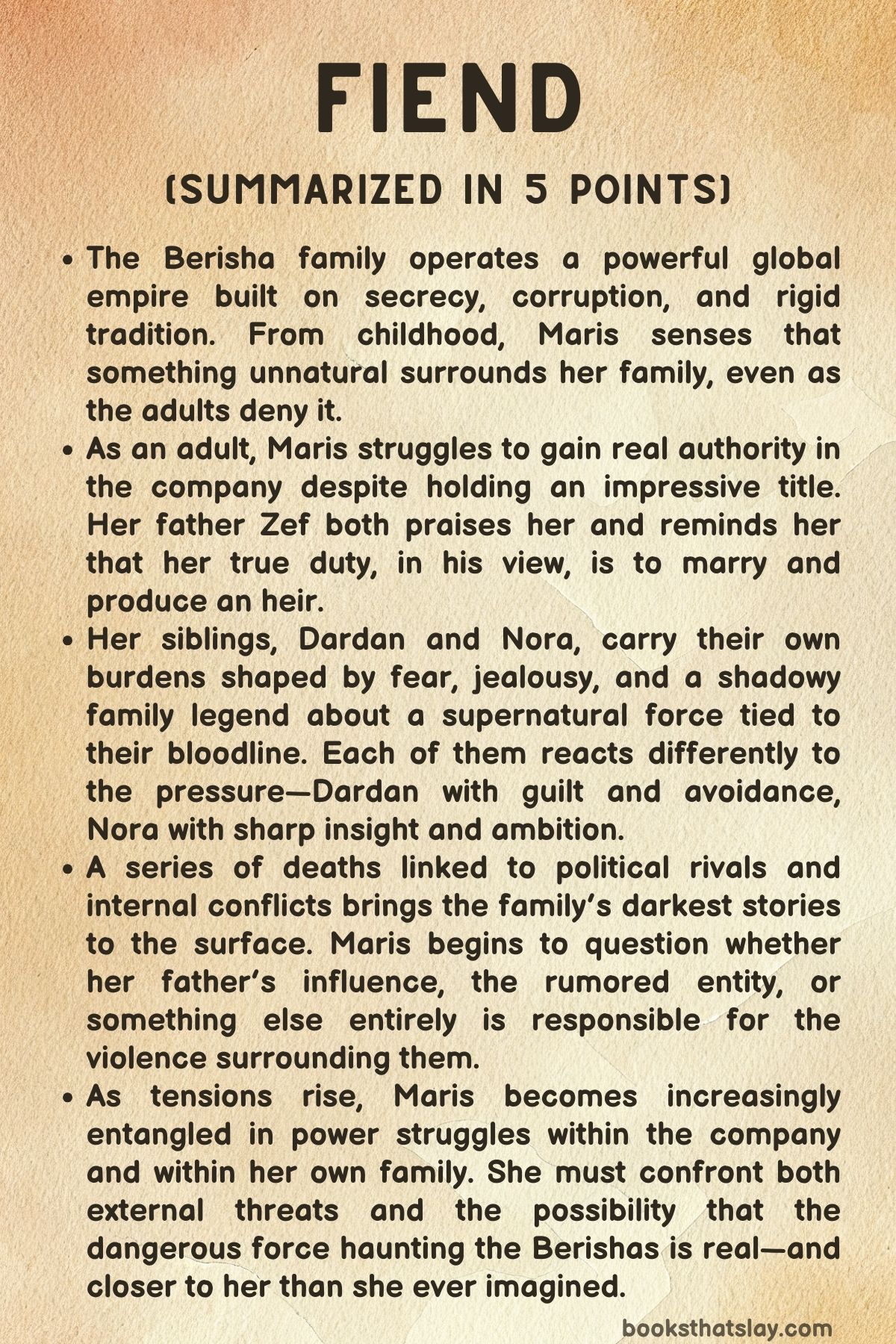
Fiend by Alma Katsu is a dark, character-driven thriller that blends corporate power, family corruption, and a chilling supernatural inheritance. Set among the elite circles of a wealthy Albanian-American dynasty, the story follows Maris Berisha as she tries to claim her place inside her father’s global empire.
What begins as a study of ambition and loyalty soon turns into a deadly struggle shaped by secrets the family has guarded for generations. As political scandals, violent deaths, and buried truths close in, Maris discovers that the greatest danger to the Berishas may come from within—and from something bound to them long ago.
Summary
Maris Berisha’s earliest memory of fear begins in her family’s Manhattan penthouse, where she hears tapping in the walls and follows the noise into the unused servants’ wing. Her older brother, Dardan, dismisses her story, though she remembers him once hinting he had also witnessed something strange.
Their mother, Olga, angrily fires the old doorman Angelo when he tells Maris a child once died in the apartment. The tapping returns that night.
Angelo vanishes from their lives. This early mystery sets the tone for what Maris will later learn: something follows the Berishas.
Years later, Maris works as a high-ranking adviser in her father Zef’s international company. The title is mostly ceremonial until a crisis drags her into real decision-making.
A former lobbyist, Jack Hargrove, is preparing to testify that Berisha International bribed politicians to secure a major Russian acquisition. The accusation is true.
At an emergency meeting, Zef is enraged. Dardan urges a legal strategy, but Maris insists they must stop the testimony before it happens.
Soon after, news arrives: Hargrove is dead under grotesque circumstances in a locked hotel room. Maris assumes Zef arranged it; Dardan is horrified.
Pressure mounts as Zef’s enemy, Congressman Andy Garrison, publicly points to the Berishas. Zef nearly retaliates until Maris helps calm him.
He then praises her but ruins the moment by declaring it is time for her to marry and provide an heir. Hurt, Maris confides in her sister Nora, who brings up the old family story of a supernatural “protector.
” She recalls that Maris once claimed it visited her. Though Maris rejects the idea, she secretly wishes something powerful could remove whatever threatens her.
A flashback reveals Nora once discovered a strange object connected to the family’s hidden power. When she tried to confront their father, he denied everything, and she understood that the family’s authority was built on secrets he would never explain.
Nora later manipulates Maris’s lover, Ricardo, into spending the day with her. Through drugs, seduction, and psychological pressure, she takes him from Maris to destabilize her.
Dardan, meanwhile, secretly meets Andy Garrison, who claims Zef caused multiple deaths, including the accident that killed Garrison’s son Conner years earlier. Dardan insists it was a tragic mishap but is shaken by the memory of delaying the rescue beacon due to Conner’s cruelty.
Garrison urges him to seize control from Zef before more blood is spilled. The meeting terrifies Dardan because he knows Zef has a violent supernatural burden he once saw as a child: a black, smoke-like force that filled a room during Zef’s rage.
When Maris discovers Nora with Ricardo, the sisters have a vicious confrontation. Maris then corners Dardan about his secret meeting with Garrison.
To stop her from revealing it, he announces at a family dinner that he plans to marry Marcie Franken. Zef is furious, but Dardan believes this move may free him from the family’s grip.
That night he is summoned to the office.
Hours later, Dardan is dead—found at the bottom of a 35-story stairwell. Maris forces her way into the investigation and secures the stairwell footage.
In it, Dardan appears to argue with someone who is not visible before flipping unnaturally over the railing. A blur of smoke crosses the frame.
Each time Maris watches, her head throbs sharply.
Zef becomes frail with grief. When Maris visits him, he temporarily names her interim CEO but says she cannot lead the clan.
That position, he insists, must go to her future husband. Maris feels discarded.
Nora then poses unsettling questions: what if their father died soon, and does Maris believe in the protector now?
At Dardan’s funeral, Maris sees a hovering plume of smoke at the family crypt. Moments later, Zef collapses.
He dies soon after, and Maris is asked to examine the body. She finds him mutilated in a way impossible for any human to have done.
Horrified, she arranges a cover-up and orders a cremation.
Shaken, she seeks answers from Olga, who finally admits the truth: a demon-like protector is bound to the head of the Berisha family, passed from father to son. It responds to emotion, especially rage or desire.
Zef lived apart from the family to protect them. Now Maris carries the burden.
Olga warns her to control it but offers little guidance.
As public protests grow over abuses at Berisha factories, Maris becomes CEO and feels the protector’s presence tightening around her life. It reacts to her anger and fear.
When she discovers Ricardo hiding in Nora’s home, a confrontation erupts. Maris loses control, black smoke fills the room, and Ricardo vanishes.
Maris asks the protector to make his death painless and remove the evidence.
A long-ago conversation with a priest resurfaces in her mind: centuries earlier, a rival clan’s grieving mother bound a demon to the Berishas to destroy them, but the patriarch learned to direct it.
Soon another death at a factory inflames the public. Walter, Zef’s aide, shows Maris altered footage from the stairwell: the new version clearly depicts her pushing Dardan.
He insists experts authenticated it and says they must go to the police. Maris claims it is a deepfake.
She flees to Nora, who seems uncertain.
The truth comes out after Maris wakes in a psychiatric cell, unable to summon the protector. Nora visits and reveals everything.
She used the protector to hide Maris’s push and erase her memory. Zef killed himself after Dardan’s death.
Olga and Nora concluded that Maris could not control the demon. Nora now commands it.
She has taken the ancient object that binds it and plans to free the protector entirely, believing she understands its suffering. She has secured a deal with authorities: Maris will be declared legally incompetent and placed in a private institution for life.
Cameras and microphones in the room have already been neutralized.
Nora leaves as Maris screams after her, ending Maris’s ascent and placing the future of the Berisha family—and the demon—fully in Nora’s hands.
Characters
Maris Berisha
Maris is the fractured center of Fiend, a woman raised in privilege yet deprived of autonomy, whose lifelong hunger for validation becomes the seedbed for her corruption. As a child, she is the most sensitive of the siblings—alert to the tapping in the walls, open to the supernatural, and keenly aware of emotional nuance.
But that sensitivity calcifies into bitterness as she grows up under Zef’s rigid patriarchy, where she is simultaneously used as an ornament and denied real power. Maris’s ambition is not inherently monstrous; it is born from years of being underestimated and controlled.
However, once given a taste of influence, she learns to mask insecurity with ruthlessness. Her moral decline accelerates with each betrayal—Nora seducing Ricardo, Zef announcing she must marry to serve the clan, and the discovery that Dardan has a life beyond her expectations.
The protector, which responds to desire more than command, becomes a perfect mirror of her unchecked resentment. By the time she kills Ricardo and is framed/forced to confront her part in Dardan’s death, Maris is trapped between victimhood and villainy.
Her tragedy is that she cannot disentangle her personal longing from the family’s curse; she becomes both inheritor and casualty of the Berisha legacy.
Dardan Berisha
Dardan is the reluctant heir, a gentle soul shaped into an anxious, compromised man by expectations he never wanted. As a child, he is the first to witness the protector in its raw form and becomes terrified of the destiny Zef intends for him.
His burst of cruelty in adolescence—his withdrawal, his tense demeanor—is less rebellion than fear of becoming like his father. Dardan’s life is marked by guilt: guilt over his school friend Conner’s death, guilt for failing to protect Maris and Nora, guilt for being unable to stand up to Zef.
He is the sibling who most clearly understands the family’s curse, yet he refuses to weaponize it. His longing for escape surfaces in his conversations with Marcie and becomes explicit when he tries to use marriage as an exit from the family structure.
His death, at once manipulated and supernatural, becomes the central hinge of the novel: the moment the protector’s allegiance shifts and the moment Maris and Nora’s fates diverge irrevocably. Dardan is the moral heart of the story, crushed by a legacy he never chose.
Nora Berisha
Nora is the family’s shadow, outwardly frivolous yet internally calculating, the sibling who has been dismissed for so long that invisibility becomes her greatest power. Her introduction as a chaotic hedonist belies the layers beneath—sharp intelligence, emotional acuity, and an intimate familiarity with loneliness.
Nora has lived her entire life knowing she was unwanted; her earliest memory confirms it. This profound abandonment makes her the perfect counterpart to the protector, which recognizes her suffering and bonds with her when she is only a toddler.
Unlike Maris, who craves recognition, Nora craves significance. Her manipulation of Ricardo, her cold assessments of family politics, and her ability to unsettle everyone around her stem from an awareness that she will never be chosen unless she chooses herself.
By the end of the novel, she becomes both savior and executioner—willing to expose Maris’s crimes, seize control of the protector, and attempt to reshape the family legacy. Nora is not benevolent, but she is purposeful.
Her final act of freeing the demon is both the ultimate rebellion and the culmination of her belief that the family’s power has always been a cage.
Zef Berisha
Zef is the embodiment of generational violence: a patriarch whose authority is absolute, whose love is conditional, and whose life is governed by a curse he pretends is power. His outward success masks a profound internal torment.
Raised to control the protector and to separate himself from his family for their safety, he becomes a man defined by emotional distance. His affection toward Maris is transactional, his disappointment toward Dardan constant, and his interactions with Nora tinged with indifference.
Zef is trapped between tradition and guilt, especially after Dardan’s death, which fractures his already fragile control. The deterioration of his body reflects the deterioration of his authority—the protector, fueled by emotion, becomes a force he can no longer restrain.
His gruesome suicide is both a surrender and a confession: he has realized that the legacy he upheld has destroyed his children. Zef is not a villain in the conventional sense; he is a man shaped by an inherited curse who perpetuates the very harm he once suffered.
Olga Berisha
Olga is a quiet but rigid enforcer of Berisha tradition. She is not cruel by impulse but by loyalty—to Zef, to the clan, and to the roles imposed upon her.
Her dismissal of Maris’s fears in childhood, her immediate firing of Angelo, and her cold reaction to Zef’s grotesque death all reveal a woman who prioritizes facade over truth. Yet she is also the keeper of forbidden knowledge: she understands the protector’s nature and the necessity of emotional restraint for the head of the family.
Her refusal to shelter Maris after confirming the demon’s existence is not purely heartless; it is a desperate attempt to prevent Maris from repeating Zef’s path. Olga is a paradox—maternal yet distant, frightened yet authoritative, a survivor who has learned that compliance is the only way to navigate the Berisha curse.
Her loyalty ultimately shifts to Nora, whom she sees as the more disciplined heir, revealing her pragmatic if painful understanding of her children.
Ricardo
Ricardo is introduced as Maris’s shallow lover, but his role becomes more symbolic than romantic. He represents escapism—for Maris, for Nora—and is a reminder of how people outside the Berisha family become collateral damage.
His interactions with Nora expose his moral pliability and his desire for validation, making him easy to manipulate. His fear when confronted by the protector shows how brutally outmatched he is in a world of supernatural inheritance and generational violence.
His death at Maris’s request is a turning point: the moment Maris irreversibly surrenders agency to the demon. Ricardo’s presence is brief, but he functions as a catalyst accelerating both sisters toward their ultimate confrontation.
Angelo
Angelo, the kindly doorman who tells young Maris the story of the child who died in the penthouse, represents the first rupture in the Berisha children’s sense of safety. His immediate disappearance after Olga’s wrath demonstrates the family’s intolerance for truth and their willingness to erase anyone who disrupts their narrative.
Though a minor character, Angelo shapes Maris’s lifelong fear: that there are truths the family hides not just from the world but from itself.
Walter and the Berisha Executives
Walter is the quintessential loyal retainer—devoted to Zef, terrified of the protector, and committed to maintaining order even when morality becomes secondary. His decision to confront Maris with the altered-but-true footage of Dardan’s death marks him as someone who values stability over loyalty to any one family member.
His actions help precipitate Maris’s downfall. The other executives, including Sally and Ajax, are emblematic of the Berisha empire’s rot: complicit, fearful, and deeply aware that the family’s power rests on something far darker than business acumen.
Themes
Power, Corruption, and Moral Decay
Power in Fiend operates as an inheritance, an expectation, and a curse, shaping every Berisha family member long before they understand its cost. The Berishas accumulate political influence, wealth, and global leverage through a mixture of business acumen and systemic corruption, but the novel shows that the true corruption begins at home.
The family’s legacy encourages secrecy, competition, and obedience, creating an internal culture where compassion is treated as weakness and success is measured by one’s willingness to participate in moral compromise. Maris, Dardan, and Nora grow up molded by a father who interprets leadership as domination and a mother who reinforces the hierarchy by silence or complicity.
Their childhood experiences teach them that the world rewards ruthlessness and that their heritage demands it. As adults, they attempt to navigate the empire Zef built, but each sibling reveals how corruption becomes a personal infection.
Maris channels her ambition into manipulation and intimidation; Dardan struggles between inherited duty and a conscience that cannot survive the environment; Nora disguises cruelty as insight and self-preservation. The presence of the demon intensifies this descent, but the narrative makes clear that the human choices come first—the supernatural element only amplifies what already exists.
The Berishas’ downfall occurs not because they encounter a powerful force but because they allow power to consume the last of their empathy. In the end, moral decay produces more destruction than the demon itself, as family members betray one another to protect reputations, grasp for control, or seek freedom from the roles imposed on them.
Power becomes a self-devouring cycle, ensuring that every victory carries the seeds of further ruin.
Family Trauma and Inherited Violence
Violence in the Berisha family is not solely physical; it is emotional, psychological, and generational. Each child grows up in an environment where fear functions as the primary organizing principle, shaped by Zef’s volatility, Olga’s calculated detachment, and the unspoken rules governing their lives.
The home is filled with rituals of avoidance—closed doors, silenced arguments, and buried truths that force the children to interpret danger without guidance. These conditions imprint themselves on Maris, Dardan, and Nora differently, yet all three internalize the message that love comes with conditions and loyalty is valuable only when it benefits the family structure.
The children carry the consequences of this upbringing into adulthood, reenacting the same patterns of silence and manipulation. Dardan’s guilt over his childhood experiences, Maris’s inability to form healthy attachments, and Nora’s attempts to weaponize intimacy all originate from the emotional violence they endured.
The demon becomes a metaphor for the unspoken rage passed from parent to child, a representation of how inherited trauma can manifest as uncontrollable impulses. The story emphasizes that violence does not begin with acts but with indoctrination: learning that fear is normal, that protection is conditional, and that survival requires suppressing vulnerability.
Even when the siblings attempt to escape or redefine themselves, the legacy of their upbringing repeatedly pulls them back. Ultimately, the family itself becomes the most destructive force in their lives, shaping their identities through cycles of resentment and wounded loyalty.
The novel argues that trauma inherited without acknowledgment becomes destiny, and the Berishas’ tragedy lies in their inability to break the cycle before it consumes them.
Identity, Worth, and the Hunger for Validation
Each member of the Berisha family struggles with the question of who they are beyond the roles assigned to them. Maris battles the contradiction between her ambition and the suffocating expectation that her ultimate purpose is marriage and motherhood.
Her desire for recognition is not shallow; it stems from years of being treated as ornamental, of being permitted proximity to power but denied actual authority. This hunger for validation shapes many of her worst decisions, pushing her to embrace manipulation, intimidation, and eventually violence.
Dardan seeks worth through compliance, trying to fulfill expectations he never truly chose, which traps him in a life defined by fear and duty rather than agency. His efforts to build a separate identity collapse under the weight of inherited obligation.
Nora masks her deepest insecurities behind confidence and hedonism. Beneath her provocations lies a lifelong belief that she is extraneous, created only because her father demanded another son.
Her sense of worth depends on proving she can outmaneuver everyone around her, yet she remains deeply affected by the rejection she experienced as a child. The demon itself reflects how identity becomes distorted by expectation; it behaves according to the desires projected onto it, just as the siblings behave according to the roles forced upon them.
The novel shows how destructive it is when identity is shaped by external pressure rather than self-understanding. Each character’s search for worth becomes entangled with ambition, resentment, and desperation.
Their inability to define themselves independent of the family leads to choices that forever sever their bonds, illustrating how the loss of personal identity can erode both morality and connection.
Supernatural Burden and the Consequences of Uncontrolled Impulse
The demon in Fiend operates as both a literal presence and a representation of unregulated human impulse. It responds to anger, fear, longing, and frustration, making it a dangerous extension of the emotional repression cultivated in the Berisha household.
Zef’s life is shaped by the constant effort to suppress his own impulses, knowing that the slightest slip can lead to catastrophic consequences. His isolation reflects the tragedy of a burden passed down without consent, transforming leadership into imprisonment.
When Maris inherits the demon, she does so without preparation or understanding, and the result mirrors how unchecked emotion can escalate into irreversible damage. The protector is not a malevolent spirit acting independently; its actions mirror the desires of its host, which makes every death tied to it both a supernatural event and a reflection of internal darkness.
Nora’s eventual control of the demon suggests a different kind of burden—one rooted in intimacy rather than duty. Her connection is born from childhood loneliness and a desire for companionship, giving the demon a new purpose that is more relational than utilitarian.
Yet this bond brings its own risks, hinting that emotional craving can be as dangerous as anger. The story’s treatment of the supernatural emphasizes that power without discipline becomes dangerous not because of the force itself but because of the emotions that guide it.
The demon’s presence highlights the consequences of suppressed rage and unresolved trauma, turning private impulses into lethal outcomes. By linking the supernatural to emotional control, the novel examines the fragile boundary between intention and action, showing how easily destructive forces emerge when internal turmoil is ignored or denied.
Betrayal, Manipulation, and the Collapse of Loyalty
Loyalty in the Berisha family is conditional, easily invoked but rarely practiced. The novel portrays loyalty as a tool used by those in power to enforce obedience rather than foster unity.
Zef demands it while giving little in return, Olga expects it while withholding warmth, and the siblings weaponize it when convenient. Within this environment, betrayal becomes almost inevitable.
Maris betrays Dardan by threatening to expose him; Nora betrays Maris by seducing Ricardo; the parents betray all three children by prioritizing lineage over well-being. Each betrayal creates fractures that deepen the family’s internal instability, eroding trust until any act of cooperation becomes impossible.
Manipulation becomes the primary form of communication: Nora relies on psychological pressure, Maris uses intimidation, and Zef uses cryptic half-truths to maintain control. These dynamics culminate in the ultimate betrayals—Nora revealing Maris’s crime, Maris allowing the demon to kill Ricardo, and Zef’s decision to impose the clan’s ancient expectations on his children.
What makes the theme especially powerful is the way every betrayal feels both personal and systemic. The characters betray one another because the family structure teaches them that survival requires gaining advantage, not offering support.
Even moments that appear protective carry hidden motives. The collapse of loyalty is not a single event but a gradual unraveling, each act building on the last until the family becomes incapable of functioning except through fear, coercion, or deception.
The story suggests that betrayal thrives where affection is conditional and power determines whose truth matters. By the end, loyalty exists only as a memory of what the family should have been, replaced entirely by the cold logic of self-preservation.