Ghost Business Summary, Characters and Themes
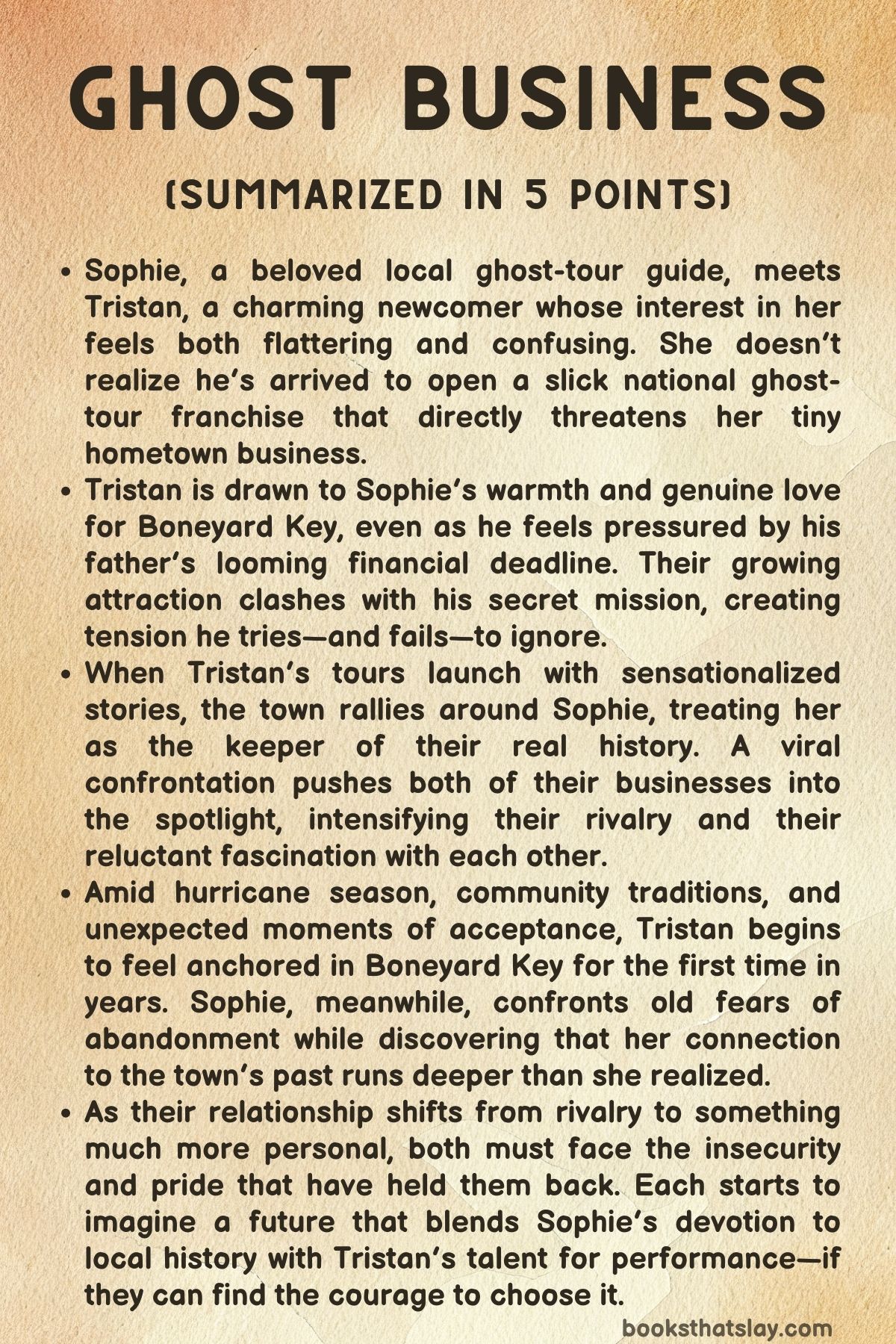
Ghost Business by Jen DeLuca is a contemporary romance set in the quirky, ghost-friendly coastal town of Boneyard Key, Florida. The story follows Sophie, a soft-spoken local who has built her life around preserving the town’s history through her small ghost tour, and Tristan, an ambitious entrepreneur whose national ghost-tour franchise threatens her livelihood.
Their connection sparks instantly, but so does a rivalry that pulls them in opposite directions. Through storms, secrets, community ties, hurt feelings, and unexpected tenderness, the novel explores how love grows between two people who start on opposite sides of the same street—one rooted in heritage, the other driven by ambition.
Summary
Sophie has lived her whole life in Boneyard Key, raised by her great-aunt Alice after her parents disappeared from her world. The town’s stories and spirits give her a sense of belonging, so she cares deeply for the small ghost-tour business she runs each week.
When she meets Tristan, a sharply dressed newcomer who seems taken with her at first sight, she imagines he might be someone worth knowing. But soon she discovers the truth: Tristan co-owns a national ghost-tour company called Ghouls Night Out, and he has come to open a branch in her tiny town.
His arrival threatens everything she’s built.
Tristan, under immense pressure from his father to prove his company’s profitability by October 1, initially sees Sophie as unexpected competition that could jeopardize years of work. But after following one of her tours, he recognizes her charm, talent, and authentic connection to the town’s past.
This only complicates his plans. Sophie, for her part, is furious when she realizes Tristan planted promotional cards around town and misread the community entirely.
Locals instantly side with her and greet him with cold resistance.
As Tristan tries to establish his business, he runs into one obstacle after another—missteps with townspeople, reactions to his embellished stories, and constant reminders that Boneyard Key already has a guide who knows its history personally. Sophie continues leading her historically grounded tours while collaborating with the local historian Theo on fact-checking an old town history book.
Her work connects her even more deeply to the spirit lore the town holds dear.
Tensions between Tristan and Sophie boil over when their tours collide and she publicly confronts him for spreading false stories. The video goes viral, bringing both guides a strange wave of attention.
Tristan, trying to be pragmatic, even offers Sophie a job using his scripted format. She refuses, offended that he would ask her to abandon accuracy for theatrics.
They strike an uneasy agreement to continue their tours until the end of September, with the lower ticket seller bowing out.
Despite this rivalry, their mutual attraction grows. Sophie unexpectedly learns that Tristan has been rattled by real supernatural encounters—thanks to some pranks from Aura Keefe and the restless spirit of Sarah Hawkins, who disapproves of his fictional tale about her life.
When Sophie and Tristan meet by chance one night, he opens up about his family pressures, and she shares how the ghosts fill the emotional spaces left by the people who abandoned her. Their understanding of each other changes, leading to late-night conversations and increasingly passionate moments.
They keep these encounters private while publicly maintaining their competitive front.
Summer passes in a rhythm of tours, whispered doorstep kisses, and awkward attempts to avoid talking about Tristan’s looming financial deadline. Meanwhile, Sophie struggles with her lingering hope that Aunt Alice might be haunting her home, but the town medium gently helps her accept that Alice likely moved on peacefully.
Sophie learns that the town’s ghosts prefer her gentle storytelling approach and feel respected by it.
When Hurricane Flynn forms and targets the Gulf Coast, Tristan and Sophie brace for impact along with the rest of Boneyard Key. After the storm, they work side by side helping the town recover.
Tristan finally feels the value of community, something he never experienced in his restless, nomadic lifestyle. With his condo damaged, he moves in with Sophie while repairs proceed.
Their connection deepens into a full relationship, but they still avoid discussing the deadline that may tear them apart.
September approaches, and Tristan’s worries mount. His partner Eric confirms that their company won’t meet the financial demands Tristan’s father set.
After a tense call with his father, Tristan believes he must abandon Ghouls Night Out and return to New York to work in the family business. When he tells Sophie he’s “lost everything,” she confronts him about the privilege he doesn’t acknowledge—unlike her, he has somewhere safe to land.
Hurt that he doesn’t even mention losing her, she tells him to go.
Both are left miserable. Sophie leans on her friends, who remind her she’s valued and loved by the community.
Tristan, feeling utterly alone, connects with the Beach Bum ghost on the shore and admits aloud all the fears he’s been carrying—about his father, his identity, his love for Sophie, and the possibility that he may never belong anywhere. He drinks with locals one last time, packs his apartment, and writes a heartfelt business plan and website structure for Sophie’s ghost tour as a parting gift.
When he brings the envelope to her door, intending to say goodbye, Sophie softens. They apologize for the ways they hurt each other.
She reveals that she built spreadsheets to merge their finances into a combined operation that would meet his father’s profit requirement, allowing him to stay without destroying her business. Her solution respects both their approaches: his showmanship and her dedication to historical truth.
When she asks whether he would stay if she wanted him to, he immediately says yes. They finally confess their love and decide to rebuild a life together in Boneyard Key.
Months later, they run their tours under the Ghouls Night Out brand while maintaining their individual styles. Their playful mid-tour “arguments” become a town favorite, drawing repeat visitors.
Sophie gains business stability and ownership, and Tristan becomes free from his father’s control while still doing what he loves most—performing. Their home becomes shared, their work intertwined in harmony, and their future rooted in the town that brought them together.
One night after their tours, Sophie tells Tristan about an old dream involving him, a top hat, and the ocean. Laughing, he wades into the water with her to recreate it, showing he’s finally embraced both the town and the love he once tried to resist.
Together on the moonlit shore, Sophie realizes that real life with him is better than anything she could have imagined, and the ghosts of Boneyard Key settle quietly around them, content with the story unfolding.
Characters
Sophie
Sophie is the emotional heart of Ghost Business, a woman deeply rooted in Boneyard Key’s history, culture, and supernatural lore. Having grown up in the town and been raised by her great-aunt Alice after both parents left, she carries an emotional vulnerability shaped by abandonment but also a fierce love for the community that became her family.
Her ghost tours are not simply a job—they are an act of caretaking for the town’s spirits and an expression of devotion to the real people behind the legends. Sophie presents a shy, self-effacing exterior, often assuming she is forgettable, yet she possesses natural charisma, grounded empathy, and a storyteller’s gift that draws people in.
Her grief over Alice, her fear of losing the small patch of stability she’s built, and her reverence for the supernatural all shape her interactions with Tristan, first filling her with wonder, then hurt, then the courage to build a future of her own choosing. Across the book, Sophie grows from someone who expects to be left to someone who learns to claim love, security, and partnership without apologizing for it.
Tristan Martin
Tristan is defined by ambition, performance, and the long shadow of paternal pressure. As co-owner of Ghouls Night Out, he initially approaches ghost tours as a polished commercial product—competitive, theatrical, and profitable rather than emotional or historical.
His drive is rooted in a need to prove himself to his wealthy, dismissive father, making him cling to the idea that success must be quantifiable, scalable, and detached from personal roots. Beneath his suave, slightly dramatic persona lies a man who longs for connection but is terrified of disappointing others.
Meeting Sophie derails his carefully controlled world: he becomes torn between corporate expectations and the real joy he finds in her company, the community, and even the town’s ghosts. His arc evolves from defensive and transactional to sincere and self-aware.
He learns to value authenticity, community belonging, and personal happiness over external metrics. His grand gesture—the business plan created for Sophie with no expectation of reconciliation—reveals how much he has changed.
By the end, Tristan becomes someone who chooses love, partnership, and a home he never realized he wanted.
Eric
Eric is Tristan’s business partner, best friend, and ex, offering grounding, clarity, and emotional reality to Tristan’s otherwise frantic ambition. While he initially encourages Tristan to treat Sophie’s tour as a competitive threat, he also repeatedly challenges Tristan to examine his motivations and happiness.
Their partnership exposes Tristan’s internal conflict: he wants to perform and create experiences, while Eric wants stability and sustainable growth. Eric sees through Tristan’s bravado, calling out his nomadic lifestyle as avoidance rather than freedom.
He plays the role of confidant, sounding board, and voice of reason, ultimately supporting Tristan’s shift toward a more grounded life. His steady presence underscores that Tristan isn’t alone, even when he feels the weight of the business collapsing.
Eric also champions the idea that Sophie and Tristan’s tours rise and fall together, offering a crucial insight that shapes the eventual merger that saves their business and relationship.
Libby
Libby is Sophie’s fiercely loyal best friend, a blend of comic relief, emotional support, and grounded common sense. She watches over Sophie with an almost protective vigilance, aware of Sophie’s abandonment wounds and determined not to let her fall apart unnoticed.
Libby’s sharp observations, hurricane tracking hobby, and dry humor help lighten the darker emotional undercurrents of the story. She is deeply rooted in town lore and connected to Nan’s paranormal investigations, which gives her a pragmatic acceptance of the supernatural and reinforces Sophie’s ties to the community.
Even when she admits she likes Tristan, she remains skeptical of his intentions, illustrating her priority: Sophie’s emotional safety. Libby’s interventions—especially during Sophie’s post-breakup spiral—serve as crucial moments that pull Sophie back from self-isolation and guide her toward healing and reconciliation.
Cassie
Cassie represents Boneyard Key’s maternal, spirited, and somewhat mischievous community soul. She is affectionate but blunt, playful yet perceptive, and often acts as an intermediary between the human and supernatural worlds.
Whether she is praising Sophie’s sentimental connection to the town or teasing Tristan about his feelings, Cassie understands the emotional rhythms of both characters long before they admit them. Her home, haunted by Sarah Hawkins, becomes a turning point in Tristan’s arc when Sarah physically reacts to his embellished ghost story.
Cassie’s acceptance of the supernatural and her insistence on respecting history mirror Sophie’s values, helping Tristan understand that ghost stories here are not commodities but legacies. Cassie also quietly encourages Sophie to open herself to love, offering steady reassurance that the community will not allow her to face life alone.
Nan Simpson
Nan acts as Boneyard Key’s spiritual elder, someone who understands the supernatural with a level of nuance that the others lack. Her calm explanations about Aunt Alice’s peaceful passing provide Sophie closure and guide her toward acceptance rather than longing.
Nan sees the town as a place where the living and the dead coexist in harmony, and she considers Sophie an essential bridge between the two. Her endorsement of Sophie’s tours as meaningful acts of remembrance—not performance—validates Sophie’s entire identity.
Nan’s declining health adds emotional urgency to her guidance, and her preference for Sophie over Tristan humorously reinforces the town’s protectiveness. Her wisdom grounds the supernatural elements, giving them emotional weight rather than spectacle.
Aura Keefe
Aura brings eccentricity, magical realism, and rebellious energy to the narrative. As part of a family with legitimate psychic powers, she sees Tristan’s fictionalized, commercial approach as both offensive and amusing, which leads her to prank him with ghostly illusions.
Her antics create tension but also humor, revealing the town’s resentment of outsiders who exploit their history without understanding it. Aura’s playful interference isn’t malicious; it’s protective.
She ensures Tristan learns that Boneyard Key’s ghosts—and their stories—deserve respect. Her presence also widens the story’s supernatural scope, affirming Sophie’s belief in the unseen and anchoring the idea that the spirits actively participate in the town’s life.
Theo
Theo is the scholarly anchor of Boneyard Key’s history, a historian devoted to accuracy and preservation. He becomes Sophie’s partner in researching and documenting the true stories behind her tours, demonstrating respect for her passion and validating the historical merit of her work.
Theo’s intellectual calm contrasts with Sophie’s emotional connection to the stories, highlighting how history can be both factual and deeply personal. His encouragement helps her see her work as valuable beyond nightly tours, inspiring her to draft a book.
Although not a romantic rival, he provides an alternative model of steady companionship and professional support that helps Sophie gain confidence in her identity as a storyteller and historian.
Sarah Hawkins
Sarah Hawkins, the ghost haunting Cassie’s home, personifies Boneyard Key’s insistence on truth and authenticity. Her poltergeist-like reactions to Tristan’s embellished pirate tale make her a silent but powerful advocate for historical integrity.
Sarah is protective of her story, her home, and her memory, and by asserting herself—through magnets, moving objects, and pointed responses—she educates Tristan on the emotional responsibility behind storytelling. When she ends her haunting episode with the compliment about Tristan’s hat, she demonstrates the town’s willingness to embrace outsiders who show humility and respect.
Sarah plays a humorous yet profound role in Tristan’s transformation.
Beach Bum Ghost
The Beach Bum ghost symbolizes the town’s quiet companionship and the idea that not all hauntings are dramatic or sorrowful. His presence at the picnic tables is gentle and consistent, offering Tristan an unexpected confidant during his lowest moment.
The emptying beer bottle is subtle but meaningful, a sign that the town’s spirits recognize Tristan’s sincerity and heartbreak. Through this ghost, Tristan experiences the supernatural not as spectacle but as connection, mirroring Sophie’s lifelong bond with the town’s spirits.
The Beach Bum ghost’s acceptance becomes an indirect blessing for Tristan’s place in Boneyard Key.
Aunt Alice
Though no longer present in the physical world, Aunt Alice’s influence permeates Sophie’s emotional landscape. As the woman who raised her after both parents left, Alice represents love, stability, and belonging—the very things Sophie fears losing throughout the book.
Sophie’s wish for Alice’s ghost to linger reflects her longing for reassurance and continued connection, though Nan later helps her understand that Alice has peacefully moved on. Even so, Alice’s presence lingers symbolically: in her jasmine scent, her mementos, and the home Sophie is afraid to fully claim.
Sophie’s eventual decision to move into Alice’s old bedroom mirrors her growth, her readiness to build a life rather than merely preserve one, and her acceptance that the love Alice gave her continues to shape her future.
Themes
Community and Belonging
Sophie’s life in Boneyard Key is shaped by her deep connection to place, and this sense of rootedness forms one of the most resonant themes in Ghost Business. What she carries is not only affection for her hometown but also the kind of familiarity that is built through shared rituals, long memories, and intergenerational ties.
Her ghost tours are an extension of this bond; they are not just performances but acts of preservation, grounding her in the stories of people who lived, loved, and lost long before she was born. The townspeople’s unwavering loyalty to her reflects how much she belongs among them: they defend her business, mourn her embarrassments, and celebrate her triumphs.
Even the supernatural residents—Sarah Hawkins, the Beach Bum, and the lingering presences Sophie feels around her—become part of the fabric of this communal embrace.
Tristan begins the story entirely outside this collective.
His relationships everywhere else are transactional, his home temporary, and his interactions professional. When he first steps into Boneyard Key, he views the town as another business venture to rescue his company from collapse.
Yet the community’s response forces him to confront what belonging actually means. Their suspicion, followed by their slow acceptance, pushes him to adjust not only his methods but his values.
The hurricane becomes a turning point: participating in cleanup, discovering the hidden cold spot, and sharing post-storm rituals allow him to feel the difference between being tolerated and being welcomed. Over time the town reshapes him, revealing how belonging is earned through contribution, honesty, and vulnerability.
By the end, Boneyard Key becomes his anchor just as much as it is Sophie’s, showing that community is not a static inheritance but a living thing that grows when someone chooses to show up for it.
Heritage, Memory, and the Preservation of Stories
The novel repeatedly emphasizes the importance of honoring the past—human, historical, and spectral. Sophie’s dedication to accuracy in her ghost tours contrasts sharply with Tristan’s early approach of embellishment and theatrics.
For her, each tale is a way to keep real people remembered. There’s a sense that if she stops telling these stories, the identities of those townspeople might dissolve, especially in a place where recorded history has gaps and inaccuracies.
Her collaboration with historian Theo to correct the town’s popular yet flawed book reinforces how seriously she takes this responsibility. Through Sophie, the novel suggests that history is more than facts on a page; it is a living presence shaped by the people who choose to keep it alive.
Even Boneyard Key’s ghosts reinforce this theme. Sarah Hawkins reacts with frustration when Tristan distorts her life story, and her interventions—clattering spoons, rearranging magnets—serve as reminders that the dead still care about how they are remembered.
Aura’s family, with roots stretching back to catastrophic storms, carries their own lineage of spiritual sensitivity, guiding Sophie toward deeper understanding. These supernatural interactions cement the idea that memory is active and reciprocal.
The living remember the dead, and the dead remain drawn to those who honor them. Tristan’s transformation begins in earnest when he apologizes to Sarah, acknowledging the weight of the stories he manipulates.
His shift from exploitation to stewardship parallels his emotional growth and his evolving respect for the town. By the end, heritage becomes not only a theme but the foundation of the couple’s shared work, reminding readers that stories endure only when they are carried with care.
Identity, Insecurity, and the Quest for Self-Worth
Sophie and Tristan both struggle with internal doubts shaped by their pasts, and their relationship becomes a catalyst for confronting these vulnerabilities. Sophie’s fear of abandonment colors much of her behavior.
After losing both parents and then her Aunt Alice, she expects people to leave eventually, and this expectation informs her hesitation with Tristan. Her ghost tours become a personal refuge: the spirits stay, the stories remain, and the town’s familiarity steadies her.
Yet this emotional safety also traps her in routines that avoid risk. When Tristan enters her life, he challenges her self-perception simply by wanting to know her, listen to her, and support her ambitions.
Their conflict later forces her to recognize her own patterns—pushing people away before they can hurt her—and she learns that protecting herself can also mean actively fighting for the relationships she values.
Tristan faces a different kind of insecurity, shaped by family expectations and the pressure to prove himself to a dismissive father.
His entire business is built on defiance rather than genuine purpose. He performs constantly—on tours, with clients, even with friends—trying to validate his choices.
Being around Sophie exposes how hollow that drive has become. For the first time he feels seen for who he is, not what he achieves.
This shift terrifies him because it threatens the identity he has constructed around independence and ambition. His emotional unraveling when he loses the company reveals how much of his self-worth depended on that structure.
Only after Sophie walks away does he recognize that what he truly wants is connection, not victory. The final reconciliation shows both characters choosing self-worth rooted in partnership rather than fear or ego, highlighting how identity evolves when someone is willing to be known.
Ambition, Conflict, and Ethical Responsibility
The competition between Sophie and Tristan explores the tension between ambition and ethics. Tristan arrives determined to grow his franchise, and his willingness to disrupt a small local business illustrates the corporate mindset he has absorbed.
He frames it as necessity—his father’s deadline, financial pressure, the need for profitability—but never considers the personal consequences for someone who depends emotionally and economically on her work. His scripted, sensationalized stories reveal how ambition can overshadow respect for truth and community.
Sophie’s ambition operates differently. She never intended to create a large enterprise; her drive comes from passion rather than profit.
Yet she is not without flaws. Her public outburst at the Hawkins House, while justified, shows how moral conviction can erupt into impulsive behavior.
The viral fallout blurs the line between integrity and spectacle, especially as tourists flock to see the “girl from the video. ” The story then complicates the theme further by showing that ambition is not inherently harmful: Sophie eventually embraces growth through a book, improved tours, and later shared ownership of a combined enterprise.
As Tristan begins to care for Sophie and the town, he reevaluates his priorities, discovering that ambition without integrity has no lasting value. His eventual decision to preserve Sophie’s distinct tour, rather than absorb or replace it, signals his understanding that success must be built in a way that respects the people it affects.
The merged business plan—created not as a competitive weapon but as an act of support—reflects a shift from conquest to collaboration. Through their journey, the novel questions what kind of ambition is worth pursuing and suggests that ethical responsibility transforms goals into something sustainable, humane, and ultimately fulfilling.
Love, Vulnerability, and Emotional Growth
The romance between Sophie and Tristan anchors the emotional landscape of Ghost Business. Their early flirtation is light and charming, but beneath the banter lie deep personal fears.
Sophie’s shyness is not simple introversion but a defense mechanism shaped by loss. Her reluctance to believe Tristan’s interest is genuine reflects years of feeling replaceable.
Tristan, meanwhile, is drawn to her warmth precisely because he lacks such grounding in his own life. Their chemistry is unmistakable, yet both instinctively hold back, sensing the danger of letting someone close enough to matter.
The hurricane functions as a symbolic turning point, stripping away distractions and leaving them exposed—literally in cold showers and figuratively in shared vulnerability. Living in close quarters accelerates their emotional intimacy.
Domestic routines, shared meals, and the quiet comfort of everyday life reveal what each has been missing. Yet the tenderness they build becomes fragile the moment Tristan’s professional crisis resurfaces.
His failure to acknowledge Sophie in his “I’ve lost everything” moment demonstrates how fear can blind someone to what truly matters, while her decision to push him away shows how past wounds can dictate reactions even when love is present.
Their reconciliation highlights how love matures through accountability.
Tristan returns not to defend himself but to offer something meaningful—support for her dreams, recognition of her value, and willingness to choose a life shaped by emotional truth rather than obligation. Sophie, in turn, chooses courage over fear, showing him the plan she built to help him long before she knew he would stay.
Their final union reflects love as an act of continual choice, grounded in mutual respect, honesty, and shared purpose. The relationship grows not because they are perfect, but because they learn to be fully themselves with one another.