Guardian Demon Summary, Characters and Themes
Guardian Demon by Aurora Ascher is a paranormal romance and urban-fantasy novel that follows a fallen angel striving for redemption and a demon trying to protect his family. Their worlds collide through secrets, danger, attraction, and a mission that threatens both Heaven and Hell.
Set mainly in modern-day Montreal, the story explores identity, loyalty, power struggles within celestial realms, and the possibility of love between beings raised to think of each other as enemies. As their choices shape the fate of angels and demons alike, the book blends emotional intensity, high stakes, and character-driven conflict.
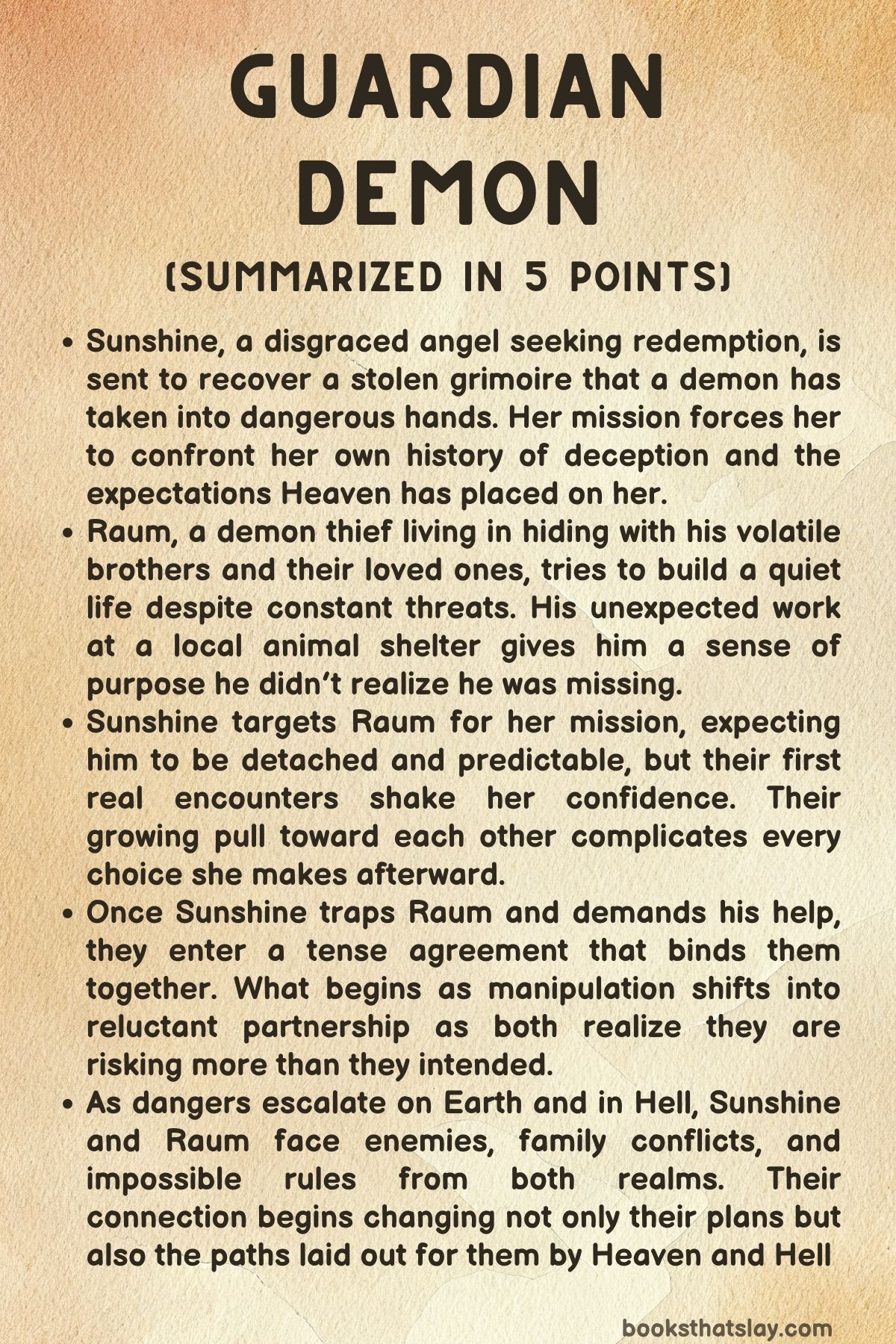
Summary
Sunshine, once a Principality of Heaven, now serves as a low-ranking guardian as part of her punishment for lies she once told. While researching the histories of the Grigori and Nephilim in the Empyrean Library, she is summoned by her mentor Adriel.
He informs her that the Dominations have agreed to give her a final test that could restore her to her former rank: she must retrieve a stolen witch’s grimoire, taken by a demon, and return it to Heaven. Although troubled by the secrecy surrounding the mission, she accepts, hoping success will repair her sense of purpose.
On Earth in Montreal, Raum, a demon who escaped Hell, lives with his brothers Belial, Asmodeus, Mephistopheles, and Mist, along with their close circle of loved ones. Their safety is fragile.
A necromancer demon named Murmur knows their location and regularly threatens them. Bel is preparing to meet Murmur again to secure his silence.
As the family debates how to handle Murmur—appease him or remove him permanently—Raum suggests stealing something valuable to Murmur. Iris, a witch, reminds them of the missing grimoire Murmur once had someone steal.
Raum is eager to attempt the theft, but Bel and the others forbid it, leaving Raum frustrated and restless.
While out running to clear his mind with his hellhound pup, Faust, Raum comes across Sunshine disguised as a human. After rescuing her from a chaotic tangle of fighting dogs, they share a charged, unexpected moment.
Sunshine, flustered by their encounter, retreats, unsure why she froze in front of him after months of careful surveillance. She has been following Raum and his brothers for weeks, having chosen him as the target she plans to seduce and trick to complete her mission.
Determined to regain control, she prepares to approach him again.
Raum soon starts working at a local animal shelter after its owner, Caro, witnesses how effortlessly he calms even the most aggressive dogs. The work grounds him and eases the loneliness that clings to him.
He keeps the job secret from his brothers until Meph discovers it and exposes him. Bel mocks the idea, pushing Raum into despair.
Raum escapes in crow form, hiding in Meph’s studio and wrestling with feelings of being left behind as others find happiness.
Sunshine keeps her distance during these days, watching from the shadows as Raum works with dogs, including Tiny and a traumatized pit bull named Luna. She remains determined to lure him into a position where she can capture him.
Her chance arrives at a nightclub, where Raum notices her dancing alone in a glowing white dress. They are immediately drawn to each other, and the chemistry between them escalates until Sunshine leads him outside.
In a dark alley, she drugs him with angel blood, a substance deadly to demons. Raum resists far longer than expected, fighting through pain, shifting forms, and trying to escape.
Sunshine eventually manages to teleport him into a sigil that traps him until he collapses.
When Raum wakes, Sunshine reveals she knows everything about him and his family. She offers a deal: he must help her retrieve the missing grimoire from Hell, and she will not expose his brothers.
Raum is furious but cannot risk the lives of the people he loves. After a long negotiation, the two seal a binding blood contract with protections for both parties.
They briefly part so Sunshine can retrieve ceremonial robes to use as disguises in Hell. She encounters the archangel Raphael and lies to escape quickly.
Meanwhile, Raum’s brothers notice the scent of an angel on him and begin to suspect betrayal. Sunshine and Raum reunite, open a hellgate, and cross into the broken ruin of Valefor’s former territory.
Because Sunshine’s glowing skin would draw attention, Raum carries her in his monstrous demon-crow form as they travel across the dangerous landscape. Eventually they reach a small cave filled with Raum’s enormous collection of stolen treasure.
Sunshine is startled, but Raum treats the hoard as an insignificant footnote in his long existence.
Raum leaves to scout Murmur’s heavily warded region, discovering that crossing the border without disguise would trigger deadly consequences. Returning to Sunshine, he prepares for the next step of their infiltration.
Their time in the cave marks a shift in their relationship. The tension between them erupts into intense physical intimacy that neither expected.
Sunshine, forbidden from such experiences, is overwhelmed, while Raum attempts to balance his desire with restraint. Their connection shifts from necessity to genuine emotion.
They return to Earth briefly so Raum can check on his brothers, bringing Luna with them to keep her safe.
Their peace ends abruptly when Mist tracks Sunshine to the rooftop and captures her with a Sheolic manacle. Inside the apartment, Raum and Belial are already fighting violently.
Sunshine stops them and admits she forced Raum into a contract to retrieve the stolen grimoire. Belial insists she must die, and only Mist’s unexpected compassion gives Sunshine the chance to free herself.
She tells Raum and his brothers the full truth, then leaves with Raum and Luna. Raum confronts her over the lies, and she apologizes, explaining how her mission twisted into something she no longer wanted.
They finally confess their feelings for each other and solidify their bond.
The conflict escalates when Sunshine kills Raphael to protect Raum, triggering a sequence of dangerous decisions. Raum takes Raphael’s severed head to Murmur to imprison permanently.
He argues that killing Raphael outright would provoke Heaven. Murmur accepts the arrangement but warns of consequences if Raum ever crosses him again.
Back on Earth, Adriel appears and reveals that both Sunshine and Raum have passed the tests set for them. Raum’s mercy toward Raphael proves that demons can evolve.
Sunshine’s choice to follow what she believed was right, rather than blind obedience, completes her penance. Raum and his brothers are granted freedom to live on Earth under new guidelines, and Sunshine is reinstated as a Principality with a unique exception that allows her relationship with Raum.
A month later, they settle into a life together in Montreal. Luna becomes their adopted dog.
Belial buys a mansion with a small cottage where Sunshine and Raum will live. Their friends dream of futures no longer shaped by survival.
Sunshine surprises Raum by decorating their home with treasures from his hoards, showing him she accepts every part of his history. They commit to building a new life together as the story closes while Murmur prepares his next move in secret, setting the stage for new conflicts ahead.
Characters
Sunshine (Sunny)
Sunshine is the emotional and moral center of Guardian Demon, a being caught between celestial law and the long-buried desires of her own heart. Formerly a Principality, she now carries the weight of her demotion like a quiet bruise—an ever-present reminder of the mistakes and lies Heaven demanded she make in the past.
Her entire journey begins with guilt, but what sets her apart is the way that guilt manifests: not as self-pity, but as an earnest hunger to repair what she has broken and re-earn a sense of self she fears she has lost. Sunshine is dutiful, but her obedience is brittle, cracking the moment she allows herself to see the world outside Heaven’s rigid structures.
Her attraction to Raum is initially framed as a weakness to overcome, a distraction, yet the more she watches him the more that “weakness” becomes the first authentic desire she’s allowed herself to feel. Her internal conflict is profound—torn between divine expectations and her raw, growing recognition that Heaven’s rules do not always serve justice or compassion.
Sunshine evolves from a remorseful angel trying to correct a past mistake into someone who chooses love, chooses her own agency, and ultimately redefines what righteousness means. Through Raum, she rediscovers tenderness, pleasure, and the power of free will; yet she never loses her core traits of empathy, loyalty, and fierce protectiveness.
By the end, Sunshine is not redeemed by Heaven—she redeems Heaven’s vision of her by choosing a path that reconciles love with purpose rather than forcing her to sacrifice one for the other.
Raum
Raum is a demon shaped by contradiction. He is introduced as a thief by compulsion, haunted by an inner emptiness that drives him toward risk, motion, and distraction.
Yet beneath that volatile surface lies a startling gentleness—particularly in the way he interacts with animals and later with Sunshine. His life in Montreal with his brothers is defined by survival and secrecy, leaving him feeling like the quiet, overlooked anchor in a family of powerful, dramatic personalities.
In truth, Raum is the emotional glue holding the group together, though he rarely sees his own value. His unexpected bond with Sunshine disrupts the numbness that has for centuries devoured him from the inside.
He is drawn to her purity not because she is angelic, but because she sees him—not the monster Hell shaped him into, nor the weapon Heaven assumes him to be. His development is marked by the slow unraveling of his loneliness, the awakening of long-suppressed memory fragments, and the discovery that he is capable of love that is both selfish and sacrificial.
His moral compass, though unconventional, is surprisingly steady, anchored in loyalty and a deep instinct to protect. Raum’s choice to spare Raphael, even after everything done to him and his family, becomes the turning point that reveals his capacity for mercy—a trait many angels fail to embody.
Through Sunshine he becomes more than a demon seeking escape; he becomes a person seeking connection, purpose, and a future he never believed was possible.
Belial (Bel)
Belial is the most volatile of the demon brothers, a being of immense power barely restrained by exhausted willpower and layers of trauma. His hellfire is not merely a destructive ability but a metaphor for the rage, fear, and helplessness that have accumulated in him since their escape from Hell.
Sleep eludes him, pleasure is dangerous for him, and his temper coils around every interaction like a live wire. Beneath his snarling exterior lies profound devotion—he would burn the world to protect his siblings, even when that protectiveness becomes destructive.
Bel’s conflict with Sunshine is rooted not in hatred of angels but in terror of losing yet another family member. His aggression masks a soul fraying at the edges, desperate for control over a life that has given him none.
Despite his fury, he listens when confronted with truth, and his eventual acceptance of Sunshine reflects a deep, if begrudging, emotional intelligence. Bel is a study in extremes: wrath and love, chaos and loyalty, destruction and sacrifice.
Asmodeus (Ash)
Ash is a demon who uses charm, humor, and sensuality as armor. What others see as confidence is, in truth, his shield against the curse Raphael inflicted on him, a curse that has twisted his relationship with desire and power.
His role within the family is that of mediator and emotional stabilizer, stepping in to soften Bel, tease Meph, or coax Raum out of his isolation. His relationship with Eva further grounds him, giving him a softer, more vulnerable dimension.
Ash’s concerns throughout the story revolve around stability—of their home, their secrets, and their freedom. Though not as central to the main plot as Raum or Sunshine, he adds balance to the group, revealing the capacity of demons to adapt to Earth, form bonds, and crave normalcy despite centuries of torment.
Mephistopheles (Meph)
Meph is the unpredictable, artistic spark among the brothers. His personality is flamboyant, dramatic, deeply feeling, and often chaotic in the most endearing ways.
He notices everything, including Raum’s emotional distance, and though he mocks relentlessly, his teasing comes from affection rather than cruelty. His relationship with Iris gives him grounding, and his creativity—both in magic and in art—reflects his refusal to be defined by Hell’s brutality.
Meph’s joy is a rebellion, his humor a survival strategy, and his empathy often sharper than he lets on. He sees through Sunshine’s lies before anyone else, not because he is suspicious, but because he is perceptive in ways others underestimate.
Mist
Mist is the silent blade of the family—the hunter shaped by centuries of violence and obedience, still wearing the brands of slavery across his skin. He speaks little, but every word carries weight.
His tracking abilities and instincts make him both a fearsome protector and a frightening adversary. When he confronts Sunshine, the encounter reveals how deeply he fears losing his family and how thoroughly he has been trained to eliminate threats before they grow.
Yet he listens when Sunshine offers a way to remove his brands—something that feels impossible to him. Mist’s arc is soft but profound: he shifts from suspicion to cautious respect, from rigid defense to the first spark of hope for personal freedom.
Adriel
Adriel embodies Heaven’s most enigmatic qualities: calm authority, hidden agenda, and an almost disconcerting mix of benevolence and manipulation. He mentors Sunshine with the warmth of a patient father but keeps her in ignorance with the coldness of a strategist.
His test for Sunshine and Raum reveals the double-edged nature of angelic morality—compassion is demanded, yet obedience is expected to the point of self-erasure. Despite this, Adriel proves capable of mercy and flexibility.
His final decree allowing demons to live freely on Earth shows that Heaven, through him, can evolve. Adriel’s relationship with Sunshine is complex: he believes in her, but he also uses her, leaving her to navigate the difference between guidance and control.
Daniel
Daniel is the grounding presence among the angels, someone who believes deeply in order but who also thinks pragmatically. His horror upon seeing Raphael’s remains shows his adherence to structure, yet his willingness to work with the demons reveals a more open mind than most angels.
He serves as a bridge between the celestial world and the chaotic reality unfolding in Montreal. Daniel’s loyalty is to balance, not extremism, making him a steadying force in a story filled with characters driven by passion or trauma.
Raphael
Raphael is the embodiment of Heaven’s hypocrisy—an archangel who weaponizes divine authority for personal dominance. His actions toward Asmodeus, Raum, and Sunshine reveal a cruelty far removed from righteousness.
His obsession with power manifests through manipulation, curses, and threats. Yet his fate—reduced to a regenerating head imprisoned by Murmur—becomes poetic justice.
Raphael represents the rot at the heart of Heaven’s hierarchy, the danger of unquestioned authority, and the violence hidden beneath divine rhetoric.
Murmur
Murmur is a necromancer demon whose ambition is cold, methodical, and terrifyingly creative. He is driven not by chaos but by calculated hunger for knowledge and power.
His use of bound souls, corrupted wards, and necromantic constructs shows a mind unbound by morality. Yet he respects cunning, which is why Raum’s offer intrigues him rather than enrages him.
Murmur is not irrationally evil; he is a scientist of cruelty, dissecting divine and infernal systems alike. His future plans, hinted at in the epilogue, suggest that he is the novel’s lingering threat—one whose intellect, not brute force, makes him lethal.
Eva
Eva is the half-angel musician whose presence among the demons exemplifies resilience and unconditional acceptance. Her artistry contrasts sharply with the violence surrounding her, acting as a symbol of beauty surviving in the cracks of trauma.
She is fiercely loyal, grounded, and unafraid to speak uncomfortable truths. Her relationship with Ash shows her courage in loving someone shaped by suffering while refusing to be intimidated by it.
Caro
Caro is the human anchor of warmth and everyday goodness, unknowingly offering Raum a glimpse into a life free from fear. Her trust in him, innocent and untainted by celestial politics, gives Raum validation he has never received from any supernatural being.
She represents normalcy—the life he could have had if not for Hell—and the compassion of ordinary people who treat him with kindness without understanding what he is.
Themes
Redemption and the Weight of Past Failures
Redemption in Guardian Demon unfolds through characters who carry deeply personal burdens, each struggling to reconcile who they were with who they hope to become. Sunshine’s journey reflects this most clearly: once a Principality, she now fights to prove she deserves to rise again, even as her conscience strains under the lies demanded by Heaven.
Her demotion is not just a punishment but a spiritual wound that shapes every decision she makes, and her desperation to “be whole again” exposes how fragile her sense of worth has become. Her mission to retrieve the stolen grimoire becomes less about heavenly duty and more about the daily conflict between truth and manipulation—between her genuine compassion and the deception she believes necessary for redemption.
Raum’s version of redemption is quieter but equally powerful. He carries centuries of emptiness, thievery compelled by instinct, and a lifetime believing he is fundamentally lesser than his brothers.
His work at the animal shelter becomes symbolic of his unspoken desire to be more than the role Hell carved for him. When Sunshine forces him into a contract, he could easily sink into resentment, yet he negotiates protections not just for himself but for his family, revealing his relentless loyalty.
Their growing connection becomes a space where both confront what they think they deserve—Sunshine believing she must earn forgiveness, and Raum believing he may never deserve it. Together, they push each other toward new possibilities.
Neither is magically absolved; instead, their redemption grows from honesty, sacrifice, and the courage to redefine themselves even when Heaven or Hell insists on their roles.
Power, Control, and Autonomy
Power in the novel is never a simple measure of strength; it is a negotiation of agency, consent, and vulnerability. Sunshine begins her mission with institutional power—Heaven’s authority, sacred knowledge, angelic abilities—yet she feels powerless under the weight of expectations and rigid hierarchy.
Her orders demand control over Raum, and she initially accepts that role, drugging and trapping him through methods that violate her own ethical boundaries. The story treats this early dynamic with moral complexity: Sunshine struggles with the contradiction between her mission and her conscience, revealing how power corrupts not only through domination but through obedience.
Raum, in contrast, appears physically formidable yet spends much of the story deprived of true autonomy. His demonic instincts, enforced contracts, and Hell-forged compulsions—like his obsessive need to steal—restrict him as much as any celestial chains.
His family’s safety becomes another form of restraint, limiting his choices even when he wants to defy Sunshine or break free from the past. Their relationship evolves only when power stops being a weapon and becomes a responsibility.
Sunshine learns to release control, choosing honesty over manipulation even when it endangers her standing with Heaven. Raum, who has lived within systems that treated him as expendable, discovers the strength in vulnerability—allowing himself to trust, to negotiate without aggression, and to defend Sunshine not out of obligation but desire.
The convergence of their arcs ultimately challenges Heaven’s rigid rules and Hell’s brutality, proving that real power emerges not from hierarchy but from mutual recognition and freedom of choice.
Identity, Transformation, and the Search for Self
Identity in Guardian Demon is a living, shifting thing—shaped by memory, trauma, desire, and the invisible expectations placed on every character. Sunshine grapples with an identity imposed by Heaven: obedient angel, repentant sinner, tool of divine judgment.
Yet her interactions on Earth show how fragile that identity is. Her connection with Raum awakens instincts and emotions she has been trained to suppress, and each step toward him dismantles her certainty that angelic purpose must override personal longing.
Raum’s identity struggles are rooted in abandonment and inferiority. Surrounded by brothers who display dramatic powers, leadership, or chaos, he feels like the quiet shadow in a family of legends.
His affinity with animals, a trait that should not exist in a demon, sparks questions he has never dared to ask. Sunshine’s explanations challenge everything he believes about his nature, pushing him to reexamine who he is beyond Hell’s labels.
Their intimacy becomes a catalyst for transformation. Sunshine begins choosing her own path rather than Heaven’s script, even contemplating falling from grace to stay with him.
Raum discovers pieces of himself that are gentle, empathetic, even noble—qualities he never thought he possessed. Their relationship reveals that identity is not predetermined by celestial rank or demonic lineage but built through choices, love, and the courage to question inherited purpose.
Even when Adriel announces their forgotten past and erased memories, the novel reinforces that identity is not anchored in what they once were but in who they decide to become together.
Love, Desire, and Emotional Vulnerability
Romantic and sexual intimacy become a force that reshapes both characters’ worldviews. Sunshine approaches desire with innocence, yet her longing for Raum is immediate, visceral, and confusing due to Heaven’s restrictions on pleasure.
Her emotional transparency disarms him, and her trust challenges the narrative he has internalized about demons being incapable of healthy connection. Raum, accustomed to keeping people at a distance, finds himself shaken by how deeply she affects him.
Their physical encounters hold layers of emotional revelation: moments where Sunshine’s inexperience meets Raum’s protective instincts, where boundaries are negotiated rather than assumed, and where pleasure becomes a way for them to understand each other without the barriers of angelic duty or demonic shame. Vulnerability—both emotional and physical—becomes their shared language.
Sunshine’s honesty about her fears and contradictions invites Raum to express his own longing, his sense of inadequacy, and eventually his love. Their bond grows strongest at their most fragile moments: after violence, during confessions, in the quiet afterglow of touch, and in choices that risk everything for the other.
The novel frames love not as weakness but as a transformative force powerful enough to bridge cosmic divides, challenge divine law, and rewrite futures that seemed predetermined.
Family, Loyalty, and Chosen Bonds
The story highlights family as both burden and salvation. Raum’s loyalty to his brothers borders on self-sacrifice; every dangerous choice he makes is rooted in their safety.
Their apartment is chaotic, crowded, and emotional, yet the foundation of their dynamic is unwavering devotion. Bel’s volatility, Mist’s protective instincts, Meph’s mischief, and Ash’s steadiness create a family shaped by trauma, escape, and desperate hope for a peaceful existence.
Sunshine, who has spent her life in hierarchical heavenly structures, is confronted with a family built on choice rather than obedience. She witnesses the brothers’ fierce loyalty, their willingness to cross moral boundaries for each other, and their refusal to abandon Raum even when he acts secretive or conflicted.
Her interactions with them slowly reshape her understanding of belonging. Throughout the novel, the idea of chosen family challenges traditional celestial concepts of order and destiny.
Loyalty becomes a moral compass more powerful than divine mandate. Even the demons who appear fearsome show tenderness in private moments—caring for animals, comforting each other, or fighting for their collective safety.
This theme underscores that family is not defined by origin but by commitment, sacrifice, and the courage to protect those who matter most.
Moral Ambiguity and the Challenge of Divine Authority
Heaven and Hell are presented as flawed systems—rigid, bureaucratic, and often cruel. Sunshine begins as a loyal servant, trusting Heaven’s directives without question.
Yet the further she ventures into her mission, the more she encounters contradictions: orders that require deception, leaders who conceal truths, and punishments that lack compassion. Her struggle reflects the tension between institutional morality and personal ethics.
Raum’s history shows the brutality of Hell’s hierarchy, where power is maintained through force, fear, and exploitation. But Hell is not portrayed as pure evil; its inhabitants possess complexity, humor, grief, and love.
The novel rejects simplistic binaries, questioning why Heaven assumes moral superiority when its methods often parallel the systems it condemns. Sunshine’s eventual defiance—protecting Raum, rejecting blind obedience, and prioritizing her own moral compass—illustrates the cost of trusting institutions more than one’s conscience.
Adriel’s final revelation reinforces the theme: even heavenly tests manipulate lives and emotions without consent. The story suggests that morality cannot be dictated from above; it grows through empathy, self-awareness, and the willingness to choose compassion over doctrine.
Destiny, Free Will, and Rewritten Futures
Characters repeatedly confront the tension between what they are told they must be and what they wish to become. Sunshine’s destiny is shaped by celestial hierarchy, penance, and the drive to reclaim her former rank.
Raum’s life seems predetermined by demonic nature, Hell’s expectations, and a past erased from his memory. Yet their choices continually break away from these imposed paths.
Sunshine chooses love over rank, honesty over obedience, and empathy over divine judgment. Raum chooses mercy over vengeance, self-control over instinct, and emotional connection over isolation.
The revelation that their memories were erased adds another layer: their past selves once made choices so significant that Heaven intervened, yet even with that history stripped away, their present selves still find each other. This reinforces the idea that destiny may create possibilities, but free will shapes the outcome.
Their final future—living openly in Montreal, building a home, and redefining angel–demon relations—emerges not from prophecy but from decisions grounded in love, sacrifice, and mutual respect. The novel closes on the message that destiny provides a starting point, but free will creates a life worth living.