No Rest for the Wicked Summary, Characters and Themes
No Rest for the Wicked by Rachel Louise Adams is a dark, atmospheric thriller set in a small Midwestern town where buried secrets, political corruption, and long-hidden trauma collide. The story follows Dolores, a forensic pathologist who is forced to return home after her estranged father, former senator Alexander Hawthorne, vanishes under violent circumstances.
As she confronts the past she fled eighteen years before, Dolores uncovers a chain of crimes linking her family, the powerful Winslow clan, and a decades-old cover-up. The novel blends psychological tension with a slow unmasking of truth, exploring memory, loyalty, and the price of silence.
Summary
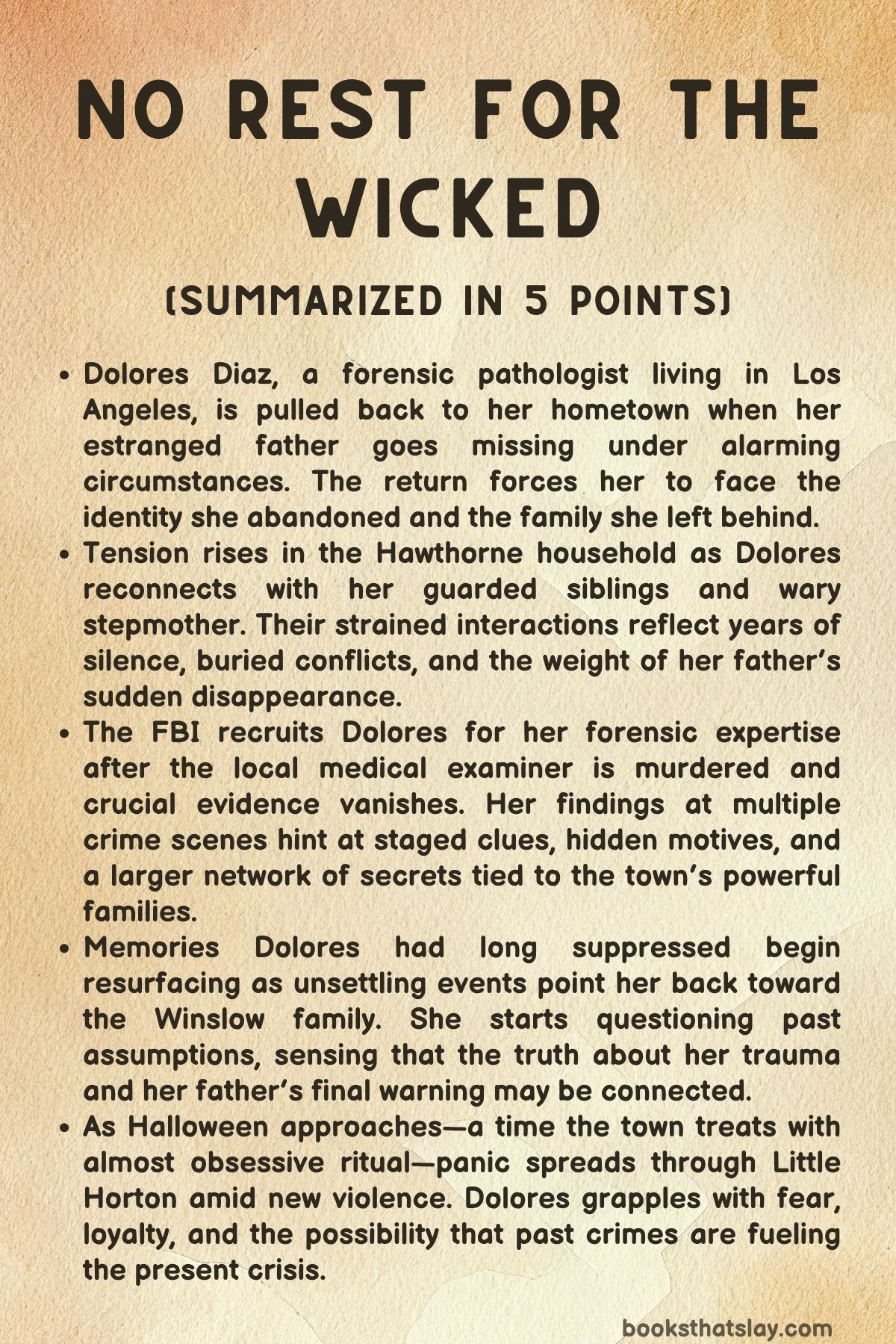
Dolores Diaz’s life in Los Angeles is interrupted by a call from FBI Agent Wyatt Holt, who addresses her by her long-abandoned birth name and informs her that her father, Alexander Hawthorne, has disappeared. Reluctant but unable to sever old ties, she flies back to Little Horton, Wisconsin.
As soon as she returns, she is struck by the suffocating atmosphere of the town she once fled, a place obsessed with Halloween and steeped in unspoken history. At the family home, she faces a cold reception from her younger half brother, Asher, and an equally strained one from her stepmother, Charlotte.
The household is tense and fraying as they wait for news of Alexander.
Charlotte recounts the disturbing circumstances surrounding Alexander’s disappearance: his study was left in chaos with signs of a violent struggle, blood on the carpet, and evidence someone had been dragged away. Dolores meets with agents Wyatt Holt and Paul Turner and learns her father had begun writing her a letter filled with regret and a stark warning—“Trust no one.
” Dolores uses her forensic training to assess the study. She detects gunpowder, a large amount of blood, and indicators of a shooting.
The agents probe the possibility of political enemies or financial corruption, revealing that Alexander’s rapid rise to political office was fueled by secret funds.
Dolores begins to feel the stirrings of old memories tied to the Winslow family, particularly Jacob Winslow, once her boyfriend and now the town’s mayor. She remembers becoming pregnant as a teen but never clearly recalling what happened.
The truth had been buried under pressure from Charlotte, who insisted it remain hidden to protect Alexander’s career.
At the same time, Officer Kate Butcher discovers a major development: the local medical examiner, Dr. Burke, has been murdered.
The FBI asks Dolores to perform the autopsy when evidence from her father’s case is found to be stolen from his office. Dolores approaches the work with grim determination and suspects the killer staged certain details to mislead investigators.
With tensions rising, she seeks comfort in alcohol and reconnects uneasily with Asher. Their conversation reveals long-held resentment and hurt, but also a lingering bond.
Pieces of the past begin resurfacing, forming cracks in Dolores’s long-suppressed memories. She hears that Alexander had recently visited the Winslows, a fact that horrifies her, suggesting he may have learned the truth about her assault.
Meanwhile, new crimes unfold. Human bones are found near City Hall, and Gregory Winslow, the domineering patriarch of the Winslow family, is brutally murdered.
Dolores’s relationship with Charlotte deteriorates as she senses Charlotte is hiding more than fear. When Jacob comes to their home seeking help, Charlotte reacts violently, slashing his face and declaring that the family is “at war.
” Dolores is forced to leave, wandering the rainy streets as she tries to understand how the past connects to the escalating violence. During a hallucination-laced moment, she sees the face of Kristen Horowitz, a girl who went missing years ago and whose fate is one of the town’s darkest mysteries.
Kate brings Dolores into her home for safety. Their uneasy alliance softens as they talk through their high school years, revealing that a humiliating scene at a Halloween party had deeper implications than either of them realized.
Kate begins to question her own memories, noticing details she overlooked at the time.
The truth finally begins to surface when Wyatt reveals his real identity: he is Junior Horowitz, Kristen’s brother. Desperate for answers, he kidnaps Alexander and forces a confession from him.
Alexander admits that Kristen died in an upstairs room at City Hall after taking pills and alcohol with Teddy Winslow. Gregory Winslow, determined to protect his son, enlisted Alexander and Dr.
Burke to cover it up. The bribe money that saved Alexander’s political career also helped fund Dolores’s future, a fact Alexander never reconciled with his conscience.
Wyatt, disgusted by Alexander’s cowardice and role in protecting abusers, kills him.
Wyatt then abducts Dolores in hopes of using her to reach Teddy and Jacob, intending to kill them both. Bound in the cabin where Wyatt once lived as a child, Dolores fights him and insists Jacob was not her attacker.
Her returning memories point to Teddy, who had been wearing a bull mask the night she was assaulted. Wyatt refuses to accept this because he wants Teddy to suffer through the loss of his brother as well.
When Kate and Paul arrive, they manage to rescue Dolores, though Wyatt escapes long enough to confront the Winslow brothers at a rural crossroads. Shots are exchanged, leaving Wyatt critically injured and one Winslow struck.
Dolores returns home and confronts Charlotte, who reveals the extent of the Hawthornes’ involvement in the cover-up. She admits she found Kristen’s body with Alexander and accepted Gregory’s bribe.
She further reveals that both she and Alexander always knew Dolores had been raped but pretended otherwise because Alexander feared the consequences of facing the truth about his allies and himself.
Dolores visits Teddy in the hospital and accuses him directly of raping her and Kristen. He responds with manipulation and threats, but she remains resolute, promising to pursue justice.
In the aftermath, she distances herself from Charlotte but supports Asher and Josie. She tries to reclaim some stability by staying with Kate and Leo while she rebuilds her sense of self.
Alexander’s funeral becomes a spectacle orchestrated by Charlotte, who eyes a political future now that Jacob has resigned. Overwhelmed by the false narrative presented to the public, Dolores steps outside, where Jacob quietly joins her.
They acknowledge the complicated love they once shared and the impossibility of reclaiming it. Jacob is devastated to learn Teddy attacked her, and Dolores recognizes that neither of them can change what happened.
In the closing moments, Dolores begins imagining a future shaped not by silence but by clarity. Sitting amid the town’s stray cats, she finally feels a small measure of peace, no longer haunted by her father’s ghost but guided by the strength she uncovered in returning home.
Characters
Dolores Diaz (Dolores Hawthorne)
Dolores is the emotional and moral core of No Rest for the Wicked, a woman defined as much by what was taken from her as by the strength she builds in reclaiming her own story. As a forensic pathologist, she has constructed a life governed by logic, precision, and emotional distance, all of which serve as armor for the unresolved trauma buried in her past.
Returning to Little Horton forces her to confront fractures in her memory: a teenage assault, a coerced medical cover-up, and a lifetime of silence enforced by family reputation. Her journey is marked by fear, grief, and anger, but also by fierce integrity.
Dolores refuses to accept the narratives that others—Charlotte, Alexander, the Winslows, or even the FBI—impose on her. Her inner turmoil is intensified by the resurfacing of lost memories, including those altered or repressed for survival, and she repeatedly grapples with the dissonance between the life she believes she lived and the truth that emerges.
Despite years of estrangement, Dolores remains tethered to her family through loyalty, guilt, and love, especially toward her siblings. She is both analytical and deeply emotional, capable of clinical detachment during autopsies but undone by personal betrayals.
Ultimately, she becomes a woman who insists on truth even at devastating personal cost, reclaiming her identity not as someone acted upon but as someone who acts.
Wyatt Holt (Junior Horowitz)
Wyatt is a study in duality—half grieving brother, half methodical predator—and his presence injects dread into the narrative long before his true identity is revealed. On the surface he is a capable, composed FBI agent with a talent for reading both rooms and people, but beneath the calm is a man consumed by obsession.
His sister Kristen’s disappearance set him on a lifelong path toward vengeance, and he justifies increasingly violent actions as justice for her. Wyatt constructs an inner dichotomy between “Daytime Wyatt,” who functions in the world with restraint and competence, and “Nighttime Wyatt,” who indulges his darkest impulses.
Dolores’s reentry into his orbit destabilizes this fragile divide, because she becomes both a link to the truth about Kristen and a symbol of everything the Winslows destroyed. His twisted sense of loyalty manifests in alternating protectiveness and brutality toward her—he wants her safe, but he also wants her to serve his vendetta.
Even when he uncovers the truth, Wyatt prioritizes revenge over morality, executing Alexander and hunting the Winslow brothers with cold deliberation. He is a tragic figure not because he is sympathetic but because he is a product of generational corruption, parental neglect, and the same culture of silence that allowed Kristen’s death to be buried.
Alexander Hawthorne
Alexander is a man defined by contradiction: publicly principled, privately weak; a loving father whose love collapses under the weight of guilt and ambition. His disappearance sets the story in motion, but his true character unfolds through memories, testimonies, and final confessions.
He is revealed to have participated in the cover-up of Kristen Horowitz’s death and later chosen silence when his own daughter was assaulted. Alexander’s love for Dolores is real—evident in the unfinished letter, the pie he orders for her, and the despair that haunts his final days—but that love is compromised by cowardice.
He allows Charlotte to shape the family narrative, prioritizes political viability, and convinces himself that ignorance is a form of protection. His death at Wyatt’s hands is both horrifying and inevitable: Alexander is a man suffocated by regret who cannot outrun the consequences of his moral failures.
His legacy, though stained, remains complicated, because Dolores recognizes the tenderness he failed to express properly and the shame that ultimately destroyed him.
Charlotte Hawthorne
Charlotte is one of the most complex and unsettling characters in the story: a woman who justifies cruelty through the language of protection. Her primary loyalty is to control—of the household, of public perception, and of the family’s secrets.
Charlotte’s relationship with Dolores is defined by sharp edges: resentment, envy, and a deeply conditional form of maternal care. She orchestrates the burying of Dolores’s assault, manipulates Alexander, and accepts the Winslows’ bribe with chilling pragmatism.
Yet she believes herself to be the family’s savior, the one who holds chaos at bay. Charlotte is shrewd, perceptive, and emotionally impenetrable, capable of sudden violence—such as cutting Jacob—but also capable of deeply concerned, if warped, affection for her children.
Her ultimate confession reveals a woman shaped by fear and hunger for power, who convinces herself that cruelty is necessary to preserve the family name. In her children’s eyes, she remains both a tyrant and a protector, a woman impossible to categorize cleanly.
Asher Hawthorne
Asher is the embodiment of a child left behind—emotionally abandoned by Dolores when she fled and emotionally dominated by Charlotte throughout his life. As an adult, he is sarcastic, reactive, and wounded, but beneath the surface he is deeply compassionate and desperate for connection.
His anger toward Dolores is a shield for the hurt of her absence, yet he also seeks reconciliation, revealing a vulnerability he rarely shows to anyone else. Asher carries his own secrets, including his sexuality and the pressure of growing up in a household built on silence and performance.
His memories of childhood Halloween celebrations reveal the unreliability of the family narrative and help Dolores confront the truth about her past. Though he is not a central force in the plot’s violence, Asher’s emotional journey highlights the generational damage inflicted by the Hawthorne household.
Josie Hawthorne
Josie is sharp, observant, and old enough to sense the fractures in her family but too young to fully understand their origins. She meets Dolores with guarded curiosity, torn between admiration for her older sister and resentment for her long absence.
Josie is growing up in an environment defined by secrets, and her perceptiveness makes her simultaneously a threat and a witness to the family’s unraveling. The brief moments in which she connects with Dolores show how much she yearns for honest relationships, contrasting with Charlotte’s suffocating influence.
Josie’s presence deepens the emotional stakes: she represents the daughter Dolores might have been if the truth had been acknowledged rather than buried.
Jacob Winslow
Jacob is a tragic figure caught between loyalty, guilt, and the unstoppable rot within his family. As mayor, he is polished and charismatic, but his interactions reveal a man struggling under the weight of suspicion, family history, and unspoken love for Dolores.
For years he has been wrongly associated with her assault, a burden that has distorted his relationships and self-image. When he learns the truth about Teddy and Kristen, he is devastated—not only by the crimes themselves but by his own failure to see what was wrong under his own roof.
His reunion with Dolores at the end of the story is heartbreaking: two people who once loved each other deeply but have been shaped, and in many ways destroyed, by the same shared trauma.
Teddy Winslow
Teddy is the novel’s most chilling portrait of entitlement and predation. His violence, manipulation, and complete lack of remorse make him a product of both personal pathology and the privileges granted by his family’s influence.
Teddy weaponizes charm and denial to maintain control over the narrative surrounding his actions. His bragging, gaslighting, and self-righteousness in the hospital highlight his belief that he is untouchable.
Teddy’s crimes against Kristen and Dolores reveal a pattern of exploitation enabled by Gregory Winslow and reinforced by a community unwilling to confront its own myths. Unlike other morally compromised characters, Teddy feels no guilt—only irritation at consequences.
He is the embodiment of the danger that festers when power goes unchecked.
Gregory Winslow
Gregory is the architect of the moral decay that surrounds the Winslow family. His ruthless pragmatism shapes both the cover-up of Kristen’s death and the protection of his sons at any cost.
He believes in maintaining power through control, wealth, and violence, and his murder reflects the collapse of his carefully maintained legacy. Gregory’s influence lingers throughout the narrative: he molds Teddy’s entitlement, pressures Jacob, bribes Charlotte and Alexander, and engineers the silence that allows the town’s darkest secrets to thrive.
His death is symbolic—the fall of a corrupt patriarch whose crimes built the world the characters are forced to navigate.
Kate Butcher
Kate provides a grounded, occasionally humorous counterbalance to the story’s darkness. As a local police officer, she is competent yet overlooked, outspoken yet vulnerable, and deeply entangled in the town’s social fabric.
Her rediscovery of her own memories, particularly the Halloween incident, mirrors Dolores’s journey and exposes how manipulation and silence distort the truth for everyone, not just for the traumatized. Kate’s loyalty to Leo, her compassion for stray cats, and her fierce sense of justice make her a quiet hero of the narrative.
She supports Dolores during her lowest moments and helps unravel the links between past and present, serving as both witness and protector.
Paul Turner
Paul begins the story abrasive, skeptical, and often insensitive, but his character evolves as he becomes increasingly invested in Dolores’s safety and the truth behind the case. His banter with Kate masks deeper insecurities and a need to prove himself, especially next to Wyatt.
Paul’s realization of Wyatt’s true nature and his role in stopping the confrontation at the crossroads mark his transformation from irritant to ally. He grows into someone capable of empathy, humility, and accountability, acknowledging his misjudgments and forming a tentative but meaningful connection with Dolores by the end.
Melissa (Burke’s Assistant)
Melissa is a minor yet symbolic character, representing the younger generation trying to build careers within corrupt or dysfunctional institutions. Her eagerness, fear, and reliance on Dolores during Burke’s autopsy show her vulnerability, while her competence reveals potential stifled by workplace dynamics.
She highlights how the town’s secrets affect even those peripheral to the central families.
Themes
Trauma and Memory
Dolores’s return to Little Horton forces her into direct contact with memories she has spent nearly two decades suppressing. Her mind does not offer her a clean narrative of what happened to her; instead, she carries fragments, false impressions, and gaps widened by years of fear, shame, and forced silence.
As she moves back through the spaces and people of her past, her memories shift not because they are unstable, but because they were shaped in a context where her pain was deliberately minimized or rewritten. The people around her—Charlotte, Alexander, Jacob, the town at large—benefited from her forgetting.
That learned habit of erasing herself becomes one of the deepest wounds she uncovers. What emerges is not simply the truth of the assault or the surgery but the realization that a community’s collective decision to ignore the suffering of a teenage girl became a part of the crime.
Her memories reform only when she is confronted with new evidence or when someone reveals a piece of the story they withheld from her. The instability of what she remembers reflects the instability of the people she once trusted.
The book shows trauma as something that does not remain locked in the body but changes alongside new discoveries, new betrayals, and new acknowledgments. It illustrates how memory becomes a battleground where truth, guilt, and self-protection collide—especially in a town that prefers myth to accountability.
Through Dolores, the narrative presents memory not as a faithful record but as something shaped by what others demand she forget, and her reclaiming of those memories becomes an act of reclaiming herself.
Corruption and Power
The Hawthornes and the Winslows represent two families whose influence saturates Little Horton, shaping not only politics but also the moral landscape of the town. Their power does not operate through overt displays but through a network of favors, silences, and long-standing agreements no one openly names.
The cover-ups surrounding Kristen Horowitz’s death and the assault on Dolores reveal a pattern of decision-making where reputation outweighs justice and where the preservation of family image becomes more valuable than human life. Alexander’s Senate run, funded by illicit money, establishes a foundation built on compromise, and that compromise eventually corrodes every relationship he touches.
The Winslows, meanwhile, manipulate the town’s loyalty through legacy and intimidation, using their established presence to shield their sons from consequences. The systems of influence in No Rest for the Wicked show how corruption embeds itself not only in institutions but in private negotiations—between spouses, between parents and children, between doctors and patients.
Even the town’s obsession with Halloween contributes to the distortion of truth, as spectacle becomes more important than accountability. The constant pressure to maintain an image forces each character to participate in lies, and the consequences of those choices spill into the present in violent and irreversible ways.
The novel suggests that corruption is sustained not just by powerful men but by anyone willing to accept comfort in exchange for silence.
Family Loyalty and Betrayal
Dolores returns to a family defined by secrecy, resentment, and unspoken debts. Loyalty in the Hawthorne household is expected but never reciprocally given, and every gesture of protection hides an act of harm.
Charlotte’s insistence that she acted for the family’s sake becomes one of the most devastating betrayals, as Dolores learns that her stepmother protected the Winslows instead of the girl she was responsible for raising. Alexander’s guilt-driven withdrawal becomes another layer of abandonment; his attempt to distance himself under the guise of shielding her results in the emotional exile of his daughter.
Yet loyalty also exists in unexpected places—Asher’s longing for his sister, Josie’s fascination with her, and Dolores’s instinctive protectiveness toward both younger siblings show a version of family untainted by political ambition. These moments of genuine connection highlight what the Hawthorne family could have been without the weight of secrets.
Betrayal, however, remains the defining force shaping their relationships. The truth about Kristen’s death, Teddy’s actions, and the money exchanged to hide both reveal a family system where betrayal is inherited and normalized.
In this environment, Dolores’s return is not just a homecoming but a challenge to a legacy built on avoidance. Her decision to stay in Little Horton and refuse silence becomes a rejection of the family code that harmed her in the first place.
Justice and Moral Accountability
The pursuit of justice in the novel is unstable, shifting between legal procedure, personal vengeance, and emotional reckoning. Dolores embodies the professional version of justice: meticulous, evidence-driven, and grounded in truth.
Yet even she is confronted with the limits of formal systems when evidence is stolen, authorities are compromised, and investigators pursue their own agendas. Wyatt Holt represents a different form of justice—driven by personal grief, shaped by the loss of his sister, and ultimately consumed by a desire for retribution rather than truth.
His transformation into a vigilante underscores how easily the pursuit of justice can be distorted when grief becomes a guiding force. The Winslow brothers demonstrate the opposite end of the spectrum, where denial and manipulation are used to evade responsibility entirely.
Teddy’s attempts to redefine his actions as consensual or harmless expose the entitlement that grows when a community refuses to hold powerful families accountable. Justice in No Rest for the Wicked is therefore not a single outcome but a complex struggle between truth, power, and personal motives.
Dolores’s insistence on naming what happened to her, even after years of silence, becomes the clearest expression of accountability in the narrative. Her voice, finally unrestricted, functions as justice in a way the legal system cannot guarantee.
Identity and Self-Definition
Dolores’s choice to live under the name Diaz represents far more than an attempt to escape Little Horton; it marks a deliberate separation from a past built on lies. Her journey back forces her to confront the versions of herself constructed by others—the dutiful daughter, the scandalous girl, the supposed addict, the one who forgot Halloween, the one who loved Jacob, the one who was attacked.
Each version is incomplete, shaped by someone else’s needs or fears. Her emerging identity comes from challenging these imposed narratives.
As she uncovers the truth behind her memories, she also reclaims the right to define who she is in the present. The act of choosing where to live, whom to trust, and how to tell her own story becomes a form of rebuilding.
Even her professional role gains new meaning when she is thrust into Burke’s murder investigation; her expertise, once used to distance herself from personal grief, becomes an anchor as she navigates chaos. By the end, Dolores does not emerge fully healed or certain of her future, but she stands on her own terms, no longer shaped by the distortions of a town that preferred the convenience of silence.
Her identity becomes something she builds consciously, not something forced on her by the shadows of her past.