One of Us Summary, Characters and Themes
One of Us by Dan Chaon is a dark, atmospheric novel that follows a pair of twins whose lives are shaped by abandonment, manipulation, unusual psychic abilities, and a long pursuit that stretches across decades. The story blends frontier history, spiritualism, carnival culture, and unsettling psychological territory.
At its core, the book examines identity—what it means to share a life with someone else, what it means to be shaped by adults who claim ownership of you, and how trauma can echo across generations. Through its strange characters and shifting perspectives, the book traces how two children grow into something neither entirely human nor entirely separable from one another.
Summary
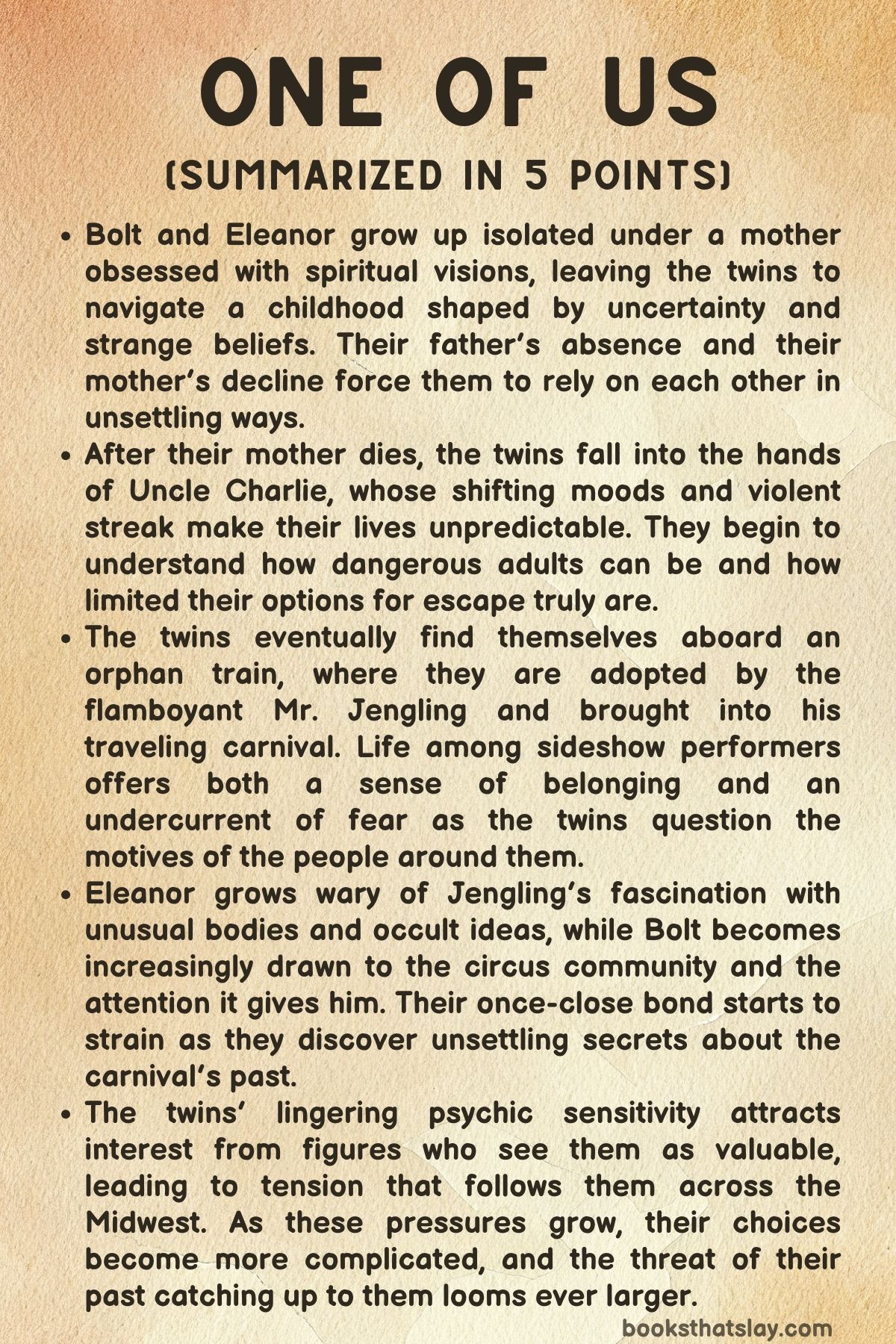
Bolt and Eleanor are twins raised in a shabby boardinghouse in Oberlin, Ohio, by a mother whose fragile health and spiritual obsessions define their early years. She belongs to the Progressive Psychic Spiritualist Church and believes the twins possess unusual sight.
Their father is long gone, leaving behind only rumors and a sense of mystery. The children grow up among odd tenants, always aware of their mother’s worsening condition.
When she dies quietly as they near adolescence, they bury her secretly in the backyard because they cannot afford a funeral. Debt soon forces the bank to take their home, and a brief stay with a rigid neighbor ends when a stranger calling himself Uncle Charlie arrives and claims them.
Charlie is not a relative. He is a volatile drifter, a con man, and a violent maniac who keeps the twins drugged with laudanum to prevent escape.
He alternates between affection and terror, spinning stories about their father and dragging them from state to state. The twins have already committed one murder years earlier—a poisoning suggested by their mother—and they consider doing the same to Charlie.
But they fear his capacity for retaliation. As Charlie’s crimes escalate, including a brutal killing in a cabin, the twins mix every poison they can find into his beer and flee into the night, convinced he is dead.
He survives, and his fixation on them intensifies.
The twins board a freight train and seek refuge in an orphanage. They are soon placed onto an orphan train headed west, where children are displayed in church halls for adoption.
Because they are thirteen and visibly worn down, no family wants them—until a flamboyant man named Mr. Jengling, dressed in a red coat, claims them both without hesitation.
He brings them to his traveling carnival, a strange community of acrobats, “oddities,” and sideshow performers. They are given beds in the circus train and put to work cleaning cages or assisting performers.
Eleanor distrusts the carnival and fears it will be another trap, while Bolt is drawn toward the performers’ warmth and the sense of belonging they offer.
Jengling keeps a private collection of preserved specimens—jars of malformed fetuses and preserved heads—that deeply disturb Eleanor. She begins to suspect his intentions, especially as he tests Bolt’s psychic abilities.
Their old bond begins to change: Bolt is dazzled by circus life while Eleanor wants escape and answers. Meanwhile, Charlie is riding west in pursuit, killing anyone he thinks might stand between him and the twins.
He takes on a new companion, Jasper, a troubled diviner whose psychic trances bring him wealth but also unbearable dread. When Jasper dies by suicide, Charlie adopts his last name, feels a twisted sense of duty toward the dead man’s children, and folds this fantasy into his obsession with reclaiming Bolt and Eleanor.
Back at the carnival, the twins are given new tasks. Eleanor works the carousel with Bigelow, the tattooed man, and learns the rhythms of circus setup and teardown.
Bolt is assigned to care for Rosalie, a girl with a parasitic second face and powerful mediumistic abilities. Through Rosalie, Bolt experiences psychic episodes that shake him.
Jengling encourages these abilities, calling Bolt “son. ” Eleanor rejects the carnival’s attempts to absorb her and focuses on deciphering their father’s mysterious diary, written in strange symbols.
As the carnival travels, the twins encounter many performers’ histories, including the tragedy of McGullian Heap, Rosalie’s previous handler, who became possessed and now exists as a barely human exhibit known as the Piltdown Man. Charlie draws closer to the carnival, hiding on its train, watching Eleanor through skylights, and lurking in disguise as an old woman.
Eleanor discovers her father’s diary has been stolen and believes Bolt took it. When she confronts him, she instead finds him entranced in a séance.
Jengling takes her to his private car and claims the diary contains messages from her father delivered through Rosalie. Eleanor steals it back using a sudden, explosive psychic force and flees into the night—only to fall directly into Charlie’s hands.
Charlie subdues her and hides her away. Bolt wanders the carnival in pain, receives a telepathic warning from Rosalie, and is captured as well.
Charlie drags both children to a riverbank. By morning, Eleanor is dead, beaten and limp in the mud, and Bolt is forced into servitude once again.
But Eleanor’s consciousness does not vanish. She merges with Bolt inside his body.
They see through the same eyes, hear the same thoughts, and struggle for control. Charlie does not understand any of this.
He decides on a story: Eleanor died of illness. He will take her body to Murdo, South Dakota, for burial near Jasper’s grave.
He preserves her with vinegar and mud and forces Bolt to help prepare the corpse.
Meanwhile, Rosalie, riding in Heap’s ruined body, sets out to find Bolt. Tickley-Feather and Herculea discover traces of Charlie’s route.
Charlie brings Bolt and Eleanor’s mummified form to Murdo, checks them into the hotel room where Jasper died, and arranges a grotesque funeral. The undertaker prepares Eleanor’s body with wigs and makeup.
At the graveside service, Charlie holds Bolt hostage with a stiletto, sensing danger from the approaching carnival rescuers. As they close in, Eleanor gathers her remaining strength and causes earth and stones to fall onto Charlie’s head.
Piltdown Man leaps onto Charlie, Herculea fires her gun, and in the chaos Charlie accidentally drives his blade deep into Bolt’s back. Bolt falls into the open grave as bullets fly.
A final shot kills Charlie at last.
Bolt survives and is taken back to the carnival. Eleanor remains fused within him, gaining clarity of thought and glimpsing the circus performers’ private futures.
She realizes she had misjudged them; many are kinder than she believed. Jengling proposes giving the merged being a new identity: Evelyn Jengling.
Over time, Eleanor becomes the dominant consciousness, while Bolt drifts into silence.
Many decades later, in 2015, a journalist arrives at the isolated Jengling Institute to interview Evelyn Jengling, now ancient, physically failing, and utterly alone inside the body once shared with Bolt. She reveals the long history of the twins’ merging, the rise of the Institute, and the experiments involving cryonics and new vessels for consciousness.
Bolt, she admits, is gone—absorbed, silenced, or erased. After the journalist leaves, Evelyn wanders the sterile halls, calling out for Bolt, desperate for any sign of the twin she once loved and consumed.
Only silence answers, leaving her to face an endless, echoing existence with no one left to hear her.
Characters
Bolt
Bolt emerges in One of Us as a boy shaped by deprivation, psychic fragility, and a yearning for connection so profound that it often eclipses his judgment. From childhood, he carries a susceptibility—to his mother’s mystical beliefs, to Eleanor’s stronger will, and later to Uncle Charlie’s coercive dominance.
His early life teaches him to equate love with danger and obedience, leaving him painfully eager for belonging once the carnival adopts him. Within Jengling’s Emporium of Wonders, he begins to bloom socially, discovering kinship with the circus misfits who treat him with a rough but genuine tenderness.
Yet the more Bolt tries to become part of something larger, the more porous he becomes: telepathically receptive, emotionally malleable, and spiritually permeable. His sensitivity grants him moments of deep insight, but it also renders him vulnerable to manipulation—by Jengling’s spiritual ambitions, Rosalie’s visions, and ultimately Eleanor’s increasingly dominant presence within their shared mind.
Bolt longs for a simple, affectionate life, but his path instead leads to an absorption of identities and the gradual erasure of his own. His tragedy lies not in darkness or malice but in his openness: a soul too willing to merge, too desperate to belong, until he becomes a quiet ghost within the body he once called his own.
Eleanor
Eleanor, unlike her brother, possesses a sharply honed wariness that defines her role throughout One of Us. From childhood she is the watcher, the interpreter, always on alert for shifts in adult moods, spiritual portents, and threats that Bolt barely registers.
While Bolt leans toward connection, Eleanor leans toward autonomy and control. The spiritualist environment of their upbringing instills in her a sense of destiny but also a deep skepticism: she resents the way adults project meaning onto her and resists any attempt to subsume her identity.
Jengling’s Emporium ignites this defiance even further. She sees clearly the coercion beneath the spectacle, the way people are turned into curiosities and preserved as artifacts, and she refuses to be absorbed into that world.
Her brilliance and suspicion sharpen into a near ruthlessness, especially once the twins encounter mortal danger. Even before her death, Eleanor’s psychic and psychological strength eclipses Bolt’s; afterward, when her consciousness merges with his, she becomes the dominant force navigating the world.
Over decades, her determination to survive and exert agency transforms into an obsessive need for mastery—over her identity, her shared body, and eventually the Jengling Institute. Eleanor’s arc charts the evolution of a fierce, brilliant, and traumatized girl into a figure who sacrifices empathy for survival, and who ultimately cannot bear the lonely expanse of her own victory.
Uncle Charlie
Uncle Charlie is the book’s most chilling presence, a man who oscillates between manic warmth and murderous unpredictability. In One of Us, he represents a perverse form of guardianship—an abuser who casts himself as savior, father, and martyr depending on his mood.
His reality is fractured by delusions, violent impulses, and a performative grief that masks a bottomless hunger for control. Charlie attaches himself to vulnerable people and then destroys them physically, psychologically, or spiritually; his shifting personas create a sense of instability that keeps children like Bolt and Eleanor trapped between fear and a twisted sense of obligation.
He mythologizes his past, adopts Jasper’s name out of grief and narcissism, and convinces himself he alone can love and protect the twins even as he brutalizes them. Charlie’s pursuit of them is propelled not by familial affection but by possession—his need to reclaim what he believes is rightfully his.
In the end, even as madness floods him through a swarm of escaping spirits, Charlie remains tragically consistent: a man whose only truth is obsession, whose violence is inseparable from his longing, and whose death leaves behind scars that echo through the twins’ merged consciousness for the rest of their lives.
Harland Jengling
Harland Jengling is the charismatic architect of the carnival world—a figure who blends showmanship, pseudo-science, spiritualism, and exploitation. In One of Us, he functions as both benefactor and captor, masking his controlling tendencies behind charm, theatricality, and paternal affection.
Jengling’s fascination with variation, deformity, and psychic potential gives the Emporium its peculiar magic, but it also reveals his darker aims: the desire not just to showcase unusual bodies but to own them, preserve them, and ultimately harness them for his own legacy. His collection of specimens, his adoption of children with unusual gifts, and his willingness to shape identities through ritual and manipulation mark him as a man obsessed with creation in its most unsettling form.
Jengling’s affection for Bolt is at once genuine and strategic; he recognizes the boy’s psychic potential and imagines a future molded through him. With Eleanor, he faces resistance and therefore seeks to overpower her through spiritual theater and psychological pressure.
Jengling is an inventor of families, but his families are curated, purchased, or constructed—never allowed autonomy. Even after his death, the institutional structures he envisioned live on, shaping Evelyn Jengling’s later life and ensuring that his influence permeates the twins’ story long after his carnival stops traveling.
Rosalie
Rosalie is both a victim and a conduit—an eerie, tender, and tragic figure whose psychic abilities shape the deepest supernatural currents of One of Us. Born with a parasitic second face, she is treated from infancy as a mystical tool, first by the predatory McGullian Heap and then by Harland Jengling, who uses her talents to elevate the carnival’s spiritual performances.
Rosalie exists in a liminal state, drifting between consciousnesses, occupying borrowed bodies, and constantly housing the voices of the dead. Her innocence blends with a terrifying clairvoyance: she sees fate with a clarity that others fear, and her warnings—cryptic, childlike, and devastating—move like dark weather through the narrative.
Despite her disorientation, she develops genuine affection for Bolt, recognizing in him someone porous enough to understand her. Her attempts to protect him, especially during the twins’ abduction, reveal a moral core untouched by the exploitation that shaped her.
Yet Rosalie’s life is finite, her body fragile, and her powers corrosive. In the dreamlike afterlife scene with Bolt, she demonstrates a wisdom far older than her years, warning him of the danger inherent in housing multiple spirits.
Her quiet departure into the water is one of the novel’s most haunting moments—a surrender that underscores how deeply she has been used and how weary she is of her connection to the dead.
Tickley-Feather
Tickley-Feather, the enigmatic clown, is one of the novel’s most ambiguous and compelling presences. Beneath his grim painted face lies a man shaped by secrets, loyalty, and a capacity for violence born of necessity rather than malice.
He becomes a reluctant guardian to Bolt and Eleanor, watching them with a mix of stern detachment and quiet protectiveness. His past, concealed even from the carnival family, threads through his behavior: he understands danger intimately, recognizes corrupt men like Charlie at a glance, and acts decisively when those in his care are threatened.
Tickley-Feather’s relationship with the twins evolves from suspicion to fierce responsibility, culminating in his intervention at Eleanor’s graveside, where he risks everything to rescue Bolt. Throughout One of Us, he stands as a reminder that even within a world built on spectacle and exploitation, some figures cultivate their own internal codes of honor.
It is Tickley-Feather who later confronts Eleanor’s spirit within Bolt, insisting she “behave”—a moment that establishes him as one of the few characters capable of perceiving and challenging the supernatural dynamics at play. His blend of weariness, toughness, and grudging tenderness makes him one of the most human figures in a story teeming with monsters both literal and emotional.
Jasper
Jasper is a man undone by visions, guilt, and the crushing weight of the spiritual abilities he cannot control. His role in One of Us is brief yet foundational: he becomes Charlie’s companion on the road, offering performances of divination that blur the line between genuine psychic sensitivity and tortured hallucination.
Jasper’s mind is crowded with forebodings, fears for his abandoned family, and apocalyptic dreams that erode his already fragile sanity. Unlike Charlie, whose madness is flamboyant and destructive, Jasper’s is inward-turning—quiet, despairing, and filled with self-loathing.
His suicide marks a turning point for Charlie, who co-opts Jasper’s identity out of a mixture of grief, envy, and a desire for reinvention. Though dead for most of the novel, Jasper’s presence lingers through his diary, through the psychic echoes Eleanor encounters, and through Charlie’s warped appropriation of his name and paternal role.
Jasper becomes, in death, a symbolic father to the twins—a figure whose tragedy feeds into their mythology and whose final absence shapes the desperate dynamics that unfold around them.
Herculea
Herculea is the embodiment of physical strength fused with emotional restraint. Once a factory girl who unexpectedly gained extraordinary power, she reinvents herself within Jengling’s carnival as its Muscle Lady.
In One of Us, she becomes an observer of suffering and resilience, recognizing something familiar in Eleanor’s determined defiance. Though she is not overtly nurturing, her integrity and loyalty are unwavering.
Herculea acts decisively in moments of crisis—not out of heroism, but out of a practical understanding of danger and responsibility. Her accidental killing of Piltdown Man during the confrontation with Charlie devastates her, revealing a depth of remorse and emotional complexity beneath her stoic exterior.
She later seeks forgiveness from Bolt, offering a blessing that marks one of the novel’s rare moments of sincerity and gentleness. Herculea represents the possibility of strength that is neither exploitative nor performative—a counterpoint to Jengling’s ambition and Charlie’s violence.
Evelyn Jengling
Evelyn Jengling, the final evolution of Bolt and Eleanor, is the ultimate culmination of the novel’s exploration of identity, power, and spiritual entanglement. By the time a journalist visits her in 2015, she is an ancient, oxygen-dependent figure whose psychic influence still exerts an unnerving force.
Evelyn is, in part, Eleanor’s long-held ambitions made flesh: sharp-minded, controlling, visionary, and deeply isolated. She has steered the Jengling Institute into a center for cryonics, legacy-building, and experiments in transferring consciousness—projects rooted in a belief that souls can be preserved, curated, and passed down like heirlooms.
Yet her triumph is also a prison. Bolt, whose gentler spirit once shared the body, has long since vanished from her inner perception, leaving her alone inside a decaying shell that she struggles to pilot with both desperation and dread.
The “Otherin”-like face she manifests at the back of her head symbolizes the grotesque lengths she will go to maintain mobility and identity. Evelyn’s final moments are marked by loneliness: a woman who achieved power but lost connection, who fears immortality more than death, and who calls out to the boy she consumed, seeking comfort that will never return.
Themes
Childhood Without Protection
Life in One of Us begins inside a household where ordinary safeguards never take shape. Bolt and Eleanor grow up in a boardinghouse that fails to resemble a home, surrounded by adults whose eccentricities, illnesses, or derangements make them unreliable witnesses to the twins’ needs.
Their mother’s frailty removes any sense of anchor, and her dependence on spiritualist fantasies places the children in a state of permanent vulnerability. They learn early that the world is built without soft surfaces; danger appears not as a sudden disruption but as the natural texture of their days.
This lack of protection shapes their emotional development more profoundly than any singular traumatic event. They see death before they see stability, commit a killing before they learn ordinary moral language, and bury a parent with the grim practicality of adults who have been denied childhood.
When Uncle Charlie arrives, the pattern of neglect mutates into outright predation, yet it feels to them like a continuation of life as they’ve always known it. Their childhood becomes an education in reading threats, making impossible decisions, and expecting harm from every direction.
Even after the carnival takes them in, the twins carry this early conditioning; trust appears to Bolt as a luxury and to Eleanor as a risk too steep to take. Their bond with each other becomes the sole surviving element of safety, yet even this becomes strained as the environment around them pulls at their loyalties and identities.
Childhood, rather than a stage of innocence, becomes the crucible in which their survival instincts, their psychic sensitivities, and their capacity for moral ambiguity are forged.
Exploitation and the Commodification of Human Difference
Across the novel, bodies and minds serve as currency in a world eager to display, sell, or manipulate anything that deviates from the norm. Charlie treats the twins not as children but as assets—young, pliable, and potentially profitable if their “Second Sight” can be sharpened into a spectacle.
His violence is matched by a practical mindset; to him, children are instruments, not individuals. Jengling operates within a different register of exploitation, cloaking his motives in affection, charm, and paternal performance.
The carnival surrounds the twins with performers whose unusual bodies or psychic gifts have been turned into attractions that satisfy audiences’ hunger for marvels and monstrosities. Even the specimens in Jengling’s collection reflect a worldview in which difference becomes property.
What distinguishes the carnival from Charlie’s brutality is not the ethical ground but the style of the transaction. Jengling’s performers often accept their roles because they have nowhere else to go, because the world outside the circus is just as cruel, or because belonging to a community of misfits feels better than isolation.
The exploitation becomes woven into family structures, creating a paradox where affection and captivity coexist. The twins must navigate this landscape carefully: Bolt is drawn to the sense of belonging, misunderstanding the hidden costs, while Eleanor sees the danger more clearly and refuses to be absorbed into a system where her identity would become another commodity.
Ultimately, the novel portrays a society eager to consume human difference, dressing its appetite in entertainment, science, or compassion, but always seeking profit from the bodies of the vulnerable.
Identity, Doubling, and the Boundaries of the Self
The novel’s exploration of identity begins with the twins’ early telepathic bond and expands into a complex examination of shared consciousness, possession, and dissolution of self. Bolt and Eleanor grow up not as two individuals discovering separate paths, but as halves of an internal dialogue that feels as natural as thought.
This closeness, initially a survival tool, becomes a battleground as outside forces pull them in different directions. Bolt’s desire for acceptance and Eleanor’s instinct for autonomy clash, and their psychic distance grows even before physical separation occurs.
After Eleanor’s death, the theme deepens into a haunting question: what remains of identity when it becomes fused with another? Their shared occupancy of Bolt’s body shifts from cooperation to tension as Eleanor’s presence becomes increasingly dominant.
Later, Evelyn Jengling—the final iteration of their merged existence—reflects a self that can no longer be cleanly divided into Bolt or Eleanor. The consciousness that narrates the ending is a composite that has absorbed strengths, fears, ambitions, and moral positions inherited from both.
The inability to separate their identities becomes both a burden and a legacy, as Evelyn eventually suffers under the weight of a mind that may be incapable of dying. The novel therefore uses doubling not simply as a twin motif but as a sustained meditation on how identity forms, erodes, and reshapes itself under pressure from trauma, psychic connection, and ambition.
Power, Control, and the Hunger for Ownership
Every major figure who crosses the twins’ path is defined by a desire to claim, direct, or reshape another life. Charlie’s domination is violent, erratic, and laced with delusions of paternal righteousness.
His need to possess the twins stems from loneliness, guilt, fantasies of redemption, and a belief that controlling them might stabilize his own chaotic sense of purpose. Jengling’s power operates through spectacle, charisma, and the promise of belonging; he builds a world where obedience is exchanged for affection, where a child can be made to believe that captivity is care.
Even Jasper’s presence in Charlie’s life reflects a dynamic of control disguised as companionship. Throughout the novel, control is rarely expressed as simple tyranny.
It often masquerades as love, mentorship, family, or spiritual guidance. This makes it all the more insidious, drawing victims into relationships where resistance feels like betrayal.
For the twins, power is something they experience primarily as an external force—until their psychic abilities begin to assert themselves. Eleanor’s mind, sharp and disciplined, grows adept at reading and influencing others.
Bolt, more receptive and empathic, experiences power as connection rather than dominance. Their eventual merger concentrates this dynamic in the figure of Evelyn, who builds an empire on the same principles of influence and containment that once threatened them.
By the novel’s end, the story poses a difficult question: when survival depends on seizing control from one’s oppressors, how easily does that survival evolve into the same hunger for ownership?
Trauma, Survival, and the Transformation of the Soul
Trauma in the novel does not merely scar; it reshapes the architecture of the self. The twins’ experiences—parental loss, exploitation, violence, and psychic overstimulation—push them into forms of survival that require adaptability beyond human norms.
Eleanor’s death and subsequent existence as a consciousness within Bolt illustrate how trauma bends the boundaries between life and soul. Their survival becomes a process of continuous reinvention, each reinvention taking them farther from the innocent children they once were.
The carnival performers embody similar transformations. Many were once ordinary individuals who adapted to hardship or exploitation until their identities aligned with their roles.
Rosalie’s fragmented consciousness, shaped by years of possession and manipulation, demonstrates a soul stretched thin by forces that never should have touched a child. Charlie’s madness, too, stems partly from the traumas of abandonment, failure, and a desperate need for purpose.
Throughout the novel, trauma creates altered beings—psychic children, deranged prophets, spiritual conduits, and eventually Evelyn, whose survival becomes an interminable sentence. The story suggests that survival is not always a triumph; sometimes it is a metamorphosis that extracts a cost greater than death.
In the end, Evelyn’s anguished cry into the empty corridors reveals a truth at the heart of the novel: trauma can preserve life long past the point where life feels bearable, leaving behind a soul that has adapted so completely to suffering that it can no longer find a way to end.
Family, Found and Lost
Family in the novel exists as a fluctuating concept, shaped by longing, necessity, and danger. The twins’ birth family disintegrates early, leaving them with a model of kinship built on precarious bonds and unspoken fears.
Charlie believes he is creating a family through force, binding the twins to himself through fear, obligation, and deluded affection. Jengling creates a found family composed of performers who carry wounds deeper than their public identities reveal, allowing them to flourish under his guidance while still depending on him for survival.
Bolt perceives this carnival family as a comforting network of acceptance; Eleanor sees it as another version of captivity. Their conflicting perceptions show how family can appear nurturing or predatory depending on one’s vulnerability.
As the twins grow older and eventually merge into Evelyn, the idea of family becomes tied to legacy and institution rather than affection. The Jengling Institute stands as a monument to a fractured lineage—part Charlie’s brutality, part Jengling’s pageantry, part the twins’ psychic connection.
Evelyn’s final loneliness makes clear that family built on power, secrets, and fear cannot sustain the spirit. The story leaves readers with a complex vision of family: it can rescue, imprison, shape, exploit, or save, but it always leaves a lasting imprint on the soul.