Other Peoples Houses Summary, Characters and Themes
Other People’s Houses by Clare Mackintosh is a crime novel set between the Welsh countryside and the wealthy English enclave known as The Hill. The story follows two police investigations that appear separate at first: a suspicious death discovered in a kayak on a quiet Welsh river, and a string of carefully planned burglaries targeting rich households.
As detectives Ffion Morgan and Leo Brady follow the threads, they discover how secrets, ambition, jealousy, and old crimes shape the behaviour of the residents on both sides of the border. The book explores the hidden lives inside polished homes and the unexpected connections that bind strangers together.
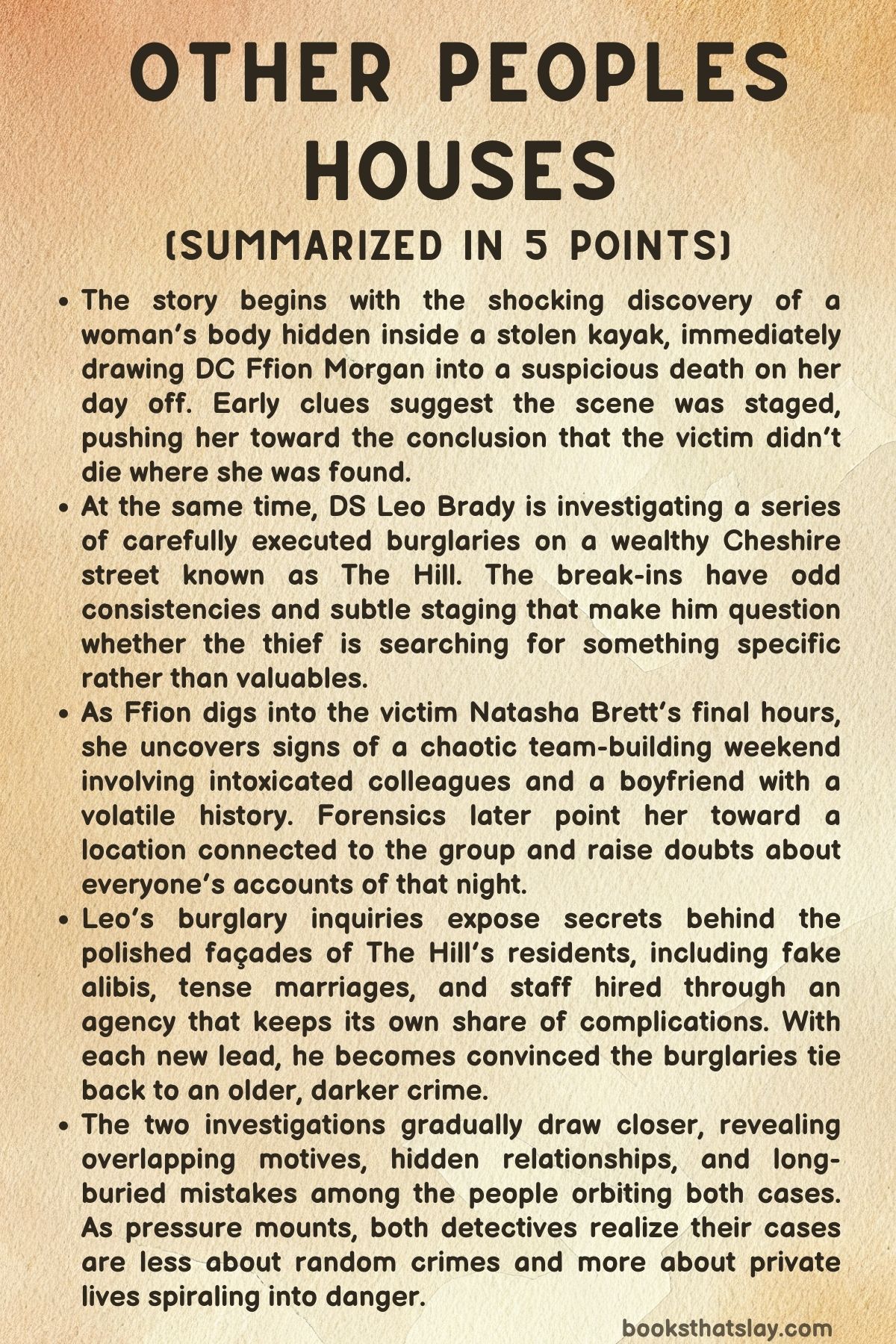
Summary
The story begins on a quiet Sunday morning after a heavy storm in rural Wales. Fifteen-year-old Ed Clough, hungover from a local Young Farmers party, walks the riverbank to find a missing kayak from the rafting centre where he works.
When he finally spots it wedged between rocks, he steps into the icy water to retrieve it. Flipping the kayak, he recoils in horror at the sight of a dead woman inside, her skin damaged by time in the river.
Ed panics and runs.
Detective Constable Ffion Morgan is called from home by her boss, DI Malik. Although it is her day off, the drifting kayak has now reached Llyn Drych and the body must be recovered.
Balancing her dog and the complicated state of her relationship with her boyfriend, Cheshire detective Leo Brady, she rushes out. At the lake, Ffion joins the team as they retrieve the body: a woman in an unsuitable swimsuit strapped into a kayak in a way that makes no sense for a simple outing.
The setup raises her suspicions.
As forensics begin work, Ffion learns that a rowdy group of estate agents had been seen near the rafting centre the previous day, possibly with a stolen kayak. This leads her to a rented holiday cottage where Carole Simmonds and several employees are recovering from a heavy night.
One colleague, Natasha Brett, is missing. The men admit to drunkenly taking a kayak but insist they do not remember going near the water.
Ffion doubts them and begins to believe the dead woman is Natasha.
Meanwhile, across the border in Cheshire, Leo is pulled into a different mystery. A burglary on The Hill resembles one from six months earlier: carefully controlled entry, neat searching, selective theft.
The street is filled with wealthy families—each protective of their status, resentful of scrutiny, or hiding complications behind their front doors. Among them are JP and Camilla Lennox, the Makepeaces, the Jeffersons, and the divorcing couple Warren and Emmy Irvine.
Leo’s inquiries highlight tensions between spouses, household staff, and neighbours. He also visits his ex-wife Allie, whose fixation on appearing affluent makes their meetings exhausting.
Back in Wales, the post-mortem confirms Natasha drowned somewhere other than the river. Chlorine in her lungs and bruising on her ankle show she was submerged in a different body of water—likely a hot tub.
Forensics soon discover drag marks from a hot tub at the estate agents’ rented cottage leading down to the river. Natasha’s death is now clearly murder.
Leo’s burglary case expands when a teenage resident, Alec Jefferson, is attacked during a break-in and left critically injured. Suspicion falls on Duncan Cragg, the pool man with a violent history, but nothing proves he is responsible.
Clues point to someone with inside knowledge: the alarm code was written on a gate, residents sometimes posted online about being away, and several domestic workers had received strange letters.
Police re-examine an older case: the Carmichael double murder from 2014. Stephanie Carmichael had secretly taken money from a joint account to support a younger lover who ran a romance scam.
A treasured locket she always wore vanished when she and her husband were killed. New evidence shows the scammer’s handwriting matches the notes received by domestic staff on The Hill.
When a woman tries to sell the missing locket at a gold shop but flees, a street camera captures her leaving in a car owned by Philip Makepeace. Leo’s questioning reveals Philip has been lying about his job and using his driver’s identity for shady activity.
As both investigations progress, Ffion interviews Natasha’s boyfriend, Luke Parks. He admits he travelled to Wales after receiving an anonymous message hinting Natasha was cheating with a coworker.
He claims he saw Natasha alive, panicked, and drove home. His account is unstable, but he provides one key detail: he saw a black SUV whose number plate ends in ROB near the cottage.
Ffion connects this to Warren Irvine’s vehicle. Around the same time, Leo’s case takes another turn when Allie finds a phone among yard-sale items and gives it to him.
Its forensic markings reveal it belonged to Natasha Brett, linking her death to the Irvines’ property.
A joint briefing is called. Police prepare to arrest Warren Irvine for Natasha’s murder and search his home for evidence relating to the burglaries and the decade-old Carmichael case.
The truth, however, lies elsewhere.
Natasha’s death was caused by Emmy Irvine. Natasha had accidentally seen Emmy having sex with another man.
Panicked about the implications for her divorce settlement, Emmy later confronted Natasha at the hot tub of the holiday cottage. Natasha, heavily drunk, teased Emmy about secrets and dangled the threat of exposing her.
Emmy grabbed Natasha’s ankle in anger, then in fear, but held on too long. Natasha drowned.
Emmy staged the scene by placing her body in a stolen kayak and sending it into the river, dressing in Warren’s boots and waterproofs to hide her identity.
Emmy also found the Carmichael locket hidden inside a porcelain shepherdess and, realising its significance, tried to profit from it. When she opened it, she discovered a secret photo not of her husband, but of Dennis Dixon—the kindly grandfather who often looked after his granddaughter Scarlett at the Coach House.
Dennis is actually Ronnie Kingsbridge, a long-active romance scammer, and Stephanie Carmichael’s former lover. He killed Peter Carmichael in a panic years earlier, stole the locket, and has been trying to recover it ever since.
Emmy attempted to blackmail him. Ronnie, believing he was meeting her at Ormindale, instead found Warren alone and stabbed him before fleeing.
Later, when Leo discovers the link, Ronnie panics and abducts Leo’s son Harris in Bianca’s car. A chaotic police chase ends with the car crashing off a Welsh farm track.
Ffion climbs down the valley, rescues Harris, and revives him until medics arrive. Ronnie is arrested.
Afterward, Emmy confesses to killing Natasha. The Carmichael case is finally solved.
Leo and Allie call a truce for their son’s sake. Leo and Ffion rebuild trust, and she reveals she is pregnant.
Together they begin planning a home for their new family, closing the long series of secrets that began with a drifting kayak on a quiet Welsh river.
Characters
Ed Clough
Ed Clough is introduced as a hungover teenager whose accidental discovery of a corpse becomes the catalyst for the entire mystery in Other Peoples Houses. Though young and inexperienced, his reaction to the gruesome find reveals a deep-seated vulnerability; he is still a boy trying to behave like a man.
His instinct to flee and his shame at vomiting show how traumatic the moment is for him, grounding the novel’s opening in raw humanity. Ed also acts as the narrative bridge between the rafting centre—an ostensibly harmless tourist environment—and the dark undercurrents of violence that run beneath the surface.
His youth highlights how easily ordinary people can stumble into extraordinary danger, and his behaviour mirrors the chaos and confusion that ripple through the community as the truth slowly emerges.
Detective Constable Ffion Morgan
Ffion Morgan is the emotional core of the Welsh investigation: sharp-witted, instinctive, messy, and deeply human. She juggles a demanding job, family obligations, and a complicated relationship with Leo, navigating all of it with a blend of humour, irritation, and fierce integrity.
Her first look at the body in the kayak immediately fuels her conviction that this is no accident, demonstrating her keen observational skills and refusal to accept convenient answers. Ffion’s ability to see past façades—whether in suspects, colleagues, or even herself—makes her uniquely suited to unravel the tangled truths behind Natasha Brett’s death.
Her courage and empathy converge most powerfully in the climax, where she risks her life to save Harris, showing her willingness to put others above herself even when emotionally broken. By the end, she emerges not only as a competent detective but as a woman confronting grief, love, and the possibility of a stable future.
Detective Sergeant Leo Brady
Leo Brady functions as Ffion’s counterpart in the Cheshire investigation, working the burglary series that ultimately converges with the murder case. He is methodical, empathetic, and often too aware of the emotional landmines around him—especially those planted by his ex-wife Allie.
His attempts to maintain stability for his son Harris while balancing new love with Ffion expose his warmth and patience. Professionally, Leo’s persistence allows him to spot patterns others overlook, particularly the links between the burglaries and the long-dormant Carmichael murders.
Despite being pulled in multiple directions, he maintains moral clarity, though his personal boundaries are constantly tested. Leo’s arc culminates in a moment of panic and desperation when Harris is taken, showing how quickly his composed exterior can crack under pressure.
His later reconciliation with both Harris and Ffion underscores his longing for a stable family life, one he finally begins to build by the novel’s close.
Natasha Brett
Natasha Brett is both victim and catalyst, a young estate agent whose ambition and impulsiveness collide to fatal effect. Initially presented as merely the woman found in the kayak, her personality—spirited, reckless, flirtatious, sometimes manipulative—emerges through others’ recollections.
Natasha walks in on Emmy’s affair at precisely the wrong moment, placing herself in a position of power she does not fully understand. Her teasing of Emmy in the hot tub, while fuelled by alcohol and bravado, highlights her tendency to provoke without gauging the danger.
Natasha’s death becomes a tragic reminder of how quickly vulnerability can be masked by confidence. Even after death, she influences the plot through her possessions—most notably the iPhone and the locket she unwittingly uncovers—driving both the investigation and the eventual unmasking of a far older crime.
Emmy Irvine
Emmy Irvine is one of the novel’s most complex figures: vain, anxious, trapped, and increasingly desperate. Caught in a bitter divorce from Warren, she lives in constant fear of losing her home and financial security.
Her affair with Ray Tinnion seems, at first, an escape, but it becomes yet another secret she must defend. Natasha’s accidental discovery of Emmy’s infidelity pushes Emmy into a frantic state, and her panic in the hot tub scene reveals a fatal combination of fear and poor judgement.
Emmy’s staging of the murder and her subsequent schemes—including her decision to exploit the Carmichael locket for personal gain—paint a portrait of a woman whose self-preservation overrides morality. Yet she is not heartless; she is misguided, cornered, and terrified.
Ultimately, Emmy’s downfall stems from her inability to stop scrambling for control, even when each lie tightens the noose around her.
Warren Irvine
Warren Irvine, though initially positioned as a volatile, suspicious husband, becomes more a victim of circumstance than villain. His deteriorating marriage to Emmy is a slow-motion disaster marked by resentment and emotional distance.
Warren’s temper and evasiveness make him appear culpable, particularly when his car is linked to the Welsh location where Natasha died. However, much of this behaviour arises from his own shame, financial concerns, and the emotional collapse of his marriage.
He is oblivious to the depth of Emmy’s desperation, and it is this obliviousness that leaves him vulnerable. His murder at Ronnie Kingsbridge’s hands is a shocking twist that recontextualises his role: he is neither monster nor mastermind, simply a man caught in a web spun by others’ secrets.
Allie (Leo’s Ex-Wife)
Allie brings a different form of tension to the narrative—domestic, social, and psychological. Obsessed with status, desperate for acceptance among the wealthy residents of The Hill, she embodies insecurity masked as superiority.
Her interactions with Leo are fraught with resentment and competition, and she frequently uses Harris as leverage in their emotional conflict. Yet her behaviour is not merely spiteful; it stems from her fear of being insignificant in a world she idolises.
Allie’s humiliation among the elite and her misguided attempts to impress them create both cringe and sympathy. Her final shift—working with Leo for Harris’s safety and letting her guard down—hints at a softened version of herself, one capable of prioritising family over prestige.
Bianca Dixon
Bianca Dixon appears first as a confident business owner juggling motherhood, but her character deepens when her father Dennis is revealed to be the notorious conman Ronnie Kingsbridge. Bianca’s past, her decision to employ ex-offenders, and her fierce self-reliance all gain new meaning when the truth surfaces: she has unknowingly built her life adjacent to a man capable of manipulation and murder.
Her horrified rejection of Dennis after his crimes come to light demonstrates her moral clarity and protects her daughter Scarlett from repeating the cycle. Bianca’s quiet resilience stands out in a community filled with pretence, making her one of the novel’s most grounded characters.
Dennis Dixon / Ronnie Kingsbridge
Dennis Dixon—whose real identity is Ronnie Kingsbridge—is the lurking shadow behind both the old Carmichael murders and the modern-day terror on The Hill. A master manipulator and a long-time romance fraudster, he operates by exploiting loneliness, trust, and desire.
His charm masks a dangerous volatility, and his past with Stephanie Carmichael reveals the devastating consequences of his deception. Ronnie’s search for the lost locket drives the burglaries, the assault on Alec Jefferson, and ultimately Warren’s murder.
His kidnapping of Harris exposes his desperation and instability as the façade finally collapses. Though chillingly calculating for much of the novel, his final moments—injured, frightened, and exposed—strip him of all power, revealing a man entirely consumed by the lies he spent decades crafting.
Ray Tinnion
Ray Tinnion is a character defined by contradictions: a man with a criminal past who has worked hard to rebuild his reputation, yet whose employment among the wealthy leaves him vulnerable to exploitation. Drawn into Emmy’s affair and used by Philip Makepeace for illicit cover, Ray becomes an unwitting bystander in a chain of far more serious crimes.
His indignation when Leo reveals Philip impersonated him demonstrates his desire to be seen as a man of integrity, even if his choices are occasionally misguided. Though adjacent to scandal at several points, Ray ultimately serves as a foil to the genuine villains—flawed but not malicious, caught up in currents beyond his control.
Philip and Suki Makepeace
Philip and Suki Makepeace represent the veneer of wealth and respectability that conceals dysfunction beneath the surface. Philip, whose career has quietly fallen apart, clings to status through lies, entitlement, and reckless behaviour—including impersonating Ray during illegal activities.
Suki, meanwhile, floats through the narrative with flirtatious charm and self-absorption, performing the role of the glamorous neighbour without real substance. Together, they exemplify the hollowness present among many residents of The Hill: all image, little truth.
Luke Parks
Luke Parks is a volatile presence shaped by insecurity and unresolved anger. His past conviction for domestic violence places him under immediate suspicion, and his possessiveness over Natasha makes him seem dangerous.
Yet his behaviour—though troubling—stems more from emotional instability than homicidal intent. Luke’s decision to follow Natasha to Wales, fuelled by Emmy’s anonymous message, becomes one of the many dominoes that fall toward tragedy.
His flashes of temper during questioning reinforce how close he always is to losing control, but he is ultimately a red herring rather than a perpetrator.
Cara and Alec Jefferson
Cara Jefferson is a polished, image-conscious figure whose carefully curated life begins to unravel when Alec is brutally attacked. She is a woman accustomed to controlling her surroundings, and the intrusion of violence leaves her terrified and brittle.
Alec, though mostly unconscious during the investigation, becomes the human face of the burglaries’ escalating danger. The cotton wool placed in his mouth—an eerie echo of attempts to silence—connects the modern crimes to Ronnie’s earlier methods and provides a crucial clue linking the mysteries.
Donna and the Rafting-Centre Staff
Donna and her team provide the practical grounding for the Welsh setting. Their interactions with Ffion offer humour and authenticity, but they also supply the pivotal detail that estate agents were using the rafting facilities before Natasha’s death.
Donna’s matter-of-fact attitude underlines the gulf between ordinary working life and the darker events unfolding nearby. Her staff, particularly young Ed, highlight how deeply the tragedy reverberates through the community.
Themes
Power, Secrecy, and the Fragile Boundaries Within Communities
In Other People’s Houses, power often operates in quiet corners rather than in dramatic declarations. The Welsh village and the affluent enclave of The Hill appear outwardly orderly, yet the people living there guard their secrets with a vigilance that shapes every relationship and conflict.
The dynamics of secrecy develop through subtle pressures—marital expectations, social status, financial fear, and the desire to maintain reputations at any cost. These forces blur moral boundaries until concealment starts to feel like self-preservation.
Within the village, individuals fear exposure not just of crimes but of insecurities, infidelities, and emotional vulnerabilities. Emmy hides her affair because it threatens her financial security; Dennis hides his past because it threatens the life he has constructed; residents hide truths about their marriages, jobs, and children because appearances dictate their worth.
The Hill functions almost like a stage where everyone must perform prosperity and composure, yet behind the façades lie broken relationships, quiet mistrust, and manipulations that grow increasingly dangerous. What begins as secret-keeping soon becomes justification for unethical choices, rationalised step by step.
The novel shows how communities dependent on image can become breeding grounds for deception, where truth is not only avoided but actively rewritten. In this environment, the smallest lie can spiral into a chain reaction that entangles everyone.
Power becomes less about authority and more about information—who holds it, who hides it, and who is willing to use it. The story ultimately reveals how entire neighbourhoods can be shaped by what people refuse to confront about themselves and how secrecy corrodes even the most seemingly intimate bonds.
Social Class Tensions and the Desire for Belonging
The contrast between the Welsh community and the residents of The Hill is repeatedly sharpened through behaviour, expectations, and unspoken rules. The wealthy regard their homes and lifestyles as a kind of armour, assuming money can insulate them from danger or scrutiny.
Yet inside these polished interiors lie insecurity and competition, particularly among those desperate to maintain or gain entry into this social circle. Allie embodies this longing for upward mobility, adopting décor trends, forcing connections, and persuading herself that admiration from neighbours will validate her choices.
Her desperation exposes how class anxieties twist self-perception, pushing her to mimic wealth in order to feel worthy. Meanwhile, the rich households depend on domestic staff to uphold their polished façades, yet they treat these workers as interchangeable tools, failing to realise that the people they overlook see more than they should.
The novel highlights how class divides are not only economic but emotional. Wealthier residents are adept at hiding dysfunction, while those of lower status must navigate the double burden of judgment and invisibility.
The police investigations further expose how class influences who is believed, who is blamed, and whose mistakes are quietly forgiven. Through these tensions, the narrative illustrates how the pursuit of belonging—whether to a relationship, a friendship group, or a neighbourhood—can drive individuals to compromise their values.
The need to appear successful becomes as powerful as any physical threat, shaping behaviour in ways that lead to tragic consequences.
Morality, Responsibility, and the Consequences of Avoidance
Throughout the book, moral responsibility is portrayed as something characters try to sidestep, often convincing themselves they are acting out of necessity rather than choice. Emmy’s panic in the hot tub begins as a moment of fear and anger, but her decision to conceal what happened reshapes the trajectory of the investigation, placing multiple lives at risk.
Her subsequent actions show how ordinary people can commit extraordinary harm when they decide that consequences must be avoided at all costs. Ronnie’s crimes emerge from a long pattern of evasion, manipulation, and self-interest, revealing how habitual avoidance hardens into a life philosophy.
Even characters who commit no crime still wrestle with moral compromise: Leo’s struggle to manage his son’s behaviour while navigating complex feelings toward his ex-wife, Ffion’s difficulty balancing personal turmoil with professional duty, and several residents’ willingness to ignore suspicious actions because acknowledging them would disrupt their comfortable routines. The narrative illustrates that responsibility is not only about the choices made in crisis but about the smaller decisions—omissions, silences, and rationalisations—that accumulate over time.
As each character tries to sidestep accountability, the cost of those choices multiplies, affecting strangers, neighbours, and loved ones alike. The novel emphasises that evading responsibility never halts consequences; it merely shifts them onto others, often with devastating impact.
Family Bonds, Harm, and the Complexity of Protection
Family in Other People’s Houses is portrayed as a source of both solace and damage. Characters cling to their families even when those relationships are strained or harmful, driven by a need for stability, belonging, or forgiveness.
Leo’s commitment to Harris is central to his identity, yet his co-parenting relationship with Allie generates tension that spills into his romantic life. Allie’s fixation on presenting the perfect family masks her inability to recognise emotional needs beneath the surface.
Ffion must manage her own complicated family history while learning how to let someone support her without feeling controlled or criticised. Ronnie’s twisted sense of family loyalty reveals the darker side of protection—how harmful people justify terrible actions by convincing themselves they are safeguarding those they love.
Emmy’s choices also reflect a distorted desire to protect herself from familial collapse, demonstrating how fear of losing one’s place in the family can drive catastrophic behaviour. At the heart of these connections lies the idea that family shapes not only identity but moral compass.
The novel explores how far individuals will go to defend the people they care about, and how difficult it is to recognise when that protection becomes destructive. It also underscores the way children absorb the emotional atmosphere around them, even when adults believe they are shielding them.
Ultimately, the story suggests that genuine protection requires honesty and courage, rather than denial or performance, and that healing begins only when characters stop trying to hide from those they love.
Identity, Reinvention, and the Masks People Wear
Many characters construct versions of themselves intended for public consumption rather than personal truth. Philip hides his unemployment to maintain an image of success.
Allie reinvents her environment to appear more affluent than she is. Bianca separates her professional identity from her complicated family ties.
Dennis substitutes charm and adaptability for authenticity, reinventing himself so many times that he begins to rely on deception as a survival tool. The urge to disguise reality becomes a central force in shaping both relationships and conflicts.
These self-constructed identities influence not only how characters present themselves but how they interpret others. Misunderstandings flourish because everyone assumes they understand the roles others are playing.
This theme highlights the emotional labour involved in maintaining façades, particularly when those façades conflict with inner turmoil. The pressure to uphold an idealised version of oneself leads characters to push boundaries, hide mistakes, and avoid vulnerability.
As layers of identity are stripped away through the investigations, many characters are confronted with parts of themselves they have long concealed—fear, shame, jealousy, or grief. The story emphasises that reinvention offers temporary relief but ultimately deepens internal conflict, showing that authentic identity cannot be built on pretense.
What emerges is a portrait of a community where nearly everyone is performing, and where the unraveling of those performances reveals the cost of a life spent hiding behind masks.