Ladies in Hating Summary, Characters and Themes
Ladies in Hating by Alexandra Vasti is a romantic historical mystery about two writers whose long-buried past collides with their present lives. It follows Lady Georgiana Cleeve, a reclusive Gothic novelist, and Catriona Lacey, the sharp-witted butler’s daughter she once adored in secret.
When Georgiana becomes convinced that Cat is stealing her story ideas, she sets out to expose the truth. Instead, the two are forced into uneasy proximity, old emotions reignite, and a deeper conspiracy unfolds around a decaying manor filled with secrets. The novel blends romance, humor, emotional growth, and a haunting mystery rooted in family history and forgotten love. It’s the 3rd book in the Belvoir’s Library Series by the author.
Summary
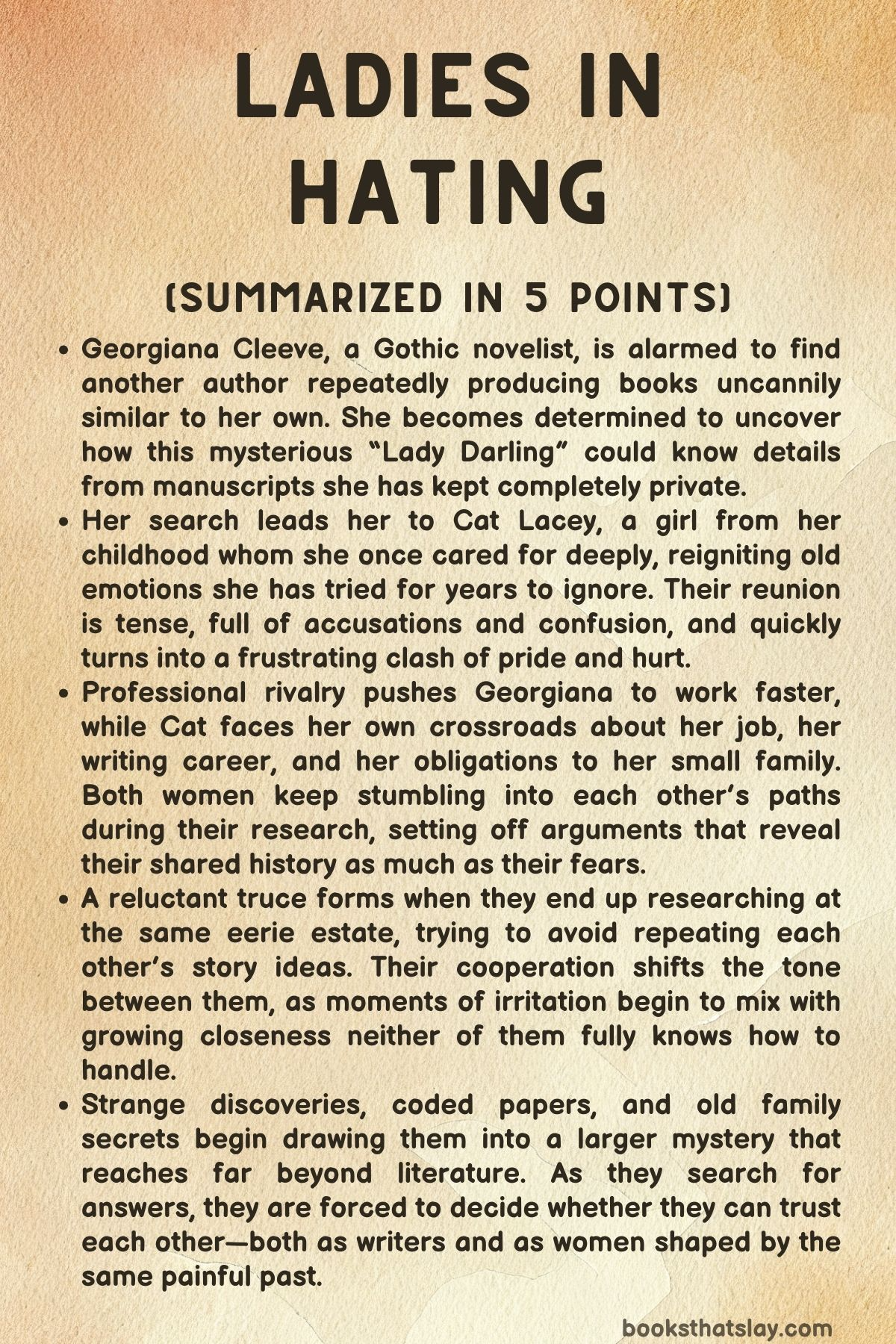
Lady Georgiana Cleeve writes bestselling Gothic novels under the secret name Geneva Desrosiers. Her controlled world collapses the moment she discovers a new book by the writer known only as Lady Darling.
The title, heroine, and central ideas match the manuscript Georgiana has not yet shown anyone. This is not the first time such similarities have appeared, and she becomes certain her work is being taken.
Determined to find out who Lady Darling is, she refuses help from her estranged brothers and decides to investigate alone.
Her search leads her to Belvoir’s Library at dawn, where she and her friend Iris hope to catch Lady Darling’s messenger. The mysterious visitor turns out to be Cat Lacey, daughter of the former butler at Georgiana’s childhood home.
Cat is the girl Georgiana once quietly longed for before their families were torn apart. Their reunion turns sour when Georgiana accuses Cat of copying her novels.
Cat is stunned and denies everything; she hasn’t read Georgiana’s recent books and has no reason to steal from her. Shaken, Cat leaves, and Georgiana convinces herself she must outrun Lady Darling by finishing her own new manuscript first.
When Georgiana brings her completed manuscript to her publisher, she finds Cat already there, leading to another bitter argument. Cat later seeks comfort from her solicitor, Martin Yorke, who assures her that Georgiana’s accusations carry no threat.
He also offers her exciting news: Renwick House, a legendary Gothic estate near their shared childhood region, has opened for research. Cat’s dream of visiting the place pushes her to quit her exhausting job at the pie shop, accept a new publishing contract, and go.
Meanwhile, Georgiana tries to move on, but a chance meeting with Cat at a haunted churchyard throws them together again. Their quarrel is sharp and full of old emotion, and the tension between them hints at feelings neither will admit.
Both women then decide, separately, to go to Renwick House for inspiration.
At the decaying mansion, they collide once more. A chaotic first encounter involving a white dog named Bacon forces them into grudging cooperation.
They agree to stay in the same corridor and compare their story plans to avoid further misunderstandings. Though they continue clashing, small moments of humor and unexpected tenderness begin to soften the distance between them.
As they explore Renwick House, they uncover hidden rooms, strange symbols, and a blooming rose garden tucked behind an oratory door despite the winter season. The place feels filled with secrets, and their discoveries unsettle and fascinate them.
Their fragile truce becomes something more personal after Georgiana gets trapped in a cramped passage and Cat rescues her. Through these moments, their attraction grows harder to ignore.
Danger escalates when a portion of the house collapses at night, trapping them briefly and killing an unknown man, Rogers. Georgiana’s quick thinking allows Cat to retrieve cryptic pages from the body.
Forced to flee to Devizes, they end up sharing an inn room. A misunderstanding about money and pride finally gives way to honesty.
Georgiana confesses that she has wanted Cat for years, and Cat admits her own long-carried feelings. Their night together breaks apart years of tension and fear, binding them to one another with new trust.
Back in London, they begin investigating the coded pages with help from their friends. They learn that Martin Yorke—who represents both women without telling either of them—may be connected to several odd coincidences surrounding their novels and research locations.
While they debate his involvement, Cat brings Georgiana home for dinner. Georgiana envies the warmth Cat shares with her brother Jem and cousin Pauline, while Cat sees how much Georgiana craves belonging.
The next crisis strikes when Jem disappears, intent on learning whether he might be the unacknowledged son of a duke. Yorke arrives to confirm that Jem truly is the late Duke of Fawkes’s natural child and that someone stole this information from his office.
Cat and Georgiana race after Jem, traveling first to the duke’s estate and then to Woodcote Hall, where Georgiana reconciles with her brothers after years apart.
Their search finally leads them back to Renwick House. Inside, they find the new Duke of Fawkes—Jem’s half brother—and Jem himself barricaded in a room after confronting Elias Beckett, Yorke’s other clerk.
Beckett, desperate for rumored treasure, had previously hired the thug Rogers, causing the disasters Cat and Georgiana experienced earlier. Now caught, he confesses everything.
With danger passed, Jem begins forming a connection with his newfound family. Yorke later brings translated letters revealing that Luna Renwick created the secret rose garden for her lover, Sarah Sophia Penhollow, hiding her jewels there.
The truth mirrors the emotional journey Cat and Georgiana have taken: love preserved despite fear and silence.
Georgiana finally admits the weight of her father’s cruelty toward the Laceys and asks Cat’s forgiveness, promising her a future built on honesty rather than fear. Cat reassures her that she bears no blame for her father’s choices, and the two choose each other fully.
In the epilogue, Renwick House begins its slow restoration. Jem returns to London to complete his training but plans to settle in Devizes later.
Cat and Georgiana make their home together at the estate. One day, sunlight catches the tiles of the garden, revealing Luna’s long-hidden jewels—a symbol of healing, legacy, and the life they are building side by side.
Characters
Lady Georgiana Cleeve
Lady Georgiana Cleeve is the fiercely intelligent, deeply anxious, and emotionally guarded Gothic novelist at the heart of Ladies in Hating. Publishing under the pseudonym Geneva Desrosiers, she has built a life of rigid independence after being publicly disgraced in her youth and then choosing estrangement from her brothers.
This self-imposed isolation shapes much of her personality: she is vigilant, perfectionistic, and constantly fearful of becoming a burden, which pushes her to carry every responsibility alone. Her paranoia about Lady Darling stealing her ideas is rooted not in vanity but in an intense fear of losing the one livelihood that sustains her household and sense of identity.
When Cat reappears in her life, Georgiana’s composure fractures, revealing a woman who has long repressed her desires and vulnerabilities. Her initial hostility masks confusion, longing, and an unresolved adolescent love for Cat.
Over time, Georgiana evolves from a defensive, suspicious figure into someone capable of trusting and being loved. Renwick House becomes a physical space that mirrors her inner journey: labyrinthine, haunted, and decayed at first, then gradually illuminated, revealed, and full of possibility.
By the end, Georgiana learns to embrace affection, to reconcile with her family, and to build a shared future rather than hiding behind her pen name or fears.
Catriona “Cat” Lacey
Cat Lacey is warm, practical, and stubbornly self-reliant, shaped by a working-class upbringing marked by precarity, family loyalty, and quiet resilience. As the daughter of Woodcote Hall’s butler—later evicted—Cat has grown up with both loss and resourcefulness.
She writes Gothic novels as Lady Darling, not out of aristocratic eccentricity but as a hard-earned means of survival. Cat’s instinct is always to protect: she works at the pie shop despite not needing the income, worries incessantly about her brother Jem’s future, and guards her emotions fiercely even when she is furious or hurt.
Her dynamic with Georgiana begins as a clash between wounded pride and mutual suspicion, yet beneath every argument lies a powerful attraction and a profound understanding rooted in their shared past. Cat embodies emotional honesty; when she commits, she commits fully, and she is deeply injured by Georgiana’s initial rejections.
Her bravery is not only physical—rescuing Georgiana, confronting danger at Renwick—but emotional, shown in her willingness to choose joy despite fear. Cat is the person who coaxes Georgiana toward openness, and her sense of humor, loyalty, and intuitive compassion anchor their growing relationship.
Ultimately, she claims not only love but also a place in a world that once cast her out, turning Renwick House into a symbol of reclamation and renewal.
Edith Cleeve
Edith, Georgiana’s mother, is gentle, pragmatic, and quietly wise. Though she lacks her daughter’s dramatic flair or Cat’s directness, she is the emotional glue trying to hold fractured relationships together.
She encourages Georgiana to accept help and to reconsider her assumptions, nudging her toward reconciliation without forcing the matter. Her steady presence prevents Georgiana from collapsing under the weight of her anxieties.
Edith’s past—remaining in the household even after Georgiana’s scandal—reflects her own complicated relationship with pride, forgiveness, and maternal devotion. She represents a loving stability that Georgiana rarely allows herself to recognize, and her suggestion that Cat might collaborate with Georgiana shows a perceptive understanding of her daughter’s emotional entanglements.
Iris Duggleby
Iris is Georgiana’s loyal friend and a scholar of ancient languages who provides levity, practical support, and intellectual grounding. She is exasperated by Georgiana’s dramatics yet deeply protective of her.
Iris’s ability to decode the mysterious pages introduces an academic layer that contrasts with Cat’s intuitive sense of the supernatural and Georgiana’s architectural fascination. Her presence also highlights the found-family theme—Georgiana’s life is shaped not only by blood relatives but by friends who offer acceptance and stability.
Iris’s humor, sharpness, and quiet competence make her a grounding force throughout the narrative.
Selina, Duchess of Stanhope
Selina is confident, socially adept, and effortlessly powerful. Through her stewardship of Belvoir’s Library and her position in society, she bridges the aristocratic world Georgiana abandoned and the professional world that sustains her.
Selina’s casual observations often become catalysts for major revelations—such as exposing the shared solicitor connection between Cat and Georgiana. Her role is that of facilitator, connector, and benevolent observer, providing resources and influence while maintaining an amused detachment.
She contributes to the playful dynamic of the novel’s social settings, offering both support and a touch of aristocratic whimsy.
Jem Lacey
Jem is earnest, hopeful, and painfully young—a boy on the cusp of adulthood who yearns for belonging and legitimacy. His relationship with Cat is foundational; she raised him with fierce love, and he adores her in return.
Jem’s dreams of becoming something more than a pie shop worker or solicitor’s apprentice reflect a deep need to understand his origins and claim a future of his own design. His disappearance springs from this yearning, making him both sympathetic and frustrating.
Jem’s eventual discovery as the natural son of the Duke of Fawkes transforms his life overnight, but what defines him is not the inheritance—it is his kindness, loyalty, and desire for family. He is both catalyst and symbol: a reminder that identity is shaped as much by chosen kin as by blood.
Pauline
Pauline, Cat and Jem’s cousin, is pragmatic, protective, and occasionally sharp-tongued. She tempers Cat’s romantic tendencies with caution and voices the concerns others hesitate to say aloud.
Her warning to Cat about trusting Georgiana reveals her deep concern for Cat’s emotional well-being, born from years of watching Cat sacrifice for others. Pauline’s presence enriches the domestic warmth of Cat’s household, giving the reader a sense of the community and security Cat has built.
Her insight and groundedness provide balance in a story full of Gothic theatrics and emotional turbulence.
Percy and Ambrose Cleeve
Percy and Ambrose represent the family Georgiana fled yet still loves. Percy is softer and more sentimental, while Ambrose is decisive and protective, but both brothers demonstrate genuine affection for their sister during their reunion.
Their readiness to help search for Jem reflects not only a strong moral compass but also a longing to mend past hurts. They stand as a counterpoint to Georgiana’s fear-driven assumptions: she believed her scandal ruined their lives, but they have been waiting to welcome her back.
Their involvement in the story underscores themes of forgiveness, reconciliation, and the reshaping of family bonds.
Martin Yorke
Martin Yorke is a complicated figure—seemingly helpful, occasionally evasive, and ultimately morally ambiguous. As a solicitor to both Cat and Georgiana without disclosing the overlap, he creates the conditions that repeatedly draw them to the same locations.
He is neither villain nor ally but a man whose secrecy, ambition, and minor manipulations set dangerous events into motion. His failure to foresee the consequences of his actions—Rogers’s involvement, Beckett’s theft, Jem’s flight—reveals a kind of professional negligence rather than malice.
Yorke’s eventual revelation of Jem’s parentage shows he is capable of good, but his character remains shadowed by poor judgment and half-truths.
Oliver, Duke of Fawkes
Oliver is gentle, earnest, and startled by his sudden responsibility for a brother he never knew existed. His immediate acceptance of Jem—with warmth rather than arrogance—reveals a decency that complicates the aristocratic stereotype.
Oliver is the embodiment of possibility for Jem: a connection to a father they both lost and a new branch of family that promises belonging. His presence at Renwick House also ties the estate’s history to the present, blending themes of inheritance, mystery, and restorative justice.
Elias Beckett
Beckett is the story’s most obvious antagonist, though ultimately more pathetic than evil. Motivated by greed and insecurity, he steals Yorke’s documents and chases rumors of treasure, leading to dangerous consequences for multiple characters.
His entanglement with Rogers and his fear of the “white demon” (Bacon) reveal his cowardice. Beckett embodies the destructive potential of desperation unchecked by morality, contrasting sharply with Cat’s and Georgiana’s determination to choose integrity even under pressure.
Luna Renwick and Sarah Sophia Penhollow (Historical Figures)
Though long dead, Luna Renwick and her beloved Sarah Sophia Penhollow haunt the novel—emotionally, symbolically, and through the coded pages and hidden garden they left behind. Luna, an inventor and visionary, represents forbidden love, ingenuity, and a refusal to be constrained by her era’s expectations.
Her creation of the rose garden as a clandestine tribute to Sarah Sophia parallels Georgiana’s hidden devotion to Cat, connecting past and present romances. The eventual discovery of their jewels acts as both literal treasure and metaphorical recognition of love made visible after years of secrecy.
Through Luna and Sarah Sophia, the novel explores queer legacy, history, and the way love persists despite erasure.
Themes
Identity, Authorship, and Creative Ownership
In Ladies in Hating, identity is never fixed but shaped by secrecy, performance, and the need for survival. Georgiana’s dual existence as Geneva Desrosiers reflects more than a pen name—it is an alternate self she created to claim authority in a world eager to dismiss a young woman’s intellect.
Her furious reaction to Lady Darling’s supposed theft stems not merely from professional fear, but from the terror that the fragile identity she built will collapse if someone else controls her narrative. Cat experiences a similar fracture between who she is and who the world assumes her to be.
To her employer, she is a pie-shop worker; to her family, she is a provider; to her readers, she is “Lady Darling,” a figure of refinement entirely disconnected from the precarious reality of her life. Both women operate behind carefully constructed facades, each convinced the other enjoys a certainty and stability she herself lacks.
Their conflict exposes how vulnerable the act of creation can be—how every writer draws from memory, longing, and private wounds, making authorship an extension of identity rather than a profession apart from it. When they begin comparing story elements at Renwick House, they confront the uncomfortable truth that their imaginations have developed in parallel because their histories are entwined.
Shared childhood landscapes, parallel traumas, and buried affection echo through their fiction. The novel suggests that creative ownership is not simply a legal category but a deeply personal claim to one’s lived experience.
Ultimately, the resolution of their rivalry requires each woman to stop defining herself through fear—fear of discovery, of judgment, of not being enough—and instead recognize that true authorship comes from honesty about who they are and who they wish to become.
Class, Power, and Social Constraint
Social position shapes every choice the characters make, revealing the subtle and overt forms of control embedded in their world. Georgiana’s upbringing grants her education, connections, and the illusion of stability, yet she remains constrained by the rigid expectations of her class.
Her family’s disgrace shows how quickly privilege can evaporate when reputation is tarnished. Meanwhile, Cat lives with constant precarity: a butchered thumb means missed wages; a lost apprenticeship could destroy Jem’s future; a ruined reputation could end her writing career.
These disparities fuel their early misunderstandings—Georgiana sees Cat’s independence and working-class resilience as proof she cannot be the victim of hardship, while Cat sees Georgiana’s privileges as evidence she cannot understand fear. At Renwick House, these assumptions crumble.
Cat watches Georgiana charm a wagon driver without hesitation, switch accents to calm a magistrate, and wash dishes to earn enough for an extra room. Georgiana, in turn, witnesses how often Cat must refuse help simply to preserve dignity in a world that equates assistance with inferiority.
Power, the novel shows, is situational rather than fixed: wealth does not prevent loneliness, and poverty does not eliminate agency. Even Jem’s inheritance exposes the fault lines of class—he must navigate a sudden elevation that threatens to sever him from the people who shaped him.
Through these characters, the story examines how individuals navigate structures they did not create yet must continually negotiate. The theme ultimately argues that intimacy becomes possible only when characters relinquish the assumptions taught to them by their respective social positions and instead meet each other with humility, curiosity, and trust.
Love, Desire, and Emotional Vulnerability
The romance between Georgiana and Cat grows from years of suppressed emotion, but the story emphasizes that desire alone is insufficient without courage. Their shared past is filled with longing that both women buried under shame: Georgiana because her upbringing taught her to fear anything that could bring scandal, Cat because her own sense of unworthiness convinced her that Georgiana belonged to a world she could never enter.
Their adult encounters reignite this old yearning but reveal how deeply guarded they have become. Every argument carries traces of wounds neither has acknowledged; every misunderstanding is heightened by fear that the other does not care.
Their night at the inn becomes the turning point not because it consummates their desire, but because it requires Georgiana to abandon her habit of retreating from intimacy. Cat’s confrontation—asking her not to hide, not to kiss and then withdraw—forces Georgiana to admit that her fear has always been stronger than her shame.
In that moment, vulnerability becomes a shared language rather than a threat. The novel treats love as something built slowly through mutual recognition: watching each other work, witnessing each other’s worst moments, and choosing not to turn away.
Even their conflicts, especially over Jem and over the dangers at Renwick House, reveal how instinctively they protect one another. Love becomes not an escape from the world but a method of surviving it—something grounded, conditional only on honesty, and strengthened by the recognition of the other’s flaws.
By the end, their relationship stands as a deliberate choice to reject solitude and to embrace a future shaped by mutual affection rather than fear.
Family, Found Kinship, and the Burden of the Past
Family in this novel is both a source of comfort and a weight that shapes the characters long after childhood. Georgiana’s estrangement from her brothers stems from years of believing she endangered their reputations; she carries the belief that she is a burden even into adulthood.
Cat’s family, though loving, struggles under economic instability and the unfair dismissal that destroyed her father’s livelihood. Both women inherit trauma from systems far larger than themselves, yet they respond to it in opposite ways—Georgiana by withdrawing, Cat by fiercely holding her family together.
Jem’s storyline deepens the exploration of kinship. His journey from apprentice to acknowledged son of a duke exposes how identity can shift overnight, but also how emotional bonds matter more than blood.
Despite the allure of newfound status, Jem chooses to maintain the foundation built with Cat and Pauline. His inheritance does not erase the years of uncertainty or the love that sustained him through them.
When the characters unite to search for him, the novel shows how found family forms through shared struggle and loyalty. Georgiana’s reunion with her brothers marks a reconciliation not only with them, but with her own history; she finally stops viewing herself as someone whose presence damages others.
Through the intertwining of blood ties and chosen relationships, the novel illustrates how family is defined not by origin but by the people who consistently show up when it matters. The restoration of Renwick House becomes a metaphor for this rebuilding—damaged by the past, but capable of becoming a home again through collective effort and belief in a different future.
Mystery, the Supernatural, and the Quest for Meaning
The novel’s recurring encounters with haunted spaces, coded manuscripts, and eerie symbols allow the characters to confront forces beyond rational explanation. Cat, who believes in ghosts, approaches these mysteries with openness, sensing that the past leaves traces on the present in ways that defy tidy logic.
Georgiana, skeptical and rational, treats every uncanny detail as something to be understood or explained. Their experiences at Renwick House challenge both perspectives.
The appearance of roses blooming in winter, the coded pages linked to Luna Renwick, and the lingering sense of a protective presence all suggest that some histories resist conventional interpretation. Yet the novel never insists upon a definitive supernatural cause.
Instead, the mystery operates as a mirror of the characters’ internal states. For Georgiana, the strange events expose how tightly she clings to control; for Cat, they validate her instinctive understanding that meaning exists even in chaos.
By the time the hidden jewels are revealed, the supernatural has become less about specters and more about the persistence of love across generations—Luna’s devotion to Sarah Sophia paralleling Georgiana’s awakening bond with Cat. The quest for meaning leads the characters not toward fear but toward understanding, encouraging them to honor the stories buried in the ruins of Renwick House just as they learn to honor the stories buried within themselves.
The mystery ultimately serves as a reminder that lives are shaped not only by what can be proven, but also by what is remembered, hoped for, and believed.
Healing, Reparation, and Rebuilding What Was Lost
Much of the novel revolves around the work of repairing damage—emotional, familial, and physical. Georgiana must confront the consequences of her father’s cruelty, which altered the course of Cat’s life and nearly destroyed Jem’s future.
Cat must accept that her ability to protect Jem has limits and that healing sometimes requires trusting others. Renwick House becomes the physical embodiment of this theme.
Its broken corridors, hidden rooms, and decayed gardens reflect the characters’ wounds, yet it remains capable of restoration. Every discovery in the house—whether a cryptic page, a hidden plaque, or the blooming roses—pushes the characters toward reckoning with the past rather than fleeing from it.
Georgiana’s apology to Cat marks one of the most significant reparative moments. She cannot change what her father did, but she can refuse to repeat the pattern of silence and avoidance that defined her family.
Cat’s forgiveness, grounded not in forgetfulness but in understanding, allows them both to move forward. Jem’s decision to restore Renwick House and eventually build a life connected to it extends this healing beyond the personal.
By the time the jewels appear in the garden, the ruins have transformed into a symbol of shared renewal. The house no longer holds only memories of loss—it becomes a place where love, work, and hope converge.
Through these arcs, the novel argues that healing is an active process: acknowledging harm, seeking truth, accepting help, and choosing to build something stronger than what existed before.