Love At First Fright Summary, Characters and Themes
Love At First Fright by Nadia El-Fassi is a romantic contemporary fantasy that blends ghost-seeing, filmmaking chaos, and an intense slow-burn romance between a horror novelist and a middle-aged movie star.
The story follows Rosemary Shaw, whose rare ability to see spirits complicates her already hectic life as she travels to London to supervise a film adaptation of her bestselling novel. There she meets Ellis Finch, the actor she initially opposed for the lead role. Their early conflicts gradually give way to desire, tenderness, and hard truths as they navigate fame, secrets, supernatural mysteries, and their own fears. The novel explores trust, vulnerability, self-worth, and the courage to choose love.
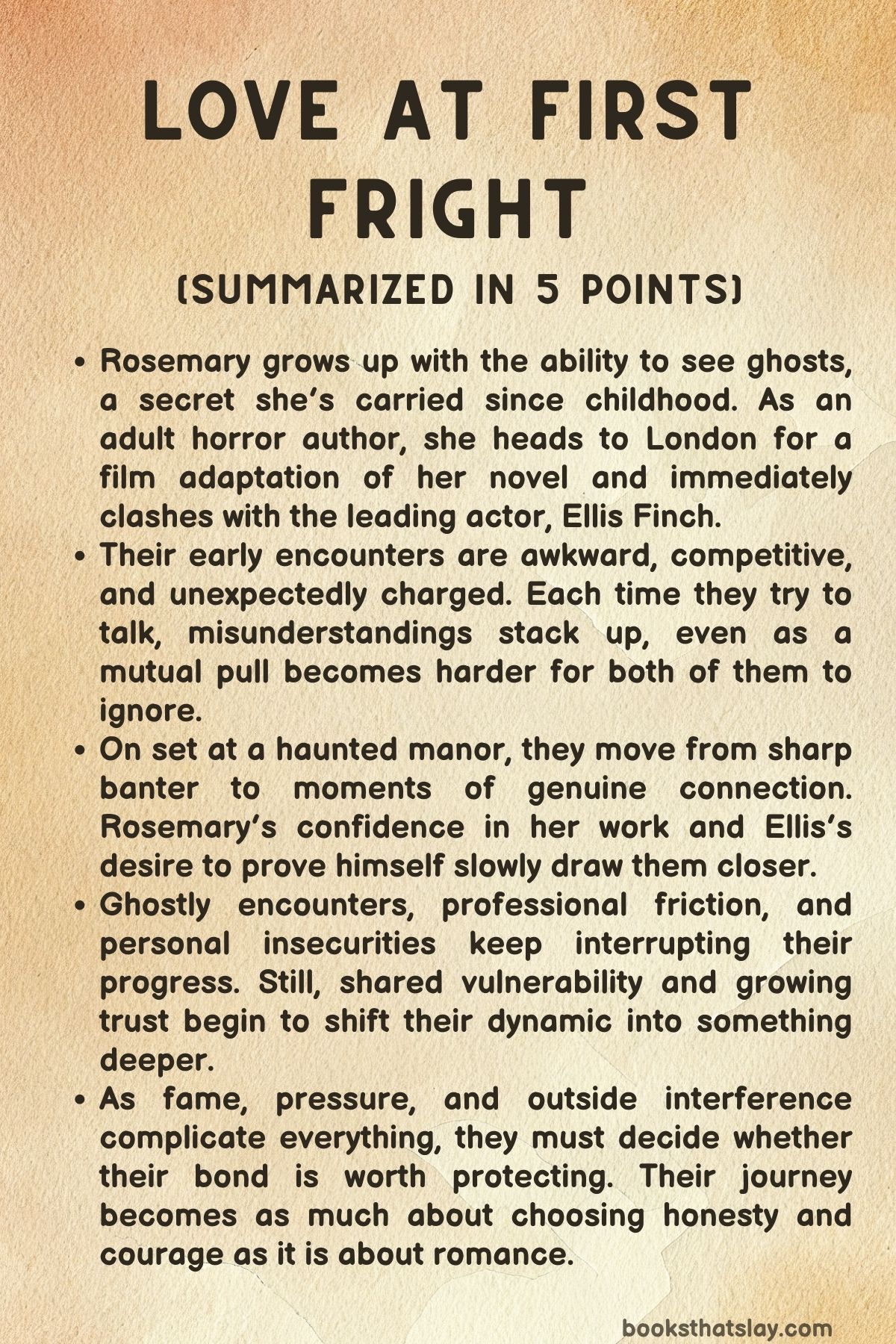
Summary
Rosemary Shaw first discovers she can see ghosts at ten, when her recently deceased grandmother appears in the family kitchen in Georgia. The spirit looks young and radiant as she teaches Rosemary to make her private strawberry jam recipe, complete with a rosewater flourish.
She explains that Rosemary has inherited her ability to see spirits, and that most ghosts will not notice her gift unless she reveals it. Moments later, she vanishes just as Rosemary’s parents come in with news of her death.
The encounter stays secret, shaping Rosemary’s understanding of herself for years.
Nineteen years later, Rosemary is a successful horror author living in Brooklyn. During a bookstore event, she notices a ghost reading over an audience member’s shoulder.
Her fellow panelists dismiss both her and her work, but Rosemary handles it with practiced calm. Max, the store manager who recently dated her, asks her out again, yet she declines because she leaves for London the next day to assist with the film version of her hit novel When the Devil Takes Hold.
Her friends in England tease her about the movie’s star, Ellis Finch, whose casting she strongly dislikes. Despite insisting she feels no interest, a viral clip of him performing a passionate on-screen kiss unsettles her.
Meanwhile in London, Ellis grows annoyed after learning Rosemary criticized his suitability for the role. His agent pressures him into a publicity romance with young actress Jenna Dunn, though Ellis is weary of such arrangements.
At home, he rereads Rosemary’s novel closely, eager for a chance at a more serious part.
Upon arriving in London, Rosemary visits Serendipity, her friend Dina’s magical café. Dina gives her a protection candle for the haunted manor where filming will occur.
Rosemary checks into the Cloverwood Hotel and later becomes caught in a storm at the ruins of St. Dunstan in the East.
Under a tree, she meets a man who brushes her off rudely, mistaking her for a fan. Only later does she realize the stranger was Ellis Finch.
At the production meeting that evening, Ellis, still unaware of who she is, sits beside her with a heavily annotated copy of her novel. When the executives ask where the author is, Rosemary introduces herself.
Ellis, startled and embarrassed, mutters that she is not who he expected. They exchange sharp remarks as they reassess each other in person.
Their interactions remain tense. Ellis invites her to dinner in an impulsive attempt to break the tension.
Later at the pool, he accidentally knocks her off her inflatable float, ruining her book and sparking yet another argument. At dinner he arrives with Jenna, and the situation grows more awkward when their stories about their relationship length don’t match.
Rosemary unexpectedly finds Jenna pleasant, while her sparring with Ellis continues. Inside a quiet room afterward, they argue again, and Rosemary notices a ghost dog trailing him.
When she wakes one morning from an intimate dream about Ellis, she finds he has replaced her ruined book with a new copy. Soon after, the cast and crew travel to Hallowvale, a historic manor used as a filming location.
Ellis’s dog Fig warms quickly to Rosemary, prompting small but meaningful exchanges between them. She thanks him stiffly for the book, and their usual argumentative rhythm resumes, softened by curiosity.
During a tour of the estate, Rosemary witnesses two Regency-era ghosts fighting. She later overhears Ellis defending her script choices against studio pressure, and her view of him shifts.
A near fall on a staircase brings them physically close for the first time. At a small gathering that night, Ellis compliments her dress, mixes cocktails for her, and shares a slow dance that leaves both uncertain and excited.
Later, when she becomes accidentally locked in a pantry, Ellis—half dressed and sleepy—breaks the door open. Their flustered goodbye leaves a charged silence between them.
The next morning he encounters her while out running. She pulls him under a bush to show him a goldcrest, and the shared moment breaks through their defenses.
They speak openly about their insecurities in writing and acting, forming the foundation for a tender shift in their dynamic.
However, Ellis overhears gossip about him and Rosemary. His old fears about age, desire, and public judgment surge, and he abruptly ends their growing closeness.
Rosemary leaves hurt. On set that evening, she argues with the producer about changes that violate the story’s lore.
Ellis steps in to support her, restoring a sense of trust. He later pulls her into a nearby ruin to apologize.
Their conversation collapses into a heated kiss, and they nearly give in to desire before he is called back to work.
Alone, Rosemary explores the ruin and finds letters and a diary belonging to the ghosts Cecilia and Juliet. She reads evidence of their secret romance.
When Juliet appears, distressed that her private writings were seen, Rosemary tries to reassure her that her love was never wrong, but Juliet cannot accept this and disappears. Rosemary resolves to help in the only way she can: by leaving sapphic romance novels in the chapel for Juliet’s spirit.
The next morning Rosemary receives confirmation of a deadline extension for her overdue manuscript. Relieved, she heads downstairs, encounters Ellis, and the tension finally breaks.
They lock the door, kiss, and share intense intimacy. Afterwards, their conversations turn gentle and warm.
Ellis asks her to go bird-watching, and they spend a quiet morning together.
On set that afternoon, Ellis films a scene, but when Jenna suddenly appears—sent by his manipulative agent—paparazzi descend. Rosemary sees him caught up in the staged romance and feels hurt again.
Ellis explains he had no warning and promises better communication. To reconnect, he suggests they escape for the weekend.
They drive with Fig to a countryside cottage, where Ellis receives a threatening call from his agent insisting he maintain the fake romance. He refuses, stands firm, and later joins Rosemary upstairs.
They walk to a hilltop, share personal stories—Ellis reveals the painful loss of a previous dog during a paparazzi incident—and find comfort in each other. Their desire resurfaces, and they have sex outdoors before racing back through the rain to the cottage, deepening both emotional and physical intimacy.
Their relationship continues quietly until Rosemary gives a reading for When the Devil Takes Hold in London. Ellis attends in disguise but is recognized and mobbed.
Rosemary ends the event early and pulls him to safety. Later, he tells her that gossip sites are stirring drama about him cheating on Jenna with her.
At a group lunch with friends and his sister, Ellis calmly states that he is willing to relocate anywhere Rosemary wants. She is stunned but touched.
Life settles into a warm routine. Ellis secretly attracts a rare willow tit to impress her, and when she finally sees the bird, she realizes she loves him.
She begins adapting a different book, Julia, as a screenplay and asks Ellis to star. Their bond grows deeper, and they speak of a shared future.
Rosemary then travels home to Georgia for Christmas, where she bonds with a barn kitten she names Bee. Time with her father helps her reflect, and she decides she wants her future in England, though she hasn’t yet told Ellis.
While she is away, Ellis appears on a talk show. His agent Brody, claiming to possess explicit footage of Ellis and Rosemary, threatens to leak it unless Ellis denies their relationship publicly.
On air Ellis calls Rosemary only a friend and declares he is still dating Jenna. Watching from home, Rosemary is devastated.
Ellis calls immediately and confesses the blackmail. Rosemary is angry he didn’t warn her and that he acted alone “for her sake.
” She ends the relationship despite his declaration of love.
In the following weeks, Ellis discovers Brody never had any footage. With help from lawyers and friends, Ellis confronts and fires him, ending a long pattern of manipulation.
Months later, Rosemary is living in a London Airbnb while apartment-hunting. Her friend Dina secretly gives Ellis the address.
One rainy day he appears at her door asking for a chance to talk. They finally speak honestly: Ellis apologizes for his fear-driven choices, Rosemary apologizes for shutting him out instead of facing the crisis with him, and both admit they still love each other.
They reconcile and decide to live together.
Eight months later they are engaged, living with Fig and Bee in Ellis’s London home. On the night of the premiere of When the Devil Takes Hold, Rosemary walks the red carpet at his side, proud of the film, the journey they survived, and the life they are building together.
Characters
Rosemary Shaw
Rosemary Shaw is the emotional core of Love At First Fright, a woman whose life has been shaped as much by grief and the supernatural as by her own ambition. From the moment she sees her grandmother’s spirit as a child, she learns that she has inherited a rare ability to perceive ghosts—an ability she keeps hidden, shaping a sense of secrecy and inwardness that continues into adulthood.
As a horror novelist she is imaginative, deeply sensitive, and quietly resilient, but she carries insecurities about her craft, her place in the industry, and her worth. Her success is frequently undermined by patronizing male colleagues, which only strengthens her determination to protect her work and her voice.
Rosemary begins the story fiercely protective of her creative vision, convinced that Ellis Finch is entirely wrong for the adaptation of her book. Yet this conviction slowly unravels as she discovers unexpected depth, sincerity, and vulnerability in him.
Her guarded nature softens into trust as their relationship develops, though she struggles to balance the intensity of their connection with her fear of being hurt or overshadowed. Her compassion is most striking in her interactions with ghosts such as Juliet and Cecilia, where she becomes a kind of emotional mediator across time.
Ultimately Rosemary grows into someone who can face both literal and metaphorical hauntings, claiming a future rooted not in fear but in love, agency, and belonging.
Ellis Finch
Ellis Finch enters the story as a seasoned, world-famous actor who seems polished from the outside but is privately weighed down by insecurity, grief, and the pressures of celebrity life. Though he initially appears confident—perhaps even smug—his actions quickly reveal a man who longs to be taken seriously as an artist and who carries scars from years of media scrutiny, manipulative PR arrangements, and past trauma.
His devotion to his dog Fig, his annotated copy of Rosemary’s novel, and his desire to escape shallow roles show how deeply he craves authenticity. With Rosemary he becomes disarmed, often stumbling between attraction, admiration, and panic as he fears the age gap, reputational risks, and his own desire will make him appear predatory or inappropriate.
Ellis’s growth is tied to learning to confront conflict directly rather than protect others through secrecy or self-sacrifice. His misguided attempt to shield Rosemary by lying publicly becomes the turning point that forces him to confront the toxicity around him, including his agent’s manipulation and the burdens of fame.
By the end, Ellis has transformed into someone capable of vulnerability, honesty, and partnership, fighting not only for Rosemary but for his own dignity and autonomy.
Immy
Immy is one of Rosemary’s closest friends in England and provides grounding warmth throughout the story. She represents a chosen-family bond that predates the novel’s central romance, consistently offering emotional clarity and playful teasing that help Rosemary remain connected to her true self.
Immy brings emotional intelligence and a sort of whimsical steadiness to the narrative; she is perceptive enough to recognize Rosemary’s growing feelings for Ellis long before Rosemary will admit them. Her presence highlights the importance of community in Rosemary’s life, anchoring the protagonist during moments of doubt and transition.
Immy’s loyalty and humor make her a steady point of comfort in an ever-changing world of filming schedules, ghosts, and romantic turmoil.
Dina
Dina, the owner of the magical café Serendipity, embodies an atmosphere of gentle enchantment. Her connection to herbs, charms, and protective rituals mirrors Rosemary’s relationship with the supernatural, but in a more grounded, nurturing way.
Dina acts as both friend and quiet mentor, understanding Rosemary’s anxieties without judgment and offering both mystical and emotional support. Her magical sensibility enriches the story’s tone, blending the everyday with the otherworldly in a way that helps Rosemary feel less alone in her ghost-seeing abilities.
Dina’s intuitive guidance, steady presence, and unwavering encouragement help Rosemary navigate both creative pressures and romantic upheaval.
Juliet
Juliet, one of the Regency-era ghosts bound to Hallowvale, serves as a poignant reflection of repression, identity, and the violence of internalized shame. Her relationship with Cecilia unfolds through the letters and diary Rosemary discovers, revealing a forbidden love shaped by the constraints of her time.
Juliet’s anguish comes not only from the tragedy of her story but from her belief that her queerness is sinful—an idea she cannot release even in death. Her interactions with Rosemary reveal the impact of generational trauma and societal expectations, and Rosemary’s attempts to soothe her offer a beautiful parallel to the novel’s themes of acceptance, self-forgiveness, and chosen liberation.
Juliet’s haunting presence creates emotional stakes beyond romance, emphasizing that not all ghosts are simply spirits—they are unresolved stories.
Cecilia
Cecilia, Juliet’s lover and the second ghost of Hallowvale, represents devotion, longing, and unresolved grief. While she appears less frequently, her emotional presence saturates the story through the artifacts she leaves behind and her desperate attempts to reach Juliet.
Cecilia’s love for Juliet is steadfast, yet she is trapped in a liminal space, unable to move on without her. The tragedy of their separation is a quiet counterpoint to Rosemary and Ellis’s contemporary romance, showing a love that failed to overcome the societal forces working against it.
Through Cecilia, the story underscores both the endurance of love and the pain that comes from unspoken truths.
Fig
Fig, Ellis’s dog, is a tender and emotionally resonant character whose presence brings warmth and humanity to Ellis’s arc. More than a pet, Fig symbolizes Ellis’s capacity for love, connection, and vulnerability.
She becomes a silent confidante during his spirals of self-doubt, grounding him when fame and fear threaten to isolate him. Fig’s attachment to Rosemary, beginning with their interactions at Hallowvale, mirrors Ellis’s own growing feelings and becomes an early indicator that Rosemary belongs in his world.
Fig also represents Ellis’s grief over his previous dog Hank, a trauma that still shapes his fears around privacy and danger. Through Fig, the novel highlights emotional healing, trust, and the quiet ways love can take root.
Jenna Dunn
Jenna Dunn at first appears to be a stereotypical young starlet involved in a fake publicity romance with Ellis, but she quickly reveals depth, intelligence, and empathy. She navigates fame with sharp awareness and is as much a victim of PR machinery as Ellis.
Her likability catches Rosemary off-guard, and over time Jenna becomes an unexpected ally, eventually helping Ellis see through his agent’s manipulation. Jenna’s friendship with Ellis underscores the theme that not all industry relationships are exploitative; some are built on mutual understanding forged in the crucible of fame.
Her role demonstrates how complicated public image can become and how false narratives are constructed around celebrities.
Brody
Brody serves as the most concrete human antagonist, representing the exploitative, coercive nature of celebrity management. He manipulates Ellis through fear, pressure, and manufactured crises, wielding power through threats and lies.
His attempt to blackmail Ellis—based solely on a fabricated claim—reveals how little regard he has for Ellis’s wellbeing or integrity. Brody embodies the toxic systems that treat actors as commodities rather than people.
His eventual downfall marks a key point in Ellis’s emancipation and symbolizes the reclamation of personal autonomy that the novel’s main characters strive for.
Rosemary’s Father
Rosemary’s father is a gentle, stabilizing presence whose quiet love supports her at crucial emotional moments. Living on a Georgia farm, he represents both home and history, grounding Rosemary when the chaos of her life overwhelms her.
Their relationship is affectionate and understated, marked by mutual respect and easy comfort. His presence during Rosemary’s heartbreak provides her with space to breathe and regain clarity, reinforcing the theme that healing often requires a return to one’s roots.
His acceptance of Bee into the family hints at his nurturing nature, which Rosemary carries with her into adulthood.
Bee
Bee, the runt of the barn kitten litter, becomes a symbol of renewal and emotional rebirth. Her bond with Rosemary during the latter’s Christmas visit reflects Rosemary’s desire for comfort, companionship, and a fresh start after heartbreak.
Bringing Bee to London marks Rosemary’s choice to build a new life, firmly committing to the future she has quietly longed for. Bee’s gentle presence later complements Fig’s energetic loyalty, representing the merging of Rosemary and Ellis’s lives.
Cecilia and Juliet
Together, the ghosts Cecilia and Juliet act as a lyrical echo of the central romance—an illustration of what happens when love is suppressed rather than pursued. Their story enhances the emotional stakes of the novel by offering a tragic parallel: two people whose love could not survive the constraints of their world.
Through Rosemary’s interactions with them, especially Juliet, the narrative explores queerness, shame, self-acceptance, and the hope that even long-buried love may find peace. Their presence reinforces the novel’s blending of romance, supernatural mystery, and historical sorrow.
Themes
Grief, Memory, and the Persistence of Love
Loss forms a quiet but constant foundation in Love At First Fright. Rosemary’s first encounter with the supernatural—her grandmother’s loving return to teach her a final recipe—establishes grief not as an ending but as an altered form of relationship.
Her grandmother’s presence affirms that love can outlast death, yet it also burdens Rosemary with an awareness that connections can cling, linger, or vanish before closure arrives. This early experience shapes the way she interprets every later moment of emotional risk.
Her guardedness in romance, her fear of being misunderstood, and her habit of carrying feelings privately all stem from learning too young that bonds can dissolve in an instant. The ghosts she sees throughout the story mirror these emotions: they represent unfinished business, trapped longings, and unexpressed truths.
Juliet’s anguish over her forbidden love becomes a reflection of Rosemary’s own fear of wanting too much or stepping beyond what others expect of her. Through helping Juliet accept her truth, Rosemary confronts her own history of avoidance.
Ellis also carries grief—namely the unresolved guilt over his former dog Hank’s death and the shame attached to years of being commodified by his industry. When he confesses these vulnerabilities, Rosemary understands that grief is not only something one survives but something that reshapes one’s capacity to love again.
Their relationship becomes a negotiation between holding onto what has hurt them and choosing what might heal. In binding their lives together, they prove that grief does not have to isolate; it can teach tenderness, patience, and the courage to reach out again.
Power, Agency, and the Right to One’s Own Narrative
Control—over one’s work, image, and identity—sits at the core of the conflicts faced by Rosemary and Ellis. Rosemary navigates a professional world eager to diminish her authority: male writers belittle her, Hollywood executives try to sand down the edges of her story, and the film industry often treats young female creators as decorative rather than essential.
Her resistance to these pressures becomes a defining act of agency. Standing up for the linguistic authenticity of her protagonist or shutting down Jeremy’s condescension isn’t simply about creative preferences; it is about claiming the right to tell her story without being reshaped to meet patriarchal expectations.
Ellis confronts a different but equally invasive pressure: the studio’s ownership of his public image. His career has trapped him in cycles of fake relationships, staged personas, and an expectation to be endlessly accessible.
Brody’s blackmail threat pushes this to an extreme, turning his private life into a commodity to be used against him. Ellis’s journey toward reclaiming his narrative involves both rejecting the manipulations of his agent and choosing honesty even when that honesty may complicate his career.
When he and Rosemary reconcile, they are no longer trying to fit into the roles the industry has written for them. Instead, they insist on writing their own terms—professionally, romantically, and personally.
Through both characters, the novel underscores that agency is not simply about independence; it is about ownership of one’s voice, one’s truth, and the stories one chooses to live.
Romantic Vulnerability and Emotional Risk
The romance in Love At First Fright thrives on the tension between desire and fear. Rosemary and Ellis are drawn to each other from the start, not because they fit a predetermined romantic mold, but because they challenge one another’s assumptions.
Their attraction grows in moments of friction—an argument in the pool, a clumsy introduction in the rain, a locked pantry door in the middle of the night. These moments reveal that emotional intimacy requires a willingness to be unguarded.
Rosemary fears losing control of her heart, worried that affection might lead to abandonment. Ellis fears he is too old, too exposed, or too damaged to deserve someone as hopeful as she is.
When Ellis briefly pushes Rosemary away out of shame, both of them confront how intimacy can activate their deepest insecurities. Their later conflict—sparked by Ellis’s public denial of their relationship—shows that love falters not only through betrayal but through miscommunication rooted in fear.
Yet what ultimately binds them is their choice to face those vulnerabilities rather than flee from them. The reconciliation scene demonstrates that romantic risk is not a hazard but a necessary part of building trust.
Love, for them, becomes an act of bravery: the willingness to be seen completely and to welcome someone else into the raw, unpolished spaces of life.
Identity, Authenticity, and Self-Rediscovery
Both protagonists enter the story believing they already understand themselves, yet both undergo transformations that reveal how much they have been performing rather than living. Rosemary hides behind her success, using work as a shield to avoid confronting her loneliness or her complicated feelings about her ghost-seeing ability.
She imagines herself as someone who thrives alone, but her friendships, her growing attachment to London, and her connection with Ellis show that her identity is far more communal than she allows. Ellis, meanwhile, has spent decades being packaged, managed, and directed until he barely recognizes where the public persona ends and the real man begins.
His relationship with Rosemary becomes a catalyst for rediscovery—he learns to trust his instincts, make choices based on personal fulfillment, and reclaim parts of himself he sidelined for career survival. Their shared love of nature, their creative work, and their vulnerable conversations become spaces where they can shed the versions of themselves shaped by others and embrace their authentic desires.
By the end of the novel, their engagement symbolizes not just romantic commitment but the merging of two individuals who have each learned to stand firmly in their own identities.
Unseen Worlds: The Supernatural as Emotional Metaphor
The supernatural element in the novel is not decorative; it functions as a metaphor for emotional legacies, internal hauntings, and truths that demand recognition. Rosemary’s ability to see ghosts forces her to confront what others overlook—grief, regret, forbidden love, and unresolved pain.
The haunting presence of Juliet and Cecilia represents stories erased by time and prejudice, while Rosemary’s determination to help them reflects her belief that compassion can mend even centuries-old wounds. Ellis, though he cannot see ghosts, is figuratively haunted by his past—Hank’s death, the manipulations of his management, and the relentless surveillance of fame.
Fig’s loyalty and gentle presence provide comfort where the ghosts bring sorrow, reminding both characters that connections with the unseen can be nurturing or painful depending on what they symbolize. Through this blend of the supernatural and the emotional, the novel suggests that everyone is shaped by invisible forces: memories, traumas, fears, and desires.
Healing comes not from ignoring these forces but from acknowledging and integrating them into one’s life.
Fame, Privacy, and the Cost of Public Scrutiny
Ellis’s world highlights the destructive nature of celebrity culture—its entitlement, invasiveness, and disregard for emotional boundaries. The paparazzi incident at the bookstore illustrates how easily the public can consume a person as spectacle, stripping them of dignity in the process.
Brody’s manipulations reveal an industry willing to exploit personal relationships for profit, while the false narrative of Ellis’s relationship with Jenna shows how fame distorts truth. Rosemary, thrust into this world through her success and her relationship with Ellis, experiences the anxiety of being misrepresented and scrutinized.
Her horror at seeing Ellis mobbed reveals how hostile public attention can feel to someone unaccustomed to it. The novel critiques this culture, emphasizing that fame often demands sacrifice—of privacy, safety, and personal choice.
The couple’s decision to stand together publicly at the end marks a refusal to let the world dictate their happiness. Their unity is not just romantic; it is an act of defiance against a system designed to control them.