Lover Forbidden Summary, Characters and Themes
Lover Forbidden by J.R. Ward returns to the world of the Black Dagger Brotherhood with a story centered on identity, legacy, and love born in dangerous circumstances. The book follows Lyric, daughter of warriors and part of a powerful vampire bloodline, who is caught between her heritage and a public human-world persona she no longer recognizes.
When a mysterious and impossibly strong man named Dev saves her life, their connection sets off a chain of events involving hidden powers, ancient enemies, and personal reckonings. The novel explores the cost of destiny, the pull of family, and the choices that define who you become.
Summary
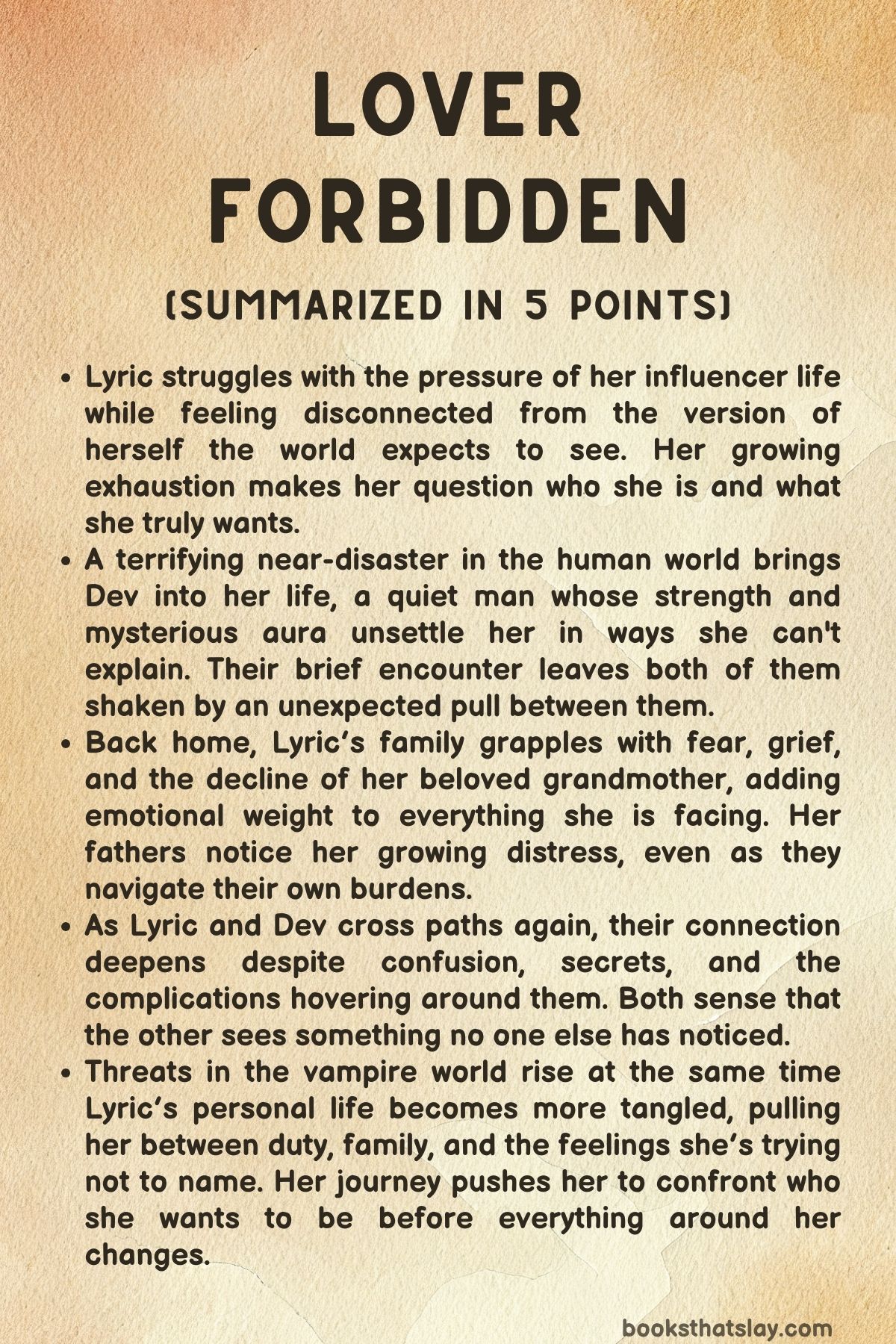
Lover Forbidden follows Lyric, daughter of Qhuinn and Layla and adopted daughter of Blay and Xcor, as she attempts to balance her vampire heritage with the glossy, exhausting human-world influencer career her manager Marcia has crafted. While her fame expands online, she feels detached from her own image, worn down by the daily pressure to perform and by Marcia’s constant push for content.
Her family remains supportive, though tensions rise as danger in Caldwell grows and the Brotherhood continues to face threats that ripple through every household.
During a branded event at the nightclub Bathe, Lyric is confronted with the gap between her true self and the version of her that the world watches. She reconnects briefly with Allhan, a gentle pretrans friend who shows up to support her, but Marcia’s dismissive treatment of him drives him away.
Lyric tries to follow him outside, sparking a public scene as fans and cameras capture every move.
As she crosses Market Street searching for Allhan, a massive billboard promoting a human self-help conference begins to tear loose from a rooftop. The structure drops toward her in a violent rush of metal and wind.
Before she can react, a huge man appears, wraps himself around her, and shields her as the billboard slams down. He lifts the wreckage off them with supernatural strength and moves it aside as the crowd erupts in shock.
His name is Devlin—Dev—a construction worker who prefers solitude and clearly does not want attention. He walks away despite the commotion, leaving Lyric strangely shaken by him.
Throughout the night, Lyric’s family reacts to the viral footage of the collapse. Qhuinn bursts into the club in a panic, Rhamp rushes to check on his twin, and Shuli—secretly in love with Lyric—struggles to hide his distress.
While the Brotherhood deals with their own missions, Lyric tries to regain control of her evening. She later returns to Dev’s worksite to give back the jacket he lent her, only to encounter eerie shadows and the sense of being watched.
Dev reappears, tracked there by his misplaced phone, and insists she keep the jacket for warmth. When he sees her fear, he stays with her until she gets safely into a car.
Meanwhile, the Brotherhood investigates rising threats, including a tortured vampire found hidden inside a secret room, and L. W.—the King’s son—is missing. L.W. continues hunting enemies alone, refusing help, and secretly battles a worsening condition: his sight is failing.
He hides this from everyone except Shuli, whom he drags into a dangerous personal mission to find Lash, leader of the Lessening Society.
While the Brotherhood grapples with their crises, Dev tries to live an ordinary life that no longer fits him. His attraction to Lyric becomes overwhelming despite years of emotional withdrawal.
At their planned dinner, the two struggle to navigate their growing connection. Lyric explains she intends to quit influencing after one final obligation: speaking at the Resolve2Evolve conference.
Dev reluctantly agrees to attend as her date. Their chemistry intensifies afterward at her empty apartment, where Dev stops short of full intimacy, haunted by a painful past he refuses to explain.
Lyric seeks clarity through spiritual guidance and unexpectedly finds herself transported to the Sanctuary, a sign that forces beyond her control are at work.
Events accelerate when Lyric later takes a bullet for L. W. during a confrontation. She briefly crosses into the Fade and meets the spirit of her granmahmen, who reminds her of her promise to stay in the world until things are truly right.
She returns to her body as the Brotherhood fights to save her. Rhamp reveals that Dev was present at the moment she revived, his palm outstretched as if giving life.
She learns the truth: Dev is the grandson of the Omega, raised in darkness and shaped by forces meant to destroy the Brotherhood. Heartbroken, she vows never to see him again.
Dev, however, prepares to face his father, Lash, alone. Rhamp and two fighters track him down, but Dev sends them away to protect them before entering the glass house where Lash waits.
Lyric is pulled across space by the spark Dev left within her and arrives at the lake house in time to see him nearly overwhelmed. She forces her way inside as Lash attacks.
Dev uses the emotion he has long feared—his love for Lyric—to create a shield strong enough to block Lash’s power. When that fails, he absorbs the darkness into himself, then sends it back with devastating force, blasting Lash into the frozen lake.
Just when it seems over, Lash’s essence rises again. Lyric shields Dev with her own body.
In this moment, Dev’s mother, Devina—disguised for years as Valentina Disserte—appears. She protects them and then battles Lash’s essence in a violent clash of light and shadow.
After the explosion fades, Devina returns and tells Lyric that only Lyric’s love can cleanse Dev of the darkness inside him. Lyric releases the piece of Dev within her and brings him back to life.
He awakens mortal, stripped of his destructive inheritance.
Two weeks later, Dev and Lyric live together in a small, warm space while she continues training with the Brotherhood. Dev has been accepted by her family and the King for his role in defeating Lash.
During a quiet Sunday Last Meal, Lyric cooks her granmahmen’s lasagna and feels her spirit nearby, peaceful and proud. Surrounded by her family and by a future she chooses freely, Lyric senses that the long-feared ending has finally become a beginning—for her, for Dev, and for everyone who fought to see them safe.
Characters
Lyric
Lyric is the emotional center of Lover Forbidden, a young female caught between two worlds—her warrior-born vampire heritage and her curated human-influencer persona. Her journey begins with profound disconnection: despite fame, she feels hollow, unseen, and increasingly suffocated by a life that has nothing to do with who she truly is.
When Dev rescues her from the falling billboard, it becomes the catalyst that breaks her double life open. What defines Lyric throughout the novel is her capacity for deep feeling—loyalty to family, compassion for others, and a powerful instinct to protect.
Her closeness to her dying grandmother grounds her, reminding her of her lineage and her purpose. Lyric’s arc is a movement from fragmentation toward spiritual and emotional integrity.
The Sanctuary sequence reveals her openness to higher guidance and her courage to face the Fade without fear. Her choices—to love Dev despite the danger he represents, to risk her life for L.
W. , and ultimately to save Dev by giving him her life-force—illustrate a heroine whose strength comes not from physical prowess alone but from her ability to withstand heartbreak, loss, and the weight of destiny.
By the end, Lyric emerges as a young warrior who has stepped fully into her identity, grounded in truth, family, and love.
Dev / Devlin
Dev is defined by contradiction: a being of immense power and supernatural lineage who wishes only to exist quietly, anonymously, and without violence. His physical presence—giant, controlled, capable of impossible feats—is paired with emotional self-exile.
His life under the shadow of Lash and Devina has taught him fear of attachment and terror of what his nature might make him become. The billboard rescue awakens in him a fierce, unexpected connection to Lyric, which he fights as much as he gravitates toward.
Dev’s arc is a slow erosion of the walls he built around himself. His attraction to Lyric destabilizes him, pushing him to act against his instincts—going on a date, quitting his job, protecting her even when he believes he should walk away.
His confrontation with Lash becomes a moment of self-definition: he chooses love, protection, and sacrifice over the darkness he inherited. When he absorbs Lash’s power and nearly dies, Dev finally accepts vulnerability, allowing Lyric to bring him back.
His transformation into a mortal being is symbolic of his rebirth—freed from demonic corruption, capable of living a real life shaped by his own choices. Dev ends the story grounded, humanized, and fully intertwined with Lyric, a man remade through love.
Qhuinn
Qhuinn’s presence in the novel is shaped by fear, grief, and the fierce paternal love he carries for his family. He has survived too much loss to ever feel secure, and the near-death of Lyric triggers every protective instinct he has.
Qhuinn’s scenes depict a warrior balancing duty with overwhelming personal responsibility: Wrath’s vulnerability, L. W.’s disappearance, the death of his brother Luchas, and his mother-in-law’s impending passing all weigh on him. Yet his interactions with Blay reveal his softer side—tender, emotional, and honest.
His conversations with Tohr show how trauma still shapes him, particularly survivor’s guilt. Despite all this, Qhuinn serves as one of the emotional anchors of Lyric’s life, representing unconditional love and the fierce stability of family bonds.
Blay
Blay is the quiet strength of the household, a steadying presence who holds the family together as elder Lyric declines. His exhaustion, devotion, and grief paint him as a character whose goodness manifests not in grand gestures but in daily acts of care—staying by his mother’s bedside, keeping the household running, and balancing his own sorrow with his duty to his mate and children.
His relationship with Qhuinn remains tender and emotionally open; they face their fears together and support each other through impending loss. Blay’s concern for Lyric’s emotional state, especially as her world begins to shift dramatically, shows the depth of his intuition and paternal love.
Rhamp
Rhamp is Lyric’s twin and her emotional counterpart—intense, protective, and deeply bound to her. His anger, especially when he storms home covered in blood, stems from fear and helplessness rather than hostility.
He grapples with the growing danger surrounding his sister and his own role within the war. The revelation that he witnessed Dev channeling life back into Lyric is a moment of vulnerability and honesty, showing his intuitive grasp of the supernatural forces at play.
Rhamp is a young male shaped by responsibility, frustration, and loyalty, and through his bond with Lyric he becomes a silent guardian, willing to hide truths, break rules, and fight for the people he loves.
Shuli
Shuli embodies nobility under pressure. As the prince and L.
W. ’s ahstrux nohtrum, he lives in constant fear of losing control—over the political landscape, over L.
W. ’s safety, and over his own conflicted emotions.
His relationship with Lyric is marked by unspoken affection, jealousy, and a quiet ache that never crosses the line into action. With L.
W. , Shuli navigates a volatile dynamic: anger, loyalty, responsibility, and desperation intertwine in their arguments.
His attempts to keep L. W. safe, even at moral and political cost, show his willingness to choose loyalty over logic. Shuli is driven, disciplined, and quietly emotional beneath his polished exterior.
L. W.
L. W. is a young warrior haunted by his lineage, his failing eyesight, and his obsession with finding Lash. His need to destroy the enemy becomes a consuming purpose, one that overrides reason and personal safety.
His secrecy and abrupt departures reflect a male who feels the world narrowing around him—his vision fading, his options diminishing, and his fears intensifying. His reliance on Shuli, even when he pretends indifference, underscores his vulnerability.
L. W.’s blindness is both literal and symbolic: he cannot see the danger he puts himself in nor the emotional wreckage he leaves in his wake. Yet he remains fundamentally noble, driven by duty and a desire to protect his people from the darkness that once destroyed his lineage.
Devina
Devina is a figure of terrifying beauty and dangerous power, but in this story she appears as something else—a mother. Her relationship with Dev is complicated, fraught with the residue of her demonic nature, yet marked by genuine love and a desire to shield him from corruption.
When she confronts Lash’s essence, she does so as a being capable of both immense destruction and sacrificial protection. Her refusal to resurrect Dev through demonic means shows a surprising moral clarity: she wants him free, untainted, capable of a real life with Lyric.
Devina’s final act—telling Lyric to return the piece of Dev within her—aligns her for once with the cause of love rather than manipulation. She remains an enigmatic force, powerful, dangerous, and unexpectedly redemptive.
Lash
Lash is the embodiment of darkness: manipulative, cruel, parasitic, and relentless. His presence dominates the narrative as a looming, corrosive force.
Dev’s childhood, L. W.’s trauma, and the Brotherhood’s fears all radiate from the legacy of his evil. In the showdown at the glass house, Lash represents the inevitable confrontation with inherited darkness—Dev’s lineage, Lyric’s destiny, and the war’s unresolved past colliding in one moment.
Even in defeat, his essence rises in a monstrous surge, a reminder that evil rarely dies easily. His final banishment beneath the ice marks a temporary victory, but his influence continues to shape the choices and consequences of the characters who fought him.
Elder Lyric
Elder Lyric’s declining health casts a quiet emotional shadow over the entire novel. She represents wisdom, memory, and the passing of tradition from one generation to the next.
Her bond with young Lyric is profound, offering guidance that becomes crucial later, especially during the Sanctuary and Fade moments. Her reassurances—that peace awaits, that endings are not final, and that love binds the living and the dead—anchor Lyric’s spiritual growth.
Even after death, she remains a protective presence, her final smile in the kitchen signaling peace, fulfillment, and her blessing over Lyric’s future with Dev.
Marcia
Marcia symbolizes everything artificial in Lyric’s influencer life. Ambitious, manipulative, and deeply self-interested, she prioritizes branding over safety, image over truth.
Her physical attempts to stop Lyric from following Allhan and her eagerness to turn trauma into content reveal her lack of empathy. Marcia functions as a foil: she reflects the life Lyric must escape in order to reclaim her authenticity.
Her narrative purpose is to push Lyric toward breaking free, forcing her to confront the cost of living for the camera instead of for herself.
Allhan
Allhan is a gentle presence in the story—a shy pretrans who genuinely supports Lyric without agenda. His discomfort around the influencer world highlights Lyric’s own discomfort, mirroring her desire for sincerity.
His brief flight from the scene, after Marcia humiliates him, triggers Lyric’s moment of truth: choosing real connection over curated image.
Themes
Identity and Self-Definition
Lyric’s struggle to understand who she is lies at the center of Lover Forbidden, and the tension in her life stems from forces constantly attempting to define her. On one side exists the vampire world into which she was born, shaped by lineage, training, and expectations that come with being the daughter of some of the most influential and battle-marked warriors in the Brotherhood.
On the other side is the human world, where she has unintentionally become an influencer—an identity crafted not from genuine passion but from curated imagery and digital performance. Her sense of self becomes blurred as both realms impose external meanings on her: the Brotherhood sees a warrior-born female with responsibilities to her species, while the human audience sees a brand that exists for consumption.
Lyric’s exhaustion, disconnection, and growing emptiness reveal how identity fractures when it is externally manufactured rather than internally chosen. Her pivotal moments—including running after Allhan despite Marcia’s objections, rejecting the commodification of her trauma after the billboard incident, and ultimately abandoning the influencer career—mark a shift toward reclaiming control over her own narrative.
Her relationship with Dev deepens this theme as he, too, embodies a fractured lineage. His identity is shaped by forces he never chose—being the grandson of the Omega and the son of Devina—yet he strives to embody discipline, restraint, and a quiet code of personal honor.
Their bond ultimately thrives because both are wrestling with an inherited identity they reject and searching for something that feels self-authored. Their journey illustrates the cost of living in roles shaped by others and the liberation that comes from acknowledging one’s authentic self, even when that authenticity emerges from pain, conflict, and the arduous process of choosing one’s path rather than accepting a predetermined one.
Trauma, Isolation, and Emotional Reawakening
Dev’s existence is saturated with isolation, fear of his own nature, and memories that he cannot escape. His supernatural strength and volatile lineage isolate him from human society, but it is the emotional aftermath of past violence—most of which is implied through his self-policing behavior—that truly imprisons him.
The near-strangling incident with his coworker, his instinctive withdrawal from crowds, and his retreat into abandoned spaces reveal a man who fears who he could become if he lets anyone close. Trauma has carved him into someone who survives rather than lives.
Lyric, though surrounded by family and public attention, suffers a different form of isolation. Her influencer world creates a sense of being watched but never truly seen, and her grandmother’s decline leaves her emotionally unmoored.
Their connection becomes a catalyst for emotional awakening: Dev feels drawn to her in a way that terrifies him, not because he fears harming her physically but because he fears needing her. Lyric sees in Dev a grounding presence that counters the artificiality of her public persona.
Their emotional journey revolves around learning to trust themselves enough to trust another person. Even their conflicts—Dev withdrawing after intimacy, Lyric feeling shattered by his secrets—are rooted in fear rather than a lack of affection.
The culmination of this theme appears when Lyric gives her life-force to bring Dev back. Trauma once kept them closed off, yet it becomes the foundation on which they build connection: each recognizes the other’s wounds without judgment.
Their story becomes one of learning to step out of self-imposed solitude and toward vulnerability, not as weakness but as a form of reclaimed humanity.
Fate, Free Will, and the Burden of Inheritance
The narrative consistently places characters at crossroads where destiny and personal choice collide, especially for those born into burdensome lineages. Dev’s entire existence is framed by the legacy of the Omega and Devina—one of destruction, manipulation, and predatory influence.
He embodies powers inherited from a demonic bloodline, yet his actions consistently reflect a desire to live in opposition to the darkness he comes from. His greatest fear is not death, but becoming what he was born from.
The act of choosing restraint at moments where violence seems inevitable demonstrates enormous internal struggle. Lyric similarly carries an inherited weight: the expectations of being Qhuinn and Layla’s daughter, the granddaughter of revered vampire families, and the emotional legacy of a grandmother whose wisdom shapes her even after death.
Both characters confront the question of whether one’s origin defines one’s future. This theme reaches its height in the battle with Lash, where Dev must reject the destiny tied to his bloodline and choose his path through deliberate sacrifice.
Lyric’s choice to follow Dev across the veil of space, even at risk to her own life, reinforces the belief that destiny is shaped by decisions made in moments of extreme consequence. The culmination of the theme appears when Dev loses his powers and becomes mortal.
Rather than being punished, he is purified from the influence of both parents. His altered nature is not a diminishment but a representation of chosen identity supplanting inherited destiny.
The story ultimately argues that lineage may define the starting point, but character arises from the choices made despite that inheritance.
Love as Transformation and Redemption
Love in Lover Forbidden operates not merely as affection or attraction but as a force capable of rewriting the very nature of a person. Dev’s arc embodies this idea most clearly.
His longing for Lyric is portrayed as something he fights with desperation because he recognizes that real emotional connection threatens the carefully controlled existence he has constructed to protect the world from his own bloodline. The more he cares for Lyric, the more he risks exposing vulnerabilities he has never allowed himself to feel.
Lyric’s affection for Dev emerges in moments of genuine interaction—when he gives her his coat, when he waits with her in the cold, when he admits fear rather than pretending strength. Love reveals their internal truths rather than covering them.
The most powerful expression of this theme occurs in the climax at the glass house, where the destructive legacy of Dev’s parents meets the redemptive potential of Lyric’s love. When Dev is dying, Devina refuses to resurrect him with demonic essence, leaving Lyric’s mortal love as the only force capable of cleansing him.
Her kiss becomes an act of re-creation, turning him from an immortal being shaped by cursed inheritance into a mortal being defined by choice and vulnerability. This transformation is not framed as a loss but as liberation: he is freed from the predatory forces that once shaped his existence.
The theme extends beyond them as well—Lyric’s acceptance of Dev allows her to break away from the emotional numbness that came from living as an influencer. In choosing one another, both become freer and more whole than they were alone, turning love into a form of salvation that neither lineage nor destiny could offer.
Family, Legacy, and the Weight of Expectation
Family relationships run through every layer of the narrative, shaping character motivations, loyalties, conflicts, and wounds. The Brotherhood households operate like interlocking clans where heritage and honor still matter deeply.
Lyric is raised with extraordinary love but also with the shadow of her family’s history of loss and sacrifice. Qhuinn’s fierce protectiveness, Blay’s emotional steadiness, and Layla’s grounding presence form her foundation, yet the decline of her grandmother shakes that foundation at a vulnerable moment.
Legacy becomes a comforting weight when represented by family traditions, memories, and the bonds between parent and child; yet it becomes a suffocating weight when represented by expectations. Rhamp’s emotional turmoil, Shuli’s conflicted loyalties, and Qhuinn’s grief over Luchas all demonstrate how legacy affects more than just personal identity—it affects the sense of duty one feels toward others.
Dev’s place within this theme is particularly complex because his parents’ legacy is one of destruction. For him, family represents danger, not comfort.
His instinct to isolate himself from others stems directly from the belief that his lineage is a curse. Yet Lyric introduces him to a different vision of family—one built on chosen bonds, shared meals, warmth, and mutual support.
The final scenes, where Dev is welcomed into the household and teased as part of ordinary life, symbolize the healing of generational wounds. The theme ultimately suggests that legacy is not fixed; it evolves as families choose who they include, how they care for one another, and what they allow to define the next generation.