Pictures of Him Summary, Characters and Themes
Pictures of Him by Clare Leslie Hall is a novel about memory, trauma, and the enduring pull of a first love. It follows Catherine, a woman whose past refuses to stay buried, and whose carefully built adult life unravels when old wounds are reopened.
Moving between university days, adult responsibilities, and a present in which Catherine has fallen silent inside a psychiatric clinic, the story traces the forces that shaped her: passion, secrecy, loss, loyalty, and the power of events she never learned to face. Through shifting timelines, the book shows how a single moment can echo across years and change every life connected to it.
Summary
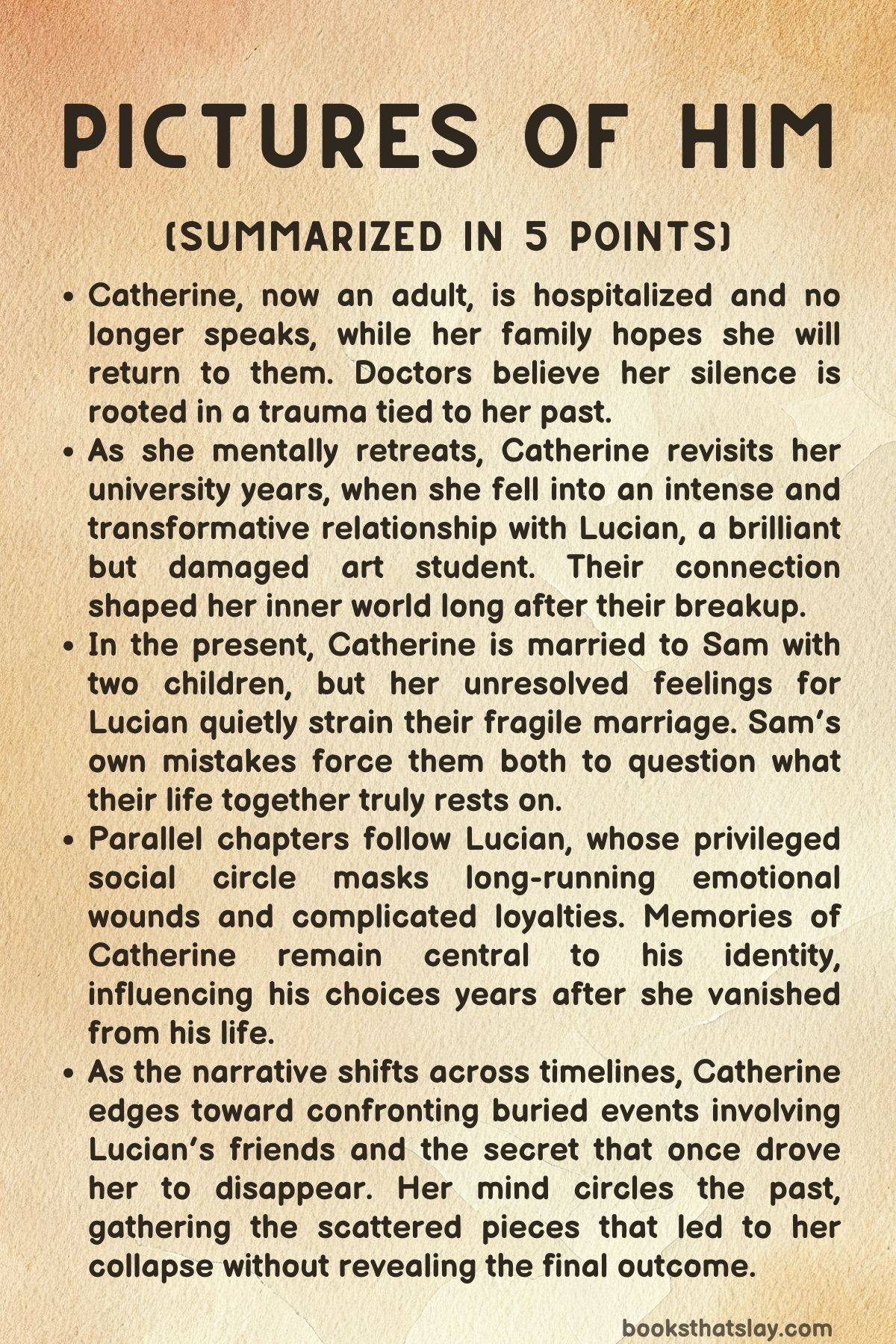
Catherine’s story opens in the present, where she is living in a psychiatric clinic, mute and locked inside herself. A gentle nurse tends to her with everyday care, while her husband Sam and their children visit in hope that she will return to them.
Doctors explain that Catherine’s silence is not physical but psychological; her mind shut down after a traumatic event at Lucian Wilkes’s estate, Shute Park. Her psychiatrist, Greg, believes she has retreated to the moment her mind could not bear, and must mentally walk back through her life to understand how everything began.
Inside her stillness, she decides to tell her life story to the man she once loved—Lucian.
Fifteen years earlier, Catherine arrives at university as an only child raised in comfort and certainty. She quickly becomes close to Sam, another student, and settles into academic success.
During a tutorial, Lucian Wilkes appears late, radiating confidence and talent. His reading of Milton captivates everyone, especially Catherine, who feels an immediate pull toward him.
Though she tells him she has just started seeing Sam, Lucian pursues her with a steady charm, leaving handwritten notes in her library cubicle. When he sketches a seaside restaurant and invites her to lunch, she goes.
He takes her to a remote beach house restaurant that matches his drawing exactly. They share hours of talk and wine, and Catherine feels as if something new has opened inside her.
This lunch becomes the beginning of an intense relationship that shapes both their lives.
As their romance deepens, Catherine learns that Lucian carries heavy emotional scars. His father died by suicide; his mother is distant; his privileged circle of friends is tight-knit but unstable.
Catherine becomes central to Lucian’s world, and he to hers. Yet one night alters everything.
After drinking heavily with Lucian and his friend Jack, Catherine loses proper awareness. Lucian leaves to help his distressed uncle, and Catherine later wakes in Lucian’s bed with Jack having sex with her.
In her foggy state, she cannot resist or understand. Jack later claims she initiated it and insists it was mutual.
Catherine feels swallowed by shame, guilt, and confusion. Convinced she has betrayed Lucian and terrified that the truth might push him toward the same fate as his father, she writes him a cold note, ends the relationship, and disappears.
The timing coincides with her mother’s terminal illness, and grief buries everything else. Lucian is devastated by her abrupt departure, and, unknown to Catherine, attempts suicide.
Harry, his closest friend, saves him, and Lucian’s circle closes ranks, judging Catherine for the pain she caused him.
In the present-day clinic, Catherine hears fragments of conversations around her. Greg and Sam discuss her past, unaware she listens.
She remains silent, trapped in memories and unable to face the truth of what happened at Shute Park.
Four months before her breakdown, Catherine is married to Sam with two children, living in Somerset. Although she loves her family, she secretly keeps a box of letters and photos from her time with Lucian.
Her marriage falters when Sam’s affair with a colleague, Julia, comes to light. The revelation forces Catherine to confront the emotional infidelity she never gave up: she has been haunted by Lucian for fifteen years.
When her friend Liv tells her that Lucian’s mother has died, Catherine refuses to attend the funeral, but Liv insists it is time she faced her past.
Lucian, meanwhile, receives support from his old friends as he prepares for his mother’s funeral. He remains deeply wounded by Catherine’s unexplained disappearance years ago.
At the funeral reception, Liv appears. Lucian immediately senses Catherine’s presence behind this visit.
Liv tells him Catherine is ready to see him.
Soon after, Catherine arrives at Hyde Park expecting to meet Liv but finds Lucian waiting. Their reunion is overwhelming.
They spend the day walking and talking, and the connection between them is painfully alive. Catherine cannot explain properly why she left him, but admits she has thought of him every day.
They eventually return to his flat and fall into a renewed physical and emotional closeness. Lucian asks her to come to Shute Park with him.
She resists until Liv convinces her to go, assuring her that Lucian’s friends will not be there.
Catherine travels with Lucian to Shute Park, where memories from their early relationship resurface. The housekeeper, Mary, welcomes her warmly.
Catherine feels watchful and anxious, aware that Lucian’s friends may be near. The estate holds the weight of their shared past.
Despite moments of joy, Catherine senses tension around Lucian’s circle and is troubled by the thought of confronting Jack, whom she has avoided for fifteen years.
Meanwhile, Lucian’s friends react variously to her return. Some, like Rachel and Alexa, suspect deeper reasons behind Catherine’s disappearance.
Alexa hints at something mysterious between Catherine and Jack. Catherine, already fragile, is unsettled by their questions.
Catherine continues to run from the truth in her mind. Greg’s therapy sessions in the present push her toward recalling the night long ago and the events at Shute Park four months earlier.
She revisits old memories: her isolation at university after the breakup, the cruelty of classmates, the grief over her mother, and her long practice of burying emotions until they swell beyond control.
In the recent past, Catherine and Lucian reunite fully at Shute Park. But when Catherine finally confesses—still describing the encounter with Jack as an act of weakness rather than rape—Lucian is horrified.
He rejects her, unable to grasp the truth behind her words. Catherine flees back to Sam, and they try to rebuild their marriage, agreeing not to speak of their betrayals.
Catherine forces herself into routines—running, family outings, hiding memories—but her internal landscape is cracking.
Meanwhile, Lucian’s circle fractures. Ling dies at Lucian’s birthday party, shattering Harry.
Rachel enters rehab. Celia leaves Jack, who spirals.
Lucian paints a portrait of Catherine. Liv eventually sees this painting and realizes he must know the truth.
She tells him what really happened fifteen years earlier: Catherine was unconscious, Jack entered the bed, and she woke to a violation she could not stop. Lucian, enraged and shaken, finally understands Catherine’s abandonment.
He summons Jack for dinner, setting up a confrontation. As the Rolling Stones play and the fire blazes, Lucian accuses Jack directly.
Jack insists it was mutual and pushes Lucian twice. On the second shove, Lucian falls backwards, hits his head on a beam holding an old nail, and dies instantly.
At that same time, Catherine, encouraged by Sam to redefine her experience with Jack as rape, drives to Shute Park to tell Lucian everything. She runs into the room to find him dead on the floor.
Jack is frantic, but Catherine collapses into dissociation, holding Lucian’s body and calling to him. Sam arrives, horrified, and pulls her away, but she is already gone inside herself.
This moment becomes the centre of her mutism, the point at which her mind shuts down.
In the present, therapy slowly unlocks her silence. Greg guides her through the truth of the rape and the shock of Lucian’s death.
Eventually, she asks Sam the question she has avoided: “He died. Didn’t he?” Sam confirms the accident and tells her Lucian died knowing the truth about her past. Catherine begins to accept this, sharing her grief with Sam.
She imagines going home and starting again, carrying with her the memory of the younger woman she once was, and the man who had shaped so much of her life.
Characters
Catherine
Catherine is the emotional core of Pictures of Him, portrayed as a woman whose life is shaped by love, trauma, secrecy, and the lifelong battle between truth and emotional survival. As a teenager and young adult, she is sheltered, adored, and academically gifted, but also deeply unprepared for the emotional intensity she encounters at university.
Her relationship with Lucian awakens a part of her that feels vivid and alive, but it also exposes her vulnerability—her tendency to internalise shame and avoid confrontation. After the traumatic night with Jack, she retreats into silence, secrecy, and self-blame, convinced that she is protecting Lucian by disappearing.
As an adult, Catherine builds a life with Sam, raising Joe and Daisy, yet her emotional world remains tethered to Lucian, preserved in the hidden shoebox she cannot destroy. Her mutism in the present timeline represents both an emotional shutdown and a return to the psychological coping mechanisms she learned after her mother’s death.
Ultimately, Catherine’s journey is one of confronting deeply buried truths—rape, betrayal, grief—and slowly reclaiming her voice, emerging from dissociation only when she can finally allow herself to face Lucian’s death and her own pain.
Lucian Wilkes
Lucian is brilliant, charismatic, tortured, and capable of immense tenderness as well as self-destruction. He comes from privilege and artistic talent, but beneath the glamour lies a child marked by trauma: his father’s suicide, his mother’s infidelity, and the fractured household he grew up in.
When he meets Catherine at university, he is instantly captivated by her intelligence and kindness; she becomes the emotional safety he has never known. Their relationship shapes him so profoundly that her abrupt disappearance devastates him and leads to a suicide attempt, an event that remains hidden from Catherine for years.
In adulthood, Lucian becomes a successful artist but is haunted by unresolved grief and the belief that Catherine abandoned him without reason. When they reunite fifteen years later, he reveals both the depth of his hurt and his enduring love.
His death—accidental but rooted in long-festering conflict with Jack—becomes the final trauma that shatters Catherine. Even in death, he remains the defining emotional force in her life, the person she returns to in memory for safety and meaning.
Sam
Sam is steady, dependable, and emotionally more grounded than Lucian, yet he struggles under the weight of being chosen not out of passion but out of Catherine’s need for stability. He loves Catherine deeply, but always senses that part of her heart lives elsewhere.
His affair with Julia—though brief—reveals his own desperation, insecurity, and longing to be truly seen by his wife. When Catherine collapses into mutism after Lucian’s death, Sam becomes her anchor, tirelessly visiting her, advocating for her, and battling guilt for letting her confront Lucian alone.
His patience during her treatment shows a deep, unconditional love, even as he confronts the reality that he has always been second in her emotional life. By the end, when Catherine speaks again, Sam’s acceptance of her grief and his willingness to build a future with her show a capacity for forgiveness and resilience that contrasts sharply with Lucian’s volatility.
Jack
Jack is one of the most complex and morally unsettling figures in the story. Outwardly charming, witty, and a central figure in Lucian’s privileged circle, he hides profound jealousy and entitlement beneath the façade of loyalty.
His assault on Catherine when she was incapacitated becomes the original trauma that derails multiple lives. Over the years, he maintains the lie that their encounter was consensual, manipulating both Catherine and Lucian’s perception of events.
He relies financially and emotionally on Lucian, yet resents him deeply. When Lucian confronts him after learning the truth, Jack’s defensiveness—laced with envy and resentment—explodes into violence.
His shove, which leads to Lucian’s accidental death, is the tragic culmination of years of rivalry, insecurity, and moral decay. After the incident, Jack’s pleading desperation shows his cowardice; he is less tormented by guilt than by fear of consequences.
Ultimately, his actions represent the corrosive consequences of entitlement and denial.
Liv
Liv is one of the few people in Catherine’s life who consistently offers honesty, loyalty, and emotional clarity. She acts as Catherine’s confidante through heartbreak, marriage troubles, and the tangled aftermath of her relationship with Lucian.
Liv sees Catherine’s inner turmoil long before Catherine admits it to herself, and she is the catalyst for Catherine’s return to Lucian, believing that unfinished emotional wounds cannot simply be buried. Her courage contrasts with Catherine’s lifelong avoidance, and her ability to confront harsh truths parallels the emotional forthrightness Catherine needs to rediscover.
Liv’s decision to tell Lucian the truth about Jack is ultimately an act of loyalty to both of them—one that exposes the moral cowardice of Lucian’s circle. She becomes the truth-teller in a world built on secrecy.
Rachel
Rachel is fragile, self-destructive, and deeply dependent on her friends to maintain the illusion that everything is fine. She and Catherine share moments of emotional recognition, yet Rachel’s inability to face her own pain often leads her to sabotage herself.
Losing custody of her son, drifting into addiction, and enabling the toxic dynamics of Lucian’s circle, she represents the collateral damage of wealth, privilege, and emotional neglect. Her eventual decision to go to rehab in Arizona marks a turning point, showing a glimmer of self-preservation.
Her relationship with Catherine—uneasy but empathetic—reveals the loneliness that runs beneath her polished exterior.
Alexa
Alexa is sharp, glamorous, and socially commanding, but beneath her confidence lies a streak of cruelty, insecurity, and superiority. She thrives in the closed world of Lucian’s friends, where status and image matter more than emotional truth.
Alexa treats Catherine with condescension, mocking her history, her marriage, and her trauma. Her insinuations about Catherine’s past and her passive-aggressive judgments during gatherings reveal a character who feeds on gossip and conflict.
Though she is part of Lucian’s inner circle, she misreads him badly, assuming that his fixation on Catherine is a weakness he should have shed. Alexa embodies the toxic, performative loyalty of the group—always present, never truly supportive.
Harry
Harry is one of Lucian’s oldest friends, solid, perceptive, and quietly protective. He is the one who saved Lucian’s life after his suicide attempt, and he carries that memory with a quiet sense of responsibility and pain.
His relationship with Ling shows his capacity for genuine love, which is shattered when she dies unexpectedly at Lucian’s birthday party. His grief is profound but controlled, unlike Lucian’s explosive emotionality.
When he warns Lucian against reconnecting with Catherine, it is not out of hostility but out of fear that Lucian will be destroyed again. Harry’s journey—from grief to the decision to travel to Thailand—marks him as a character who seeks healing rather than denial.
Ling
Ling brings warmth and sincerity into the otherwise toxic circle surrounding Lucian. Her death becomes a pivotal tragedy that exposes the emotional fragility of everyone around her.
She represents the possibility of grounded love in Harry’s life, and her absence leaves him unmoored. Her funeral, arranged with bright flowers reflecting her personality, becomes one of the story’s most poignant contrasts between authenticity and the hollow rituals of the elite.
Emma
Emma, Lucian’s sister, appears primarily in moments of tragedy—informing him of their mother’s death, dealing with family tensions, and navigating the fractured dynamics of their childhood. She represents the lingering pain of their upbringing and the silent burden carried by all the Wilkes children.
Her relationship with Lucian is complicated: affectionate but shaped by secrecy and the scars of their shared past.
Mary
Mary, the housekeeper at Shute Park, serves as a stabilising presence in Lucian’s chaotic world. Her warmth toward Catherine and her quiet wisdom offer a rare sense of grounding in a place otherwise filled with emotional danger.
She remembers Catherine from long ago and treats her with a tenderness that contrasts with the cold scrutiny of Lucian’s friends. Mary symbolises the continuity of Shute Park’s history—its memories, its ghosts, and the emotional truth lurking behind its beauty.
Joe and Daisy
Joe and Daisy represent innocence and the life Catherine built in her attempt to escape her past. Joe’s easy companionship with Sam highlights the quiet, honest bonds of family that Catherine both loves and struggles to fully inhabit.
Daisy’s sweetness and emotional openness contrast with Catherine’s learned repression. Their presence deepens the stakes of Catherine’s breakdown, reminding the reader of the life interrupted by trauma.
Greg
Greg, the psychiatrist, is gentle, perceptive, and patient, guiding Catherine through the labyrinth of her memories without forcing revelations before she is ready. He recognises that Catherine’s mutism is not a refusal to speak but an expression of profound trauma.
His steady presence helps her navigate the most painful truths—rape, abandonment, guilt, and the violent shock of witnessing Lucian’s death. Greg’s belief that healing requires revisiting the beginning of Catherine’s story becomes the framework for the entire novel.
Julia
Julia is the catalyst for the unraveling of Catherine and Sam’s marriage, yet she is also a victim of her own emotional naivety. Her brief affair with Sam leaves her clinging to false hopes, and her confrontation with Catherine reveals her vulnerability rather than malicious intent.
Her presence exposes the fractures in Catherine and Sam’s relationship, forcing Catherine to confront her own emotional infidelity.
Charlotte Lomax
Charlotte represents the cruelty of social judgment. Years earlier, she publicly shamed Catherine after she abruptly left Lucian, and her reappearance at the party reawakens Catherine’s old wounds.
Charlotte’s cold, cutting remarks reflect the toxic culture of Lucian’s circle, where gossip holds more weight than compassion, and where Catherine is forever cast as the girl who wronged the golden boy.
Themes
Love, Obsession, and the Persistence of Memory
In Pictures of Him, love refuses to obey the boundaries of time, marriage, or rational thought. Catherine’s connection to Lucian is not simply a past romance but an emotional force that shapes the whole architecture of her adult life.
The novel shows how a first love, especially one rooted in intensity, vulnerability, and youth, can remain lodged in the psyche long after the relationship itself ends. Catherine’s marriage to Sam cannot erase what she felt for Lucian, and her attempts to bury her memories—symbolised by the shoebox of mementoes—only give them more power.
The story illustrates how unresolved longing reshapes identity: Catherine builds a life, raises children, and tries to be content, yet her interior world remains organised around the figure of Lucian. That emotional fixation becomes both a sanctuary and a trap.
Even her mutism in the present timeline is tied to her retreat into the memory of that relationship; she prefers to inhabit a world where Lucian still exists rather than accept the devastation of the present. Love in this novel does not operate as a choice but as an imprint left on Catherine’s mind, resistant to logic or healing.
The narrative suggests that certain emotional bonds become so entwined with personal development that losing them feels like losing the self, explaining why Catherine’s psyche fractures when Lucian dies. Her eventual acceptance of his death is not a tidy resolution but an acknowledgment of a love that shaped her profoundly and will remain part of her inner landscape even as she tries to return to life with Sam.
Trauma, Silence, and Psychological Fragmentation
Catherine’s silence is not simply a symptom; it is the outward expression of years of accumulated trauma that she has been unable to articulate or even fully acknowledge. The novel traces how a single night—Jack’s assault—funnels into a chain of emotional consequences: shame, self-blame, fear of destabilising Lucian, and the belief that she must disappear to protect him.
These suppressed traumas harden over time, reinforced by her mother’s illness, the loneliness she experienced after being ostracised at university, and later by the strain of secret grief during her marriage. Her mutism in adulthood functions as a psychological refuge, a “glass box” where she can avoid confronting unbearable memories.
The narrative presents trauma not as a singular moment but as something cumulative, strengthened by silence and secrecy. Catherine’s inability to speak in the present timeline reflects how deeply she has internalised the idea that her truth is too destructive to be voiced.
The journey through therapy becomes a process of reconstructing fractured memory, connecting past events, and accepting that the assault was not a betrayal but a violation. Her ultimate breakthrough—acknowledging Lucian’s death aloud—is less about communication and more about reclaiming ownership of her experiences.
The theme underscores how trauma disrupts the continuity of a life, trapping a person psychologically in the moment of injury until the truth is finally allowed to surface.
Class, Privilege, and Social Power
Lucian’s world is defined by wealth, inherited status, and a circle of friends insulated by privilege. For Catherine, who comes from a more modest and emotionally grounded background, entering that world at nineteen initially feels glamorous but later reveals itself as dangerous.
Lucian’s circle operates with unspoken rules, unexamined entitlement, and a shared loyalty that often enables their worst behaviour. Characters like Jack and Rachel are shaped by this environment; they are accustomed to being shielded from consequences, and their emotional upheavals play out across estates, parties, and expensive retreats.
The disparity between Catherine’s life and theirs heightens her vulnerability, particularly during the assault. Jack assumes that his version of events will stand, and the group’s later judgment of Catherine reflects how class dynamics determine whose story is accepted.
Even years later, when she returns to Shute Park, she feels out of place among Lucian’s friends, who treat her with a mixture of fascination, disdain, and possessive curiosity. Lucian himself is both a product of privilege and a victim of the expectations attached to it.
His upbringing, marked by his father’s suicide and his mother’s emotional distance, reveals the emotional cost hidden beneath the veneer of wealth. The novel portrays privilege as a shield that conceals damage and absolves wrongdoing, while those outside its borders carry the consequences.
Guilt, Self-Blame, and Misunderstood Responsibility
Throughout the novel, Catherine carries an overwhelming sense of responsibility for events that were never her fault. Her guilt over the assault transforms into the belief that she betrayed Lucian, leading her to flee without explanation.
Her silence protects Jack more than anyone else, but she internalises the story he told her, convinced that she allowed it to happen. This distortion shapes her entire adulthood: the decisions she makes, the relationships she forms, and the self-image she clings to.
Similarly, Lucian carries guilt about his father’s suicide and the belief that he is destined to repeat the same despair. Sam carries guilt over his affair and over how little he understood Catherine’s emotional world.
The novel approaches guilt as an inherited emotional legacy—passed through families, friendships, and intimate relationships. For Catherine, the hardest step is recognising that she was not responsible for Jack’s actions and that she did not destroy Lucian’s life.
Her psychological unraveling is entwined with this misplaced sense of duty: she believes she must absorb all the blame to prevent anyone else from being harmed. Her eventual release from this belief marks one of the emotional turning points of the story.
The theme reveals how guilt can shape entire lives when left unchallenged, and how freeing oneself from it requires confronting painful truths that have been buried for years.
The Collapse of Relationships and the Cost of Secrets
Relationships in the novel fracture not because of a lack of love but because of the secrets and unspoken truths that accumulate over time. Catherine and Lucian’s relationship collapses under the weight of a lie forced upon her by trauma.
Her marriage to Sam suffers from emotional distance and the hidden presence of Lucian in her thoughts. Lucian’s friendships fall apart as long-suppressed resentments surface, particularly the jealousy and imitation Jack harbours and Rachel’s dependency on substances.
Secrets act like fault lines: they create instability even when the characters try to construct stable lives above them. Lucian’s death becomes a catastrophic convergence of these hidden truths—Jack’s guilt, Catherine’s long-suppressed memory, and Lucian’s unresolved longing.
The novel explores how people attempt to rebuild relationships using silence as the foundation, only to find that the structure eventually collapses. Catherine and Sam attempt reconciliation after their respective affairs, but their optimism is hollow because neither of them confronts the deeper emotional fractures.
Only when the truth about the past is finally spoken does Catherine begin to imagine a marriage based on something other than avoidance. The theme emphasises that relationships can survive conflict, loss, and pain, but they cannot survive the weight of secrets that fundamentally alter how people see themselves and each other.
Identity, Selfhood, and the Search for Emotional Truth
Catherine’s journey is ultimately about reclaiming her own identity from the fragments of her past. Her life becomes divided into the self she was with Lucian, the self she was when she fled, and the self she tried to become as a wife and mother.
The mutism represents a complete withdrawal from a world where she no longer knows who she is. Her breakdown forces her to reconsider the narrative she has told herself: that she destroyed Lucian, that she betrayed him, that she can never reconcile her past with her present.
The novel suggests that identity becomes distorted when built on silence and emotional repression. The process of piecing together her memories is not just a therapeutic exercise but a reconstruction of her sense of self.
Lucian’s identity is equally fractured—caught between the expectations placed on him by wealth, the scars of his childhood, and the version of himself he could only access with Catherine. Sam also grapples with who he is in the shadow of Catherine’s devotion to another man.
Through these intersecting struggles, the narrative explores how identity can be shaped by love, trauma, loss, and the stories people tell themselves to survive. Catherine’s final acceptance of the truth marks the beginning of a new identity—one that does not erase her past but finally incorporates it.
Death, Grief, and the Impossibility of Letting Go
Death pervades the story—not only literal death but the emotional deaths that characters endure through loss, betrayal, and rupture. Lucian’s father’s suicide shapes his entire childhood and his understanding of emotional instability.
Catherine’s mother’s death is one of the first major blows that pushes her further into silence. Ling’s death devastates Harry and exposes the fragility of their entire social circle.
But it is Lucian’s death that forms the emotional centre of the narrative: sudden, violent, and emblematic of all the unresolved pain between him and Catherine. For Catherine, witnessing his death becomes the breaking point where she loses the ability to remain present in her own life.
The novel portrays grief as something that does not follow a linear path; it has layers, echoes, and aftershocks. Catherine’s grief is not solely for Lucian’s death but for the life they might have had, the self she once was, and the years lost to silence and misunderstanding.
Her final confrontation with the truth allows her to begin mourning in a way she could not before. The theme underscores that grief is not about forgetting but about learning how to carry both love and loss without being consumed by them.