Road Trip with a Vampire Summary, Characters and Themes
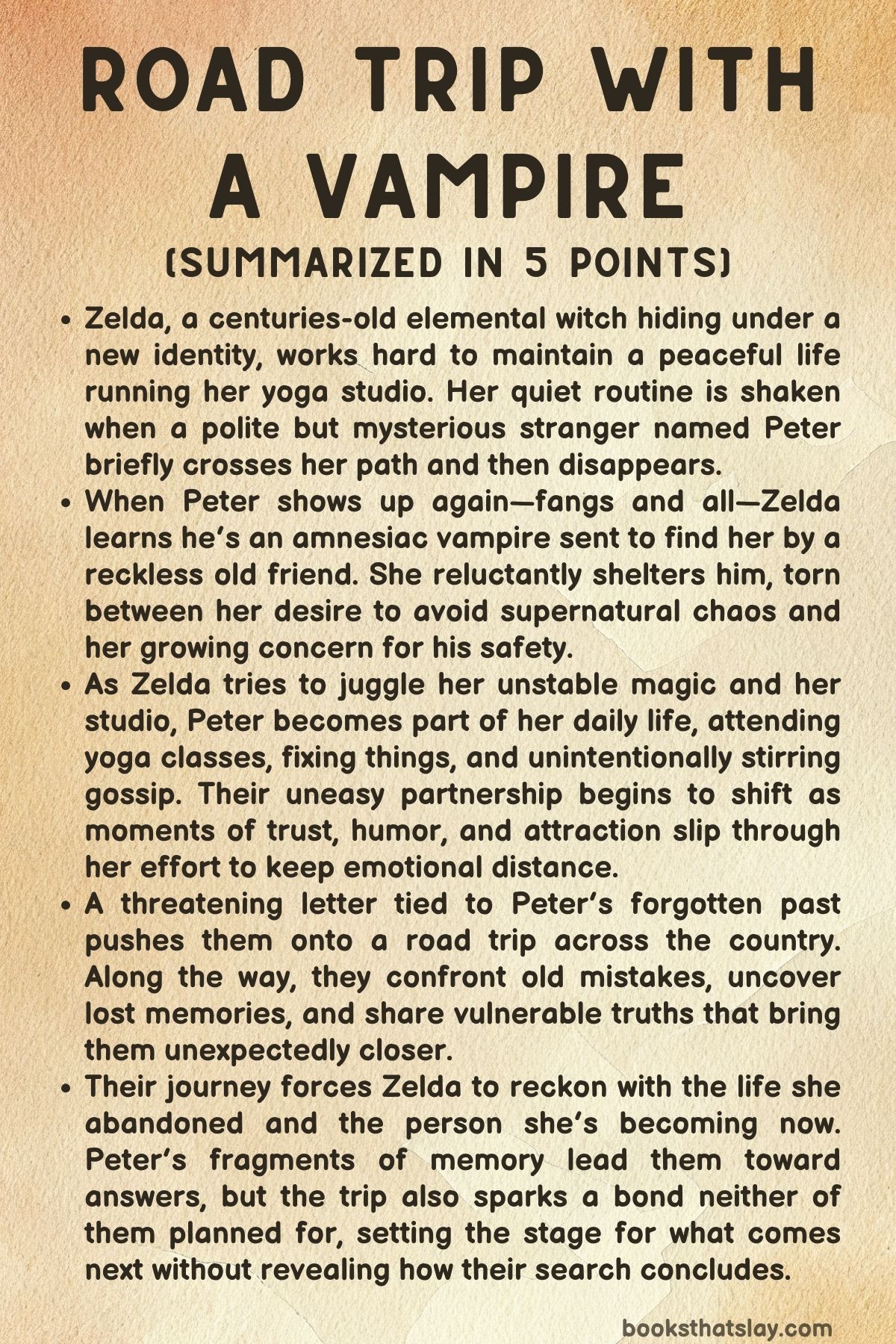
Road Trip with a Vampire by Jenna Levine is a paranormal romantic comedy about identity, second chances, and choosing who you want to be. It follows Zelda Turret, formerly the infamous elemental witch Grizelda Watson, who has spent a decade building a quiet life running a yoga studio in Northern California.
When a charming but lost vampire named Peter appears on her doorstep with amnesia and a mysterious past, Zelda is forced back into the supernatural world she has tried to avoid. Their unexpected connection leads them on a cross-country journey filled with danger, rediscovery, and the chance to build a future neither ever imagined. It’s the 3rd book in the My Vampires series by the author.
Summary
Zelda Turret has worked for years to leave behind her old identity as Grizelda Watson, a centuries-old elemental witch once known for reckless magic and a chaotic reputation among vampires. Now she lives a calm, deliberate life in Northern California, running a yoga studio and using only the small rituals necessary to manage the magical energy that builds painfully in her body when she avoids spellwork for too long.
She keeps her past buried—and her life peaceful—until the night she meets a handsome stranger in an alley. He helps her with a heavy box, disappears unnaturally fast, and leaves her unsettled but determined to continue with her routine.
The truth arrives the next day when the stranger, Peter, shows up at her studio asking for Grizelda Watson. Under the bright lights, Zelda sees his fangs and recognizes that he is a hungry vampire struggling to keep control.
Wanting to protect her students, she pulls him aside. Peter presents a letter from Reggie, a vampire from her old life, explaining that Peter has amnesia and cannot seek help through human channels.
Reggie, thinking Zelda might guide him, sent him to her—and even put him on a plane inside a coffin. Furious yet sympathetic, Zelda reluctantly allows Peter to stay in her apartment for one night, as long as he feeds safely and avoids her students.
Peter’s lost memories and the journal he carries, filled with sketches and unfamiliar notes, make Zelda uneasy. He is polite, uncertain, and strangely sincere, but she has spent a decade building a life free from vampires.
Still, when he admits he is effectively homeless and wants to stop drifting, she allows him limited involvement at her studio. Her friends immediately assume there is romantic tension, and Zelda works hard to deny it, even as she starts noticing his gentleness, awkward humor, and careful respect for boundaries.
As they spend more time together, Peter attends yoga classes, helps with cleaning, and tries to piece together clues about his past. Zelda confronts Reggie about sending Peter to her, which drags up memories of her former life—especially the magical stunt she once pulled in Chicago that resulted in a fire and injured children.
Overwhelmed with guilt, she had faked her death and built an entirely new life. Now she worries that letting Peter stay is the first step back into danger.
Everything shifts when Peter receives threatening letters ordering him to report to a location in Indiana. Zelda warns him that going without understanding his past is dangerous.
When he admits he has no transportation to visit the places in his journal, she impulsively offers to drive him. She also needs to leave town briefly to safely release magical energy before it erupts again.
Her friends worry about her traveling with an amnesiac vampire, but Zelda insists she knows exactly what she’s doing.
Their road trip brings them across several states and deepens their connection. Zelda shares the full story of her disastrous Chicago incident and the shame that forced her to reinvent herself.
Instead of recoiling, Peter listens with compassion and admiration. Their emotional closeness quickly becomes physical, and they fall into a passionate relationship that neither expected.
Zelda’s magic reacts strongly to her emotions, creating bursts of wind and scattered objects, but Peter loves that she trusts him enough to lose control.
As they continue the journey, Peter experiences flashes of memory. In one sudden moment, he recognizes a Michigan lakeshore town from a commercial and recalls that he designed a small house there when he was human.
This is his first genuine recovered memory, giving both of them hope that the road trip is working.
But circumstances pull them apart. After their time together ends abruptly in Indiana, weeks pass without contact.
Zelda returns home and tries to rebuild her routine, though everything—from her nightly rituals to Peter’s cleaning schedule still tucked in the studio closet—reminds her of him. When he finally texts her under the flimsy excuse of fixing a novelty hat she bought him, they circle around their feelings with hesitation and longing.
He admits he reached out because he was worried about her safety. She admits that anything from him would have captured her attention.
As Zelda tries to move forward, heavy rains damage the roof of her building. Her friends nervously reveal that Peter—back in town briefly—came by and offered to replace the entire roof for free.
After a storm causes power failures, Zelda agrees to let him help. Their reunion is awkward but warm.
He confesses he has been trying to improve himself and seek advice from their mutual friends in Chicago. When a downpour leaves him soaked and she invites him upstairs to dry off, honesty finally breaks through.
Peter admits he feels he must prove himself because being with her was the first time he has ever felt at home. Moved, Zelda forgives him, and they reunite physically and emotionally.
When he blurts out that he loves her, she realizes she wants a life with him after all.
Two weeks later, the town hosts a wildly popular goat yoga event. Zelda and Peter work together with easy affection.
Afterward, she leads him across town to an old loft space she secretly purchased for him—an attic-style workshop with a small window safe for a vampire. It is meant to be the foundation for a stable, creative career, far removed from the dangerous odd jobs he used to take.
Peter is overwhelmed and calls it the best gift he has ever received. They kiss, and he suggests a name for his new business: Elliott and Turret, blending his reclaimed human surname with hers.
Zelda loves it, and the story ends with the two of them planning a shared future built on trust, steady work, and the home they have finally found in each other.
Characters
Grizelda “Zelda” Watson / Zelda Turret
Zelda is a centuries-old elemental witch who has spent the last decade attempting to outrun her chaotic past and redefine herself through peace, stillness, and human connection. Once infamous for destructive magical hijinks, terrifying power, and her unpredictable reputation among supernatural communities, she has since buried her old identity and rebuilt her life around gentleness and routine.
Living as Zelda Turret, she runs a warm, community-oriented yoga studio called Yoga Magic in a quiet California town, striving to help others find emotional grounding because she longs for that grounding herself. Zelda’s internal conflict is shaped by guilt, fear of her own power, and the trauma of a magical prank gone catastrophically wrong.
Her abstaining from magic is both a penance and a desperate attempt to avoid ever harming innocents again, yet that restraint becomes dangerous as her powers accumulate painfully without release. Zelda’s characterization revolves around duality—she is both ancient and modern, fierce and nurturing, reclusive yet deeply compassionate.
Her journey is not only about helping Peter reclaim his identity, but also accepting that her own past does not negate her capacity for love, growth, or joy. Through her vulnerability and willingness to confront old wounds, Zelda emerges as a woman who learns to embrace all parts of herself: the witch, the caregiver, the lover, and the survivor.
Peter (Elliott)
Peter begins as a vampire thief-for-hire, wandering through supernatural underworlds with quiet competence and bone-deep loneliness. His amnesia at the start of the novel is not just a plot device but a metaphor for the blankness of his emotional life—he knows what he is, but not who he is.
Rootless, unsure, and pulled by an inexplicable instinct to find Zelda, he is a creature caught between predatory instincts and an almost painfully earnest desire to be good. Despite his vampiric strength, he is gentle, awkward, shy, deeply observant, and unexpectedly wholesome.
He struggles with the hunger that defines his kind but works hard to control himself, especially around humans, and especially around Zelda, whose safety becomes paramount to him. As memories return, flashes of his human life reveal an architect with a love of design and creation—traits that continue to shape him even in undeath.
This creative spark contrasts beautifully with the shadows of his former profession. Peter’s relationship with Zelda is transformative: she gives him a sense of belonging he hasn’t felt in decades, while he provides her with unconditional acceptance and quiet devotion.
His arc moves from displacement and self-doubt to reclaiming a life he wants to live, pursuing work that fulfills him, and choosing a future built with Zelda rather than fleeing from his past.
Reginald “Reggie”
Reggie is a charming, dramatic, somewhat chaotic vampire whose affection for Zelda spans centuries, even though their friendship dissolved after her self-imposed disappearance. He embodies the supernatural world Zelda abandoned: flamboyant, nosy, loyal, and morally flexible.
His impulsive decision to send the amnesiac Peter directly to Zelda is wrongheaded but well-intentioned, reflecting both his belief in Zelda’s strength and his flawed assumption that she is still the Grizelda he once knew. Reggie’s warmth, gossiping nature, and tendency to meddle create comedic relief, but beneath the theatrics lies genuine care—he wants Zelda safe, wants Peter helped, and ultimately supports their choices even when they puzzle or annoy him.
He also functions as a tether to Zelda’s old self, forcing her to confront the identities she tried to bury. Through him, the book explores themes of forgiveness, friendship, and the complex bonds that survive across centuries.
Becky
Becky is one of Zelda’s closest friends and part of the lively trio that helps run Yoga Magic. She represents grounded human connection in Zelda’s otherwise supernatural life.
Outgoing, enthusiastic, and business-minded, Becky loves the studio and is fully invested in its success—sometimes through questionable but hilarious marketing schemes like scarcity-based goat-yoga hype. She is fiercely protective of Zelda, immediately suspicious of Peter, and hilariously persistent with her theories about the romance brewing between them.
Her blunt honesty and comedic timing serve as emotional support and reality-checking throughout the story. Becky’s presence reinforces that Zelda’s life in Redwoodsville has meaning, community, and love outside of magic.
Lindsay
Lindsay is the third core friend at the yoga studio, and she balances Becky’s boldness with earnestness and a slightly chaotic sweetness of her own. She is warm, loyal, and often unintentionally funny, especially in her reactions to Zelda’s secretive behavior and her habit of walking straight into situations that reveal more than Zelda wants to share.
Like Becky, she teases Zelda affectionately about Peter, but her concern is rooted in genuine fear for Zelda’s emotional well-being. Lindsay represents the simple, sincere kind of friendship that Zelda never had in her supernatural life—friendship grounded in everyday human messiness rather than centuries of magical history.
Her presence also highlights how far Zelda has come in integrating into a human community.
John
John is a vampire employer who hires Peter in one of the flashback scenes, representing the darker, transactional world of supernatural crime. Cold, vague, and impatient, John uses Peter for his skills without offering any real loyalty or transparency.
His interactions with Peter highlight the exploitative nature of Peter’s former life and contrast sharply with the care and acceptance Peter later receives from Zelda. Though John is a minor character, he underscores the danger, loneliness, and moral ambiguity that Peter wants to leave behind.
Frederick
Frederick is part of Peter’s Chicago circle—a quirky, slightly snarky vampire friend of Reggie. He acts as a sounding board when Peter seeks advice after Zelda’s polite post-breakup note.
Frederick approaches supernatural drama the way a human might approach celebrity gossip: with enthusiasm, dramatic commentary, and humor. His support of Peter is genuine, though couched in teasing, and he contributes to the novel’s moments of levity while emphasizing that Peter is more loved and supported than he realizes.
Themes
Identity and Reinvention
Zelda’s life in Road Trip with a Vampire constantly circles back to the question of who she is allowed to become rather than who the world insists she has been. Her past as Grizelda Watson casts an enormous shadow, marked by centuries of volatility, magical misconduct, and alliances that defined her in ways she no longer accepts.
Reinvention for her isn’t a simple change of name but a complete restructuring of how she moves through the world: she builds Yoga Magic, forms relationships grounded in honesty and kindness, and cultivates a life that requires restraint rather than spectacle. Yet the novel shows how frail that reinvention feels when Peter appears, carrying reminders of everything she left behind.
Zelda’s struggle is not about whether she can change but whether change stays valid when confronted with memory, guilt, or supernatural danger. Her journey suggests that identity is a fluid, ongoing act of choosing, not a fixed history to be endlessly repaid.
Peter mirrors this conflict through his amnesia, living in a space where he has no past to anchor him. While Zelda tries to outrun a history she knows too well, Peter fears the history he cannot recall.
Their dynamic reinforces the idea that reinvention requires courage whether one is shedding a known identity or stepping into an unknown one. Both characters learn that the self is not a prison; it is a narrative they can reshape—together or alone—through intention, vulnerability, and choice.
Guilt, Accountability, and the Search for Redemption
Zelda’s guilt is not a background detail; it is a driving engine of the story. Her retreat from magic, the secrecy of her new name, and her aversion to anything connected to vampires all stem from one catastrophic moment in Chicago.
The fire she unintentionally caused becomes a symbol of how a single lapse of judgment can warp a person’s confidence in their own morality. What makes the theme compelling is that redemption is not treated as a singular act but as a long-term discipline.
Every grounded spell, every yoga class, every boundary she enforces is part of her attempt to live responsibly. Zelda’s fear is not only that she might hurt someone again but that she might enjoy the dangerous self she once was.
Peter’s arc reinforces this theme in a different direction. His amnesia leaves him uncertain whether he deserves forgiveness for past deeds he cannot remember.
The looming threat from JR and the unfinished Chicago job suggests there may be violence or betrayal in his history. His desperation to “prove himself” to Zelda once memories start returning shows that guilt can grow even in a vacuum, driven by imagined wrongdoing and the fear of disappointing someone who sees the best in you.
Their parallel redemptive efforts highlight that reclaiming oneself requires humility and the willingness to confront—not erase—one’s past. Ultimately, redemption becomes an act of love toward oneself, not a verdict delivered by others.
The Burden and Necessity of Power
Power in the novel is depicted not as a gift but as a weight. Zelda’s elemental magic accumulates pressure whenever she refuses to use it, turning into an almost physical manifestation of emotional repression.
Her nightly rituals are not indulgences; they are survival mechanisms. The blue fire eruption in her bedroom illustrates how dangerous avoidance can be.
Magic becomes a metaphor for suppressed emotion, unresolved trauma, and the parts of oneself one tries to hide for the sake of peace. Peter’s vampiric strength functions similarly.
His hunger, instinctive predatory allure, and heightened abilities can easily cross into harm. His fear of losing control around humans parallels Zelda’s fear of magical outbursts.
Yet both characters also experience moments when their power is not destructive but protective, intimate, or affirming. During their sexual connection, Zelda’s magic becomes an extension of trust rather than danger.
Peter’s strength, used to repair roofs, fix tables, and care for Zelda, becomes a tool of grounding rather than violence. The theme suggests that power is neither good nor bad; it is shaped by the intent behind it and the emotional honesty with which it is handled.
The story advocates not for abandoning power but for integrating it—accepting that strength is safest when paired with self-awareness and compassion.
Intimacy as Healing
The novel places emotional and physical intimacy at the core of both characters’ healing. Zelda’s reluctance to be vulnerable stems from centuries of self-protection, while Peter’s longing for connection grows out of the void created by amnesia.
Their relationship develops through small, tender moments—shared breakfasts, yoga mishaps, road conversations, and late-night honesty—before culminating in physical closeness that becomes transformative rather than dangerous. Their intimacy is not just desire; it is a permission slip for each to be fully themselves.
Zelda’s magic responds most freely when she is emotionally open, suggesting her power is tied to her capacity for vulnerability. Peter’s cautious affection shows that intimacy requires restraint, respect, and trust, especially when one carries the potential for harm.
Even their conflicts reinforce the idea that intimacy is a risk worth taking. Their breakup and reconciliation highlight that real closeness demands accountability and the willingness to repair damage.
The cookies, the roof repairs, the hesitations, and the declarations all demonstrate acts of love that extend beyond passion. Intimacy becomes a means through which the characters reclaim parts of themselves they thought were lost—Zelda’s capacity for passionate connection and Peter’s ability to root himself in a home and a partnership.
Through each other, they discover that healing does not always require solitude; sometimes it requires being fully seen.
Community, Belonging, and the Meaning of Home
Despite the supernatural drama, the novel consistently centers the idea of home—how one builds it, protects it, and finally shares it. Zelda’s yoga studio is not just a workplace but a community she nurtures into a chosen family.
The Early Crew, Lindsay, Becky, and her devoted students give her a sense of belonging she never managed to create in her centuries-long life. Their concern, teasing, and unwavering presence ground her far more than any spell.
Peter, meanwhile, begins the story with no home and no past. His journey across states, coffins, bus terminals, and seedy vampire meetings reflects emotional homelessness as much as physical.
The loft Zelda buys for him becomes more than a workspace; it symbolizes trust, stability, and the chance to anchor his identity. Home, in this story, is a place built through effort and vulnerability rather than bloodlines or history.
It is created through community, nurtured through care, and solidified through love. In the end, both characters find that belonging is not something bestowed upon them but something they choose and cultivate—one supportive friend, one repaired roof, one yoga class, and one heartfelt gesture at a time.